Identification
-

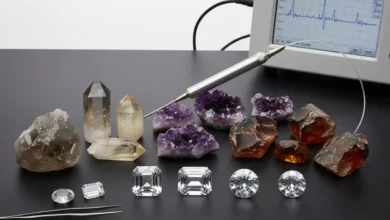
How to Spot Treated or Synthetic Amethyst
Amethyst is purple crystalline quartz. Its color arises from iron-related defects and natural radiation acting within the quartz structure. Most…
Read More » -
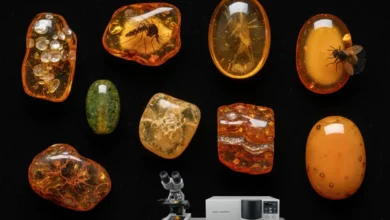
How to Spot Treated or Synthetic Amber
Amber is fossilized plant resin rather than a crystalline mineral. Its organic structure makes it light, relatively soft, heat sensitive,…
Read More » -
How to Spot Treated or Synthetic Amazonite
Amazonite is the blue-green to green variety of potassium feldspar, most commonly microcline. Much of the commercial material reaches the…
Read More » -
How to Spot Treated or Synthetic Alexandrite
Natural Alexandrite is the chromium-bearing color-change variety of Chrysoberyl. Fine stones appear green, bluish green, or blue-green under daylight-equivalent illumination…
Read More » -
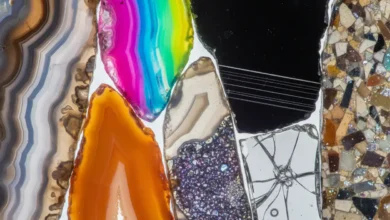
How to Spot Treated or Synthetic Agate
Agate is a banded form of Chalcedony, a fine-grained silica material composed mainly of intergrown quartz and moganite. Its natural…
Read More » -
Tiger’s Eye vs Pietersite: How to Tell Them Apart
Tiger’s Eye and Pietersite belong to the same broad family of chatoyant, quartz-rich ornamental materials. Both contain fine amphibole-related fibers…
Read More » -
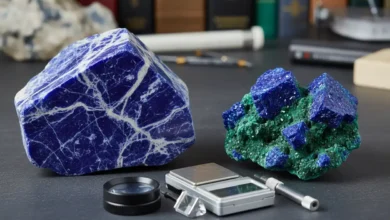
Sodalite vs Azurite: How to Tell Them Apart
Sodalite and Azurite are blue minerals whose names and colors can create confusion in polished stones, beads, carvings, and rough…
Read More » -
Smoky Quartz vs Citrine: How to Tell Them Apart
Smoky Quartz and Citrine are color varieties of the same mineral species. Both are crystalline quartz with the composition SiO₂,…
Read More » -
Selenite vs Satin Spar: How to Tell Them Apart
Selenite and Satin Spar are not two unrelated crystals. Both are varieties or habits of Gypsum, a hydrated calcium sulfate…
Read More » -
Ruby vs Spinel: Differences and the Crown Jewels Mix-Up
Ruby and red spinel can display nearly identical scarlet, vivid red and purplish-red colors. For centuries, both were collected under…
Read More »