
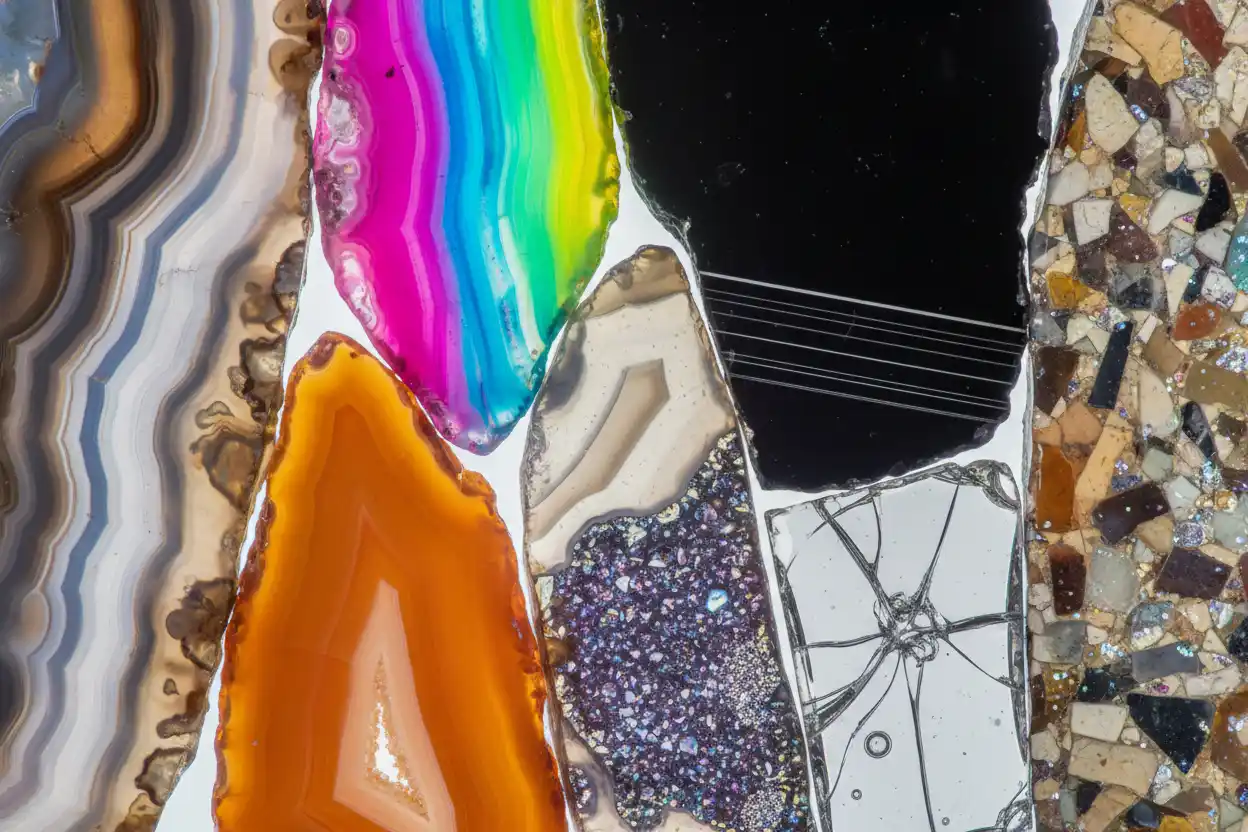

Agate is a banded form of Chalcedony, a fine-grained silica material composed mainly of intergrown quartz and moganite. Its natural porosity, microscopic fibers, fractures, and contrasting bands make it unusually receptive to color treatment.
Dyeing has been practiced for centuries and remains the most important Agate enhancement. Heating can strengthen red, orange, yellow, or brown colors by altering iron-bearing compounds, while bleaching, blackening, coating, resin impregnation, filling, and reconstruction may change the appearance or durability of commercial material.
True laboratory-grown Agate that reproduces natural rhythmic Chalcedony banding is not a routine mainstream jewelry product. Many objects marketed as synthetic Agate are actually glass, resin, ceramic, polymer clay, dyed quartz-rich material, or reconstructed mineral fragments.
The correct identification process therefore separates four questions: whether the material is Agate, whether its color is natural, whether foreign substances were added, and whether the object formed as one natural stone or was manufactured from several components.
Agate treatment categories at a glance
| Product category | What was changed | Common evidence | Correct description |
|---|---|---|---|
| Natural-color Agate | No introduced color or filler | Geological banding and natural trace-element distribution | Natural Agate |
| Dyed Agate | Color introduced into pores or fractures | Color in cracks, band boundaries, pits, and drill holes | Dyed natural Agate |
| Heat-treated Agate | Existing iron or defect-related color altered by heat | Strengthened red, orange, yellow, or brown | Heat-treated natural Agate |
| Bleached and dyed Agate | Original color lightened before dyeing | Pale interior plus introduced surface or pore color | Bleached and dyed Agate |
| Blackened Agate or Onyx | Porous bands darkened chemically or with dye | Black color follows selected layers or pores | Treated Chalcedony |
| Coated Agate | Thin material applied to the surface | Peeling, edge wear, metallic or iridescent film | Coated Agate |
| Resin-impregnated Agate | Polymer introduced into pores or fractures | Resin fluorescence, bubbles, polymer absorption | Stabilized or impregnated Agate |
| Fracture-filled Agate | Open cracks filled with resin, glass, wax, or oil | Flash effects, bubbles, luster differences | Filled Agate |
| Reconstructed Agate | Fragments or powder bonded together | Binder between grains, molded form, repeated pattern | Composite material containing Agate |
| Synthetic quartz or Chalcedony | Laboratory-grown silica material | Growth-related features and spectroscopy | Laboratory-grown quartz material |
| Agate imitation | Glass, resin, ceramic, or polymer made to resemble Agate | Bubbles, mold seams, painted or repeated banding | Imitation Agate |
What natural Agate is
Natural Agate forms when silica-rich fluids deposit microscopic Chalcedony fibers and quartz within cavities, fractures, veins, or other open spaces.
The bands record changes in fluid chemistry, porosity, crystal size, impurities, and growth conditions. They may be concentric, horizontal, fortification-like, lace-like, plume-like, mossy, dendritic, or irregular.
The broad material profile appears in Agate: Meaning, Types & Healing Properties, while Types of Agate owns the full variety structure.
Natural Agate can be extremely colorful. Bright orange Condor Agate, intricate Crazy Lace Agate, vivid Fire Agate, and contrasting Botswana Agate show why intensity alone does not prove treatment.
The question is not whether the color looks dramatic. It is whether the color distribution agrees with natural growth and mineral inclusions.
Dyeing is the most common treatment
Chalcedony contains microscopic pores and channels that can accept dye. Different bands may absorb color at different rates because their fiber size, porosity, mineral content, and microstructure vary.
This allows treaters to create vivid blue, green, pink, purple, red, yellow, orange, and black material. One slice can even be divided into separate color zones through controlled masking and repeated dye baths.
Dye does not change the underlying silica into glass or plastic. The host may remain genuine natural Agate, but the color origin must be disclosed because it affects value, stability, and care.
The general visual framework appears in How to Spot Dyed Crystals.
How dye distributes through Agate
Introduced color commonly follows pathways through which a liquid could move.
Under magnification, the strongest color may appear inside open fractures, around pits, along porous band boundaries, within drill holes, or near the outer rind of a bead.
A dyed slice may show intense color on exposed surfaces while a chipped interior remains pale. In beads, dye may become darkest where the drill enters or where fractures radiate from the hole.
Some products show a halo effect, with stronger color around cracks and weaker color within dense Chalcedony bands. Others are dyed so evenly that no obvious concentration is visible.
Natural trace elements can also follow bands and fractures. Therefore, one dark line is not automatic proof of dye. The distribution must look like introduced liquid rather than mineral growth.
Neon color is a warning, not proof
Electric blue, hot pink, vivid purple, and fluorescent green Agate are often dyed because those colors are easy to create and uncommon in natural banded Chalcedony.
Nevertheless, natural Agate can produce surprisingly saturated red, orange, yellow, green, blue-gray, and multicolored patterns.
The strongest warning appears when color intensity combines with liquid-like concentrations, pale chips, repeated inventory, or seller refusal to discuss treatment.
Natural-color variety examples include Botswana Agate: Meaning, Properties & Symbolism, Crazy Lace Agate: Meaning, Properties & Symbolism, and Blue Lace Agate: Meaning, Healing Properties & Uses.
Heat treatment
Heating can alter iron-bearing minerals and color centers within Agate and related Chalcedony.
Yellowish, brownish, or iron-rich material may become stronger orange, red, or reddish brown as hydrated iron oxides transform into more intensely colored phases.
Amethystine Chalcedony can shift from purple toward yellowish orange after sufficient heating, similar to the transformation of some Amethyst into Citrine-like quartz.
Heat-treated Agate remains natural silica material. The treatment modifies existing impurities or structural defects rather than introducing a completely different substance.
Color produced through heating is often stable under ordinary wear, although excessive future heat can cause further change or damage.
Carnelian and heat
Carnelian is orange-to-red Chalcedony. Natural color exists, but heating pale, brownish, or iron-bearing material can strengthen its orange or red appearance.
The transition between Agate and Carnelian depends on texture and trade usage. A banded specimen may be called Carnelian Agate, while evenly colored material is more often called Carnelian.
A buyer should not assume that every red Chalcedony is heated, nor should a seller claim untreated color without evidence when the price depends on that distinction.
Black Agate and Onyx treatments
Uniform black Chalcedony is commonly treated. Historically and commercially, porous layers can be blackened using dye or chemical processes that deposit dark carbonaceous material within the stone.
The treatment may follow selected bands, producing black-and-white Onyx, or create an almost uniformly black cabochon.
A black stone can still be genuine Chalcedony. The issue is whether the color is naturally developed or introduced.
The tracker’s Real vs Fake Onyx article owns the broader distinction among Chalcedony Onyx, Calcite Onyx, glass, plastic, and other substitutes.
Bleaching
Bleaching can lighten brown, gray, or uneven material before dyeing. By reducing unwanted natural color, the process allows the introduced hue to appear brighter and more uniform.
A bleached Agate may look pale, chalky, or unusually clean in areas where dye did not penetrate completely.
Bleaching is difficult to establish visually once a strong dye has been applied. Laboratory analysis and comparison with untreated material may be required.
The treatment can also change surface chemistry or make porous material more vulnerable to future staining.
Crackling before dyeing
A relatively dense quartz or Chalcedony object may be heated and cooled rapidly to create a network of fractures. Dye then enters those openings.
The resulting material shows bright color concentrated within sharp cracks while the unfractured silica remains colorless or pale.
This crackled product is not the same as naturally banded Agate, even when the host is genuine quartz. It should be described as dyed crackle quartz or treated Chalcedony rather than given a natural Agate variety name.
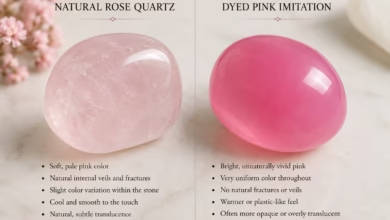
The same visual principle appears in the completed Real vs. Fake Rose Quartz workflow, where dye-filled fracture networks are an important imitation clue.
Coatings
Agate slices, drusy surfaces, beads, and cabochons can receive colorless or colored coatings.
A colorless polymer may strengthen a fragile drusy surface or improve polish. Colored films can create metallic, iridescent, neon, or unusually uniform appearances.
Possible coating evidence includes peeling, scratches through the surface layer, colorless areas at worn edges, bubbles, a plastic-like luster, or color restricted to the outer surface.
Metal-oxide coatings can produce an aura-like rainbow sheen over quartz crystals or drusy Agate. The effect is treatment-created rather than natural Agate iridescence.
True Iris Agate displays transmitted-light diffraction associated with extremely fine natural banding, while Fire Agate shows natural reflected iridescence associated with layered mineral structures. Neither should be confused with a thin-film surface coating.
Resin impregnation and stabilization
Porous or fractured Agate may be impregnated with resin to strengthen the material, improve polish, reduce surface pits, or deepen apparent color.
A clear polymer can be difficult to detect visually. Under ultraviolet light, the resin may fluoresce differently from the surrounding Chalcedony. Microscopy may reveal bubbles, filled pores, surface-reaching polymer, or luster differences.
FTIR spectroscopy is especially useful because polymers produce characteristic absorption features absent from untreated quartz.
Resin-stabilized Agate remains partly natural Agate, but the added polymer can affect repair, cleaning, value, and long-term aging.
Fracture and cavity filling
Open fractures or cavities may be filled with resin, wax, oil, glass, or colored material to improve appearance and stability.
A filled fracture may become less visible because the filler’s refractive index approaches that of the surrounding stone. Under magnification, the examiner may still see flash colors, trapped bubbles, flattened gas pockets, or different surface luster.
Colored filler can perform two functions at once: hiding the fracture and introducing additional color.
The treatment should not be confused with natural mineral deposition inside a geode or seam. Natural quartz crystals and iron oxides have their own structure, whereas filler occupies an existing opening as a foreign material.
Drusy Agate
Drusy Agate contains a surface of small quartz crystals over Chalcedony.
Its sparkle can be enhanced through dye, metallic coating, resin, or artificial backing. Some drusy products are assembled from a thin natural layer attached to a stronger base.
Inspect the crystal points, valleys, edges, and back. Coating may collect between crystals, while dye may be strongest within the porous Chalcedony beneath them.
A natural drusy surface should not display peeling metallic film or transparent polymer bridging the crystal points.
Reconstructed Agate
Agate fragments, powder, rejected slabs, and Chalcedony grains can be bonded with resin, cement, or glass and molded into beads, spheres, carvings, and decorative blocks.
A reconstructed product may contain substantial natural mineral material. Nevertheless, its pattern and overall shape were manufactured rather than deposited geologically.
Microscopy may reveal angular chips separated by binder, repeated grain size, round resin bubbles, artificial matrix, or a molded outer skin.
The product should be described as reconstructed, reconstituted, bonded, or composite Agate.
Synthetic Agate versus imitation Agate
Laboratory-grown quartz is widely produced for technology and gemstones. Laboratory-grown Chalcedony and silica aggregates can also be manufactured under specialized conditions.
However, true synthetic Agate reproducing the natural, rhythmic, multistage banding of geological Agate is not a routine consumer jewelry category.
Many retail objects labeled synthetic Agate are actually glass, resin, ceramic, polymer clay, or reconstructed stone. These are imitations or composites rather than synthetic Agate in the strict gemological sense.
A laboratory-grown material should have essentially the same composition and structure as the natural gem. A simulant merely resembles its appearance.
The distinction appears in Lab-Grown vs Natural Gemstones and Gemstone Treatments Explained.
Glass, resin, and ceramic imitations
Glass can reproduce curved bands, bright color, transparency, and high polish. Possible clues include round bubbles, curved flow lines, mold seams, conchoidal chips, and bands that look painted or fused rather than fibrous.
Resin and polymer clay can create almost any lace, fortification, moss, plume, or multicolor pattern. Repeated designs, low weight, seams, soft scratches, bubbles, and transparent binder are common warnings.
Ceramic may feel more stone-like but can show pores, pigment concentrations, molded surfaces, and a homogeneous manufactured interior.
The broader structural distinction appears in Glass vs. Crystal.
Natural patterns that are often misjudged
Moss Agate contains branching or moss-like mineral inclusions rather than dye-created plant material. Its separate profile appears in Moss Agate: Meaning, Healing Properties & Uses.
Dendritic Agate contains natural branching inclusions commonly formed by manganese or iron compounds. It is covered in Dendritic Agate: Meaning, Properties & Symbolism.
Tree Agate, Flower Agate, Grape Agate, and other trade materials may lack classic concentric bands but remain part of the broader Chalcedony market. Their relevant profiles include Tree Agate: Meaning, Properties & Symbolism, Flower Agate: Meaning, Properties & Symbolism, and Grape Agate: Meaning, Properties & Symbolism.
These natural patterns should not be classified as dyed merely because they resemble landscapes, plants, flowers, or bubbles.
Home tests to avoid
Do not soak an unknown Agate in acetone, alcohol, bleach, acid, or household cleaner. These substances can dissolve dye, attack coating, weaken resin, damage adhesive, and alter metal settings.
A destructive result may reveal treatment, but it also permanently damages the object and provides no reliable information about how the untreated material originally looked.
Boiling, flame, hot needles, aggressive scratching, and freezer tests are equally inappropriate.
The safer consumer approach combines magnification, seller disclosure, side and back inspection, and professional testing where value justifies it.
Professional laboratory testing
A gemologist can first confirm that the material is Chalcedony or quartz rather than glass, resin, Calcite, ceramic, or another imitation.
Microscopy reveals dye concentrations, resin, coating, bubbles, fractures, and assembly. Raman spectroscopy confirms quartz and associated mineral phases.
FTIR detects polymers, waxes, oils, and some synthetic-growth or treatment-related features. UV-visible spectroscopy can identify certain dyes and color centers.
X-ray diffraction distinguishes quartz, moganite, glass-ceramic phases, and other crystalline components. Chemical methods such as X-ray fluorescence or laser-ablation analysis can show whether coloring elements follow natural growth patterns or were introduced from the surface.
The general examination sequence appears in How to Identify Crystals: A Beginner’s Guide.
Reports and seller disclosure
A full laboratory report is rarely economical for an ordinary inexpensive bead. It becomes more useful for exceptional collector Agate, expensive carvings, rare natural-color claims, high-value Fire Agate, or suspected reconstructed material.
The completed Gemstone Certification Labs Compared explains laboratory services. How to Read a Gem Lab Report helps interpret material, treatment, and construction wording.
The seller should identify dye, heat, coating, resin, reconstruction, and laboratory-grown origin clearly when applicable. The broader authenticity page Real vs Fake Agate owns the distinction between genuine Agate and completely different imitation materials.
The planned Where to Buy Real Agate will own marketplace and seller selection. Until then, use How to Buy Gemstones Online Without Getting Scammed for transaction safeguards.
Care for treated Agate
Untreated sound Agate is relatively durable at Mohs 6.5–7 and normally tolerates gentle warm soapy water.
Dyed material should be protected from prolonged sunlight, strong solvents, and harsh cleaners. Coated stones should be kept away from abrasion and repolishing.
Resin-filled or reconstructed material should not receive steam, high heat, or prolonged ultrasonic cleaning. Heat during jewelry repair can soften adhesive, alter dye, or damage polymer.
When treatment is unknown, use a soft damp cloth and mild soap, then dry the piece promptly.
Frequently Asked Questions
1. Is dyed Agate still real Agate?
The underlying material can be genuine natural Agate, but its color was introduced and should be disclosed.
2. How can I recognize dyed Agate?
Look for color concentrated in fractures, pores, drill holes, band boundaries, surface pits, and chipped edges.
3. Does neon color always mean Agate is dyed?
No. It is a strong warning, but some natural Agates are vivid. Color distribution and laboratory evidence matter more than intensity alone.
4. Can Agate be heat treated?
Yes. Heat can strengthen red, orange, yellow, or brown colors by altering iron-bearing compounds and color centers.
5. Is heated Agate fake?
No. It remains natural Chalcedony whose color has been changed through treatment.
6. Is black Agate naturally black?
Natural dark Chalcedony exists, but much uniformly black commercial Agate or Onyx has been dyed or chemically blackened.
7. Can Agate be resin stabilized?
Yes. Polymer can strengthen porous material, improve polish, and fill fractures or cavities.
8. What is reconstructed Agate?
It is a manufactured composite made from Agate fragments or powder held together with resin, glass, cement, or another binder.
9. Is synthetic Agate widely available?
True laboratory-grown banded Agate is not a routine mainstream product. Many “synthetic Agate” listings are glass, resin, ceramic, or reconstructed material.
10. Can ultraviolet light detect treatment?
It may reveal resin, coating, dye, or adhesive, but reactions vary and a negative UV result does not prove untreated material.
11. Can I use acetone to test Agate dye?
No. Acetone can damage dye, coating, resin, adhesive, and jewelry settings, and a negative result is inconclusive.
12. When is laboratory testing worthwhile?
Testing is worthwhile for expensive natural-color claims, important collector specimens, suspected reconstruction, valuable Fire Agate, or material represented as rare synthetic Agate.
Conclusion
Agate treatment is common because Chalcedony’s microscopic fibers and pores accept color readily. Dyeing is the most familiar process, while heating, bleaching, blackening, coating, resin impregnation, filling, and reconstruction create additional market categories.
The host stone may remain natural Agate even when its appearance has been altered. Synthetic Agate is a different claim and should be reserved for laboratory-grown silica material rather than glass, resin, ceramic, or bonded chips.
The strongest treatment evidence comes from color distribution, magnification, spectroscopy, polymer detection, and accurate seller disclosure. Destructive home tests usually damage the evidence before they provide a dependable answer.