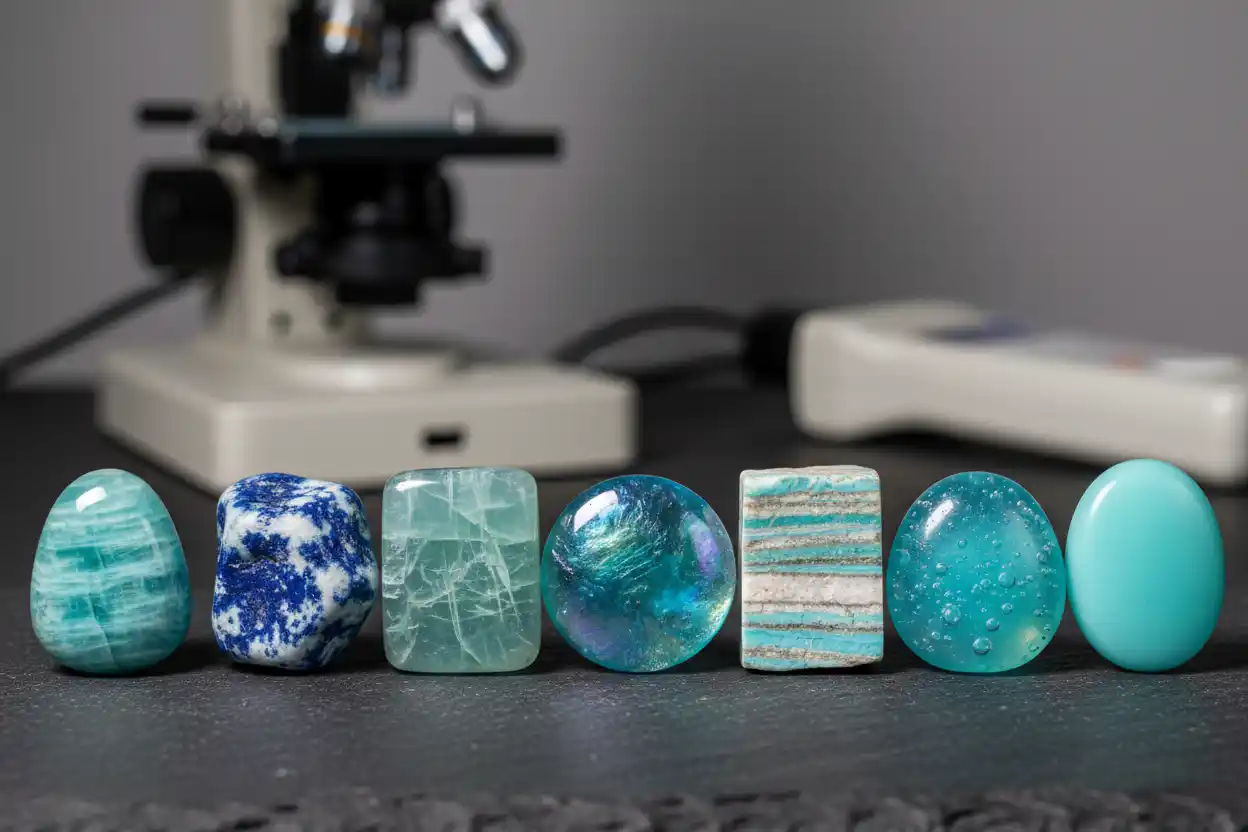
How to Spot Treated or Synthetic Amazonite
Amazonite is the blue-green to green variety of potassium feldspar, most commonly microcline. Much of the commercial material reaches the market with natural color, but lower-quality stones can be dyed, waxed, coated, filled, stabilized with resin, or reconstructed from fragments and mineral powder.
True laboratory-grown Amazonite is not a routine mainstream gemstone product. Listings described as synthetic Amazonite more often contain colored glass, resin, ceramic, dyed feldspar, reconstructed mineral material, or another stone selected to imitate Amazonite’s sea-green appearance.
The correct identification process therefore asks several separate questions. Is the object potassium feldspar? Is its blue-green color natural? Has a foreign substance entered its fractures or pores? Finally, is it one solid natural stone or a manufactured composite?
Amazonite treatment categories at a glance
| Product category | What it contains | Common evidence | Correct description |
|---|---|---|---|
| Natural-color Amazonite | Naturally blue-green potassium feldspar | Feldspar texture, perthitic streaks, natural zoning | Natural Amazonite |
| Dyed Amazonite | Natural feldspar with introduced blue or green color | Dye in fractures, pits, grain boundaries, and drill holes | Dyed natural Amazonite |
| Waxed or oiled Amazonite | Natural stone with a surface or shallow pore treatment | Greasy luster, residue, temporary color deepening | Surface-treated Amazonite |
| Resin-stabilized Amazonite | Natural Amazonite impregnated with polymer | Filled fractures, resin bubbles, UV or FTIR response | Stabilized natural Amazonite |
| Fracture-filled Amazonite | Foreign material placed in open cracks | Flash effects, bubbles, luster differences | Filled Amazonite |
| Coated Amazonite | A colored or clear surface film | Peeling, worn edges, surface-only color | Coated stone |
| Reconstructed Amazonite | Fragments or powder held in a binder | Resin between grains, molded shape, repeated texture | Composite containing Amazonite |
| Dyed feldspar imitation | Pale feldspar colored to resemble Amazonite | Blue concentrated in cracks or cleavage | Treated feldspar imitation |
| Glass or ceramic imitation | Manufactured inorganic material | Bubbles, flow, mold seams, uniform color | Amazonite simulant |
| Resin or plastic imitation | Molded polymer | Low weight, seams, bubbles, soft surface | Artificial imitation |
| Laboratory-grown feldspar | Human-grown feldspar material | Synthetic growth evidence and analytical confirmation | Laboratory-grown feldspar, if proven |
What natural Amazonite is
Amazonite is generally a variety of microcline, a triclinic potassium feldspar with the approximate composition KAlSi₃O₈.
Its relationship to other feldspars appears in Feldspar: Types, Properties & Meaning. Microcline is chemically related to Orthoclase: Meaning, Properties & Symbolism, while white streaks and intergrowths in Amazonite may include sodium-rich Albite: Meaning, Properties & Symbolism.
Amazonite commonly forms in granitic pegmatites. It may occur as large crystals, massive blocks, perthitic intergrowths, and material associated with Smoky Quartz, Albite, mica, and other pegmatite minerals.
The broader identity, geology, and visual range belong to Amazonite: Meaning, Healing Properties & Uses. This page remains focused on color modification, stabilization, reconstruction, and synthetic terminology.
Natural Amazonite color
Natural Amazonite ranges from pale green and mint through turquoise-green, blue-green, teal, and deeper greenish blue.
The color may be even, softly mottled, patchy, or crossed by pale white lines. Some specimens contain darker green areas beside cream, gray, or colorless feldspar.
The familiar blue-green color is associated with structural defects involving lead, water, and the feldspar lattice rather than a simple copper pigment. Consequently, Amazonite color is part of the crystal structure and can respond to heat or irradiation differently from an ordinary surface dye.
This complexity means one color tone does not prove a specific locality or quality grade. Ethiopian, Brazilian, Russian, American, Madagascan, and other Amazonites may overlap visually.
White lines and perthitic texture
Many Amazonites contain white streaks, patches, grids, or feather-like markings. These commonly result from feldspar intergrowths, cleavage-related structures, and pale Albite within potassium feldspar.
Natural markings generally continue through the stone rather than sitting only on its surface. They can vary in thickness, direction, spacing, and brightness.
An imitation may use painted white lines, polymer swirls, or fragments embedded in resin. Those patterns may repeat across several beads or stop at a polished edge.
However, natural Amazonite can also be remarkably uniform. The absence of white markings does not prove treatment, while dramatic streaks do not automatically prove authenticity.
Most commercial Amazonite is not routinely heat treated
Amazonite differs from Sapphire, Ruby, Tanzanite, and blue Topaz because there is no dominant routine heat-treatment market designed to improve most commercial stones.
Heat can actually weaken or destroy Amazonite’s blue-green color. Experimental work on feldspar shows that prolonged or higher-temperature heating can reduce saturation, produce cloudiness, and eventually decolorize the material.
In some studies, irradiation partially restored or changed Amazonite-related color centers after thermal fading. That does not mean irradiated Amazonite is a standard retail product. It means the color is structurally responsive to radiation and heat.
A seller should not claim that intense heat improves Amazonite safely. Jewelry repair torches, kiln exposure, and prolonged high temperature can change color or worsen fractures.
Artificial irradiation
Amazonite’s color centers can respond to ionizing radiation. In principle, irradiation may strengthen, restore, or modify color in suitable feldspar.
Commercial detection can be difficult because natural radiation also contributes to color-center development over geological time. The material’s trace chemistry, structural water, lead-related defects, and previous heat history all influence the response.
Artificial irradiation is not commonly disclosed as a routine Amazonite treatment in ordinary bead and cabochon markets. Therefore, it should not be assumed merely because a stone is deeply colored.
When the price depends on a claim of completely natural color, spectroscopy and controlled laboratory analysis carry more weight than visual saturation.
Dyed Amazonite
Pale Amazonite, white feldspar, quartz-rich material, or another porous stone can be dyed blue-green to create a stronger and more uniform appearance.
Dye often enters surface-reaching fractures, cleavage planes, pits, drill holes, and grain boundaries. Under magnification, those areas may appear darker or more saturated than the surrounding crystal.
A polished bead can show an intense blue ring around its drill hole. A chipped edge may reveal white, cream, or pale-green material beneath the surface color.
Natural Amazonite can also show darker color beside fractures and intergrowths. Therefore, the distribution must behave like introduced liquid rather than normal geological zoning.
The broader non-destructive inspection process appears in How to Spot Dyed Crystals.
Dyeing pale feldspar rather than Amazonite
Not every dyed blue-green feldspar started as Amazonite.
White microcline, Orthoclase, Albite-rich feldspar, or low-color pegmatite material may receive dye and be sold under the Amazonite name. The finished object may still produce feldspar hardness and refractive readings, making simple mineral testing insufficient.
A laboratory must determine whether the color is structural or introduced. Microscopy, UV-visible spectroscopy, chemical analysis, and dye-related absorption can help.
This is why proving that an object is feldspar does not automatically prove natural-color Amazonite.
Waxing and oiling
Wax or oil can enter shallow pores, coat the surface, reduce a chalky appearance, and deepen color temporarily.
A waxed stone may feel unusually greasy or display a softer luster than ordinary polished feldspar. Residue can collect around drill holes, carving recesses, and unpolished areas.
Oil may evaporate, migrate, collect dust, or change with cleaning. Wax can soften under heat and may be removed during repolishing.
Neither treatment transforms the mineral identity, but it can make pale or dry-looking material appear more saturated and compact.
Resin stabilization
Amazonite commonly contains cleavage, fractures, and feldspar intergrowths. Weak or highly fractured material can be impregnated with polymer to improve cutting, polish, and durability.
Resin may fill open cracks and hold fragmented material together. In heavily treated pieces, the polymer can form a meaningful part of the product rather than a trace surface treatment.
Under magnification, possible evidence includes round bubbles, transparent filler, flash colors, smooth material bridging a crack, or different luster between the resin and feldspar.
Ultraviolet light may reveal contrasting fluorescence, although some polymers are inert and natural inclusions can also fluoresce. FTIR spectroscopy provides stronger evidence because organic polymers produce absorption features absent from untreated feldspar.
A stabilized natural stone remains Amazonite, but its treatment should be disclosed because it affects value, cleaning, and jewelry repair.
Fracture filling
Fracture filling focuses on hiding or strengthening specific open fissures rather than impregnating the entire stone.
A filler may be clear, colored, waxy, glass-like, or polymeric. Colored filler can improve both apparent clarity and blue-green saturation.
The filled area may flash blue, orange, or purple when viewed at the correct angle. Bubbles, flow lines, or a smooth surface across an otherwise rough crack can also appear.
The original cleavage or fracture remains within the stone. A filler cannot restore the feldspar crystal lattice, and heat or solvents may damage the foreign material.
Coatings
Colorless or weakly colored feldspar can receive a blue-green surface film. Clear coatings may also be used to improve luster or protect a rough surface.
Inspect facet junctions, bead holes, raised carving edges, and existing chips. Coating wear may reveal a pale base, while peeling or iridescent reflections can expose a thin film.
A coated stone may look perfectly colored face up but show different color on the back. In drilled beads, the coating may stop abruptly at the hole.
Do not scratch or apply solvent to test the surface. Those methods can permanently damage a correctly disclosed coated product.
Reconstructed Amazonite
Amazonite fragments, feldspar powder, colorant, and resin can be mixed and molded into beads, cabochons, spheres, towers, or carvings.
The product may contain genuine Amazonite, but its body is manufactured rather than one natural crystal or solid rock.
Under magnification, angular mineral grains may sit inside transparent binder. Round resin bubbles, repeated grain size, artificial white matrix, or a molded outer skin may be visible.
A reconstructed product should be described as bonded, composite, reconstituted, or reconstructed Amazonite. The word natural is incomplete when it hides the binder and manufactured structure.
“Synthetic Amazonite” terminology
A strict synthetic gemstone should have essentially the same composition and crystal structure as the named natural material.
Laboratory-grown feldspar can be produced for research and technical purposes, but gem-quality synthetic Amazonite is not a standard mass-market category comparable to synthetic Ruby, Sapphire, Spinel, Quartz, or Emerald.
Consequently, many products advertised as synthetic Amazonite are actually glass, resin, ceramic, reconstructed powder, or another dyed mineral.
The seller should name the material rather than use synthetic as a vague synonym for artificial.
The wider distinction among laboratory-grown, treated, composite, and imitation products appears in Lab-Grown vs Natural Gemstones and Gemstone Treatments Explained.
Glass, ceramic, and resin imitations
Turquoise-colored glass can reproduce Amazonite’s color and white clouding. It may contain round bubbles, curved flow lines, conchoidal chips, or mold seams.
Ceramic can feel more stone-like because it is rigid, opaque, and relatively dense. Manufactured pores, pigment grains, and uniform internal texture can reveal it.
Resin or plastic may show low weight, seams, bubbles, soft scratches, repeated swirls, or transparent binder.
High-quality imitations can be difficult to identify visually, especially in small beads. The full amorphous-material comparison appears in Glass vs. Crystal.
Natural lookalikes
Amazonite is commonly confused with Turquoise because both can occupy blue-green and green-blue colors. Their complete distinction belongs to Amazonite vs Turquoise.
Turquoise is a hydrated copper aluminum phosphate rather than feldspar. Its broader material profile appears in Turquoise: Meaning, Healing Properties & Uses.
Green or blue-green Jade, Aventurine, Sodalite, dyed Howlite, and glass can also be mislabeled as Amazonite. Green Aventurine: Meaning, Healing Properties & Uses and Jade: Meaning, Healing Properties & Uses provide the relevant mineral context.
The broad material-authenticity workflow belongs to Real vs Fake Amazonite, while this page remains limited to treatments, reconstruction, and synthetic terminology.
Hardness, cleavage, and treatment clues
Amazonite generally ranks about 6–6.5 on the Mohs scale. It has two prominent cleavage directions and is brittle.
Resin can make a weak piece seem tougher, while a surface coating can distort scratch observations. Consequently, hardness is not an effective treatment test.
The Gemstone Hardness Chart explains Amazonite’s scratch resistance, while Gemstone Cleavage Explained and Gemstone Toughness vs Hardness explain why a relatively hard feldspar can still split.
Never strike, flex, or scratch a polished Amazonite to expose treatment.
Laboratory identification
A laboratory can first confirm potassium feldspar through refractive index, density, microscopy, Raman spectroscopy, and X-ray diffraction.
Crosshatched microcline twinning may be visible under polarized microscopy in suitable transparent or thin material. Perthitic Albite intergrowths provide additional context.
UV-visible spectroscopy helps investigate the blue-green color center and distinguish structural color from some dyes or coatings. X-ray fluorescence or other chemical analysis can measure potassium, aluminum, silicon, lead-related traces, and unexpected pigment elements.
FTIR detects resin, wax, oil, and other organic substances. Microscopy reveals filler, bubbles, coatings, and reconstructed grain boundaries.
Several methods may be required because a composite bead can contain feldspar, dye, white filler, and resin simultaneously.
Reports and seller disclosure
A laboratory report is rarely economical for an ordinary inexpensive bead. It becomes more useful for valuable collector crystals, unusual saturated material, significant locality claims, reconstructed objects, or products sold as laboratory-grown Amazonite.
The completed Gemstone Certification Labs Compared explains testing services. Use How to Read a Gem Lab Report to match the report’s identification, weight, dimensions, photograph, treatment comments, and sample limitations.
Seller-selection guidance belongs to Where to Buy Real Amazonite. Before ordering from an unfamiliar marketplace, follow How to Buy Gemstones Online Without Getting Scammed.
Care for treated Amazonite
Untreated sound Amazonite can be cleaned with lukewarm water, mild soap, and a soft cloth or brush. Prolonged soaking is unnecessary because fractures and cleavage can admit moisture.
Dyed, coated, filled, or resin-stabilized material requires more caution. Avoid steam, ultrasonic cleaners, high heat, harsh chemicals, and household solvents.
Jewelry repair heat can weaken polymer and may alter Amazonite’s color. A jeweler should know about treatment before resizing or soldering near the stone.
Strong prolonged heat and intense treatment experiments should be avoided because Amazonite color centers can fade or decolorize.
Frequently Asked Questions
1. Is most Amazonite treated?
Much commercial Amazonite has natural color, although dye, wax, oil, resin stabilization, filling, coating, and reconstruction can occur.
2. Can Amazonite be dyed?
Yes. Pale Amazonite, white feldspar, and fractured material can be dyed blue-green.
3. How can dye appear in Amazonite?
It may concentrate in cleavage planes, surface-reaching fractures, drill holes, pits, and grain boundaries.
4. Is resin-stabilized Amazonite fake?
No. The host can be natural Amazonite, but the polymer treatment should be disclosed.
5. Can Amazonite be fracture filled?
Yes. Resin, wax, or another filler may reduce the visibility of open cracks and improve stability.
6. Does Amazonite receive heat treatment?
Heat is not a routine enhancement because sufficiently high or prolonged heating can fade or destroy its color.
7. Can irradiation change Amazonite color?
Yes. Amazonite’s color centers respond to radiation, although artificial irradiation is not a standard disclosed retail treatment.
8. Is synthetic Amazonite common?
No. Gem-quality laboratory-grown Amazonite is not a routine mainstream product. Many synthetic listings are imitations or composites.
9. Can glass imitate Amazonite?
Yes. Blue-green glass can reproduce its color and clouding but differs in structure, fracture, and optical behavior.
10. Can a scratch test reveal treatment?
No. It damages the stone and cannot determine dye, resin, coating, or laboratory origin reliably.
11. Can ultraviolet light detect resin?
It may reveal contrasting fluorescence, but some polymers are inert and natural minerals can also fluoresce.
12. When is laboratory testing worthwhile?
Testing is useful for valuable crystals, strong natural-color claims, reconstructed products, prestigious locality claims, and material sold as synthetic Amazonite.
Conclusion
Amazonite treatment is less routine than enhancement in many major gemstones, but it should not be ignored. Dye can intensify pale material, wax and oil can deepen surface color, resin can stabilize fractures, coatings can create a uniform blue-green face, and reconstruction can turn mineral fragments into manufactured objects.
The term synthetic Amazonite is frequently used imprecisely. Unless laboratory-grown potassium feldspar has been demonstrated, glass, resin, ceramic, dyed feldspar, or reconstructed stone is the more likely explanation.
A dependable conclusion first confirms microcline or related potassium feldspar, then investigates color origin, foreign substances, and construction. Microscopy, spectroscopy, chemical analysis, and transparent seller disclosure provide more information than color or hardness alone.