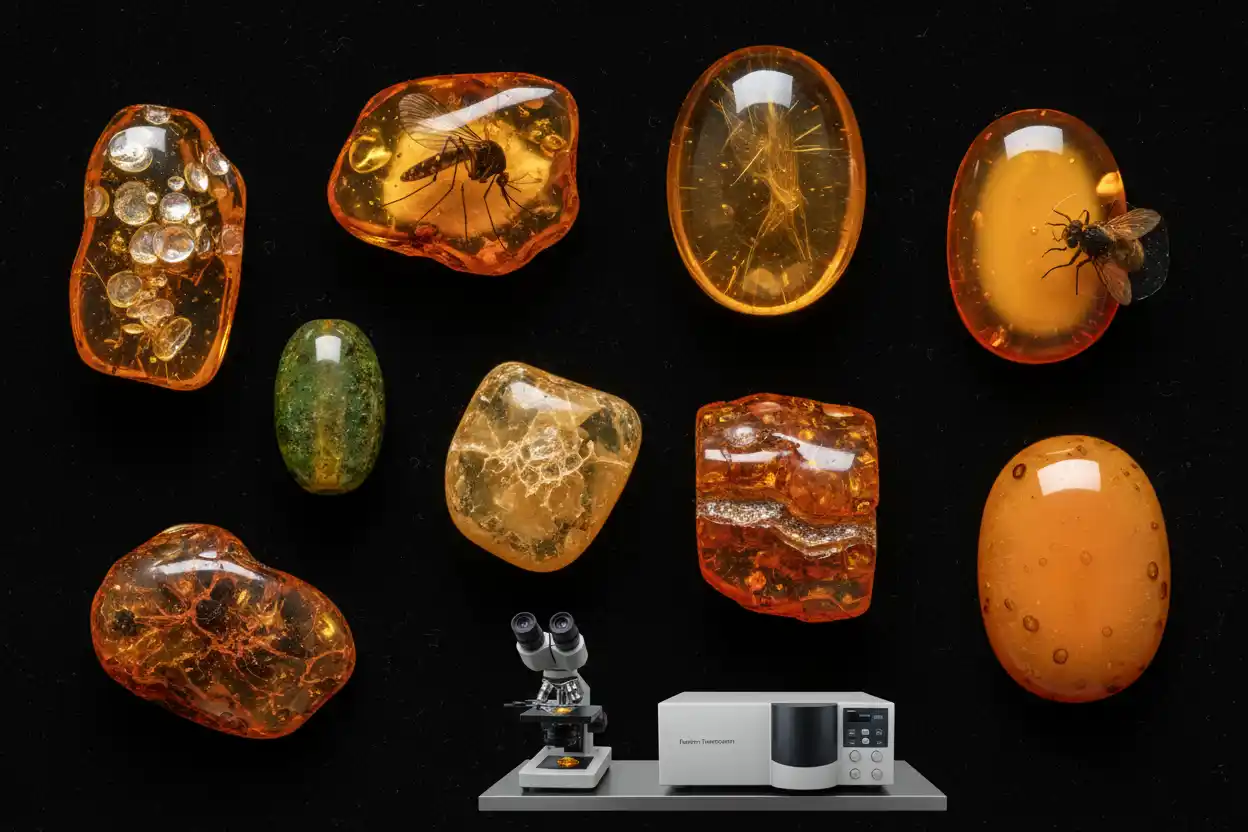
How to Spot Treated or Synthetic Amber
Amber is fossilized plant resin rather than a crystalline mineral. Its organic structure makes it light, relatively soft, heat sensitive, and especially receptive to pressure, heat, oil, dye, filling, and reconstruction.
Commercial treatments can clarify cloudy Amber, darken or redden its color, create circular “sun spangles,” produce bright green material, fill cavities, or consolidate small pieces into larger objects.
The word synthetic is often used incorrectly in Amber listings. Plastic and modern resin can imitate Amber’s appearance, but they are not synthetic Amber in the strict gemological sense because they do not reproduce the natural geological maturation of fossil resin.
The market is better understood through separate categories: untreated Amber, treated Amber, pressed or reconstructed Amber, filled natural resin, younger copal, composite products, and complete imitations.
Amber treatment categories at a glance
| Product category | What it is | Common evidence | Correct description |
|---|---|---|---|
| Natural untreated Amber | Fossilized plant resin without major post-mining enhancement | Natural flow structures, weathering, inclusions, Amber FTIR spectrum | Natural Amber |
| Heat-clarified Amber | Cloudy Amber heated in oil or controlled conditions | Improved transparency, heat-related stress features | Heat-treated Amber |
| Sun-spangled Amber | Heated Amber containing circular stress fractures | Disk-like reflective “spangles,” often with central bubbles | Heat-treated Amber |
| Baked or darkened Amber | Amber heated with pressure or oxygen | Brownish-yellow, red-brown, or darkened surface and body | Color-enhanced Amber |
| Green Amber | Amber or copal modified through heat and pressure | Bright yellow-green or green color, treatment-related spectrum | Treated natural resin |
| Dyed Amber | Amber colored with introduced dye | Color in fractures, pores, drill holes, or near the surface | Dyed Amber |
| Hydrothermally treated Amber | Amber modified in a pressurized hot-water environment | Treated skin, tiny bubbles, changed color or transparency | Hydrothermally treated Amber |
| Pressed or Ambroid Amber | Small Amber pieces fused under heat and pressure | Fragment boundaries, flow seams, stretched bubbles | Reconstructed Amber |
| Filled Amber or copal | Cavities or porous resin filled with plastic or polymer | Filler bubbles, contrasting fluorescence, artificial inclusions | Filled natural resin |
| Composite Amber | Amber bonded to resin, backing, or another component | Join lines, adhesive, layers with different reactions | Composite product |
| Copal | Younger, less polymerized natural resin | Different FTIR, greater solubility or volatile content | Copal, not Amber |
| Plastic imitation | Manufactured polymer resembling Amber | Mold seams, plastic spectrum, artificial insects, repeated patterns | Amber imitation |
What natural Amber is
Amber forms when plant resin undergoes long-term burial, chemical change, polymerization, and geological maturation.
It is not simply hardened modern tree sap. Its structure varies by botanical source, age, depositional environment, and geographic origin.
The broader material profile appears in Amber: Meaning, Properties & Symbolism. Color, geographic groups, transparent, cloudy, root, blue, green, and other commercial varieties belong to Types of Amber.
Natural Amber can be transparent, translucent, or opaque. Its colors include pale yellow, honey, orange, brown, reddish brown, cream, white, greenish, bluish, and nearly black.
Treatment status cannot be established from color alone because natural variation and enhancement overlap.
Heat clarification
Cloudy Amber contains microscopic gas bubbles, internal structures, particles, and natural irregularities that scatter light.
Controlled heating can reduce cloudiness and improve transparency. Historically, Amber has been immersed in heated oils such as linseed or rapeseed oil. Modern treatment can also use controlled furnaces or pressure vessels.
Heat allows oil or resin-like substances to enter small openings and changes internal gas or liquid features. The finished piece may appear clearer, warmer, or darker.
A clarified stone remains natural Amber if its fossil resin formed naturally. However, the treatment changes its visual category and should be disclosed when it affects value.
Sun spangles
One of the most recognizable Amber treatment features is the sun spangle: a reflective circular, oval, or disk-like internal fracture.
These features develop when internal bubbles or stress zones expand during heating and rapid pressure or temperature change. A small bubble may remain near the center of the disk.
Several spangles can create a glittering floral appearance sometimes marketed as flower Amber.
Sun spangles are not proof that the entire object is plastic. They are commonly associated with heat-treated Amber.
Natural internal fractures can occur, and geological heat may occasionally create related structures. A laboratory evaluates the total inclusion scene and treatment context rather than using one disk as an absolute verdict.
Baking and color darkening
Amber can be heated under pressure and controlled oxygen conditions to deepen its color.
Pale yellow material may become golden, brownish yellow, orange-brown, reddish brown, or darker red. The treatment may affect the surface first and progress inward depending on time, temperature, pressure, and atmosphere.
A treated piece can show a darker outer layer around a lighter center. Drill holes or damaged edges may expose the contrast.
Other pieces are treated sufficiently that the color appears uniform throughout ordinary inspection.
This darkening process should not be confused with natural aging. Amber can gradually darken over time, but controlled commercial baking creates an accelerated and deliberate effect.
Treated green Amber
Bright peridot-like yellow-green or green Amber is frequently produced through heat and pressure treatment in an autoclave.
The starting material can be natural Amber or younger copal. Treatment alters molecular structure, reduces volatile components, and may make copal appear more Amber-like.
Some treated green products have a dark backing or surface layer that modifies reflected light. Others acquire greenish color through the treatment environment itself.
A bright green stone is therefore not automatically naturally green Amber. The seller should disclose treatment and identify whether the starting resin was Amber or copal.
FTIR and, in specialized research, nuclear magnetic resonance can distinguish untreated resin from certain treated products.
Hydrothermal treatment
Hydrothermal treatment exposes Amber to elevated temperature and pressure in an aqueous environment.
The process can change color, transparency, skin texture, bubbles, and internal structure. Some treated pieces develop a yellowish-white or greenish treated layer beneath the original weathered skin.
Tiny bubbles may appear inside transparent areas. Corrugated or porous surface zones can also form.
Because water, pressure, and heat act simultaneously, the product may not resemble Amber heated only in oil or dry air.
Laboratory spectroscopy and microscopy are usually needed because the visible features overlap natural weathering and conventional heat treatment.
Steam dyeing
Steam dyeing introduces colored water or vapor into Amber under pressure and temperature.
The treatment can create colored filaments, bubbles, and color concentrated along internal pathways. Squashed bubbles and reddish traces have been documented in treated material.
Unlike a simple surface stain, pressurized vapor may carry dye deeper into the resin.
The color may still fade, migrate, or respond to solvents and prolonged light. Such material should be described as dyed or steam-dyed Amber rather than a naturally colored variety.
Conventional dyeing
Amber may be dyed red, green, yellow, orange, brown, blue, or another color.
Introduced color commonly concentrates in surface-reaching cracks, drill holes, pores, weathered skin, or along heat-created spangles.
A dyed bead may appear darker around the string hole or show unusually saturated color near the surface.
Natural Amber also develops uneven color and weathered crusts. Dye detection should therefore consider the shape of the color boundary and whether it follows liquid-access pathways.
The broader visual framework appears in How to Spot Dyed Crystals.
Pressed Amber, Ambroid, and reconstructed Amber
Amber fragments and cutting waste can be softened and fused under heat and pressure to create larger pieces.
The resulting product is called pressed Amber, Ambroid, consolidated Amber, or reconstructed Amber.
Pressed material can consist entirely of natural Amber, yet its body was manufactured from several pieces rather than preserved as one geological fragment.
Microscopic clues can include fragment outlines, elongated bubbles, flow lines, swirled zones, compressed inclusions, and irregular boundaries between pieces.
Well-made pressed Amber can be difficult to recognize visually because the interfaces become highly fused. FTIR may confirm Amber chemistry while microscopy and structural analysis reveal reconstruction.
Pressed Amber generally sells for less than a comparable solid natural piece and should be disclosed.
Pressed Amber mixed with other substances
Some reconstructed products combine Amber with Calcite powder, pigment, plastic, or another filler to imitate specific natural varieties.
For example, a pale granular product may be manufactured to resemble root Amber or opaque beeswax Amber.
The added powder changes density, texture, fluorescence, and spectroscopy. A piece may contain genuine Amber yet qualify as an imitation of a more valuable natural variety because its pattern and opacity were manufactured.
A correct description should name both the reconstructed construction and any added non-Amber material.
Filled Amber and filled copal
Natural cavities, cracks, or drilled spaces can be filled with clear plastic, colored resin, or another polymer.
Copal may also be filled to improve hardness, transparency, or apparent age. In some products, an artificial insect or plant inclusion is suspended inside the filler to imitate a valuable fossil inclusion.
Under magnification, the filler may show round bubbles, flow lines, shrinkage, a smooth boundary, or different luster. Ultraviolet light may reveal contrasting fluorescence between natural resin and plastic.
FTIR or Raman spectroscopy identifies the polymer and separates it from the surrounding Amber or copal.
A filled product should not be described simply as natural insect Amber.
Composite Amber
Composite objects may join Amber to artificial resin, glass, backing material, metal, shell, or another Amber piece.
A clear upper dome may be attached over an Amber layer. Thin Amber may be backed with dark resin to strengthen color, or several pieces may be joined around a central artificial inclusion.
Possible signs include straight join lines, trapped adhesive bubbles, separate fluorescence colors, abrupt changes in refractive appearance, or peeling at the boundary.
The general assembled-gem framework appears in Gemstone Doublets and Triplets.
Copal is not synthetic Amber
Copal is natural plant resin that has undergone less geological maturation than Amber.
Its exact age boundary is not universal because resin chemistry and polymerization differ among botanical sources and deposits. The distinction relies on molecular structure rather than one fixed number of years.
Copal may be softer, contain more volatile material, and respond more readily to certain organic solvents. However, destructive solvent tests should not be performed on jewelry or valuable inclusions.
Heat and pressure can artificially age copal’s molecular features, making identification more difficult. Advanced FTIR and related analysis may still distinguish the treated product.
Copal should be sold under its own name rather than upgraded to Amber through treatment or marketing.
Plastic and modern resin imitations
Phenolic resin, acrylic, polyester, epoxy, amino resin, and other plastics can imitate Amber’s yellow, orange, red, green, cloudy, or root-like appearance.
Manufacturers can add bubbles, insects, leaves, glitter, cracks, or opaque particles. Mold seams, repeated inclusions, perfectly centered insects, and identical bead patterns are warning signs.
Some plastic has a similar density to Amber and may float in strong saltwater. Others can acquire electrostatic charge when rubbed.
This is why saltwater, static, smell, and hot-needle tests are unreliable and potentially destructive.
FTIR quickly separates many plastics from natural fossil resin. The broad imitation-screening process appears in Real vs Fake Amber and How to Spot Fake Crystals.
Artificial insect inclusions
A valuable inclusion should appear geologically and biologically plausible.
Insects preserved in natural Amber may be incomplete, distorted, decomposed, surrounded by flow structures, or accompanied by plant debris and tiny bubbles.
An imitation may contain a modern insect in perfect condition, placed centrally with spread wings and no evidence of resin flow or decay.
However, an unusual-looking inclusion is not automatically artificial. Genuine Amber can preserve exceptional specimens.
A significant insect inclusion should receive independent imaging and spectroscopy. Surface drilling, plugs, filler, and join lines require particular attention.
Is there true synthetic Amber?
Synthetic normally means a laboratory-grown material reproducing the essential composition and structure of a natural gemstone.
Amber does not have one fixed crystal lattice or simple chemical formula. It is a complex fossilized organic resin whose structure depends on botanical source and geological maturation.
Manufactured polymers can imitate many Amber properties, but they do not reproduce the full natural fossilization history. The more accurate terms are imitation Amber, artificial resin, plastic simulant, or reconstructed product.
A treated natural resin and a manufactured plastic should not share one vague synthetic label.
The wider terminology appears in Lab-Grown vs Natural Gemstones and Gemstone Treatments Explained.
Ultraviolet fluorescence
Many Ambers fluoresce blue, blue-white, greenish, yellowish, or other colors under ultraviolet light.
Treatment, locality, weathering, oxidation, botanical source, and clarity affect the reaction. Plastic, adhesive, filler, and copal can also fluoresce.
A composite may reveal different fluorescence across separate layers. This can be highly useful for locating filler or joins.
Nevertheless, no one UV color proves Amber, Baltic origin, natural color, or untreated status.
FTIR, Raman, and advanced analysis
FTIR is the primary analytical method for fossil resins. It distinguishes Amber, copal, plastics, fillers, and many treatment-related molecular changes.
Baltic succinite has a characteristic infrared pattern often discussed through the Baltic shoulder, although treatment, weathering, and non-Baltic botanical sources require careful interpretation.
Raman spectroscopy helps identify polymer, resin, mineral powder, and filler. Nuclear magnetic resonance has been used in research on heat-and-pressure-treated green Amber.
Microscopy reveals sun spangles, bubbles, flow structures, artificial insects, joins, dye, and fragment boundaries.
Several methods may be necessary when the product contains natural Amber, copal, plastic filler, and mineral powder together.
Reports, value, and seller claims
The Amber Buying Guide owns clarity, color, inclusions, provenance, and purchase quality. Price factors belong to the Amber Price Guide.
A laboratory report is especially important when the price depends on a rare inclusion, untreated green or blue color, Baltic or Dominican origin, solid construction, or unusual size.
The completed Gemstone Certification Labs Compared explains report providers. Use How to Read a Gem Lab Report to match photographs, dimensions, weight, material description, treatment, and inclusion comments.
Before ordering online, follow How to Buy Gemstones Online Without Getting Scammed.
Care for treated and reconstructed Amber
Amber is soft and sensitive to heat, solvents, perfume, hairspray, alcohol, acids, and aggressive polishing.
Warm water, mild soap, and a soft cloth provide the safest routine cleaning method. Do not soak the piece unnecessarily.
Heat can soften Amber, darken it, worsen spangles, weaken adhesive, or damage plastic filler. Steam and ultrasonic cleaners should be avoided.
Dyed green or red color may fade under strong light. Pressed and composite objects may separate at joins.
The complete care workflow appears in How to Clean Amber Jewelry Safely. Traditional nonwater handling appears in How to Cleanse and Charge Amber.
Amber’s light weight makes it especially suitable for Amber Earrings: A Style Guide and Amber Necklaces and Pendants Guide, but treatment and assembly should be known before repair.
Frequently Asked Questions
1. Is heat-treated Amber still real Amber?
Yes. The starting fossil resin can remain natural Amber, although heat treatment should be disclosed.
2. What are sun spangles?
They are reflective disk-like stress fractures commonly created when internal bubbles expand during heat and pressure treatment.
3. Is bright green Amber natural?
Some natural greenish Amber exists, but vivid yellow-green market material is commonly produced through heat and pressure treatment.
4. What is pressed Amber?
Pressed Amber is made by fusing small natural Amber pieces under heat and pressure to create a larger manufactured object.
5. Is Ambroid genuine Amber?
It contains Amber but is reconstructed rather than one intact natural piece.
6. Can Amber be dyed?
Yes. Red, green, and other colors can be introduced, sometimes using pressure or steam.
7. Is copal the same as Amber?
No. Copal is less mature natural resin and has different molecular and stability characteristics.
8. Can copal be treated to resemble Amber?
Yes. Heat and pressure can reduce volatile components and make copal appear more Amber-like.
9. Is plastic sold as synthetic Amber?
Frequently, but imitation plastic is a more accurate term because it does not reproduce fossil Amber’s natural structure and history.
10. Can an insect be added to Amber?
Yes. Artificial insects can be inserted into plastic, filler, drilled cavities, or composite products.
11. Does saltwater floating prove Amber is genuine?
No. Density varies, and some plastics, copal, hollow products, and composites can produce misleading results.
12. When should Amber receive laboratory testing?
Testing is important for valuable insect inclusions, rare colors, Baltic or Dominican origin claims, large solid pieces, and suspected pressed or filled material.
Conclusion
Amber enhancement ranges from modest clarification to complete reconstruction. Heat can improve transparency, darken color, or create sun spangles. Pressure treatments can produce green material, while dye, hydrothermal treatment, filling, and backing create further categories.
Pressed Amber contains natural resin but is a reconstructed product. Copal is younger natural resin, while plastic and modern polymers are imitations rather than true synthetic Amber.
The strongest identification combines microscopic structure, FTIR, fluorescence, construction analysis, and precise seller disclosure. A convincing color or insect inclusion is never enough by itself.