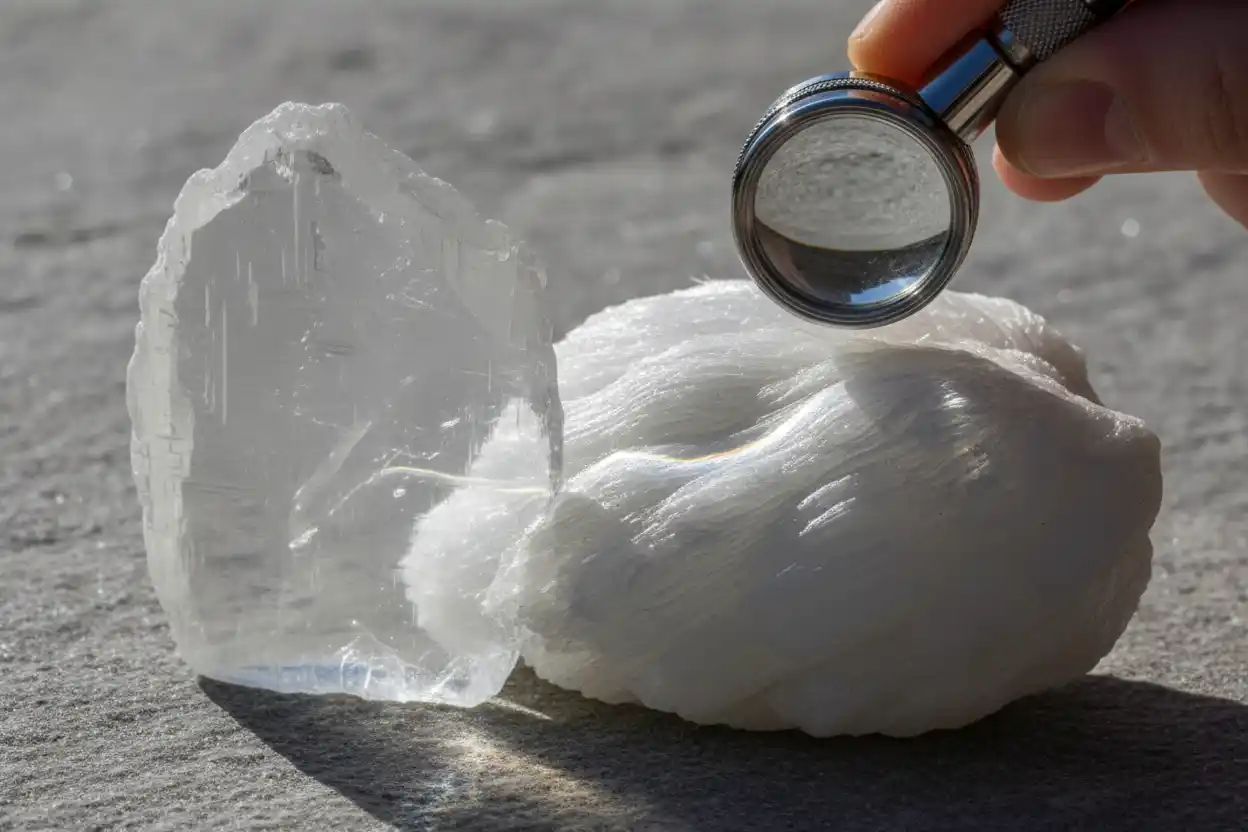
Selenite vs Satin Spar: How to Tell Them Apart
Selenite and Satin Spar are not two unrelated crystals. Both are varieties or habits of Gypsum, a hydrated calcium sulfate mineral with the formula CaSO₄·2H₂O.
The principal difference is how the Gypsum crystals developed. Selenite usually refers to transparent or translucent, nonfibrous Gypsum crystals that form as plates, blades, sheets, or distinct crystal faces. Satin Spar Gypsum consists of closely packed parallel fibers that create a white, translucent body and a silky band of moving light.
Most white “Selenite” towers, wands, spheres, palm stones, lamps, and charging plates sold in crystal shops are more accurately Satin Spar Gypsum. The retail name is widespread, so the label does not necessarily indicate deliberate fraud. However, understanding the distinction helps buyers identify what they own, evaluate damage, and choose appropriate care.
Selenite and Satin Spar at a glance
| Property | Selenite | Satin Spar Gypsum |
|---|---|---|
| Mineral species | Gypsum | Gypsum |
| Composition | CaSO₄·2H₂O | CaSO₄·2H₂O |
| Typical structure | Broad, platy, bladed, tabular, or sheet-like crystals | Parallel fibrous aggregate |
| Transparency | Commonly transparent to translucent | Commonly translucent |
| Typical luster | Vitreous to pearly | Silky |
| Main optical feature | Clear windows, reflective cleavage surfaces | Moving silky band or cat’s-eye-like effect |
| Common retail form | Natural plates, blades, clusters, window crystals | Towers, wands, spheres, bowls, lamps, palm stones |
| Mohs hardness | 2 | 2 |
| Cleavage | Perfect and easily separated into sheets | Fibers split and splinter along their length |
| Water resistance | Poor | Poor |
| Main handling risk | Cleavage, scratches, chipping | Splinters, frayed fibers, scratches, crushing |
| Correct broad identity | Nonfibrous transparent Gypsum | Fibrous Gypsum |
Both materials are Gypsum
Gypsum is one of the softest common minerals. Its composition includes water as part of the crystal structure rather than merely as moisture trapped on the surface.
The mineral commonly forms in evaporite deposits where saline water evaporates and leaves calcium sulfate behind. It also occurs in caves, sedimentary beds, hydrothermal environments, and as a secondary mineral.
The broader species-level explanation appears in Gypsum: Types, Properties & Meaning. That page owns the full mineral family, including Selenite, Satin Spar, alabaster, desert roses, and other Gypsum habits.
Selenite and Satin Spar should therefore produce the same basic chemical and many of the same physical test results. Their differences come primarily from crystal habit, transparency, fiber arrangement, and visual texture.
What true Selenite looks like
Selenite commonly forms broad transparent or translucent crystals. These may appear as flat plates, elongated blades, tabular crystals, clear sheets, or intergrown clusters.
A good crystal can be transparent enough to see text, objects, or light through it. Internal cleavage planes may create reflections that resemble stacked glass sheets.
Selenite can also form twinned crystals with distinctive geometric shapes. Some specimens develop long blades or curved forms, while others appear as flat window-like plates.
The natural faces generally look glassy or pearly rather than fibrous. When the crystal breaks along cleavage, it may separate into thin sheets with broad smooth surfaces.
The general material profile appears in Selenite: Meaning, Healing Properties & Uses, while Types of Selenite owns the wider range of crystal shapes, colors, and Gypsum-related trade forms.
What Satin Spar looks like
Satin Spar Gypsum consists of many fine crystals arranged in roughly parallel fibers. Instead of one clear plate, the material resembles a compact bundle of translucent mineral threads.
When light crosses those fibers, it creates a silky bright line that moves as the specimen or light source changes position. This optical effect is one reason Satin Spar is popular for polished towers, spheres, eggs, palm stones, and wands.
The fibers may appear as fine straight lines running from one end of the piece to the other. On an unpolished or damaged surface, they can separate into hair-like splinters.
A Satin Spar tower usually has a cloudy white body with a bright vertical band that shifts across its face. Although shops commonly label this product Selenite, its fibrous structure identifies it more precisely as Satin Spar Gypsum.
The easiest distinction is crystal habit
Transparency alone is helpful but not sufficient. Some Selenite is cloudy, while thin Satin Spar can transmit substantial light.
The more dependable visual question is whether the structure is platy or fibrous.
Selenite tends to show broad crystal faces, sheets, plates, blades, and large cleavage surfaces. Satin Spar shows numerous parallel fibers that create a soft silky texture.
Side lighting makes the distinction clearer. A Satin Spar object often develops a moving luminous stripe across the fibers. Selenite more often produces transparent windows, mirror-like internal reflections, or broad flashes from cleavage planes.
A loupe may reveal individual fiber lines in Satin Spar. Selenite instead shows larger continuous crystal areas without the same fine parallel thread structure.
Why most “Selenite” towers are Satin Spar
Satin Spar occurs in compact fibrous veins that can be cut efficiently into commercial objects. Its uniform white appearance, silky movement, and ready availability make it suitable for mass-produced décor and crystal-shop items.
True Selenite plates and blades are more difficult to shape into thick towers because their perfect cleavage encourages separation into sheets. Transparent crystals may also show natural irregularities that reduce the yield from polished products.
For this reason, a white tower, wand, lamp, bowl, or charging plate with parallel fibers is almost certainly Satin Spar Gypsum, even when the invoice says Selenite.
The distinction is mineralogically useful, but both products remain genuine Gypsum when correctly identified. A buyer should not assume that Satin Spar is fake merely because the shop used the broader retail term.
Silky chatoyancy
Satin Spar’s moving light band is produced by reflection from its parallel fibers. A polished sphere or rounded cabochon can show a concentrated line resembling a cat’s eye.
The effect should move perpendicular to the fiber direction as the object rotates. On a tower, the luminous band may seem to slide from side to side.
This behavior distinguishes Satin Spar from ordinary cloudy glass or massive white stone. However, fibrous Calcite, synthetic fiber-optic glass, and other materials can also display silky or cat’s-eye-like effects.
The optical effect supports a fibrous structure but does not prove that the fibers are Gypsum. Mineral identity must still agree with hardness, cleavage, density, and other observations.
Selenite’s transparent window effect
Clear Selenite can be transparent enough to function historically as a window material. Its broad crystals and easy cleavage allow thin transparent sheets to be separated from larger pieces.
When text is viewed through a clean plate, the image may remain visible with reflections or distortion from internal cleavage.
This should not be confused with the image-transmitting behavior of Ulexite, sometimes marketed as television stone. Ulexite’s fibrous structure can transport an image toward the surface in a more pronounced way.
Satin Spar Gypsum may create a bright optical line, but it does not become Ulexite simply because it has fibers.
Cleavage and fracture
Selenite has perfect cleavage. A crystal can split readily along broad, smooth structural planes.
This makes clear plates vulnerable to bending, pressure, and impact. A seemingly solid blade may separate into thinner sheets after a light knock.
Satin Spar has the same underlying Gypsum structure, but its fibrous habit changes the way damage appears. It tends to split lengthwise, fray, crush, or release sharp mineral splinters.
The broader distinction between cleavage and ordinary fracture appears in Gemstone Cleavage Explained.
Neither habit should be dropped or squeezed. Satin Spar towers can break across the base, while long Selenite blades may snap or peel along cleavage planes.
Hardness and scratch resistance
Both Selenite and Satin Spar rank approximately 2 on the Mohs scale. A fingernail can usually scratch a fresh surface.
This softness explains why polished pieces develop dull areas, handling marks, edge abrasion, and scratches from ordinary household dust. Quartz-rich dust is much harder and can abrade Gypsum quickly.
The Gemstone Hardness Chart places Gypsum near the soft end of the scale.
Softness should not be used as permission to scratch a finished specimen. A fingernail test causes permanent damage and cannot separate Selenite from Satin Spar because both produce the same basic response.
Hardness is not toughness
Neither material tolerates rough handling well, but they fail differently.
Selenite’s broad cleavage makes it vulnerable to splitting and peeling. Satin Spar’s fibers can crush, splinter, and fray.
A thick Satin Spar sphere may survive a gentle bump better than a thin Selenite blade, yet this does not make the mineral hard. It only reflects differences in shape and internal arrangement.
The relationship between abrasion, impact, and structural weakness is explained in Gemstone Toughness vs Hardness.
Water sensitivity
Both materials are Gypsum and should be kept away from soaking, running water, saltwater, and prolonged humidity.
Gypsum is slightly soluble in water. Brief accidental contact may not destroy a polished piece immediately, but repeated wetting can dull the surface, soften edges, expose fibers, and gradually alter the finish.
Satin Spar is particularly vulnerable because water can enter between its fibers. A tower may become rough, chalky, or frayed after repeated washing.
The complete material-specific answer appears in Is Selenite Safe in Water and Sunlight?. The wider reference page Which Crystals Can and Can’t Go in Water places Gypsum among other moisture-sensitive materials.
Dry cleaning methods are safer. Use a soft brush, microfiber cloth, or gentle air blower instead of water.
Selenite, Satin Spar, and desert roses
A desert rose is another Gypsum habit. It forms clusters of flat crystals that trap sand and create flower-like rosettes.
Desert roses are not Satin Spar because they do not consist primarily of compact parallel fibers. They are also not typical transparent Selenite plates, although all belong to the same Gypsum mineral species.
Their sand-bearing structures and locality context are covered in Desert Rose: Meaning, Properties & Symbolism.
The variety illustrates why one mineral can develop dramatically different appearances depending on growth conditions.
Satin Spar can also refer to other minerals
The term satin spar describes a fibrous material with a silky luster. Although it most commonly refers to fibrous Gypsum in the crystal trade, fibrous Calcite or Aragonite may also receive the name.
Satin Spar Calcite is harder than Gypsum and has carbonate properties. It may show different cleavage, density, refractive behavior, and acid reaction.
Do not perform an acid test on a finished specimen. Acid can etch Calcite and damage the surface permanently.
When precision matters, use the full term Satin Spar Gypsum rather than Satin Spar alone.
Selenite versus Clear Quartz
Clear Selenite and Clear Quartz can both appear colorless and transparent, but their durability is dramatically different.
Quartz has Mohs hardness 7 and no easy cleavage. Gypsum has hardness 2 and perfect cleavage.
Quartz crystals commonly form six-sided prisms with pointed terminations. Selenite more often forms plates, blades, tabs, or broad transparent sheets.
The full direct comparison belongs to Clear Quartz vs Selenite. The quartz species itself appears in Clear Quartz: Meaning, Healing Properties & Uses.
A polished object without natural crystal faces may require refractive-index, hardness, and structural testing rather than shape alone.
Glass and resin imitations
Clear or white glass can imitate Selenite, while fiber-optic glass and resin can imitate Satin Spar’s moving line.
Glass may contain round bubbles, flow lines, mold seams, and conchoidal chips. Resin may feel lighter, show seams, dent under pressure, or contain bubbles.
A synthetic fiber-optic material can show an unusually sharp moving line and extremely regular fibers. Natural Satin Spar usually displays subtle variations, mineral grain, and cleavage-related damage.
The broad screening process appears in How to Spot Fake Crystals.
Because genuine Gypsum is inexpensive and abundant, mislabeling among Gypsum habits is more common than elaborate counterfeiting. Decorative synthetic materials become more likely in unusually perfect lights, beads, or mass-produced objects.
Jewelry and decorative use
Selenite and Satin Spar are poor choices for exposed daily jewelry. Both scratch easily and can be damaged by perspiration, impact, cleaning products, and friction against metal or harder stones.
Pendants and earrings are safer than rings or bracelets. Even then, a protective metal frame should not place excessive pressure on the Gypsum.
Decorative objects should rest on a soft, dry surface away from kitchens, bathrooms, windows with condensation, and high-traffic shelf edges.
A Satin Spar lamp should be handled by its base rather than the mineral body. Heat from an ordinary low-output bulb is less concerning than moisture, impact, and repeated abrasion, but electrical components must remain dry.
Buying accurately labeled material
The most useful seller photographs show the side and an unpolished or damaged area. Fine parallel fibers identify Satin Spar more confidently than a front-facing photograph.
A true Selenite listing should show broad crystal faces, clear plates, bladed growth, or transparent sheets. A Satin Spar listing should acknowledge the fibrous structure, especially when the item is a tower, wand, sphere, or lamp.
The planned Where to Buy Real Selenite owns marketplace and seller selection.
For broader examination methods, use How to Identify Crystals: A Beginner’s Guide. That workflow emphasizes structure, hardness, luster, cleavage, density, and context rather than relying on a trade label.
Spiritual terminology versus mineral identity
Crystal traditions often use Selenite as an umbrella name for clear Selenite and white Satin Spar. Readers may therefore encounter the same spiritual associations attached to both habits.
Those traditions do not alter the geological distinction. The dedicated belief-focused page Selenite Healing Properties: A Complete Guide can discuss customary uses without treating them as mineral tests.
Likewise, How to Cleanse and Charge Selenite should be approached through dry, non-damaging methods that respect Gypsum’s physical limitations.
Frequently Asked Questions
1. Are Selenite and Satin Spar the same mineral?
Yes. Both are forms of Gypsum with the chemical composition CaSO₄·2H₂O.
2. What is the main difference?
Selenite is generally transparent to translucent and nonfibrous, while Satin Spar Gypsum consists of closely packed parallel fibers with a silky luster.
3. Are most white Selenite towers actually Satin Spar?
Yes. White towers and wands with visible parallel fibers are more accurately Satin Spar Gypsum.
4. Is Satin Spar fake Selenite?
No. It is genuine Gypsum. The issue is imprecise variety naming rather than an artificial material.
5. How can I identify true Selenite?
Look for broad clear plates, blades, tabs, sheets, and smooth cleavage surfaces rather than fine parallel fibers.
6. Why does Satin Spar show a moving light band?
Its parallel fibers reflect light collectively, producing a silky or cat’s-eye-like optical effect.
7. Can Selenite scratch Satin Spar?
Both have essentially the same Mohs hardness, so scratching does not provide a useful distinction.
8. Can either material go in water?
Neither should be soaked. Gypsum is slightly water soluble and repeated wetting can damage the surface and fibers.
9. Does Satin Spar produce splinters?
Yes. Broken or frayed fibers can form sharp splinters, so damaged pieces should be handled carefully.
10. Is desert rose a type of Selenite?
Desert rose is another Gypsum habit made of rosette-like crystals containing sand. It differs from both clear Selenite and fibrous Satin Spar.
11. Can Satin Spar be Calcite?
The descriptive term can also be applied to fibrous Calcite or Aragonite, so Satin Spar Gypsum is the more precise name.
12. Which is more valuable?
Value depends on crystal size, transparency, formation, locality, damage, and aesthetics. Fine transparent Selenite crystals may command more collector interest than common polished Satin Spar.
Conclusion
Selenite and Satin Spar share the same Gypsum composition but display different crystal habits. True Selenite forms transparent or translucent plates, blades, tabs, and sheets. Satin Spar consists of parallel fibers that create a white body and moving silky light.
The difference affects appearance and the way each material breaks, but not their fundamental softness or water sensitivity. Both rank around 2 on the Mohs scale and require dry, gentle handling.
A white fibrous tower is not a fake crystal simply because it is technically Satin Spar. It is genuine Gypsum whose retail label has become broader than its mineralogical definition.