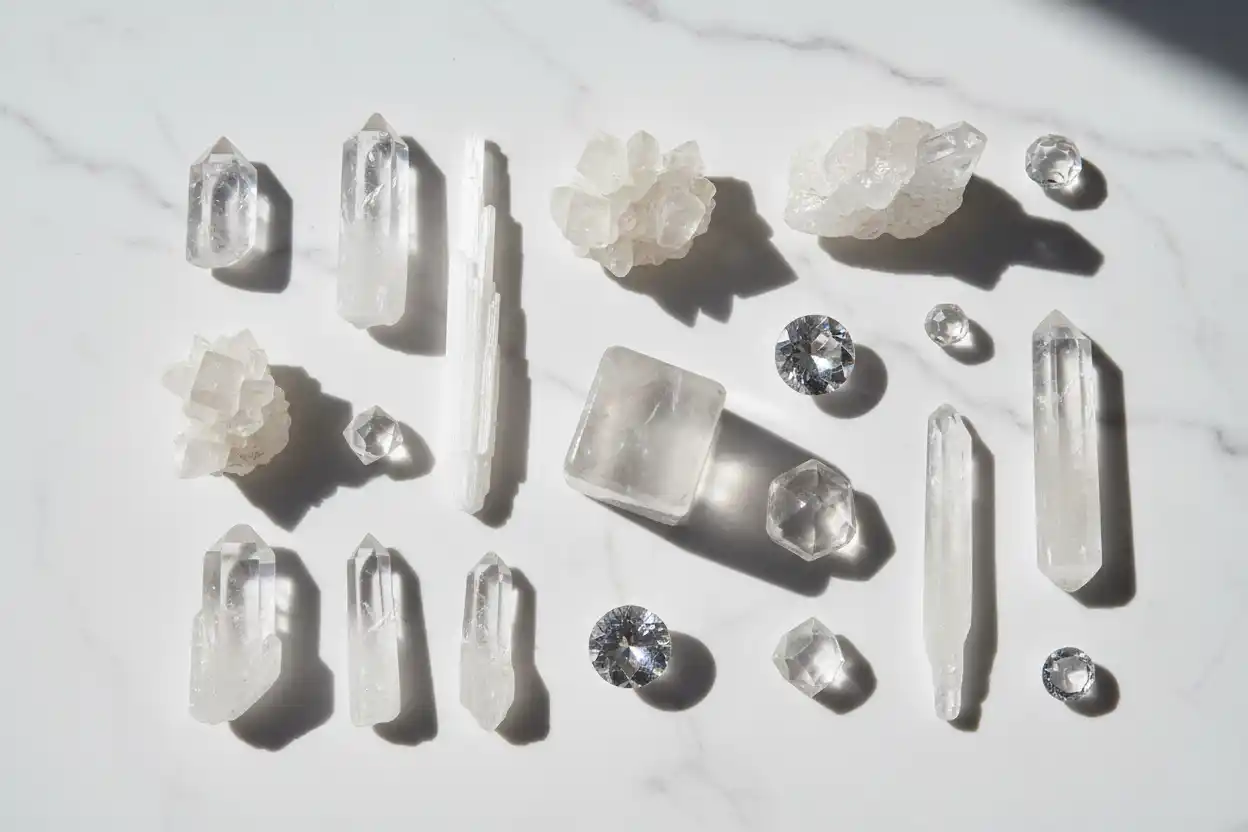
Clear Crystals: Benefits, Uses & Practical Guidance
Clear crystals are often grouped together because they share a transparent, colorless, white, or glass-like appearance, but they are not one mineral family and should not be treated as if they have identical properties. Clear quartz, gypsum sold as selenite, calcite, fluorite, apophyllite, danburite, and colorless beryl can all appear visually clear while differing sharply in hardness, cleavage, water sensitivity, durability, and appropriate care. Understanding those differences is more useful than choosing clear crystals by appearance or symbolic reputation alone.
For practical purposes, the benefits of clear crystals can be divided into four areas: visual appeal, mineral collecting and learning, decorative or meditative use, and traditional symbolism. Claims about “energy,” purification, manifestation, or emotional healing belong to spiritual and cultural practice rather than established mineral science. A grounded approach allows you to enjoy those traditions while still handling each specimen according to its actual mineral identity.
What Are Clear Crystals?
Clear crystals are transparent or translucent mineral specimens whose visible color is minimal enough for the material to appear colorless, near-colorless, white, or glassy. “Clear” describes appearance, not chemistry. Two specimens that look almost identical can have completely different structures and physical behavior.
That distinction is essential when collecting clear crystals. Quartz is relatively hard and has no true cleavage, while gypsum is extremely soft and can be damaged by water or fingernails. Calcite behaves differently again, fluorite has perfect cleavage, and apophyllite can split along cleavage planes. The safest starting point is therefore to identify the mineral before deciding how to clean, display, carry, or use it.
For stone-by-stone guides and traditional interpretations, browse the Healing Crystal collection.
Clear Crystals at a Glance
| Crystal or mineral | Typical clear appearance | Mohs hardness | Important handling point | Practical use |
|---|---|---|---|---|
| Clear quartz | Colorless and transparent to milky | 7 | Durable but can chip from impact | Collecting, display, meditation objects |
| Selenite/gypsum | Transparent to translucent, often white | 2 | Very soft; avoid soaking in water | Display, carving, symbolic practice |
| Clear calcite | Transparent to translucent | 3 | Soft with strong cleavage; acid sensitive | Optical specimens, collecting |
| Colorless fluorite | Transparent, glassy | 4 | Perfect cleavage; avoid hard knocks | Mineral collecting, display |
| Apophyllite | Colorless to white, often highly lustrous | About 4.5–5 | Cleavage makes thin areas fragile | Specimen collecting, display |
| Danburite | Colorless to pale, often transparent | About 7–7.5 | More durable, but specimens still need care | Collecting, faceting, display |
| Goshenite | Colorless beryl, transparent | About 7.5–8 | Fairly hard; inclusions and fractures still matter | Gem and mineral collecting |
The table shows why clear crystals cannot share one universal cleaning or storage method. Mineral identity matters more than color.
Clear Quartz: The Familiar Reference Point
Clear quartz is usually the first mineral people picture when they hear clear crystals. It is crystalline silicon dioxide with a Mohs hardness of 7, no true cleavage, and a wide range of natural habits, from small terminated points to large clusters. Inclusions, internal veils, fractures, phantoms, and mineral inclusions can make individual specimens visually distinctive even when the quartz itself is colorless.
Because quartz is relatively durable, it suits handling and display better than many softer clear crystals, but it is not indestructible. Sharp blows can chip points or fracture internal flaws. The clear quartz meaning guide separates the mineral’s physical identity from traditional symbolism, while real vs fake clear quartz explains why bubbles, molding features, optical effects, and proper testing matter when glass or manufactured material is suspected.
Selenite and Gypsum: Beautiful but Very Soft
Much of the material sold in crystal shops as “selenite” is gypsum, and fibrous satin spar is frequently marketed under the same familiar name. Gypsum has a Mohs hardness of only 2, which makes it dramatically softer than quartz. A clear or translucent piece can scratch easily, develop worn surfaces, and be damaged by prolonged contact with water.
That softness makes these clear crystals better suited to careful display than rough everyday handling. Avoid soaking them, using abrasive brushes, or assuming that a glossy polished surface means high durability. If you own both quartz and gypsum, the clear quartz vs selenite guide explains their measurable differences, while is selenite safe in water covers the care issue directly.
Clear Calcite: Optical Interest and Strong Cleavage
Clear calcite can be exceptionally transparent and is famous for strong double refraction in suitable specimens, where an object viewed through the crystal can appear doubled. Calcite has a Mohs hardness of 3 and perfect cleavage, so it is much easier to scratch and split than quartz.
Collectors should handle clear crystals made of calcite with clean hands and avoid knocks, acids, harsh household cleaners, and abrasive cleaning. Some transparent calcite specimens are prized specifically for optical behavior rather than for wearability. The broader calcite meaning guide covers mineral properties and traditional interpretations without treating symbolic claims as scientific effects.
Colorless Fluorite: Glassy but Cleavage-Prone
Fluorite can occur in purple, green, blue, yellow, and colorless varieties. Transparent colorless fluorite can resemble other clear crystals visually, yet its Mohs hardness is only 4 and it has perfect octahedral cleavage. That cleavage can produce attractive geometric fragments but also means the mineral can break along preferred planes.
Use colorless fluorite primarily as a specimen or display mineral unless the specific piece has been prepared for another purpose. Avoid impacts and careless mechanical cleaning. The fluorite meaning guide provides additional mineral and symbolism context.
Apophyllite: Bright Luster, Delicate Structure
Apophyllite specimens are popular because their colorless or white crystals can be highly transparent and intensely lustrous, often forming attractive clusters on matrix. The name commonly refers to minerals in the apophyllite group, and the specimens sold to collectors can differ in exact composition.
These clear crystals are not ideal for rough handling. Their moderate hardness and pronounced cleavage mean points and thin crystal faces can be damaged by pressure or impact. Apophyllite is best treated as a display specimen rather than something to carry loose in a pocket or bag. See the apophyllite meaning guide for a more focused mineral profile.
Danburite: A Harder Clear Crystal
Danburite is commonly colorless to pale yellow and can occur as transparent prismatic crystals. With a hardness around 7 to 7.5, it is considerably more scratch resistant than gypsum, calcite, fluorite, or apophyllite. Fine transparent material can also be faceted, although attractive natural crystal specimens are often kept intact by collectors.
Among clear crystals, danburite is useful for showing why colorless appearance does not imply softness. Even so, natural crystal points can fracture if dropped, and specimen value can depend heavily on intact terminations, luster, matrix, and overall aesthetics. The danburite meaning guide covers its properties and traditional symbolism in more depth.
Goshenite: Colorless Beryl
Goshenite is the colorless variety of beryl, the same mineral species that includes emerald and aquamarine. Its Mohs hardness of about 7.5 to 8 gives it substantially better scratch resistance than many clear crystals, and transparent material can be used as a gemstone as well as collected in crystal form.
When the goal is jewelry selection rather than specimen or spiritual practice, use the dedicated clear gemstones guide because gemstone buying involves cut, optical performance, treatments, setting durability, and value in ways that a broad crystal directory does not.
Why People Use Clear Crystals
People choose clear crystals for many reasons that do not require supernatural claims. Transparent specimens can make mineral structures easier to observe, show inclusions clearly, reflect light attractively, and create visually quiet displays that fit many interiors. Collectors can also appreciate how different crystal systems produce distinctive habits even when color is absent.
In meditation or reflective routines, clear crystals can serve as physical prompts for attention. A person might place a quartz point beside a journal, hold a smooth stone while setting an intention, or use a specimen as a reminder to simplify a decision. Those are practical behavioral uses: the object provides a cue, while the actual reflection or action comes from the person.
Traditional Meaning of Clear Crystals
In modern crystal traditions, clear crystals are often associated with clarity, cleansing, focus, amplification, or a fresh start. Clear quartz in particular is frequently described as an “amplifier,” while selenite is often associated with purification and calm. These ideas are traditions and symbolic interpretations, not established physical or medical effects.
A useful way to work with that symbolism is metaphorically. “Clarity” can mean writing down the facts of a decision; “cleansing” can mean reducing distractions; “focus” can mean choosing one priority; and “fresh start” can mean changing a habit. Clear crystals can accompany those practices without being presented as guaranteed causes of emotional, financial, relationship, or health outcomes.
Clear Crystals for Meditation and Reflection
For meditation, choose clear crystals that are physically safe to handle and comfortable in the hand. A tumbled quartz piece is generally more practical than a fragile apophyllite cluster or a sharp, delicate gypsum blade. Place fragile specimens nearby rather than gripping them.
You can also use clear crystals as visual anchors. Set one object in front of you, notice its inclusions, reflections, surfaces, and shape, then return attention to those details whenever the mind wanders. The mineral does not need to “send” anything for the practice to work; it simply provides a consistent focus point.
Clear Crystals for the Home
Clear crystals work well in displays because their neutral appearance combines easily with other minerals, wood, metal, plants, and decorative objects. Quartz clusters can catch directional light, calcite can show interesting optical effects, and apophyllite clusters can create strong sparkle without relying on saturated color.
Placement should still consider physical safety. Keep delicate specimens away from shelf edges, direct contact with water, cleaning sprays, children who could handle them roughly, and locations where pets can knock them down. The crystals at home guide expands on display, placement, and practical household considerations.
Crystal Shapes Change Use, Not Mineral Properties
Points, spheres, towers, palm stones, clusters, and carved shapes can feel different to hold or display, but shaping a mineral does not change its chemistry or scientifically establish a different energy. The practical effect comes from ergonomics, stability, visibility, and the way the object is used.
For example, a sphere can work well as a desk object, a tower can create a vertical visual focal point, and a cluster can be better for display than carrying. If shape symbolism is part of your practice, the crystal shapes meaning guide explains common interpretations while keeping them separate from mineral facts.
Using Clear Crystals in Crystal Grids
Crystal grids are intentional arrangements of stones, often organized around geometric patterns or symbolic goals. There is no scientific evidence that arranging clear crystals in a grid produces a measurable energy field or guarantees an outcome, but the layout can function as a visual planning or meditation tool.
If you enjoy the ritual, assign each stone a written purpose such as focus, boundaries, gratitude, or completing a task, then pair the arrangement with an action you can actually take. The crystal grids guide provides practical layout ideas without requiring predictive claims.
How to Clean Clear Crystals Safely
Never assume all clear crystals can be cleaned the same way. Quartz generally tolerates gentle washing better than gypsum, while calcite needs protection from acids and fluorite or apophyllite need cautious handling because of cleavage. If you do not know the mineral identity, dry dusting with a very soft brush is often safer than soaking.
Avoid making water the default “cleansing” method. Some specimens are water-sensitive, porous, coated, repaired, matrix-bearing, or structurally fragile. For broader material-specific options, use how to cleanse crystals and choose a method based on the mineral rather than its color.
Physical Safety With Clear Crystals
Clear appearance does not guarantee that a specimen is safe for every type of handling. Some clear crystals are soft enough to shed particles, some have sharp edges, and some can contain inclusions or matrix minerals that require extra caution. Do not grind, ingest, lick, or deliberately place unidentified mineral material in drinking water.
Crystal elixirs are especially unnecessary because appearance does not reveal chemical safety, coatings, contaminants, adhesives, or associated minerals. If the mineral identity is uncertain, keep the specimen external and use it only for display or non-contact symbolic practice.
How to Store Clear Crystals
Store clear crystals according to hardness and fragility rather than grouping them together because they are the same color. Hard quartz or goshenite can scratch softer gypsum, calcite, and fluorite if they rub together. Fragile clusters also need enough space that points do not press against neighboring pieces.
Individual pouches, divided boxes, padded drawers, or stable display stands reduce contact damage. Keep labels with collector specimens so mineral identity and locality information are not lost. The how to store crystals safely guide gives a broader storage system for mixed collections.
How to Choose Clear Crystals
Start with purpose. If you want a durable handling stone, clear quartz is generally more practical than gypsum or apophyllite. If you want an optical specimen, clear calcite can be more interesting. If you want a delicate display cluster, apophyllite can offer exceptional luster, while danburite or goshenite can appeal to collectors who prefer harder transparent minerals.
Next, inspect the specimen itself. Look for undisclosed glue, coatings, repaired points, chips, artificial bases, excessive oil, or damage hidden in photographs. Natural fractures and inclusions are not automatically defects, especially in specimens, but the seller should describe repairs or treatments honestly when they affect value or stability.
Clear Crystals vs Clear Gemstones
Clear crystals and clear gemstones overlap, but the practical purposes are different. A mineral specimen can be valued for crystal habit, intact terminations, matrix, locality, rarity, or educational interest, even if it would make poor jewelry. A clear gemstone is normally judged more heavily by transparency, cut, brilliance, durability, treatment disclosure, carat weight, and suitability for a setting.
Keeping that distinction in mind prevents poor comparisons. A sparkling apophyllite cluster should not be evaluated using the same criteria as a faceted colorless sapphire, and a quartz point does not need jewelry-grade clarity to be an appealing specimen.
A Practical Clear Crystals Checklist
Before buying or using clear crystals, ask:
- What mineral is this specimen actually made of?
- Is it natural, synthetic, treated, coated, repaired, or assembled?
- What is its hardness?
- Does it have important cleavage?
- Is water contact appropriate for this mineral?
- Are there sharp edges, loose particles, or fragile points?
- Is the specimen intended for handling, display, collecting, or jewelry?
- Does the seller disclose repairs and treatments?
- Are symbolic claims being presented as beliefs rather than medical facts?
- Can the specimen be stored without harder stones scratching it?
This simple process makes clear crystals easier to enjoy because care and expectations are based on material facts rather than appearance alone.
Final Thoughts
Clear crystals are visually related but mineralogically diverse. Quartz, gypsum, calcite, fluorite, apophyllite, danburite, goshenite, and other transparent minerals can share a colorless appearance while behaving very differently in the hand, in water, under impact, and during storage. Identifying the mineral first is therefore the most important practical step.
The most grounded way to use clear crystals is to combine mineral knowledge with personal meaning. Appreciate crystal form, transparency, inclusions, and luster as physical properties, and treat ideas such as clarity, focus, or renewal as symbolic prompts for reflection rather than guaranteed effects. That approach preserves both the beauty of the specimens and the distinction between tradition and science.
FAQs
What are clear crystals?
Clear crystals are mineral specimens that appear transparent, near-colorless, white, or glass-like. The term describes appearance rather than a single mineral group, so clear quartz, gypsum, calcite, fluorite, apophyllite, danburite, and other minerals can all fit the description.
What is the most common clear crystal?
Clear quartz is one of the most familiar and widely available clear crystals. It is crystalline silicon dioxide with a Mohs hardness of 7 and is commonly collected as points, clusters, tumbled stones, and polished objects.
Are all clear crystals safe in water?
No. Mineral identity determines water safety. Gypsum sold as selenite is particularly unsuitable for soaking, while other specimens can contain fragile matrix, coatings, repairs, or inclusions that make water exposure a poor choice.
Do clear crystals have healing properties?
There is no established scientific evidence that clear crystals cure disease or provide guaranteed physical or emotional healing. Healing language in crystal traditions is best understood as symbolic or spiritual belief rather than medical fact.
Which clear crystal is best for handling?
Clear quartz is generally a practical choice because its hardness of 7 and lack of true cleavage make it more durable than gypsum, calcite, fluorite, or many delicate apophyllite specimens. It can still chip if dropped or struck.
Why is clear calcite different from clear quartz?
Calcite has different chemistry and crystal structure, a hardness of 3, strong cleavage, and characteristic double refraction in suitable transparent specimens. Quartz is harder at 7 and has no true cleavage.
Can clear crystals be fake?
Yes. Glass, synthetic material, coated stones, assembled pieces, and mislabeled minerals can be sold as natural clear crystals. Identification should rely on mineral properties and credible seller disclosure rather than appearance alone.
How should I store clear crystals?
Separate hard and soft specimens, protect fragile points, and prevent pieces from rubbing together. Soft gypsum or calcite can be scratched by harder quartz, so padded compartments or individual storage are useful.
What do clear crystals symbolize?
Modern crystal traditions commonly associate clear crystals with clarity, focus, purification, and new beginnings. These are symbolic interpretations and can be used as reflective prompts, not as scientifically proven effects or guaranteed outcomes.
Should I choose clear crystals or clear gemstones?
Choose clear crystals when your interest centers on mineral specimens, crystal forms, collecting, display, or symbolic practice. Choose a clear gemstone guide when your main concerns are jewelry durability, cut, brilliance, treatments, value, and setting suitability.