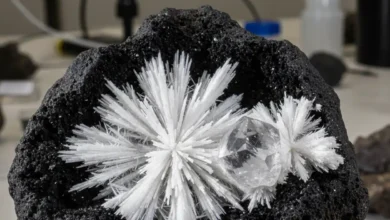


Creedite is an uncommon calcium-aluminum sulfate fluoride mineral that forms transparent blades, needles and radiating crystal sprays. Colorless and white Creedite occur at the Colorado type locality, while orange starburst clusters from Mexico transformed the species into one of the most recognizable modern mineral specimens.
Creedite at a Glance
| Property | Details |
|---|---|
| Mineral group or material type | Complex calcium-aluminum sulfate fluoride mineral |
| Composition | Ca₃Al₂(SO₄)(OH)₂F₈·2H₂O |
| Colors | Colorless, white, pale violet, purple and orange; generally colorless in transmitted light |
| Crystal system | Monoclinic |
| Habit | Short prismatic, bladed, acicular, radiating sprays, spherical aggregates, druses and granular masses |
| Luster | Vitreous |
| Transparency | Transparent to translucent |
| Mohs hardness | 4 |
| Cleavage | Perfect in one direction |
| Tenacity | Brittle |
| Common use | Mineral specimens, micromounts, locality collections and rare faceted collector stones |
| Main care concern | Fragile needles, perfect cleavage, hydrated structure, matrix instability and dust from fluoride-rich material |
A Mineral Named After a Place, Not a Belief
Creedite takes its name from the Creede quadrangle in Colorado. The type material came from the Colorado Fluorspar Company Mine at Wagon Wheel Gap, not from the town’s religious or philosophical meaning.
The spelling therefore carries no connection with a creed, doctrine or spiritual group. Any metaphysical interpretation developed after the mineral name was established.
Creedite was described scientifically in the early twentieth century from a fluorite-barite vein. The original material was colorless to white rather than the bright orange form now common in crystal shops.
What Is Creedite Made Of?
Creedite contains calcium, aluminum, sulfate, fluoride, hydroxyl and structural water. Its formula is more complex than that of visually similar minerals such as Fluorite or Calcite.
Fluorite has the simple formula CaF₂. Creedite contains fluoride but also incorporates aluminum polyhedra, sulfate groups, hydroxyl and water into a monoclinic crystal structure.
Calcite is CaCO₃ and reacts strongly with acids. Creedite lacks carbonate and belongs to a different chemical and structural category.
Gypsum is a hydrated calcium sulfate, so it shares calcium, sulfate and water with Creedite. It does not contain Creedite’s aluminum-fluoride framework and is much softer.
These distinctions matter because white blades from a fluorite mine can be mislabeled easily when the matrix has not been tested.
How Creedite Forms
Creedite is characteristic of fluorite-rich hydrothermal deposits. Hot fluids transport calcium, aluminum, fluorine and sulfate through fractures before depositing the mineral as conditions change.
The mineral commonly forms late in the sequence. It may coat earlier Barite, Fluorite or altered wall rock rather than crystallizing as the first vein mineral.
Open cavities allow radiating sprays to develop freely. Narrow fractures produce flattened blades, druses and embedded crystals.
Water content is built into the structure. This does not mean Creedite dissolves instantly, but it does make strong heat and steam inappropriate.
The mineral’s unusual chemistry requires a narrow set of conditions. Fluorine must remain available while sulfate, aluminum and calcium are also present in the correct proportions.
The Colorado Type Locality
Wagon Wheel Gap lies west of Creede in Mineral County, Colorado. The Colorado Fluorspar Company Mine worked a vein containing Fluorite, Barite, kaolinite and Creedite.
Type-locality crystals are generally colorless, white or pale. They may form blades, prisms or radiating groups rather than the orange spherical clusters familiar from Mexico.
A small authenticated type-locality specimen can hold more systematic value than a larger ordinary orange cluster. The mine label, collection history and specimen preparation therefore matter greatly.
Creedite also occurs at the Henderson Mine and several other western American localities. Henderson material may occur with Quartz and Rhodochrosite, adding a different association from the original fluorite-barite vein.
Santa Eulalia, Chihuahua
The Santa Eulalia mining district produced large Creedite crystals well before the famous Durango discoveries dominated the market.
Potosí Mine and related workings yielded transparent to pale-purple blades, radiating groups and crystals associated with Fluorite and ore minerals.
Santa Eulalia specimens often have a more open crystal architecture than dense orange Navidad spheres. Sharp colorless blades on purple Fluorite can be particularly attractive.
Precise mine attribution matters because material from different workings entered collections under the broad district name.
Navidad Mine, Durango
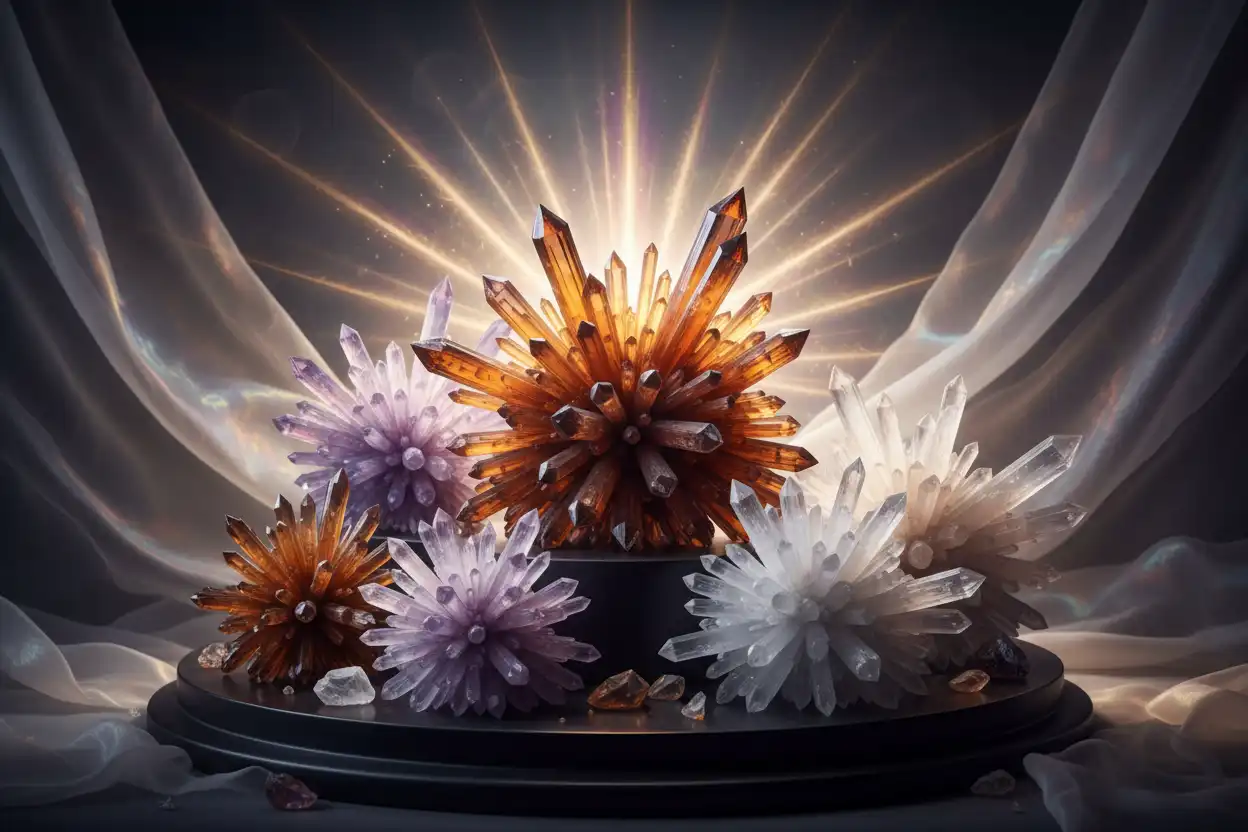
The Navidad Mine near Indé in Durango redefined commercial expectations for Creedite. Discoveries produced bright orange blades arranged into spherical, hemispherical and fan-shaped aggregates.
Individual blades can reach several centimeters. When dozens radiate from one center, the specimen resembles a sea urchin, pom-pom or starburst.
The orange appearance is commonly attributed to extremely fine iron-bearing inclusions or staining rather than a completely different Creedite composition. Thin edges may remain nearly colorless under transmitted light.
Some specimens grow on colorless or purple Fluorite. Others form nearly matrix-free clusters in which several spheres join into one sculptural group.
Navidad material ranges from delicate pale-orange sprays to deep orange-brown aggregates. Color intensity alone does not determine value because dark staining can hide luster and crystal definition.
The best pieces show separate sharp blades, open space between groups and complete spherical form without crushed edges.
Colquiri, Bolivia
Colquiri in Bolivia has produced exceptional Creedite crystals, including large transparent and pale-purple examples.
Bolivian material helped refine the understanding of Creedite’s crystal structure. It may appear as long blades or radiating groups rather than the compact orange spheres associated with Navidad.
Collectors value Colquiri specimens for both crystal size and classic locality status. Accurate provenance becomes essential because pale Creedite can resemble material from several other fluorite deposits.
Akshatau, Kazakhstan
Akshatau produced fine Creedite in a complex tungsten-molybdenum and hydrothermal mineral district. Specimens may be white, colorless, pale-violet or lightly stained.
Older Soviet-era labels can add historical value. Transliteration differences may cause the locality to appear under several spellings, so retaining original labels is preferable to rewriting them.
Fine Akshatau pieces are less common in general crystal shops than Mexican Creedite. They are more likely to appear through specialist mineral dealers and established collections.
Qinglong, China
Qinglong County in Guizhou has supplied Creedite, including orange-to-purple material. Some pieces show radiating clusters on contrasting matrix.
Chinese material can resemble Navidad Creedite in commercial photographs, particularly when the locality is reduced to “orange Creedite.”
The matrix, crystal shape and dealer documentation should therefore be examined rather than assuming every orange sphere comes from Mexico.
Creedite Crystal Shapes
Creedite crystals are prismatic, bladed or needle-like. Terminal faces can create pointed or chisel-like ends depending on the combination of forms.
Radiating sprays begin at a central growth point. As more blades develop, the aggregate becomes a fan, hemisphere or complete sphere.
Drusy Creedite forms a sparkling coating of small crystals. This material may show strong luster but less individual crystal definition.
Granular masses have limited display value unless they come from a rare locality. The species can be present chemically even when it lacks the starburst habit associated with collector pieces.
Crystals up to several centimeters are known, but length alone does not guarantee value. A long blade with a damaged termination may be less desirable than a smaller complete spray.
Creedite vs Fluorite
Fluorite commonly forms cubes or octahedrons and has perfect octahedral cleavage. Creedite forms monoclinic blades and has one principal perfect cleavage direction.
Both have hardness near 4, so scratch testing does not separate them reliably. They can also be transparent, colorless or purple.
Fluorite has a higher specific gravity and a much simpler calcium-fluoride composition. Creedite’s radiating sprays and sulfate-bearing chemistry provide the key distinction.
The types of Fluorite guide covers cubic, octahedral, color-zoned and rare-earth-bearing forms. Creedite should not be described as a Fluorite variety merely because it grows in Fluorite deposits.
Purple Fluorite commonly provides the matrix beneath colorless Creedite. The two minerals may create a naturally contrasting specimen rather than one mixed-color crystal.
Creedite vs Barite and Celestite
Barite can form pale blades and rosettes, but it is dramatically heavier because of barium. Creedite feels relatively light for its size.
Celestite commonly forms colorless or pale-blue blades. It is also denser than Creedite and has a different strontium sulfate composition.
All three minerals can occur in hydrothermal settings and share a vitreous luster. Crystal habit alone may not be enough when the specimen lacks matrix or locality information.
Laboratory testing avoids destructive hardness or acid experiments on fragile blades.
Creedite vs Cryolite
Cryolite is sodium aluminum fluoride, Na₃AlF₆. It shares aluminum and fluoride with Creedite but lacks calcium, sulfate and structural water.
Cryolite commonly occurs as massive white-to-colorless material rather than orange radiating starbursts. Its refractive index is so close to water that clear pieces can visually disappear when immersed, although immersion is unnecessary for identification.
The comparison illustrates why “fluoride mineral” is too broad to define Creedite. Several chemically unrelated species contain fluorine.
Creedite vs Clear Quartz
Small colorless Creedite blades can resemble Clear Quartz in a low-resolution photograph.
Quartz is much harder, lacks cleavage and commonly forms six-sided prisms with characteristic terminations. Creedite forms monoclinic blades and radiating sprays.
Quartz also has a different luster and density. When both minerals occur on one specimen, the Quartz generally provides sturdier transparent points while Creedite forms finer coatings or fans.
Is Creedite a Gemstone?
Transparent Creedite can technically be faceted. Its refractive indices and dispersion can produce an attractive collector stone.
Suitable rough is extremely limited. Most crystals are thin, cleaved, included or more valuable in their natural radiating form.
Hardness 4 is inadequate for routine jewelry, and perfect cleavage makes setting dangerous. A cutter can lose the entire stone when pressure reaches one unfavorable plane.
Faceted Creedite therefore belongs in a gem collection rather than a ring. Natural orange clusters and transparent blades dominate the market.
Creedite Price
Small colorless crystals, fragments and modest thumbnails commonly sell for approximately $20–$100.
Attractive orange Navidad clusters often range from $100 to $500. Complete hemispheres, visible individual blades and strong luster support the upper end.
Fine miniatures and cabinet pieces may sell for $500–$2,000. Large matrix-free spheres, Creedite on Fluorite and balanced multi-cluster compositions can exceed $2,000.
Current specialist market data show median prices above $1,000 for better examples, although this reflects a dealer and auction segment rather than every retail piece.
Historic Colorado, Santa Eulalia, Colquiri and Akshatau material may command locality premiums even when the color is less dramatic than Mexican orange Creedite.
What Determines Creedite Value?
Crystal completeness is crucial. A sphere with flattened or broken outer blades loses the crisp outline that defines the habit.
Luster should remain vitreous across the terminations. Orange staining can improve color but should not make the crystals dull or muddy.
Aggregate shape matters. A complete floater sphere generally receives more demand than half a sphere attached awkwardly to bulky matrix.
Associated Fluorite can add contrast when both minerals remain well formed. A broken Fluorite base with sparse Creedite may contribute weight without improving the specimen.
Color is important but not absolute. Transparent violet, colorless and type-locality material can be rarer than common orange Navidad clusters.
Provenance separates classic material from generic offerings. Original labels from Wagon Wheel Gap, Potosí, Colquiri or Akshatau should remain with the specimen.
Repairs and Specimen Preparation
Creedite blades break easily during mining, trimming and shipping. Repairs are therefore not unusual in larger display pieces.
A detached cluster may be reattached to its original matrix. The repair preserves appearance but should be disclosed because the joint can fail during wet cleaning or temperature change.
Some clusters are mounted permanently on acrylic bases. A base can improve stability, but excessive glue may obscure the natural contact.
Matrix trimming should create a secure specimen without cutting through the radiating crystals. Fresh saw marks close to the display surface may indicate aggressive preparation.
Orange enhancement through dye is possible but uncommon in reputable mineral dealing. Pigment concentrated in matrix cracks or glue deserves inspection.
The fake-crystal guide provides wider checks for glued clusters, coatings and reconstructed specimens.
How to Identify Creedite
A likely specimen combines vitreous transparent blades with radiating or spherical growth. Color can range from white to orange or purple.
Hardness is 4, but scratch testing will permanently damage the crystal. Perfect cleavage makes even an inconspicuous test risky.
Specific gravity lies near 2.72. Creedite feels much lighter than Barite and somewhat lighter than Fluorite.
Refractive indices are relatively low, approximately 1.46–1.49. These values help separate loose fragments but may be difficult to measure on narrow blades.
Raman spectroscopy and X-ray diffraction identify the species without needing a powdered streak. Elemental analysis can confirm calcium, aluminum, sulfur and fluorine.
Use the broader crystal identification guide for preliminary observation, then seek professional testing when the locality or species affects value.
Hardness, Cleavage and Display Risk
The gemstone hardness chart shows that Quartz dust, metal and many common minerals can scratch Creedite.
Perfect cleavage presents a greater threat than routine abrasion. The gemstone cleavage guide explains why a blade can split cleanly even when its surface looks unmarked.
Never lift a specimen by the orange sphere. Support the Fluorite or rock matrix beneath it.
Open Creedite clusters should not sit on a frequently used desk. A sleeve, cleaning cloth or hand movement can remove several crystals at once.
A covered display case prevents accidental touch and reduces cleaning frequency.
Water, Heat and Cleaning
Creedite is a hydrated mineral, but that fact does not mean it requires water. Soaking can reach cleavage cracks, repairs and unstable matrix.
The crystal water-safety guide should be applied conservatively. A brief accidental splash is different from immersion, baths or mineral-water preparation.
Begin cleaning with a hand air blower. Do not direct canned compressed air at the crystal sprays.
An extremely soft brush may be used on sturdy matrix areas, not across the blade tips.
Steam and ultrasonic cleaning are unsuitable. Heat can disturb hydrated minerals and adhesives, while vibration detaches delicate crystals.
Acids may damage associated Calcite, Fluorite alteration products and other matrix minerals even when the Creedite itself does not react visibly.
Handling Fluoride-Bearing Material
Fluoride in Creedite is bound within the mineral structure. An intact specimen is not equivalent to soluble fluoride chemicals.
Nevertheless, cutting, grinding or crushing creates mixed mineral dust containing calcium, aluminum, sulfate and fluoride-bearing particles.
Do not ingest Creedite or place it in drinking water. The toxic-crystals list explains why mineral formula alone does not justify elixir use.
Professional dust control is required for lapidary or analytical preparation. Most collectors should preserve the natural crystal rather than attempting to cut it.
Creedite Meaning and Symbolism
Orange Creedite spheres consist of many narrow crystals growing outward from one center. That geometry has encouraged modern interpretations connected with coordinated effort and several actions emerging from one underlying decision.
The colorless type-locality material provides a useful contrast with the orange commercial form. The same mineral can appear visually different when inclusions and growth conditions change.
These observations may support personal symbolism, but they are not measurable spiritual effects. Creedite does not increase motivation, repair relationships or alter fluoride levels in the body.
For color-based exploration, compare it with orange crystals, orange gemstones, purple crystals and purple gemstones.
Browse more species through crystals that start with C or continue through the Gemstone Guides collection.
Disclaimer: Do not ingest Creedite, place it in drinking water or generate fluoride-bearing mineral dust. Avoid grinding, drilling, steam, ultrasonic cleaning and prolonged soaking. Handle fragile crystal sprays by their matrix rather than the crystals.