Crocoite Meaning: Mineral Facts, History & Symbolism
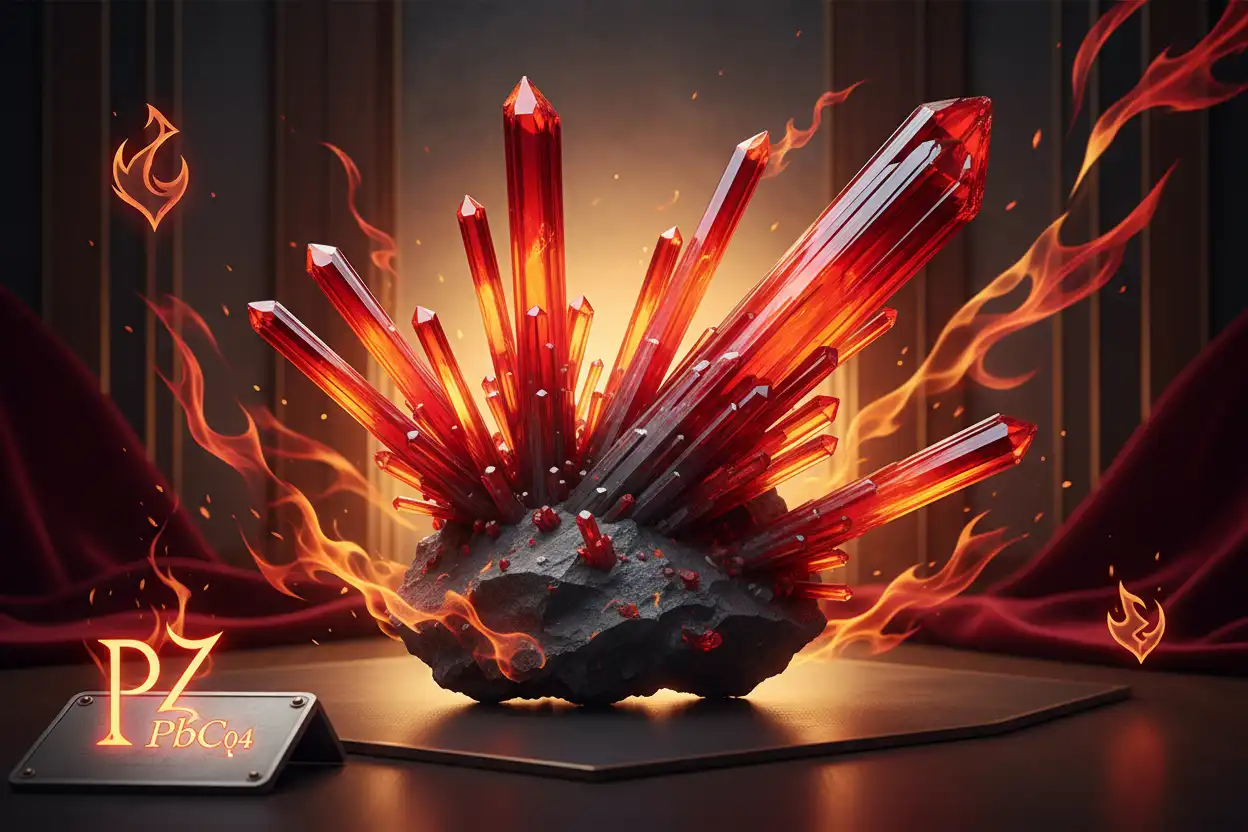
Crocoite meaning begins with a mineral whose intense orange-red color can look almost artificial even when the specimen is entirely natural. Crocoite is lead chromate, PbCrO₄, a distinct mineral species containing lead and chromium within a chromate structure. It crystallizes in the monoclinic system and commonly forms elongated prismatic, acicular, or bladed crystals whose vivid scarlet, orange-red, and yellow-orange colors make fine specimens immediately recognizable to experienced collectors. Despite that visual intensity, crocoite is relatively soft and mechanically delicate, so the spectacular crystals seen in collections are better understood as fragile mineral specimens than as conventional durable gemstones. Within Gems Lore’s Gemstone Guides, crocoite meaning is therefore built from mineral identity first, with historical associations and modern symbolism kept separate from measurable physical properties.
That separation matters more with crocoite than with many decorative minerals because its chemistry has direct implications for responsible ownership. Lead is an essential part of the mineral’s composition, and the chromate group contains chromium in the hexavalent oxidation state. Those facts do not mean that an intact display specimen is automatically dangerous to have in a collection, but they do mean that crocoite should not be licked, ingested, powdered for rituals, used in drinking-water preparations, or casually cut and ground without suitable controls. A responsible discussion of crocoite meaning can preserve its symbolism while treating the specimen as the lead-bearing mineral that it actually is.
Crocoite at a Glance
| Property | Practical reference |
|---|---|
| Material identity | Lead chromate mineral |
| Formula | PbCrO₄ |
| Mineral class | Chromate |
| Crystal system | Monoclinic |
| Typical color | Orange, orange-red, scarlet, vermilion-red, yellow-orange |
| Common habit | Elongated prismatic, acicular, bladed and clustered crystals |
| Transparency | Transparent to translucent in suitable crystals |
| Luster | Adamantine to resinous or vitreous |
| Mohs hardness | About 2.5–3 |
| Specific gravity | Approximately 6, giving compact material substantial heft |
| Cleavage | Present and contributes to mechanical fragility |
| Important chemistry | Contains lead and hexavalent chromium as structural components |
| Typical formation | Secondary mineral in oxidized portions of lead-bearing ore deposits where chromium is available |
| Primary collector concern | Fragile crystals plus lead/chromate exposure if dust or soluble material is generated |
| Symbolic status | Modern meanings are interpretations rather than scientifically demonstrated effects |
These properties provide the essential foundation for crocoite meaning. Brilliant color does not make crocoite a variety of ruby, carnelian, cinnabar, or orange quartz, while its elongated crystal form does not make it a member of the quartz family. Chemistry, structure, density, softness, and geological context distinguish it from those superficially similar materials.
What Crocoite Actually Is
Crocoite is a lead chromate mineral whose formula, PbCrO₄, describes lead cations associated with chromate groups in a monoclinic crystal structure. The mineral’s chemistry is unusually important to its identity because both lead and chromium contribute to the physical and optical characteristics that distinguish crocoite from more common orange and red minerals. It is not merely a chromium-colored variety of another species, nor is the lead present as an accidental contaminant; both elements are fundamental components of the mineral.
Fine crystals can be slender and elongated, sometimes forming radiating sprays or dense groups that project dramatically from matrix. Other specimens occur as crusts, granular material, small prismatic crystals, or coatings. Long undamaged prisms are especially visually striking because their strong color, translucency, and bright luster create an appearance far more gem-like than the mineral’s softness would suggest.
Crocoite meaning should therefore begin with the tension between appearance and physical reality. A crystal may look fiery, sharp, and exceptionally robust in a photograph while actually being soft enough to scratch easily and delicate enough that careless handling can break terminations or loosen crystals from matrix.
How Crocoite Forms
Crocoite usually develops as a secondary mineral in the oxidized portions of lead-bearing ore deposits where chromium is also available. Earlier lead minerals can weather and release lead into circulating fluids, while chromium-bearing rocks or minerals provide chromate under suitable oxidizing conditions. When those chemical components meet within fractures, cavities, or altered ore zones, lead chromate can precipitate as crocoite.
This makes crocoite a useful example of how weathering can create minerals that did not exist during the original high-temperature or hydrothermal stage of an ore deposit. The mineral may form long after earlier sulfides and other primary phases, occupying open spaces created or modified by alteration. Its position on matrix can therefore record a late stage in the evolving chemistry of the deposit.
The detailed deposit-level story belongs in crocoite formation and deposit geology, where lead sources, chromium availability, oxidation, fluid movement, and associated minerals can be considered more fully. For crocoite meaning, the important point is that its vivid crystals are products of specific geochemical conditions rather than visual symbols made physically real by the mineral.
Why Crocoite Is So Intensely Orange and Red
The remarkable color central to crocoite meaning arises from the chromate component of the mineral and the way its electronic structure interacts with visible light. Crocoite can range from yellow-orange through vivid orange-red to deep scarlet, with thicker crystals often appearing darker than thin translucent edges. Light passing through a slender crystal can produce an almost glowing appearance without the mineral emitting its own light.
Surface condition also affects color. Fresh, clean crystal faces may display strong brilliance, while abrasion, coatings, dust, alteration, or microscopic damage can dull the appearance. Crystal orientation and lighting change the balance between red, orange, and yellow reflections, which means two photographs of the same specimen can look surprisingly different without any change to the mineral itself.
The specialist crocoite optical properties and color behavior guide addresses those interactions in greater depth. A careful crocoite meaning reference only needs the central boundary: vivid natural color is a real optical property, but brightness, saturation, and apparent glow in photography do not provide evidence of supernatural energy.
Diagnostic Traits
Several features work together to support a crocoite identification. Its intense orange-red color is highly suggestive, particularly when combined with elongated monoclinic prisms, high density, relatively low hardness, translucent crystal edges, and an appropriate oxidized lead-ore context. The luster can be notably bright and may approach adamantine on good crystal faces.
Density provides a useful conceptual clue because lead-rich crocoite is heavy for its volume. A compact specimen can feel much denser than quartz or calcite of similar size, although matrix, cavities, and delicate crystal geometry make subjective heft unreliable as a standalone test. Hardness likewise distinguishes crocoite from quartz-family materials, but intentionally scratching a collectible crystal is unnecessary and permanently damaging.
Magnification can reveal surface striations, cleavage-related breaks, growth features, inclusions, coatings, dust, tiny associated minerals, and repaired crystal contacts. The dedicated crocoite microscope and inclusion notebook is the better place for detailed microscopic interpretation because crocoite meaning should not become a full laboratory-identification manual.
An Original Crocoite Specimen and Photo Checklist
A useful crocoite meaning page should give collectors a repeatable way to examine what they actually have. Begin with the complete specimen and record whether the orange-red material occurs as isolated prisms, clustered sprays, crusts, broken crystals, granular zones, or small crystals lining cavities. Note how those crystals attach to matrix and whether other visible minerals appear to predate or postdate the crocoite. Geological relationships are often more informative than an isolated color swatch.
Next, examine crystal geometry without touching delicate terminations unnecessarily. Natural crocoite crystals frequently show variations in thickness, length, termination quality, growth interruption, and contact with neighboring crystals. A good specimen does not need every point to be perfect. Broken ends, partial contacts, and crystals that grew against matrix are ordinary geological features rather than automatic signs of low authenticity.
Then compare color under neutral diffuse lighting. Photograph the specimen against a plain neutral background and avoid pushing saturation until orange areas become neon red. Thin crystal edges may transmit more yellow-orange light, while thicker portions can appear scarlet or dark red. If the same specimen changes dramatically between images, first examine lighting and camera processing before inventing a mineralogical explanation.
Look closely at existing damaged areas rather than creating new ones. A natural broken surface can reveal internal color, fracture character, and whether a suspicious coating is only superficial. No collector needs to snap a crystal to establish crocoite meaning or identity. The preservation cost is far greater than the information gained.
Finally, record which claims remain unproven. Photographs may support crocoite-like color, habit, matrix relationships, visible condition, and approximate scale. They cannot independently establish chemical purity, precise lead or chromium concentration, exact locality, treatment history, or every associated mineral. Stronger claims require analytical evidence or credible provenance.
Disputed Names and Unsupported Claims
| Name or claim | What it can reasonably mean | What it does not establish |
|---|---|---|
| Crocoite | The mineral species PbCrO₄ | A specific mine or locality without provenance |
| Red lead ore | Historical/descriptive language associated with lead chromate material | A modern species identification without context |
| Tasmanian crocoite | A provenance claim referring to material from Tasmania | Origin based only on red color or long crystals |
| “Fire crystal” | Modern descriptive or metaphysical language | A separate mineral variety |
| “Manifestation stone” | Personal symbolic interpretation | Scientifically demonstrated influence over external events |
| “Vitality crystal” | Symbolic association with intense color | Medical stimulation or improved health |
| “Energy activator” | Modern metaphysical terminology | Measurable biological or spiritual energy transfer |
| “Healing crocoite” | Crystal-healing language | Proven therapeutic action |
This reconciliation is important because crocoite meaning is often expanded through adjectives that sound mineralogical but are actually commercial or spiritual. A trade phrase can be useful for describing appearance, but it should not quietly become a claim about chemistry, provenance, rarity, or medical action.
Crocoite and Cinnabar Are Not the Same Red Mineral
Crocoite’s scarlet coloration can invite comparison with other vividly colored mineral species, yet chemistry separates them decisively. Cinnabar is mercury sulfide, HgS, whereas crocoite is lead chromate, PbCrO₄. Both contain potentially hazardous elements and both can produce striking red specimens, but they have different structures, geological environments, optical behavior, densities, and exposure considerations.
The comparison demonstrates why color should never carry the full burden of identification. Two minerals can occupy overlapping parts of the visual spectrum while representing completely different chemical systems.
That principle extends beyond red minerals. Crazy Lace Agate can display orange and red silica bands but is a much harder microcrystalline silica material, while crocoite remains a soft, dense lead chromate crystal.
Crocoite Compared With Creedite and Cryolite
Creedite is sometimes visually compared with crocoite because both can form striking elongated crystal clusters. Creedite, however, is a hydrous calcium-aluminum sulfate-fluoride-hydroxide mineral and is commonly colorless, pale violet, purple, cream, or orange rather than characteristically scarlet lead chromate. Similar crystal silhouette does not imply chemical relationship.
Cryolite differs even more fundamentally. It is a sodium-aluminum fluoride mineral known historically for its unusual optical appearance and industrial significance, not a chromate mineral. These comparisons clarify crocoite meaning by showing that color, habit, locality fame, and collector appeal are secondary to material identity.
Cubic zirconia provides another useful boundary because it is generally encountered as a manufactured zirconium dioxide gem material rather than a naturally occurring lead-chromate specimen. Crocoite belongs primarily to mineral collections, whereas cubic zirconia belongs primarily to jewelry and synthetic gemology.
Documented History of Crocoite
The documented history behind crocoite meaning is closely tied to mineral science and the study of chromium. Crocoite specimens from lead deposits attracted scientific attention because their striking red material contained an unusual chemical component that eventually contributed to the recognition of chromium as an element. That connection gives crocoite a genuine place in the history of chemistry as well as mineralogy.
Older mineralogical descriptions used names related to the mineral’s red coloration and lead content before modern classification stabilized the name crocoite. The modern name is linked linguistically with saffron-like coloration, reflecting the orange-to-red appearance rather than a spiritual doctrine.
This documented scientific history is substantially stronger than claims that crocoite was universally used as an ancient chakra stone or manifestation mineral. Modern crocoite meaning can include symbolic practice, but it should not invent antiquity for a tradition when the evidence instead points toward mineralogical and chemical history.
Crocoite Meaning in Modern Symbolism
Modern crocoite meaning commonly emphasizes vitality, creativity, motivation, confidence, transformation, passion, and willingness to act. The symbolism is easy to understand visually because crocoite’s saturated orange-red color resembles fire, heat, movement, and biological vitality in many modern cultural associations. Some practitioners also place crocoite within sacral- or root-chakra systems or use it as a focus object during meditation and goal setting.
Those practices are interpretive rather than experimentally demonstrated. Crocoite does not scientifically increase metabolism, enhance fertility, treat fatigue, improve circulation, stimulate sexual function, remove depression, heal trauma, or force creative inspiration. Its lead and chromium content make literal wellness narratives particularly inappropriate because the mineral’s chemistry should be treated with respect rather than reframed as a nutritional or medicinal advantage.
A grounded approach to crocoite meaning can preserve the symbolism. Someone might use the mineral’s strong color as a visual reminder to move from planning into action, schedule a creative task, or confront a delayed decision. The practical result comes from deliberate behavior prompted by the object, not from a biologically active energy transmitted by lead chromate.
Crocoite Meaning and the Symbolism of Fire
Fire imagery appears frequently in crocoite meaning because the crystals can look like frozen flames, especially when long orange-red prisms rise from dark matrix. As symbolism, this can represent motivation, transformation, intensity, courage, or creative momentum. Such metaphors can be useful precisely because they are metaphors.
The mineral is not actually hot, does not emit a flame-like field, and does not generate psychological energy simply because its color resembles fire. A collector can appreciate that visual connection without converting resemblance into mechanism.
This distinction keeps crocoite meaning reader-facing and useful. Symbolic language can describe what the specimen evokes while mineralogical language explains what the specimen does physically.
Lead and Chromium Require a Clear Safety Boundary
Crocoite contains lead as an essential structural element, so a responsible crocoite meaning article cannot describe the mineral as chemically harmless. It also contains chromate, in which chromium is present in the hexavalent oxidation state. The practical question is exposure route rather than panic: an intact specimen sitting undisturbed in a display case creates a different situation from grinding the mineral into airborne dust or dissolving material into liquid.
Avoid putting crocoite in the mouth, licking it, allowing children or pets unrestricted access to loose specimens, or using it in direct-contact drinking-water rituals. Wash hands after handling, particularly before eating, and consider minimizing direct contact with delicate or dusty material. Storage that prevents breakage also reduces the chance of producing loose particles.
Cutting, sanding, drilling, crushing, or grinding deserves substantially stronger controls because those activities can generate lead- and chromate-bearing dust. Detailed workshop considerations belong with crocoite cutting, orientation, and polish, but casual dry processing is not an appropriate experiment.
Why Crocoite Is a Poor Candidate for Everyday Jewelry
Crocoite meaning is sometimes paired with advice to wear the mineral continuously, yet its physical properties make that recommendation impractical. Hardness around 2.5–3 means exposed surfaces scratch easily, while cleavage and elongated crystal habit make natural prisms vulnerable to breakage. The chemistry further reduces the appeal of exposing fragile crocoite repeatedly to skin oils, sweat, abrasion, impact, and eventual repair work.
Collector jewelry can theoretically protect small specimens or encapsulated material, but that is very different from treating crocoite like quartz, sapphire, or another conventional daily-wear gemstone. The specialist crocoite setting and wear engineering guide addresses those mechanical constraints more appropriately.
For most high-quality specimens, preservation in a stable display environment makes better sense than trying to turn delicate crystals into wearable objects.
Conservation Matters Because the Best Crystals Are Fragile
Fine crocoite crystals can be exceptionally delicate. Long prisms may detach from matrix after impact, pressure, vibration, or poor packaging, while crystal faces can scratch against harder minerals during storage. The same surface brilliance that gives crocoite its appeal is difficult to restore once damaged.
Cleaning should therefore be conservative. Aggressive brushing, ultrasonic cleaning, strong chemicals, abrasion, and experimental acid treatments are inappropriate default choices for a lead chromate specimen. Dust prevention through enclosed display is generally preferable to repeatedly cleaning fragile crystal groups.
A crocoite specimen conservation record can document broken terminations, detached crystals, previous repairs, labels, cleaning history, coatings, and changes in condition. Maintaining such a record is particularly valuable when a specimen has important locality or collection history.
Provenance Can Be a Major Part of Collector Value
Certain localities are especially famous for exceptional crocoite, and locality can materially affect collector interest. Tasmania is strongly associated with world-class crocoite specimens, particularly long brilliant crystals from historically productive lead-mining districts. Yet a spectacular red crystal cannot prove Tasmanian origin by appearance alone.
Long prisms, dark matrix, vivid color, or similarity to published specimens can make a locality claim plausible, but provenance requires evidence. Old collection labels, mine tags, dealer records, acquisition notes, institutional documentation, and traceable ownership history are more persuasive than pattern matching.
The crocoite provenance disclosure checklist provides the appropriate framework for distinguishing documented origin from “looks Tasmanian.” Crocoite meaning and collector history are stronger when the provenance level is stated plainly rather than upgraded through confidence alone.
What a Photograph Can and Cannot Prove
A high-quality photograph can show many characteristics relevant to crocoite meaning: vivid orange-red color, crystal habit, matrix relationships, apparent luster, damage, dust, repairs visible at the surface, and relative dimensions when a scale is provided. Multiple angles can also show whether crystals radiate naturally from the matrix and whether unusual colors remain consistent under different lighting.
A photograph cannot directly measure chemical composition, specific gravity, hardness, or crystallographic structure. It cannot verify an exact mine, confirm that every red crystal is crocoite, establish the absence of coatings, or determine the concentration of lead and chromium in a mixed specimen.
This boundary is useful because visually spectacular crocoite is particularly vulnerable to overconfident online identification. The stronger the financial, scientific, or provenance claim, the stronger the supporting evidence should be.
Frequently Asked Questions About Crocoite Meaning
What is crocoite?
Crocoite is a lead chromate mineral with the formula PbCrO₄. It commonly forms brilliant orange-red to scarlet elongated crystals in oxidized portions of lead-bearing mineral deposits where chromium is available.
What does crocoite mean spiritually?
Modern crocoite meaning commonly includes creativity, vitality, motivation, transformation, confidence, and passionate action. These are symbolic interpretations rather than scientifically demonstrated properties of lead chromate.
Why is crocoite so red?
Crocoite’s orange-red and scarlet colors arise from the chromate component of its crystal structure and the way the material interacts with visible light. Crystal thickness, orientation, surface condition, and lighting can change the apparent shade.
Is crocoite a gemstone?
Crocoite is primarily a collector mineral rather than a conventional jewelry gemstone. It can be visually spectacular, but its low hardness, cleavage, fragile crystal habit, and lead-chromate chemistry make everyday wear impractical.
Does crocoite contain lead?
Yes. Lead is an essential part of crocoite’s composition, PbCrO₄. Responsible ownership therefore includes avoiding ingestion, minimizing unnecessary dust exposure, washing hands after handling, and preventing access by children or pets.
Does crocoite contain hexavalent chromium?
The chromium in the chromate group of crocoite is in the hexavalent oxidation state. This is an important reason to avoid generating dust, ingesting the mineral, heating it unnecessarily, or using it in direct-contact elixirs.
Is crocoite safe to keep in a mineral collection?
An intact, stable specimen can be kept responsibly when sensible handling and storage practices are followed. Exposure concerns become substantially greater when material is powdered, ground, cut, heated, ingested, or otherwise converted into a form that increases contact.
Can crocoite go in water?
Crocoite should not be used in drinking-water preparations or direct-contact crystal elixirs. Its lead chromate composition makes intentional ingestion or dissolution an unnecessary exposure route.
Is crocoite the same as cinnabar?
No. Crocoite is lead chromate, PbCrO₄, whereas cinnabar is mercury sulfide, HgS. Their red coloration may overlap visually, but their chemistry, crystallography, geological occurrence, and safety considerations differ.
Is crocoite rare?
Crocoite is not uniformly rare as a mineral species, but fine specimens with long, brilliant, undamaged crystals can be highly desirable and much less common than small, broken, granular, or low-quality material. Locality and provenance can add substantial collector significance.
Can crocoite be worn as jewelry?
Crocoite is generally a poor choice for routine exposed jewelry because it is soft, cleavage-prone, mechanically delicate, and lead-bearing. Protected collector designs are possible, but preservation is usually a better priority for fine crystals.
How can I tell whether a crocoite specimen is genuine?
Look for several consistent features, including orange-red to scarlet color, elongated monoclinic crystal habit, strong luster, high relative density, low hardness, appropriate matrix, and geological context. Valuable or ambiguous specimens may require analytical confirmation rather than destructive home tests.
What Crocoite Meaning Can Responsibly Mean
Crocoite meaning becomes more useful when mineral science, historical evidence, symbolism, and personal practice remain distinct. Mineralogically, crocoite is PbCrO₄: a soft, dense, brightly colored lead chromate mineral whose chemistry, crystal system, formation environment, optical behavior, and physical limitations can be investigated. Historically, it has genuine significance within mineralogy and chemistry because lead-chromate material contributed to scientific understanding of chromium. Those documented facts provide a stronger foundation than unsupported claims of one universal ancient crocoite tradition.
Modern crocoite meaning can still be personally valuable. The stone’s fiery color and radiating elongated crystals may symbolize creativity, action, intensity, courage, or transformation, and those associations can be incorporated into journaling or reflective practices. They should not be converted into claims that crocoite treats illness, improves circulation, increases fertility, stimulates metabolism, removes toxins, or emits a medically active energy field.
Responsible crocoite meaning also includes responsible ownership. The mineral’s lead and chromate chemistry deserves respect, particularly when dust or soluble exposure could be created, while its fragile crystals deserve careful conservation simply because fine natural specimens are difficult to replace. Crocoite does not need healing claims to be extraordinary; its chemistry, color, mineral history, geological formation, and collector importance provide more than enough substance.
Gems Lore explains its broader authorship and site context on the About page, while the Disclaimer clarifies the limits of mineral, symbolic, health, safety, and identification information. Questions, factual corrections, or supporting documentation relevant to a particular crocoite specimen can be submitted through Contact, especially when exact identity, provenance, treatment, or safe handling cannot be resolved from photographs alone.