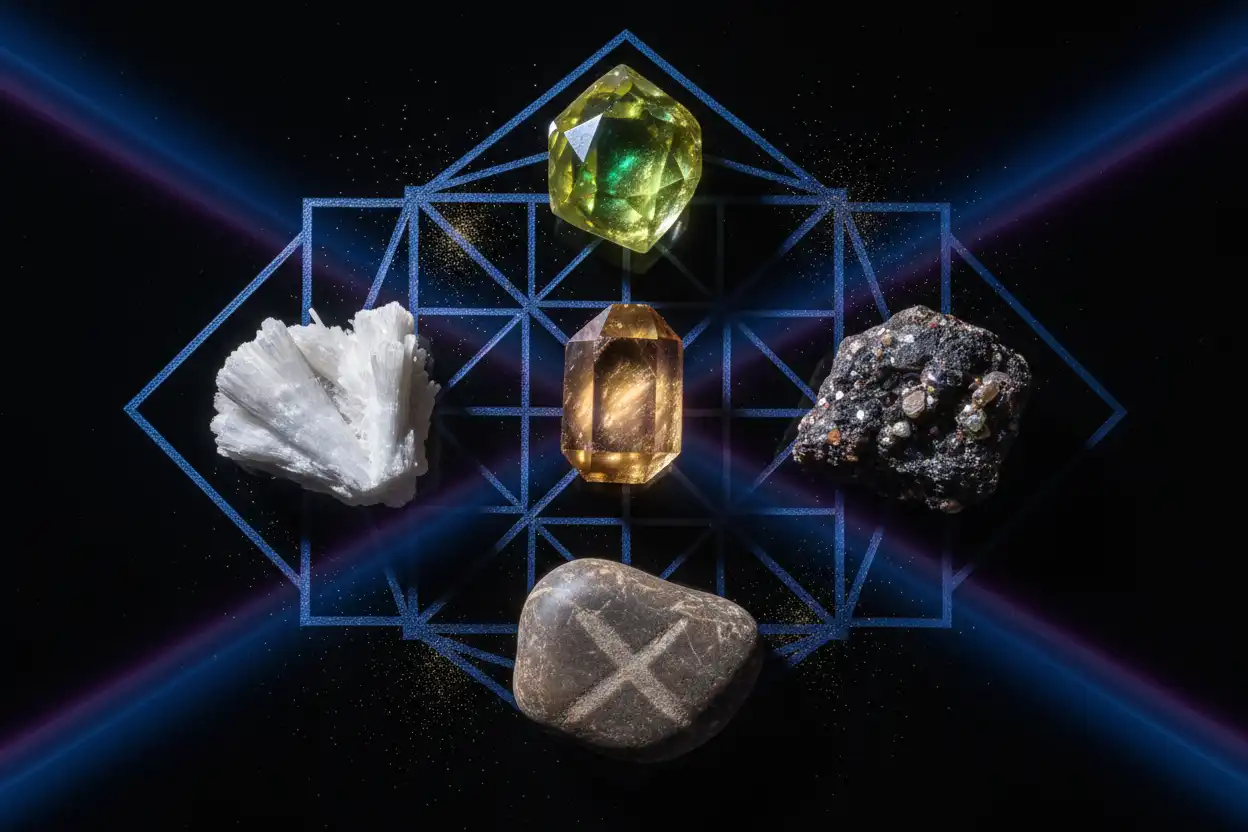
Crystals That Start With X: Names and Meanings
Crystals and gem materials that start with X include xanthoconite, xenotime, xonotlite and xylopal.
X is one of the shortest letters in the crystal alphabet. Its entries include an arsenic-bearing silver mineral, a rare-earth phosphate, a fibrous calcium silicate and opalized wood.
The meanings below are traditional symbolic interpretations rather than scientifically proven medical effects.
Continue from Crystals That Start With W.
X Crystals at a Glance
| Crystal or material | Typical appearance | Traditional symbolic meaning |
|---|---|---|
| Xanthoconite | Yellow, orange or red microscopic crystals | Awareness and caution |
| Xenotime | Brown, yellow, reddish or gray crystals | Independence and precision |
| Xonotlite | White, gray or pale fibrous aggregates | Structure and patience |
| Xylopal | Wood-grain material replaced by opal | Transformation and continuity |
Xanthoconite
Xanthoconite is a rare silver arsenic sulfide mineral with the formula Ag₃AsS₃.
It commonly occurs as:
- Yellow crystals.
- Orange crystals.
- Reddish-orange grains.
- Tiny translucent crystals.
- Mineral coatings associated with silver deposits.
Its crystals are often small, making xanthoconite primarily a specialist collector mineral rather than a jewelry material. Mineralogical data identifies it as a silver-arsenic sulfide and records orange examples occurring with related silver minerals.
Xanthoconite is traditionally associated with:
- Awareness.
- Caution.
- Recognizing consequences.
- Careful observation.
- Respecting personal limits.
Because it contains arsenic, avoid grinding, heating, licking, soaking or creating dust. Store it in a sealed, labeled specimen container.
Xenotime
The name xenotime commonly refers to xenotime-(Y), an yttrium phosphate mineral that may also contain minor heavy rare-earth elements, uranium and thorium.
Its colors include:
- Yellowish brown.
- Reddish brown.
- Wine yellow.
- Pale green.
- Gray.
- Gray-white.
Xenotime-(Y) is a brittle tetragonal mineral with a Mohs hardness of approximately 4 to 5.
It is traditionally associated with:
- Independence.
- Precision.
- Patience.
- Analytical thinking.
- Recognizing small but important details.
Some specimens may contain radioactive trace elements. Their actual activity depends on composition and locality, so unknown pieces should not be kept beside beds, carried continuously or altered without proper testing.
Xonotlite
Xonotlite is a calcium silicate hydroxide mineral.
It may appear:
- White.
- Gray.
- Pale pink.
- Colorless.
- Fibrous.
- Needle-like.
- As radiating or compact aggregates.
Its crystal structure is based on calcium, silicon, oxygen and hydroxyl components.
Xonotlite is traditionally associated with:
- Structure.
- Patience.
- Practical organization.
- Stability.
- Building progress gradually.
Fine fibrous formations can be delicate. Avoid bending, crushing or dry-brushing material that may release dust.
Xonotlite is mainly collected as a mineral specimen and is not a common mainstream jewelry stone.
Xylopal
Xylopal is an older gem and lapidary term for wood that has become opalized.
It may preserve:
- Wood grain.
- Growth rings.
- Bark textures.
- Cellular structures.
- Branch or trunk shapes.
The original organic material is partly or extensively replaced by opal or other silica. Xylopal is therefore a form of petrified or opalized wood rather than one mineral crystal.
It is traditionally associated with:
- Transformation.
- Continuity.
- Patience.
- Respect for history.
- Recognizing gradual change.
Its colors may include white, cream, brown, yellow, red, gray and black. Some pieces display play-of-color, while others are valued mainly for preserved wood patterns.
Xylopal belongs among the fossil and organic-origin materials described in the guide to types of gemstones.
Minerals, Fossils and Collector Materials
The four X entries belong to different categories:
- Xanthoconite is a silver-arsenic sulfide mineral.
- Xenotime is a rare-earth phosphate mineral.
- Xonotlite is a calcium silicate mineral.
- Xylopal is fossil wood replaced by opaline silica.
Only xylopal is commonly fashioned into decorative lapidary pieces. The other three are mainly mineral specimens.
Which X Materials Are Suitable for Jewelry?
Xylopal is the most practical X material for:
- Pendants.
- Cabochons.
- Inlay.
- Beads.
- Decorative carvings.
Xenotime may occasionally be faceted, but its rarity, brittleness and possible radioactive trace elements make it a specialist collector material.
Xanthoconite is unsuitable for ordinary jewelry because of its arsenic content and tiny crystal habit. Xonotlite is generally too fibrous or delicate for exposed wear.
Explore the limited jewelry options in Gemstones That Start With X.
Identification and Safety
- Keep xanthoconite in a sealed container and prevent dust.
- Do not heat or chemically test arsenic-bearing specimens at home.
- Consider professional radiation screening for substantial or unusually rich xenotime specimens.
- Avoid crushing or brushing fibrous xonotlite.
- Protect xylopal from hard impacts and rapid environmental changes.
- Do not use any unknown X mineral in drinking water or skincare preparations.
- Record locality and seller information for rare collector specimens.
The toxic crystals safety list explains why mineral composition matters more than a stone’s commercial or spiritual name.
When visual features are inconclusive, use the non-destructive observations in How to Identify Crystals before considering laboratory analysis.
Frequently Asked Questions
What is the most popular crystal that starts with X?
Xylopal is the most accessible lapidary material. Xenotime is better known among rare-mineral collectors.
Is xanthoconite safe to touch?
It contains arsenic. Handle it minimally, avoid dust and ingestion, and wash your hands after accidental contact.
Is xenotime radioactive?
Some xenotime specimens contain uranium or thorium. The degree of radioactivity varies and cannot be determined reliably from appearance.
Is xonotlite a crystal?
Yes. Xonotlite is a recognized calcium silicate mineral, although it often occurs in fibrous aggregates rather than large transparent crystals.
Is xylopal the same as petrified wood?
Xylopal is a type of petrified wood in which opal is a major replacement material. Other petrified wood may be replaced mainly by chalcedony or quartz.
Can xylopal display rainbow colors?
Some opalized wood contains precious opal and displays play-of-color. Other pieces show only body color and preserved wood structure.
Are X crystals suitable for beginners?
Xylopal can be a manageable lapidary material. Xanthoconite and some xenotime specimens require more advanced safety precautions.
Continue Exploring
Continue with Crystals That Start With Y, or browse crystal directories and identification guides in the Crystals 101 collection.