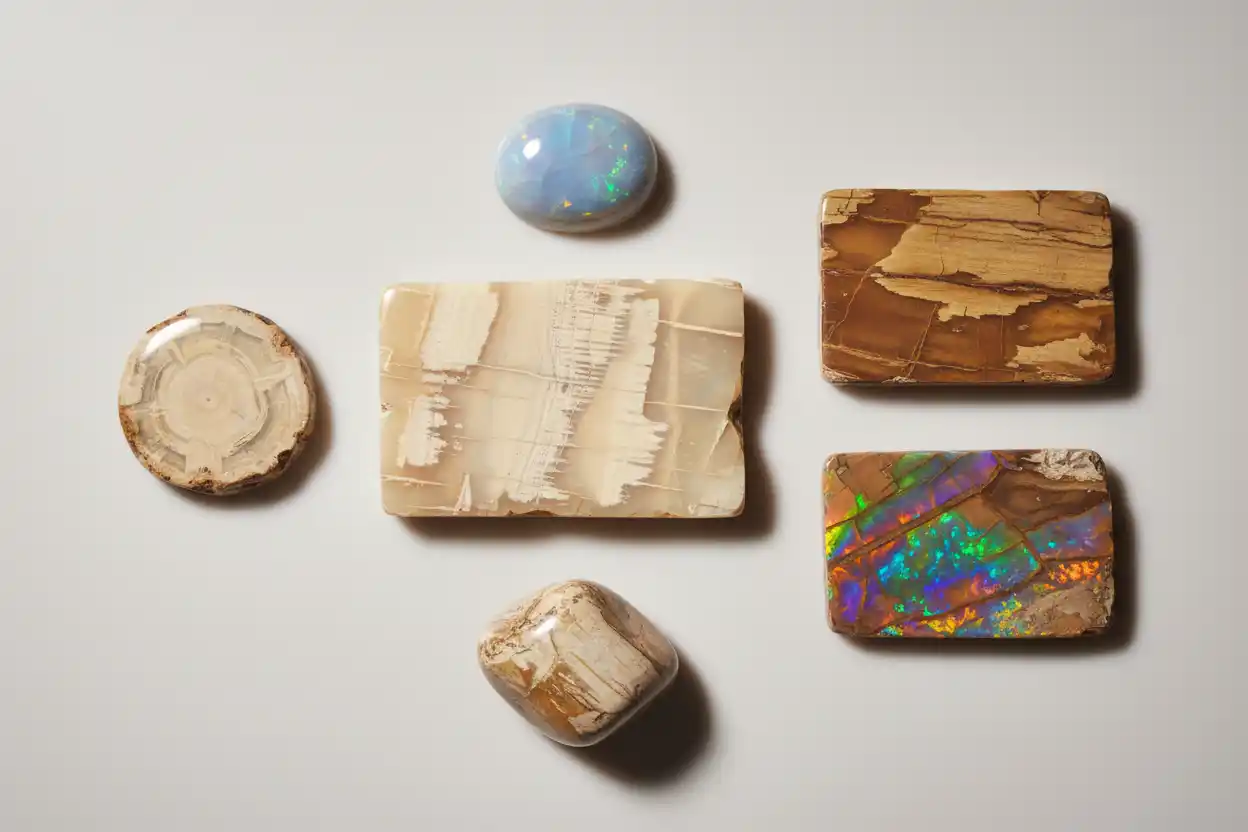
Xylopal Meaning, Properties, Value and Identification
Xylopal is wood that has become mineralized principally by opal while retaining recognizable botanical structure. Also called wood opal or opalized wood, it may preserve growth rings, vessels, tracheids, bark textures and cellular patterns while replacing most or all of the original organic material with hydrated silica.
The term identifies both a fossil origin and an opaline mineral composition. Therefore, xylopal overlaps the subjects of petrified wood and opal without being identical to every example of either material.
Xylopal at a Glance
| Property | Xylopal |
|---|---|
| Material type | Opalized fossil wood |
| Dominant composition | Hydrated silica, SiO₂·nH₂O |
| Possible additional phases | Opal-CT, chalcedony, quartz, cristobalite, tridymite, iron oxides, carbon and clay |
| Mineral classification | Opal-dominant mineraloid replacing or filling fossil wood |
| Typical colors | Cream, white, tan, brown, black, gray, red, orange, yellow, green and blue |
| Optical appearance | Common opal sheen or, rarely, precious play-of-color |
| Crystal system | None for opal; the fossil material may contain later crystalline silica |
| Luster | Waxy, vitreous or resinous after polishing |
| Transparency | Opaque to translucent |
| Refractive index | Commonly approximately 1.37–1.47 when opal-dominant |
| Specific gravity | Commonly about 1.9–2.2, but higher in quartz-rich or mineralized material |
| Mohs hardness | Usually about 5–6.5; harder where chalcedony or quartz is abundant |
| Cleavage | None in opal, although fractures may follow wood structure or mineral boundaries |
| Tenacity | Brittle |
| Common cuts | Cabochons, slabs, pendants, carvings, beads, bookends and display specimens |
| Main care concern | Variable porosity, crazing risk, natural fractures and sensitivity to heat or drying |
What Is Xylopal?
Xylopal is a traditional term for petrified wood in which opal forms the dominant mineralizing material.
The name combines a root meaning wood with opal. Wood opal, opalized wood and opalized petrified wood are its most common synonyms.
Xylopal is not one formally defined opal species. Instead, it describes a fossil and lapidary material whose original biological structure has been preserved by opaline silica.
Some pieces consist largely of common opal without play-of-color. Rare examples contain precious opal that flashes blue, green, orange or red.
The material belongs to the organic and fossil-gem category within the types of gemstones guide, even though almost none of the original wood may remain.
Is All Petrified Wood Xylopal?
No. Petrified wood can be mineralized by opal, chalcedony, quartz, calcite, pyrite and several less common minerals.
Xylopal specifically emphasizes opal as the dominant replacement or pore-filling phase. Agatized wood contains substantial chalcedony, while jasperized wood contains opaque microcrystalline quartz enriched by iron or other coloring material.
Many specimens contain more than one silica phase. Opal may fill original cells first and then reorganize partly into cristobalite, tridymite, chalcedony or quartz over geological time.
Consequently, a dealer may use opalized, agatized and silicified wood for overlapping materials. Laboratory analysis provides the strongest distinction when precise composition matters.
Xylopal, Wood Opal and Opalite
Wood opal and opalized wood are legitimate descriptive synonyms for xylopal.
“Opalite,” however, creates confusion. In modern retail markets, opalite usually means manufactured glass with a blue-white glow rather than natural opalized wood.
A product called opalite wood may therefore be natural xylopal, resin-treated fossil wood or an entirely manufactured material. The seller should state the underlying composition clearly.
“Lithoxyle” or “lithoxyl” is an older term for petrified wood. It does not necessarily mean that opal dominates the replacement mineral.
Common and Precious Xylopal
Common Xylopal
Most xylopal consists of common opal without spectral play-of-color. It may display a soft internal haze, waxy translucence or striking wood-grain patterns.
Common material is far more abundant than precious opalized wood. Its value depends on botanical detail, color, polish, size and locality.
Precious Xylopal
Precious xylopal contains ordered silica structures that diffract light and produce play-of-color.
The flashes may follow cell walls, fractures, pores or broad opal-filled areas. Red play-of-color is particularly desirable, although brightness and pattern matter more than the presence of one color alone.
Fine precious wood opal is rare. It can combine fossil anatomy with the optical properties described in the types of opal guide.
Blue Xylopal
Blue opalized wood is especially associated with Indonesia and some American deposits. Its color may arise from light scattering, trace elements, inclusions or the opal’s internal structure.
Not every blue specimen shows play-of-color. Many are common opal valued for body color and wood pattern.
Dark and Carbonized Xylopal
Black, brown and gray areas may represent carbonized organic remnants, iron or manganese oxides, clay or dark host material.
A dark background can strengthen the apparent play-of-color in precious specimens. However, sellers should disclose whether the contrast is natural, dyed or created through backing.
How Xylopal Forms
Xylopal formation begins when wood becomes buried before oxygen and microorganisms can destroy its structure completely.
Volcanic ash, lake sediment, floodplain mud or fine sand can seal the wood and slow decomposition. Silica-rich groundwater then moves through pores, vessels and cell walls.
During permineralization, silica precipitates inside empty cells and spaces without immediately replacing every part of the tissue.
Replacement occurs as the original cellulose, lignin and other organic components decay while silica occupies their microscopic positions.
Opal-A commonly forms during early stages because it can precipitate rapidly from silica-rich water at relatively low temperatures.
Over time, unstable opal may reorganize into opal-CT, cristobalite, tridymite, chalcedony or quartz. Therefore, old fossil wood can preserve its anatomy even after the initial opal has partly crystallized.
The final result depends on burial chemistry, temperature, pH, groundwater flow, silica supply and the rate at which the original wood decomposed.
Preserved Botanical Features
Fine xylopal can preserve tree rings, knots, bark boundaries, vessels, rays, tracheids and resin canals.
Vessels appear as elongated or rounded pores in hardwoods. Conifers instead show tracheids and may preserve distinctive bordered pits or resin ducts.
Growth rings can reveal seasonal changes in cell size. However, polished color bands do not always represent true annual rings because later mineralization may add unrelated zoning.
Wood anatomy can sometimes allow paleobotanists to identify a plant family or genus. Gemological appearance alone rarely supports a confident species-level identification.
Botanical preservation adds scientific and collector value, especially when the specimen retains reliable locality and geological information.
Important Xylopal Sources
Virgin Valley, Nevada
Virgin Valley is famous for opalized wood containing common and precious opal. The material formed within volcanic sediments that preserved ancient wood, cones and other plant remains.
Fine precious wood opal can show intense play-of-color. However, some Virgin Valley material contains substantial water and may craze or fracture when environmental conditions change.
Indonesia
Indonesia, especially parts of Java, supplies blue, brown, black and multicolored opalized wood.
Some pieces preserve sharp wood grain, while others appear more abstract because opal filled fractures or replaced the structure unevenly.
Treatment disclosure is important because resin stabilization, coating and color enhancement can occur in porous material.
Russian Far East
The Russian Far East has produced opalized petrified wood with opal, cristobalite and tridymite components.
Studied examples preserved enough microscopic anatomy to identify conifer-related structures, demonstrating that mineral replacement can retain fine botanical detail.
Western United States
Oregon, Washington, Idaho, Arizona, Utah, California and New Mexico contain silicified and opalized wood deposits.
The exact mineralogy varies considerably. One locality may produce common opal, while nearby material has transformed largely into chalcedony or quartz.
Australia and Other Regions
Australia contains opalized plant fossils and wood in several sedimentary and volcanic settings.
Additional occurrences are documented in Turkey, Ethiopia, Madagascar, Slovakia, the Czech Republic and other regions with silica-rich fossil deposits.
Fossil collecting laws differ by country, state and land designation. Provenance should establish that material entered the market legally.
Colors and Internal Features
Iron oxides commonly produce red, yellow, orange and brown areas. Manganese oxides can create black dendrites or dark bands.
Carbonized material may preserve black or charcoal-gray wood structure. Clay and sediment can fill cracks or hollow areas.
Microscopic cells, vessels and rays often create repeated linear, dotted or honeycomb patterns. These are anatomical structures rather than conventional gemstone inclusions.
Fractures may follow growth rings, bark layers or changes in mineral composition. Opal can later fill those cracks, sometimes producing bright seams that cut across the original wood grain.
Precious play-of-color may occur as pinfire, broad flash, rolling flash or small mosaic patches. Its orientation depends on the arrangement of silica structures rather than the direction of the original tree grain alone.
Identifying Real Xylopal
A genuine specimen should show plausible wood anatomy beneath its polish. Growth rings, vessels, cell patterns and branching structures should continue through the material rather than sitting only on the surface.
Magnification can reveal silica-filled cellular spaces, iron staining, carbon remnants and natural fractures.
Opal-dominant material commonly gives a spot refractive-index reading around 1.37–1.47. Chalcedony-rich zones can produce higher quartz-related readings.
Specific gravity also varies. Highly porous opalized wood may feel relatively light, while quartz-rich specimens are noticeably denser.
Raman spectroscopy, X-ray diffraction and infrared analysis can identify opal, cristobalite, tridymite, chalcedony and quartz.
The general crystal identification guide provides a broader testing framework, while real versus fake opal addresses common opal imitations and composites.
Xylopal Versus Agatized Wood
Agatized wood contains chalcedony or agate as its principal silica phase. It typically has greater hardness and may show banding, translucence or a glassier polish.
Xylopal is usually softer and can display a waxier surface. Its structure may include hydrated amorphous silica rather than fully crystallized quartz.
Nevertheless, the same specimen can contain both opal and chalcedony. A clean commercial boundary is not always geologically realistic.
The broader petrified wood guide retains the complete classification of wood mineralized by different materials.
Xylopal Versus Jasperized Wood
Jasperized wood is dominated by opaque microcrystalline quartz, commonly colored by iron oxides.
Its hardness generally approaches 6.5–7, while opal-dominant xylopal commonly falls lower.
Both can show red, yellow, brown and black wood grain. Laboratory mineralogy provides a more reliable distinction than color.
Xylopal Versus Ordinary Opal
Ordinary common or precious opal may form in seams, nodules and cavities without any biological template.
Xylopal must preserve or replace wood. A colorful opal without tree rings, cells or recognizable woody structure is not xylopal merely because it has a brown body color.
The parent opal page owns broad opal mineralogy, while xylopal owns the fossil wood-replacement intent.
Xylopal Versus Fossil Coral and Other Fossil Gems
Fossil coral preserves colonial coral structures, often through calcite or silica replacement. Its repeated flowerlike corallite pattern differs from wood vessels and growth rings.
Orthoceras fossils preserve straight-shelled marine cephalopods within sedimentary rock rather than plant anatomy.
These materials share a fossil origin but require separate biological and mineral identification.
Treatments, Stabilization and Composites
Resin stabilization is common in porous, fractured or unstable opalized wood. Polymer enters voids and helps the material survive cutting, polishing and wear.
Stabilized xylopal remains natural fossil material, but its strength and appearance partly depend on the resin.
Wax, oil and clear coatings can deepen color or improve surface luster. These treatments may yellow, scratch or change under heat.
Dye can intensify blue, green, red or black areas. Color concentrated within fractures, drill holes and porous bands may indicate enhancement.
Thin precious opalized wood can be backed with dark material to strengthen it and improve contrast. A transparent cap may create a triplet-like construction.
The dedicated guide to gemstone doublets and triplets explains how to recognize assembled layers.
Synthetic opal can be carved or patterned to imitate fossil material, but a manufactured opal with engraved wood grain is not xylopal because it lacks a natural fossil origin.
Resin blocks containing wood fragments, powdered stone or opal chips should be described as composites. The treatment and synthetic distinctions remain with treated opal and lab-grown versus natural gemstones.
Cutting and Polishing
Lapidaries cut xylopal into cabochons, slabs, free-form pendants, beads, bookends and carvings.
The cutter first studies the grain direction and fracture pattern. A cross-cut can reveal growth rings, while a longitudinal cut emphasizes vessels, rays and elongated wood structure.
Precious play-of-color may require a different orientation from the most recognizable wood anatomy. Consequently, the cutter sometimes chooses between botanical detail and maximum optical brightness.
Mixed mineralogy creates uneven polishing. Soft opal can undercut beside harder chalcedony or quartz, leaving a wavy surface.
Porous areas may absorb polishing compound. Resin stabilization before final polishing can prevent crumbling, though the treatment should remain disclosed.
Heat must be controlled carefully. Dry grinding can dehydrate opal, extend cracks and produce hazardous silica-bearing dust.
Hardness, Toughness and Jewelry Suitability
Opal-dominant xylopal usually measures around 5–6.5 on the Mohs scale. Quartz-rich areas may approach 7.
The gemstone hardness chart provides comparative context, but one xylopal specimen may contain several hardness levels.
Natural fractures, fossil boundaries and variable mineral phases influence toughness. The distinction in gemstone toughness versus hardness therefore matters more than a single Mohs number.
Pendants, earrings and brooches offer the safest jewelry uses. The opal necklace guide and opal earrings guide provide lower-impact design considerations.
Rings expose the fossil to repeated knocks, handwashing and temperature changes. Even stable material requires a protective bezel and occasional rather than continuous wear.
Large slabs work well as display pieces when supported evenly. Uneven pressure can open hidden fractures along growth rings.
Xylopal Prices in 2026
Xylopal has no standardized per-carat market because pieces vary in fossil detail, opal content, stability, locality and size.
Small common-opal cabochons and polished pieces commonly retail for approximately $10–$50.
Attractive Indonesian or American cabochons with strong wood pattern and good polish often range from $40–$200. Current commercial examples include pieces around $20–$60, while larger or unusually colorful stones can cost several hundred dollars.
Polished slabs, limb sections and display specimens commonly sell for $50–$500, depending on size, pattern, condition and locality.
Precious opalized wood with strong play-of-color may range from $250–$2,500 per cabochon or specimen. Current specialist listings include fine Virgin Valley and Indonesian material from about $900 to more than $2,000.
Exceptional stable Virgin Valley limbs, large precious fossil specimens and important provenance pieces can exceed $5,000. However, a high asking price does not prove stability, authenticity or market value.
The broader opal price guide retains family-wide valuation principles, while xylopal requires additional fossil and stability assessment.
What Determines Xylopal Value?
Precious play-of-color creates the largest price premium. Bright red, green and multicolored flashes generally receive more attention than weak blue-only pinfire.
Wood anatomy is equally important in common material. Clear growth rings, vessels and cellular patterns distinguish genuine fossil wood from ordinary patterned opal.
Color and contrast influence decorative value. Blue opal against black carbonized grain can be especially striking.
Stability matters greatly. A beautiful specimen with active crazing may be less valuable than a less colorful piece that remains structurally sound.
Size adds value only when the material is unbroken and visually balanced. Large rough pieces may contain cracks, sediment or areas without recognizable wood structure.
Documented locality and legal provenance can add collector appeal. Fossil identification and original labels should remain with the specimen.
Buying Guidance
Ask whether the material is common opalized wood, precious opalized wood, agatized wood or a mixed silica fossil.
Request dry photographs. Wet or oiled surfaces can hide fractures and make color appear more saturated.
Inspect the back and edges for resin, backing layers, dye concentration and exposed pale material.
Ask whether the piece has crazed, changed color or required water storage. A seller should disclose unusual stability requirements.
For expensive precious xylopal, seek an independent laboratory report confirming natural opal and any assembled structure. The opal buying guide retains the full seller and quality-assessment workflow.
Do not rely on the name opalite. Confirm whether the product is natural fossil wood, glass or resin composite.
Check collecting provenance. Fossils removed from protected land or exported against local law may create ethical and legal problems.
Cleaning, Water, Heat and Sunlight
Clean stable xylopal briefly with lukewarm water, mild soap and a soft cloth or brush. Dry it gently without abrupt temperature change.
The complete opal procedure appears in how to clean opal jewelry.
Avoid prolonged soaking unless a specialist has confirmed that a particular unstable specimen requires controlled water storage. Generalized advice cannot safely cover every Virgin Valley or high-water opal.
The broader guide to crystals in water explains why porosity, resin and setting materials must be considered.
Never use ultrasonic or steam cleaning. Heat, vibration and rapid moisture changes can extend fractures or trigger crazing.
Keep the fossil away from heaters, jewelry torches and hot display lights. Opal contains water, and uneven dehydration can cause cracking.
Ordinary indoor light is generally safe for stable material, but prolonged direct sunlight can heat the piece and damage dyes, resin or adhesive. The sunlight-fading guide provides additional display context.
Store xylopal in a padded compartment away from harder stones. A stable room environment is preferable to cycles of extreme heat, dryness and humidity.
Meaning and Symbolism
Modern crystal traditions commonly associate xylopal with patience, continuity, adaptation and connection with the deep history of life.
Its preserved wood structure encourages symbolism involving roots, memory and gradual transformation. Meanwhile, its opal component is often associated with imagination, creativity and changing perspective.
Some people use the fossil as a reminder that transformation does not always erase identity; mineral replacement can preserve the visual architecture of the original tree.
These interpretations are cultural, spiritual or personal rather than scientifically demonstrated effects. Xylopal should not replace medical, psychological or professional support.
Frequently Asked Questions
1. What does xylopal mean?
Xylopal means wood that has been opalized. The term combines a root meaning wood with opal.
2. Is xylopal the same as petrified wood?
Xylopal is a type of petrified wood, but not all petrified wood is xylopal. Other pieces may be replaced mainly by chalcedony, quartz, calcite or pyrite.
3. Is wood opal the same as xylopal?
Yes. Wood opal, opalized wood and xylopal commonly describe the same general material.
4. Is xylopal a mineral?
It is a fossil material dominated by opal rather than one conventional crystalline mineral. Opal itself is a hydrated silica mineraloid.
5. Can xylopal show play-of-color?
Yes, but most material is common opal without spectral flashes. Precious xylopal with strong play-of-color is comparatively rare.
6. How does wood become opal?
Silica-rich groundwater fills cells and replaces decaying wood tissue. Opal precipitates while preserving growth rings and microscopic botanical structures.
7. How can xylopal be distinguished from agatized wood?
Xylopal is dominated by opal and is usually softer. Agatized wood contains more chalcedony or quartz and commonly takes a harder, glassier polish.
8. Is blue Indonesian opalized wood natural?
Natural blue material exists, but dye, resin and coatings also occur. Buyers should request treatment disclosure and examine dry photographs.
9. Can xylopal go in water?
Brief gentle cleaning is often acceptable for stable material, but soaking is not recommended without knowing the specimen’s porosity, treatment and stability.
10. Is xylopal suitable for everyday jewelry?
Pendants and earrings can work when the material is stable. Rings and bracelets expose it to more impact, water and temperature changes.
11. How much is xylopal worth?
Common pieces often cost $10–$200, while fine precious opalized wood can sell for hundreds or thousands of dollars. Exceptional specimens may exceed $5,000.
12. Does xylopal have scientifically proven healing properties?
No. Its symbolic meaning may hold personal or cultural value, but scientific evidence does not establish healing effects.
Xylopal preserves two histories at once: the biological structure of an ancient tree and the geological movement of silica-rich water through buried sediment. The finest pieces do more than resemble wood—they retain its microscopic architecture while replacing its vulnerable organic tissue with opal.
Xylopal appears in Crystals That Start With X and Gemstones That Start With X.
Safety disclaimer: Cutting, grinding or polishing xylopal can release respirable silica-bearing dust. Use wet lapidary methods, local ventilation and appropriate respiratory and eye protection, and confirm that fossil material was collected and sold legally.