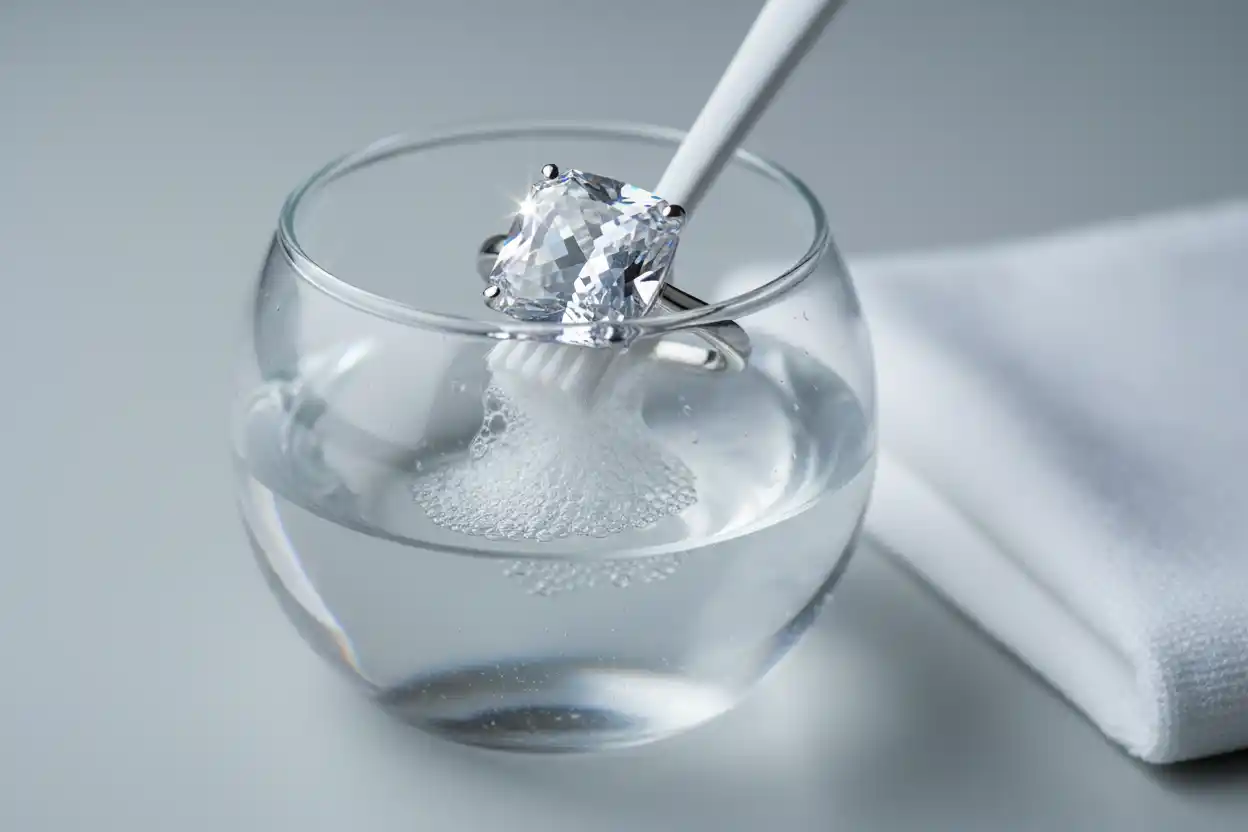
How to Clean Cubic Zirconia Jewelry Safely
Cubic zirconia jewelry can usually be cleaned with lukewarm water, mild dish soap, and a soft brush. This removes the fingerprints, skin oils, lotion, and soap film that frequently make cubic zirconia appear cloudy or less brilliant.
Uncoated cubic zirconia itself can generally tolerate ultrasonic and steam cleaning. However, the setting may contain glue, plating, enamel, delicate pavé, surface coatings, or other gemstones that require a gentler manual method.
What Cubic Zirconia Is
Cubic zirconia, commonly abbreviated as CZ, is a laboratory-created crystalline form of zirconium dioxide. It is widely used as a diamond simulant because it can be colorless, transparent, brilliant, and highly dispersive.
Its material properties and background are covered in the Cubic Zirconia guide.
CZ normally ranks around 8 to 8.5 on the Mohs scale. It is harder than quartz but softer than sapphire, moissanite, and diamond. The gemstone hardness chart explains why it can withstand routine jewelry wear while still accumulating scratches over time.
| Property | Cleaning implication |
|---|---|
| Material | Laboratory-created zirconium dioxide |
| Mohs hardness | Approximately 8 to 8.5 |
| Safest routine method | Lukewarm water, mild soap, and a soft brush |
| Ultrasonic cleaning | Generally safe for uncoated CZ in a secure compatible setting |
| Steam cleaning | Generally safe for uncoated CZ in a suitable setting |
| Common appearance problem | Oil, fingerprints, lotion, and residue reducing brilliance |
| Main exceptions | Coatings, glue, plating, damaged settings, delicate accent materials, and antique construction |
Hardness does not describe every aspect of durability. The guide to gemstone toughness versus hardness explains why sharp impacts, thin girdles, worn prongs, and setting design remain important.
Why Cubic Zirconia Becomes Cloudy
CZ does not necessarily become cloudy from an internal chemical change. In many cases, the apparent haze is a film of skin oil, hand lotion, soap, cosmetics, dust, or cleaning residue.
Because a transparent stone depends on clean facets to return light, residue beneath the pavilion can reduce sparkle dramatically. Cleaning the underside often makes a greater difference than polishing the crown repeatedly.
Fine surface scratches may also reduce brilliance after extended wear. Cleaning removes residue but cannot restore lost polish.
Cloudiness can additionally come from glue beneath the stone, a damaged foil backing, a worn coating, moisture in an assembled setting, or residue trapped where a brush cannot reach.
Inspect the Setting and Finish
Check the jewelry under bright light before washing it. Look for loose prongs, movement in the stone, missing pavé, damaged claws, cracked solder, lifting plating, cloudy glue, peeling coatings, or chips along facet edges.
Many CZ pieces use sterling silver, gold plating, rhodium plating, base-metal alloys, or glued settings. Those components may be less durable than the stone.
Do not place loose, glued, heavily plated, antique, or damaged jewelry in an ultrasonic or steam cleaner.
Colored or effect-coated CZ also requires caution. When a surface treatment creates the color or optical effect, clean according to the coating rather than the durable zirconia core.
The tracker’s Gemstone Treatments Explained guide provides the broader distinction between coatings, filling, irradiation, diffusion, dye, and other alterations.
Gather the Cleaning Supplies
Prepare a small bowl of lukewarm water, mild liquid dish soap, a second bowl of clean water, a soft toothbrush or jewelry brush, and a lint-free cloth.
Avoid cleaning over an open sink. Small studs, loose accent stones, and lightweight fashion jewelry can slip easily from wet fingers.
Use only a few drops of soap. Formulas containing bleach, abrasive particles, strong solvents, or heavy moisturizers may damage the mounting or leave an additional film.
Choose a brush with soft, straight bristles. A worn toothbrush with hardened or bent bristles can scratch metal finishes and catch beneath prongs.
Wash the Cubic Zirconia
Place the jewelry briefly in the mild cleaning solution or hold it securely over the bowl.
Brush the top, sides, pavilion, gallery, prongs, and openings beneath the stone. Pay particular attention to the rear facets because accumulated oil there often causes the most visible dullness.
Use light pressure. CZ is resistant to ordinary scratches, but metal plating, enamel, glue, and softer accent materials may not be.
A short wash is sufficient. Long soaking is unnecessary, especially for glued stones, plated fashion jewelry, watches, lockets, hollow settings, and pieces containing other materials.
Rinse Thoroughly
Rinse the piece in a second bowl of clean lukewarm water. Soap remaining on the facets can dry into a film and make the stone appear cloudy again.
Do not rinse directly over an uncovered drain. If a prong was already weak, the stone may loosen during brushing.
Blot the jewelry with a lint-free cloth and allow hidden moisture to evaporate at room temperature. A soft polishing cloth can remove the final fingerprints once the piece is dry.
Avoid paper towels because their fibers may create fine wear on softer metal finishes.
Can Cubic Zirconia Go in an Ultrasonic Cleaner?
Uncoated cubic zirconia itself is generally suitable for ultrasonic cleaning. The decision therefore depends mainly on the setting, treatment, and accompanying materials.
| Jewelry condition | Ultrasonic recommendation |
|---|---|
| Uncoated CZ in a secure solid-metal setting | Generally safe |
| Secure colorless CZ studs or solitaire | Generally safe |
| Glued stones | Avoid |
| Surface-coated or effect-coated CZ | Use manual cleaning |
| Loose pavé or worn prongs | Avoid |
| Heavily plated fashion jewelry | Prefer manual cleaning |
| Antique, repaired, or enamel jewelry | Avoid unless professionally assessed |
| Mixed gemstone jewelry | Follow the least durable material |
Ultrasonic vibration can loosen glue, expose weak prongs, remove fragile plating, or damage another stone in the piece. The complete equipment comparison belongs to Which Gemstones Can Go in an Ultrasonic Cleaner?.
Can Cubic Zirconia Be Steam Cleaned?
Uncoated cubic zirconia generally tolerates steam. However, steam should be avoided when the jewelry contains glue, coating, enamel, plating, repairs, hollow components, or heat-sensitive accent materials.
A stone may survive while its setting does not. Therefore, warm soapy water is usually the most practical home method even though the CZ core can withstand more aggressive equipment.
Professional steam cleaning is more appropriate for secure solid-gold or platinum jewelry that has been inspected first.
Cleaning CZ Rings
CZ rings collect hand lotion, soap, sanitizer, and skin oils beneath their center stones. Clean through the gallery openings and around every prong.
Remove the ring before applying thick moisturizer, using household cleaners, gardening, exercising, or swimming.
A large solitaire may appear dull quickly because fingerprints cover a wide surface. Wiping it after wear reduces the frequency of full washing.
Gold-plated or silver-plated rings require gentle brushing because aggressive polishing can wear through the surface finish.
Cleaning CZ Earrings
CZ earrings collect cosmetics, hair products, and skin oils behind the stones. Clean the posts, backs, hinges, and areas beneath the settings.
Stud earrings may contain a stone secured with prongs, glue, or both. Avoid soaking or ultrasonic cleaning when adhesive is visible or suspected.
Use alcohol-based disinfectant only on a compatible metal post, keeping it away from glue, plating, coatings, and the stone’s setting.
Cleaning CZ Necklaces and Pendants
A CZ pendant often becomes dull where its back contacts the skin. Perfume, sunscreen, and body lotion can produce a persistent film.
Apply cosmetic products before putting on the necklace and allow them to dry. During cleaning, prevent the chain from rubbing against the stone or catching in the setting.
If the pendant has a plated surface, avoid chemical metal dips and abrasive polishing cloths.
Cleaning CZ Bracelets and Tennis-Style Jewelry
Bracelets combine multiple stones, hinges, links, clasps, and flexible joints. Inspect every component before immersion or machine cleaning.
Clean one section at a time while supporting the bracelet. Small pavé stones can loosen when prongs wear or links bend.
A professional inspection is sensible when a tennis-style bracelet has many stones because one weak setting may be difficult to notice.
Products to Avoid
Do not use toothpaste, baking soda, scouring powder, or stiff brushes. Such products can scratch metal, remove plating, and create fine wear on CZ facets.
Avoid bleach, chlorine, acetone, paint thinner, drain cleaner, oven cleaner, and concentrated household chemicals. The stone may resist some exposure, but the setting, glue, solder, plating, and accompanying materials may not.
Silver dip and tarnish remover should not be used on a complete CZ jewel unless the manufacturer explicitly confirms compatibility. These products may leave residue beneath stones or affect plated finishes.
Avoid waxy cleaners that leave a film. The goal is to remove oil rather than replace it with another coating.
Cubic Zirconia Is Not Zircon
Cubic zirconia and zircon are materially different. CZ is laboratory created from zirconium dioxide, while zircon is a natural zirconium-silicate mineral.
Their durability and equipment recommendations also differ. Zircon may have abraded facet edges and generally requires more conservative care.
The tracker’s Zircon guide, Zircon buying guide, and types of Zircon own those separate questions.
A cleaner labeled safe for CZ should not automatically be assumed safe for zircon.
Cubic Zirconia Versus Diamond and Moissanite
CZ is a diamond simulant rather than a laboratory-grown diamond. It does not share diamond’s chemical composition or crystal structure.
The best Diamond alternatives guide places CZ alongside moissanite, white sapphire, zircon, and other options. Direct performance and identification differences belong to Moissanite vs Cubic Zirconia.
Questions about natural and laboratory-grown materials are covered in Lab-Grown vs Natural Gemstones.
Cleaning should never be used as a diamond test. The dedicated Real vs Fake Diamond guide owns the identification workflow, while the Diamond guide covers the natural gem itself.
Colored and Coated Cubic Zirconia
CZ can be manufactured in many colors. Some color originates throughout the material, while some optical effects may depend on a surface coating.
A body-colored CZ generally follows the same care routine as colorless material. A surface-coated stone should receive gentle manual cleaning because abrasion or aggressive equipment may affect the coating.
Do not attempt to polish away an uneven color or rainbow film. The appearance may be part of the treatment rather than removable dirt.
The types of Cubic Zirconia guide owns the complete color, cut, effect, and variety discussion.
Storage and Preventive Care
Store CZ separately from diamond, sapphire, ruby, and moissanite, which can scratch it. Keep it away from loose chains and metal clasps that may abrade facet edges or coatings.
Wipe the jewelry after wear with a clean lint-free cloth. Because CZ readily shows oils and fingerprints, preventive wiping can preserve its brilliance between washes.
The Cubic Zirconia buying guide covers cut quality, setting construction, color, coatings, and seller disclosure. The Cubic Zirconia price guide explains why value usually depends more on workmanship, metal, design, and brand than the stone’s carat weight alone.
For online purchases, the principles in How to Buy Gemstones Online Without Getting Scammed can help verify metal content, plating, setting method, stone dimensions, and return terms.
When Documentation Matters
Most everyday CZ jewelry does not require a laboratory report. Documentation becomes more relevant when a seller makes claims about unusual coatings, designer origin, precious-metal content, or identification as another material.
The gemstone certification guide explains which reports are meaningful, while How to Read a Gem Lab Report covers terminology and limitations.
A report does not replace inspection of the mounting. Loose prongs and worn plating remain practical jewelry problems rather than gem-identification issues.
Frequently Asked Questions
1. What is the best way to clean cubic zirconia?
Use lukewarm water, mild liquid dish soap, and a soft brush, then rinse thoroughly and dry with a lint-free cloth.
2. Can cubic zirconia get wet?
Yes. The CZ itself can get wet, but prolonged soaking may be unsuitable for glue, plating, watches, hollow settings, or other materials.
3. Can cubic zirconia go in an ultrasonic cleaner?
Uncoated CZ in a secure compatible setting is generally safe. Avoid ultrasound for glued, coated, plated, loose, antique, or mixed-material pieces.
4. Can cubic zirconia be steam cleaned?
Uncoated CZ generally tolerates steam, but glue, coatings, plating, enamel, repairs, and accompanying stones may not.
5. Why does cubic zirconia look cloudy?
Skin oils, lotion, soap film, fingerprints, dust, surface scratches, glue, or residue beneath the setting may reduce its brilliance.
6. Can toothpaste clean cubic zirconia?
No. Toothpaste is abrasive and may scratch the stone or damage its metal setting and plating.
7. Can vinegar clean cubic zirconia?
Vinegar is unnecessary and may affect the mounting, solder, plating, glue, or accompanying materials.
8. Can rubbing alcohol clean CZ?
Alcohol may be tolerated by an uncoated loose stone, but it can affect glue, coatings, finishes, and plated jewelry. Mild soap is safer.
9. How often should cubic zirconia be cleaned?
Clean it when fingerprints and oils reduce its sparkle. Frequently worn rings may benefit from wiping after each wear and washing every few weeks.
10. Can scratched cubic zirconia be polished?
Minor surface wear may sometimes be professionally repolished, but replacement is often more economical for inexpensive stones.
11. Is cubic zirconia cleaned the same way as zircon?
No. Zircon is a different natural gem and usually requires more conservative treatment than CZ.
12. When should CZ jewelry be professionally cleaned?
Professional care is appropriate for loose pavé, worn prongs, glued stones, antique construction, expensive precious-metal settings, or persistent cloudiness.
Conclusion
Cubic zirconia usually loses brilliance because residue coats its facets rather than because the stone has permanently changed. Mild soap, careful brushing beneath the setting, thorough rinsing, and a clean cloth restore most pieces without difficulty. Before using steam or an ultrasonic cleaner, the important next question is how the CZ is mounted and treated, because the setting often determines the real cleaning limit.