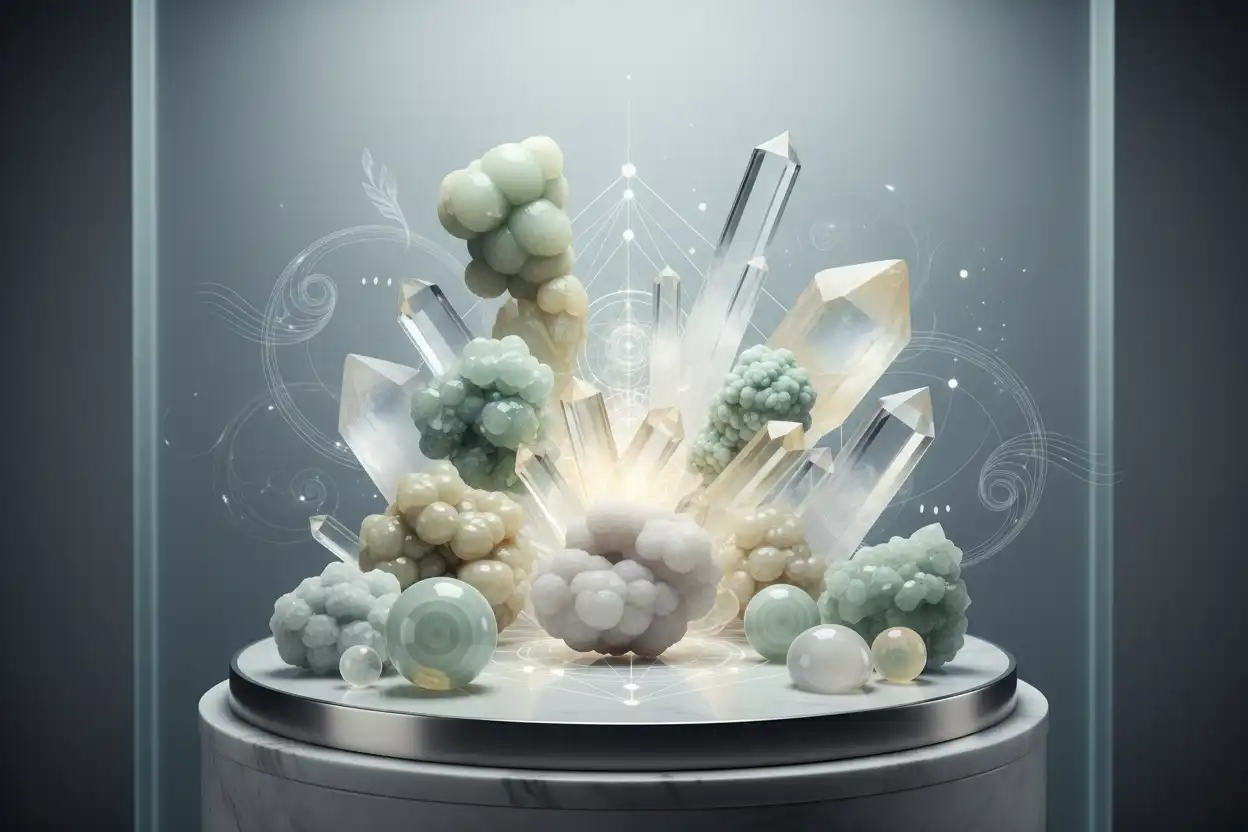
Datolite Meaning: Mineral Facts, History & Symbolism
Datolite meaning begins with a mineral whose appearance changes enough from specimen to specimen that relying on one photograph can be misleading. Datolite is a calcium borosilicate hydroxide mineral commonly represented by the formula CaB(SiO₄)(OH). It crystallizes in the monoclinic system and may occur as transparent or translucent glassy crystals, compact granular masses, nodules, crust-like aggregates, or pale porcelain-looking material. Natural colors include colorless, white, grayish, pale green, yellow, pink, reddish, and brownish tones, while attractive gem-quality pieces can show enough transparency and luster to invite comparison with other pale collector minerals. Datolite has a Mohs hardness of roughly 5–5.5 and a specific gravity near 3, so it occupies a moderate position between very soft collector minerals and harder conventional jewelry gems.
Those measurable characteristics form the factual foundation of datolite meaning. Modern crystal traditions add another layer, commonly associating datolite with clarity, perspective, memory, emotional organization, compassion, or spiritual reflection. Such meanings can be personally useful as symbolism, but they are not experimentally demonstrated consequences of boron, calcium, silica, crystal symmetry, or color. A pale green datolite crystal does not scientifically improve memory because green is associated with growth, and its boron content does not become a neurological treatment simply because boron participates in other chemical or biological contexts.
Within Gems Lore’s Gemstone Guides collection, datolite meaning therefore starts with material identity and moves outward into history and symbolism. That order is important because the mineral is frequently confused with other pale crystals, while commercial descriptions sometimes attach disputed variety names, locality assumptions, or wellness claims that sound more certain than the underlying evidence allows.
Datolite at a Glance
| Property | Practical reference |
|---|---|
| Material identity | Calcium borosilicate hydroxide mineral |
| Common formula | CaB(SiO₄)(OH) |
| Crystal system | Monoclinic |
| Typical colors | Colorless, white, pale green, grayish, yellow, pink, reddish, brownish |
| Transparency | Transparent, translucent, or opaque depending on material |
| Luster | Vitreous to resinous |
| Mohs hardness | About 5–5.5 |
| Specific gravity | Approximately 2.96–3.00 |
| Streak | White |
| Tenacity | Brittle |
| Common forms | Prismatic or wedge-like crystals, granular masses, nodules, compact porcelain-like material |
| Typical geological context | Hydrothermal, volcanic, metamorphic, and skarn-related environments depending on locality |
| Main identification caution | Pale color and glassy luster overlap with many unrelated minerals |
| Jewelry suitability | Facetable transparent material exists, but moderate hardness limits exposed daily wear |
| Symbolic status | Modern interpretations rather than scientifically demonstrated effects |
The variety of natural forms explains why datolite meaning should not be tied to one idealized specimen. A transparent pale green crystal from a hydrothermal cavity and an opaque rounded nodule may look almost unrelated, yet mineral identity is determined by structure and composition rather than by whether the object resembles a classic collector crystal.
What Datolite Actually Is
Datolite is a boron-bearing silicate mineral containing calcium as an essential structural component. It is not a variety of quartz, chalcedony, prehnite, calcite, or fluorite, even though certain specimens can resemble those materials visually. The combination of boron, silicon, calcium, oxygen, and hydrogen forms a specific monoclinic structure that defines datolite as its own mineral species.
The hydroxyl component in the formula also deserves careful wording. Datolite’s chemistry is sometimes oversimplified in commercial explanations into a list of “beneficial elements,” as though touching the mineral delivers calcium or boron to the body. The formula explains mineral structure; it does not describe bioavailable nutrients or a therapeutic delivery system.
Some datolite is sufficiently transparent to be faceted, while other material is completely unsuitable for gem cutting because it is opaque, fractured, granular, or valued more highly as a natural specimen. Mineral identity therefore remains constant even as commercial use changes.
Datolite Can Look Very Different From One Specimen to Another
One of the most useful lessons in datolite meaning is how strongly habit influences recognition. Fine crystals may be glassy, transparent, and irregularly wedge-shaped, while massive datolite can appear creamy, granular, earthy, or porcelain-like.
Well-developed crystals can have numerous faces that create a visually complex geometry rather than the immediately recognizable six-sided prism of quartz. The result can look almost asymmetrical at first glance, even though the crystal is governed by monoclinic symmetry.
Nodular material adds another challenge. Rounded datolite masses can develop in volcanic cavities and may show pale interiors, mineral inclusions, concentric-looking differences, or contrasting associated phases. Once cut and polished, these pieces can resemble ornamental rocks more readily than conventional crystal specimens.
This variation is why datolite meaning should begin with a material definition rather than “datolite is the pale green crystal that looks like…” descriptions.
How Datolite Forms
Datolite commonly forms through low- to moderate-temperature geological processes involving boron-bearing fluids. It occurs in several settings, including hydrothermal veins, cavities in volcanic rocks, contact-metamorphic environments, skarns, and some low-grade metamorphic systems. The exact mineral association depends on the chemistry of the host rock, temperature, fluid composition, pressure, and the availability of calcium and boron.
In volcanic rocks, fluids can move through fractures and gas cavities after the host rock has formed. Those spaces may later become lined or filled with secondary minerals, including datolite. Such occurrences can produce crystals, nodules, or compact aggregates associated with other low-temperature minerals.
Contact-metamorphic and skarn settings develop differently. Heat and chemically reactive fluids associated with igneous intrusions can transform calcium-rich host rocks while introducing components such as boron. The resulting mineral assemblage may contain datolite alongside calc-silicate and other hydrothermal minerals.
The more detailed sequence belongs in datolite formation and deposit geology. For datolite meaning, the central point is that the mineral can emerge through several geological routes, so one formation story should not be projected onto every specimen.
Why Datolite Can Be Colorless, Green, Pink, or Yellow
Pure structural chemistry does not require datolite to display one strong body color. Colorless and white material is common, while pale green, yellow, pink, reddish, grayish, or brownish tones can arise through minor impurities, microscopic inclusions, alteration, surface staining, or locality-specific mineral chemistry.
Pale green is particularly familiar in collector specimens, but green should not be treated as a species-level requirement. A colorless datolite crystal can be just as authentic as a green specimen, and a compact pinkish or reddish nodule should not automatically be excluded from the species because it does not match a crystal-shop photograph.
Color can also change dramatically with specimen thickness. A nearly colorless thin edge may become visibly green or yellow through a thicker region, while dense aggregates can appear more saturated because several grains overlap optically.
Lighting adds another variable. Warm indoor illumination can make colorless material appear cream or yellow, while cool light can exaggerate greenish or gray tones. The detailed datolite optical properties and color behavior guide separates these optical effects from genuine compositional differences.
Color Is Not a Reliable Locality Test
Certain mining districts and collector localities become strongly associated with recognizable datolite appearances. That can tempt buyers to identify origin from color alone: pinkish material may be assigned to one region, green crystals to another, or porcelain-like nodules to a famous volcanic district.
Appearance can make a locality claim plausible, but plausibility is not provenance.
Several deposits can produce overlapping colors and habits, while photography, polishing, staining, alteration, and specimen thickness further complicate comparisons. Once a nodule is sliced or a crystal is detached from matrix, much of the geological evidence that could have supported locality interpretation disappears.
The datolite provenance disclosure checklist provides the more appropriate framework: labels, acquisition records, old collection cards, dealer documentation, and coherent chain-of-custody evidence carry more weight than resemblance to another photograph.
Diagnostic Traits That Matter
A strong datolite identification depends on several compatible observations. Monoclinic crystal morphology, moderate hardness, a density close to 3, vitreous or resinous luster, white streak, brittle fracture, appropriate mineral association, and compatible optical measurements can collectively build confidence.
Color alone performs poorly. Pale green datolite may resemble prehnite, fluorite, calcite, some feldspars, glass, or other collector materials, while colorless transparent crystals can overlap visually with quartz, danburite, topaz, or beryl depending on habit and cutting.
Hardness helps narrow possibilities but should not be tested destructively on fine specimens. Deliberately scratching a transparent crystal to see whether it falls near 5.5 destroys natural surface evidence that may matter more than the result.
Density is similarly useful only when measured carefully. Subjective heft can be distorted by matrix, cavities, specimen shape, or comparison with an inappropriate reference material.
What Magnification Can Reveal
Datolite often rewards magnification because natural crystals and nodular material can contain internal fractures, growth zones, mineral grains, fluid-related features, tiny cavities, surface coatings, and secondary mineral inclusions that are not visible from ordinary viewing distance.
A transparent crystal may show numerous internal features even when it appears eye-clean, while polished nodular material can reveal small contrasting grains distributed through a pale body. Those features can help reconstruct growth history or show that apparently uniform material is more complex internally.
The specialized datolite microscope and inclusion notebook covers those observations more fully. On this page, the important limitation is that magnification cannot automatically name an inclusion. A black grain remains a black grain until morphology, chemistry, spectroscopy, or other evidence supports a specific mineral identification.
Magnification is also useful for detecting post-collection alteration. Glue, resin, polishing lines, surface scratches, fracture filling, artificial coatings, and cleaning residues can become conspicuous even when seller photographs make the specimen look completely natural.
An Original Datolite Specimen and Photo Checklist
Begin with the object as a whole. Record whether the suspected datolite occurs as a free crystal, crystal cluster, nodule, massive aggregate, vein filling, cut slab, cabochon, or faceted stone. The format determines what evidence remains available, because a natural crystal preserves morphology while a polished gem sacrifices most exterior growth information.
Next, examine geometry. In crystalline material, look for the irregular-looking arrangement of faces and wedge-like forms commonly associated with datolite. Do not expect every crystal to look identical. Contact with matrix, neighboring crystals, dissolution, breakage, and interrupted growth can modify otherwise useful crystallographic features.
Then inspect the surface. Natural growth faces may show steps, small pits, contact areas, minor coatings, or uneven development. A highly polished crystal represented as completely natural deserves closer examination, though an unusually smooth face alone is not proof of artificial modification.
For nodules, inspect an existing cut or broken surface. Observe whether colors and mineral grains continue into the interior and whether the object displays coherent rock-host relationships. A superficial color treatment may behave differently from coloration distributed throughout the material.
Photograph the specimen in diffuse daylight-balanced illumination against a neutral gray background. Add a scale reference and capture at least one image from the side rather than only the most flattering front view. Thin edges should be photographed separately when transparency matters.
Finally, categorize the claims. “Pale green vitreous monoclinic-looking crystal” describes visible evidence. “Consistent with datolite” is an interpretation. “Confirmed datolite from a named mine with natural untreated color” requires progressively stronger analytical and provenance evidence.
A Source-Comparison Table for Common Datolite Claims
| Common claim | What can reasonably be retained | What requires correction or stronger evidence |
|---|---|---|
| “Datolite is CaB(SiO₄)(OH).” | Accepted ideal mineral formula | Individual specimens may contain inclusions and associated phases |
| “Datolite is always pale green.” | Pale green material is familiar | Natural datolite occurs in numerous colors |
| “Datolite is a type of quartz.” | Both are silicate minerals and can be transparent | Their composition and crystal systems are different |
| “Datolite is the same as danburite.” | Both contain calcium and boron | They are distinct mineral species with different formulas and structures |
| “Nodular datolite is fake because it lacks crystal points.” | Crystals are popular collector forms | Genuine datolite can occur in massive and nodular forms |
| “Every dark inclusion identifies the locality.” | Inclusion suites can sometimes add geological context | One visible grain rarely proves geographic origin |
| “Pink datolite is a separate species.” | Pink is a useful color description | Color does not create a new mineral species |
| “Datolite improves memory.” | Memory is a common modern symbolic association | No established mineralogical mechanism demonstrates cognitive treatment |
| “Boron in datolite is healing.” | Boron is essential to datolite chemistry | The mineral is not a nutritional or medical boron source |
| “Datolite carries ancient crystal-healing traditions.” | Modern metaphysical traditions use datolite | Specific ancient claims require historical evidence |
This comparison is important because datolite meaning is often built from several plausible-sounding statements stacked together. A mineral formula can be correct while a health conclusion drawn from it is unsupported; a specimen can resemble material from a famous locality while lacking provenance; and a traditional trade description can be useful without functioning as a scientific classification.
Datolite Versus Danburite
Danburite is one of the most useful comparisons because both minerals contain calcium and boron and both can occur as transparent collector crystals. That chemical overlap sometimes encourages the mistaken idea that they are varieties of the same mineral.
They are not.
Danburite has the formula CaB₂Si₂O₈ and crystallizes in the orthorhombic system, while datolite is commonly represented as CaB(SiO₄)(OH) and crystallizes in the monoclinic system. Danburite is also harder, generally around 7–7.5 compared with datolite’s 5–5.5, which gives the two minerals different lapidary and jewelry behavior.
A pale transparent crystal can therefore resemble both while still requiring mineral-specific evidence for identification.
Datolite Versus Dendritic Agate
Dendritic Agate is primarily chalcedony distinguished visually by branching inclusions that resemble vegetation. Its identity and appeal depend heavily on a silica-rich host with dendritic mineral patterns.
Datolite may also contain contrasting mineral inclusions, especially in nodular or massive material, but those inclusions do not turn it into chalcedony. The underlying host remains datolite when analytical evidence supports that identification.
This comparison illustrates why visual pattern should not outrank composition. Branching, spotted, cloudy, or included appearances can emerge in several unrelated materials.
Datolite Versus Dendritic Opal
Dendritic Opal offers another useful contrast because it is opaline silica containing branching inclusions. Unlike crystalline datolite, opal is a mineraloid with very different structure, physical behavior, and hydration characteristics.
A polished pale stone containing dark inclusions might therefore be assigned to very different material families depending on its actual host substance. The fact that two objects are both sold as cabochons does not bring their mineralogy closer together.
This is one reason rough or matrix-bearing evidence can be so valuable before cutting removes geological context.
Datolite Versus Dalmatian Jasper
Dalmatian Jasper is a spotted polymineralic ornamental rock rather than a single mineral species. Datolite, by contrast, has a defined crystal structure and composition.
The comparison becomes useful in polished material because both may appear creamy, included, or patterned. A buyer looking only at color and decorative form could treat them as members of the same broad “crystal stone” category even though one is a mineral species and the other is a rock.
Gemological and petrological terminology prevents those broad commercial labels from becoming identification shortcuts.
Documented History of Datolite
Datolite’s recorded history is primarily mineralogical rather than metaphysical. The mineral was named by Danish-Norwegian geologist Jens Esmark in the early nineteenth century, with the name derived from a Greek expression associated with dividing, referring to the granular character of some massive material. Its original scientific history is connected with Norwegian specimens and the gradual development of mineralogical description and crystallography.
That documented history provides a much firmer foundation than claims that ancient civilizations universally recognized datolite as a memory stone, angelic crystal, emotional healer, or chakra mineral. Older societies certainly worked boron-bearing and pale decorative minerals, but a historical reference to a white or green stone cannot automatically be identified retrospectively as datolite.
Modern symbolic interpretations can be discussed without being backdated.
Datolite Meaning in Modern Symbolism
Modern datolite meaning commonly centers on clarity, memory, emotional organization, perspective, compassion, learning, and releasing repetitive thought patterns. Pale green specimens may also acquire symbolism related to balance, renewal, or emotional openness, while transparent crystals are often linked with mental clarity.
These interpretations make intuitive metaphorical sense. A transparent mineral can represent seeing a problem more clearly; a complex multi-faced crystal can symbolize examining a situation from several angles; a nodule whose plain exterior conceals an attractive polished interior can represent looking beyond first impressions.
The symbolic value does not require a physical healing mechanism. Datolite does not scientifically enhance memory, cure cognitive impairment, eliminate anxiety, repair trauma, improve academic performance, or alter neurotransmitters through skin contact.
A practical use might involve placing a datolite specimen beside written notes while reviewing a difficult decision. The stone can act as a cue to ask, “What information am I forgetting?” or “Which assumption needs to be checked?” The resulting behavior can be useful even though the mineral itself is not changing memory chemistry.
The “Memory Stone” Claim
Datolite is sometimes called a memory stone or associated strongly with recall. That wording should remain in the realm of crystal lore rather than being presented as a cognitive intervention.
There is no established evidence that holding datolite improves encoding, storage, or retrieval of memories. Nor does its boron content provide a direct mechanism for neurological improvement through ordinary handling.
The symbolism can still be used intelligently. A physical object placed beside a notebook can function as an external memory cue because the person intentionally associates the object with a task. That is ordinary behavioral prompting, not a mineral-specific medical effect.
This distinction preserves the personally useful part of datolite meaning without overstating the evidence.
Boron Chemistry Does Not Make Datolite a Supplement
Boron is an essential structural component of datolite, which makes the mineral chemically interesting. That fact is occasionally used to support claims about cognition, bones, hormones, or other biological processes.
The inference is invalid.
Chemical form and exposure route matter. Boron locked within a mineral crystal is not equivalent to a controlled dietary compound, and handling a datolite specimen does not provide a measured biological dose. The same principle applies to calcium: datolite contains calcium, but it is not a calcium supplement.
Mineral chemistry should explain why the specimen has its structure and properties rather than be converted into wellness claims.
Datolite and Chakra Symbolism
Different modern crystal systems associate datolite with different chakras depending on color and author. Pale green material may be linked symbolically with the heart chakra, while colorless or highly transparent pieces can be assigned to crown-oriented practices.
These associations are not standardized mineral classifications. A green datolite specimen remains the same mineral whether one practitioner interprets it through heart symbolism and another does not use chakra language at all.
The color may provide a visual metaphor, but there is no scientifically validated instrument that determines whether a datolite crystal opens, balances, clears, or activates a chakra.
Datolite meaning can acknowledge these practices without presenting them as anatomy.
Safe Ownership of Datolite
An intact datolite specimen can generally be handled using ordinary mineral-collection hygiene. The main routine concerns are specimen damage and associated minerals rather than an unusual hazard from brief contact with clean solid datolite.
Its hardness around 5–5.5 means crystal faces and polished surfaces can scratch more readily than quartz. Natural crystals may also contain fractures or delicate terminations that chip under impact.
Cutting, grinding, drilling, or sanding creates a different exposure environment because fine mineral dust is produced. Wet processing, local extraction, ventilation, eye protection, and appropriate respiratory controls are prudent during lapidary work rather than casual dry grinding.
Direct-contact drinking-water elixirs are unnecessary. Natural specimens may contain matrix material, inclusions, polishing compounds, cleaning residues, adhesives, or associated minerals not represented by the simplified datolite formula.
The broader boundary between mineral education and individualized health guidance is set out in the site’s Disclaimer, which is especially relevant when symbolic descriptions such as memory, emotional balance, or healing are interpreted literally.
Can Datolite Be Faceted?
Transparent datolite can be faceted and may produce attractive collector gems, particularly when color and clarity are strong. However, its moderate hardness makes it less suitable for heavy daily abrasion than quartz, topaz, sapphire, or other harder gem materials.
The cutter also has to decide whether faceting improves or destroys the object. A fine natural crystal with good form, locality documentation, or unusual inclusions may carry more scientific and collector interest intact than it would after every natural face is removed.
Broken crystals, unattractive fragments, or suitable massive transparent material may make more rational cutting rough. The detailed lapidary tradeoffs belong in datolite cutting, orientation, and polish rather than being repeated here.
Jewelry Use Requires Realistic Expectations
Datolite jewelry exists, but the mineral’s hardness places limits on exposed everyday wear. Pendants and earrings generally experience less abrasion than rings and bracelets, while a large elevated ring stone receives frequent impact and contact.
A protective setting can reduce some risks, but no metal design changes the mineral’s hardness. Existing fractures and edge condition should also be considered before mounting a transparent datolite gem.
The datolite setting and wear engineering guide addresses those construction questions specifically. Datolite meaning may symbolize resilience or perspective, but those ideas do not make the stone physically more resistant to abrasion.
Conservation of Crystals and Nodules
Datolite specimens require different conservation approaches depending on form. Transparent crystals should be protected from scratches, termination damage, and impact, while nodular specimens may contain fractures, contrasting mineral phases, weathered surfaces, or historic cut faces that deserve preservation.
Aggressive polishing of a collector crystal can remove natural growth surfaces permanently. Likewise, chemical cleaning aimed at making a specimen brighter can dissolve associated minerals, modify surface coatings, or erase evidence of alteration.
The datolite specimen conservation record provides a more appropriate framework for recording repairs, detached fragments, old labels, cleaning history, fractures, color changes, and other condition information.
For historically labeled material, preserving documentation can be as important as preserving polish.
What Datolite Meaning Should Own
Datolite meaning should answer the reader’s first questions clearly: What is datolite? Why does it have different colors and forms? How can it be distinguished from superficially similar materials? What is genuinely known about its history? Which symbolic associations are modern interpretations? What handling limits follow from the material itself?
It should not reproduce the complete microscopic identification workflow, optical data tables, deposit geology, lapidary instructions, jewelry engineering, conservation protocols, or provenance analysis. Those topics require different evidence and already have dedicated cluster pages.
Keeping those boundaries intact prevents a common content problem in mineral guides: the same treatment, care, price, jewelry, and symbolism paragraphs appearing under every related URL.
How to Judge a Datolite Claim
A strong datolite claim should match the evidence capable of supporting it. Mineral identity can be investigated through physical properties, optical measurements, chemical analysis, spectroscopy, diffraction, or appropriate combinations of those techniques. Locality requires provenance. Historical claims require documentary evidence. Symbolic claims should be labeled according to the traditions in which they are used.
The site’s About framework matters here because datolite sits at an intersection where scientific vocabulary can easily be borrowed to make metaphysical claims sound experimentally established. Saying that datolite contains boron is mineral chemistry; saying that boron makes a datolite crystal improve memory through touch is a separate medical-style claim that does not follow from the formula.
Where a specimen or published statement provides evidence that conflicts with a particular mineralogical claim, the exact issue can be submitted through Contact for correction rather than expanding every article with the same generic site-language ending.
Frequently Asked Questions About Datolite Meaning
What is datolite?
Datolite is a calcium borosilicate hydroxide mineral commonly represented by the formula CaB(SiO₄)(OH). It crystallizes in the monoclinic system and occurs as crystals, granular masses, nodules, and compact material.
What does datolite mean spiritually?
Modern datolite meaning commonly includes clarity, memory, perspective, emotional organization, compassion, and reflection. These are symbolic interpretations rather than scientifically demonstrated effects.
What color is datolite?
Natural datolite can be colorless, white, pale green, gray, yellow, pink, reddish, brownish, or other subdued shades depending on impurities, inclusions, alteration, and specimen characteristics.
Is datolite a type of quartz?
No. Quartz is SiO₂ and crystallizes differently. Datolite contains calcium and boron and belongs to the monoclinic crystal system.
Is datolite the same as danburite?
No. Both contain calcium and boron, but they have different formulas, crystal structures, hardness, and physical characteristics.
Why does some datolite occur as nodules?
Datolite can form in cavities and other spaces within volcanic or hydrothermal environments, where mineralizing fluids produce compact or rounded aggregates rather than free-standing crystals.
Is green datolite a separate variety?
Green is a useful descriptive color, but pale green datolite remains datolite. Color alone does not define a separate mineral species.
Is pink datolite natural?
Pink and reddish datolite material occurs naturally, though a specific specimen’s color origin, treatment status, and locality should be evaluated from evidence rather than color alone.
What is datolite hardness?
Datolite is roughly 5–5.5 on the Mohs scale. It is harder than minerals such as calcite but softer than quartz.
Can datolite be used in jewelry?
Transparent material can be faceted and set in jewelry, but moderate hardness means protected designs and lower-impact wear are more practical than highly exposed daily rings.
Does datolite improve memory?
There is no established scientific evidence that datolite improves memory or treats cognitive problems. “Memory stone” belongs to modern crystal symbolism.
Does datolite have healing properties?
No established evidence shows that datolite prevents, diagnoses, treats, or cures medical or psychological conditions through normal handling.
Can datolite go in drinking water?
Direct-contact mineral elixirs are unnecessary. Natural datolite specimens may contain associated minerals, residues, treatments, or contaminants that cannot be assessed from the species name alone.
How can I identify datolite?
Use several compatible characteristics, including crystal habit, hardness, density, luster, optical properties, matrix relationships, and—when needed—analytical testing. Color alone is insufficient.
Where did the name datolite come from?
The name has Greek linguistic roots connected with dividing, historically referring to the granular texture of massive material. Datolite entered formal mineralogical literature during the early development of modern mineral classification.
Datolite Meaning Without the Shortcuts
Datolite meaning becomes much more distinctive when the mineral is allowed to be complicated. A transparent pale green crystal, a creamy compact aggregate, and a polished nodule may look like three unrelated materials, yet they can express the same mineral species through different growth environments and textures. That variability is scientifically more interesting than reducing datolite to one color, one crystal shape, or one spiritual adjective.
Its documented history is equally useful. Datolite belongs to the development of mineralogical classification and borosilicate research, not to an automatically ancient crystal-healing tradition. Modern symbolism arrived later and can be treated honestly as a separate cultural layer.
That symbolism does not have to disappear. Datolite’s many-faced crystals can represent looking at a problem from several perspectives, while its varied outward forms can symbolize the danger of judging identity from appearance alone. A person may use the mineral as a reminder to retrieve forgotten information, examine assumptions, or organize a complicated decision without claiming that CaB(SiO₄)(OH) directly changes memory or emotional chemistry.
The most grounded datolite meaning therefore keeps three questions visible at once: what the specimen is, what evidence supports the claims made about it, and what meaning a person chooses to attach afterward. When those layers remain separate, datolite does not lose its symbolism; it gains a clearer identity.