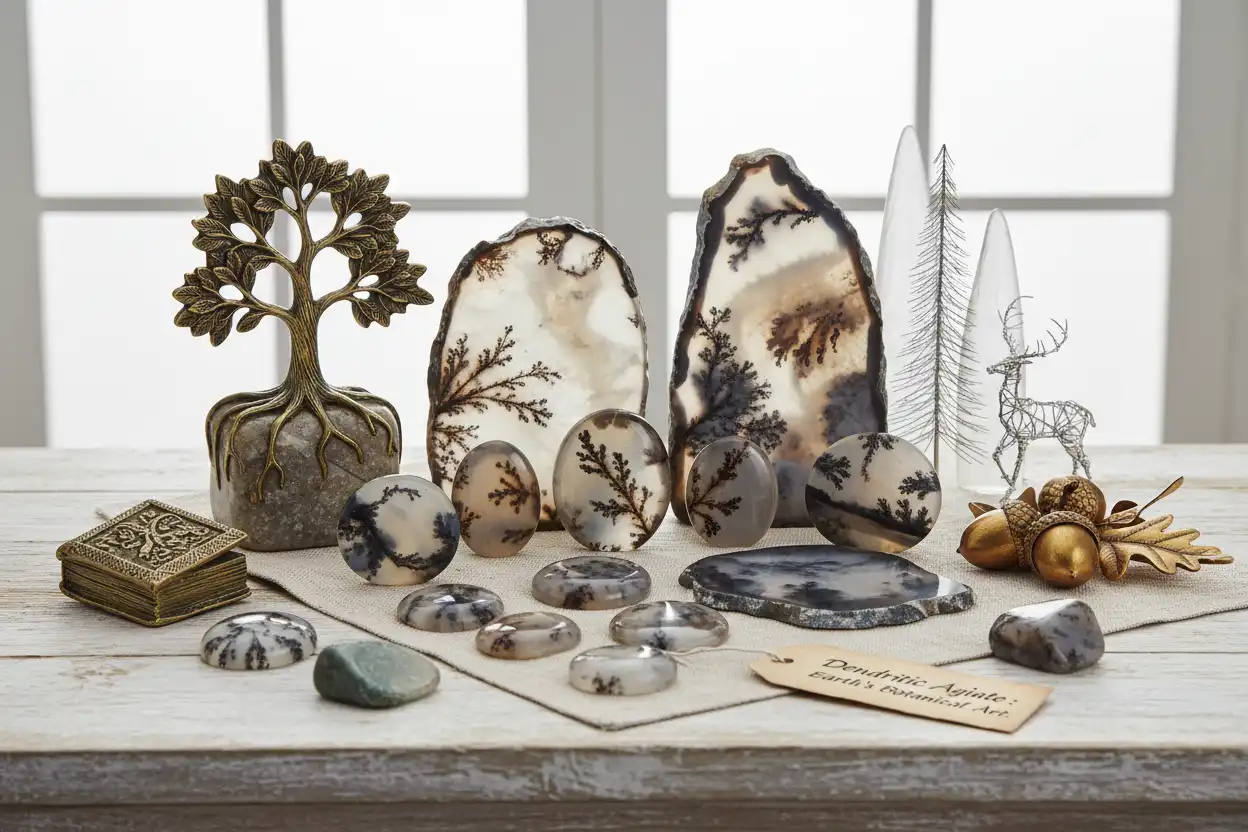
Dendritic Agate Meaning: Facts, History & Symbolism
Dendritic agate meaning begins with a material whose landscape-like patterns can look so deliberate that they are easily mistaken for fossil plants, trapped moss, miniature trees, or even hand-painted decoration. In reality, dendritic agate is generally a chalcedony-rich ornamental material containing branching mineral inclusions called dendrites. The pale host is predominantly microcrystalline to cryptocrystalline silica, while the dark branching patterns commonly involve manganese- and iron-bearing oxides or hydroxides precipitated along tiny fractures, interfaces, or pathways through the silica. The result can resemble forests, ferns, roots, lightning, coral, or winter branches even though no plant material is required to create the pattern.
The name also deserves precision. Despite being called agate, dendritic agate often lacks the conspicuous concentric or parallel banding associated with classic agate, so “dendritic chalcedony” can be the more descriptive mineralogical phrase for some specimens. The commercial name remains useful because it is well established, but it should not be treated as proof that every piece has conventional agate banding or identical inclusion chemistry. Within Gems Lore’s Gemstone Guides collection, dendritic agate meaning is therefore built around three separate layers: the silica host, the mineral dendrites inside it, and the symbolism people later attach to the natural branching patterns.
Modern crystal traditions commonly associate dendritic agate meaning with growth, patience, stability, connection with nature, gradual development, balance, abundance, and reflection. These themes are understandable because the inclusions resemble roots, branches, and vegetation, yet the resemblance is visual rather than biological. Dendritic agate does not contain a miniature tree, and the stone does not scientifically cause growth, prosperity, healing, or environmental attunement simply because manganese- or iron-rich minerals formed branching patterns inside chalcedony.
Dendritic Agate at a Glance
| Property | Practical reference |
|---|---|
| Material identity | Dendrite-bearing chalcedony; commonly sold as dendritic agate |
| Main host material | Microcrystalline to cryptocrystalline silica, SiO₂ |
| Pattern type | Branching mineral dendrites |
| Common dendrite colors | Black, dark brown, rusty brown, reddish brown, occasionally lighter tones |
| Typical host colors | Colorless, white, cream, pale gray, beige, translucent gray |
| Common dendrite chemistry | Often manganese- and/or iron-bearing oxide or hydroxide minerals |
| Important caution | Exact dendrite mineral species cannot be established reliably from color alone |
| Transparency | Commonly translucent to opaque; some thin areas may be more transparent |
| Luster | Waxy to vitreous when polished |
| Mohs hardness | Approximately 6.5–7 because chalcedony dominates the host |
| Common forms | Rough nodules, slabs, cabochons, beads, carvings, display slices |
| Plant fossils? | Normally no; branching patterns are mineral growths |
| Classic agate banding required? | Not necessarily |
| Main identification issue | Moss agate, dendritic opal, included jasper, altered chalcedony, glass, and composites can resemble it |
| Symbolic associations | Growth, patience, nature, stability, perspective, abundance |
| Evidence boundary | Symbolism is interpretive rather than a scientifically demonstrated mineral effect |
This distinction between host and inclusion is central to dendritic agate meaning. The chalcedony provides most of the stone’s physical framework, while the dendritic minerals create the recognizable visual pattern. Neither component should be inferred from pattern alone when a valuable or scientifically important specimen needs exact identification.
What Dendritic Agate Actually Is
Dendritic agate is best understood as chalcedony containing branching mineral inclusions. Chalcedony consists of extremely fine intergrowths of silica minerals, principally quartz with structural complexities at microscopic scale, creating the dense, relatively tough material used throughout ornamental stone cutting.
The dendrites are separate mineral matter. They develop as branching films, networks, or aggregates that may occupy fractures, interfaces, cavities, or zones within the silica. Because the branches can divide repeatedly into smaller branches, the pattern resembles biological growth even though it can form entirely through inorganic mineral precipitation.
That distinction prevents one of the most persistent misunderstandings in dendritic agate meaning: the black shapes are not normally fossilized plants. Nature can produce highly organized patterns through crystallization, diffusion, fluid movement, precipitation, and fracture-controlled growth without biological templates.
Is Dendritic Agate Really an Agate?
The answer depends on how strictly the word agate is being used. In everyday gem and lapidary trade, dendritic agate is an established name for translucent chalcedony containing dendritic mineral patterns. Under a narrower descriptive definition, agate is associated particularly with visibly banded chalcedony, which means a non-banded dendritic specimen may be better described as dendritic chalcedony.
This is a naming issue rather than evidence that the stone is artificial. Trade terminology and mineralogical description do not always divide materials in exactly the same way.
A transparent seller can retain the familiar name while explaining the nuance: “dendritic agate” is the recognized commercial term, while the physical material may be predominantly non-banded chalcedony with dendritic inclusions.
Dendritic agate meaning is more reliable when familiar language is preserved without pretending that the name settles every petrographic detail.
How Dendritic Agate Forms
Dendritic agate forms through more than one geological step. First, silica-rich fluids infiltrate cavities, fractures, pore spaces, or other suitable openings and precipitate fine-grained silica. Repeated silica deposition can build chalcedony-rich material over time, sometimes preserving subtle zones even when obvious agate banding is absent.
The dendrites require another process. Mineral-bearing fluids move through tiny fractures or interfaces in the silica and deposit manganese- or iron-rich compounds under suitable chemical conditions. Rather than forming one compact crystal, the precipitating material can spread outward through branching pathways, producing increasingly fine subdivisions that resemble stems and leaves.
The process is controlled by chemistry and available pathways, not by the mineral intentionally copying vegetation. Branching is an efficient pattern that occurs in many physical systems when material grows outward through limited space or along favorable transport routes.
A more detailed treatment of silica deposition, fracture-controlled fluids, and inclusion growth belongs in dendritic agate formation and deposit geology. For dendritic agate meaning, the most important geological insight is that the “landscape” can be fully inorganic.
Why the Dendrites Look Like Trees and Ferns
Human vision is highly responsive to recognizable forms. When a branching mineral inclusion resembles a tree, fern, root network, or distant landscape, the brain quickly organizes an irregular pattern into a familiar image.
The geological reason for the resemblance is simpler. Dendritic growth repeatedly splits as mineral precipitation extends into available pathways. Plants also branch because branching helps distribute leaves, roots, vessels, or other structures. Similar geometry can therefore emerge from very different processes.
This phenomenon makes dendritic agate unusually attractive for symbolic interpretation. A stone whose mineral patterns happen to resemble living growth naturally invites themes of nature, patience, development, roots, and seasons.
The resemblance is real. The conclusion that the inclusion is biological is not.
What Causes Black and Brown Dendrites?
Dark dendrites in chalcedony are commonly associated with manganese-bearing and iron-bearing mineral phases, including oxide and hydroxide materials. Black patterns are frequently described broadly as manganese oxides, while brown, orange, or rusty patterns may involve iron-rich phases.
However, color alone cannot establish the exact mineral species. Several manganese minerals can be dark, several iron compounds can produce earthy brown or red colors, and mixtures can occur in the same dendritic network.
This is why a statement such as “every black branch is pyrolusite” is stronger than an ordinary photograph can support. The defensible description is often “dark manganese-rich dendritic mineralization” unless analytical work identifies a specific phase.
The dendritic agate microscope and inclusion notebook provides the appropriate place for closer examination of individual branches, mineral films, fractures, and internal relationships.
Dendrites Can Sit at Different Depths
One of the most attractive characteristics of good dendritic agate is visual depth. Some branches lie close to the polished surface, while others appear suspended deeper in translucent chalcedony. When a slab or cabochon contains dendrites at several planes, overlapping patterns can create a surprisingly three-dimensional scene.
That depth is useful for authentication because a genuinely internal mineral pattern behaves differently from a printed design or superficial coating. Tilting the stone under magnification may reveal branches passing behind cloudy silica zones or disappearing into deeper material.
Depth alone still does not prove untreated natural origin. A manufactured composite can contain internal decoration, and fracture filling can complicate visual interpretation. However, three-dimensional relationships are significantly more informative than pattern seen from one front-facing image.
Why the Background Is White, Gray, or Clear
The chalcedony host in dendritic agate is commonly colorless, white, pale gray, cream, or slightly beige. Differences in translucency can arise from microscopic pores, silica textures, included minerals, tiny fractures, water-related structural features, and the thickness of the material being viewed.
A thin polished slab may appear surprisingly translucent even when a thicker rough nodule looks opaque. Backlighting can make faint dendrites suddenly visible, while reflected light emphasizes surface polish and darker inclusion contrast.
These changes belong to ordinary optics rather than metaphysical energy. The dendritic agate optical properties and color behavior guide addresses the relationship among translucency, scattering, thickness, polish, and inclusion contrast in greater detail.
Diagnostic Traits That Matter
Dendritic agate identification should begin with the chalcedony host rather than with the tree-like pattern. The material is generally relatively hard, dense, fine-grained, and capable of taking a smooth polish. It lacks the easy cleavage seen in minerals such as calcite or fluorite and should behave broadly like other chalcedony-rich ornamental materials.
The dendrites should then be assessed as inclusions rather than assumed species. Genuine mineral patterns commonly vary in branch thickness, spacing, color, depth, and termination. Some branches overlap, some stop abruptly at fractures, and some expand into diffuse patches.
A perfectly repeated motif deserves additional scrutiny, but irregularity alone cannot authenticate a specimen. Computer-designed, printed, dyed, or composite objects can imitate natural randomness.
For valuable material, the strongest conclusion comes from several compatible observations rather than one attractive branch.
An Original Dendritic Agate Photo and Specimen Checklist
Begin by photographing the specimen without backlighting. Use diffuse neutral illumination, a gray background, and a scale reference. Record whether the piece is rough, sliced, polished, carved, cabochon-cut, or mounted because processing changes what evidence remains visible.
Next, add transmitted light if the stone is sufficiently translucent. Observe whether dendrites sit at one plane or several depths. Real inclusions may overlap each other, disappear into cloudy regions, cross internal fractures, or appear sharper in thin areas.
Then examine the side and back. A pattern that looks convincing from the front becomes much easier to understand when the stone is rotated. Look for dendrites continuing through the thickness, terminating at genuine internal features, or existing primarily as a very thin surface film.
Use magnification on branch junctions. Natural dendrites commonly split irregularly, taper, merge, widen, or form granular patches. Do not expect botanical perfection. A mineral network can suggest a fern without reproducing leaves accurately.
Inspect existing chips or edges rather than creating new damage. Chalcedony should show a dense silica-rich body, and internal branches may sometimes be visible beneath the surface at exposed edges.
Finally, document uncertainty explicitly. A photograph may support “dendritic chalcedony,” “natural-looking internal branching inclusions,” or “manganese/iron-rich dendrites likely.” It cannot reliably establish a precise manganese mineral species, mine locality, treatment history, or every component of a mixed inclusion without stronger evidence.
A Claim-Comparison Table for Dendritic Agate
| Common claim | What can reasonably be retained | What needs correction or stronger evidence |
|---|---|---|
| “Dendritic agate contains tree fossils.” | The inclusions often resemble trees or plants | Typical dendrites are inorganic mineral growths |
| “Every black dendrite is manganese oxide.” | Manganese-rich phases commonly create dark dendrites | Exact mineral species needs analytical support |
| “Brown dendrites are iron.” | Iron-bearing phases often create brown or reddish tones | Color alone does not identify one iron mineral |
| “Dendritic agate must be banded.” | Agate is traditionally associated with chalcedony | Many commercial dendritic agates have little obvious banding |
| “Non-banded dendritic agate is fake.” | Dendritic chalcedony may lack classic bands | Lack of bands does not imply artificial material |
| “Every landscape-looking stone is dendritic agate.” | Branching inclusions are characteristic | Dendritic opal, jasper, limestone, and other materials can produce similar visual effects |
| “The branches grow like plants because they contain life energy.” | Natural branching is visually plant-like | The geometry can form entirely through inorganic mineral precipitation |
| “Dendritic agate causes physical growth.” | Growth is a common symbolic theme | No evidence shows the stone changes biological growth |
| “It attracts money because it resembles vegetation.” | Abundance is a modern symbolic association | No demonstrated financial mechanism exists |
| “Ancient users understood modern dendritic agate crystal healing.” | Patterned chalcedony has a long ornamental history | Modern metaphysical claims require separate historical evidence |
This comparison gives dendritic agate meaning a clearer boundary than a generic list of benefits. The material’s natural patterns are genuinely remarkable, but their geological explanation and their symbolic interpretation answer different questions.
Dendritic Agate Versus Moss Agate
Dendritic agate and moss agate are frequently grouped together because both are chalcedony materials whose inclusions resemble vegetation. The difference is primarily visual and textural rather than a sharp mineral-species boundary.
Dendritic agate commonly shows two-dimensional or branching tree-like mineral networks. Moss agate more often contains diffuse, filamentous, cloudy, or moss-like inclusions distributed through translucent chalcedony rather than sharply branching dendrites.
Individual specimens can blur this distinction, which is why trade classification sometimes varies between sellers. A stone can contain both dendritic and moss-like textures.
The useful question is therefore not which commercial label sounds more valuable, but what pattern is actually present.
Dendritic Agate Versus Dendritic Opal
Dendritic Opal can look remarkably similar because it may also contain dark branching mineral inclusions against a white, cream, or translucent background. The difference lies primarily in the host material.
Dendritic agate is chalcedony-rich crystalline silica, whereas dendritic opal is opaline silica with a different internal structure and generally different physical behavior. Hardness, optical response, water-related characteristics, and fracture may therefore differ even when the dendrites look similar.
A black branching inclusion is not enough to decide between the two. The host must be identified.
This is one of the strongest examples of why dendritic agate meaning cannot be derived from the dendrites alone.
Dendritic Agate Versus Datolite
Datolite is a calcium borosilicate hydroxide mineral that can occur as pale crystals, nodules, and included compact material. Certain polished datolite nodules can show contrasting internal patterns that make a superficial comparison with dendritic ornamental stones plausible.
Chemistry separates them decisively. Datolite is one mineral species with calcium and boron built into its structure; dendritic agate is chalcedony hosting separate mineral dendrites.
The comparison is particularly useful for polished material because lapidary shaping can remove natural crystal form and make unrelated substances look more alike.
Dendritic Agate Versus Desert Rose
Desert Rose refers to rosette-like mineral aggregates, usually involving gypsum or barite with incorporated sand, and has almost nothing mineralogically in common with dendritic agate despite both names invoking natural imagery.
A desert rose resembles flower petals because crystals aggregate into rosettes. Dendritic agate resembles trees because mineral inclusions branch inside chalcedony.
Both illustrate the same broader lesson: a visually biological form does not necessarily have a biological origin.
Dendritic Agate Versus Danburite
Danburite is a transparent calcium boron silicate mineral that commonly forms distinct prismatic crystals. It has a defined orthorhombic structure and is substantially different from cryptocrystalline chalcedony.
A faceted danburite and polished dendritic agate are therefore evaluated using different evidence. Danburite can be tested as one mineral species, while dendritic agate requires separate attention to host chalcedony and included dendrites.
This comparison helps prevent the consumer category “crystal” from replacing actual mineral identification.
Documented History and the Problem of Backdating Symbolism
Patterned chalcedony and agate have been used ornamentally for a very long time, and stones containing scenic or plant-like inclusions have naturally attracted attention from cutters and collectors. Human interest in landscape-like stones is therefore not a modern invention.
However, evidence that older societies used agate does not automatically establish that they used today’s specifically defined dendritic agate for the same modern meanings found in crystal shops. Historical terminology for agate, chalcedony, jasper, and related materials was not always mineralogically precise enough to assign every written reference to a modern variety.
The safest historical approach is therefore layered. The material belongs to a long tradition of appreciating patterned chalcedony, while specific claims that dendritic agate universally represented business success, chakra healing, agricultural fertility, or emotional therapy require evidence of their own.
Modern dendritic agate meaning can stand on its own without borrowing certainty from older agate traditions.
Why Nature Symbolism Became So Strong
Few gemstone varieties visually invite nature symbolism as directly as dendritic agate. A thin polished slice can resemble a winter landscape, tree line, fern, root system, river delta, or miniature forest without containing any actual vegetation.
Modern dendritic agate meaning consequently emphasizes connection with nature, patience, gradual growth, rootedness, cycles, stability, and awareness of larger systems. The symbolism follows the appearance logically.
Someone who spends most of the day indoors may use a dendritic stone as a reminder to walk outside. A gardener may interpret branching patterns as a symbol of patient cultivation. A person working on a long project might use the stone as a visual analogy for slow development that becomes more complex over time.
Those are coherent symbolic uses because the object helps focus attention. The stone does not need to emit a measurable natural-energy field for the metaphor to work.
Growth Symbolism Without Biological Claims
Growth is probably the most recognizable component of dendritic agate meaning because the inclusions look like growing plants. Yet mineral dendrites are not growing in the biological sense.
A branching mineral pattern expands through precipitation as fluid chemistry changes and material deposits along available pathways. A tree grows through cellular processes, metabolism, genetic regulation, nutrient transport, and biological reproduction.
The visible similarity allows metaphor but does not establish shared mechanism.
Therefore, claims that dendritic agate accelerates plant growth, increases fertility, repairs tissue, or physically stimulates human growth require evidence that the branching appearance cannot provide.
Abundance and Prosperity Symbolism
Vegetation, branching, and fertile landscapes are frequently associated with abundance. Dendritic agate meaning often adopts that imagery and extends it into prosperity, business growth, financial stability, or successful projects.
As symbolism, the connection is easy to understand. A dense branching pattern can represent one starting point expanding into many outcomes.
As a financial mechanism, the claim is unsupported. Owning dendritic agate does not scientifically change investment returns, customer demand, probability, income, or business performance.
A more useful prosperity practice would connect the stone to a concrete behavior: reviewing expenses, finishing proposals, contacting clients, saving consistently, or maintaining a long-term project. The symbol then supports an action the user can actually control.
Patience May Be the Most Grounded Metaphor
Dendritic patterns are visually complex, yet they form through cumulative mineral processes rather than one dramatic event. That makes patience one of the more coherent interpretations within dendritic agate meaning.
A person can use the stone as a reminder that gradual progress remains progress. The branches themselves become a visual analogy for systems that expand incrementally.
This does not mean chalcedony emits patience or changes personality. It means a memorable physical object can anchor an intentionally chosen idea.
The distinction may seem subtle, but it is what separates reflective practice from a medical or behavioral guarantee.
Dendritic Agate and Chakra Symbolism
Modern chakra-based crystal systems may associate dendritic agate with root, heart, or other symbolic centers depending on color and practitioner tradition. Brown and black dendrites can invite grounding interpretations, while greenish or nature-oriented associations may be connected with heart symbolism.
There is no standardized mineralogical chakra classification, and different authors may assign the same stone differently. A dendritic agate does not change composition when one practitioner calls it a root-chakra stone and another associates it with the heart.
No established diagnostic instrument demonstrates that the material opens, clears, balances, or activates a chakra.
Dendritic agate meaning can include chakra practice as modern symbolism without turning that symbolism into anatomy.
Chemistry Is Not Medicine
The silica host and manganese- or iron-bearing dendrites contain elements familiar from biology and industry. Silicon, oxygen, iron, manganese, and other components may all appear in the complete specimen.
Their presence does not mean the stone supplies those elements therapeutically through skin contact. Chemical form, dose, solubility, exposure route, concentration, and metabolism determine biological effects.
A manganese-rich mineral inclusion is not a manganese supplement. An iron oxide dendrite is not an iron treatment. Chalcedony does not detoxify tissue because it contains silicon and oxygen.
Dendritic agate meaning should therefore keep composition within mineralogy rather than converting a chemical formula into health advice.
Safe Ownership
An intact polished dendritic agate object is generally suitable for normal handling. Its chalcedony-rich host is relatively hard and durable compared with many softer ornamental stones, which is one reason cabochons, beads, pendants, and carvings are common.
Safety changes when the stone is cut, ground, drilled, or sanded. Silica-rich lapidary dust should not be inhaled, and dry grinding is an inappropriate casual practice. Wet processing, suitable ventilation, extraction, eye protection, and respiratory controls are more appropriate for workshop exposure.
Unknown dendritic minerals add another reason not to intentionally ingest powdered material. Direct-contact crystal elixirs are unnecessary, particularly when exact inclusion chemistry, polishing residues, treatments, or matrix components are unknown.
The site’s Disclaimer provides the broader boundary where general mineral handling information meets occupational, toxicological, or medical questions that require situation-specific professional guidance.
Cutting Changes the Pattern You See
Dendritic agate is especially dependent on cutting orientation because a beautiful branch network may occupy only one plane or narrow zone within the rough. Cutting a slab a few millimeters away can produce a completely different pattern—or almost no visible dendrites at all.
The cutter therefore studies translucency, fracture orientation, dendrite depth, likely pattern continuation, and usable thickness before deciding where to saw. Cabochons may be designed specifically to position an attractive dendritic scene under the dome, while thin slabs can emphasize transmitted-light landscapes.
The technical process belongs in dendritic agate cutting, orientation, and polish. For dendritic agate meaning, the important insight is that a spectacular pattern in a finished stone reflects both geology and human selection.
Jewelry Wear and Setting
Chalcedony’s hardness makes dendritic agate suitable for many jewelry applications, but a finished piece is still vulnerable to hard impacts, edge chips, severe abrasion, and poorly designed settings.
Thin scenic slabs deserve particular protection because their visual appeal may depend on translucency and broad surface area rather than thickness. Cabochons generally tolerate jewelry use better when their girdles and edges are supported appropriately.
The specialist dendritic agate setting and wear engineering guide addresses bezel support, edge exposure, drilling, mounting pressure, and long-term wear.
Calling the stone protective in a symbolic sense does not protect it physically from impact.
Provenance and Locality Claims
Dendritic agate occurs in more than one geological region, and similar-looking branching patterns can develop in chalcedony from different sources. A visually impressive “forest” pattern therefore cannot prove geographic origin.
Once rough material has been sliced into a cabochon, even more locality evidence disappears. Host rock, weathered rind, associated minerals, nodule shape, and original geological relationships may all be removed during cutting.
The dendritic agate provenance disclosure checklist provides the more useful evidence hierarchy: original labels, purchase records, mine or district documentation, reliable supplier records, and coherent chain of custody should support a locality premium.
A landscape that resembles photographs from one famous source remains resemblance until provenance establishes more.
Preserving Pattern and Context
A fine dendritic agate slab can preserve both geological evidence and lapidary artistry. Recutting it may improve polish while simultaneously destroying part of the scene that made the object distinctive.
Rough specimens can preserve even more information. Natural exterior surfaces, fractures carrying dendritic mineralization, host-rock contacts, and old collection labels may help reconstruct formation or provenance.
The dendritic agate specimen conservation record is useful for unusual specimens, repaired pieces, old lapidary work, or documented collection material where changes in polish, fractures, labels, and condition deserve to be tracked.
Preservation is not merely about keeping the stone shiny. Sometimes the most informative feature is the one polishing would remove.
How to Read Dendritic Agate Claims More Critically
The challenge with dendritic agate meaning is that its patterns encourage stories. A branch becomes a fossil tree, a dark mineral becomes one named manganese species, a scenic cabochon acquires a precise mine origin, and the resemblance to vegetation becomes evidence of a physical growth energy.
A better approach starts by categorizing each statement. Host identity belongs to gemology and mineralogy. Dendrite chemistry belongs to analytical mineral science. Locality belongs to provenance. Historical interpretation belongs to documentary evidence. Metaphysical meaning belongs to cultural or personal practice.
The approach described on Gems Lore’s About page is particularly relevant here because visually persuasive stones are easy to overinterpret. A beautiful pattern is evidence that nature created a beautiful pattern; everything beyond that needs its own support.
Frequently Asked Questions About Dendritic Agate Meaning
What is dendritic agate?
Dendritic agate is a chalcedony-rich ornamental material containing branching mineral inclusions called dendrites. The dark branches commonly involve manganese- and iron-bearing compounds.
What does dendritic agate meaning symbolize?
Modern dendritic agate meaning commonly includes growth, patience, stability, connection with nature, abundance, balance, and long-term development. These are symbolic interpretations rather than scientifically demonstrated mineral effects.
Are the trees in dendritic agate fossils?
Usually not. Tree- and fern-like patterns are generally inorganic mineral dendrites that formed through precipitation along fractures or other pathways inside chalcedony.
Is dendritic agate really agate?
It is an established commercial name, although some specimens lack obvious classic agate banding and may be described more precisely as dendritic chalcedony.
What are the black inclusions in dendritic agate?
Black dendrites are commonly associated with manganese-rich oxide or hydroxide minerals. Exact species should not be assigned solely from color or a photograph.
What causes brown dendrites?
Brown, reddish, or rusty patterns commonly involve iron-bearing mineral phases, although exact composition can require analytical identification.
Is dendritic agate the same as moss agate?
No, although the materials overlap commercially. Dendritic agate typically emphasizes sharply branching inclusions, while moss agate more commonly displays diffuse, filamentous, moss-like internal patterns.
Is dendritic agate the same as dendritic opal?
No. Their branching inclusions may look similar, but dendritic agate has a chalcedony-rich host while dendritic opal has an opaline silica host with different structural and physical characteristics.
Is dendritic agate natural?
Natural dendritic agate exists and forms through geological silica deposition followed or accompanied by mineral dendrite formation. Individual products can still require evaluation for dyeing, composites, artificial patterns, or other modifications.
Does dendritic agate have scientifically proven healing properties?
No established scientific evidence shows that dendritic agate treats medical or psychological conditions, changes fertility, accelerates physical growth, or produces therapeutic effects through ordinary handling.
Does dendritic agate attract abundance?
Abundance is a modern symbolic association inspired partly by branching, growth-like imagery. There is no evidence that the stone directly changes financial outcomes.
Is dendritic agate good for jewelry?
Yes, chalcedony-rich material has useful hardness and toughness for many jewelry forms. Thin slabs, exposed edges, fractures, and individual setting designs still require appropriate protection.
Can dendritic agate go in water?
Brief contact with clean water may be acceptable for many intact untreated chalcedony pieces, but prolonged soaking is rarely necessary. Treatments, dyes, adhesives, jewelry components, fractures, and uncertain inclusion chemistry can change care requirements.
How can I tell natural dendrites from painted patterns?
Examine the pattern at multiple angles and depths. Natural inclusions commonly continue internally, overlap, interact with fractures, taper irregularly, and occur on more than one plane. Magnification can help, though sophisticated composites may require professional examination.
Why does dendritic agate look like a landscape?
Branching mineral growth and the human tendency to recognize familiar forms combine to create landscape-like scenes. The resemblance can be remarkable without requiring fossils or biological material.
When the Branching Pattern Is the Evidence
The most distinctive part of dendritic agate meaning is not a promised benefit but the tension between what the stone looks like and what it actually records. A translucent cabochon can resemble a forest in fog, yet its “trees” may be manganese- or iron-rich mineralization occupying microscopic pathways through chalcedony. A branch that looks organic can be completely inorganic, and a scene that appears intentionally composed can emerge from fluid chemistry, fractures, precipitation, and careful lapidary orientation.
That makes dendritic agate a useful object for thinking about interpretation itself. The material reminds us that resemblance is not identity: tree-like does not mean tree, black does not identify one manganese mineral, “agate” does not guarantee visible bands, and a familiar locality pattern does not prove provenance.
Its modern symbolism can grow directly from that reality. Branching can represent long development, interconnected choices, patience, or the way one starting point produces many outcomes. Those ideas are meaningful because the viewer recognizes and chooses them, not because silica and manganese oxides have been shown to control human biology or external events.
When an unusual specimen challenges the usual explanation—for example, a supposed dendritic agate with surface-only branches, unexpected host material, contradictory provenance, or a seller claiming fossil vegetation—clear photographs and supporting documentation can be sent through Contact so the specific physical claim can be evaluated. In a material defined by deceptive visual resemblance, evidence is more useful than repeating the most attractive story.