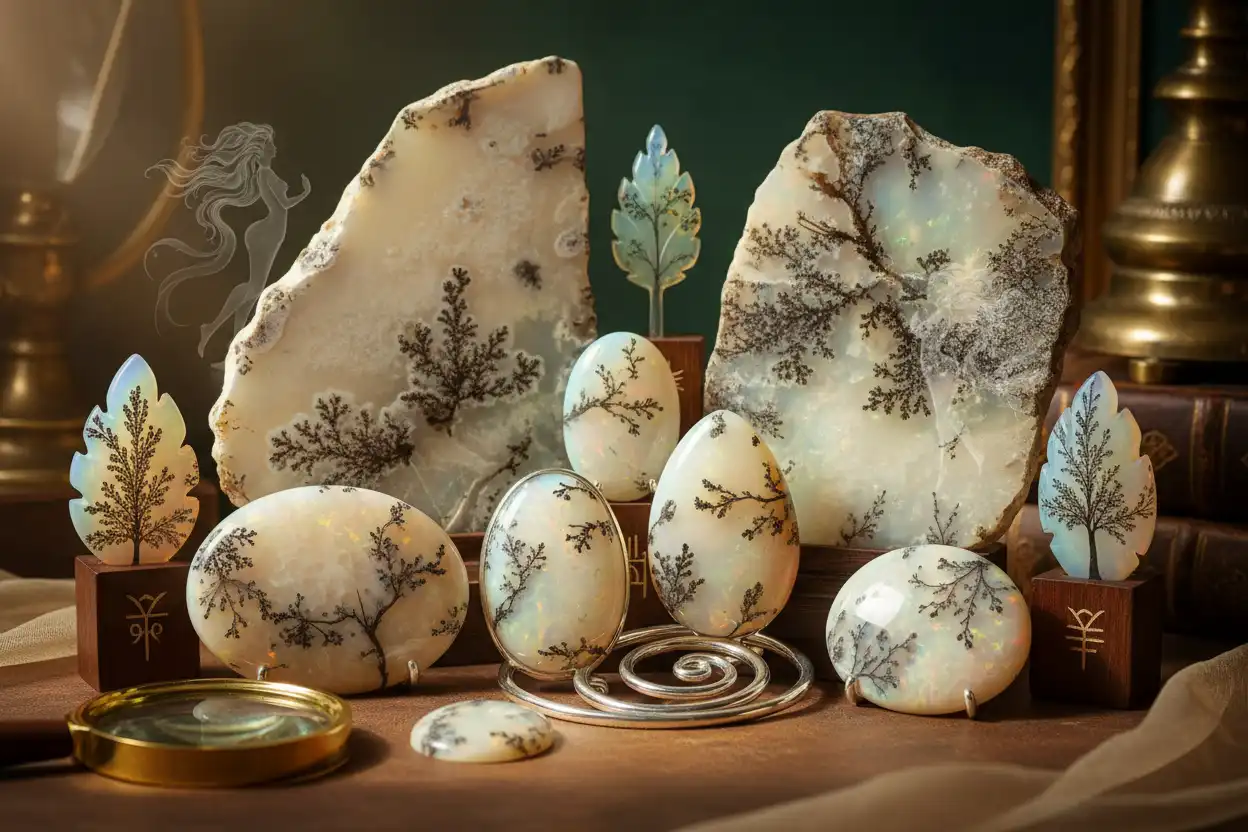
Dendritic Opal Meaning: Facts, History & Symbolism
Dendritic opal meaning begins with a visual illusion that is easy to interpret too literally. A polished piece can appear to contain miniature trees, roots, ferns, moss, coral, or a distant winter landscape, yet those branching forms are usually inorganic mineral dendrites rather than fossilized vegetation. The host material is opal—hydrated silica with a disordered internal structure rather than the long-range crystalline structure of quartz—while the dark branching inclusions commonly involve manganese- and iron-bearing mineral phases deposited along fractures, interfaces, or other pathways. The result is a natural geological pattern that can look remarkably biological without requiring any plant tissue at all.
That distinction also separates dendritic opal meaning from the closely related world of dendritic chalcedony. Both materials can contain tree-like mineral patterns, but the host substances are not interchangeable. Chalcedony is microcrystalline silica, whereas opal is a mineraloid composed primarily of hydrated silica. Their hardness, refractive behavior, internal structure, fracture characteristics, response to environmental change, and lapidary behavior can therefore differ even when two polished pieces display almost identical black branches.
Modern dendritic opal meaning commonly centers on growth, patience, connection with nature, perspective, resilience, personal development, and the idea that complex outcomes can emerge gradually from small beginnings. Those themes fit the material visually, but they remain symbolic interpretations. Dendritic opal has not been shown scientifically to accelerate biological growth, alter emotional health, attract prosperity, activate chakras, or communicate with nature through a mineral-generated field.
Within Gems Lore’s Gemstone Guides reference collection, the material itself comes first. The most useful dendritic opal meaning is built by understanding what opal is, how dendrites form, why the host and inclusions have different colors, which observations can support identification, what history is actually documented, and where modern symbolism begins.
Dendritic Opal at a Glance
| Property | Practical reference |
|---|---|
| Material identity | Dendrite-bearing opal |
| Material class | Mineraloid rather than a conventional crystalline mineral |
| Main composition | Hydrated silica, commonly represented as SiO₂·nH₂O |
| Typical host colors | White, cream, gray, beige, pale brown, translucent colorless-to-milky tones |
| Dendrite colors | Black, charcoal, dark brown, rusty brown, reddish brown |
| Dendrite composition | Commonly manganese- and/or iron-bearing mineral phases |
| Exact dendrite species | Cannot reliably be determined from color alone |
| Transparency | Transparent in limited areas to translucent or opaque |
| Typical luster | Waxy to vitreous when polished |
| Mohs hardness | Commonly about 5.5–6.5 |
| Structure | Noncrystalline to poorly ordered hydrated silica |
| Play-of-color required? | No; much commercial dendritic opal is common opal without precious play-of-color |
| Plant fossils? | Normally no |
| Main look-alike | Dendritic agate or dendritic chalcedony |
| Symbolic associations | Growth, patience, nature, perspective, interconnectedness |
| Evidence boundary | Symbolism is interpretive rather than a demonstrated physical effect |
The most important distinction in dendritic opal meaning is that the dark branching pattern and the pale host are different geological components. The opal gives the object its basic structure and physical behavior, while the dendrites create the landscape-like imagery that attracts collectors and fuels much of the later symbolism.
What Dendritic Opal Actually Is
Dendritic opal is opaline silica containing branching mineral inclusions. Opal is commonly represented chemically as hydrated silica, but that simplified formula does not mean every specimen contains an identical amount of water or the same degree of internal organization. Natural opal can vary substantially in porosity, transparency, body color, water content, associated minerals, and microscopic structure.
Unlike quartz, opal lacks the same long-range crystalline lattice. That is why it is usually described as a mineraloid rather than a mineral species in the strict crystallographic sense. This structural difference matters because commercial language often groups opal, quartz, agate, jasper, and other silica-rich materials together as though they were interchangeable varieties of one substance.
They are not.
The dendrites are separate inclusions occupying or crossing the opal host. They may occur as extremely thin films along internal planes, more three-dimensional branching networks, diffuse mineralized patches, or combinations of these textures.
Dendritic opal meaning therefore involves two identities at once: the opal host and the included mineral pattern.
Dendritic Opal Is Usually Not Fossilized Moss or Trees
The visual resemblance can be extraordinary. A single cabochon may look like leafless trees standing against fog, while another resembles roots spreading through pale soil. This appearance naturally encourages biological explanations.
Typical dendrites, however, can form completely through inorganic chemistry.
Mineral-rich fluids move through microscopic fractures, pores, surfaces, or interfaces and deposit dark compounds when chemical conditions favor precipitation. As deposition advances, the material may branch repeatedly, creating a self-organized geometry that resembles plant growth.
No fossil tree is required.
A genuine plant fossil would require biological structures or other evidence supporting an organic origin. A branch-shaped black mineral inclusion is not sufficient.
This distinction gives dendritic opal meaning an unusual conceptual strength: it is an object that demonstrates how easily resemblance can be mistaken for identity.
How Dendritic Opal Forms
Dendritic opal formation begins with silica-rich fluids. Silica can be mobilized in groundwater or hydrothermal systems and later accumulate in fractures, cavities, sedimentary pore spaces, weathered rock, or other favorable environments. As conditions change, hydrated silica precipitates and may progressively fill available space.
The dendrites can form during or after that silica deposition. Fluids carrying manganese, iron, or other elements migrate along tiny openings or boundaries and precipitate mineral matter in branching patterns. Changes in oxidation state, pH, fluid chemistry, concentration, diffusion, and access to open pathways can influence where the dark material accumulates.
Not every dendrite must therefore have formed at exactly the same moment as its surrounding opal.
Some may represent a later episode of mineralization after the host had already developed fractures or internal surfaces. Others may form during a more complex sequence of silica deposition and fluid movement.
The geological sequence is explored more deeply in dendritic opal formation and deposit geology. For dendritic opal meaning, the essential point is that the branch pattern records fluid movement and precipitation rather than biological growth.
Why the Opal Host Is White, Cream, Gray, or Translucent
Common dendritic opal often has a white, cream, gray, beige, or pale translucent host. These appearances reflect the way light interacts with hydrated silica, microscopic pores, structural irregularities, fine inclusions, fractures, and specimen thickness.
A thin edge may transmit considerable light even when the center of a cabochon appears milky or opaque. Likewise, a rough exterior can look dull and chalky while a polished interior reveals far greater translucency.
Body color can also be influenced by trace mineral matter and staining. Pale yellow, tan, or brownish regions may reflect included or associated compounds rather than an entirely different opal species.
Photography can exaggerate these differences considerably. Strong backlighting may make ordinary translucent common opal look nearly transparent, while an overexposed white background can erase subtle cream, gray, or brown areas.
The neighboring guide to dendritic opal optical properties and color behavior owns the detailed optical discussion. On this page, color is useful primarily because it helps describe the material without turning appearance into a metaphysical claim.
What Makes the Dendrites Black or Brown?
Dark dendrites are frequently associated with manganese-rich mineral phases, while reddish or rusty brown areas may include iron-bearing oxides or hydroxides. Mixed chemistry is possible, and one stone may contain several visually similar phases.
This makes exact species claims difficult from photographs.
A black branch cannot safely be called pyrolusite merely because pyrolusite is a well-known manganese oxide. Several manganese-bearing minerals can appear dark, while microscopic grain size and mixtures complicate identification further.
The same caution applies to brown inclusions. Brown may be consistent with iron-bearing mineralization, but it does not prove one specific iron mineral.
Dendritic opal meaning is therefore stronger when it uses compositional families where appropriate—manganese-rich dendrites or iron-bearing dendrites—rather than pretending that every visible branch has been analytically identified.
Why Branching Happens Without Biology
Branching patterns occur throughout physical systems. Frost spreads into delicate structures on glass. River systems divide into tributaries. Electrical discharges can branch. Mineral solutions form dendrites. None of those structures requires a tree or fern to act as a template.
In dendritic opal, mineral precipitation can advance preferentially into available pathways while diffusion controls the delivery of dissolved material. Small differences in concentration or surface geometry can cause growth fronts to divide, and repeated division produces the familiar tree-like pattern.
This process explains why the dendrites often appear natural yet uncannily organized.
Their resemblance to vegetation is therefore genuine in geometry but not in origin.
That distinction matters because much of dendritic opal meaning derives from nature symbolism. A symbolic connection with forests or roots can still be meaningful even after the inclusions are correctly identified as inorganic.
Dendrites Can Be Films or Three-Dimensional Networks
A polished stone viewed from the front can hide the actual geometry of its inclusions. Some dendrites are extremely thin deposits concentrated along one fracture or internal plane. Others extend through several depths, overlap neighboring branches, or connect with cloudy mineralized regions.
Rotating a translucent stone under magnification can reveal those depth differences.
A branch that disappears behind a milky zone and reappears deeper inside the opal provides more information than a flat front-facing photograph. Several overlapping dendritic planes can create landscape scenes with remarkable apparent depth.
This feature is valuable for identification because a surface-painted design behaves differently from a genuinely internal inclusion.
However, three-dimensional appearance alone does not prove untreated natural origin. Composite materials and artificial inclusions can also be internal. The host material, pattern relationships, surface evidence, and provenance still need to agree.
What Magnification Can Reveal
Magnification can transform a picturesque dendritic opal into a geological record. Branch tips may break into tiny granular particles rather than perfect botanical leaves. Dark networks can follow healed fractures or occupy interfaces between cloudy and clearer opal. Brown and black material may occur together in the same branch system.
The specialized dendritic opal microscope and inclusion notebook deals with these features more closely.
Microscopy can also reveal whether apparent scratches are surface damage or internal dendrites viewed edge-on. Polishing lines, pits, resin-filled fractures, glue, coating residue, and abrasive wear can become visible as well.
The limitation is equally important. A microscope usually cannot identify the exact chemical species of an opaque microscopic inclusion solely from its appearance. Analytical evidence may be required when the mineral name matters.
An Original Dendritic Opal Specimen and Photo Checklist
A useful specimen check begins with format. Record whether the object is rough opal, a slab, cabochon, freeform, bead, carving, or matrix specimen. Cutting can remove host rock, weathered rind, fracture context, and other evidence that would otherwise help interpret origin.
Next, photograph the object under diffuse neutral light. Include a scale and avoid backgrounds that make white opal appear brighter than it is. Record body color before using transmitted light.
Then add backlighting if the material is translucent. Observe whether branches exist at several depths, whether they overlap cloudy areas, and whether portions become visible only when light passes through thin sections.
Rotate the specimen ninety degrees and examine the edge. A pattern that looks like a forest from the front may reveal itself as a thin mineral film when viewed sideways. That observation does not make it less natural; it clarifies how the dendrite occupies the opal.
Use magnification at branch junctions. Natural dendrites commonly split irregularly, widen into granular patches, thin toward their ends, cross small fractures, or develop asymmetrical branches. A perfectly botanical pattern with repeated identical “leaves” deserves additional scrutiny.
Inspect the polished surface for cracks or crazing separately from internal branches. Opal can develop fine fracture networks, and dark contamination in surface cracks should not automatically be interpreted as original dendritic mineralization.
Finally, separate conclusions by evidence strength. “Translucent common opal with internal black branching inclusions” may be supportable visually. “Manganese-rich dendritic opal” may be a reasonable compositional interpretation. “Pyrolusite dendrites from a specific mine, completely untreated” requires much stronger evidence.
A Claim-Reconciliation Table
| Common claim | What can reasonably be retained | What requires correction or stronger evidence |
|---|---|---|
| “Dendritic opal contains miniature trees.” | The inclusions frequently resemble trees | Typical dendrites are inorganic mineral growths |
| “The black dendrites are always pyrolusite.” | Manganese-rich phases commonly produce dark dendrites | Exact species needs analytical support |
| “Brown branches are iron minerals.” | Iron-bearing phases can produce brown and rusty colors | Color does not identify one mineral species |
| “Dendritic opal is dendritic agate.” | Both can contain similar branching inclusions | Their host materials have different internal structures |
| “Dendritic opal must show play-of-color.” | Opal can display play-of-color in appropriate material | Most dendritic opal is valued for inclusions rather than precious-opal effects |
| “No rainbow means it is fake opal.” | Precious opal is famous for spectral play-of-color | Common opal is genuine opal without that optical phenomenon |
| “The dendrites prove fossil vegetation.” | Patterns can strongly resemble plant forms | Shape alone does not demonstrate biological origin |
| “The stone makes plants grow.” | Growth is a common symbolic theme | No established evidence demonstrates accelerated plant growth |
| “Dendritic opal connects the wearer biologically with nature.” | Nature connection can be meaningful symbolism | No measurable physiological connection is established |
| “Every old scenic opal has ancient spiritual meaning.” | Scenic patterned stones have long attracted attention | Specific historical symbolism must be documented rather than assumed |
The table illustrates why dendritic opal meaning benefits from source comparison. Many inaccurate explanations start from something real—the branches resemble plants, opal contains water, manganese can be dark—and then extend those facts into conclusions they cannot support.
Dendritic Opal Versus Dendritic Agate
Dendritic Agate is the most important comparison because the visible patterns can be almost indistinguishable. Both materials may have pale translucent hosts filled with black or brown branching mineral inclusions.
The host provides the decisive distinction.
Dendritic agate is chalcedony-rich, meaning its silica is organized as microscopic crystalline material. Dendritic opal is hydrated noncrystalline or poorly ordered silica. That structural difference influences hardness, refractive properties, density, fracture behavior, stability, and cutting response.
A branch pattern alone cannot determine which host is present.
The terms can also be used loosely in trade, particularly when material has not been tested carefully. For a valuable specimen, identifying the host is more informative than deciding which landscape-like trade name sounds better.
Dendritic Opal Versus Desert Rose
A Desert Rose creates nature-like imagery through a completely different mechanism. Desert roses are rosette-shaped mineral aggregates, commonly gypsum or barite, whose blade-like crystals and incorporated sand produce structures resembling flower petals.
Dendritic opal creates its biological resemblance internally. The host is opal, while dark mineral inclusions branch through or across it like trees.
One resembles a flower because of external crystal aggregation; the other resembles vegetation because of internal mineral precipitation.
Both demonstrate how natural mineral geometry can look organic without actually being living material.
Dendritic Opal Versus Datolite
Datolite can occur as pale nodular or massive material and may contain contrasting inclusions, which can create superficial similarities after polishing.
Datolite is nevertheless a calcium borosilicate hydroxide mineral with a defined crystalline structure. Dendritic opal is hydrated silica mineraloid material containing separate dendritic inclusions.
Their hardness, structural organization, chemistry, optics, and geological formation therefore differ substantially.
This comparison becomes particularly useful in cut material because polishing removes many exterior clues that would otherwise make unrelated substances easier to distinguish.
Dendritic Opal Versus Diamond Color Terminology
The concept of color is handled very differently across gem materials. In diamond, body color is assessed within a highly developed gemological grading context, and the neighboring guide to diamond color meaning addresses how color influences description and interpretation in that material.
Dendritic opal cannot be reduced to a comparable single color scale. Its visual identity depends on interaction among host color, translucency, dendrite color, branch distribution, pattern depth, polish, and sometimes matrix.
A white opal with sparse black dendrites and a cream opal with dense brown branching may appeal to entirely different collectors without one being objectively “higher color.”
Pattern is part of the material’s identity in a way that a simple body-color grade cannot capture.
Common Opal Versus Precious Opal
Dendritic opal is often common opal rather than precious opal. Common opal lacks the organized optical structures necessary to produce the shifting spectral play-of-color for which precious opal is famous.
This does not make it defective.
The value and appeal of dendritic opal usually come from its inclusions, landscape effect, translucency, color contrast, cutting, and individuality rather than from rainbow flashes.
A seller who implies that genuine opal must always show play-of-color is confusing one famous opal phenomenon with the entire material family.
Dendritic opal meaning should therefore celebrate what makes the stone distinctive rather than describing common opal as an incomplete version of precious opal.
Documented History Versus Invented Dendritic Lore
Opal has an extensive history in jewelry, decorative art, trade, symbolism, and folklore. Patterned and included stones have likewise attracted human attention for generations because recognizable images naturally invite storytelling.
However, broad historical evidence for opal does not prove that a particular ancient culture recognized dendritic opal as a distinct variety with the exact modern meanings attributed to it today.
Older texts frequently used stone terminology differently from modern mineralogy, and descriptions may not provide enough structural or chemical detail to distinguish common opal, chalcedony, agate, glass, or another pale ornamental stone.
Dendritic opal meaning is therefore best divided into documented opal history and modern dendritic symbolism rather than merging the two into a seamless ancient tradition.
That approach preserves history instead of rewriting it.
Why Nature Became Central to Dendritic Opal Meaning
Few gem materials invite nature symbolism as directly as dendritic opal. A single cut surface may look like a forest, roots beneath soil, winter branches, grasses, river systems, or distant mountains.
Modern dendritic opal meaning consequently emphasizes nature, interconnectedness, patient growth, adaptation, and awareness of gradual processes.
These ideas are interpretations of appearance.
A person might place dendritic opal on a desk as a reminder to spend more time outdoors, maintain a garden, take breaks from screens, or consider how one decision branches into many consequences. The stone can make those intentions memorable because the pattern is visually distinctive.
No claim about a special biological frequency is required.
Growth as Symbolism Rather Than Physiology
Growth is one of the most repeated themes in dendritic opal meaning because the inclusions look like expanding vegetation. The similarity can support a useful metaphor for projects, relationships, learning, or habits that develop incrementally.
The underlying geology makes the metaphor even more interesting. Dendrites can emerge through repeated mineral precipitation as material follows available pathways. A complicated branching network may therefore result from many small deposition events rather than one instantaneous transformation.
Human biological growth is completely different.
The stone has not been demonstrated to increase cell growth, fertility, wound healing, hair growth, plant growth, or tissue regeneration. Branching appearance is not evidence of a biological effect.
Patience and Incremental Change
Patience is a particularly coherent symbolic interpretation because dendritic structures evoke processes that unfold gradually. A highly detailed pattern can look finished and intentional even though it represents numerous small changes accumulated over time.
Someone working toward a long-term goal can use dendritic opal meaning as a visual reminder that progress does not need to be dramatic to be meaningful.
The usefulness lies in the reminder.
The mineral does not reduce impatience chemically, nor does it change personality through proximity. A person associates the object with an intentional behavior, and repeated attention can reinforce that association.
This is a stronger and more testable framing than saying the opal “emits patient energy.”
Nature Connection Without Nature Mysticism
Dendritic opal is sometimes described as creating a direct energetic connection with plants, forests, Earth spirits, or natural cycles. Those ideas belong to spiritual traditions and should be presented as belief rather than mineral science.
A non-mystical nature connection is easier to support. Humans can respond emotionally to natural imagery, and a stone resembling a landscape can trigger memories or associations involving forests, gardening, hiking, seasons, or environmental places.
The object can therefore become a meaningful cue for behavior connected with nature.
Keeping a dendritic opal beside a plant may remind someone to water it. Carrying one on a walk may make the outing feel ritualized. Neither example requires the stone to change plant physiology or communicate with an ecosystem.
Chakra Associations
Modern crystal systems sometimes connect dendritic opal with the root chakra because of earthy brown and black inclusions, while other practitioners emphasize the heart because of nature and growth symbolism. Still others assign different meanings according to the host color.
These differences illustrate that chakra classification is interpretive rather than mineralogical.
One dendritic opal does not physically change its properties according to which chakra chart is being consulted. No validated gemological or medical test measures chakra activation by the stone.
Dendritic opal meaning can include such associations when they are identified clearly as contemporary spiritual practice.
Opal’s Water Content Is Not a Healing Mechanism
Opal contains water within its hydrated silica structure, and that fact sometimes becomes the basis for claims about hydration, emotional flow, detoxification, or balancing bodily fluids.
The inference is not supported.
Structural water in opal is part of the material itself. It is not a reservoir that transfers useful hydration through skin contact, and wearing opal does not replace drinking water or medical management of fluid balance.
The same distinction applies to the elements within the dendrites. Manganese or iron compounds inside a stone do not become nutritional supplements through ordinary handling.
Mineral chemistry explains the object. It does not prescribe therapy.
Safe Ownership
Finished dendritic opal can generally be handled and worn normally, but its physical properties deserve more caution than harder chalcedony-rich materials. Opal can be vulnerable to scratching, impact, rapid temperature changes, dehydration-related instability in some material, and existing internal fractures.
That vulnerability varies among specimens.
A stable cabochon that has been worn successfully for years may behave very differently from freshly cut, highly porous, crazed, or unstable opal. The stone should therefore be evaluated as an individual object rather than assuming every dendritic opal reacts identically.
Cutting, grinding, drilling, and sanding create fine silica-bearing dust and require appropriate lapidary controls. Wet processing and suitable extraction are preferable to casual dry grinding.
Direct-contact drinking-water elixirs are unnecessary. Natural dendritic opal can contain several mineral phases, fracture residues, polishing compounds, or treatments that are not obvious from the trade name.
The site’s Disclaimer is relevant when dendritic opal meaning crosses from symbolism into claims about physical or psychological health; educational mineral information cannot establish an individualized treatment.
Cutting Dendritic Opal Is Pattern Selection
The cutter does more than shape the stone. Orientation determines which part of the dendritic network becomes visible and whether the finished piece looks like a forest, a single branch, a distant horizon, or an abstract pattern.
A promising rough specimen may contain excellent dendrites only along one internal plane. Removing too much material can erase the scene entirely. Conversely, cutting slightly deeper can expose a stronger branching layer that was barely visible from the surface.
Translucency also influences orientation. A thin cabochon may make deeper dendrites visible through the host, while a thick design can hide them behind milky opal.
These lapidary decisions belong in dendritic opal cutting, orientation, and polish. For dendritic opal meaning, the important insight is that the final “landscape” represents cooperation between geological pattern and human cutting judgment.
Jewelry Requires More Protection Than the Symbolism Suggests
Dendritic opal can make distinctive pendants, earrings, brooches, rings, and other ornamental pieces, but its moderate hardness and possible sensitivity to impact require realistic expectations.
Large scenic cabochons often have broad polished surfaces, making scratches more visible than they would be on a heavily patterned opaque stone. Thin edges can chip, and existing fractures may worsen if a setting applies concentrated pressure.
The dendritic opal setting and wear engineering guide addresses those construction issues directly.
Calling dendritic opal a protective stone in symbolic practice does not make an exposed opal ring mechanically protected.
Provenance Is Not Hidden in the Landscape
A dendritic pattern can become so visually distinctive that sellers sometimes attribute a stone to a famous locality from appearance alone. That inference needs restraint.
Similar manganese- or iron-bearing branching patterns can form in opal from more than one region. Body color, dendrite density, and cutting style can increase resemblance without establishing geographic origin.
Once a specimen has been sliced into a cabochon, much of its original context disappears. Host rock, weathered exterior, associated minerals, fracture relationships, and matrix may all have been removed.
The dendritic opal provenance disclosure checklist provides the stronger approach: mine labels, purchase records, old collection information, credible dealer documentation, and traceable chain of custody should support a geographic claim.
A landscape-looking cabochon is a visual object, not a geographic certificate.
Conservation Means Preserving More Than Polish
A dendritic opal specimen can contain information that disappears through recutting or aggressive cleaning. Natural fracture surfaces may show how mineralized branches entered the host. Rough rind can preserve weathering evidence. Old labels can establish locality more strongly than the stone’s appearance.
Polished pieces require a different kind of conservation. Fine scratches, chipped edges, crazing, repairs, or changes in fracture networks can alter the scene permanently.
The dendritic opal specimen conservation record provides a structure for tracking condition when a piece has scientific, historical, collector, or sentimental importance.
The goal is not to make every specimen look newly polished. It is to preserve the features that explain what the object is and where it came from.
A Better Way to Interpret Dendritic Opal Meaning
The broader editorial approach described on Gems Lore’s About page is particularly useful for dendritic stones because they encourage the human mind to create stories immediately. A branch becomes a fossil tree, a dark inclusion becomes one named manganese mineral, a white opal becomes a symbol of purity, and an unusual pattern acquires a precise locality.
Each inference may be plausible. None should be treated as automatically proven.
A better sequence is to describe first, identify second, document third, and interpret last.
That means recording a “black branching inclusion” before naming its mineral species, identifying the host as opal before comparing it with agate, documenting provenance before claiming mine origin, and labeling nature symbolism as symbolism rather than physiology.
Dendritic opal meaning becomes more distinctive, not less, when those boundaries are visible.
Frequently Asked Questions About Dendritic Opal Meaning
What is dendritic opal?
Dendritic opal is opal containing branching mineral inclusions called dendrites. The host is hydrated silica, while the dark branches commonly involve manganese- or iron-bearing mineral phases.
What does dendritic opal meaning symbolize?
Modern dendritic opal meaning commonly includes growth, patience, nature, resilience, perspective, interconnectedness, and gradual personal development. These are symbolic interpretations rather than scientifically demonstrated effects.
Are the tree shapes in dendritic opal fossils?
Usually not. The tree-like shapes are generally inorganic mineral dendrites formed through precipitation along internal pathways or fractures.
What causes the black branches in dendritic opal?
Black dendrites are often associated with manganese-rich mineral phases. Exact mineral identity cannot be established reliably from black color alone.
What causes brown dendrites?
Brown, rusty, or reddish branches may contain iron-bearing oxide or hydroxide phases, manganese compounds, or mixtures. Analytical testing is required for precise species identification.
Is dendritic opal the same as dendritic agate?
No. The inclusion patterns can look similar, but dendritic opal has an opaline hydrated-silica host, whereas dendritic agate has a chalcedony-rich microcrystalline silica host.
Does dendritic opal have rainbow play-of-color?
Some opal varieties display play-of-color, but dendritic opal does not need to show it. Many desirable specimens are common opal valued primarily for their branching inclusions.
Is dendritic opal real opal if it has no rainbow colors?
Yes. Common opal is genuine opal even when it lacks the spectral play-of-color associated with precious opal.
Is dendritic opal a crystal?
In strict mineralogical terminology, opal is a mineraloid rather than a conventional crystal because it lacks the long-range ordered structure expected of crystalline minerals.
Is dendritic opal natural?
Natural dendritic opal exists and forms through geological silica deposition combined with mineral dendrite formation. Individual commercial pieces can still require examination for treatments, composites, coatings, or artificial patterns.
Does dendritic opal have healing properties?
There is no established scientific evidence that dendritic opal treats disease, changes hormone levels, improves circulation, heals emotional disorders, or produces medical effects through ordinary wear.
Does dendritic opal help plants grow?
No established evidence shows that placing dendritic opal near a plant accelerates biological growth. The association with growth comes from its plant-like visual pattern.
Can dendritic opal go in water?
Brief accidental contact does not automatically destroy every opal, but prolonged soaking is unnecessary and may be inappropriate for porous, unstable, treated, fractured, or mounted material. Care should be based on the specific object.
Is dendritic opal suitable for jewelry?
Yes, attractive material can be cut into jewelry, but opal’s moderate hardness and potential sensitivity to impact or environmental change favor thoughtful setting and wear.
How can I distinguish dendritic opal from dendritic agate?
The host material must be identified. Hardness, refractive properties, specific gravity, microscopic structure, fracture behavior, and professional gemological testing can distinguish opal from chalcedony when appearance is ambiguous.
What the Landscape Actually Tells You
The most useful dendritic opal meaning does not depend on imagining that a miniature forest was trapped inside a gemstone. Its geology is already more interesting than that shortcut. Hydrated silica accumulated within a geological environment, mineral-bearing fluids later moved through favorable pathways, and dark material precipitated into branching structures whose geometry happens to resemble living growth.
That resemblance explains the symbolism without proving it. Branches can represent decisions spreading into consequences, roots can suggest stability, and a slowly developing mineral network can become a metaphor for patience or sustained work. Those meanings belong to the person interpreting the stone rather than to an experimentally verified force inside the opal.
Dendritic opal also offers a useful lesson in identification: visually convincing stories are not necessarily material facts. A tree-like branch is not automatically a fossil, black is not a species name, an opal landscape does not reveal its mine, and a common opal does not need rainbow play-of-color to be genuine.
When a particular specimen challenges those boundaries—such as a supposed dendritic opal whose pattern appears surface-applied, whose host tests more like chalcedony, or whose documentation makes an unusual locality claim—the specific photographs or records can be submitted through Contact for review. In this material, examining what the pattern physically does is often more informative than asking what picture it resembles.