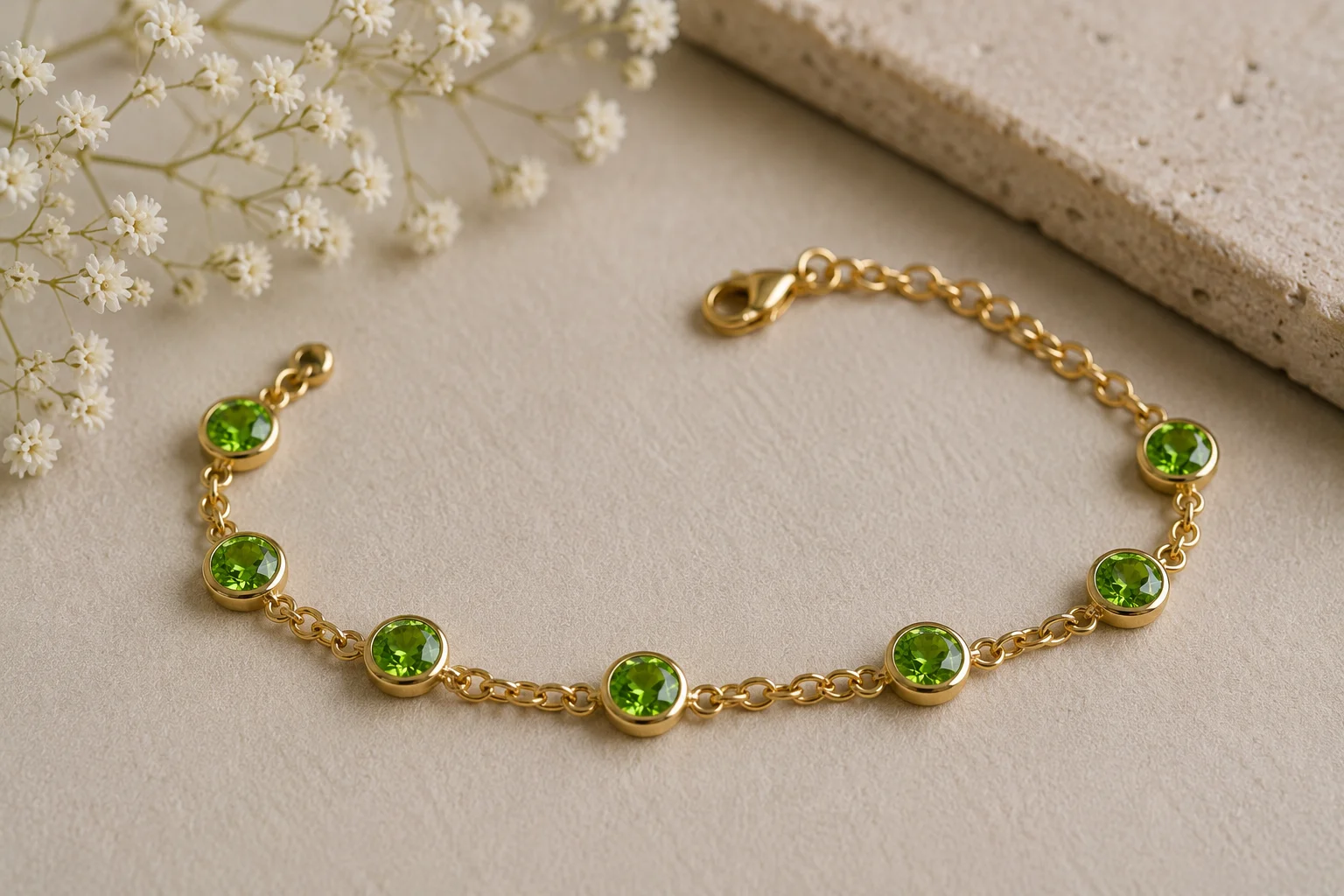
Demantoid Garnet Bracelets: Buying, Styling and Care Guide
A demantoid garnet bracelet combines vivid green color with unusually strong brilliance and dispersion. Demantoid is the green variety of andradite garnet, and fine stones can show more rainbow fire than many other colored gemstones.
Bracelets expose gems to desks, doors and accidental blows, so demantoid designs need secure settings and careful wear. Small matched stones in a well-constructed line bracelet may offer the best balance of color, sparkle and protection.
Demantoid Garnet Bracelet Overview
| Factor | What to look for |
|---|---|
| Gem identity | Natural green andradite garnet |
| Best color | Lively green without excessive brown or gray |
| Cut | Bright, symmetrical stones with limited windowing |
| Clarity | Eye-clean appearance or attractive characteristic inclusions |
| Matching | Consistent tone, saturation, size and cutting |
| Setting | Secure low-profile prongs, bezels or protective links |
| Metal | Gold or platinum for high-value pieces; disclosed alloys |
| Fit | Close enough to limit impact, with comfortable movement |
| Clasp | Secure clasp with an additional safety feature |
| Care | Warm mild soapy water; no steam and cautious ultrasonic use |
What Is Demantoid Garnet?
Demantoid is a green variety of andradite, one of the major garnet-group species. Chromium usually contributes to the green color, while iron can influence yellowish or brownish components.
The name comes from a word meaning diamond-like, reflecting the gem’s high brilliance and dispersion.
Unlike emerald, demantoid belongs to the garnet group and generally does not receive routine oil treatment. Unlike tsavorite, it is andradite rather than grossular garnet.
The completed guide to types of garnet explains how andradite, grossular, pyrope, almandine, spessartine and related mixtures differ.
Why Demantoid Works in Bracelets
Demantoid’s brilliance allows small stones to remain visually lively. This makes it suitable for line bracelets, station bracelets and accent designs where individual gems may be under one carat.
A row of small well-matched demantoids can create a continuous green effect without requiring one exceptionally large stone.
However, bracelets receive more impact than earrings or necklaces. The design must protect exposed girdles and prevent stones from striking one another.
Demantoid is also rarer in larger fine-quality sizes. A bracelet containing many sizable matched stones may carry a substantial premium.
Demantoid Garnet Bracelet Styles
Line Bracelets
A line bracelet places a continuous row of demantoids around the wrist. This format emphasizes matched color and brilliance.
Examine the bracelet under diffuse light to confirm that some stones are not noticeably darker, yellower or less lively than the others.
Flexible links should move smoothly without allowing stones to collide. Every setting needs independent inspection because one loose stone can compromise the complete design.
Station Bracelets
Station bracelets space demantoids along a chain. They use fewer gems and may feel lighter and more understated.
Check whether the stations flip constantly or expose the back of the setting. Balanced construction helps the stones face outward.
The chain should be strong enough for the gemstone value and intended wear frequency.
Tennis-Style Bracelets
A tennis-style demantoid bracelet provides a refined continuous look similar to diamond line bracelets.
Because demantoid is less tough than diamond, the piece should not be treated as an all-day sports or work bracelet.
Low-profile settings, secure articulation and a dependable clasp are particularly important.
Beaded Bracelets
Faceted or polished demantoid beads are less common than faceted mounted gems, especially in fine quality.
Confirm whether the beads are natural demantoid, another green garnet or a trade-name product. Drill holes can introduce weak points.
Stringing material should suit the bead weight, and the bracelet should receive regular inspection.
Mixed-Gem Bracelets
Demantoid may be paired with diamond, tsavorite, sapphire or other gems.
Diamond accents can emphasize brilliance, while yellow gold may warm yellow-green stones. White metals create a cooler visual effect.
Mixed designs must be cleaned according to the most sensitive stone, treatment and construction in the bracelet.
How to Judge Demantoid Color
Color is one of the most important quality factors.
Fine demantoid ranges from yellowish green to vivid green. Strong, lively green without excessive darkness, brown or gray usually receives the greatest interest.
Very dark stones may appear attractive under intense display lighting but lose brightness in ordinary rooms. Compare the bracelet under daylight-equivalent, warm and neutral illumination.
Matching matters more in a bracelet than in a single-stone ring. Slight variations can look natural, but one noticeably dull stone may interrupt the entire design.
Brilliance and Dispersion
Demantoid has high refractive index and strong dispersion, producing flashes of spectral color known as fire.
A well-cut stone balances green body color with brilliance. Poor proportions may create a transparent window through the center or dark areas that do not return light effectively.
Small demantoids can appear remarkably lively when the cut is precise.
Do not judge sparkle only under concentrated jewelry-store spotlights. Diffuse lighting provides a more realistic view of how the bracelet will look during normal wear.
Clarity and Horsetail Inclusions
Some demantoids contain radiating fibrous inclusions known as horsetails. Fine horsetails can add collector interest, especially in material associated with Russia.
However, not every Russian demantoid has a horsetail, and horsetail-like inclusions can occur in stones from other localities. The feature does not prove Russian origin by itself.
Heavy inclusions may reduce transparency or create durability concerns, particularly when fractures reach the surface.
In a bracelet, small stones should still look bright and reasonably matched. Collector inclusions should not be used to excuse weak color, poor cutting or structural damage.
Russian and Non-Russian Demantoid
Russia’s Ural region is historically famous for demantoid and remains strongly associated with vivid color and characteristic inclusions.
Demantoid has also been found in Namibia, Madagascar, Iran, Italy and other localities. Each source can produce attractive stones.
Origin may affect price, but it should not be assumed from color or inclusions alone. A credible laboratory report is appropriate when a seller charges a substantial premium for geographic origin.
Quality still matters independently of location. A fine non-Russian demantoid may be more beautiful than a weakly colored stone carrying a prestigious origin claim.
Choosing the Cut
Rounds are common because they emphasize brilliance and match easily across a bracelet.
Ovals, cushions and other shapes may appear in station or designer pieces. Consistency is essential when several stones form a repeated pattern.
Look for even outlines, centered tables and balanced facet reflections. A stone that appears tilted may be poorly set rather than poorly cut, so inspect both the gem and mounting.
Small demantoids should not be cut so shallowly that they show obvious windowing.
Choosing the Setting
Prongs allow more of each stone to remain visible, but they must be strong, even and smooth.
Bezel and partial-bezel settings offer greater edge protection. They may reduce some light entry, although skilled design can preserve plenty of brilliance.
Shared-prong settings create a delicate appearance but place greater importance on maintenance because one damaged prong may affect adjacent stones.
Low-profile construction is preferable for frequent wear. High exposed settings increase the likelihood of snagging and impact.
Choosing the Metal
Yellow gold complements the warm yellow-green component seen in some demantoids. White gold and platinum create a cooler frame that may make vivid green appear especially crisp.
Rose gold can produce attractive contrast but may compete with softer yellow-green stones.
The metal should match the bracelet’s value and intended use. Fine demantoid deserves secure construction, but the most expensive metal is not automatically the best design.
Verify alloy fineness and ask whether white gold contains nickel when metal sensitivity is a concern.
Bracelet Fit
A demantoid bracelet should move comfortably without sliding far enough to strike desks, counters or door frames repeatedly.
Measure the wrist and compare the bracelet’s interior length rather than relying only on labels such as small or medium.
A line bracelet generally needs a little movement for comfort, while a station chain may allow adjustable sizing.
Excessive looseness increases impact and snagging. An overly tight bracelet strains links, settings and skin.
Clasp and Safety Features
A secure clasp is essential because the combined value of many demantoids can be significant.
Box clasps are common in line bracelets and should close with a clear, stable engagement. Additional safety latches or chains provide another layer of security.
Lobster clasps work well for some station designs when appropriately sized.
Inspect the clasp while the bracelet is open and closed. It should not feel loose, bent or dependent on friction alone.
Demantoid vs Tsavorite Bracelets
Demantoid and tsavorite are both green garnets, but they belong to different garnet species.
Demantoid is green andradite and typically offers stronger dispersion. Tsavorite is green grossular, generally harder and often more resistant to abrasion.
Demantoid may show more fire, while tsavorite can provide richly saturated green with fewer rainbow flashes.
For a bracelet exposed to frequent contact, tsavorite may offer a modest durability advantage. Demantoid remains compelling when brilliance and rarity are the priorities.
Demantoid vs Emerald Bracelets
Emerald is a green beryl colored primarily by chromium, vanadium or both. It commonly contains visible inclusions and is frequently treated with oil or resin.
Demantoid is generally more dispersive, producing stronger fire. Its green can range from yellowish to vivid, while fine emerald often shows a more bluish green.
Both materials need careful bracelet design. Emerald treatments complicate cleaning, while demantoid’s slightly lower hardness compared with some other garnets makes abrasion a concern.
The best choice depends on preferred color, optical effect and maintenance expectations.
Demantoid vs Sphene Bracelets
Sphene can show even stronger dispersion than demantoid, but it is softer and less suitable for exposed everyday bracelet use.
The completed comparison of sphene and demantoid garnet explains their optical and physical differences.
A sphene bracelet should generally be treated as delicate special-occasion jewelry. Demantoid is more practical, although it still requires cautious wear.
Understanding Price and Value
Demantoid value rises with color, brilliance, clarity, cut, size and provenance. Large fine stones are rare, so size can produce a steep premium.
Bracelet value also depends on matching. Assembling many stones with consistent color, proportions and brightness requires additional selection.
Metal weight, craftsmanship and brand may significantly affect the retail price.
The completed demantoid garnet price guide examines size premiums, Russian origin, horsetail inclusions and market quality factors.
How to Buy a Demantoid Bracelet
Begin with a seller who provides clear gemstone identity, dimensions, treatment disclosure and return terms.
Inspect the bracelet under several lighting conditions. Confirm that the stones remain lively outside concentrated spotlights.
Check every link, prong and clasp. Ask whether the bracelet has been repaired, resized or fitted with replacement stones.
The completed demantoid garnet buying guide provides a detailed checklist for color, clarity, cut, origin and documentation.
For a high-value bracelet, an independent report or professional appraisal may be appropriate.
Laboratory Reports and Appraisals
A laboratory report can identify the garnet variety and may address treatment. Origin determination may be available for some significant stones, depending on the laboratory and material.
A report does not assign beauty or guarantee market value. It should be considered alongside direct inspection and workmanship.
An appraisal serves a different purpose, often estimating replacement value for insurance.
Do not treat a retailer’s in-house certificate as equivalent to an independent gemological report without understanding who issued it and what was tested.
How to Wear a Demantoid Bracelet
Wear the bracelet after dressing and applying perfume, lotion or hair products.
Keep it on the non-dominant wrist when practical because that hand may receive fewer impacts.
Avoid stacking demantoid beside watches, diamonds or harder bracelets that can strike and abrade the stones.
Remove the bracelet before exercise, cleaning, gardening, cooking, childcare tasks or manual work.
Styling Demantoid Garnet Bracelets
A fine line bracelet can serve as the central jewelry statement with simple earrings or a plain ring.
Yellow-gold demantoid works well with warm neutrals, navy, cream and earth tones. White-metal designs create a cooler, more formal look.
Green does not need exact color matching with clothing. Contrast often shows the gemstone more effectively.
For mixed jewelry, coordinate metal or overall scale rather than forcing every gemstone to match.
Cleaning a Demantoid Bracelet
Warm water with mild soap and a soft brush is the safest general cleaning method for garnet jewelry.
Clean over a bowl rather than an open drain. Brush gently behind the stones and around the settings, then rinse carefully and dry with a lint-free cloth.
Steam cleaning is not recommended. Ultrasonic systems may be inappropriate when stones contain fractures or have received fracture filling.
The completed guide to cleaning demantoid garnet jewelry provides a full material- and setting-conscious process.
Water and Sunlight
Demantoid garnet generally tolerates brief contact with water and normal light, but a complete bracelet includes metal, joints and possibly treatments.
Do not soak the bracelet for long periods or expose it to harsh cleaners.
The completed guide explaining whether garnet is safe in water and sunlight covers garnet-group care distinctions.
Normal wear in daylight is reasonable. Prolonged hot-window storage remains unnecessary.
Storage
Fasten the bracelet before storage so links do not tangle or twist.
Place it flat in a padded compartment away from diamonds, sapphires and other hard gemstones. Individual pouches should not allow a flexible bracelet to fold sharply.
Do not hang a valuable line bracelet from a hook, as this may place ongoing stress on links and clasp components.
Keep purchase documents and laboratory reports in a separate safe location.
Repairs and Professional Inspection
Have the bracelet checked when a stone moves, a prong catches fabric or the clasp no longer closes firmly.
Do not continue wearing a piece with a loose gem. Movement can enlarge wear around the setting and lead to loss.
Professional jewelers can inspect links, settings, clasp alignment and any previous repairs.
Cleaning cannot correct worn metal or structural weakness. Maintenance should address the construction before polishing the appearance.
Conclusion
A demantoid garnet bracelet offers exceptional green brilliance but needs careful design and wear. Look for lively, well-matched stones, secure low-profile settings, smooth articulation and a clasp with an effective safety feature.
Color and cut matter more than marketing grades, while horsetail inclusions do not prove Russian origin by themselves. Choose the bracelet according to lifestyle and treat it as fine jewelry rather than a piece for rough daily activity.
Frequently Asked Questions
1. What is a demantoid garnet bracelet?
It is a bracelet set with demantoid, the green variety of andradite garnet known for high brilliance and dispersion.
2. Is demantoid suitable for bracelets?
Yes, but bracelets expose stones to impacts and abrasion. Secure settings and careful or occasional wear are important.
3. What color is the best demantoid?
Vivid, lively green without excessive brown, gray or darkness generally receives the strongest demand.
4. Are horsetail inclusions desirable?
Fine horsetail inclusions can add collector interest, but heavy inclusions may reduce transparency or durability.
5. Do horsetail inclusions prove Russian origin?
No. Not every Russian demantoid has a horsetail, and similar inclusions can occur in material from other locations.
6. Is demantoid rarer than tsavorite?
Both can be rare in fine quality and large size. Demantoid is particularly uncommon in large, vivid, well-cut stones.
7. Which is better for a bracelet, demantoid or tsavorite?
Tsavorite generally offers slightly greater hardness, while demantoid provides stronger dispersion and fire.
8. Can a demantoid bracelet be worn every day?
It can be worn carefully, but frequent rough activity increases abrasion and impact risk. Occasional wear is safer for fine pieces.
9. How should a demantoid bracelet fit?
It should allow comfortable movement without sliding far enough to strike surfaces repeatedly.
10. How should demantoid bracelets be cleaned?
Use warm mild soapy water and a soft brush. Avoid steam and use ultrasonic cleaning only after professional evaluation.
11. Can demantoid garnet go in water?
The gemstone usually tolerates a brief rinse, but prolonged soaking is unnecessary and the bracelet’s complete construction must be considered.
12. Should an expensive demantoid bracelet have a laboratory report?
Independent documentation is advisable when identity, treatment or claimed origin materially affects the price.