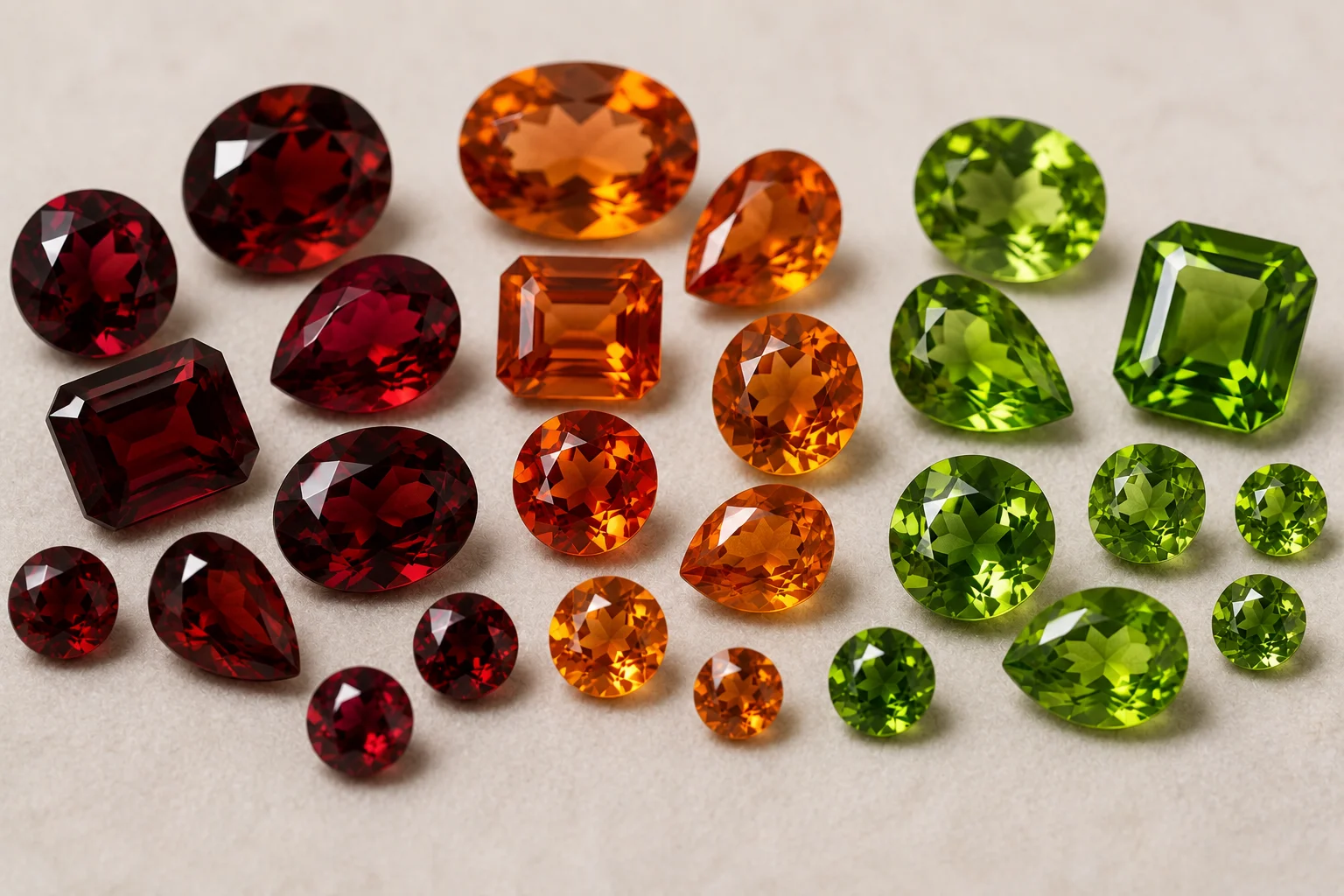
Types of Garnet: The Complete Variety Guide
Garnet is not one mineral with one predictable red color. It is a group of closely related silicate minerals whose chemical compositions blend across several species, producing red, purple, orange, yellow, green, brown, pink, colorless and exceptionally rare color-changing appearances.
Six mineral species account for most familiar Garnets: pyrope, almandine, spessartine, grossular, andradite and uvarovite. Many commercial varieties—including Rhodolite, Malaya, Mali and color-change Garnet—fall between ideal species because Garnets commonly form solid solutions.
Understanding the difference between a species and a variety makes Garnet labels much easier to interpret. Almandine and grossular are mineral species. Hessonite and Tsavorite are varieties of grossular, while Demantoid, Topazolite and Melanite are varieties of andradite. Rhodolite is usually a pyrope-almandine mixture rather than a separate mineral species.
Garnet Types at a Glance
| Garnet type | Mineral classification | Typical appearance |
|---|---|---|
| Pyrope | Species | Deep red, purplish red, pink or orange-red |
| Almandine | Species | Dark red, brownish red or purplish red |
| Spessartine | Species | Yellow-orange, vivid orange or reddish orange |
| Grossular | Species | Colorless, yellow, orange, brown, green or pink |
| Andradite | Species | Yellow, green, brown or black |
| Uvarovite | Species | Rich chromium green, usually as small crystals |
| Rhodolite | Pyrope-almandine variety | Raspberry, purplish red or pinkish purple |
| Umbalite | Mixed Garnet variety | Pinkish red, purple-pink or reddish purple |
| Hessonite | Grossular variety | Honey, cinnamon, orange-brown or reddish orange |
| Tsavorite | Grossular variety | Vivid yellowish green to bluish green |
| Demantoid | Andradite variety | Yellowish green to deep green |
| Topazolite | Andradite variety | Yellow, golden or yellow-brown |
| Melanite | Andradite variety | Opaque black to very dark brown |
| Mali Garnet | Grossular-andradite mixture | Yellow, yellow-green or brownish green |
| Malaya Garnet | Mixed Garnet variety | Peach, pinkish orange, orange-red or brownish pink |
| Color-change Garnet | Usually mixed pyrope-spessartine or related composition | Changes between daylight and incandescent light |
| Star Garnet | Usually included almandine | Four- or six-rayed star on a cabochon |
Why Garnet Has So Many Varieties
Garnet minerals share the same general crystal structure but accept different chemical elements within that structure.
Iron, magnesium, manganese, calcium, aluminum and chromium can substitute for one another. These substitutions produce the major species and the compositions between them.
For example, a red Garnet may contain substantial amounts of both pyrope and almandine components. A yellow-green Garnet from Mali may fall between grossular and andradite rather than matching either pure end member.
Consequently, many Garnets cannot be described accurately by assigning them to one ideal species from appearance alone. Laboratory analysis may use refractive index, specific gravity, spectroscopy and chemical composition to determine where the stone lies within the group.
The broader Garnet meaning guide explains the family’s mineral structure, history and symbolism.
Garnet Species Versus Trade Varieties
A mineral species has a defined structural and chemical identity. Pyrope, almandine and grossular are species.
A variety is a recognizable form within a species or composition range. Color, optical effect, chemistry or locality may define it.
Tsavorite is a vivid green grossular colored mainly by vanadium and sometimes chromium. Hessonite is an orange-to-brownish grossular variety. Both belong to the same species despite looking completely different.
Trade varieties can also span more than one species. Rhodolite generally combines pyrope and almandine components, while Malaya Garnet may include pyrope, spessartine and almandine in varying proportions.
The variety name should communicate a real gemological or market distinction rather than function as an unsupported marketing invention.
Pyrope Garnet
Pyrope is a magnesium-aluminum Garnet traditionally associated with deep red color.
Its ideal chemical formula is Mg₃Al₂(SiO₄)₃, although natural stones nearly always contain components from other Garnet species.
Classic pyrope can appear dark blood red, purplish red or red with a brown modifier. Some material is pale pink, orange-red or nearly colorless.
Historically important pyrope came from the Czech region of Bohemia, where small intensely colored stones became popular in cluster jewelry. Larger transparent material occurs in several other geological environments.
Pure-looking red pyrope can resemble Ruby, red Spinel and Almandine. Refractive index, density and spectroscopy separate them more reliably than color.
The dedicated Pyrope Garnet guide covers its geology and individual properties.
Almandine Garnet
Almandine is an iron-aluminum Garnet and one of the most widespread gem Garnet species.
Its ideal formula is Fe₃Al₂(SiO₄)₃.
Most Almandine appears red, brownish red, purplish red or extremely dark red. Large stones can look nearly black because the iron-rich material absorbs considerable light.
Much inexpensive red Garnet jewelry contains Almandine or an almandine-rich mixture. Fine transparent stones can still show strong color and attractive brilliance when cut to control darkness.
Almandine also produces some of the best-known star Garnets. Oriented needle-like inclusions create four- or six-rayed stars when the material is cut as a cabochon.
The Almandine Garnet guide explains this species in detail.
Spessartine and Spessartite Garnet
Spessartine is a manganese-aluminum Garnet with the ideal formula Mn₃Al₂(SiO₄)₃.
The names spessartine and spessartite refer to the same mineral. Spessartine is the mineralogical form, while spessartite remains common in the gemstone trade and in jewelry descriptions.
Colors range from yellow and yellow-orange to vivid orange, reddish orange and brownish red.
Bright orange material is sometimes marketed as Mandarin Garnet, especially when it shows strong saturation with relatively little brown. The trade term is descriptive rather than a separate mineral species.
Inclusions can include needles, crystals and distinctive liquid-related features. Fine orange stones may command substantial prices, particularly in larger clean sizes.
The Spessartite Garnet guide and Spessartite buying guide provide the variety-specific details.
Grossular Garnet
Grossular is a calcium-aluminum Garnet with the formula Ca₃Al₂(SiO₄)₃.
It has one of the widest color ranges in the family. Grossular may be colorless, pale green, yellow, golden, orange, brown, pink or vivid green.
Important varieties include Hessonite and Tsavorite. Hydrogrossular and massive green Grossular are often cut as cabochons or carvings rather than transparent faceted gemstones.
Grossular’s broad appearance means a green, orange and colorless stone can all belong to the same mineral species.
The Grossular Garnet guide explains the parent species and its geological environments.
Hessonite Garnet
Hessonite is an orange, reddish orange, honey or cinnamon-brown Grossular variety.
Its color commonly comes from iron.
Hessonite often contains a distinctive roiled, granular or heat-wave-like internal appearance. This texture can help distinguish it from cleaner orange Zircon, Sapphire, Citrine and Spessartine, although visual evidence alone is not definitive.
Fine Hessonite should show warm color and enough transparency to remain lively. Excessively dark or cloudy material has lower visual impact.
The name “cinnamon stone” refers to its traditional warm color, not to a separate mineral.
The Hessonite Garnet guide covers its individual identity and symbolism.
Tsavorite Garnet
Tsavorite is vivid green Grossular colored primarily by vanadium and sometimes chromium.
Its color ranges from yellowish green through balanced green to slightly bluish green. Fine stones combine strong saturation with enough brightness to avoid appearing black.
Tsavorite was brought to international market attention through East African deposits, especially in Kenya and Tanzania.
The material usually receives no routine color or clarity treatment. This characteristic, combined with its brilliance and durability, makes it a significant alternative to Emerald.
Fine stones become much rarer as size increases.
The Tsavorite guide explains the variety, while Tsavorite versus Emerald handles the direct comparison.
Hydrogrossular Garnet
Hydrogrossular is a grossular-related material in which hydroxyl groups replace part of the silica component.
It is usually translucent to opaque and commonly appears pale green, medium green, pink, white or gray.
Green hydrogrossular may resemble Jade and has sometimes been marketed under confusing terms such as “Transvaal jade.” It is not Jadeite or Nephrite.
The material is commonly fashioned into cabochons, beads and carvings rather than transparent faceted gems.
A laboratory can distinguish it from Jade through refractive index, spectroscopy, structure and density.
Andradite Garnet
Andradite is a calcium-iron Garnet with the ideal formula Ca₃Fe₂(SiO₄)₃.
It has the highest refractive index and dispersion among the major Garnet species. Consequently, well-cut transparent stones can show exceptional brilliance and colored flashes.
Andradite occurs in yellow, green, brown and black.
Its principal gem varieties are Demantoid, Topazolite and Melanite. Their appearances differ so strongly that many buyers do not initially recognize them as members of one species.
Demantoid Garnet
Demantoid is green andradite and one of the most prized Garnet varieties.
Color ranges from yellowish green to rich green. Chromium contributes desirable green, while iron can add yellow.
Demantoid’s high dispersion can produce visible spectral flashes, although strong green body color may conceal some fire.
Certain stones, particularly material associated with Russia’s Ural region, contain radiating fibrous inclusions traditionally called horsetails. These inclusions can support origin and identity interpretation but do not occur in every Demantoid.
The Demantoid Garnet guide and Demantoid buying guide cover its quality factors.
Topazolite Garnet
Topazolite is yellow to yellow-brown andradite.
The name refers to its resemblance to some yellow Topaz colors, not to any mineral relationship with Topaz.
Fine material can show strong brilliance and dispersion because it shares andradite’s optical properties.
Transparent facetable crystals are less familiar than Demantoid and may occur in small sizes.
Greenish yellow examples can overlap visually with Mali Garnet, yellow Sapphire, Zircon and other gems.
The variety name should be used only for andradite rather than any yellow Garnet.
Melanite Garnet
Melanite is black to very dark brown andradite.
Titanium contributes to its opaque dark appearance.
The material is fashioned into cabochons, beads, carvings and faceted black jewelry. Its surface can show a glassy or submetallic luster when polished well.
Melanite may be confused with black Spinel, Tourmaline, Obsidian, Onyx and glass.
Because color reveals little internal detail, identity often depends on refractive properties, density, luster and spectroscopy.
Uvarovite Garnet
Uvarovite is a calcium-chromium Garnet with the formula Ca₃Cr₂(SiO₄)₃.
It produces a vivid emerald-green color associated with chromium.
Uvarovite most commonly forms as small sparkling crystals coating a matrix. Crystals large and transparent enough for ordinary faceting are exceptionally rare.
Jewelry often preserves the natural crystal coating as a druzy-like surface. The matrix and attachment strength then become central durability concerns.
A green crystal-covered specimen should not be assumed to be Uvarovite solely from appearance, since other chromium-bearing minerals can look similar.
The Uvarovite Garnet guide covers this uncommon species.
Rhodolite Garnet
Rhodolite is a purplish red, raspberry, pinkish red or reddish-purple Garnet generally lying between pyrope and almandine.
The name is a trade variety rather than a formal mineral species.
Fine Rhodolite usually appears lighter and more purple than typical dark Almandine. It can also show high transparency and attractive brilliance.
Compositions vary, and some stones contain a measurable spessartine component.
The color overlaps red Spinel, Ruby, pink Tourmaline and other Garnet mixtures.
The Rhodolite Garnet guide and Rhodolite buying guide explain its identification and quality.
Umbalite Garnet
Umbalite is a pinkish red to reddish-purple mixed Garnet associated with Tanzania’s Umba Valley.
Its composition commonly includes pyrope, almandine and spessartine components.
The term describes a recognized trade variety and geographic association rather than one ideal mineral species.
Umbalite may resemble Rhodolite but can show warmer pink, red or orange modifiers depending on composition.
A geographic trade name should not be assigned from color alone. Provenance or analytical evidence is needed when locality materially affects the description.
The Umbalite Garnet guide provides the focused profile.
Malaya or Malaia Garnet
Malaya Garnet is a mixed-composition variety whose name is also spelled Malaia.
The material commonly contains pyrope and spessartine, sometimes with almandine or grossular components.
Colors include peach, pinkish orange, orange-red, reddish pink and light brownish pink.
The term originated in East African gem trading and has been interpreted as meaning outside the established categories available at the time.
Fine stones are valued for delicate peach or pink-orange colors rather than strict species purity.
The label should be supported by gemological characteristics rather than used for every pastel orange Garnet.
Mali Garnet
Mali Garnet generally falls between grossular and andradite.
It was introduced to the gem market through deposits in Mali and commonly appears yellow, yellow-green, greenish yellow, brownish green or light brown.
The andradite component can give the gem higher brilliance and dispersion than pure grossular.
Fine green material may resemble Tsavorite, while yellow stones can resemble Topazolite, Chrysoberyl or yellow Sapphire.
A stone marketed as Mali Garnet should have a grossular-andradite composition rather than merely a West African origin claim.
Color-Change Garnet
Color-change Garnet appears different under daylight-equivalent and incandescent illumination.
Many examples contain pyrope and spessartine components, although compositions vary.
A stone may shift from greenish, grayish or bluish tones in daylight to red, purplish red or pink under incandescent light. Other examples show subtler changes between purple, pink and red.
The quality of the effect depends on the strength, attractiveness and separation of the two colors.
Color change should be evaluated under standardized lights rather than by moving the stone between an unusually cool lamp and a strongly colored decorative bulb.
Blue Garnet
Strongly blue Garnet is exceptionally rare.
Some color-change material can show blue-green, teal or blue-gray under daylight-equivalent light before changing toward purple or red under incandescent light.
The description should not imply that blue is a common stable Garnet color comparable with blue Sapphire or Aquamarine.
Vivid blue or color-change claims deserve laboratory confirmation because synthetic materials, glass and other gemstones can imitate the appearance.
The value depends on natural identity, color strength, size, clarity and the quality of the change.
Star Garnet
Star Garnet displays asterism caused by oriented inclusions.
Most examples are almandine or almandine-rich Garnet cut as cabochons.
Four-rayed stars are common, while six-rayed examples also occur. The rays should move across the surface when the light source or stone changes position.
A well-centered star requires correct cutting orientation and an even dome.
Dark body color can make the star highly visible while limiting transparency.
Star Garnet is particularly associated with material from Idaho and India, although locality should not be inferred solely from the optical effect.
Cat’s-Eye Garnet
Some Garnets show a single chatoyant band rather than a complete star.
The effect results from oriented inclusions reflecting light across a cabochon.
Cat’s-eye Garnet is much less familiar than star Garnet and can occur in several colors and compositions.
The eye may be broad and soft rather than sharply defined.
Identification should confirm that the host stone is Garnet and that the optical effect comes from natural inclusions rather than a manufactured fiber-optic material.
Pastel Garnets
Pastel Garnet is an informal market description for pale pink, peach, lavender, orange or near-colorless material.
These stones may belong to pyrope-rich, spessartine-rich or mixed compositions.
The category is based on appearance rather than one species.
Fine pastel stones can show excellent brilliance because lighter tone permits more light to return through the gem.
A descriptive color label should not replace mineral identification when species or origin affects value.
Garnet Colors by Type
| Color | Common Garnet types |
|---|---|
| Deep red | Almandine, Pyrope and mixtures |
| Raspberry or purple-red | Rhodolite and Umbalite |
| Pink or peach | Pastel Pyrope, Malaya and mixed Garnets |
| Orange | Spessartine, Malaya and Hessonite |
| Yellow | Grossular, Topazolite and Mali Garnet |
| Bright green | Tsavorite, Demantoid and Uvarovite |
| Brown | Hessonite, Andradite and Almandine |
| Black | Melanite |
| Colorless | Rare Grossular and Pyrope-rich material |
| Color-changing | Mixed Pyrope-Spessartine and related compositions |
The separate Garnet color-meaning guide handles symbolism rather than mineral classification.
How Garnet Types Are Identified
Color provides an initial clue but cannot determine species reliably.
Gemologists examine refractive index, specific gravity, absorption spectra, microscopic inclusions and chemical composition.
Garnet is normally singly refractive because its crystal structure belongs to the cubic system. Internal strain can create anomalous reactions under crossed polarizers.
Density and refractive index vary considerably across the group. Andradite lies near the higher end, while pyrope and grossular occupy lower ranges.
Advanced laboratories may use Raman spectroscopy, ultraviolet-visible spectroscopy and trace-element analysis.
The real-versus-fake Garnet guide explains the wider authentication process.
Garnet Versus Ruby and Spinel
Red Garnet can resemble Ruby and Spinel.
Ruby is red Corundum, while Spinel is a separate magnesium-aluminum oxide mineral. Their refractive indices, density, hardness, spectra and inclusion patterns differ.
Dark Almandine often shows a brown or purple modifier, while fine Ruby can display stronger fluorescence and a different brilliance pattern. Red Spinel may appear bright and clean with no visible birefringence, but so can Garnet.
The Ruby versus Garnet versus Spinel guide handles the complete comparison.
Destructive scratch testing is unnecessary and can damage valuable stones.
Are Garnets Treated?
Most Garnets reach the market without routine color treatment.
This is one of the group’s major commercial advantages.
Fracture filling can occur, while unusual heating or experimental treatment has been reported in limited material. Such practices are far less central to Garnet trading than heating in Sapphire or oiling in Emerald.
A treated or filled stone should be disclosed.
Lack of treatment does not guarantee high quality. Color, clarity, cutting, size and structural condition still determine beauty and value.
Garnet Durability
Garnet hardness generally ranges from about 6.5 to 7.5, depending on species.
The minerals have no cleavage, which supports jewelry use. However, fractures, thin corners and inclusions can still chip after impact.
Andradite and some grossular material may differ slightly in wear behavior from almandine-rich stones.
The Garnet durability guide explains daily-wear suitability, while the Garnet jewelry-cleaning guide covers maintenance.
Choosing a Garnet Type
Choose according to color, use, rarity and budget rather than assuming red is the only authentic option.
Almandine offers accessible dark-red jewelry. Rhodolite provides lighter raspberry and purple-red color, while Spessartine supplies vivid orange.
Tsavorite and Demantoid occupy premium green categories. Hessonite offers warm cinnamon color, and Mali Garnet combines unusual yellow-green color with strong brilliance.
The Garnet buying guide provides the complete purchasing process, while Garnet quality and grading explains why seller-created AAA labels are not standardized.
Garnet Prices by Variety
Different Garnet types occupy very different markets.
Common small Almandine can be inexpensive, while fine Demantoid, Tsavorite, color-change Garnet and large clean Spessartine may command substantial prices.
Variety name alone does not determine value. Color quality, size, clarity, cutting, treatment, origin and optical phenomenon all matter.
The Garnet price guide owns the detailed market discussion.
Rare does not necessarily mean attractive, and attractive does not always mean rare.
Garnet Jewelry
The broad Garnet bracelet guide explains strands, tennis bracelets and mixed-variety designs.
The Garnet earrings guide focuses on pair matching.
The Garnet necklace guide covers pendants and bead strands, while the Garnet ring guide addresses setting protection and hand wear.
Each jewelry format can use several Garnet species, so an invoice should identify the variety rather than listing only “Garnet” when the distinction affects price.
January Birthstone
Garnet is January’s modern birthstone family.
The January birthstone guide explains why January jewelry can include green Tsavorite, orange Spessartine, purple Rhodolite and other colors rather than red alone.
The birthstone label does not identify the species.
A green January ring might contain Tsavorite, while a red pendant may be Almandine, Pyrope or a mixture.
Where Garnet Is Found
Garnet deposits occur on every inhabited continent and in many rock types.
Individual varieties have stronger locality associations. Tsavorite is linked with East Africa, Demantoid with Russia and several newer sources, Spessartine with Africa and other pegmatite regions, and Almandine with widespread metamorphic rocks.
The guide to where Garnet is found covers deposits and mining regions without treating every country as a separate variety.
Final Perspective
Garnet classification becomes clearer when species, composition and variety are separated.
Pyrope, almandine, spessartine, grossular, andradite and uvarovite form the mineral foundation. Rhodolite, Hessonite, Tsavorite, Demantoid, Malaya, Mali and color-change Garnet describe recognizable appearances within or between those species.
A precise label should communicate more than color. It should help the buyer understand composition, rarity, likely inclusions, treatment expectations, durability and market position.
Frequently Asked Questions
1. How many main Garnet species are there?
Six species account for most familiar Garnets: pyrope, almandine, spessartine, grossular, andradite and uvarovite.
2. Is every Garnet red?
No. Garnet occurs in red, pink, purple, orange, yellow, green, brown, black, colorless and rare color-changing appearances.
3. Is Rhodolite a mineral species?
No. Rhodolite is generally a pyrope-almandine variety with raspberry, purple-red or pinkish-red color.
4. What is the rarest Garnet color?
Strong blue or blue-green daylight color is exceptionally rare and is generally associated with color-change Garnet.
5. What is the difference between Tsavorite and Demantoid?
Tsavorite is green Grossular, while Demantoid is green Andradite. Demantoid has higher dispersion, while Tsavorite is generally harder.
6. Are spessartine and spessartite the same?
Yes. Both names refer to the manganese-aluminum Garnet species, although spessartine is the preferred mineralogical spelling.
7. What is Mali Garnet?
Mali Garnet is generally a grossular-andradite mixture showing yellow, yellow-green or brownish-green color.
8. What is Malaya Garnet?
Malaya or Malaia Garnet is a mixed-composition variety commonly showing peach, pink-orange or reddish-orange color.
9. What causes a star in Garnet?
Oriented needle-like inclusions reflect light from a cabochon and create four- or six-rayed asterism.
10. Are Garnets normally treated?
Most are untreated, although rare fracture filling and limited treatment can occur.
11. Which Garnet is best for everyday jewelry?
Sound Almandine, Pyrope, Rhodolite, Spessartine, Grossular and Tsavorite can perform well in suitable settings. Individual fractures and setting design still matter.
12. Which Garnet type is most valuable?
Fine Demantoid, Tsavorite, vivid color-change Garnet and exceptional large clean stones can be highly valuable, but no variety name guarantees quality.