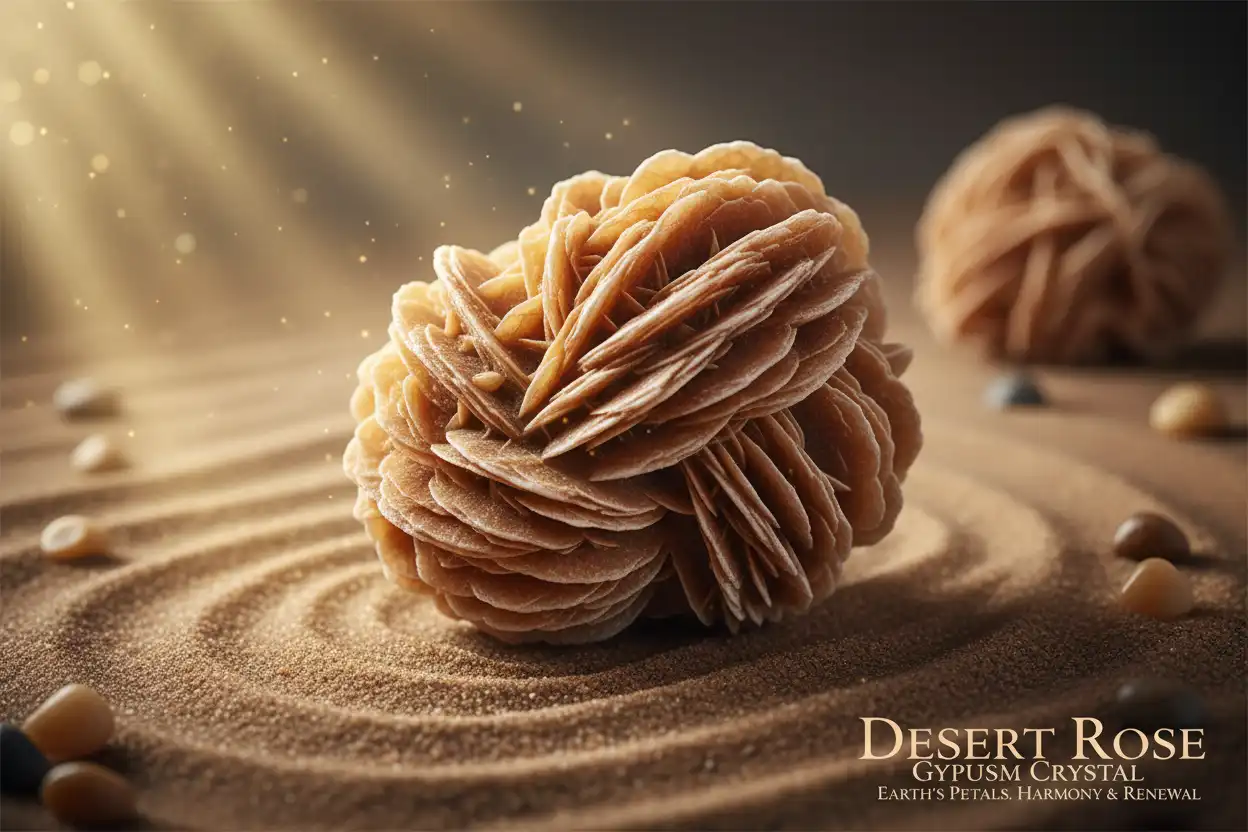
Desert Rose Meaning: Mineral Facts, History & Symbolism
Desert rose meaning starts with an unusually important identification detail: desert rose is a descriptive mineral habit, not one mineral species. The familiar flower-like clusters can form from gypsum, often in the selenite variety, or from barite, with sand grains commonly incorporated between and within the growing crystal blades. Both can develop radiating rosettes whose overlapping flat crystals resemble petals, yet gypsum and barite have different formulas, densities, hardness, crystal systems, cleavage behavior, and handling characteristics. A seller who describes every desert rose as “selenite” is therefore oversimplifying the material, while a description that treats every rosette as barite makes the opposite mistake.
That distinction gives desert rose meaning a stronger scientific foundation than the usual image of a mysterious flower-shaped crystal forming spontaneously in sand. The rosette develops because mineral-bearing water moves through sediment, evaporates or changes chemically, and allows tabular crystals to grow outward from clustered nucleation points. Sand becomes trapped during growth, producing the sandy cream, tan, gray, or brown appearance that makes many specimens look as though the desert itself has crystallized into petals. The resemblance to a rose is genuine; the biological interpretation is not.
Modern symbolism commonly connects desert rose meaning with resilience, patience, clarity, grounding, adaptation, perseverance, and finding structure within difficult conditions. These themes are understandable because the specimen forms in arid or evaporitic environments and visually resembles a flower emerging from sand, but they remain human interpretations rather than demonstrated effects of calcium sulfate, barium sulfate, crystal habit, or included sediment. Within Gems Lore’s Gemstone Guides collection, the material identity comes first so that later history and symbolism do not erase the important difference between gypsum desert roses and barite desert roses.
Desert Rose at a Glance
| Feature | Gypsum desert rose | Barite desert rose |
|---|---|---|
| Mineral identity | Gypsum, commonly selenite habit | Barite |
| Formula | CaSO₄·2H₂O | BaSO₄ |
| Mineral class | Sulfate | Sulfate |
| Crystal system | Monoclinic | Orthorhombic |
| Typical rosette form | Thin to moderately thick bladed crystals | Often thicker, heavier tabular blades |
| Mohs hardness | About 2 | About 3–3.5 |
| Specific gravity | Roughly 2.3 | Roughly 4.3–4.6 |
| Typical appearance | Cream, beige, pale tan, grayish, sandy white | Tan, brownish, cream, reddish, grayish |
| Transparency | Individual clean gypsum areas may be translucent | Common rosettes usually translucent to opaque |
| Included material | Frequently sand and fine sediment | Frequently sand and fine sediment |
| Major field clue | Very soft; can scratch easily | Much heavier for comparable size |
| Main caution | Easily damaged by scratching, soaking, and abrasion | Brittle blades can chip; density makes specimens unexpectedly heavy |
| Is “desert rose” a species name? | No | No |
| Symbolic status | Modern interpretation | Modern interpretation |
The table explains why a single chemical formula should never be presented for every desert rose. The trade and collector name describes a rosette-shaped aggregate formed under particular sedimentary or evaporitic conditions, while the actual mineral must still be identified.
What a Desert Rose Actually Is
A desert rose is a rosette aggregate composed of intersecting tabular or bladed mineral crystals, usually gypsum or barite, with varying amounts of incorporated sand or other fine sediment. The crystals grow in clusters rather than as one flower-shaped crystal, and their repeated overlapping blades create the petal-like structure visible from the outside.
This is an important correction to a common description. The “petals” are not separate decorative layers deposited onto a core. Each apparent petal is part of a mineral crystal or crystal blade whose geometry is governed by its underlying crystal structure. As multiple blades grow from neighboring nucleation sites, they intersect, overlap, and radiate outward.
Sand modifies the appearance considerably. Some specimens have relatively clean mineral surfaces, while others are so heavily coated or included with sediment that the crystal itself is difficult to see. Neither appearance automatically determines whether the specimen is gypsum or barite.
The shape therefore gives the object its name, but not its complete identity.
Why Some Desert Roses Are Gypsum and Others Are Barite
Gypsum and barite are both sulfate minerals, but they form from different chemical systems. Gypsum contains calcium, sulfate, and structural water, while barite contains barium sulfate and no comparable water component in its ideal formula.
Both can grow as tabular crystals in sediment-rich environments, which allows each mineral to develop similar-looking rosette aggregates. That morphological overlap is why appearance alone can mislead.
The difference becomes much more obvious when physical properties are considered. Gypsum is extremely soft at Mohs hardness 2 and can be scratched readily. Barite is harder, though still relatively soft by gemstone standards. More dramatically, barite is almost twice as dense as gypsum, so a similarly sized barite rose can feel unexpectedly heavy in the hand.
Those differences make the phrase “selenite desert rose” appropriate only after the mineral has been identified as gypsum. “Desert rose” by itself should remain a habit or trade description.
Is Desert Rose the Same as Selenite?
Not always.
Selenite is a traditional variety name applied to transparent or well-crystallized gypsum. Many commercially sold desert roses are gypsum and are routinely called selenite roses, gypsum roses, sand roses, or desert roses. In those cases, the association is reasonable.
However, barite also forms authentic desert rose rosettes.
That means every statement beginning “desert rose is a form of selenite” needs qualification. Some desert roses are gypsum; some are barite. A collector who needs species-level identification should examine density, hardness, crystal form, locality information, and, when warranted, analytical data rather than relying on the flower-like habit.
This naming ambiguity is one of the defining issues in desert rose meaning and one reason the material deserves its own reference rather than being treated as merely another shape of selenite.
How Desert Roses Form
Desert roses commonly develop in arid or evaporitic environments where mineral-rich groundwater moves through sandy or fine-grained sediment. Water carries dissolved ions through pores between grains, and changes in evaporation, concentration, groundwater chemistry, or local saturation eventually allow gypsum or barite to precipitate.
Crystal growth begins at favorable nucleation sites within the sediment. As tabular crystals extend outward, they encounter sand grains and neighboring crystals. Some sediment is displaced, some becomes trapped between blades, and some becomes incorporated into or attached to crystal surfaces.
Repeated growth produces a rosette rather than a perfectly isolated crystal.
The process may occur below the visible desert surface rather than on top of open dunes. Later erosion, excavation, or changes in sediment can expose the mineral aggregates.
The complete sedimentological and geochemical context belongs in desert rose formation and deposit geology. For desert rose meaning, the essential point is that the rose shape is a crystallographic and environmental outcome, not evidence that the mineral contains biological flower material.
Why the Crystals Form “Petals”
Crystal habit follows internal structure, but the final external form also depends on growth space, fluid supply, impurities, neighboring crystals, and sediment.
Gypsum and barite can both develop flattened crystals. When many such crystals nucleate close together and grow outward at different orientations, their broad faces resemble flower petals. Continued growth makes the cluster increasingly three-dimensional.
No two rosettes need to be identical.
Some specimens form open flowers with clearly separated blades. Others become dense balls in which individual crystals overlap heavily. One side may be flattened where the aggregate grew against compact sediment, while another side opens freely into available space.
This irregularity is part of the geological record rather than a flaw.
Why Desert Roses Are Sandy
The sandy appearance is not merely dirt that happened to stick to a finished crystal. Sand can become involved during the growth process itself.
As crystals expand through sediment, mineral blades interact with grains surrounding them. Fine particles may be trapped between crystals, enclosed along growth surfaces, or incorporated unevenly into the aggregate. This produces the distinctive rough, dusty, matte, or granular surfaces associated with many desert roses.
Cleaning therefore needs restraint. Trying to remove every sand grain can destroy part of the specimen’s natural growth context and may break delicate crystal edges.
The sediment can also contribute color. Pale quartz-rich sand produces cream or beige appearances, while iron-rich sediment can shift specimens toward brown, orange, or reddish tones.
What Causes Desert Rose Color?
The underlying gypsum or barite may be colorless or pale, yet desert roses are commonly cream, beige, tan, gray, brown, yellowish, or reddish because the visible object is a combination of mineral and incorporated sediment.
Iron oxides and hydroxides can create rusty, yellow, orange, or brown staining. Clay-rich sediment can produce muted earthy colors. Fine dark mineral grains may create gray or brown areas. Surface weathering can change the apparent color further.
Specimen thickness and lighting also influence appearance. Thin clean gypsum blades may transmit light while heavily sand-filled regions remain opaque. Barite blades can likewise show different translucency depending on purity, thickness, and inclusions.
The detailed relationship among light, sand loading, translucency, and mineral identity belongs in desert rose optical properties and color behavior. Color is useful descriptively, but there is no reliable rule that “white means gypsum” or “brown means barite.”
Color Cannot Identify the Mineral Species
This is one of the simplest but most important practical lessons.
A beige desert rose can be gypsum. A beige desert rose can also be barite. The same is true for tan, brownish, or pale gray material.
Local sediment often dominates visible color more strongly than the pure mineral would.
Therefore, identifying species from internet photographs becomes difficult unless additional evidence is available. Weight, crystal morphology, locality, matrix, hardness where appropriate, and laboratory analysis provide stronger evidence.
The page on desert rose microscope and inclusion notebook is particularly useful when surface textures, embedded sand, secondary minerals, or unusual growth features need closer examination, although microscopy alone may still be insufficient for separating gypsum from barite conclusively.
Diagnostic Trait #1: Weight
Among intact specimens of similar volume, weight can be one of the most useful clues because barite has much greater specific gravity than gypsum.
A barite desert rose can therefore feel surprisingly heavy for its size.
This should still be interpreted carefully. Large voids, attached matrix, varying sand content, broken interiors, and irregular shape make subjective comparisons imperfect. A tiny dense barite specimen may still weigh less overall than a much larger gypsum cluster.
When an accurate volume estimate is possible, density becomes much more informative than simple hand heft.
For ordinary collecting, however, the unexpected heaviness of barite remains a valuable clue when combined with other features.
Diagnostic Trait #2: Hardness
Gypsum has Mohs hardness 2, making it extremely easy to scratch compared with quartz-rich sand. Barite is somewhat harder at roughly 3–3.5.
That difference can help identification, but destructive scratch testing should not be used casually on an attractive rosette. The natural crystal surfaces are part of the specimen, and scratching one to prove softness permanently alters it.
Existing broken areas, detached fragments, or laboratory testing provide better options when species identity matters.
A specimen’s sandy coating can also interfere with simple scratch interpretation because quartz sand is significantly harder than both gypsum and barite.
This is another reason one quick home test should not carry the entire identification.
Diagnostic Trait #3: Crystal Blades and Aggregate Form
Gypsum desert roses often develop relatively thin, delicate blades, whereas barite rosettes may show thicker and more substantial tabular crystals. That distinction can be visually useful, but there is enough natural variation that it should not become a rigid rule.
Growth environment matters.
A heavily sand-included gypsum cluster can appear thick and massive, while some barite blades may be thinner than expected. Broken edges can further distort crystal proportions.
The best approach combines habit with density, hardness, provenance, and mineral association.
An Original Desert Rose Specimen and Photo Checklist
Start by recording the specimen’s total size and weight. Because density is such an important difference between gypsum and barite, accurate measurements are more useful here than they are for many visually distinctive collector minerals.
Next, photograph the entire rosette under neutral diffuse light. Include a ruler or millimeter scale and capture at least three orientations. The front view may emphasize the flower-like shape, but the side and base can reveal sediment contacts, broken crystal blades, matrix, and zones where growth was restricted.
Examine the apparent petals individually. Record whether they are thin and delicate, thick and tabular, sharply edged, rounded by sand, broken, or heavily encrusted. Do not assign mineral species from thickness alone.
Look closely at the sand. Determine whether grains merely coat the surface or appear trapped between crystal blades and inside the aggregate. Natural incorporated sediment often varies from one growth zone to another rather than covering every surface uniformly.
Use magnification on naturally broken edges. Gypsum and barite may reveal different cleavage and crystal textures, while enclosed sand can show how deeply sediment participates in the aggregate.
Document color without increasing saturation. A reddish specimen should be recorded as reddish or iron-stained unless analytical evidence identifies the coloring phase. Likewise, a gray surface should not automatically be called clay-coated.
Finally, separate four conclusions: habit, mineral species, locality, and symbolic interpretation. A specimen can confidently be called a desert rose while remaining uncertain as to gypsum versus barite. Its species may be identified while its geographic origin remains unproven. None of those physical conclusions establishes metaphysical properties.
A Source-Comparison Table for Common Desert Rose Claims
| Common claim | What can reasonably be retained | What needs correction or stronger evidence |
|---|---|---|
| “Desert Rose is selenite.” | Many desert roses are gypsum | Barite can also form authentic desert roses |
| “Desert Rose has the formula CaSO₄·2H₂O.” | Correct for gypsum desert rose | Not correct for barite specimens |
| “Barite roses are not real Desert Roses.” | Gypsum is common in the trade | Barite rosettes are also established desert rose forms |
| “The petals are fossilized flowers.” | Rosettes resemble flowers | They are mineral crystal blades, not ordinary fossil petals |
| “The sand is just surface dirt.” | Loose dirt may be present | Sand can be incorporated during crystal growth |
| “White Desert Rose is gypsum; brown is barite.” | Color can reflect mineral and sediment | Color alone does not determine species |
| “Every Desert Rose forms on the desert surface.” | Arid settings are strongly associated with the habit | Growth can occur within sediment below the exposed surface |
| “Desert Rose cleanses energy because it is selenite.” | Selenite cleansing is a modern crystal-lore concept | Neither species identity nor chemistry demonstrates energy cleansing |
| “Desert Rose contains healing calcium.” | Gypsum contains calcium | Touching the mineral is not calcium supplementation |
| “Barite Desert Rose is dangerous because it contains barium.” | Barite contains barium structurally | Intact barite is not equivalent to soluble barium salts; exposure form matters |
| “Desert Rose is an ancient universal spiritual symbol.” | Flower and desert imagery can inspire symbolism | Specific ancient traditions require documentary evidence |
This comparison is especially useful because desert rose meaning contains two separate identification traps. The first is assuming a flower-like aggregate must be gypsum. The second is assuming that a correct gypsum identification automatically proves every spiritual statement commonly attached to selenite.
Gypsum Desert Rose and Structural Water
Gypsum contains water as part of its crystal structure, which distinguishes it chemically from anhydrite and from barite. That structural water is not simply liquid trapped between crystal blades.
This fact is occasionally transformed into metaphysical language about hydration, emotional flow, or water memory. Those interpretations may function symbolically, but mineral-bound water does not make a gypsum desert rose a hydration device or medical treatment.
The chemistry does explain several real properties, including gypsum’s softness and behavior under heating.
Keeping those categories separate makes desert rose meaning more informative: chemical water is mineralogy, while emotional flow is metaphor.
Barite Desert Rose and the Barium Misunderstanding
Barite consists primarily of barium sulfate, BaSO₄. The word barium can sound alarming because some soluble barium compounds are hazardous.
Chemical form matters enormously.
Barite is highly insoluble compared with many soluble barium salts, which is why it behaves differently from those compounds. An intact barite desert rose should therefore not be described as though ordinary brief handling exposes someone to the same hazard as ingesting a soluble barium compound.
At the same time, unnecessary ingestion or dust generation should still be avoided. Mineral collecting does not require grinding specimens or placing them into drinking water.
This is a good example of why chemistry cannot be interpreted from element names alone.
Desert Rose Compared With Dendritic Opal
Dendritic Opal creates natural imagery internally rather than through external crystal habit. Its dark branches can resemble miniature trees inside pale opal, while desert rose develops an external flower-like form from intersecting crystal blades.
The geological mechanisms are therefore very different.
Dendritic opal is hydrated silica hosting mineral dendrites. A desert rose is a gypsum or barite rosette containing sediment.
Both demonstrate how geological structures can resemble biological forms without being biological objects.
Desert Rose Compared With Dendritic Agate
Dendritic Agate is chalcedony containing branching mineral inclusions. Its silica-rich host is considerably harder than either gypsum or barite and normally takes a much more durable polish.
That difference becomes obvious in lapidary use. Dendritic agate can be cut into cabochons that tolerate substantial ordinary jewelry wear, while a delicate gypsum desert rose is generally better preserved as a specimen.
The comparison reinforces a useful rule: visually nature-inspired names do not imply geological relationship.
Desert Rose Compared With Diamond
A diamond is crystalline carbon and differs from desert rose in almost every significant mineralogical property. Diamond is extremely hard, commonly transparent in gem material, and usually evaluated as an individual crystal or faceted gemstone rather than as a sand-rich rosette aggregate.
The comparison becomes useful because popular crystal content sometimes groups minerals according to symbolic themes rather than physical identity. A diamond and a gypsum desert rose may both be described with words such as clarity or strength, but shared metaphor does not imply shared chemistry or behavior.
Their care requirements demonstrate the difference immediately.
Desert Rose and Color Symbolism
Color symbolism is often applied to desert rose specimens even though much of the visible color comes from sediment rather than from the pure gypsum or barite crystal.
Cream and white material may be associated with clarity, simplicity, or reflection. Golden or tan examples may be connected with stability or earth symbolism, while reddish material can acquire themes of vitality or courage.
The way color acquires symbolic meaning in gems is treated more directly in diamond color meaning, where even a material famous for color grading demonstrates that color description and symbolic interpretation are separate layers.
For desert rose meaning, the added complication is that the “color of the crystal” may actually be the color of included sand or staining.
Documented History Before Spiritual History
Gypsum, barite, evaporite minerals, and mineral rosettes have long been observed, collected, and described in geological contexts, particularly where arid landscapes expose unusual mineral growths. Desert rose specimens have also become recognizable collector objects because their natural geometry requires little imagination to see a flower.
What should be avoided is turning that broad history into an undocumented claim that one ancient civilization universally used gypsum desert roses for cleansing, psychic vision, protection, or chakra work.
Mineral terminology changes through time, and historic descriptions of gypsum, alabaster, selenite, barite, sand crystals, or flower-shaped stones do not automatically refer to today’s commercial category in exactly the same way.
A documented mineral history and a modern symbolic history can both be valuable without being merged.
Desert Rose Meaning in Modern Symbolism
Modern desert rose meaning frequently centers on resilience, endurance, patience, clarity, grounding, adaptation, and creating beauty under difficult conditions. The symbolism follows the specimen’s appearance and environment naturally: a flower-like mineral aggregate forms amid sand and limited water, so people interpret it as a reminder that challenging conditions do not prevent structure or beauty from developing.
That metaphor can be useful.
Someone facing a long project might keep a desert rose as a reminder that progress can accumulate layer by layer. Another person might connect the tightly intersecting blades with structure and organization, using the specimen as a cue to turn an overwhelming task into smaller steps.
Neither practice requires the mineral to emit a measurable healing field.
The symbolic effect is created by association, memory, and behavior.
Resilience Is a Metaphor, Not a Mechanical Property
Calling desert rose a symbol of resilience creates an interesting contrast because many actual specimens are physically delicate.
Gypsum roses can break, scratch, and shed crystal edges easily. Even denser barite rosettes have brittle blades that can chip under impact.
The object therefore does not demonstrate resilience by being physically indestructible. Its symbolism comes from formation: organized mineral growth develops within a challenging sedimentary environment.
This makes the metaphor more precise. Resilience does not have to mean hardness; it can mean continued formation under constraint.
Grounding Symbolism and Desert Sediment
The visible sand incorporated into many specimens encourages grounding symbolism because the material looks inseparable from the Earth in which it formed.
That interpretation is culturally intuitive but not a measurable physiological effect.
Holding a textured mineral may help someone redirect attention to touch and immediate surroundings simply because tactile focus is a behavioral exercise. The same technique can use a smooth pebble, coin, piece of fabric, or other harmless object.
Desert rose meaning can therefore support grounding as an intentional practice without claiming that gypsum or barite has a unique medical action.
Clarity and “Cleansing” Claims
Gypsum varieties, particularly selenite, are widely described in modern crystal communities as cleansing stones. Desert roses identified as gypsum often inherit the same language.
There is no established scientific evidence that a gypsum rosette removes invisible negative energy from a person, room, or another mineral.
A non-literal use is still possible. The specimen can become a reminder to clear clutter, review priorities, write down unresolved tasks, or create a calmer physical space.
That converts cleansing from a supernatural mechanism into a deliberate action while preserving the symbolic theme.
Chemistry Is Not Medicine
Gypsum contains calcium and sulfur-bearing sulfate. Barite contains barium and sulfate. Quartz-rich sand may add silicon and oxygen to the specimen. Iron-rich staining may contribute additional elements.
None of those observations proves a medical benefit.
Element names inside a mineral formula do not indicate that the body absorbs useful amounts through skin contact. Biological effects depend on chemical form, solubility, concentration, dose, and route of exposure.
A gypsum desert rose is not a calcium supplement. A barite desert rose is not a barium treatment. Iron-colored sand is not iron therapy.
The site’s Disclaimer is particularly relevant when mineral chemistry is used to support claims about detoxification, bones, hormones, digestion, mental health, or other medical outcomes.
Safe Ownership: Gypsum and Barite Need Different Expectations
Ordinary intact specimens can generally be collected and displayed using sensible handling practices, but the two principal desert rose minerals have different physical behavior.
Gypsum is extremely soft. Fingernails, harder minerals, gritty dust, and rough storage can scratch natural surfaces. Delicate petals can break under relatively modest pressure, so repeated handling should be minimized for good specimens.
Barite is harder and much denser, but its blades remain brittle. A large specimen can carry considerable mass, which means a drop can damage both the mineral and whatever it lands on.
Neither type benefits from aggressive washing simply to make it look clean. Sand is often part of the natural specimen.
Water and Cleaning Require Restraint
Desert roses are frequently dusty, which tempts owners to soak or scrub them.
That approach can be damaging.
Gypsum is slightly soluble in water, and repeated wetting can alter delicate surfaces, loosen sandy material, or degrade fine edges over time. Aggressive brushes can mechanically damage either gypsum or barite roses.
Loose dust can often be addressed with gentle dry methods appropriate to the specimen, while significant cleaning of scientifically or financially important material should be approached conservatively.
A natural desert rose is not supposed to look like a polished gemstone.
Cutting a Desert Rose Usually Destroys What Makes It Distinctive
The value of most desert roses lies in natural rosette habit. Sawing, grinding, or polishing the aggregate removes the overlapping flower-like crystal geometry that defines the object.
That makes lapidary treatment fundamentally different from cutting conventional gem rough. A broken fragment or unusual compact material might be processed for study or artistic purposes, but an intact aesthetic rosette normally gains little from being converted into a polished shape.
The neighboring desert rose cutting, orientation, and polish guide addresses the technical implications for specimens that do require intervention.
For desert rose meaning, the conservation principle is more important: natural habit is evidence.
Jewelry Use Is Limited by Structure
Desert rose jewelry occasionally appears as wire-wrapped specimens, pendants, decorative brooches, or protected display pieces, but the rosette form creates obvious engineering problems.
Thin crystal blades project outward and can catch on clothing. Gypsum scratches easily, while barite’s greater weight can make larger pieces impractical. Drilling directly through a good rosette can fracture blades and destroy natural form.
The mechanical compromises are explored in desert rose setting and wear engineering. In most cases, a protected display setting or removable specimen holder makes more sense than treating the rosette like a conventional durable gemstone.
Symbolic protection cannot prevent physical breakage.
Provenance Is More Than “Found in the Sahara”
Desert rose listings frequently use broad desert imagery, sometimes implying a famous desert or country without supporting documentation. The problem is that similar rosette habits can form in several arid regions and sedimentary environments.
Appearance alone rarely proves origin.
Sand color is not a reliable geographic fingerprint. A reddish specimen does not automatically come from one named desert, and a pale rosette does not prove another.
The desert rose provenance disclosure checklist provides a stronger framework based on original labels, acquisition records, locality documentation, collector history, and reliable supplier information.
A romantic desert name may improve a product description; it does not establish provenance.
Conservation Should Preserve the Sand
Collectors sometimes assume that a cleaner specimen is automatically a better specimen. With desert roses, that can be exactly wrong.
Sand trapped among crystal blades can record the environment in which the rosette grew. Removing it aggressively may erase natural context, expose fragile crystal surfaces, or change the appearance permanently.
Broken blades should also be retained when they detach from an important specimen because they can help document condition or support later conservation decisions.
The desert rose specimen conservation record is useful for recording detached fragments, repairs, old labels, changes in stability, cleaning history, and specimen weight when the object has enough scientific, collector, or sentimental importance to justify systematic documentation.
How to Evaluate a Desert Rose Claim
Desert rose meaning becomes much clearer when each claim is matched with the evidence needed to support it.
“Rose-like mineral aggregate” is an observation.
“Gypsum desert rose” is a mineral identification requiring compatible physical or analytical evidence.
“Barite desert rose from a specific locality” adds a provenance claim that needs documentation.
“Historically collected as a mineral curiosity” belongs to documentary mineral history.
“Symbol of resilience” belongs to interpretation.
“Heals bones because it contains calcium” is a medical-style claim that does not follow from mineral chemistry.
The evidence-separation principles described on Gems Lore’s About page are especially useful for desert roses because one trade name can hide two different minerals while the flower-like form encourages symbolic storytelling.
Frequently Asked Questions About Desert Rose Meaning
What is a desert rose?
A desert rose is a flower-like mineral rosette formed from intersecting crystal blades, commonly gypsum or barite, with sand or fine sediment incorporated during growth.
What does desert rose meaning symbolize?
Modern desert rose meaning commonly includes resilience, patience, grounding, clarity, adaptation, perseverance, and creating structure under difficult conditions. These are symbolic interpretations rather than scientifically demonstrated mineral effects.
Is desert rose a type of selenite?
Some desert roses consist of gypsum and are commonly called selenite roses. Others are barite, so desert rose should not automatically be treated as a synonym for selenite.
Is desert rose gypsum or barite?
It can be either. Mineral identification should consider density, hardness, crystal morphology, locality information, and analytical evidence when certainty matters.
How can I tell gypsum desert rose from barite desert rose?
Barite is substantially denser and somewhat harder than gypsum. Crystal-blade thickness and appearance can provide supporting clues, but no single visual feature is completely reliable.
Why does desert rose look like a flower?
Flat crystal blades grow outward in overlapping orientations, producing a natural rosette that resembles flower petals.
Is the sand inside desert rose natural?
Yes, sand and fine sediment can become trapped between or incorporated into growing crystal blades. It is often part of the specimen rather than simple surface dirt.
What color is natural desert rose?
Cream, beige, tan, white, gray, brown, yellowish, and reddish tones can all occur. Sediment and staining often influence the visible color strongly.
Is desert rose a fossilized flower?
No. The flower-like form is produced by mineral crystal growth rather than ordinary fossilized petals.
Is desert rose fragile?
Often, yes. Gypsum desert roses are particularly soft and easy to scratch, while both gypsum and barite rosettes can have brittle projecting blades.
Can desert rose go in water?
Prolonged soaking is not advisable, particularly for gypsum roses. Water and mechanical cleaning can alter surfaces, loosen sediment, and damage delicate crystals.
Does desert rose have healing properties?
There is no established scientific evidence that desert rose treats disease, repairs bones, detoxifies the body, changes mental-health conditions, or produces medical benefits through ordinary handling.
Does desert rose cleanse other crystals?
Crystal cleansing is a modern metaphysical practice rather than an experimentally established mineral property. A gypsum desert rose does not scientifically remove invisible negative energy from another stone.
Is barite desert rose dangerous to touch?
An intact barite specimen is chemically different from soluble barium compounds and should not be treated as though ordinary handling creates the same exposure. As with other minerals, avoid ingestion and unnecessary dust generation.
How should a desert rose be stored?
Store it separately from harder specimens, support the rosette so projecting blades do not bear weight, minimize repeated handling, and preserve labels and natural sand when collector context matters.
The Meaning Is in the Rosette, Not a Single Mineral Name
The most useful desert rose meaning begins by resisting the urge to make the specimen simpler than it is. A desert rose is not automatically selenite, does not have one universal formula, and cannot be identified reliably by cream or brown color. The familiar flower shape can be produced by gypsum or barite, and the sand embedded among the crystal blades is often part of the geological story rather than contamination that needs to be removed.
That ambiguity makes the specimen more interesting. Two desert roses may look similar while differing dramatically in density, hardness, chemistry, and crystal structure. Their shared identity comes from growth habit and environment: tabular mineral crystals developing together within sediment until inorganic geometry begins to resemble a biological flower.
Modern symbolism can remain connected to that real process. Resilience can represent structure developing under environmental constraints, patience can reflect gradual crystal growth, and grounding can draw from the literal integration of mineral and sediment. Those meanings do not require claims that gypsum or barite medically heals the body or emits a cleansing field.
When an unusual rosette does not fit the expected picture—perhaps it feels far heavier than a supposed gypsum specimen, has disputed locality documentation, or has been sold under contradictory mineral names—photographs, measurements, labels, and supporting evidence can be submitted through Contact for a material-specific review. For desert rose meaning, determining what the “flower” is made of is the most important step before deciding what it represents.