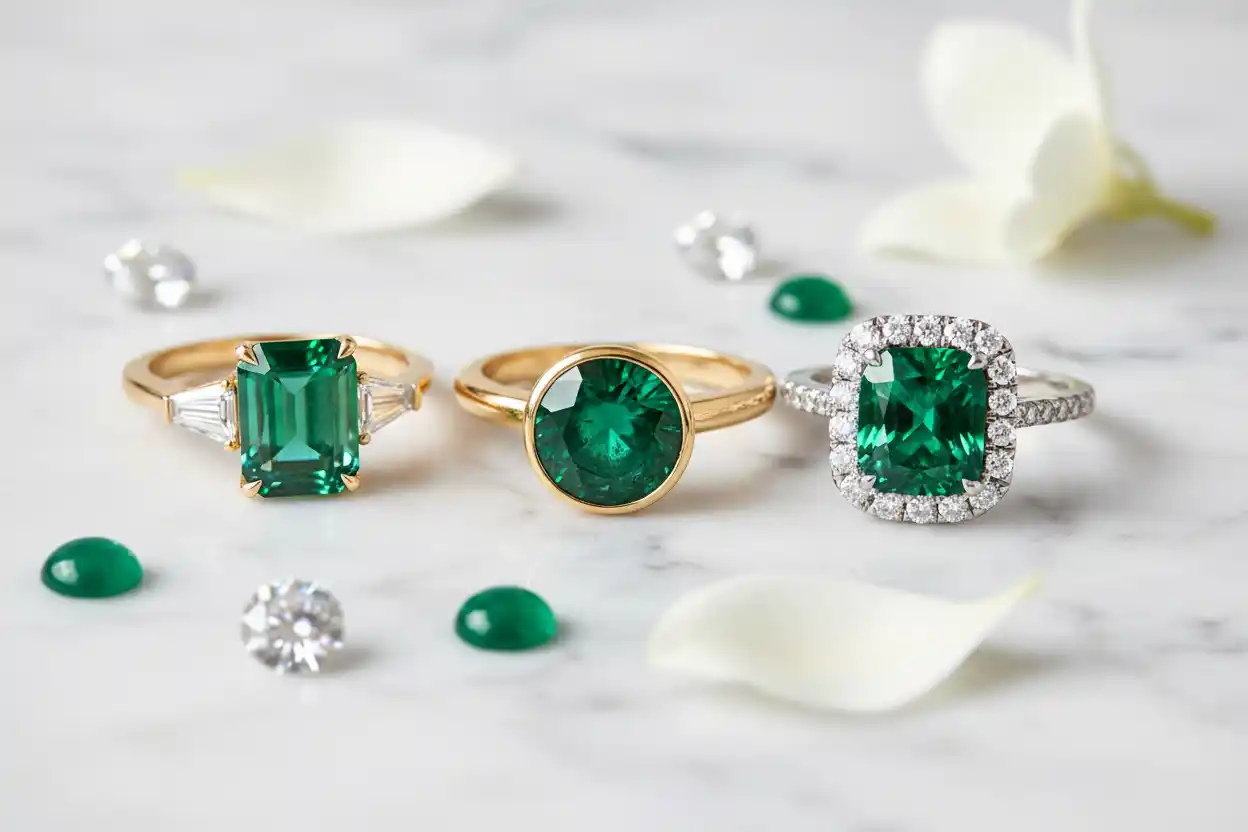
Emerald Engagement Rings: Complete Buyer’s Guide
An emerald engagement ring offers one of fine jewelry’s most distinctive combinations: saturated green color, centuries of gemstone history and a visual character that differs completely from a colorless diamond. However, emerald also requires more thoughtful setting and care because natural stones commonly contain fissures and are frequently clarity-enhanced.
The best emerald engagement ring balances color, transparency and personality with a protective setting and realistic expectations for daily wear. Prioritize an attractive center stone and secure construction before chasing carat milestones, famous origins or commercial quality labels.
Emerald Engagement Rings at a Glance
| Factor | What to prioritize |
|---|---|
| Gem identity | Natural or laboratory-grown emerald, clearly disclosed |
| Color | Attractive green to bluish green with strong saturation |
| Tone | Rich but not so dark that the stone loses life |
| Transparency | Enough transparency for the desired appearance |
| Inclusions | Expected in natural emerald; assess durability as well as beauty |
| Treatment | Written disclosure of fracture filling and other enhancement |
| Cut | Good color presentation with limited windowing |
| Setting | Bezel, protective halo or sturdy low-profile prongs |
| Metal | Gold or platinum with adequate structural strength |
| Ring fit | Secure without excessive spinning |
| Documentation | Independent report for significant natural stones |
| Wear expectation | Careful daily or regular wear rather than rough continuous wear |
Why Choose an Emerald Engagement Ring?
Emerald has an unmistakable visual identity. Its green color can appear sophisticated, organic, historical or contemporary depending on the setting.
Unlike a colorless diamond, an emerald does not need extreme brilliance to create presence. Color itself becomes the focal point.
Emerald also has longstanding associations with love, renewal, loyalty and spring. The drafted emerald meaning and symbolism guide explores those traditions separately.
Symbolism may add personal significance, but an engagement ring should still be chosen primarily because the wearer genuinely likes the stone and understands its care requirements.
Is Emerald Durable Enough for an Engagement Ring?
Emerald has a Mohs hardness of about 7.5 to 8, which gives it reasonable resistance to everyday scratching.
However, hardness does not describe the entire durability picture.
Natural emerald commonly contains fissures and other inclusions. Surface-reaching fractures may be filled with oil, resin or another substance to improve appearance. Those features can make an individual stone more vulnerable to impact, heat and aggressive cleaning.
Therefore, emerald can work in an engagement ring, but the wearer should remove it before high-impact or chemical-heavy activities.
A low protective setting greatly improves practicality.
Emerald vs Diamond for an Engagement Ring
Diamond is much harder and generally more resistant to routine abrasion. Emerald provides a completely different visual experience centered on color rather than maximum brilliance.
A diamond may be better for someone who wants to wear one ring through nearly every activity. Emerald suits a wearer comfortable removing jewelry before exercise, gardening, cleaning, mechanical work and similar tasks.
Neither gemstone is inherently more meaningful.
The choice involves lifestyle, aesthetic preference, care tolerance and budget.
An emerald-and-diamond design can combine both materials while allowing the green center stone to remain the principal feature.
Natural vs Laboratory-Grown Emerald
Natural emerald forms geologically, while laboratory-grown emerald is produced through controlled growth processes.
Laboratory-grown emerald is synthetic emerald rather than a green imitation. It has essentially the same mineral species and fundamental chemical and physical characteristics as natural emerald.
Its commercial value and rarity differ because geological formation is not involved.
The completed lab emerald buying guide covers laboratory growth, inclusions and buying considerations in more detail.
Either can make an attractive engagement ring. The origin simply needs to be represented accurately.
Color: The Most Important Emerald Quality Factor
Color generally has the greatest influence on emerald beauty and market appeal.
Desirable stones commonly fall between green and bluish green with strong saturation. The tone should remain light enough that the stone looks alive rather than nearly black.
Extremely pale green beryl may not be classified as emerald in professional gemological contexts.
Evaluate the stone under several types of light. Jewelry-store spotlights can make an emerald appear more vivid than it does in ordinary rooms.
Personal preference matters as well. Some wearers prefer bright medium green, while others enjoy deeper forest tones.
Understanding Emerald Tone
Tone describes how light or dark the color appears.
A medium to medium-dark emerald can combine saturation with sufficient brightness. Very dark stones may conceal transparency and inclusions but also lose visual liveliness.
Very light stones can look fresh and elegant yet may command less market demand if their saturation is weak.
Do not evaluate tone independently from saturation.
A moderately dark stone with strong color may be much more attractive than a darker emerald selected only because the seller describes it as intense.
Emerald Clarity and Jardin
Natural emeralds commonly contain visible inclusions.
Their internal appearance is often called jardin, meaning garden, because fissures, crystals and fluid inclusions can create branching or moss-like scenes.
Unlike diamond, emerald is not generally expected to be eye-clean.
The important questions are whether the inclusions harm transparency and whether surface-reaching fractures create durability concerns.
An attractive jardin may reinforce natural character. Heavy cloudiness or unstable fissures can reduce both beauty and suitability for an engagement ring.
Emerald Treatments
Clarity enhancement is common in natural emerald.
Oil, resin or other fillers may enter surface-reaching fractures and make them less visible. The amount and type of filling can affect value and care.
The completed treated emerald guide explains the distinction between treatment, laboratory-grown emerald and imitation material.
Ask the seller whether treatment has been detected and whether independent documentation describes its extent.
“Natural emerald” does not automatically mean untreated emerald.
Minor, Moderate and Significant Clarity Enhancement
Laboratories may describe the apparent extent of clarity enhancement using terms such as minor, moderate or significant.
A stone with minor enhancement generally carries a different market position from an otherwise comparable emerald with extensive filling.
Treatment should be considered alongside color, transparency and price rather than used as the sole quality measure.
An attractive moderately enhanced emerald may suit a buyer better than a weakly colored stone with minimal treatment.
The key is disclosure and appropriate pricing.
Emerald Cut
The classic emerald cut uses a rectangular outline with beveled corners and broad step facets.
This style suits emerald partly because it can protect corners while emphasizing color and transparency.
However, engagement rings can also use:
- Oval emeralds
- Cushion emeralds
- Round emeralds
- Pear shapes
- Cabochons
- Antique-style cuts
The best cut should display color evenly without a large transparent window through the center.
Cutters often balance beauty against weight retention because fine emerald rough is valuable.
Emerald-Cut Engagement Rings
A rectangular emerald-cut center creates a refined geometric appearance.
Step facets show the stone’s internal features clearly, so color and transparency become especially important.
Inspect the corners carefully because they need secure support.
Four substantial corner prongs can work, although a bezel or partial bezel provides stronger protection.
An elongated emerald cut can make the finger appear longer, while a squarer proportion creates a more architectural look.
Oval Emerald Engagement Rings
Oval cuts combine soft curves with strong finger coverage.
They avoid the vulnerable sharp corners of princess or marquise shapes and can work particularly well in bezels and halos.
Check for a large central window. Colored gemstones are sometimes cut shallowly to preserve face-up size, but excessive shallowness may weaken color through the center.
Both sides should have a balanced outline.
A low oval halo offers a useful combination of protection and visual scale.
Pear-Shaped Emerald Engagement Rings
A pear creates a distinctive tapered silhouette.
The pointed end is more vulnerable than rounded shapes and needs protection through a V-prong, bezel or substantial halo.
Pear symmetry matters. One shoulder should not appear much fuller than the other.
The stone can point toward or away from the fingertip according to preference.
For frequent wear, avoid extremely thin exposed points and very high settings.
Emerald Cabochon Engagement Rings
Cabochons have smooth domed surfaces rather than conventional facets.
They work particularly well with translucent or heavily included material whose color remains attractive even when brilliance is limited.
A bezel-set emerald cabochon can be an excellent option for someone who likes antique, organic or minimalist jewelry.
The smooth profile also reduces snagging.
However, cabochon material still needs treatment disclosure and appropriate care. A polished dome does not make fractures or fillers irrelevant.
Solitaire Emerald Engagement Rings
A solitaire gives the emerald complete visual attention.
A bezel solitaire offers strong protection, while a sturdy low prong setting creates more openness around the stone.
Because there are no surrounding diamonds to increase apparent size, center-stone color and proportions become especially important.
A simple solitaire can also make future maintenance easier.
Choose enough band width to support the center securely rather than using an extremely thin shank solely to make the emerald appear larger.
Halo Emerald Engagement Rings
A diamond halo creates bright contrast around the green center.
The design can increase apparent size and provide an additional protective border.
A low halo is generally more practical than a tall floating design.
Inspect every small diamond setting because pavé adds maintenance points.
The emerald should still be evaluated independently. A halo cannot correct muddy color, weak transparency or a poorly cut center.
Three-Stone Emerald Engagement Rings
A three-stone design may pair emerald with two diamonds or three green stones.
Diamond sides emphasize the emerald’s color, while matching emerald sides create a richer green composition.
Baguettes and trapezoids work especially well beside rectangular centers. Rounds and pears can soften the design.
The side stones should not sit so high that they catch constantly.
When several emeralds are used, treatment and color matching across the stones deserve careful attention.
Emerald and Diamond Engagement Rings
Diamond accents can be particularly effective around emerald because color contrast remains strong.
However, diamond is much harder than emerald.
The design should prevent exposed diamond girdles from rubbing against the emerald. This concern also applies when stacking the engagement ring with a diamond wedding band.
A small spacer or carefully designed gallery can prevent direct contact.
Clean the complete ring according to emerald’s more restrictive care requirements rather than treating it like ordinary diamond jewelry.
Choosing a Protective Setting
For a frequently worn emerald ring, setting protection should rank highly.
| Setting | Protection | Visual character | Best suited to |
|---|---|---|---|
| Full bezel | Excellent | Modern, smooth | Active lifestyle |
| Partial bezel | Very good | Open but protected | Balanced everyday wear |
| Low halo | Very good | Sparkling and larger-looking | Traditional or glamorous style |
| Six-prong setting | Good | Open and classic | Round or oval emerald |
| Four substantial prongs | Moderate to good | Minimal | Careful wearer |
| High exposed prongs | Lower | Dramatic | Occasional wear |
Craftsmanship matters more than the setting label. A poorly constructed bezel is not automatically safer than strong prongs.
High vs Low Settings
A high center stone can look dramatic and may allow a straight wedding band to sit beneath the engagement ring.
However, higher settings catch more easily on fabric, furniture and equipment.
A low setting provides greater protection and comfort but may require a contoured wedding band.
Look at the ring from the side before purchasing.
The center should not sit higher than necessary for the design.
Choosing the Metal
Yellow gold is a classic emerald pairing and creates warm contrast.
Platinum and white gold make green appear cooler and pair naturally with white-diamond accents.
Rose gold creates stronger warmth and can produce an unusual romantic appearance.
Metal choice should also account for maintenance and allergy concerns.
A fine emerald deserves enough metal to protect it. Extremely lightweight prongs and thin shanks may reduce long-term security.
Choosing a Wedding Band
Plan the wedding band before finalizing the engagement setting.
A low emerald setting may require a curved or contoured band. A high basket may accommodate a straight band but expose the stone more.
Check for direct diamond-to-emerald contact.
A diamond band can abrade metal and potentially contact the emerald if the rings rub together.
A plain gold spacer is sometimes useful when two gemstone settings would otherwise collide.
Ring Size
Emerald engagement rings should fit securely enough to limit spinning.
A loose ring exposes the center stone to more impacts as it turns around the finger.
Wide bands can feel tighter than narrow bands at the same nominal size.
Full eternity designs and extensive pavé may limit future resizing.
Have the wearer measured under normal conditions and confirm the jeweler’s resizing policy before purchase.
Emerald Engagement-Ring Budget
There is no responsible salary rule for engagement rings.
Set a budget according to actual financial circumstances and include the entire ring rather than only the emerald.
Consider:
- Center stone
- Setting
- Side diamonds
- Taxes
- Laboratory report
- Resizing
- Insurance
- Future maintenance
The completed emerald price guide explains the major gemstone value factors.
A smaller beautiful emerald in a strong setting is preferable to creating financial strain to reach a carat milestone.
Origin Claims
Colombia, Zambia, Brazil, Pakistan, Afghanistan and other regions produce emerald.
Origin can affect collector and market demand, but appearance overlaps between deposits.
Do not assume Colombian origin because a stone looks warm green or Zambian origin because it appears bluish.
When origin creates a substantial price premium, an independent laboratory opinion is appropriate.
The completed types of emerald guide covers major sources and varieties without treating locality as a universal quality ranking.
Laboratory Reports
For a significant natural emerald, an independent colored-stone report can provide valuable evidence.
Depending on the service, a report may identify whether the stone is natural or laboratory-grown, describe detectable clarity enhancement and sometimes provide an opinion on geographic origin.
A laboratory report does not tell the buyer whether the ring is beautiful or whether the price is fair.
It should be combined with direct evaluation, seller disclosure and construction quality.
The completed real versus fake emerald guide explains why home identification has important limitations.
Buying an Emerald Engagement Ring Online
Confirm the exact emerald rather than assuming photographs represent the item accurately.
Request:
- Natural or laboratory-grown disclosure
- Stone measurements
- Carat weight
- Treatment information
- Laboratory report where applicable
- Video in several lighting conditions
- Setting dimensions
- Metal fineness
- Ring size
- Return period
- Resizing limitations
Magnified photographs can make inclusions appear more dramatic and stone size appear much larger than real life.
Millimeter dimensions provide better scale.
How to Inspect the Finished Ring
Examine the emerald under ordinary lighting.
Check that color remains attractive and that any windowing is acceptable.
Look at the stone from the side. It should sit level and remain secure.
Run a soft cloth carefully around the prongs to detect obvious catches.
Confirm that the ring fits comfortably and does not rotate excessively.
When the stone has a laboratory report, check that measurements and identifying information correspond with the supplied emerald.
How to Wear an Emerald Engagement Ring
Put the ring on after applying cosmetics, sunscreen and lotions.
Remove it before:
- Exercise
- Cleaning
- Gardening
- Swimming
- Showering
- Cooking involving heavy equipment
- Home repairs
- Mechanical work
Do not rely on gloves to protect the ring during high-risk tasks.
A ring beneath a tight glove can still experience pressure and may create an injury hazard if caught.
Cleaning an Emerald Engagement Ring
Warm water, mild soap and gentle brushing provide the safest general cleaning method for most emerald jewelry.
Avoid steam and ultrasonic cleaners because heat and vibration may affect fractures and fillers.
Do not use strong solvents or jewelry dips.
The completed guide to cleaning emerald jewelry safely explains care for enhanced emeralds and settings.
Professional cleaning should include inspection of the setting rather than aggressive polishing alone.
Insurance and Maintenance
An engagement ring worn regularly deserves periodic professional inspection.
Have prongs, bezels, side stones and the shank checked when the ring experiences a hard impact or shows any visible change.
Insurance may be appropriate for a high-value ring. Review whether the policy covers theft, accidental damage, stone loss and international travel.
Keep photographs, receipts, laboratory reports and appraisals separately from the ring.
Maintenance protects the ring more effectively than assuming emerald hardness makes it carefree.
Conclusion
Emerald can make an exceptional engagement-ring stone when its distinctive beauty is matched with thoughtful construction and care. Choose color and transparency first, then evaluate inclusions, treatment, cut and documentation.
Bezels, low halos and sturdy prongs improve durability, while realistic wearing habits reduce unnecessary impact. Natural and laboratory-grown emerald can both create beautiful rings when origin is disclosed accurately.
The strongest engagement-ring purchase is not the one with the largest emerald. It is the ring that the wearer loves, can maintain comfortably and can afford without compromising broader financial priorities.
Frequently Asked Questions
1. Is emerald good for an engagement ring?
Yes. Emerald can work beautifully in an engagement ring when it has a protective setting and the wearer removes it during rough activities.
2. Is emerald durable enough for daily wear?
Emerald has good scratch resistance but commonly contains fissures. Careful daily or regular wear is more appropriate than truly nonstop wear.
3. What is the best setting for an emerald engagement ring?
A bezel, partial bezel or low protective halo provides strong protection. Sturdy prongs can also work for careful wear.
4. What color emerald is best?
Attractive green to bluish green with strong saturation and enough lightness to remain lively generally receives the strongest demand.
5. Are inclusions bad in an emerald engagement ring?
Not necessarily. Natural inclusions are expected, but surface-reaching fractures that affect durability deserve careful evaluation.
6. Are emerald engagement rings usually treated?
Many natural emeralds receive clarity enhancement with oil, resin or another filler. Treatment should be disclosed.
7. Is a lab-grown emerald suitable for an engagement ring?
Yes. Laboratory-grown emerald can provide strong color and clarity, but its laboratory origin must be represented accurately.
8. Is emerald more fragile than diamond?
Yes. Diamond offers much greater scratch resistance and generally greater practicality for rough wear.
9. Can emerald and diamond be used together?
Yes. Emerald-and-diamond rings are classic, but the design should prevent harder diamonds from rubbing directly against the emerald.
10. Should an emerald engagement ring have a laboratory report?
A report is advisable when natural identity, treatment extent or claimed geographic origin materially affects the price.
11. Can an emerald engagement ring be cleaned ultrasonically?
No. Ultrasonic and steam cleaning should generally be avoided for emerald because fractures and fillers can be affected.
12. Can an emerald engagement ring be resized?
Many can, but extensive pavé, eternity designs and complex settings may restrict resizing options. Ask before purchase.