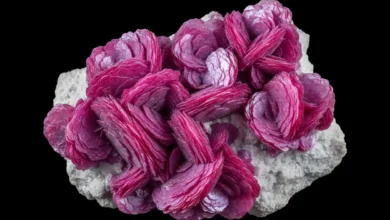

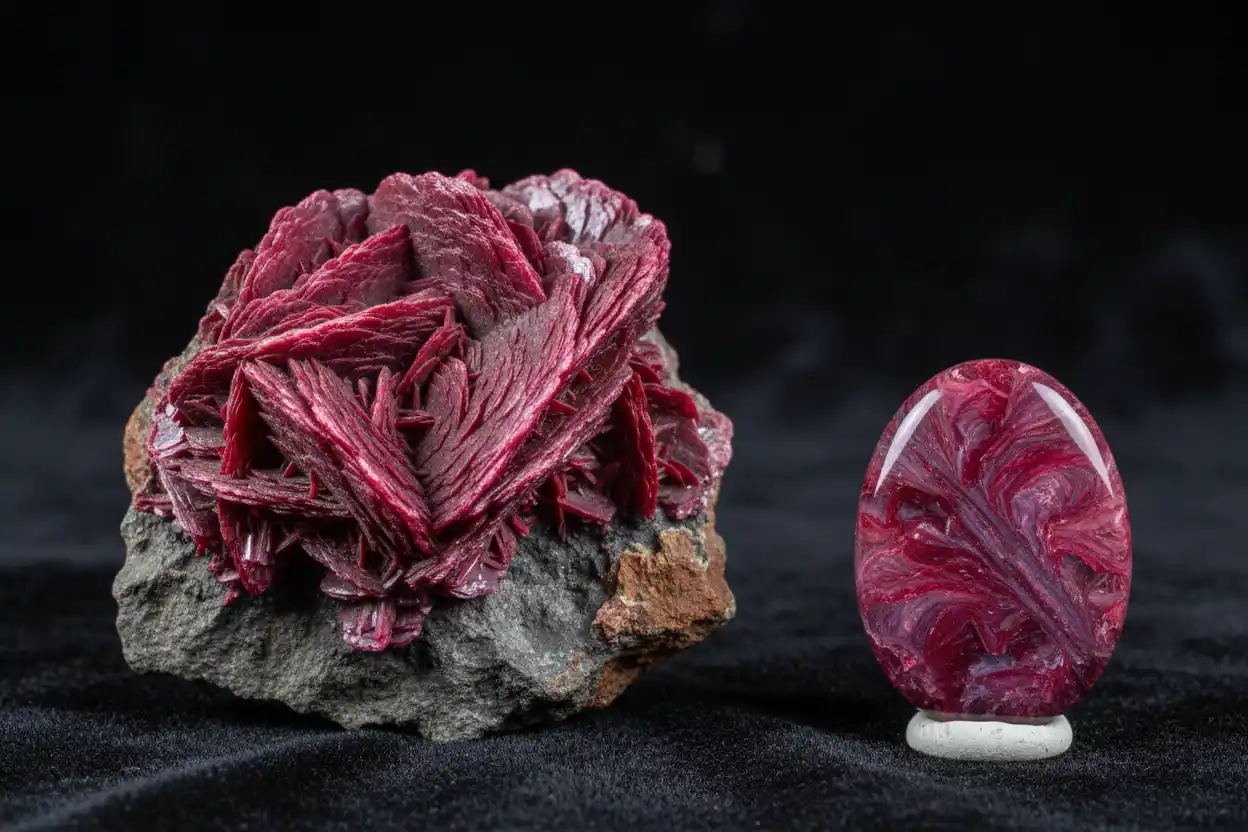

Erythrite is a hydrated cobalt arsenate mineral recognized by crimson, raspberry, peach-pink and violet crystal coatings on weathered cobalt ore. Its color can reveal cobalt-bearing mineralization, which explains the traditional name cobalt bloom, but its softness and arsenic content make it a display specimen rather than a jewelry or handling stone.
Erythrite at a Glance
| Property | Details |
|---|---|
| Mineral group or material type | Hydrated cobalt arsenate; Vivianite-group mineral |
| Composition | Co₃(AsO₄)₂·8H₂O |
| Colors | Crimson, raspberry red, peach red, rose pink, pale pink and violet-pink |
| Crystal system | Monoclinic |
| Habit | Flattened blades, slender prisms, needles, radial sprays, stellate groups, druses, crusts and powdery masses |
| Luster | Subadamantine to vitreous; pearly on cleavage surfaces |
| Transparency | Transparent to translucent in individual crystals; coatings may appear opaque |
| Mohs hardness | Approximately 1.5–2.5 |
| Cleavage | Perfect in one direction; poor in two additional directions |
| Tenacity | Sectile; thin cleavage sheets may be flexible |
| Specific gravity | Approximately 3.06 |
| Common use | Mineral specimens, cobalt-ore indicators, museum displays and systematic collections |
| Main care concern | Arsenic and cobalt content, softness, fragile crystal sprays, dehydration, dust and unstable associated ore minerals |
Erythrite Is a Cobalt Arsenate
Erythrite contains cobalt, arsenate groups and structural water. Its formula, Co₃(AsO₄)₂·8H₂O, distinguishes it from cobalt-bearing carbonates, sulfides and oxides.
The cobalt produces its characteristic pink-to-red appearance. Arsenate remains an essential structural component rather than a trace impurity, so the mineral requires stricter handling than an ordinary pink silicate or carbonate.
Erythrite belongs to the Vivianite group. Members share related hydrated structures while different metals and anions occupy key chemical positions.
Nickel-rich Annabergite forms a green counterpart. Magnesium-rich Hörnesite is usually colorless or pale, while zinc-bearing Köttigite can appear pinkish or white.
Natural Erythrite may contain some nickel, magnesium, zinc or iron. Consequently, color and chemistry can vary within a single deposit or even across one crystal group.
Why It Is Called Cobalt Bloom
Cobalt-bearing arsenides and sulfarsenides weather near the surface of an ore deposit. Oxygen-rich groundwater attacks the primary minerals and releases cobalt and arsenic into the surrounding fractures.
Under suitable conditions, those elements recombine with water and oxygen to form Erythrite.
The bright coating can appear to bloom across dark metallic ore, creating pink crusts, needles and sparkling sprays. Early miners learned that the color frequently indicated cobalt mineralization below or beside the weathered surface.
The coating does not prove that an ore body is economically mineable. However, it can help mineralogists and prospectors recognize cobalt-rich alteration.
Primary minerals commonly associated with the process include Cobaltite and Skutterudite. Additional oxidation-zone minerals may include Scorodite, Roselite, Adamite, Annabergite and Malachite.
How Erythrite Forms
Most Erythrite forms in the oxidized portions of cobalt–nickel–arsenic deposits.
Rainwater and groundwater enter fractures above or around the primary ore. Meanwhile, oxygen changes the chemical state of exposed arsenides and sulfides.
Cobalt becomes mobile in the weathering environment. Arsenate also enters solution or remains available on mineral surfaces.
As water evaporates or chemistry changes, Erythrite precipitates in open spaces. Narrow fractures may receive a powdery pink film, whereas protected cavities can support free-standing crystals.
The mineral often represents a relatively late alteration stage. Later water movement can dissolve, replace or coat it with additional arsenates and iron oxides.
Because it contains eight water molecules in its formula, heat and dry conditions can alter its hydration state. Direct heating should therefore never be used to clean or intensify the color.
Crystal Forms
Well-formed Erythrite crystals are less common than crusts and powdery coatings.
Individual crystals may form flattened blades with strong pearly cleavage reflections. Slender prismatic crystals can grow in parallel groups or intersect as open sprays.
Needle-like crystals sometimes radiate from one central point. These groups can resemble flowers, stars or miniature fans.
Drusy surfaces occur when many small crystals cover the matrix closely. Their sparkle depends on intact terminations, so brushing or handling can destroy the strongest visual feature.
Powdery cobalt bloom is geologically useful but usually less valuable than well-defined crystals. Even so, an old mine specimen with clear provenance can remain desirable despite modest crystal development.
Color and Pleochroism
Erythrite ranges from pale peach-pink to deep crimson and violet-red.
Transparent crystals can show strong directional color. One viewing direction may appear pale rose, while another looks violet-pink or deep red.
This pleochroism becomes easiest to see in thin crystals under transmitted light. Thick crystal groups may look darker and more metallic because less light passes through them.
Nickel substitution can shift the appearance toward paler or slightly different pink tones as the composition approaches Annabergite.
Iron staining adds orange-brown areas. Dark ore beneath a thin coating can also make the pink appear stronger than it would on a white matrix.
The mineral fits visually within the pink-crystals guide, although its chemistry and handling requirements differ sharply from Rose Quartz, Rhodonite and pink Calcite.
Deeper specimens can overlap with materials in the red-crystals directory, while violet-rich groups may resemble examples collected under purple crystals.
Erythrite vs Cobaltocalcite
Cobaltocalcite is cobalt-bearing Calcite rather than cobalt arsenate.
Both minerals can appear pink, rose or magenta. However, their chemistry, hardness and crystal habits differ.
Cobaltocalcite commonly forms rhombohedrons, botryoidal coatings or sparkling carbonate druses. Erythrite more often forms blades, needles, sprays and powdery cobalt bloom.
Calcite reacts readily with dilute acid, whereas Erythrite is an arsenate. Acid testing remains inappropriate because it damages the specimen and can mobilize hazardous material.
Cobaltocalcite is also somewhat harder, although neither mineral suits exposed jewelry.
An expensive pink cobalt specimen should receive structural testing rather than a color-based label.
Erythrite vs Annabergite
Annabergite is hydrated nickel arsenate and forms a continuous compositional series with Erythrite.
Pure Erythrite appears pink to red because cobalt dominates. Annabergite commonly appears apple green because nickel occupies the corresponding structural position.
Intermediate material may show pale pink, mixed green-pink areas or compositional zoning.
One specimen can contain both minerals as separate growths or as chemically graded crystals. Consequently, assigning every area one species from color alone can oversimplify the specimen.
Raman spectroscopy, X-ray diffraction and quantitative chemical analysis provide more dependable identification.
Erythrite vs Roselite
Roselite is another cobalt arsenate, but it contains calcium and has a different crystal structure.
Fine Roselite can show intense rose-red, raspberry or violet color similar to Erythrite. However, it commonly forms shorter, more robust crystals and has greater hardness.
The two minerals can occur together in Moroccan cobalt deposits. As a result, locality and color do not provide a final answer.
A mixed pink coating may also contain Beta-Roselite, Wendwilsonite or other cobalt arsenates. Accurate labels should reflect analytical uncertainty when several phases remain possible.
Schneeberg, Germany
The Daniel Mine near Schneeberg in Saxony is the recognized type locality for Erythrite.
Historic mining in the district exposed silver–cobalt–nickel–arsenic ores. Oxidation created Erythrite with additional arsenates and secondary ore minerals.
Schneeberg specimens can form delicate pink coatings, crystals or sprays on dark metallic matrix.
Old labels increase their scientific and historical value. Because the district includes many mines, “Schneeberg” alone is less informative than a mine, vein or collection record.
Classic German crystals may command strong premiums even when newer Moroccan material has greater crystal size.
Bou Azzer, Morocco
The Bou Azzer district in Morocco is the leading modern source of fine Erythrite.
Cobalt- and nickel-bearing arsenide deposits weathered to create an exceptional range of colorful secondary minerals. Erythrite occurs as bright crusts, blades and free-standing crystal sprays.
Fine specimens can show metallic crimson crystals rising above Quartz, Calcite or dark ore. Some crystals reach several centimeters, which is unusually large for the species.
A broad Bou Azzer label remains useful, but the named mine or occurrence adds more value. Aghbar, Irhtem, Bouismas and other workings have produced distinct associations.
Repairs deserve attention because the sprays are fragile. A reattached crystal can remain collectible when the dealer discloses the work.
Cobalt, Ontario
The Cobalt mining district in Ontario produced major silver and cobalt–nickel arsenide ores.
Erythrite commonly formed as alteration around Skutterudite, Cobaltite and related minerals. Pink coatings can mark the boundaries of metallic ore fragments.
Canadian specimens may also contain native Silver, Calcite, Safflorite, Nickeline and additional arsenic minerals.
That combination creates a significant safety concern. The Erythrite may not be the only arsenic- or metal-bearing phase present.
Mine and vein provenance can add substantial interest, particularly for older specimens tied to the district’s mining history.
Cornwall and Jáchymov
Botallack and other Cornwall mines produced Erythrite as a secondary mineral in cobalt-bearing ore.
Jáchymov in the Czech Republic also contains complex silver, cobalt, nickel and uranium mineralization. Erythrite may occur with numerous arsenates and alteration products.
Specimens from either region are often small. Nevertheless, historic mine labels, rare associations and collection provenance can outweigh crystal size.
Unknown old European material should not be cleaned aggressively. Matrix minerals may include arsenic-, uranium- or lead-bearing phases that require conservation-level handling.
United States and Australia
The Blackbird Mine area in Idaho is an important American Erythrite locality associated with cobalt mineralization.
Additional occurrences exist in Arizona, Nevada, Sonora in Mexico and several western ore districts.
Australian localities include Mount Cobalt in Queensland and Dome Rock in South Australia.
Most localities produce crusts, needles or study material rather than large transparent crystals. Fine locality-specific specimens can therefore interest systematic collectors even when their visual quality falls below Bou Azzer material.
Is Erythrite a Gemstone?
Erythrite is not a practical gemstone.
Its hardness of 1.5–2.5 means a fingernail or ordinary handling can scratch, bruise or crush the surface. Perfect cleavage makes thin blades even more vulnerable.
The mineral also contains cobalt and arsenate. Cutting, drilling and polishing would generate hazardous dust while destroying fragile natural crystal forms.
Occasionally, a collector may encounter a polished ore fragment, resin-mounted chip or encapsulated specimen. Such products should not be confused with durable faceted jewelry.
The gemstone-hardness chart places Erythrite far below conventional jewelry materials.
Moreover, the gemstone-cleavage guide explains why a crystal can separate along flat internal planes even when its surface has not been deeply scratched.
Erythrite Price
Small powdery or crusted specimens commonly list for approximately $10–$40.
Better thumbnails with visible crystals may range from $40 to $150. Color, luster and an identifiable locality support the upper end.
Attractive Bou Azzer miniatures commonly appear around $150–$500. Free-standing blades, strong crimson color and contrasting matrix can increase the price.
Fine crystal sprays and larger cabinet specimens may range from $500 to $2,000 or more.
Exceptional old Schneeberg pieces, large Bou Azzer crystals, rare associations and important provenance can reach several thousand dollars.
These bands reflect asking prices rather than guaranteed resale values. The specimen market remains thin, and condition can change the price dramatically.
What Determines Value?
Crystal Development
Distinct blades, prisms and radial groups receive more interest than flat powdery coatings.
Color
Bright crimson, raspberry and violet-pink crystals generally attract more demand than pale or brown-stained material.
Luster
Subadamantine or glassy faces add depth. Dull, dehydrated or heavily weathered crystals appear less vivid.
Crystal Size
Large individual crystals are uncommon. However, a complete small spray may be more valuable than a larger damaged blade.
Matrix Contrast
Dark ore, white Quartz or pale Calcite can make the color easier to see.
Locality
Bou Azzer dominates modern supply, while Schneeberg, Cobalt and historic European mines carry provenance premiums.
Mineral Associations
Roselite, Skutterudite, native Silver and other identifiable minerals can add scientific interest.
Condition
Broken terminations, rubbed surfaces, glue and repairs reduce value unless disclosed and professionally completed.
Stability
Fresh, well-preserved crystals deserve more confidence than powdering or visibly altered material.
Treatments, Repairs and Imitations
Routine color treatment is uncommon because natural Erythrite already has intense color.
Repairs are more relevant. Fragile sprays may be reattached to their original matrix, or a broken base may be stabilized with adhesive.
Clear coatings can deepen color, strengthen powdery crusts or create artificial luster. However, coatings also change conservation requirements and should be disclosed.
Dyed Gypsum, Calcite, Quartz druse and synthetic decorative material can imitate pink cobalt bloom in photographs.
Artificially assembled pieces may use loose crystals glued to unrelated matrix. Magnification can reveal adhesive, mismatched contact surfaces or crystal groups positioned without natural growth relationships.
The general treatment terminology appears in Gemstone Treatments Explained, while glue, coatings and artificial color are covered in How to Spot Fake Crystals.
How to Identify Erythrite
Begin with the geological context. A pink blade or coating on cobalt–nickel–arsenic ore supports Erythrite as a possibility.
Crystal habit provides another clue. Expect flattened blades, needles, radial sprays and pearly cleavage.
Hardness is extremely low, but destructive scratch testing should never be used. Damage would create potentially hazardous residue.
Strong pink-to-red pleochroism can appear in transparent crystals. Specific gravity near 3.06 also fits the species.
Raman spectroscopy provides a non-destructive structural identification. X-ray diffraction and quantitative chemistry can separate Erythrite from Annabergite, Roselite and mixed cobalt arsenates.
The observation sequence in How to Identify Crystals should stop before any acid, streak or abrasion test when an arsenate mineral is suspected.
Durability and Display
Erythrite combines low hardness, perfect cleavage and delicate crystal geometry.
The toughness-versus-hardness guide explains why these weaknesses act independently. A soft coating can abrade, while an apparently intact blade can still split along cleavage.
Place the specimen inside a closed display case. A fitted acrylic box also reduces dust transfer and accidental contact.
Support the matrix beneath its strongest area. Never lift the specimen by a crystal spray or needle group.
Keep it away from vibration, direct airflow and crowded shelves. A neighboring Quartz point can destroy the Erythrite coating with one accidental touch.
Light and Heat
Strong heat can drive water from hydrated minerals and change their structure or appearance.
Erythrite should remain away from radiators, heated display lamps and direct sunlight. Even when visible color loss is not immediate, heating can promote dehydration and brittleness.
The broader list of light-sensitive materials in Crystals That Fade in Sunlight supports a conservative display approach.
Use cool LED lighting for short display periods. A stable, shaded cabinet provides a safer long-term environment than a sunny windowsill.
Water and Cleaning
Do not soak Erythrite.
Water can enter cleavage cracks, mobilize surface residue, affect associated minerals and leave contamination in the sink or cleaning container.
The fact that Erythrite formed in a hydrated environment does not make a collected specimen appropriate for washing or drinking-water use.
The crystal water-safety guide should be applied to the entire ore specimen, including every visible and hidden associated mineral.
Use a hand-operated air blower only when necessary. Avoid compressed air, brushes, cloths and household sprays.
A valuable or unstable specimen that requires further cleaning should go to a mineral conservator.
Safe Handling
Erythrite contains arsenate and cobalt. Consequently, it should not be ingested, licked, placed against food, added to water or handled casually.
Avoid creating dust through rubbing, scraping, drilling or dry cleaning.
Use disposable nitrile gloves when moving a friable or powdery specimen. Afterwards, remove the gloves carefully and wash your hands.
Keep the piece away from children and pets. Do not display loose powder on an open shelf.
The toxic-crystals safety list provides broader guidance for arsenic-, lead-, mercury- and copper-bearing specimens.
An intact crystal in a closed case presents a different exposure scenario from airborne dust. Responsible storage focuses on preventing breakage and transfer rather than treating the specimen as untouchable under all conditions.
Erythrite Meaning and Symbolism
Erythrite’s color reveals a chemical change that began when hidden cobalt ore reached an oxidizing environment.
That relationship can support a personal interpretation centered on evidence becoming visible. The pink coating does not create the cobalt deposit; instead, it indicates what already exists beneath or beside the altered surface.
Its fragility adds another material-specific idea. Strong color does not guarantee structural strength.
Modern crystal traditions sometimes associate Erythrite with emotional openness, courage or enthusiasm. Those claims do not come from scientifically measured mineral effects.
Erythrite cannot safely supply cobalt, improve blood health or influence emotional states through contact.
Its inclusion in Crystals That Start With E should therefore emphasize mineralogy, collector value and safe display rather than wearable use.
Frequently Asked Questions
Is Erythrite poisonous?
Erythrite contains cobalt and arsenate, so ingestion and inhalation of dust are hazardous. Store it enclosed and avoid creating powder or residue.
Can Erythrite be touched?
A stable specimen can be moved carefully with gloves or clean hands, followed by handwashing. Friable, powdery material should not receive direct handling.
Is Erythrite radioactive?
Erythrite itself is not classified as a radioactive mineral. However, specimens from complex ore deposits may contain other hazardous or occasionally radioactive phases.
Why is Erythrite called cobalt bloom?
It frequently forms as a pink-to-red weathering coating over cobalt-bearing ore, visually revealing cobalt mineralization.
Is Erythrite the same as Cobaltocalcite?
No. Erythrite is hydrated cobalt arsenate, while Cobaltocalcite is cobalt-bearing calcium carbonate.
Can Erythrite go in water?
No soaking or elixir use is appropriate. Water can spread residue and affect the mineral, repairs and associated ore phases.
Is Erythrite rare?
The mineral occurs at many cobalt deposits, but well-formed, large, lustrous crystals are uncommon.
What is the best Erythrite locality?
Bou Azzer is the leading source of large modern crystals. Schneeberg is historically important as the type locality, while Cobalt, Ontario, has major mining provenance.
Can Erythrite be made into jewelry?
Its extreme softness, perfect cleavage, fragile habit and arsenic content make conventional jewelry unsuitable.
Before purchasing a cobalt-ore specimen, apply the provenance, labor and disclosure questions in Ethically Sourced Crystals rather than judging the piece only by color.
Disclaimer: Erythrite contains cobalt and arsenate. Do not ingest it, place it in drinking water, heat it, or cut, grind, sand or polish it. Store friable material in a closed container away from children, pets, food and frequently handled surfaces.