Euclase Meaning: Properties, Uses & Symbolism
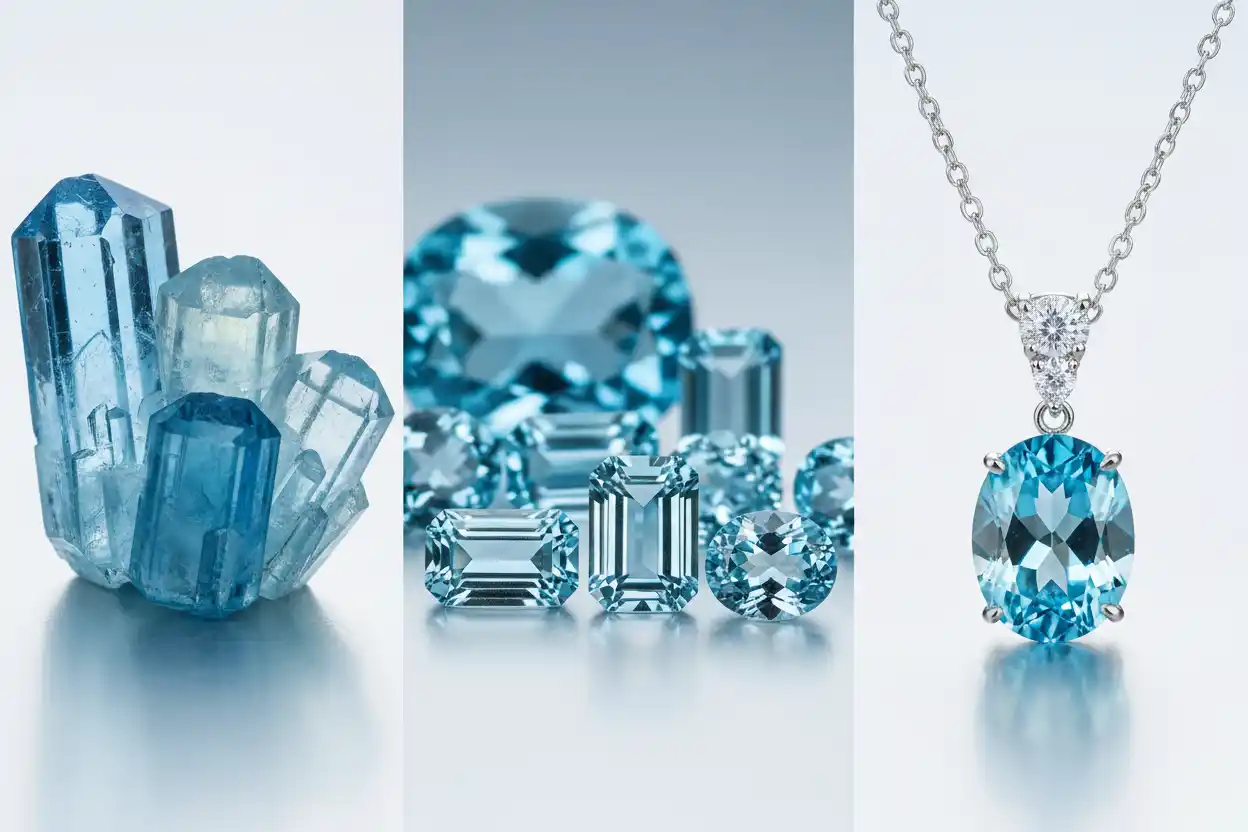
Euclase meaning begins with a comparatively uncommon beryllium-bearing mineral whose beauty is matched by a structural weakness important enough to influence its name, cutting, collecting, and jewelry use. Euclase is a beryllium aluminum hydroxide silicate, commonly represented by the formula BeAlSiO₄(OH). It crystallizes in the monoclinic system and can form transparent to translucent prismatic crystals with a vitreous luster. Colorless, pale blue, blue-green, green, and occasionally deeper blue material can occur, while fine transparent crystals may be faceted as collector gemstones. Its defining physical limitation is highly developed cleavage, which can allow an otherwise attractive crystal or cut gem to split along preferred structural planes.
A responsible explanation of euclase meaning therefore has to begin with mineral identity rather than symbolic associations. Chemistry, crystallography, optical behavior, hardness, cleavage, color, inclusions, and geological occurrence are measurable or testable. Historical records can document how the mineral was described and named. Modern claims that euclase improves communication, increases clarity, attracts relationships, or alters emotional states belong to personal or metaphysical interpretation rather than established gemology. Readers comparing other fact-led mineral references can browse the wider Gemstone Guides collection while keeping those evidence levels separate.
Euclase Meaning at a Glance
| Feature | Grounded reference |
|---|---|
| Mineral type | Beryllium aluminum hydroxide silicate |
| Common formula | BeAlSiO₄(OH) |
| Crystal system | Monoclinic |
| Typical colors | Colorless, pale blue, blue-green, green, and related light tones |
| Transparency | Transparent to translucent |
| Luster | Vitreous |
| Mohs hardness | Approximately 7.5 |
| Cleavage | Perfect to highly developed; a major durability consideration |
| Typical form | Prismatic crystals, crystal fragments, and rare faceted gems |
| Main gem interest | Transparency, blue-to-green color, rarity, crystal quality |
| Identification caution | Color and hardness alone are insufficient |
| Symbolism | Modern reflective associations rather than measurable mineral effects |
| Ownership concern | Protect from impact despite relatively high hardness |
These characteristics explain why euclase meaning cannot be reduced to a simple “blue crystal” description. The mineral can be hard enough to resist ordinary scratching yet still vulnerable to splitting because hardness and cleavage describe different kinds of mechanical behavior. That distinction is one of the most important facts for anyone collecting, cutting, mounting, or evaluating euclase.
What Euclase Actually Is
Euclase belongs to the relatively small group of gem and collector minerals containing beryllium, but it should not be treated as another variety of beryl. Beryl, chrysoberyl, phenakite, and euclase are chemically and structurally distinct minerals even though beryllium appears in each of them. Euclase has its own monoclinic crystal structure, characteristic cleavage, optical properties, and geological associations.
Well-formed euclase crystals can show elongated prismatic habits and sharply developed faces. Transparent material may be visually striking because its body color can be delicate rather than saturated, allowing brilliance and internal reflections to become important parts of its appearance. Fine blue crystals are especially sought by mineral collectors, while clean facetable material is uncommon enough that many euclase specimens remain more valuable or meaningful as natural crystals than as cutting rough.
Euclase meaning is therefore better understood through the distinction between mineral species, specimen quality, and gem use. A crystal can be scientifically important even if it is unsuitable for jewelry. A faceted stone can be visually beautiful even if it requires protective handling. A pale crystal can still be genuine euclase even though commercial photographs often emphasize more strongly colored examples.
How Euclase Forms
Euclase occurs in geological environments where beryllium, aluminum, silica, hydroxyl-bearing fluids, and suitable structural conditions come together. It is often associated with granitic pegmatitic and hydrothermal systems, where late-stage fluids can transport unusual elements and form comparatively uncommon minerals in fractures, cavities, or altered zones. Euclase may also occur where beryl-bearing material has been altered under conditions that permit different beryllium minerals to develop.
This setting helps explain why euclase may occur alongside quartz, feldspar, mica, topaz, beryl, or other minerals typical of evolved granitic environments. The precise mineral assemblage varies by locality, and association alone cannot prove that a colorless or blue crystal is euclase. Matrix and neighboring minerals can provide geological context, but the final species identification still depends on the properties of the crystal itself.
Collectors interested in the deeper geological story can continue to euclase formation and deposit geology. That separation keeps this euclase meaning reference focused on foundational identity instead of duplicating the full deposit and paragenesis discussion owned by the geology page.
Why Euclase Can Be Blue, Green, or Colorless
Pure or nearly pure euclase can be colorless or very lightly colored, while natural substitutions and trace impurities can create blue or greenish tones. Iron is commonly discussed as an important contributor to color in many natural specimens, although the exact relationship between color and trace chemistry can vary among samples. Different oxidation states, concentrations, structural sites, and optical orientations may influence the final appearance.
Crystal thickness also matters. A deeply colored thick crystal may appear much paler at a thin edge, while a faintly colored transparent crystal can look almost colorless against a bright background. Faceting can intensify or weaken apparent color depending on orientation and light return. In some specimens, directional optical behavior means the stone does not show the same color equally along every viewing direction.
This is one reason photographs should not be treated as analytical evidence. Camera white balance, background color, exposure, saturation, and lighting direction can make pale blue euclase appear more vivid than it does in ordinary observation. The specialized relationship between color, optical properties, and viewing direction is addressed in euclase optical properties and color behavior rather than being repeated in full here.
Diagnostic Traits That Matter
Euclase combines several properties that can support identification when evaluated together. Its relatively high hardness, strong vitreous luster, monoclinic crystal form, transparent-to-translucent character, pronounced cleavage, density, and refractive behavior can narrow the field considerably. Yet no single observation should normally be treated as decisive.
Hardness is especially easy to misuse. Euclase is around 7.5 on the Mohs scale, so an owner might assume it is automatically durable. Mohs hardness measures resistance to scratching, not resistance to splitting. Because euclase has exceptionally significant cleavage, a sharp impact along a vulnerable orientation can damage a crystal that would otherwise resist casual abrasion quite well.
Crystal habit also helps but has limits. A transparent pale-blue prismatic crystal may resemble other minerals in a photograph, particularly when the termination is incomplete or the specimen is broken. Refractive measurements, optic properties, density, spectroscopy, or structural analysis may be needed where identity is uncertain or financially consequential.
Internal features can provide additional clues without intentionally damaging the material. The euclase microscope inclusion notebook provides a dedicated framework for recording fractures, mineral inclusions, growth features, surface-reaching structures, and other observations under magnification.
Original Euclase Specimen and Photo Checklist
A strong euclase record should distinguish observations from conclusions. The checklist below is designed for collectors examining a labeled specimen, inherited crystal, dealer photograph, or loose gemstone without assuming that every claim is already proven.
| Record | What to document | What it can support | What it cannot prove |
|---|---|---|---|
| Body color | Colorless, pale blue, blue-green, green, or zoned appearance | Descriptive comparison | Mineral species |
| Transparency | Transparent, translucent, cloudy, or opaque zones | Suitable examination methods | Geographic origin |
| Crystal form | Prism shape, termination, striations, broken faces | Compatibility with known habit | Identity by itself |
| Luster | Vitreous or altered surfaces | Surface description | Treatment status |
| Existing cleavage | Flat structural break surfaces already present | Compatibility with euclase behavior | Reason to perform destructive testing |
| Internal fractures | Direction, extent, and whether they reach the surface | Durability assessment | Exact cause of damage |
| Inclusions | Crystals, particles, tubes, fractures, or zoning | Repeatable microscopic record | Locality from appearance alone |
| Dimensions | Length, width, depth, and weight if known | Accurate future comparison | Quality grade |
| Matrix | Associated host material or attached minerals | Geological context | Mine authentication |
| Old label | Photograph exact wording | Collection and provenance history | Modern identification accuracy |
| Locality claim | Record mine, district, region, and country exactly as supplied | Traceable claim for checking | Origin proof |
| “Untreated” claim | Preserve report or seller wording | What was represented | Absence of every possible modification |
| “Rare blue euclase” | Document actual hue and transparency | Commercial description | Rarity ranking without market evidence |
| “Healing crystal” | Record as cultural or commercial wording | History of the claim | Medical or physiological effect |
This kind of record is particularly valuable before cleaning, mounting, trimming, repairing, or cutting a crystal. Once a natural crystal surface or matrix relationship has been altered, part of the original evidence may be permanently lost.
Euclase, Beryl, Aquamarine, and Similar Blue Materials
One recurring misunderstanding around euclase meaning comes from appearance-based naming. Pale blue transparent euclase can resemble aquamarine visually, especially in photographs, but aquamarine is blue to blue-green beryl and belongs to a different mineral species with a different crystal system and different cleavage behavior. A blue color match does not make the two interchangeable.
Topaz can also occur colorless or blue and has hardness comparable to or greater than euclase, but it differs in chemistry, crystallography, optical properties, and cleavage. Phenakite and colorless beryl can create additional confusion in rough or poorly formed crystals. Even quartz may enter casual comparisons when a specimen is colorless and transparent.
This is where unsupported trade language becomes risky. A seller phrase such as “euclase aquamarine,” “blue beryl euclase,” or “aquamarine-type euclase” should be understood as descriptive marketing unless the mineral species is stated clearly and supported separately. Mixing two species names does not create a scientifically recognized hybrid mineral.
Documented History Behind the Name
The name euclase comes from Greek roots associated with “good” or “easy” cleavage, referring to the mineral’s pronounced tendency to split along a structural plane. The name is unusually informative because it points directly to one of the mineral’s defining physical properties rather than to color, locality, or mythology.
That history also provides a useful warning against symbolic over-interpretation. It would be tempting to transform “easy cleavage” into a claim that euclase helps people “cut ties,” “release relationships,” or “break emotional patterns.” The mineral name does not provide evidence for such psychological effects. Its historical meaning describes fracture behavior in a crystal.
Euclase meaning becomes more accurate when this distinction is preserved. Mineralogical etymology belongs to the history of classification. Symbolic metaphors can develop later, but they should be identified as human interpretations rather than presented as the original purpose of the name.
Euclase Meaning in Modern Symbolism
Modern crystal traditions commonly connect euclase meaning with clarity, honest communication, thoughtful decision-making, self-discipline, or the willingness to examine a situation without unnecessary distortion. Its transparent appearance and pale blue colors make those associations understandable as metaphors, particularly in systems that already connect blue gemstones with communication or calm reflection.
A person can use such symbolism in a grounded way. A euclase specimen might serve as a visual prompt to write down the difference between what is known, what is assumed, and what still needs evidence before making a decision. Someone else might associate its strong cleavage with a reminder that apparent hardness does not eliminate vulnerability—a useful metaphor for maintaining boundaries without pretending to be unaffected by pressure.
Those practices are personal. There is no established gemological evidence that euclase transmits clarity into the brain, improves speech, repairs relationships, changes neurological function, relieves anxiety, treats depression, alters hormones, or produces another medical effect. Broader boundaries around such claims are explained in the site’s Disclaimer.
Beryllium Chemistry Is Not a Health Benefit
Euclase contains beryllium as an essential part of its mineral composition. That chemistry helps define the mineral species, but it does not create a nutritional or therapeutic benefit. Beryllium is not something a person should attempt to obtain by wearing, licking, ingesting, powdering, or soaking euclase.
The same principle applies to aluminum and silicon. Elements locked into a crystal structure should not be treated as supplements simply because their names appear in a chemical formula. Mineralogy describes what a material is; it does not imply that contact with the mineral delivers medically useful quantities of its constituent elements.
There is no need to prepare euclase elixirs or place the mineral in drinking water. Symbolic reflection can be practiced without ingestion or chemical exposure.
Safe Ownership of Euclase
Normal ownership of an intact euclase crystal or polished gem should be distinguished from cutting, grinding, drilling, sanding, or other operations that create fragments or dust. A stable specimen stored and handled carefully is a different situation from active lapidary processing.
For everyday owners, mechanical fragility is often the more immediate concern. Euclase’s high hardness can be misleading because its perfect cleavage creates vulnerability to sharp blows. Dropping a crystal onto a hard surface, pressing a stone into a tight setting, or striking a vulnerable edge can cause damage despite its resistance to scratching.
The separate euclase setting and wear engineering guide addresses how mounting style, exposed edges, jewelry type, and impact risk interact. For cutting decisions involving cleavage direction, orientation, yield, polish, and fracture control, see euclase cutting, orientation and polish.
Collectors preserving natural specimens face another set of priorities. Repeated handling, aggressive cleaning, unstable mounting putty, vibration, and careless storage can damage delicate crystals or remove provenance evidence. Longer-term preservation practices belong in euclase specimen conservation and record keeping.
Provenance Matters More Than a Familiar Locality Name
Fine euclase is associated in the mineral trade with several famous producing regions, and locality can matter significantly to collectors. Yet a crystal’s appearance rarely proves its exact geographic origin. Pale-blue color, crystal habit, matrix type, or a seller’s familiarity with a locality may support comparison, but none replaces a documented chain of attribution.
An old handwritten label can therefore be more important than it looks. Even if the wording is incomplete or uses outdated locality terminology, it preserves evidence about how the specimen entered a collection. Original invoices, dealer notes, collection numbers, prior-owner records, and laboratory reports should be kept together whenever possible.
The euclase provenance disclosure checklist provides a structured way to separate documented origin, dealer attribution, inherited labels, and unsupported assumptions without turning this euclase meaning page into a locality authentication guide.
Euclase Compared With Other Mineral Meaning References
Comparisons are most useful when they clarify material identity rather than repeating symbolic themes. Eudialyte meaning concerns a chemically complex zirconium-bearing silicate that is commonly red, pink, or brownish and belongs to a very different structural and geological system. Its typical appearance, hardness, composition, and collector context are not interchangeable with euclase.
Ethiopian opal meaning concerns hydrated amorphous silica rather than a monoclinic crystalline mineral. Opal’s play-of-color, porosity, and lack of a conventional crystal lattice create a completely different set of identification and ownership considerations.
Erythrite meaning provides an even stronger chemical contrast because erythrite is a soft hydrated cobalt arsenate mineral. Its vivid red-to-pink color and secondary ore-deposit formation differ fundamentally from transparent beryllium aluminum silicate euclase.
Broader historical and cultural examples involving notable stones are treated in famous gemstones. That distinction matters because being rare, colorful, or collectible does not automatically place euclase within the same historical category as every celebrated gem.
What Euclase Meaning Can Reliably Tell You
A grounded euclase meaning reference can explain what euclase is, why its cleavage matters, how its color varies, where it can form, which traits support identification, how the mineral’s name relates to its physical behavior, and where modern symbolism begins.
It cannot authenticate a mine from a photograph, prove a crystal untreated because no modification is obvious, establish gem value from color alone, guarantee that a stone will survive jewelry wear, or determine an exact species from one visual clue. It also cannot prove that carrying euclase changes health, emotions, relationships, or future events.
Gems Lore’s broader distinction between measurable mineral properties and interpretation is described on About Gems Lore. When a specimen presents an unusual identification, historical-label issue, or correction supported by documentation, readers can provide that evidence through Contact Gems Lore.
FAQ
What is the basic euclase meaning?
The basic euclase meaning is mineralogical: euclase is a beryllium aluminum hydroxide silicate mineral known for transparent crystals, occasional blue-to-green color, relatively high hardness, and exceptionally important cleavage. Modern symbolic interpretations may associate it with clarity or communication, but those themes are not measurable mineral properties.
Why is euclase considered fragile if it is fairly hard?
Hardness measures resistance to scratching, while cleavage describes how readily a crystal can split along particular structural directions. Euclase is relatively hard but has highly developed cleavage, so a sharp impact can damage it even when ordinary abrasion does not.
Is blue euclase the same as aquamarine?
No. Aquamarine is blue-to-green beryl, while euclase is a separate mineral species with different chemistry, crystal structure, optical properties, and cleavage. Similar color does not make them the same material.
What causes blue color in euclase?
Natural trace-element substitutions, particularly involving iron in many specimens, can contribute to blue or greenish coloration. Exact color mechanisms can vary and should not be inferred solely from visual appearance.
Can euclase be identified from a photograph?
A photograph can document color, crystal habit, transparency, matrix, and visible fractures, but it cannot independently confirm chemical composition or crystal structure. Important or disputed specimens may require gemological or mineralogical testing.
Is euclase suitable for jewelry?
Euclase can be faceted and mounted, but its pronounced cleavage makes protective design important. Pendants or carefully protected settings may impose less risk than exposed pieces subjected to repeated knocks, but suitability depends on the individual stone and construction.
Does euclase have healing properties?
No scientifically established property of euclase demonstrates that it treats disease, anxiety, depression, neurological disorders, hormonal problems, or other health conditions. It can be used as a personal symbolic object without presenting those associations as medical effects.
Is beryllium in euclase beneficial to the body?
No. Beryllium is part of the mineral’s crystal chemistry, not a nutritional benefit. Euclase should not be ingested, powdered, or used as a source of dietary elements.
Understanding Euclase Without Turning Rarity Into Myth
Euclase meaning becomes more useful when the mineral’s real contradictions are allowed to remain visible. It can be hard yet structurally vulnerable, transparent yet difficult to identify confidently from photographs, rare enough to interest collectors while still requiring evidence before a locality or quality claim is accepted. Its blue and green colors can be beautiful without needing supernatural explanations, and its historically informative name already tells a meaningful story about cleavage.
Modern symbolism can coexist with that mineralogical foundation when it is clearly labeled. Euclase may serve as a personal reminder to separate evidence from assumption, to communicate precisely, or to recognize that strength and vulnerability can exist together. Those interpretations arise from people, not from a scientifically demonstrated force within the crystal.
Keeping chemistry, history, specimen evidence, and symbolism in their proper places gives euclase meaning a stronger foundation. The result is not a less interesting stone, but a more accurately understood one.