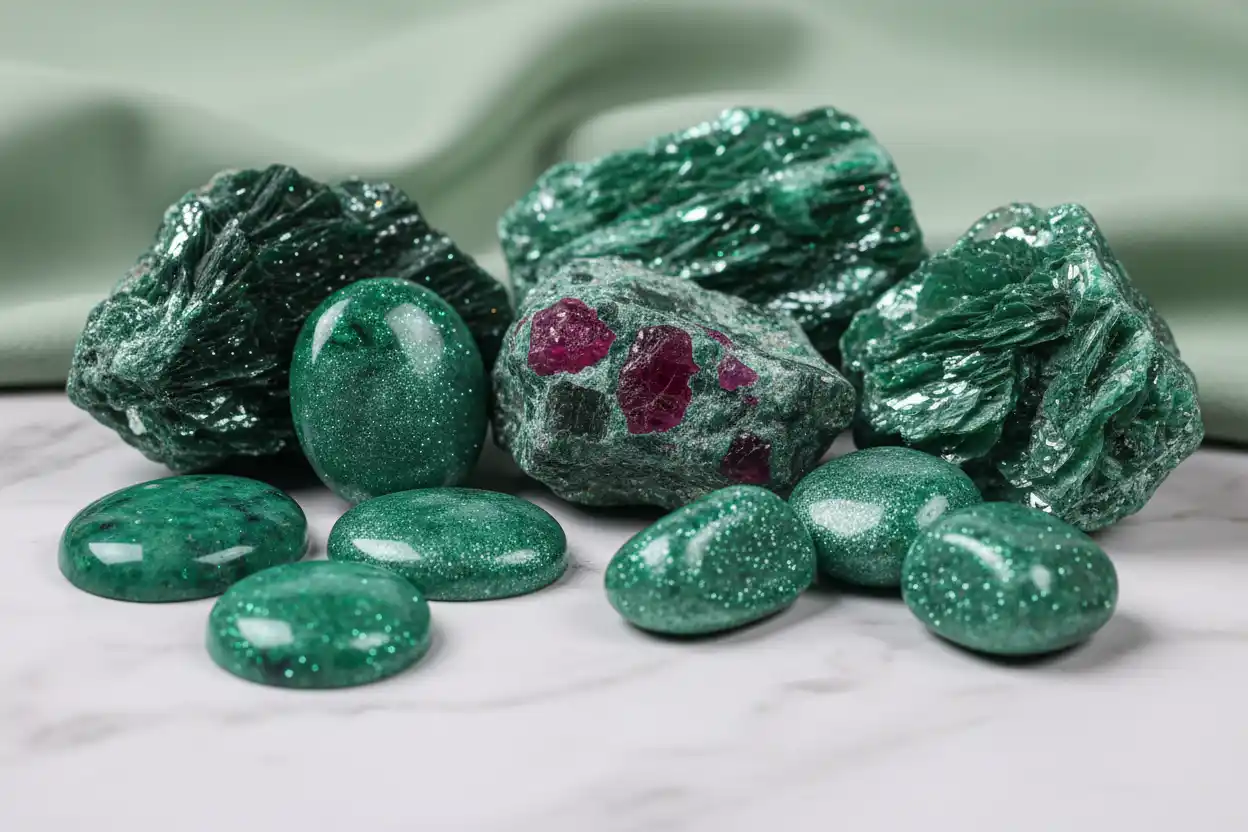
Fuchsite Meaning: Properties, Uses & Symbolism
Fuchsite meaning begins with a chromium-bearing variety of muscovite mica, not with the healing or abundance claims commonly attached to its green color. Fuchsite belongs to the mica group and retains the sheet-like structure, perfect basal cleavage, relatively low hardness, and pearly-to-vitreous luster expected from muscovite. What distinguishes it visually is chromium substituting for part of the aluminum in the structure, producing colors that can range from pale mint and silvery green to much richer emerald-like green. The amount and distribution of chromium vary, so fuchsite does not have one fixed color intensity or one perfectly uniform chemical formula beyond its relationship to chromium-bearing muscovite.
That identity is the foundation of fuchsite meaning. A sparkling green rock containing mica flakes may include fuchsite, but the whole rock should not automatically be called pure fuchsite. Likewise, green aventurine quartz may derive much of its glittering appearance from tiny fuchsite inclusions while remaining quartz-dominant material. Ruby-in-fuchsite combines red corundum with a green fuchsite-rich matrix, creating another visually distinctive material whose identity cannot be reduced to the mica alone.
Modern symbolism can be discussed after those distinctions are clear. Fuchsite meaning is often associated with growth, renewal, perspective, compassion, boundaries, or practical resilience because its green color and reflective mica texture lend themselves easily to those metaphors. Such themes can serve as personal prompts, but they are not measurable effects of chromium-bearing muscovite. Readers exploring other material-first references can use the broader Gemstone Guides while keeping mineral identity, history, symbolism, and health claims separate.
Fuchsite Meaning at a Glance
| Feature | Grounded reference |
|---|---|
| Material identity | Chromium-bearing variety of muscovite mica |
| Mineral group | Mica |
| General chemistry | Potassium aluminum silicate mica with variable chromium substitution |
| Crystal system | Monoclinic |
| Typical colors | Pale green, mint, silvery green, medium green, rich emerald-like green |
| Main color influence | Chromium substituting into the muscovite structure |
| Mohs hardness | Commonly about 2–3 |
| Cleavage | Perfect basal cleavage |
| Luster | Pearly to vitreous, often strongly reflective on cleavage surfaces |
| Habit | Platy, flaky, foliated, scaly, micaceous masses and crystals |
| Transparency | Thin flakes can be translucent to transparent |
| Common geological setting | Metamorphic and hydrothermally altered rocks containing chromium-bearing source material |
| Important related materials | Green aventurine, ruby in fuchsite, fuchsite-bearing quartzite or schist |
| Formal species status | Fuchsite is a variety of muscovite rather than an independent mineral species |
| Symbolism | Modern cultural or personal interpretation, not a scientifically demonstrated force |
| Main ownership issue | Softness and perfect cleavage make flakes and polished surfaces vulnerable to abrasion and splitting |
The most important point in fuchsite meaning is that the word describes a chromium-rich muscovite variety. It does not describe every green mica, every green sparkling stone, or every green quartz-rich rock.
What Fuchsite Actually Is
Micas are sheet silicates whose atomic structure naturally creates extremely strong directional cleavage. In fuchsite, as in ordinary muscovite, the mineral can separate into thin sheets along the basal plane. These sheets may be flexible and can reflect light strongly, producing the shimmering appearance characteristic of many fuchsite-rich rocks.
Chromium is responsible for the most recognizable departure from ordinary muscovite. Standard muscovite is commonly colorless, silver, pale gray, or lightly tinted, while chromium substitution can produce green coloration. Because substitution is variable, fuchsite can occur as discrete green mica crystals, fine scales disseminated through rock, concentrated foliation, or tiny inclusions inside another mineral.
That variability affects terminology. A specimen containing abundant fuchsite flakes embedded in quartz may be described as fuchsite-bearing quartzite rather than as a single mass of fuchsite. A polished slab can obscure that distinction because the eye focuses on color and sparkle rather than on mineral proportions.
For close examination of plates, cleavage, inclusions, alteration boundaries, quartz contacts, and other internal details, the fuchsite microscope inclusion notebook provides the more appropriate specialist framework.
How Fuchsite Forms
Fuchsite formation requires the ingredients needed for muscovite plus a geological source of chromium. It commonly develops during metamorphic or hydrothermal alteration processes where chromium-bearing rocks interact with silica-, aluminum-, potassium-, and water-bearing systems under suitable temperature and pressure conditions.
Chromium-rich ultramafic or related rocks can provide the chromium needed for green mica formation. During alteration or metamorphism, fluids may redistribute chemical components, while new mica crystallizes within fractures, foliation planes, reaction zones, quartz-rich rocks, or other metamorphic assemblages. Depending on the local environment, fuchsite can occur alongside quartz, carbonate minerals, corundum, kyanite, and numerous other minerals.
The mineral’s presence can therefore provide useful geological information. Fuchsite may record chemical exchange between chromium-bearing source material and surrounding rocks rather than merely appearing as a decorative green inclusion.
Its relationship with quartz is especially important commercially. When abundant tiny fuchsite plates occur within quartz, reflected light from the mica can produce aventurescence—the sparkling effect associated with green aventurine. In other rocks, larger mica flakes remain visibly distinct rather than becoming a fine glitter dispersed through quartz.
The detailed sequence of chromium availability, metamorphic reactions, fluid movement, host-rock chemistry, and mineral associations belongs in fuchsite formation and deposit geology, keeping this page focused on foundational fuchsite meaning rather than reproducing a full deposit study.
What Causes Fuchsite’s Green Color?
The green color central to fuchsite meaning is associated primarily with chromium incorporated into the muscovite structure. Chromium ions interact with visible light in ways that absorb some wavelengths more strongly than others, leaving the reflected or transmitted light perceived as green.
Color intensity depends on more than the mere presence of chromium. Concentration, structural environment, crystal thickness, associated minerals, transparency, grain size, and lighting all affect what the observer sees. Thin mica sheets can appear lighter and more translucent than thick aggregates. Finely dispersed fuchsite within quartz can create a pale sparkling green, while concentrated mica-rich zones can appear deeper and more saturated.
Surface orientation matters because mica reflects light strongly from cleavage surfaces. A specimen may flash bright silver-green when tilted toward a light source and look considerably darker from another angle. That directional reflectivity should not be confused with a separate color-changing phenomenon.
Detailed color behavior, reflectance, transparency, aventurescence, and related optical questions belong in fuchsite optical properties and color behavior rather than being repeated across every section of this fuchsite meaning reference.
Fuchsite Is Soft Because It Is Mica
A polished green stone can look solid and robust while containing a mineral that is mechanically delicate. Fuchsite commonly falls around 2–3 on the Mohs hardness scale, making it substantially softer than quartz.
Perfect basal cleavage creates an additional weakness. The sheet structure separates readily along one dominant direction, so individual flakes can peel, split, or abrade. Massive fuchsite-rich material may appear stronger because neighboring quartz or other minerals support the mica, but that does not change the softness of the fuchsite itself.
This distinction is important in jewelry and specimen handling. A quartz-rich rock with minor fuchsite can inherit much of its surface durability from quartz. A mica-rich specimen may scuff, shed flakes, or split much more readily.
Hardness numbers should therefore be assigned to the phase actually being described rather than copied from whichever mineral dominates the commercial name.
Diagnostic Traits That Support Fuchsite Identification
Green color alone is not enough to identify fuchsite. Several minerals and rocks can be green, sparkling, foliated, or flaky.
The most useful field clues include micaceous habit, very good basal cleavage, low hardness, pearly reflective surfaces, thin flexible flakes, and green coloration compatible with chromium-bearing muscovite. If the material occurs as sparkling green particles within much harder quartz, the specimen may be a fuchsite-bearing quartz rock rather than massive mica.
Magnification can reveal stacked plates, cleavage steps, flaky edges, quartz-mica boundaries, secondary staining, inclusions, and fractures. It can also show whether the apparent glitter is produced by mica platelets rather than metallic particles or glassy inclusions.
Exact chromium content requires chemical analysis rather than visual inspection. Likewise, distinguishing fuchsite from another green mica may require composition data when habit and color overlap. Techniques such as Raman spectroscopy, X-ray diffraction, or electron-beam chemical analysis may become appropriate for consequential technical questions.
A responsible identification can therefore be specific enough to be useful without claiming more than the evidence supports: “green chromium-bearing muscovite consistent with fuchsite” is stronger than an unsupported statement about precise chromium concentration.
An Original Fuchsite Name and Specimen Claim Audit
Fuchsite meaning is complicated by commercial names that blur mineral, rock, inclusion, and metaphysical categories. The following table separates commonly encountered wording from the conclusions it can legitimately support.
| Name or claim | What it can reasonably indicate | What should not be assumed |
|---|---|---|
| Fuchsite | Chromium-bearing muscovite mica | Separate formal mineral species |
| Chrome muscovite | Descriptive synonym emphasizing chromium content | Exact chromium percentage |
| Green muscovite | Green mica compatible with muscovite | Fuchsite without confirming chromium |
| Fuchsite mica | Commercially clear wording for chromium-bearing muscovite | Pure monomineralic material |
| Fuchsite quartz | Quartz-bearing material containing fuchsite | One standardized rock composition |
| Fuchsite quartzite | Quartz-rich rock containing fuchsite | That all green sparkling areas are pure fuchsite |
| Green aventurine | Quartz with aventurescent inclusions, commonly including fuchsite in green material | Solid fuchsite |
| Ruby in fuchsite | Corundum crystals in fuchsite-rich matrix | That every red inclusion is ruby without confirmation |
| Ruby fuchsite | Commercial shorthand for ruby-in-fuchsite material | A distinct mineral species |
| Verdite | Historical/commercial rock name applied to certain green chromium-bearing metamorphic rocks | Pure fuchsite or universal composition |
| Emerald fuchsite | Color-marketing term for rich green material | Emerald or beryl content |
| Natural untreated | Seller or laboratory statement | Absence of all stabilization, dye, coating, filler, or repair based only on appearance |
| AAA fuchsite | Seller-specific quality terminology | Universal grading standard |
| Heart-healing fuchsite | Modern metaphysical wording | Medical or cardiovascular effect |
| Abundance stone | Symbolic marketing language | Guaranteed financial outcome |
The distinction between fuchsite and green aventurine is particularly important. Green aventurine is primarily quartz. Fuchsite can be the inclusion that creates its green color and sparkling aventurescence, but the host mineral remains quartz.
Ruby-in-fuchsite introduces a second boundary. A red crystal inside green mica may be corundum, but red color alone does not prove ruby. Garnet and other red minerals can occur in metamorphic rocks as well. Exact identification should follow crystal properties and testing rather than the commercial name alone.
Fuchsite and Green Aventurine Are Not the Same Material
Because fuchsite commonly contributes to green aventurine’s appearance, the two names are sometimes treated as interchangeable. They are not.
Fuchsite is mica. Green aventurine is a quartz-rich material whose aventurescent sparkle can result from aligned or dispersed mineral inclusions, commonly chromium-bearing mica in green varieties.
That difference changes hardness dramatically. Quartz is about 7 on the Mohs scale, while fuchsite itself is much softer. A polished green aventurine cabochon can therefore resist scratching far better than a mica-rich fuchsite specimen even when both owe their color to chromium-bearing mica.
This distinction also affects identification. If a polished stone is predominantly hard, dense quartz with fine internal sparkles, “green aventurine” may be the more accurate material name. If the specimen consists mainly of visible soft mica plates, fuchsite is more likely to describe the dominant mineral.
Ruby in Fuchsite Requires Two Identifications
Ruby-in-fuchsite is visually striking because red corundum crystals contrast strongly against green mica-rich matrix. Yet the commercial name contains two mineral claims, so both should be evaluated independently.
The green material needs to be consistent with chromium-bearing muscovite. The red material needs to be consistent with corundum rather than simply being any red inclusion.
This becomes especially important in polished material, where crystal habit may have been removed. Color, luster, hardness relationships, cleavage, and appropriate gemological testing can help separate possible phases.
The composite can also have uneven durability. Corundum is extremely hard, while fuchsite is soft and cleavable. Polishing across those minerals requires different expectations because the softer matrix can undercut or wear away around the harder red crystals.
Those mechanical problems are handled more fully in fuchsite cutting, orientation and polish rather than being turned into a procedural cutting guide here.
Verdite Is a Rock Name, Not a Simple Fuchsite Synonym
“Verdite” is another term that can create confusion around fuchsite meaning. It has been used commercially and historically for green metamorphic rock containing chromium-bearing minerals, often including fuchsite.
The precise mineral proportions can vary, which is why verdite should not automatically be reduced to “pure fuchsite.” A polished carving sold as verdite may contain mica, quartz, chlorite, talc, or other components depending on the material.
This is a broader classification lesson: mineral names and rock names operate at different scales. Fuchsite identifies a mica variety. Verdite describes a composite rock material in relevant commercial or geological usage.
The Documented History Behind Fuchsite
Fuchsite takes its name from the German mineralogist Johann Nepomuk von Fuchs. The name recognizes the scientific study of minerals rather than an ancient metaphysical tradition. That historical origin is useful because modern crystal writing sometimes attributes broad ancient meanings to fuchsite without demonstrating that historical cultures recognized the same mineral variety under the modern name.
Mica itself has a much longer history of practical use. Its ability to split into thin sheets, combined with heat resistance and electrical properties in suitable mica species, contributed to numerous industrial and decorative applications. Muscovite has historically been important in window-like sheets, insulation, pigments, fillers, and other technical contexts.
Fuchsite’s distinctive green color made it attractive to collectors and lapidaries, while fuchsite-bearing rocks became decorative carving and jewelry materials.
A careful fuchsite meaning history therefore distinguishes the documented mineralogical naming tradition from much newer crystal-healing narratives. The latter can be discussed as modern cultural practices without being projected backward as ancient fact.
Fuchsite Meaning in Modern Symbolism
Modern fuchsite meaning commonly centers on growth, emotional perspective, compassion, renewal, boundaries, self-respect, cooperation, and practical resilience. Green color naturally encourages associations with plants and growth, while the mineral’s reflective mica surfaces lend themselves to metaphors involving self-examination or seeing a situation from different angles.
A grounded symbolic practice can use those associations as prompts. Someone might place fuchsite near a journal and ask whether helping another person is actually sustainable or whether clearer boundaries are needed. Another person might use its layered mica structure as a reminder that a complex problem can contain multiple perspectives rather than one simple explanation.
Those uses do not require a claim that fuchsite emits therapeutic energy. Their mechanism is deliberate reflection.
There is no established scientific evidence that fuchsite automatically heals emotional trauma, improves relationships, controls stress hormones, repairs the heart, changes immune function, attracts money, or causes opportunities to appear. Such statements exceed what mineralogy can demonstrate.
The broader distinction between reflective symbolism and medical, financial, or other professional claims is explained in the site’s Disclaimer.
“Heart” Symbolism Is Not a Cardiovascular Effect
Green crystals are frequently linked with “heart” symbolism in modern metaphysical systems. That can refer metaphorically to affection, compassion, relationships, or emotional boundaries, but it should not be converted into claims about the physical heart.
Fuchsite does not scientifically treat heart disease, blood-pressure disorders, circulation problems, cardiac rhythm disturbances, or other cardiovascular conditions through skin contact.
The same boundary applies to chromium. Although chromium occurs in different chemical forms across minerals, industrial materials, and biological discussions, chromium locked within a mica structure is not a controlled nutritional supplement delivered by wearing the stone.
Mineral chemistry describes the stone. It does not establish a therapeutic dose or medical mechanism.
Fuchsite Does Not Need to Be Ingested or Added to Water
Crystal symbolism does not require chemical exposure. Fuchsite should not be powdered for ingestion or intentionally added to drinking water as an elixir.
Natural specimens can include other minerals, surface contamination, iron staining, polishing residues, coatings, adhesives, or matrix components that are not obvious visually. A commercial name does not provide a complete chemical safety analysis.
Using the intact mineral as a visual or reflective object avoids unnecessary exposure while preserving the symbolic practice a person may value.
Safe Ownership of Fuchsite
Normal handling of a stable intact fuchsite specimen is different from grinding, sanding, drilling, cutting, or crushing it. Lapidary processing can create fine mineral dust from fuchsite and associated quartz or matrix minerals, so professional dust-control practices are appropriate rather than assuming a decorative stone is harmless when pulverized.
Quartz-bearing fuchsite material deserves particular attention because cutting can create respirable crystalline silica. Suitable wet methods, local extraction, eye protection, respiratory protection appropriate to the task, and careful cleanup are preferable to uncontrolled dry grinding.
Mechanical care is also important. Fuchsite’s low hardness and perfect cleavage mean exposed flakes can scratch, split, or peel. Rough specimens should not be packed tightly against quartz, corundum, or other harder minerals.
For jewelry, the engineering problem depends on whether the piece is mica-rich or quartz-supported. Those distinctions are covered in fuchsite setting and wear engineering.
Fuchsite in Jewelry Requires Material-Specific Expectations
Mica-rich fuchsite is not an ideal everyday ring material. Repeated abrasion can dull the surface, and impacts can disturb cleavage-rich zones. Large exposed flakes are particularly vulnerable.
Fuchsite-bearing quartz can behave differently. If quartz forms most of the polished surface, the piece may retain a polish substantially better while still showing green mica inclusions. Ruby-in-fuchsite presents another combination in which extremely hard corundum sits inside a much softer matrix.
This mixed hardness complicates polishing and repair. A jeweler cannot assume that every part of the stone responds equally to abrasion or pressure.
Pendants, brooches, and protected decorative pieces generally place fewer mechanical demands on soft fuchsite-rich material than rings or bracelets. The best choice depends on actual mineral proportions and construction rather than on symbolism.
Preserve Fuchsite Specimens Before Aggressive Cleaning
Natural fuchsite specimens can preserve mica books, crystal faces, foliation, quartz relationships, associated minerals, alteration textures, matrix, and old collection labels. Those features may carry more geological information than a polished decorative surface.
Aggressive brushing can detach delicate flakes. Abrasive cleaning can dull cleavage faces. Mechanical trimming can remove contact relationships between fuchsite and associated minerals.
An important specimen should therefore be photographed before alteration. Original labels should remain with it, and any repair, stabilization, or later coating should be documented rather than silently incorporated into the object’s history.
The dedicated fuchsite specimen conservation and record keeping guide addresses long-term storage, handling, condition photography, labeling, and intervention without duplicating that material here.
Provenance Should Not Be Guessed From Shade of Green
Rich emerald-green fuchsite can resemble material from well-known collecting regions, but color does not prove locality.
The same chromium-driven green can occur wherever suitable geological conditions allow chromium-bearing muscovite to form. Crystal size, host rock, associated minerals, texture, and color may suggest comparison with known deposits, yet none provides a complete chain of provenance.
If locality matters to value or research, preserve original labels, invoices, collection numbers, dealer records, mine information, and earlier photographs. A seller statement is evidence of what was represented, but it should remain distinguished from independently confirmed origin.
The fuchsite provenance disclosure checklist provides a structure for keeping those evidence levels separate.
Original Fuchsite Specimen and Photo Checklist
Before assigning a strong commercial, locality, or inclusion claim to a specimen, record what is actually visible.
| Observation | Useful interpretation | Limit |
|---|---|---|
| Green platy flakes | Compatible with green mica such as fuchsite | Does not confirm chromium chemically |
| Perfect sheet-like cleavage | Strongly supports mica-group behavior | Does not alone distinguish all mica species |
| Pearly silver-green reflection | Compatible with mica cleavage surfaces | Not a quantitative chromium indicator |
| Quartz-rich host | May indicate fuchsite-bearing quartz or quartzite | Does not make the whole specimen fuchsite |
| Fine glitter throughout quartz | Compatible with aventurescence from mica inclusions | Inclusion species still deserves confirmation |
| Red crystals in green matrix | Compatible with ruby-in-fuchsite material | Red color alone does not prove corundum |
| Deep green color | May reflect higher or differently distributed chromium | Does not prove rarity or locality |
| White or colorless veins | Could be quartz, carbonate, or another phase | Visual appearance alone is insufficient |
| Foliate rock texture | Supports metamorphic fabric | Does not identify exact rock type |
| Soft scratching behavior | Compatible with mica-rich areas | Destructive testing should be avoided on important pieces |
| “Natural untreated” label | Records seller representation | Does not independently verify absence of treatment |
| Famous locality name | Records provenance claim | Cannot be authenticated from color alone |
| “AAA fuchsite” | Seller quality language | Not a universal grading system |
| “Emerald fuchsite” | Describes vivid green color commercially | Does not mean emerald is present |
| “Healing fuchsite” | Records modern belief or marketing | Does not establish medical efficacy |
This checklist deliberately separates observations from conclusions. The approach is especially useful for photographs, where a green mica-rich appearance may be obvious but hardness, chemistry, treatment, and exact mineral proportions remain unknown.
Fuchsite Compared With Fulgurite
The adjacent fulgurite meaning page concerns material formed through intense, rapid alteration associated with lightning. Fulgurites can include glassy or fused components and often preserve tubular structures created during an extreme thermal event.
Fuchsite forms through entirely different processes involving mica crystallization during metamorphism or alteration. One material records a rapid high-energy transformation; the other records mineral reactions and crystal growth within evolving rock systems.
Their shared use in modern symbolic contexts does not imply mineralogical similarity.
Fuchsite Compared With Fossil Coral
Fossil coral meaning concerns preserved biological structures that have undergone geological mineralization. A polished fossil coral may contain silica-rich replacement material, but its repeating patterns originated in ancient coral anatomy.
Fuchsite has no biological origin. Its platy structures result from mica crystallography, while its green color comes principally from chromium substitution.
Both can be polished into decorative objects, yet one is a mineral variety and the other is a fossil material.
Fuchsite Compared With Gabbro
Gabbro meaning concerns a coarse-grained intrusive igneous rock composed principally of minerals such as plagioclase and pyroxene, with additional phases depending on the rock.
Fuchsite is a particular mica variety rather than an igneous rock. A rock can contain several minerals, whereas a mineral name refers to one structurally and chemically defined phase or variety.
That distinction matters when commercial stones receive attractive trade names. A green or multicolored rock cannot be identified by transferring the properties of whichever mineral is visually dominant.
Fuchsite Compared With Fordite
The contrast with Fordite meaning is even more fundamental. Fordite is human-made hardened paint accumulation rather than a mineral or natural rock. Fuchsite is a naturally occurring chromium-bearing mica formed through geological processes.
Both can show vivid layered color and be cut for decorative use. Their origins, chemistry, physical properties, and evidence requirements are entirely different.
This is why lapidary presentation should never be used as a substitute for material classification.
What Fuchsite Meaning Can Reliably Tell You
A grounded fuchsite meaning reference can establish that fuchsite is chromium-bearing muscovite mica, explain why chromium produces its characteristic green color, describe its sheet-silicate structure and perfect cleavage, outline how metamorphic and hydrothermal processes can form it, and distinguish fuchsite itself from rocks and composites that merely contain it.
It can also identify important limits. Green sparkle does not prove fuchsite without considering the host material. A red crystal in green matrix does not prove ruby without additional evidence. “Emerald fuchsite” does not contain emerald merely because the color is vivid. A geographic origin cannot be established reliably from shade, pattern, or a seller photograph alone.
No first-hand mine visit, chemical assay, laboratory identification, treatment determination, or specialist review is implied where supporting evidence does not exist.
The broader material-first approach used throughout Gems Lore is described on About Gems Lore. Readers with analytical data, documented locality records, specimen corrections, or evidence concerning disputed commercial terminology can provide supporting context through Contact Gems Lore.
FAQ
What is the basic fuchsite meaning?
The basic fuchsite meaning is mineralogical: fuchsite is a chromium-bearing green variety of muscovite mica. Modern symbolic traditions commonly associate it with growth, perspective, compassion, boundaries, or renewal, but those themes are personal interpretations rather than measurable mineral effects.
Is fuchsite a mineral?
Fuchsite is generally classified as a chromium-rich variety of the mineral muscovite rather than a separate mineral species. It belongs to the mica group and shares muscovite’s sheet structure and perfect basal cleavage.
Why is fuchsite green?
Its characteristic green color is primarily associated with chromium substituting for some aluminum within the muscovite structure. Color intensity varies with composition, grain thickness, mineral associations, and lighting.
Is fuchsite the same as green aventurine?
No. Green aventurine is primarily quartz and may contain tiny fuchsite inclusions that create green color and sparkling aventurescence. Fuchsite itself is mica and is considerably softer than quartz.
Is ruby in fuchsite real ruby?
Some material genuinely contains corundum crystals in fuchsite-rich matrix, but a red inclusion should not be called ruby solely because of its color. Important specimens should have both the red and green components identified appropriately.
Is fuchsite the same as verdite?
No. Verdite is a rock or commercial material name applied to certain green chromium-bearing metamorphic rocks and may contain fuchsite along with other minerals. Fuchsite refers specifically to chromium-bearing muscovite.
Is fuchsite soft?
Yes. Fuchsite inherits the relatively low hardness and perfect basal cleavage characteristic of muscovite mica. Mica-rich material can scratch, peel, and split more readily than quartz-rich gemstones.
Can fuchsite be used in jewelry?
Yes, but the design should reflect the actual material. Mica-rich fuchsite is relatively soft and cleavable, while fuchsite enclosed in or mixed with quartz can be more durable. Protected pendants generally present less risk than heavily exposed everyday rings.
Does fuchsite have scientifically proven healing properties?
No. There is no established scientific evidence that wearing or holding fuchsite treats physical or mental-health conditions. It can be used as a symbolic or reflective object without those meanings being presented as medicine.
Does chromium in fuchsite benefit the body?
Chromium bound within a mineral structure is not equivalent to a controlled dietary or medical chromium source. Wearing fuchsite does not provide an established nutritional dose through the skin.
Can fuchsite attract money or abundance?
There is no scientific evidence that fuchsite changes financial outcomes. A person can use the stone as a reminder to review goals, spending, work habits, or opportunities, but any practical effect comes from decisions and behavior rather than a demonstrated mineral force.
Fuchsite Meaning Starts With a Mineral That Is More Interesting Than Its Marketing
Fuchsite meaning becomes clearer when the actual mineral is allowed to remain the foundation. Chromium enters the muscovite structure and turns an ordinarily pale mica green. The layered crystal structure produces perfect cleavage and reflective sheets. Geological reactions bring the mica together with quartz, carbonate minerals, corundum, and other phases, creating everything from delicate green specimens to sparkling quartz-rich rocks and ruby-bearing decorative material.
Those facts also explain many of the naming problems surrounding fuchsite. Green aventurine can contain fuchsite without being fuchsite. Ruby-in-fuchsite is a composite requiring more than one mineral identification. Verdite is a rock term rather than a simple synonym. “Emerald fuchsite” describes color commercially but does not turn mica into beryl.
Modern symbolism can sit beside that evidence without replacing it. Fuchsite meaning may represent growth, reflection, sustainable generosity, or stronger personal boundaries because people choose those metaphors when looking at a green, layered mineral. The meaning is human. The mineral remains chromium-bearing muscovite—and understanding that distinction makes both sides of the subject more precise.