Fossil Coral Meaning: Properties, Uses & Symbolism
Fossil coral meaning begins with evidence of an ancient biological structure preserved through geological change. Fossil coral is not one mineral species, one gemstone variety, or one fixed chemical composition. It is coral skeletal material that entered the fossil record and was preserved, replaced, filled, or altered by minerals during burial and diagenesis. In many lapidary specimens, original skeletal spaces have been silicified with chalcedony or microcrystalline quartz, producing the durable patterned material frequently sold as agatized coral. Other fossil corals may retain or acquire calcite and other mineral phases, so identifying every specimen simply as “agate” can be as imprecise as treating every fossil coral as chemically unchanged coral.
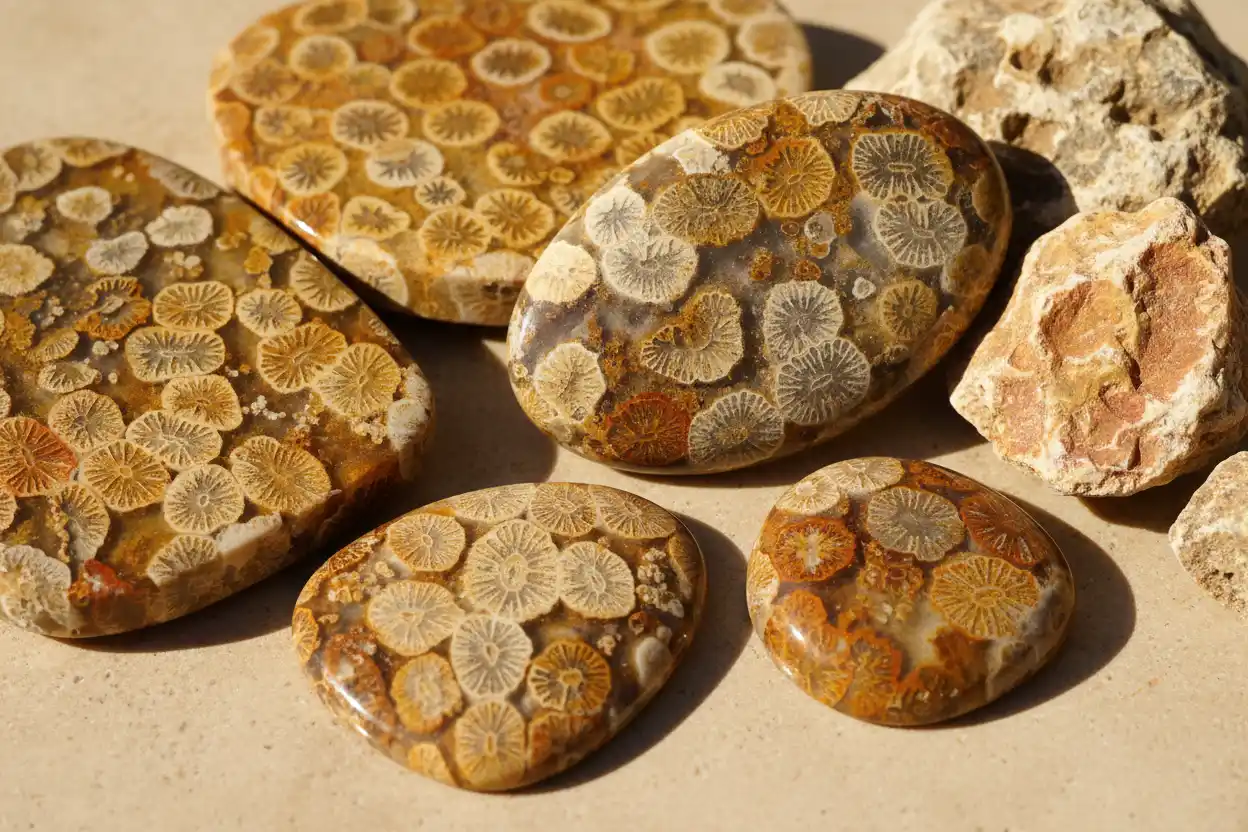
The repeated flower, honeycomb, star, cell, or radial patterns visible in polished pieces are especially important to fossil coral meaning because they preserve aspects of the organism’s skeletal architecture. A circular structure may represent a corallite—the skeletal cup associated with an individual coral polyp—while radiating lines can preserve septa or related internal partitions. Colonial coral growth can therefore create dense repeating patterns across a cut surface. Those structures are geological and biological evidence, not decorative patterns generated intentionally by the mineral replacement.
A grounded fossil coral meaning separates that evidence from modern symbolism. Fossil anatomy, replacement minerals, host rock, hardness, fracture, and preservation can be examined scientifically. Geological and paleontological context can help interpret the organism and environment. Modern themes such as resilience, continuity, community, patience, ancestry, or adaptation are human interpretations inspired by the fossil’s appearance and history rather than measurable forces emitted by the stone. Readers exploring similarly material-first references can use the broader Gemstone Guides while keeping fossils, minerals, rocks, and commercial gemstone names distinct.
Fossil Coral Meaning at a Glance
| Feature | Grounded reference |
|---|---|
| Material identity | Fossilized remains or preserved skeletal structures of ancient coral |
| Mineral identity | Variable; replacement or infilling may include silica, calcite, or other minerals |
| Common lapidary material | Silicified or agatized fossil coral |
| Typical structures | Corallites, radial septa, colonial cells, branching or honeycomb-like patterns |
| Common colors | Cream, beige, gray, brown, tan, reddish, orange-brown, black, white, or mixed |
| Transparency | Usually opaque to translucent; silica-rich portions can show greater translucency |
| Hardness | Depends on the replacement mineral; silicified material can approach chalcedony hardness |
| Cleavage | Depends on mineral replacement and matrix |
| Fracture | Silicified material can show conchoidal fracture |
| Geological significance | Records ancient marine organisms and post-burial mineral alteration |
| Gemstone status | A fossil lapidary material rather than one formal mineral species |
| Common names | Fossil coral, fossilized coral, agatized coral, coral agate and locality-specific names |
| Identification limit | Pattern alone cannot establish coral species, geological age, locality, or replacement mineral |
| Symbolic meaning | Modern interpretation centered on themes such as continuity or resilience |
| Ownership emphasis | Preserve fossil context; distinguish normal handling from cutting and dust-generating work |
The variability in this table is central to fossil coral meaning. A polished silicified coral cabochon and a carbonate-rich fossil coral specimen can share recognizable biological structures while behaving differently under testing, cutting, and conservation.
What Fossil Coral Actually Is
Coral is produced by marine organisms whose colonies construct skeletal frameworks. Depending on the coral group, those original skeletons can contain calcium carbonate mineral phases such as aragonite or calcite. Once buried, however, original skeletal chemistry does not necessarily remain unchanged. Groundwater, sediment chemistry, pressure, pore fluids, dissolution, recrystallization, and mineral precipitation can alter the material substantially.
Some fossil corals preserve fine skeletal architecture even after most original material has been replaced. Silica can reproduce walls, internal partitions, and pore spaces with enough fidelity that polished slices reveal recognizable coral patterns. In other specimens, recrystallization may blur fine detail or replace original textures with coarser mineral material. Fossil coral meaning therefore depends not merely on the existence of a pattern but on understanding that the pattern can survive while the chemistry changes.
This distinction separates biological identity from current mineral composition. A specimen can genuinely be fossil coral even when much of the material now occupying its skeleton is quartz-family silica. Conversely, a modern coral skeleton is not fossil coral simply because it contains calcium carbonate and looks similar.
How Fossil Coral Forms
Fossil coral formation begins with living coral becoming incorporated into sediment or otherwise entering conditions favorable for preservation. Burial can protect skeletal material from complete destruction while groundwater and pore fluids move through the surrounding sediment. Over time, mineral-rich fluids may enter skeletal cavities, precipitate within pore spaces, replace existing material molecule by molecule or through broader dissolution-and-reprecipitation processes, and cement the fossil into surrounding rock.
Silicification is particularly important in material used for lapidary purposes. Dissolved silica can enter pore spaces and replace carbonate structures, eventually producing chalcedony or fine quartz that preserves original biological architecture. Because silica-rich fossil coral can take a high polish and resist abrasion better than soft carbonate material, it is especially common in cabochons, slabs, carvings, beads, and polished display specimens.
Not every fossil coral follows that same pathway. Some specimens remain predominantly carbonate, some are partly silicified, and others contain several replacement minerals or generations of mineral filling. The surrounding sedimentary rock can also contribute matrix, fractures, secondary veins, iron staining, or cavities.
The deeper sequence of burial, mineral replacement, silicification, recrystallization, host-rock relationships, and deposit environments belongs in fossil coral formation and deposit geology rather than being compressed into a single universal formation story.
Why Fossil Coral Shows Flowers, Stars, and Honeycomb Patterns
The patterns responsible for much of fossil coral meaning usually originate in coral anatomy rather than in a later decorative mineral-growth process. Colonial corals consist of many individual skeletal units arranged according to the biology of the organism. When a specimen is cut across those structures, circular, polygonal, flower-like, star-like, or honeycomb-like cross-sections can become visible.
Radial lines inside a circular corallite may represent septal structures. Adjacent corallites can create repeated cellular patterns. A cut through a branching colony may produce elongated or irregular shapes instead of neat flowers. The exact pattern therefore depends both on coral morphology and on the direction of the cut.
That last point is easy to overlook. One fossil can show a dramatic floral pattern in one plane and elongated tubes in another because the cutter is intersecting the same three-dimensional colony at different angles. Pattern names used in jewelry commerce therefore describe appearance, not necessarily biological taxonomy.
A polished surface can reveal extraordinary anatomical detail, but it can also remove contextual information such as original growth orientation, surrounding sediment, exterior colony form, and matrix. That tradeoff becomes important when scientifically interesting specimens are considered for cutting.
What Causes Fossil Coral’s Colors?
Fossil coral color is controlled primarily by the minerals, impurities, pore fillings, staining, and alteration products present after fossilization—not by the original color of the living coral. Cream, white, gray, tan, brown, reddish, orange, black, and mixed tones are all possible.
Iron-bearing minerals and oxides can contribute red, orange, yellow, and brown coloration. Organic matter or finely dispersed dark material can deepen gray or black regions. Silica may appear white, gray, translucent, brownish, or colored by included impurities, while calcite-rich areas can be pale or cream. Secondary mineral veins may cross-cut the fossil in colors unrelated to its biological structures.
A key fossil coral meaning boundary follows from this: a red fossil coral is not evidence that the living coral was red, and a black specimen does not prove one specific species or locality. Fossil color commonly records post-mortem geology more strongly than original biology.
Lighting also changes perceived color. Transmitted light can reveal translucent chalcedony around fossil structures, while reflected light emphasizes opaque walls and mineral-filled pores. The specialist relationship between mineral replacement, translucency, pattern contrast, and optical appearance is covered in fossil coral optical properties and color behavior.
Diagnostic Traits: What Can Be Identified From the Material?
Recognizing fossil coral begins with structure. Repeated skeletal cells, radial partitions, polygonal corallites, branching architecture, or other organized biological patterns can support the interpretation that a specimen preserves coral rather than an ordinary inorganic agate pattern.
The second question concerns mineralization. A silica-rich specimen may show chalcedony-like hardness, waxy-to-vitreous polish, conchoidal fracture, and areas of translucency. A carbonate-dominated fossil may behave differently, including greater reaction to acid testing in professional or controlled contexts and lower hardness. Destructive testing should not be performed casually on valuable fossils simply to satisfy curiosity.
Magnification can reveal corallite walls, mineral-filled cavities, secondary crystals, replacement fronts, fractures, pore structures, iron staining, and polishing artifacts. These details can help distinguish true preserved skeletal organization from purely inorganic orbicular patterns. A structured framework for recording such evidence is provided in the fossil coral microscope inclusion notebook.
However, pattern recognition has limits. Determining the exact coral genus or species can require a paleontologist familiar with skeletal morphology, and mineral replacement may obscure diagnostic biological characters. Geological age likewise depends on stratigraphic context or associated evidence; it cannot responsibly be assigned from a polished flower pattern alone.
Original Fossil Coral Name and Specimen Claim Audit
Fossil coral meaning is surrounded by names that mix paleontology, lapidary terminology, locality, and marketing. The following checklist separates useful descriptions from claims that require stronger evidence.
| Name or claim | What it can reasonably describe | What it does not prove |
|---|---|---|
| Fossil coral | Preserved or mineralized skeletal remains of ancient coral | Exact species, age, locality, or replacement mineral |
| Fossilized coral | General synonym for fossil coral | Complete preservation of original skeletal chemistry |
| Agatized coral | Coral whose structures have been substantially replaced or filled by chalcedony/quartz-family silica | That every part of the specimen is agate |
| Coral agate | Commercial term often used for patterned silicified coral | Formal mineral species |
| Silicified coral | Coral fossil preserved substantially through silica replacement or infilling | Specific silica phase throughout the entire specimen |
| Calcified coral | Ambiguous commercial wording that may refer loosely to mineralized coral | A precise fossilization mechanism |
| Petoskey stone | A specific fossil-coral material traditionally associated with a particular coral group and regional geology | Generic name for all flower-patterned fossil coral |
| Honeycomb coral | Appearance-based or biological descriptive wording | One universal fossil coral species |
| Flower coral stone | Commercial pattern description | Botanical origin |
| Natural fossil coral | Genuine fossil-material claim | Exact provenance or legality of collection |
| Untreated fossil coral | Seller’s modification claim | Absence of resin, dye, filling, stabilization, or polishing history without evidence |
| Museum grade | Seller or collector quality language | Universal scientific grade |
| Ancient ocean energy stone | Modern symbolic wording | A measurable physical field |
| Healing fossil coral | Metaphysical or commercial wording | Medical efficacy |
| Rare fossil coral | Rarity claim | Rarity without taxonomic, locality, abundance, and market evidence |
“Agatized coral” is especially useful when mineral replacement is genuinely silica-rich, but the phrase should not be applied automatically to every fossil coral. Fossil identity and mineral replacement are separate observations.
“Petoskey stone” needs an even tighter boundary. It is not a generic synonym for every fossil coral cabochon showing flower-like cells. Using the name outside its appropriate biological and geographic context removes the specificity that makes the term useful.
Fossil Coral Versus Agatized Coral
All agatized coral is fossil coral, but not all fossil coral is necessarily agatized.
That distinction follows directly from the preservation process. “Fossil coral” identifies the biological origin of the structure. “Agatized” describes a mineralization state in which chalcedony or related silica has substantially replaced or filled the fossil.
A specimen can therefore be fossil coral while remaining predominantly calcitic. Another can be heavily silicified and properly described as agatized coral. A third may contain both silica-rich and carbonate-rich zones.
This is why copying the hardness of chalcedony onto every fossil coral description is inappropriate. Hardness depends on what mineral now makes up the material being tested.
Fossil Coral Versus Modern Coral
Modern coral skeleton and fossil coral should not be treated as interchangeable decorative materials. A modern coral skeleton represents relatively recent biological material, whereas fossil coral has passed through geological preservation and mineralization processes.
The distinction also matters ethically and legally, because modern biological coral can be associated with conservation and trade controls that are not identical to those governing fossils. This page does not infer the legal status of a particular object from a photograph. Provenance documentation should state clearly whether a specimen is fossil material and where it originated.
For buying or collecting, the label should describe what the material actually is rather than relying on the generic word “coral.”
Documented History of Fossil Coral
Fossil corals have long been important to geology and paleontology because they preserve evidence of ancient marine ecosystems, reef development, sedimentary environments, and biological change. Their skeletal structures can help specialists distinguish coral groups and interpret the rocks in which they occur.
Some fossil corals have also served as useful stratigraphic indicators where particular groups occur within restricted portions of the geological record. That scientific usefulness belongs to identifiable fossils in documented geological context—not automatically to polished cabochons whose locality and stratigraphy have been lost.
Lapidary use emerged from a different quality: mineralized coral can expose striking repeated patterns when cut and polished. Silicified specimens in particular combine biological structure with the durability of quartz-family material, creating a natural bridge between fossil collecting and ornamental stonework.
The documented history behind fossil coral meaning is therefore already rich. The material records biological growth, burial, mineral replacement, geological time, scientific interpretation, and later human craftsmanship. None of those layers requires invented ancient metaphysical claims.
Fossil Coral Meaning in Modern Symbolism
Modern fossil coral meaning commonly draws on continuity, resilience, cooperation, accumulated history, community, adaptation, and the relationship between change and preserved identity. These themes arise naturally from the material’s story: the organism is gone, much of its original chemistry may be gone, yet recognizable skeletal structure can remain.
A person might use fossil coral as a reflective reminder that change does not always erase every part of what came before. Another might focus on the colonial pattern, where many neighboring corallites formed part of a larger biological structure, as a metaphor for cooperation without assuming that the stone physically changes social relationships.
The fossilization process also creates a useful distinction between preservation and permanence. Fossil coral survives because it changed. Mineral replacement preserved form by altering substance. As a metaphor, that can support questions about which parts of a project, identity, or plan need to remain stable and which parts can change without losing the core purpose.
Those interpretations arise from reflection on real geological history. There is no established scientific evidence that fossil coral transmits ancestral memory, heals emotional trauma, improves relationships automatically, guarantees resilience, or changes neurological or physiological function.
The broader boundary between symbolic practice and medical or professional advice is explained in the site’s Disclaimer.
Fossil Coral Is Not a Medical Calcium or Silica Source
Because coral skeletons are associated with calcium carbonate and many fossil specimens are silicified, commercial symbolism sometimes turns composition into health claims. That is not a valid inference.
Calcium-bearing fossil coral is not a calcium supplement simply because the mineral contains calcium. Silicified fossil coral is not a dietary silica treatment because quartz-family material is present. Wearing or touching the fossil does not provide controlled nutritional doses of either substance.
Fossil coral meaning should therefore not include claims that the stone strengthens bones, treats arthritis, corrects calcium deficiency, heals cardiovascular conditions, regulates hormones, improves neurological function, treats depression, or relieves anxiety.
The mineral composition of a fossil explains preservation and material properties. It does not prescribe medical use.
Safe Ownership of Fossil Coral
Normal handling of an intact fossil coral specimen, polished cabochon, bead, or display slab is fundamentally different from cutting, grinding, drilling, sanding, or crushing the material.
Silicified fossil coral can generate crystalline silica-bearing dust during lapidary work. Unknown specimens can also contain matrix minerals, iron compounds, carbonates, secondary veins, or other constituents whose dust should not be treated casually. Wet processing, effective local extraction, appropriate respiratory protection, eye protection, and controlled cleanup are more suitable than uncontrolled dry grinding.
Freshly broken silica-rich specimens can also produce sharp edges. Large slabs and rough nodules may contain fractures that open unpredictably during cutting.
Technical decisions about preserving coral pattern, choosing the best cross-section, managing fractures, and polishing mineralized structures belong in fossil coral cutting, orientation and polish rather than turning this fossil coral meaning page into a lapidary procedure.
Fossil Coral in Jewelry
Silicified fossil coral can be sufficiently hard for pendants, earrings, beads, cabochons, and many other jewelry applications. Durability still depends on the actual mineral replacement, fracture density, cavities, thin fossil walls, matrix, and cut.
A highly silicified cabochon may behave much like other chalcedony-rich lapidary material. A partially calcitic fossil can be softer. Open pores or mineral-filled cavities can create weak points. A beautifully preserved colony pattern does not guarantee mechanical uniformity across the entire stone.
Mounting should therefore respond to the individual specimen rather than the generic label. The dedicated fossil coral setting and wear engineering guide covers edge exposure, backing, drilling, setting pressure, and wear considerations separately.
Preserve Scientific Context Before Cutting
Fossil coral is unusual among decorative stones because cutting can remove paleontological information as well as mineralogical context. A natural colony surface, attached sedimentary matrix, orientation within a host rock, or distinctive skeletal feature may be more scientifically useful before it is polished.
That does not mean every fossil coral should remain uncut. Much lapidary material is collected specifically for decorative use, and slicing can reveal internal anatomy beautifully. The important step is recognizing what may be lost.
Before altering an unusual or well-documented specimen, photograph all sides, retain labels, record dimensions, note matrix relationships, and preserve any locality information. If the fossil appears scientifically significant or taxonomically unusual, specialist paleontological review is more appropriate than irreversible cutting based only on commercial potential.
Long-term storage, labeling, documentation, and condition monitoring are addressed in fossil coral specimen conservation and record keeping.
Provenance Matters More Than Pattern Matching
A floral fossil pattern cannot authenticate a mine, country, formation, or collecting site. Similar colonial coral structures occur in multiple geological regions, and polishing removes much of the surrounding context specialists would use.
A strong provenance record can include original locality labels, field notes, acquisition records, collection numbers, quarry or formation information, photographs taken before cutting, and a chain of custody between collectors or dealers.
A seller statement remains useful evidence of what was represented, but it should not silently become an independently confirmed locality. The fossil coral provenance disclosure checklist provides a structured way to preserve those distinctions.
Exact coral taxonomy deserves the same restraint. A general fossil-coral identification may be reasonable from recognizable colonial structures, while a precise genus or species assignment can require thin-section study, specialist morphology, and geological context.
Fossil Coral Compared With Fuchsite
The next material reference, fuchsite meaning, concerns a chromium-bearing mica mineral rather than a fossil. Fuchsite’s green color, platy structure, perfect mica cleavage, and metamorphic occurrence have little mineralogical relationship to fossil coral despite both materials being polished for decorative use.
The comparison highlights an important classification rule: lapidary presentation does not determine origin. A cabochon can be a mineral, rock, fossil, glass, or industrial composite.
Fossil Coral Compared With Fordite
That distinction becomes even clearer with Fordite meaning. Fordite is an anthropogenic accumulation of hardened industrial paint layers. Fossil coral records biological structures altered through geological processes.
Both can show repeating patterns when cut. Both can be polished into cabochons. Neither similarity makes them mineralogically related.
Fossil coral’s patterns originate in anatomy and fossilization. Fordite’s patterns originate in manufacturing and repeated paint deposition.
Fossil Coral Compared With Fulgurite
Fulgurite meaning concerns material formed when intense electrical discharge associated with lightning rapidly alters or fuses soil, sand, or rock. Its tubes and glassy textures record an extremely rapid high-temperature event.
Fossil coral records almost the opposite style of transformation: biological construction followed by burial and prolonged mineral alteration. The two materials demonstrate how very different natural processes can create collectible objects without belonging to the same mineral category.
Fossil Coral and Color-Based Mineral Interpretation
Color symbolism can also blur material boundaries. The dedicated fluorite color meaning reference deals with colors occurring within calcium-fluoride crystals. Fossil coral’s colors instead reflect replacement minerals, impurities, staining, matrix, and preservation history.
A purple, green, red, or black fossil should therefore not inherit the mineral properties of a similarly colored fluorite or another gemstone. Color can support description and symbolism, but it does not define mineral identity.
What Fossil Coral Meaning Can Reliably Tell You
A grounded fossil coral meaning reference can establish that the material began as coral skeletal structure and later entered a geological preservation process. It can explain why silica or carbonate minerals may replace or fill the skeleton, why polished surfaces reveal flower-like and honeycomb-like anatomy, how color can reflect post-burial mineralization, and why the term agatized coral applies more precisely to some specimens than others.
It can also establish meaningful limits. A photograph cannot securely identify exact coral species, geological age, mine, formation, or replacement mineral in every case. A seller’s use of “Petoskey stone,” “agatized coral,” “museum grade,” or another specialized term should be supported at the level implied by that claim. No first-hand excavation, laboratory analysis, taxonomic determination, or specialist review is claimed where it has not occurred.
Gems Lore’s broader approach to separating measurable evidence from interpretation is described on About Gems Lore. Readers with geological records, paleontological corrections, analytical data, or documented specimen provenance can provide supporting context through Contact Gems Lore.
FAQ
What is the basic fossil coral meaning?
The basic fossil coral meaning is geological and paleontological: fossil coral is preserved ancient coral skeletal material that has undergone burial and mineral alteration. Modern symbolism may associate it with continuity, resilience, community, or adaptation, but those themes are interpretations rather than measurable fossil properties.
Is fossil coral actually coral?
Its structures originated from coral organisms, but fossilization can substantially change the original mineral composition. A fossil may preserve coral anatomy while much of the original skeletal material has been replaced by silica, calcite, or other minerals.
Is all fossil coral agatized?
No. Agatized coral is fossil coral substantially replaced or filled by chalcedony or quartz-family silica. Other fossil coral can remain carbonate-rich or contain different mineral assemblages.
Why does fossil coral look like flowers?
Many colonial corals formed repeating skeletal cups containing radial partitions. When fossil material is cut across those structures, the resulting cross-sections can resemble flowers, stars, honeycombs, or cells.
Is fossil coral a gemstone?
It is better described as a fossil lapidary material than as one formal gemstone mineral species. Silicified material is commonly cut and polished for jewelry because its preserved patterns can be highly decorative.
Is coral agate the same as fossil coral?
“Coral agate” is commonly used commercially for silicified or agatized fossil coral, but the term should not imply that every fossil coral is composed entirely of agate. The actual mineral replacement should be considered separately.
Is Petoskey stone the same as every fossil coral?
No. Petoskey stone is a specific fossil-coral material with particular biological and geographic context. It should not be used as a generic name for all flower-patterned fossil coral.
Can fossil coral be identified from a photograph?
A photograph can show skeletal patterns strongly compatible with fossil coral and can document color, matrix, fractures, and polishing. Exact coral taxonomy, geological age, mineral replacement, and geographic origin may require specialist examination and provenance.
Is fossil coral durable enough for jewelry?
Highly silicified fossil coral can be relatively durable because chalcedony-rich material has useful hardness and no prominent cleavage. Individual stones can still contain softer mineral areas, fractures, cavities, or matrix that change durability.
Does fossil coral have healing properties?
There is no established scientific evidence that fossil coral treats physical or mental-health conditions. It can serve as a personal symbol of continuity, adaptation, or community without those themes being presented as medicine.
Does fossil coral provide calcium or silica to the body?
No. Calcium- or silica-bearing mineral material does not become a nutritional supplement through skin contact. Wearing fossil coral is not a method of delivering calcium, silica, or other nutrients.
Fossil Coral Meaning Is a Story of Form Surviving Change
Fossil coral meaning becomes most compelling when the real transformation remains visible. A coral colony once constructed a biological skeleton in a marine environment. That structure was buried. Fluids moved through it. Original material could dissolve, recrystallize, become filled, or be replaced by minerals. Much of the chemistry might change while enough architecture survived for a polished cross-section to reveal cells, walls, and radial patterns long after the living colony disappeared.
That history provides a grounded basis for symbolism without turning a fossil into medicine or supernatural technology. Continuity is an understandable metaphor because structure can survive profound material change. Community is an understandable metaphor because colonial corals built interconnected skeletal systems. Adaptation is an understandable metaphor because preservation itself depended on transformation.
The evidence boundary remains equally important. Fossil coral is a fossil first. Its replacement minerals should be identified rather than assumed, specialized names should remain tied to appropriate biological and geographic evidence, and significant specimens deserve documentation before irreversible cutting. Keeping those layers separate gives fossil coral meaning more depth while preserving the scientific story written inside the stone.