Fulgurite Meaning: Properties, Uses & Symbolism
Fulgurite meaning begins with the physical evidence left when lightning transfers extreme energy into soil, sand, rock, or other geological material. A fulgurite is not one mineral species with a single chemical formula. It is a natural product of lightning-induced melting, fusion, vitrification, and rapid alteration. In silica-rich sand, the result can contain natural glass dominated by fused silica alongside partly melted quartz grains, surviving mineral fragments, bubbles, newly altered phases, and material inherited from the original sediment. In other substrates, the composition can be substantially more complex.
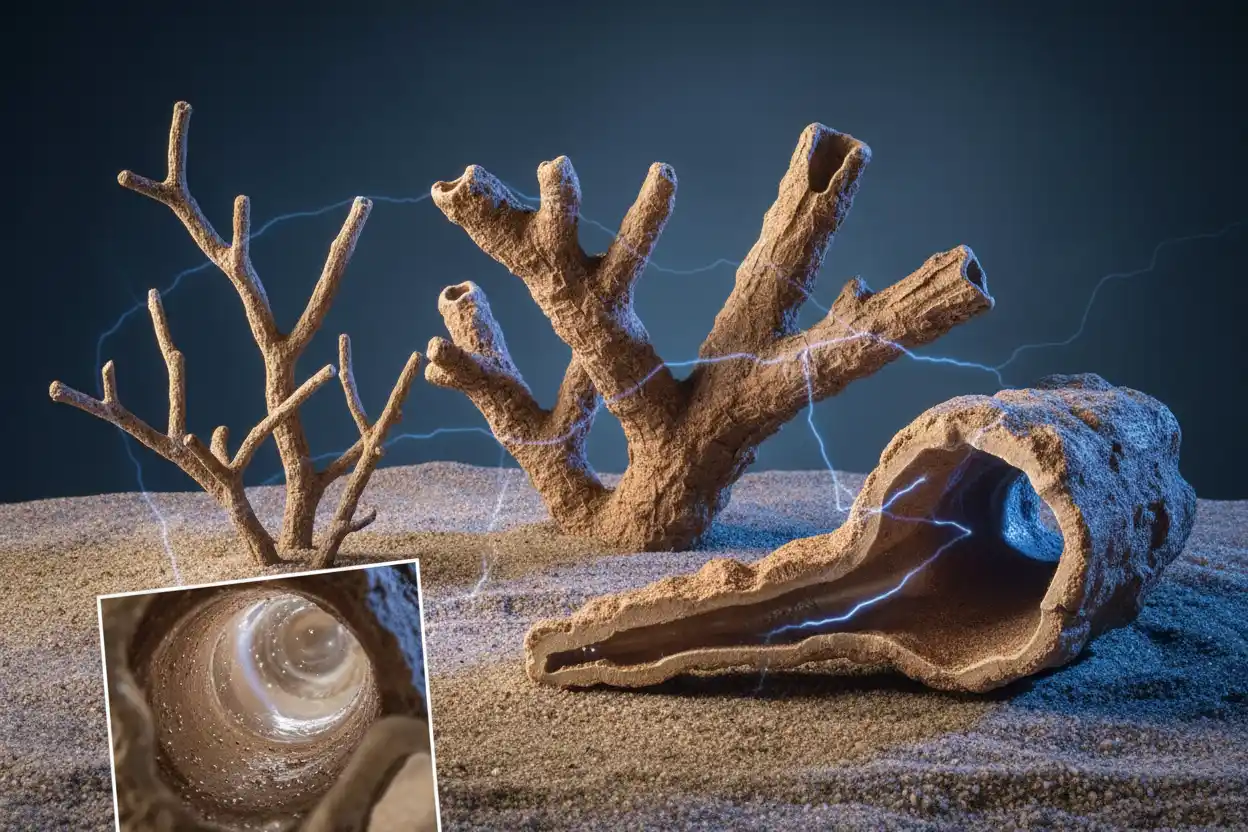
The classic fulgurite is a fragile, branching tube with a rough granular exterior and a smoother or glassier internal wall. That shape can form because the electrical discharge travels through the ground while intense heating locally melts or sinters surrounding material. Gas expansion and the geometry of the discharge path can leave a hollow center. Yet not every fulgurite is a neat tube, and not every lightning-produced geological object has identical texture. Irregular masses, crusts, fused surfaces, branching structures, and rock fulgurites can all occur.
A grounded fulgurite meaning therefore separates the evidence into distinct layers. Lightning origin, texture, composition, bubbles, fused grains, and glass formation belong to geology and materials science. Human descriptions of lightning stones belong to documented history and folklore. Modern associations with sudden change, transformation, focus, or irreversible turning points are symbolic interpretations. None of those symbolic meanings establishes that a fulgurite stores lightning, emits electrical energy, grants wishes, or produces medical effects. Readers exploring other material-first references can use the broader Gemstone Guides while keeping geological evidence separate from modern metaphysical language.
Fulgurite Meaning at a Glance
| Feature | Grounded reference |
|---|---|
| Material identity | Natural material altered, fused, or melted by lightning |
| Formal mineral status | Not a single mineral species |
| Typical silica-rich component | Natural silica glass, often associated with lechatelierite in strongly fused material |
| Other possible components | Quartz grains, feldspar, clay-derived material, iron-bearing phases, rock fragments, bubbles, and other substrate-derived constituents |
| Typical form | Hollow or partly hollow branching tubes, irregular fused masses, crusts, or rock-surface alterations |
| Exterior | Often rough, granular, and coated with partly fused sediment |
| Interior | Can be smoother, glassy, vesicular, or irregular |
| Typical colors | Tan, cream, gray, brown, black, reddish, greenish, or mixed depending on substrate |
| Hardness | Variable because fulgurite is a composite material rather than one mineral |
| Fracture | Glass-rich zones may fracture conchoidally and form sharp edges |
| Formation process | Extremely rapid heating and alteration associated with a lightning discharge |
| Geological significance | Can preserve evidence of high-temperature electrical interaction with near-surface material |
| Identification challenge | Root casts, industrial slag, furnace products, melted glass, and other fused materials can imitate parts of the appearance |
| Symbolic meaning | Modern interpretation involving transformation, intensity, or sudden change |
| Main ownership concern | Fragility, sharp glassy edges, and silica-bearing dust during cutting or grinding |
The central point in fulgurite meaning is that lightning origin defines the material more strongly than one fixed mineral composition. A specimen formed in quartz-rich sand can differ significantly from one formed in soil containing abundant clay, iron minerals, carbonate, or volcanic components.
What Fulgurite Actually Is
Fulgurite is best treated as a geological object produced by an event rather than as a conventional mineral variety. Lightning provides an exceptionally intense but brief energy input. Where a discharge enters suitable ground, portions of the material surrounding the electrical pathway can be heated enough to melt, fuse, or transform.
In quartz-rich sand, this process can generate natural silica glass. Lechatelierite is the name commonly applied to natural silica glass formed through extreme heating, and it can occur in fulgurites. However, calling every entire fulgurite “pure lechatelierite” is usually too simplistic. The exterior may contain only partly fused sand grains, while the wall can trap quartz, feldspar, iron-bearing particles, bubbles, and other remnants of the original substrate.
A fulgurite can therefore be compositionally layered across only a few millimeters. The inner wall may have undergone stronger melting than the rough exterior. Some grains survive with recognizable boundaries; others are partly fused; still others become incorporated into glass.
This is why fulgurite meaning should not borrow one universal hardness, density, refractive index, or chemical formula. Those properties depend on the particular material and which part of the specimen is being examined.
How Fulgurites Form
The formation of a fulgurite begins when a lightning discharge enters or travels through geological material. Electrical energy is converted into intense local heating along the current path. Temperatures can rise sufficiently for minerals and sediments near that path to melt or fuse before cooling rapidly.
In loose sand, the discharge can produce a branching tube following the electrical channel. The surrounding sand may partly melt inward toward the channel while grains farther from the hottest zone remain only sintered or attached to the exterior. Rapid gas expansion and the temporary discharge pathway can contribute to the hollow core.
The cooling interval is short relative to normal geological crystallization. Instead of slowly developing large new crystals, much of the melted silica can solidify as glass. Bubbles, distorted grains, flow textures, fractures, and heterogeneous layers can be trapped during that rapid transition.
Rock fulgurites introduce a different geometry. Lightning striking exposed bedrock can create thin fused coatings, glassy patches, altered mineral surfaces, fractures, or localized melt rather than a sand tube. The underlying process remains lightning-driven, but the resulting object reflects the structure and chemistry of the target rock.
A detailed treatment of discharge pathways, substrate chemistry, melt development, branching morphology, and host-material differences belongs in fulgurite formation and deposit geology rather than turning this foundational fulgurite meaning page into a full formation study.
Why Fulgurites Are Hollow and Branching
The classic branching tube is one of the strongest visual associations with fulgurite meaning. Lightning does not travel through soil as though moving through a perfectly machined pipe. The electrical pathway can branch through material according to moisture, conductivity, grain packing, composition, and the geometry of the discharge.
Material immediately around portions of that channel may fuse, while the central pathway remains open or later loses loose material. The resulting tube can narrow, widen, split into branches, terminate abruptly, or collapse in fragile sections.
A hollow structure is therefore compatible with a sand fulgurite, but it is not sufficient proof. Natural root casts can also produce branching tubes. Industrial processes can create vesicular slag and fused hollow forms. Artificially melted sand can be shaped into superficially similar objects.
The strongest identification combines morphology with material texture, glass formation, fused grains, provenance, and evidence that the object came from an appropriate natural setting.
What Causes Fulgurite Color?
Fulgurite color primarily reflects the material that lightning altered. A nearly pure pale quartz sand can produce cream, gray, tan, or translucent glassy sections. Iron-bearing sediments may contribute yellow, brown, reddish, or dark colors. Organic material, clay, heavy minerals, feldspar, volcanic grains, and other constituents can modify the appearance further.
Dark or greenish glass does not automatically identify one chemical ingredient. During extreme heating, oxidation states can change, mineral phases can partially decompose, and melted components can mix unevenly. Tiny bubbles and inclusions can also affect how light scatters through the glass.
Thickness matters. A thin glass wall may appear translucent when held to light even though the entire tube looks opaque on a table. Surface sand can hide an internally glassy layer. Weathering can dull an originally smoother surface or introduce staining after formation.
The detailed relationship between glass composition, surviving grains, bubbles, thickness, translucency, and color belongs in fulgurite optical properties and color behavior. For fulgurite meaning, color is best treated as evidence about substrate and alteration—not as a reliable indicator of metaphysical purpose or geographic origin.
Is Every Fulgurite Made of Lechatelierite?
No. Lechatelierite is important to fulgurite identification because intense heating of silica-rich material can produce natural silica glass. But a fulgurite is generally a heterogeneous object.
A silica-rich tube may contain glassy lechatelierite together with unmelted or partly melted quartz grains. Feldspar, clay-derived phases, iron oxides, heavy minerals, and other sediment components can remain embedded in or attached to the glass. An exterior crust may be much less completely melted than an interior wall.
In a rock fulgurite, the composition can become still more complicated because the target rock contains several mineral species before the strike.
The more defensible wording is therefore “a fulgurite containing natural silica glass” when that is what the evidence demonstrates. Calling the entire object chemically pure lechatelierite should require appropriate material analysis.
Diagnostic Traits That Support Fulgurite Identification
A plausible sand fulgurite often combines several recognizable features: branching tubular morphology, a hollow or partly hollow center, rough exterior grains fused onto the wall, smoother or glassier interior surfaces, variable wall thickness, bubbles or vesicles, irregular fractures, and sediment matching the surrounding environment.
No single feature proves lightning origin.
Magnification can help distinguish fused grain boundaries from loose sand attached by soil cement or adhesive. It can reveal glassy films, partially melted quartz, bubbles, flow-like areas, fracture surfaces, contamination, and secondary deposits. A structured examination framework is provided in the fulgurite microscope inclusion notebook.
Specialist techniques can provide stronger evidence when authenticity matters. Microscopy, Raman spectroscopy, X-ray diffraction, electron microscopy, chemical analysis, and other methods can characterize glass and mineral phases. Geological provenance can be equally important because a specimen recovered and documented directly from an appropriate lightning-strike site has a stronger evidentiary context than an unproven tube purchased without records.
No photograph alone can reconstruct all those facts.
Original Fulgurite Specimen and Claim Audit
Fulgurites attract dramatic names because lightning itself is dramatic. The following checklist separates useful descriptive terminology from claims that need stronger evidence.
| Name or claim | What it can reasonably indicate | What it does not prove |
|---|---|---|
| Fulgurite | Material formed or strongly altered by lightning | Exact composition |
| Sand fulgurite | Lightning-produced material formed principally in sandy sediment | Pure silica glass |
| Rock fulgurite | Lightning alteration or fusion occurring on or within rock | One standardized morphology |
| Lightning glass | Informal description for glassy lightning-produced material | That every glass fragment near a strike is a fulgurite |
| Lechatelierite fulgurite | Fulgurite containing silica glass | That the whole specimen is chemically pure lechatelierite |
| Lightning tube | Descriptive term for a tubular fulgurite | Natural origin merely from shape |
| Petrified lightning | Poetic or commercial phrase | Preservation of an electrical bolt as matter |
| Thunderstone | Historical/folkloric term applied to several objects in different traditions | Fulgurite identity |
| Lightning stone | Broad descriptive or folkloric term | A single mineralogical category |
| Desert fulgurite | Claimed formation in desert sediment | Specific desert or country |
| Natural fulgurite | Natural lightning-origin claim | Provenance without supporting records |
| Ancient fulgurite | Claim that the object formed far in the past | Age from surface appearance alone |
| High-energy fulgurite | Metaphysical or marketing wording | Measurable retained lightning energy |
| Wish stone | Modern symbolic or commercial terminology | Ability to alter future events |
| Healing fulgurite | Metaphysical wording | Medical efficacy |
“Petrified lightning” is a memorable metaphor, but it should not be interpreted literally. A fulgurite is material transformed by a lightning discharge; the electrical current itself does not become fossilized inside the tube.
“Thunderstone” has an even broader historical problem. Across different cultural and antiquarian contexts, thunderstones have referred to stone axes, fossils, unusual rocks, meteorites, and other objects believed to have fallen with or been produced by storms. The term is therefore part of cultural history rather than a precise synonym for fulgurite.
Fulgurite Versus Root Cast
Root casts are among the most useful natural comparison materials because they can also form branching tubes in sediment. A root can decay and leave a void that later becomes lined or filled with minerals. Iron oxides, carbonate cement, silica, or other material may preserve the original branching geometry.
The critical difference is formation mechanism. A root cast preserves biological geometry through sedimentary or mineralization processes. A fulgurite records rapid high-temperature alteration around an electrical discharge.
A root cast may show smooth mineral cement, organic textures, or sedimentary infilling without evidence of melted grains. A fulgurite may show vitrification, fused sand particles, glassy inner surfaces, and heat-modified material.
Where the specimen has been cleaned aggressively or lacks collection context, distinguishing the two from photographs can be difficult. This is why the name should follow evidence rather than shape alone.
Fulgurite Versus Industrial Slag
Industrial slag and furnace products can mimic several features seen in fulgurites: glassy surfaces, bubbles, irregular tubes, dark coloration, fused grains, and sharp fractures.
Slag often preserves evidence of bulk melting, flowing material, vesicular masses, metallic inclusions, industrial contaminants, or manufacturing context. Fulgurites more commonly reflect a narrow discharge pathway interacting with natural substrate.
However, appearance can overlap enough that an undocumented object found near roads, railways, construction fill, factories, dumps, or historic industrial sites deserves caution.
A dramatic branching shape should not override provenance. The question “Where was this recovered, and what was the surrounding material?” can sometimes be more informative than another close-up photograph.
Fulgurite Versus Manufactured Melted Sand
Sand can be intentionally melted using high-temperature equipment or electrical methods. Artificially fused sand may reproduce glassy walls, rough grain-covered surfaces, and even elongated or branching shapes.
That does not make the material worthless. Experimental lightning simulations and intentionally melted silica can be scientifically or artistically interesting. The issue is whether the object is being represented accurately.
A natural fulgurite claim implies formation through natural lightning. An artificial discharge product should be disclosed as laboratory-made or manufactured rather than relying on visual similarity.
Surface weathering does not automatically solve the distinction. A manufactured object can age outdoors, while a natural fulgurite can be freshly excavated and appear comparatively clean.
The Documented History Behind Fulgurite
The word fulgurite derives from language associated with lightning. The scientific interest in these objects developed as naturalists and geologists recognized that unusual fused tubes in sand were connected with lightning strikes rather than biological growth or ordinary sediment cementation.
Fulgurites became important because they provide tangible geological evidence of a process that is usually seen only for fractions of a second. Lightning is transient; the altered material can persist. Its structure allows researchers to investigate extreme heating, rapid cooling, mineral transformation, glass formation, and the interaction between atmospheric electrical events and Earth’s surface.
Historical folklore surrounding stones associated with thunder and lightning is much broader than the scientific category. Cultures have attributed storm-related origins to prehistoric tools, fossils, unusual rocks, and other objects. Those beliefs are historically interesting, but a modern fulgurite should not automatically inherit every thunderstone tradition.
A careful fulgurite meaning reference therefore separates documented natural history from later attempts to make all lightning-associated objects part of one continuous metaphysical tradition.
Can a Fulgurite Tell You How Strong the Lightning Was?
Not with a simple visual conversion.
A larger tube may indicate that substantial energy interacted with the ground, but fulgurite size and morphology are also influenced by substrate composition, moisture, grain size, porosity, current pathway, discharge branching, and how much of the original structure survived excavation.
Wall thickness likewise cannot be turned into a universal lightning-current meter. Two strikes interacting with different sands could produce different structures even if some electrical parameters were similar.
Detailed physical modeling and laboratory analysis may allow researchers to extract information from particular specimens, but a collector should not assign an exact current, voltage, temperature, or strike energy from appearance alone.
This is another reason to preserve scientific context rather than treating a fulgurite merely as a decorative tube.
Fulgurite Meaning in Modern Symbolism
Modern fulgurite meaning commonly centers on sudden transformation, decisive change, intensity, breakthrough, clarity, and the idea that one brief event can permanently alter existing material. These themes have an unusually direct visual connection with the actual formation process.
A fulgurite can therefore function as a reflective object without requiring supernatural claims. Someone facing an irreversible decision might use its formation story as a reminder that certain actions permanently change available options. Another person might focus on the branching tube as a metaphor for one event producing several consequences.
Its rapid formation can also challenge a common assumption that meaningful change must always be gradual. Geological processes are often slow, but fulgurites demonstrate that some geological alteration happens almost instantaneously when sufficient energy is concentrated in one place.
That is a compelling metaphor. It is not evidence that the object retains lightning’s electrical power.
There is no established scientific evidence that carrying a fulgurite automatically accelerates manifestation, opens spiritual portals, enhances telepathy, attracts opportunities, grants wishes, changes another person’s intentions, or protects its owner from lightning.
The broader boundary between symbolic practice and medical, financial, or supernatural claims is explained in the site’s Disclaimer.
A Fulgurite Does Not Store a Usable Lightning Charge
Because fulgurites are formed by lightning, it is easy to imagine that some of the electrical event remains trapped inside the glass. That is not how the material should be understood.
Lightning transfers electrical energy through the substrate and produces heating, melting, chemical changes, mechanical shock, and structural alteration. Once the event ends and the material cools, the resulting glass does not function as a battery preserving the original lightning discharge for later release.
Static charge can develop on many ordinary insulating materials under suitable conditions, including glass and plastics. Such ordinary electrostatic behavior would not demonstrate stored lightning energy.
Fulgurite meaning can use lightning symbolically while remaining consistent with basic physics.
Fulgurite Is Not a Medical Treatment
Claims that fulgurites stimulate the nervous system, correct electrical signaling in the body, treat neurological disorders, improve heart rhythm, eliminate anxiety, relieve depression, or “reprogram cells” are not established by the material’s formation history.
A lightning strike interacting with silica does not convert the resulting glass into a controlled medical electrical device.
Similarly, silicon and oxygen in silica glass do not become nutritional treatments through skin contact. Trace minerals inherited from the original soil do not provide medically useful doses simply because they are present.
Fulgurite should not be ingested, powdered for consumption, or placed directly into drinking water as an elixir.
Symbolic reflection requires no chemical or electrical exposure.
Safe Ownership of Fulgurite
A stable intact fulgurite can generally be handled as a geological specimen, but it deserves more physical care than its rough exterior may suggest. Many sand fulgurites have thin walls, narrow branches, brittle glassy interiors, and loosely attached grains. A strong grip can crush a delicate tube.
Broken glass-rich edges can be sharp. Handling fragments as though they were soft sandstone can result in cuts, particularly around freshly fractured internal surfaces.
Processing creates another concern. Silica-rich fulgurites can contain quartz and natural silica glass. Cutting, grinding, sanding, drilling, or crushing them can create fine silica-bearing dust. Professional wet methods, local extraction, appropriate eye and respiratory protection, and disciplined cleanup are preferable to uncontrolled dry grinding.
A specimen can also contain whatever mineral components were present in its original substrate. Its decorative appearance should not be treated as a complete chemical safety assessment.
Specialist choices involving fragile wall geometry, voids, orientation, support, and polishing belong in fulgurite cutting, orientation and polish rather than being converted into step-by-step fabrication instructions here.
Should Fulgurite Be Used in Jewelry?
Fulgurite can be mounted, wire-wrapped, incorporated into pendants, or cut into decorative pieces, but its suitability depends strongly on structure.
A thick compact fulgurite fragment can be much easier to mount than a delicate branching tube. Thin walls may crack under prong pressure. Open cavities can collect debris. Rough grains may detach. Glassy edges can chip.
The specimen may also carry more geological value intact than it would after aggressive reshaping. An unusually complete branching system provides information about discharge morphology that a polished fragment cannot preserve.
Where jewelry use is appropriate, mounting should protect the structure rather than force the object into a conventional gemstone setting. Mechanical considerations are treated in fulgurite setting and wear engineering.
Preserve the Context Before Cleaning or Cutting
Fulgurites are event-generated geological specimens, which makes context especially important. Attached sediment can help show the substrate in which the object formed. Branching orientation may reveal part of the discharge pathway. Exterior fused grains can distinguish formation zones. A natural termination may preserve information that disappears when the specimen is trimmed.
Aggressive washing, acid treatment, grinding, resin coating, or excessive stabilization can change those features. Stabilization may sometimes be justified for a very fragile specimen, but it should be documented because the treatment becomes part of the object’s later history.
Photographing the specimen before alteration, recording dimensions, preserving detached fragments, retaining original labels, and documenting repairs create a stronger scientific and collector record.
Long-term approaches to handling, storage, condition monitoring, and intervention are covered in fulgurite specimen conservation and record keeping.
Provenance Is Critical for Fulgurite Authentication
A specimen accompanied by documented recovery from a known lightning-strike site has a much stronger natural-origin case than an anonymous tube purchased with only the label “desert fulgurite.”
Useful provenance can include photographs from the recovery site, records of the surrounding sediment, collector notes, location information, chain-of-custody documentation, original labels, associated fragments, and independent examination.
A country or desert name cannot be authenticated from color alone. Tan tubes can form in many sandy environments. Dark fulgurites can occur in more than one substrate. Branching architecture is not a geographic fingerprint.
The fulgurite provenance disclosure checklist provides a dedicated framework for distinguishing known recovery history, seller attribution, and unsupported locality assumptions.
Fulgurite Compared With Gabbro
The adjacent gabbro meaning reference concerns a coarse-grained intrusive igneous rock formed through comparatively slow crystallization of magma below Earth’s surface. Gabbro commonly contains visible crystals of plagioclase and pyroxene, with additional minerals depending on composition.
Fulgurite represents almost the opposite thermal timescale. It can form through extremely rapid heating and cooling along a lightning pathway.
Both can contain silicate minerals, but one records magmatic crystallization and the other records a transient electrical event.
Fulgurite Compared With Fuchsite
Fuchsite meaning concerns chromium-bearing muscovite mica formed through geological mineral growth and alteration. Its sheet structure, green color, perfect cleavage, and low hardness are intrinsic to mica crystallography.
Fulgurite has no comparable single crystal structure because it is an event-produced composite that may contain glass and surviving mineral grains.
The comparison demonstrates why a “crystal” marketplace should not be treated as one mineralogical category. A collector object may be a mineral, rock, fossil, glass, or event-generated geological material.
Fulgurite Compared With Galena
Galena meaning concerns lead sulfide, PbS, a dense metallic mineral with cubic cleavage and a clearly defined chemical identity.
Fulgurite is compositionally variable and typically nonmetallic. A dark fulgurite containing metallic-looking grains should not be called galena merely because a reflective inclusion is present. Exact metallic phases require identification.
This comparison also illustrates why safe handling depends on actual material composition rather than symbolic category.
Fulgurite Compared With Fossil Coral
Fossil coral meaning concerns biological structures preserved through burial and mineral alteration. Its characteristic patterns can record ancient coral anatomy.
Fulgurite records no biological skeleton. Its tubes and branches reflect an electrical pathway and the response of surrounding sediment or rock to extreme heat.
One is a fossilization story that can involve prolonged diagenesis; the other is an exceptionally rapid event. Both are geological records, but of completely different processes.
What Fulgurite Meaning Can Reliably Tell You
A grounded fulgurite meaning reference can establish that fulgurites are natural materials formed through lightning interaction with soil, sand, or rock. It can explain why silica-rich substrates can produce natural glass, why classic sand fulgurites form branching hollow tubes, why their composition remains heterogeneous, and how fused grains, glassy walls, bubbles, and geological context contribute to identification.
It can also define meaningful limits. A hollow tube alone does not prove lightning origin. “Petrified lightning” is metaphorical rather than literal. Not every fulgurite is pure lechatelierite. A photograph cannot reliably determine exact lightning current, formation temperature, age, locality, or complete composition. Natural-origin claims become stronger when supported by provenance and appropriate materials analysis.
No first-hand lightning-site recovery, laboratory analysis, electrical measurement, or specialist authentication is implied where such evidence has not actually been obtained.
Gems Lore’s broader approach to separating physical evidence from interpretation is described on About Gems Lore. Readers with analytical data, documented recovery information, disputed specimen terminology, or corrections supported by geological evidence can provide that context through Contact Gems Lore.
FAQ
What is the basic fulgurite meaning?
The basic fulgurite meaning is geological: a fulgurite is material melted, fused, or otherwise transformed when lightning passes through soil, sand, or rock. Modern symbolism commonly connects it with transformation, sudden change, intensity, or decisive moments, but those themes are interpretations rather than measurable powers.
Is fulgurite a mineral?
No. Fulgurite is not one mineral species. It is an event-generated geological material that can contain natural glass, surviving mineral grains, partly melted sediment, bubbles, and other components inherited from the substrate.
Is fulgurite the same as lechatelierite?
Not exactly. Lechatelierite is natural silica glass and can be an important component of silica-rich fulgurites. An entire fulgurite can also contain unmelted quartz, other minerals, fused sediment, and heterogeneous outer layers.
Why are fulgurites hollow?
Many sand fulgurites form around the pathway followed by an electrical discharge through sediment. Intense heating fuses surrounding material while the central pathway and rapid gas movement can contribute to a hollow or partly hollow core.
Are all fulgurites tubes?
No. Tubular branching forms are especially familiar in sandy substrates, but lightning can also create irregular fused masses, crusts, glassy patches, and altered surfaces in other geological materials.
How can you tell a real fulgurite from slag?
Look for a combination of appropriate branching morphology, fused natural grains, glassy alteration, substrate-consistent material, and credible geological provenance. Industrial slag can also be glassy and vesicular, so photographs alone may not establish natural lightning origin.
Is “petrified lightning” scientifically accurate?
It is useful as a poetic description but not a literal one. The lightning itself is not petrified. Geological material is melted or transformed by the lightning discharge and then preserved after cooling.
Does fulgurite still contain lightning energy?
A fulgurite preserves physical consequences of a lightning strike but does not function as a battery storing the original electrical discharge. Its glassy material does not retain a usable lightning charge.
Is fulgurite safe to handle?
Stable intact material can generally be handled with care, but delicate tubes can break easily and glass-rich fracture edges may be sharp. Cutting or grinding creates a separate concern because silica-rich dust can be hazardous when inhaled.
Can fulgurite be worn as jewelry?
Some compact specimens can be mounted or fashioned into jewelry, but thin tubular pieces can be fragile. The object’s structural integrity and geological significance should be considered before drilling, cutting, or applying setting pressure.
Does fulgurite have healing properties?
There is no established scientific evidence that fulgurite treats physical or mental-health conditions. Its formation by lightning can inspire symbolic reflection, but that history does not establish medical or physiological effects.
Can fulgurite grant wishes or accelerate manifestation?
There is no scientific evidence that fulgurite changes external events or guarantees desired outcomes. It can serve as a personal reminder to act decisively or reflect on major change, but practical results depend on actions and circumstances rather than a demonstrated force from the material.
Fulgurite Meaning Is the Record of an Event, Not a Captured Bolt
Fulgurite meaning is unusually powerful even when every supernatural claim is removed. A lightning discharge reaches the ground, follows a complex pathway through sediment or rock, heats material intensely, melts or fuses portions of it, and disappears. What remains is an object whose tubes, glassy walls, bubbles, fused grains, and branches can preserve physical evidence of that transient event.
That history provides a strong basis for symbolism. Sudden change is an understandable metaphor because fulgurites can form rapidly. Transformation is appropriate because ordinary sand or rock can acquire a fundamentally different structure. Direction and consequence are useful themes because a branching discharge pathway literally leaves different physical outcomes along its route.
The evidence boundary makes those meanings more credible rather than less. A fulgurite is not pure lightning frozen in stone. It does not necessarily consist entirely of lechatelierite. It cannot reveal an exact lightning voltage from appearance, and it does not store a supernatural or electrical charge for later use.
What it does preserve is already remarkable: a physical record of atmosphere, electricity, extreme heat, geological material, and rapid cooling intersecting in one brief natural event. That is the strongest foundation for fulgurite meaning.