Gabbro Meaning: Properties, Uses & Symbolism
Gabbro meaning begins with an intrusive mafic igneous rock, not with the metaphysical names sometimes applied to dark polished material. Gabbro forms when mafic magma cools slowly enough beneath Earth’s surface for individual mineral grains to grow large enough to see without magnification. Typical gabbro is composed principally of calcium-rich plagioclase feldspar and pyroxene, with variable amounts of olivine, amphibole, iron-titanium oxides, and other accessory minerals. Because gabbro is a rock rather than a single mineral species, it has no single chemical formula, crystal system, hardness, refractive index, or fixed color.
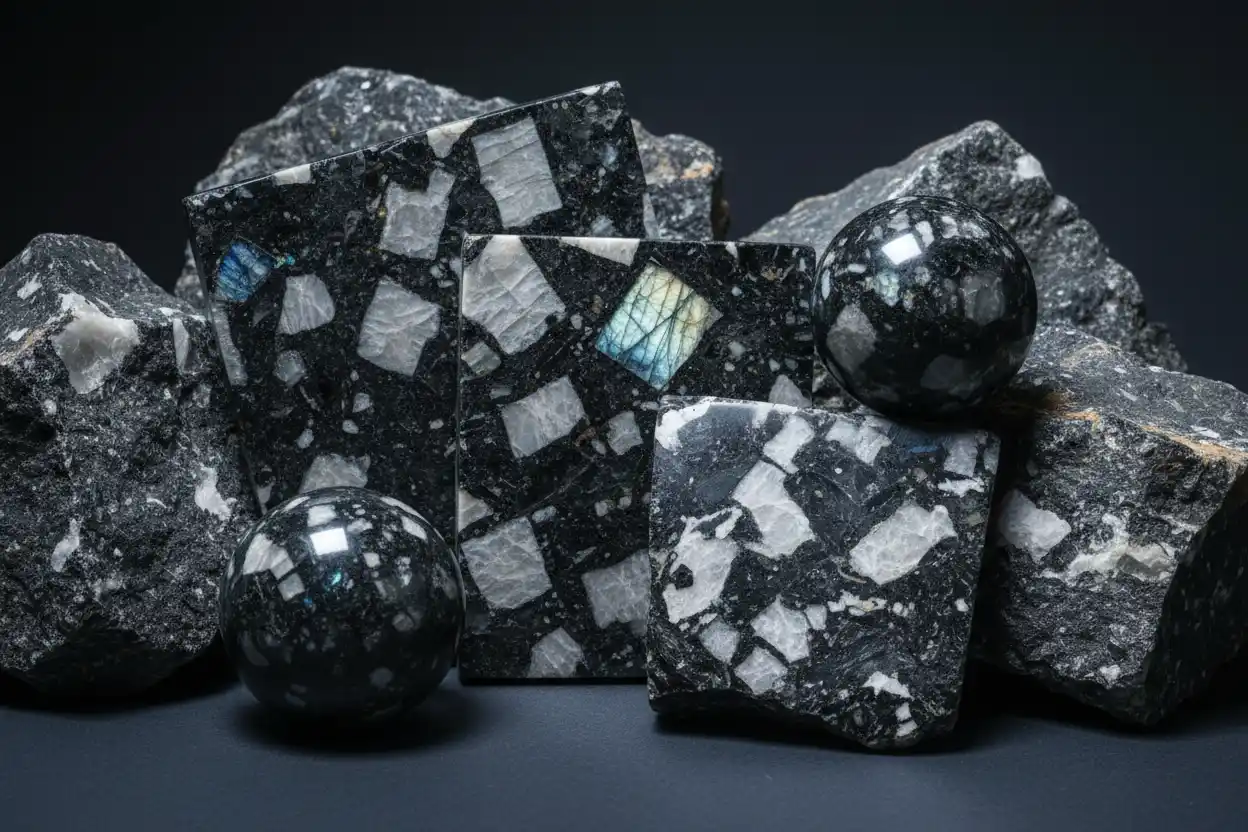
That rock-level identity is essential to understanding gabbro meaning. A hand specimen may appear nearly black at first glance but reveal white, gray, greenish, bronze, or bluish mineral grains under stronger light. Another can be medium gray and visibly speckled. Some ornamental varieties contain feldspar that produces striking blue, violet, silver, or iridescent effects. Those appearances reflect the mineral assemblage and texture of a particular rock, not a universal property shared by every material labeled gabbro.
Modern symbolic traditions often associate gabbro meaning with stability, adaptation, introspection, strength, transformation, or balancing contrasting parts of life. Those ideas can be used as personal metaphors, but they are not measurable effects of pyroxene, plagioclase, or any other constituent mineral. A material-first interpretation keeps rock classification, geological history, commercial terminology, and symbolism distinct. Readers exploring related references can use the broader Gemstone Guides without assuming that every dark ornamental stone belongs to the same rock family.
Gabbro Meaning at a Glance
| Feature | Grounded reference |
|---|---|
| Material identity | Coarse-grained intrusive mafic igneous rock |
| Rock status | Rock composed of multiple minerals, not one mineral species |
| Major minerals | Commonly calcium-rich plagioclase and pyroxene |
| Possible additional minerals | Olivine, amphibole, magnetite, ilmenite and other accessory phases |
| Texture | Usually phaneritic, with interlocking crystals visible to the unaided eye |
| Typical colors | Dark gray, black, greenish black, mottled gray-white, locally bluish or iridescent |
| Chemical character | Mafic; generally richer in iron, magnesium and calcium than felsic rocks such as granite |
| Volcanic counterpart | Broadly comparable in composition to basalt, but cooled more slowly underground |
| Hardness | Variable because individual constituent minerals have different hardnesses |
| Cleavage | Variable by mineral; the rock itself has no single cleavage system |
| Fracture | Depends on grain relationships, alteration and constituent minerals |
| Major geological setting | Intrusions, layered mafic bodies, oceanic crust and related magmatic systems |
| Common uses | Dimension stone, aggregate, architectural material, polished ornamental stone and specimens |
| Symbolic meaning | Modern personal or cultural interpretation rather than a measurable rock property |
| Main ownership issue | Individual specimens can fracture along mineral boundaries; cutting and grinding produce mineral dust requiring proper controls |
The most important distinction in gabbro meaning is that properties belong partly to the whole rock and partly to the minerals inside it. Quoting the Mohs hardness of one feldspar grain as though it described every grain in a gabbro slab would ignore the heterogeneous nature of the material.
What Gabbro Actually Is
Gabbro belongs to the mafic branch of intrusive igneous rocks. “Mafic” refers broadly to rocks rich in magnesium- and iron-bearing minerals relative to silica-rich felsic rocks. The term does not mean that a specimen consists entirely of magnesium and iron minerals; plagioclase feldspar is usually a major component as well.
The defining texture is coarse enough that separate crystals can generally be distinguished. That texture reflects cooling history. Magma trapped below the surface loses heat more slowly than lava exposed to air or water, giving mineral crystals more time to grow. The result is an interlocking mosaic rather than the very fine-grained matrix typical of basalt.
Gabbro can still vary substantially. One specimen may contain abundant pyroxene and appear very dark. Another may have enough pale plagioclase to look distinctly mottled. Olivine-bearing gabbro can include olive-green grains, while oxide minerals may contribute black opaque crystals. Alteration can introduce additional minerals and change both color and texture.
This variability makes gabbro meaning more accurate when the reader thinks in terms of a rock family rather than one standardized decorative stone.
How Gabbro Forms
Gabbro develops when mafic magma cools and crystallizes below Earth’s surface. As temperature falls, different minerals become stable and begin to crystallize from the melt. Calcium-rich plagioclase and pyroxene are particularly important in typical gabbro, while olivine can crystallize in appropriate compositions.
Because crystallization occurs over time rather than instantaneously, minerals can influence the composition of the remaining melt as they form. Crystals may settle, accumulate, react with later melt, or become concentrated into distinct layers. Large mafic intrusions can consequently contain systematic variations from one zone to another rather than one perfectly uniform gabbro composition.
Gabbro is also an important component of oceanic crust. Mafic magma generated at spreading environments can cool below the seafloor, forming coarse intrusive rocks while compositionally related lava reaches the surface and forms basalt. This relationship makes gabbro and basalt useful examples of how similar magma can produce different textures depending largely on cooling environment.
A fuller treatment of magma evolution, intrusive bodies, oceanic crust, crystal accumulation, alteration, and host-rock relationships belongs in gabbro formation and deposit geology rather than being duplicated throughout this meaning reference.
Gabbro and Basalt: Similar Composition, Different Texture
Gabbro is often described as the intrusive equivalent of basalt. That shorthand is useful as long as it is not interpreted too rigidly.
Both are mafic igneous rocks and commonly contain similar major mineral components. The dominant difference is cooling history and therefore grain size. Basalt generally cools quickly at or near Earth’s surface and is fine grained. Gabbro cools more slowly underground and develops coarser visible crystals.
A dark rock is not automatically gabbro simply because it looks basaltic. If individual mineral grains cannot be distinguished, basalt, diabase/dolerite, or another mafic rock may be a better description depending on texture and geological context.
Likewise, a polished black countertop marketed with a commercial stone name may be gabbro even when the seller calls it “granite.” Building-stone vocabulary and petrographic classification do not always use the same terminology.
Why Gabbro Is Usually Dark
The dark character associated with gabbro meaning comes largely from mafic minerals such as pyroxene, amphibole when present, olivine, and opaque iron-titanium oxides. These minerals absorb much of the visible light that reaches them, creating black, dark gray, deep green, or brownish areas.
Plagioclase provides much of the contrasting pale material. Depending on composition, alteration, inclusions, and optical orientation, feldspar grains may appear white, gray, cream, bluish, or darker. In some ornamental gabbros, feldspar produces attractive blue or silver optical effects.
Weathering can change the exterior dramatically. Iron-bearing minerals may oxidize to brown or rusty products. Feldspar can alter toward clay minerals. Olivine and pyroxene may develop secondary alteration minerals that give weathered surfaces greenish, reddish, or duller tones.
The visible surface of an old boulder may therefore look quite different from a fresh cut through its interior.
More detailed treatment of reflectance, feldspar effects, mineral zoning, grain orientation, and polished appearance belongs in gabbro optical properties and color behavior.
Gabbro Is a Rock, So It Has No Single Hardness
A common error in gabbro meaning references is assigning one precise Mohs hardness to the entire rock. Gabbro contains several minerals, and each has its own mechanical properties.
Plagioclase feldspar is relatively hard, commonly around 6–6.5 on the Mohs scale. Many pyroxenes are broadly around 5–6. Olivine commonly falls around 6.5–7. Secondary alteration minerals can be substantially softer.
The practical hardness of a polished gabbro surface therefore depends on which grains are exposed and how securely they interlock. Differential wear can occur when softer altered zones sit beside harder fresh minerals.
The same principle applies to cleavage. Feldspar and pyroxene possess mineral-specific cleavage directions, but “gabbro cleavage” is not one crystallographic property. When the rock breaks, fractures can pass through grains, follow grain boundaries, exploit altered zones, or combine several mechanisms.
Diagnostic Traits That Support Gabbro Identification
The first useful gabbro clue is texture. A typical specimen is coarse grained enough that individual mineral grains can be distinguished, yet the rock remains mafic overall. Dark pyroxene and pale calcium-rich plagioclase commonly dominate the visual field.
Olivine may appear as olive-green grains. Magnetite or ilmenite can occur as opaque black phases. Amphibole may be present, especially where original minerals have reacted or alteration has modified the assemblage.
The second clue is mineral proportion. A rock containing substantially more light-colored feldspar or quartz may fall into another intrusive igneous classification. Diorite, tonalite, granite, anorthosite, peridotite and several related rock types can overlap superficially with portions of the gabbro spectrum.
A hand lens or microscope can help document interlocking textures, alteration rims, cleavage, exsolution, opaque minerals, feldspar relationships, and weathering. The dedicated gabbro microscope inclusion notebook provides a more systematic way to record those observations without pretending that one photograph can provide a full petrographic classification.
Precise classification may require thin-section petrography and mineral-proportion analysis. A polished decorative object without provenance often provides less diagnostic information than an unpolished geological specimen.
Original Gabbro Specimen and Name-Claim Audit
Trade names create some of the largest problems in gabbro meaning. This checklist separates geological terminology from commercial and metaphysical labels.
| Name or claim | What it can reasonably indicate | What should not be assumed |
|---|---|---|
| Gabbro | Coarse-grained mafic intrusive igneous rock | One exact mineral recipe |
| Olivine gabbro | Gabbro containing significant olivine | Exact olivine percentage without classification work |
| Hornblende gabbro | Gabbro containing substantial hornblende/amphibole | That all dark grains are hornblende |
| Gabbronorite | Related mafic intrusive rock containing both orthopyroxene and clinopyroxene | Ordinary gabbro based on appearance alone |
| Norite | Mafic intrusive rock dominated by orthopyroxene rather than clinopyroxene | Generic synonym for all gabbro |
| Black granite | Commercial building-stone term sometimes applied to dark gabbro | Geological granite composition |
| Indigo gabbro | Trade description for dark ornamental gabbro with bluish, violet, gray, or contrasting feldspar patterns | One formally defined petrographic subtype |
| Mystic Merlinite | Metaphysical trade name commonly applied to indigo gabbro | Relation to a formal mineral called “merlinite” |
| Merlinite | Commercial/metaphysical term used inconsistently for several patterned materials | Gabbro identity without supporting mineralogy |
| Blizzard stone | Informal trade name applied to some spotted gabbroic material | Formal rock classification |
| Galaxy gabbro | Appearance-based commercial wording | One geological source or standardized variety |
| Natural untreated | Seller claim regarding enhancement | Proven absence of coating, dye, resin, or repair from appearance alone |
| Rare gabbro | Seller rarity claim | Geological or commercial rarity without context |
| Healing gabbro | Metaphysical wording | Medical efficacy |
| Protection stone | Symbolic interpretation | Measurable protective field |
“Indigo gabbro” is especially important because it is widely encountered in the crystal market. It can be a useful commercial description for dark, mottled gabbroic material, but it does not define one universally standardized rock composition.
“Mystic Merlinite” goes a step further by adding a metaphysical brand-like name. The label can identify a commercial product category, but it should not replace petrographic identification.
Indigo Gabbro and “Mystic Merlinite”
Indigo gabbro typically refers to ornamental dark gabbroic material with contrasting gray, bluish, violet, lavender, white, or black mineral areas. Polished surfaces can be visually dramatic because light feldspar-rich zones sit against much darker mafic minerals.
The name “indigo” describes appearance. It does not indicate the presence of indigo pigment or one unique mineral species.
“Mystic Merlinite” is a modern metaphysical trade term commonly applied to some of this material. It should not be interpreted as a scientific rock name. The word “Merlinite” has also been applied commercially to other patterned stones, which makes mineralogical identification from that name alone especially unreliable.
The safest description is hierarchical: identify the material petrographically as accurately as evidence allows, then record the trade name separately. For example, “gabbroic ornamental rock sold as indigo gabbro or Mystic Merlinite” preserves both geological and commercial information without treating them as equivalent classifications.
Gabbro Versus Diorite
Gabbro and diorite can overlap visually because both are coarse-grained intrusive rocks containing plagioclase and dark minerals. The main distinction is compositional.
Gabbro generally contains more calcium-rich plagioclase and mafic minerals and belongs to the mafic part of igneous classification. Diorite is compositionally more intermediate.
A black-and-white speckled appearance alone cannot always separate them. Accurate classification depends on mineral proportions and feldspar composition, ideally supported by petrographic observation when the boundary matters.
This is why decorative trade names such as “black granite” can be problematic. Commercial stone markets often prioritize polish, appearance, slab performance, and recognizable customer terminology rather than strict igneous classification.
Gabbro Versus Granite
Geological granite is a felsic intrusive rock commonly rich in quartz and alkali feldspar. Gabbro is mafic and ordinarily lacks the substantial quartz and potassium-feldspar proportions characteristic of granite.
The two can nevertheless occupy the same commercial product category. Dimension-stone suppliers sometimes use “granite” broadly for hard polishable crystalline rocks suitable for countertops, cladding, and architectural use. A dark commercial “granite” may therefore be petrographically classified as gabbro, diabase, anorthosite-related rock, or another non-granite material.
Neither vocabulary is necessarily fraudulent when its context is clear. The problem arises when a commercial category is presented as though it were a geological identification.
Gabbro meaning should therefore specify which naming system is being used.
Is Gabbro the Same as “Black Granite”?
Not scientifically.
Some gabbro is sold in the dimension-stone industry under names containing “black granite” because the material is dark, crystalline, polishable, and used in applications associated commercially with granite. Geological granite, however, has a different mineralogical and compositional definition.
A polished countertop marketed as black granite may genuinely be an excellent building material while not being granite in the petrographic sense.
For collectors or educational content, “gabbro sold commercially as black granite” is much clearer than quietly replacing one classification with the other.
The Documented History Behind Gabbro
Gabbro has a long history in geology, quarrying, construction, and ornamental stone use. Its durability, availability, coarse crystalline appearance, and capacity for polishing have made suitable varieties useful for architectural stone, monuments, flooring, aggregate, roadstone, and decorative objects.
Its scientific importance extends deeper. Gabbro provides direct evidence of mafic magmatism below the surface and plays a major role in understanding oceanic crust, layered intrusions, magma differentiation, and tectonic processes.
Geologists study relationships between mineral grains, chemical composition, textures, and field structures to reconstruct how magma cooled and evolved. In layered mafic bodies, crystal accumulation can also concentrate economically important elements and minerals.
This documented geological history should not be replaced by claims that ancient cultures universally knew gabbro as a spiritual transformation stone. Particular societies may have used dark igneous rocks, but connecting a modern trade variety to a historical belief requires evidence tied to the actual material.
Gabbro Meaning in Modern Symbolism
Modern gabbro meaning commonly focuses on stability, self-examination, integration, adaptability, resilience, and transformation. Dark and light interlocking grains make integration an understandable visual metaphor: a gabbro specimen is literally a coherent rock composed of contrasting minerals.
Its intrusive origin can inspire another useful theme. The rock crystallizes below the surface before erosion or geological processes expose it. Someone might use that history as a metaphor for work that develops privately before becoming visible.
Slow cooling provides a third reflective idea. Coarse crystals require time to develop. As a metaphor, gabbro can serve as a reminder that some skills, plans, and relationships improve through sustained development rather than immediate results.
These themes can be personally meaningful without claiming that the rock causes them. There is no established scientific evidence that gabbro automatically balances emotions, increases intuition, removes trauma, protects against negative energy, changes another person’s intentions, or guarantees transformation.
The site’s broader distinction between symbolism and medical or professional claims is explained in the Disclaimer.
Gabbro Does Not Have Scientifically Proven Healing Properties
The presence of iron-, magnesium-, calcium-, sodium-, aluminum-, or other element-bearing minerals in gabbro does not convert the rock into a nutritional or medical delivery system.
Iron inside pyroxene or oxide minerals is not an iron supplement through skin contact. Magnesium within silicate minerals is not a transdermal magnesium treatment. Calcium within plagioclase is not a bone-health therapy.
Gabbro meaning should therefore not include claims that holding the rock treats anemia, cardiovascular disease, neurological disorders, anxiety, depression, hormonal conditions, inflammation, pain, or other medical conditions.
A polished stone can still be used for meditation, journaling, decoration, or personal symbolism. Those activities simply belong to a different evidence category from healthcare.
Safe Ownership of Gabbro
Normal handling of an intact gabbro specimen, slab, carving, or polished stone is different from sawing, grinding, drilling, sanding, crushing, or polishing it.
Gabbro is a multi-mineral rock. Dust produced during processing can contain silicate minerals, accessory phases, alteration products, and potentially crystalline silica-bearing components depending on the specimen. The safe approach is not to guess that dark mafic rock dust is harmless.
Lapidary and fabrication work should use appropriate wet methods or effective local extraction, suitable respiratory protection, eye protection, and controlled cleanup. Dry dust should not be dispersed through living or food-preparation areas.
Individual specimens can also contain fractures or altered zones that behave differently during cutting. Technical decisions involving grain orientation, differential hardness, edge stability, and polish are covered in gabbro cutting, orientation and polish.
Gabbro in Jewelry and Decorative Objects
Gabbro can be polished into cabochons, beads, pendants, carvings, spheres, slabs, and other decorative forms. Quartz-poor gabbro does not behave exactly like agate, and its surface durability is controlled by several constituent minerals rather than one uniform phase.
Fresh, tightly interlocking gabbro can be mechanically robust. Altered material may contain softer zones that undercut during polishing or weather faster in use. Grain boundaries can also influence chipping, especially around thin edges and drilled holes.
A broad polished cabochon in a protected pendant therefore presents a different durability problem from a thin ring stone exposed to repeated impacts. Practical setting choices are treated separately in gabbro setting and wear engineering.
The distinction is particularly important for indigo gabbro because attractive pale and dark areas may represent minerals with different hardness, cleavage, and alteration behavior.
Preserve Gabbro’s Geological Texture Before Altering It
A rough gabbro specimen can preserve field and petrographic information that polishing removes. Natural weathering surfaces, chilled contacts, mineral layering, veins, reaction rims, alteration patches, and relationships with neighboring rocks can all contribute to geological interpretation.
If a specimen comes from a documented outcrop or important intrusion, recording its orientation and field context can be more valuable than simply converting it into a decorative piece.
Photographing all sides before cutting, preserving a representative rough fragment, retaining labels, and recording repairs or coatings creates a more useful long-term record.
The gabbro specimen conservation and record keeping guide addresses documentation, storage, condition monitoring, and intervention separately.
Provenance Cannot Be Established From Pattern Alone
A mottled black-and-white gabbro may resemble material from a known quarry or commercial source, but visual similarity does not establish locality.
Large mafic intrusions occur in many geological regions, and broadly similar plagioclase-pyroxene textures can develop independently. Even distinctive blue or indigo ornamental material should not be assigned to a mine or country solely from photographs.
Useful provenance includes original quarry or locality records, dealer documentation, field notes, collection labels, shipment records, and traceable acquisition history. These sources vary in strength, but each is more useful than reverse-engineering origin from color.
The gabbro provenance disclosure checklist provides a framework for distinguishing documented source information from seller attribution and visual guesswork.
Original Gabbro Specimen and Photo Checklist
Before applying a strong geological or commercial label, record the observable evidence.
| Observation | What it may support | What it cannot establish alone |
|---|---|---|
| Coarse interlocking texture | Intrusive igneous origin | Gabbro specifically |
| Abundant dark pyroxene-like grains | Mafic composition | Exact pyroxene species |
| Pale plagioclase grains | Feldspar-rich component | Precise anorthite content |
| Olive-green grains | Possible olivine | Olivine without mineral testing |
| Black opaque grains | Possible magnetite or ilmenite | Exact oxide species |
| Blue/silver feldspar flashes | Feldspar-related optical effect | One specific locality |
| Strong dark-light mottling | Typical ornamental appearance | “Indigo gabbro” as a formal petrographic category |
| Weathered brown surface | Oxidation or alteration | Age of the specimen |
| Fine-grained margin | Possible chilled contact | Complete intrusive history |
| Visible layering | Possible magmatic differentiation or accumulation | Specific layered intrusion |
| “Black granite” label | Commercial building-stone category | Geological granite |
| “Mystic Merlinite” label | Modern trade/metaphysical name | Separate mineral species |
| “Rare indigo gabbro” | Seller rarity claim | Geological rarity without comparative data |
| “Natural untreated” | Records seller representation | Absence of all coatings or repairs |
| “Healing gabbro” | Records modern symbolic belief | Medical efficacy |
The checklist is intentionally conservative. Gabbro is usually easy to recognize broadly when texture and mineral proportions are clear, but exact rock classification can become technical near boundaries with norite, gabbronorite, diorite, troctolite, anorthosite and related rocks.
Gabbro Compared With Galena
The adjacent galena meaning reference concerns a single mineral species—lead sulfide, PbS—with metallic luster, high density and characteristic cubic cleavage.
Gabbro is a rock containing several minerals. Its dark grains may include pyroxene or opaque oxides, but a shiny black component should not be labeled galena merely because it looks metallic.
This comparison highlights the difference between mineral and rock classification. Galena has a defined crystal chemistry. Gabbro has an assemblage and texture.
Gabbro Compared With Fulgurite
Fulgurite meaning concerns material altered or fused rapidly by lightning. Its structure can contain glass, bubbles, fused grains and branching tubes created during an extremely brief high-temperature event.
Gabbro forms at the opposite end of the cooling spectrum. Slow cooling underground gives its minerals enough time to produce coarse interlocking crystals.
Both can be dark and both are geological materials, but their textures record radically different thermal histories.
Gabbro Compared With Garden Quartz
Garden quartz meaning concerns macrocrystalline quartz containing visually complex mineral inclusions, coatings or internal features that can resemble landscapes.
A garden quartz crystal has quartz as a dominant single host mineral. Gabbro is a polymineralic rock in which plagioclase, pyroxene and other grains form the bulk material together.
A polished dark gabbro and an included quartz cabochon can both be sold in crystal markets, but their structures and geological histories are not remotely interchangeable.
Gabbro Compared With Fuchsite
Fuchsite meaning concerns chromium-bearing muscovite mica. Fuchsite’s green color and sheet-like perfect cleavage are mineral-level properties.
Gabbro may contain green minerals, but green color does not imply fuchsite. Olivine, pyroxene, amphibole, chlorite or alteration products can all contribute greenish tones in mafic rocks depending on the specimen.
Again, color should follow mineral identification rather than determine it.
What Gabbro Meaning Can Reliably Tell You
A grounded gabbro meaning reference can establish that gabbro is a coarse-grained mafic intrusive igneous rock, usually dominated by plagioclase and pyroxene. It can explain why slow underground cooling creates visible interlocking crystals, why dark mafic minerals dominate its appearance, how gabbro relates broadly to basalt, and why commercial terms such as black granite or Mystic Merlinite should remain separate from petrographic classification.
It can also define important limits. One polished photograph cannot determine exact mineral percentages, specific pyroxene composition, precise feldspar chemistry, treatment history, geological locality, or whether a borderline mafic rock is best classified as gabbro, norite, gabbronorite or another related type. Those questions may require thin-section petrography, chemical analysis or documented field context.
No first-hand quarry inspection, petrographic thin-section study, laboratory analysis, treatment determination or specialist review is implied where supporting evidence has not actually been obtained.
The broader evidence-first approach used throughout Gems Lore is described on About Gems Lore. Readers with petrographic data, documented provenance, correction evidence, or unusual gabbro specimens can provide supporting information through Contact Gems Lore.
FAQ
What is the basic gabbro meaning?
The basic gabbro meaning is geological: gabbro is a coarse-grained mafic intrusive igneous rock commonly composed mainly of calcium-rich plagioclase and pyroxene. Modern symbolic traditions may associate it with stability, resilience, integration or transformation, but those themes are personal interpretations rather than measurable rock properties.
Is gabbro a mineral?
No. Gabbro is a rock made from multiple minerals. Typical constituents include plagioclase feldspar and pyroxene, with olivine, amphibole, magnetite, ilmenite and other minerals possible.
Is gabbro the same as basalt?
They are compositionally related mafic igneous rocks but differ principally in texture and cooling environment. Gabbro cools slowly underground and develops coarse visible crystals; basalt generally cools quickly at or near the surface and is fine grained.
Is gabbro the same as black granite?
Not geologically. Some dark gabbro is sold commercially as black granite because building-stone terminology uses “granite” more broadly than petrography. True geological granite is compositionally more felsic and commonly contains substantial quartz and alkali feldspar.
What is indigo gabbro?
Indigo gabbro is a commercial name commonly applied to dark gabbroic ornamental material with contrasting gray, blue, violet, black or pale mineral patterns. It is not one universally standardized petrographic subtype.
Is Mystic Merlinite really gabbro?
The trade name Mystic Merlinite is commonly applied to some material marketed as indigo gabbro. “Mystic Merlinite” is not a formal mineral species, so the underlying rock should be identified independently of the metaphysical name.
Why does some gabbro look blue?
Bluish or silver effects can be associated with feldspar grains and their internal optical structure, while other minerals and lighting conditions can influence the overall appearance. A blue flash does not authenticate a particular mine or commercial variety by itself.
How hard is gabbro?
Gabbro does not have one exact Mohs hardness because it contains several minerals. Plagioclase, pyroxene, olivine and secondary alteration minerals each have different hardnesses.
Can gabbro be used in jewelry?
Yes. Dense, well-interlocked gabbro can be polished into cabochons, beads, pendants and other decorative objects. Durability depends on mineral composition, alteration, fractures, grain boundaries and the type of setting.
Is gabbro safe to handle?
Ordinary handling of a stable intact specimen is different from cutting or grinding it. Rock processing can generate fine mineral dust, so appropriate wet methods, ventilation or extraction, eye protection and respiratory controls should be used.
Does gabbro have scientifically proven healing properties?
No. There is no established scientific evidence that wearing or holding gabbro treats physical or mental-health conditions. It can be used as a personal symbolic object without representing those meanings as medicine.
Can gabbro provide iron or magnesium to the body?
No. Iron and magnesium bound inside silicate and oxide minerals do not become controlled nutritional supplements through ordinary skin contact. Mineral composition should not be confused with medical or dietary availability.
Gabbro Meaning Is Written in an Interlocking Rock
Gabbro meaning becomes more substantial when the rock itself is allowed to explain the themes people later attach to it. It forms from mafic magma beneath the surface. Slow cooling allows several minerals to crystallize side by side. Dark pyroxene, pale plagioclase, occasional olivine, oxides and other phases become mechanically interlocked into one coherent rock even though they remain different minerals.
That real structure provides understandable metaphors for patience, integration and development without requiring supernatural claims. Slow crystallization can suggest processes that need time. Contrasting grains can suggest a system built from different components. Exposure of deep intrusive rock at the surface can provide a metaphor for work that becomes visible only after substantial change.
The classification boundary remains equally important. Gabbro is not a single crystal. “Black granite” is often commercial rather than geological terminology. Indigo gabbro is an appearance-based trade category, and Mystic Merlinite is a modern metaphysical name rather than a mineral species. Exact rock classification follows mineral proportions, texture and geological evidence.
Keeping those distinctions clear makes gabbro meaning more informative: the symbolism can remain personal, while the foundation remains an actual mafic igneous rock whose interlocking minerals record the slow cooling of magma beneath Earth’s surface.