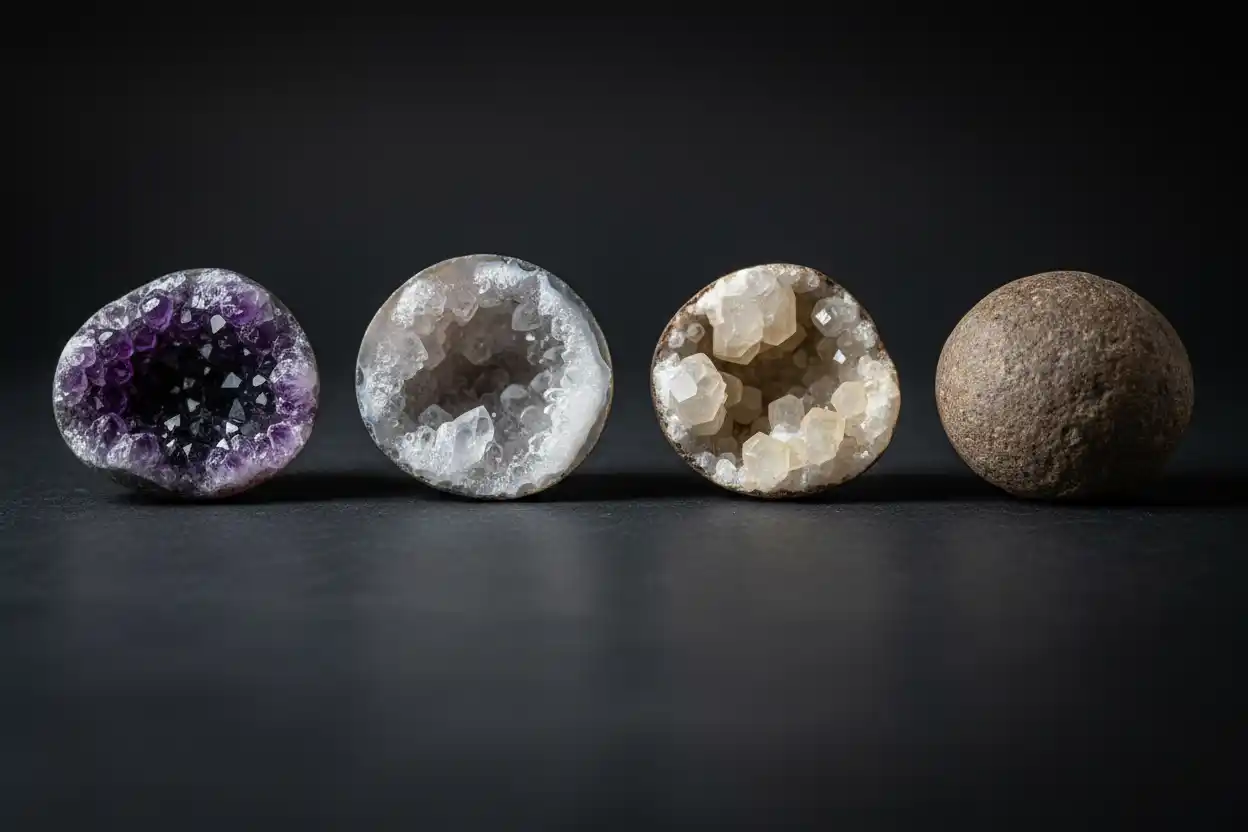
Geodes: How They Form and What’s Inside
A geode is a rock formation containing an internal cavity that becomes lined, partly filled or decorated with secondary minerals. From the outside, many geodes look like ordinary rounded rocks; once opened, they can reveal quartz points, chalcedony bands, amethyst, calcite and other mineral growth.
Geodes do not all form by one identical process. They occur particularly in certain volcanic and sedimentary environments where cavities develop first and mineral-rich fluids later deposit material inside those spaces.
Geodes at a Glance
| Feature | Geode |
|---|---|
| Basic structure | Rock with an internal mineral-lined cavity |
| Common host environments | Volcanic rocks and sedimentary carbonate rocks |
| Initial requirement | A cavity or void |
| Mineral source | Mineral-bearing fluids moving through rock |
| Common lining | Chalcedony and quartz |
| Possible crystals | Quartz, amethyst, calcite, celestite and others |
| Common exterior | Rounded, irregular or nodular rock surface |
| Internal structure | Hollow to partly filled |
| Formation timescale | Variable; commonly geologically long |
| Main distinction from a solid nodule | Geode retains internal open space |
| Common collector form | Whole, split, sawn or polished specimen |
| Identification challenge | Exterior may reveal little about the interior |
What Is a Geode?
A geode begins with a void inside rock.
That empty space distinguishes geode formation from a crystal simply growing on an exposed rock surface.
Over time, water or other mineral-bearing fluids enter the cavity through pores, fractures or surrounding rock.
Changes in chemistry, temperature, pressure, evaporation or saturation cause dissolved material to precipitate.
Minerals then accumulate on the cavity walls.
Repeated episodes can create layers of chalcedony or agate followed by larger crystals projecting inward.
If enough open space remains, the finished formation is recognizable as a hollow crystal-lined geode.
Where Do Geodes Form?
Two of the most familiar geological settings are:
volcanic rocks, including basalt and volcanic tuff; and
sedimentary carbonate rocks, especially limestone and dolomite.
The original cavity develops differently in those environments.
What happens afterward is broadly similar: mineral-bearing fluids move through the rock and deposit material inside the available space.
Geodes can occur in other settings as well, so these two categories should be treated as major examples rather than the only possible geological mechanisms.
How Volcanic Geodes Form
Volcanic geodes commonly begin with gas cavities.
When lava reaches or approaches the surface, dissolved gases can form bubbles. As the lava cools and solidifies, some bubbles become trapped as empty or partly empty spaces called vesicles.
A cavity alone does not make a geode.
Later, water or hydrothermal fluid carrying dissolved silica, carbonate or other chemical components moves through the rock.
When conditions favor precipitation, material begins coating the interior walls.
Chalcedony may form an early lining.
Later fluid episodes can produce quartz or other crystals growing inward from that lining.
Over enough time, an ordinary volcanic void can become a mineral-filled cavity.
How Sedimentary Geodes Form
Sedimentary geodes can develop differently.
Cavities may originate where:
organic material decays, a shell or other object dissolves, a root leaves a void, an animal burrow creates space, or chemical processes produce a cavity within a concretion or sedimentary mass.
Mineral-bearing groundwater later enters.
As dissolved material precipitates, layers form along the cavity wall and crystals may grow toward the center.
Limestone and dolomite regions are particularly well known for this type of geode occurrence.
The resulting exterior can look quite different from a volcanic geode even when both contain quartz or calcite crystals.
Why Geodes Are Hollow
A geode stays hollow because mineral growth does not completely fill the original cavity.
Crystals nucleate on the walls and grow inward.
If mineral deposition stops before the center becomes filled, open space remains.
The amount of empty space can vary significantly.
Some geodes contain a broad central cavity.
Others contain so much chalcedony and crystal growth that only a narrow hollow zone survives.
If secondary minerals completely fill the space, geologists and collectors may describe the resulting object as a nodule rather than a true hollow geode, depending on context.
What Is Inside a Geode?
Quartz is among the most familiar minerals inside geodes, but it is not the only possibility.
Possible interiors include:
| Mineral or Material | Typical Appearance |
|---|---|
| Chalcedony | Smooth or banded microcrystalline lining |
| Agate | Distinctive bands of chalcedony |
| Quartz | Clear, white, smoky or other crystal points |
| Amethyst | Purple quartz crystals |
| Calcite | Rhombohedral, scalenohedral or other crystal forms |
| Celestite | Pale blue crystals in some famous deposits |
| Iron oxides | Red, yellow or brown staining |
| Other locality-specific minerals | Depend on host rock and fluid chemistry |
The exact mineral assemblage records the chemistry of the fluids and geological environment.
Quartz Geodes
Quartz geodes are among the most common collector forms.
The outer cavity may first receive a chalcedony lining because microcrystalline silica precipitates along the wall.
Later, larger quartz crystals can grow into the remaining open space.
These crystals may be colorless, milky or smoky depending on impurities, irradiation history and growth conditions.
The completed Quartz: Types, Properties & Meaning article explains quartz itself rather than repeating the whole mineral profile here.
Amethyst Geodes
An amethyst geode contains purple quartz.
Many spectacular commercial specimens come from volcanic regions of Brazil and Uruguay, where cavities in volcanic rocks became lined with quartz and amethyst.
Amethyst’s purple color develops through iron-related defects and irradiation within quartz.
It is therefore inaccurate to explain purple geodes simply as ordinary quartz being “stained purple.”
The color forms through processes within the crystal structure.
The freshly reconciled Amethyst: Meaning, Healing Properties & Uses provides the full amethyst profile.
Agate-Lined Geodes
Many geodes show bands of chalcedony between the host rock and central crystals.
When those bands develop distinctive colors or patterns, they may be described as agate.
Each band can represent a stage of mineral deposition under somewhat different chemical conditions.
This explains why a cut geode may show a plain outer rock shell, several layers of agate and then a central cavity lined with quartz.
The freshly reconciled Agate: Meaning, Types & Healing Properties covers agate as a material rather than the geode-forming process.
Calcite Geodes
Calcite forms in many open geological cavities.
Unlike quartz, which has Mohs hardness 7, calcite is much softer and belongs to the carbonate mineral system.
It can form rhombohedral, scalenohedral and other crystal shapes.
Calcite-filled geodes may occur in sedimentary environments where carbonate chemistry is particularly important.
Acidic cleaning methods should not be used casually on an unknown geode because calcite can react readily with acids.
The completed Calcite: Meaning, Properties & Symbolism provides the full mineral context.
Celestite Geodes
Some geodes contain pale blue celestite crystals.
The best-known commercial examples include material from Madagascar.
Celestite is strontium sulfate and has substantially different physical properties from quartz.
Therefore, a blue crystal-lined cavity should not be identified merely as “blue quartz.”
Mineral identification should rely on crystal form and physical testing when necessary.
The completed Celestite: Meaning, Properties & Symbolism owns the individual mineral profile.
Why Geodes Have Layers
A geode may experience more than one episode of fluid movement.
The chemistry of the incoming solution can change over time.
One episode may deposit chalcedony.
Another may add iron-rich staining.
Later conditions may allow larger quartz or calcite crystals to form.
Because precipitation occurs from the cavity wall inward, those episodes can remain visible as concentric or irregular layers.
A sliced geode therefore provides a cross-section through several stages of its geological history.
How Crystals Grow Inside
Crystal growth requires material to reach a growing crystal surface.
Mineral-bearing fluid transports dissolved chemical components into the cavity.
When the solution becomes supersaturated with respect to a mineral, atoms and ions can attach to existing nuclei or crystal surfaces.
The crystal then grows according to its internal structure.
Space matters.
An open cavity allows well-formed crystal faces to develop because the mineral is not constrained by neighboring solid rock on every side.
That is why geodes often contain attractive terminated crystals.
Geodes vs Druzy
Druzy describes a coating of many small crystals on a surface.
A geode can contain druzy, but the terms are not interchangeable.
A rock fracture with a sparkling layer of tiny quartz crystals may be druzy without being a geode.
A geode refers to the cavity-bearing geological structure.
Druzy describes the texture of the crystal coating.
The completed Crystal Clusters guide provides wider context for crystal growth forms and groupings.
Geode vs Nodule
The easiest distinction is open space.
A geode retains a cavity.
A nodule is largely or completely solid.
Both can form through related processes and may have similar exteriors.
An agate nodule can contain beautiful concentric bands but no open crystal-lined center.
Meanwhile, a geode may show both agate bands and a hollow quartz-lined interior.
Collectors sometimes use the terminology loosely, so the cut interior provides more information than the seller’s label.
Geodes vs Thundereggs
Thundereggs are commonly associated with rhyolitic volcanic environments and are usually solid or largely solid nodular structures filled with silica minerals.
They can contain agate, chalcedony, opal or quartz.
Although some people casually call them geodes, they are not automatically the same geological structure.
A thunderegg can contain a cavity, but many are valued precisely for their solid internal patterns.
Using the terms interchangeably can obscure how the structures formed.
Why Some Geodes Are Round
A rounded shape often reflects the geometry of the original cavity.
A volcanic gas bubble naturally tends toward a rounded or elongated form.
Sedimentary geodes can also develop rounded shapes through concretionary growth or the geometry of the original void.
However, geodes are not always perfect spheres.
Irregular, flattened and elongated examples occur.
A suspiciously perfect exterior is therefore not proof of authenticity, while an irregular shape does not make a specimen less genuine.
Can You Tell What Is Inside an Unopened Geode?
Not reliably.
Exterior texture, weight, locality and host-rock characteristics can provide clues, but none guarantees the exact interior.
Some geodes sound slightly hollow when tapped.
Others are too thick-walled for that test to reveal anything useful.
A heavy specimen may contain substantial solid mineral growth, but density also depends on rock type and size.
Experienced collectors can improve their predictions when they know a specific locality, yet opening or imaging remains the only way to know the internal structure with confidence.
How to Recognize a Possible Geode
Look for rocks consistent with known geode-producing geology.
Potential clues include:
rounded or nodular shape, weathered volcanic or carbonate host rock, unusual weight for size, and a locality where geodes are known to occur.
Do not assume every round rock is a geode.
Concretions, nodules and ordinary weathered stones can produce similar forms.
If the mineral identity becomes important after opening, the site’s How to Identify Crystals provides a more systematic approach than relying on color alone.
How Are Geodes Opened?
Collectors commonly use several methods.
A geode cracker applies controlled pressure around the specimen and can produce a relatively clean break.
A rock saw creates flat matching halves and preserves a cross-section through the layers.
Hammer-and-chisel methods are more accessible but can shatter delicate crystals and create flying rock fragments.
The best technique depends on the specimen’s size, value and intended display.
Rare or expensive geodes are better handled by someone experienced with lapidary equipment rather than opened experimentally.
Cutting vs Cracking
Cracking preserves a more natural broken edge.
It can reveal the cavity dramatically but may split unevenly.
Sawing produces smooth faces that display banding particularly well. Those cut surfaces can then be polished.
For agate-lined geodes, sawing may reveal internal structure more clearly than random cracking.
Neither method makes the specimen more “authentic.”
The decision is about presentation and how much material the owner is willing to remove.
Cleaning a Geode
Cleaning depends entirely on what minerals are present.
Water and a soft brush may be suitable for many quartz geodes.
However, an unknown specimen could contain calcite, delicate coatings, iron minerals or other materials that respond differently to chemicals.
Acid cleaning can dissolve calcite.
Aggressive mechanical cleaning can break small crystals.
Household bleach, strong acids and industrial rust removers should not be applied casually to unidentified specimens.
Identify the main minerals before selecting a chemical cleaning method.
Are Dyed Geodes Real?
A geode can be geologically natural yet artificially dyed after cutting.
Bright neon blue, hot pink and intense green commercial geode slices are frequently color enhanced.
Dye does not mean the underlying rock cavity is manufactured.
It means the color has been altered.
Natural agate and chalcedony are porous enough to accept dyes under certain conditions.
Buyers should therefore separate two questions:
Is the geode natural?
and
Is the color natural?
Those are not the same issue.
Can Geodes Be Artificial?
Yes.
Manufactured decorative objects can imitate geodes with resin, glass, grown crystals or assembled rock components.
Natural geodes can also be modified by dyeing, coating or attaching crystals.
A specimen marketed as natural should have a plausible host-rock shell and mineral growth relationship rather than looking as though crystals were simply glued onto a cavity.
When value is significant, provenance and seller disclosure matter more than one home authenticity test.
Why Geodes Matter to Collectors
Geodes combine geology with surprise.
Two externally similar rocks from the same locality can contain very different interiors.
Collectors may value:
mineral species, crystal quality, color, symmetry, unusual associations, locality, size and overall aesthetics.
Scientific interest can also arise because internal mineral layers preserve information about fluid chemistry and geological conditions.
A geode is therefore more than a decorative crystal container.
It represents a sequence of geological events recorded from the cavity wall inward.
Frequently Asked Questions
1. What is a geode?
A geode is a rock formation containing an internal cavity that has become lined or partly filled with secondary minerals and crystals.
2. How do geodes form?
A cavity forms first, often in volcanic or sedimentary rock. Mineral-bearing fluids later enter and deposit layers or crystals along its walls.
3. Why are geodes hollow?
Minerals grow inward from the cavity walls but do not always fill the entire void, leaving open space in the center.
4. What crystals are commonly found inside geodes?
Quartz, amethyst and calcite are common, while chalcedony or agate frequently forms the inner lining. Other minerals occur depending on locality.
5. Are all purple geodes amethyst?
Purple quartz geodes are amethyst, but artificial dye can also make chalcedony or other material purple. Color alone does not prove natural amethyst.
6. Are geodes and agates the same thing?
No. Agate is banded chalcedony, while a geode is a cavity-bearing rock structure. Many geodes contain agate linings.
7. What is the difference between a geode and a nodule?
A geode retains an internal cavity. A nodule is largely or completely solid.
8. Are thundereggs geodes?
Not necessarily. Thundereggs are commonly solid rhyolitic nodules filled with silica minerals, although some may contain cavities.
9. Can you tell whether a rock is a geode before opening it?
Sometimes locality, shape and weight provide clues, but the interior cannot usually be predicted with certainty.
10. How long does a geode take to form?
There is no universal formation time. Growth depends on geology, fluid movement and mineral precipitation and can occur over long geological timescales.
11. Are brightly colored geodes natural?
The geode itself may be natural while its color has been enhanced. Extremely vivid neon colors are commonly produced by dyeing.
12. What is the safest way to open a geode?
Purpose-built geode crackers or lapidary saws provide greater control than uncontrolled hammering. Eye protection and appropriate rock-working precautions are essential.
Conclusion
Geodes form through a sequence rather than a single event. First, rock develops a cavity. Later, mineral-bearing fluids enter that space and deposit chalcedony, quartz, calcite or other minerals along the walls. If crystal growth stops before the cavity fills completely, the hollow center remains.
That process explains why a plain exterior can hide complex layers and well-formed crystals.
Volcanic gas bubbles create many familiar geode cavities, while sedimentary geodes can begin through very different mechanisms. The specific minerals inside depend on the chemistry of the surrounding geology and the fluids that passed through it.
For collectors, the result is both aesthetically appealing and geologically informative: every genuine geode records a sequence of cavity formation, fluid movement and mineral growth that took place before the rock was ever opened.
Disclaimer: Opening or cutting geodes can produce sharp rock fragments, silica-containing dust and flying debris. Use suitable eye and respiratory protection, appropriate tools and safe rock-working practices; valuable or unusually large specimens are best opened by an experienced lapidary or rock professional.