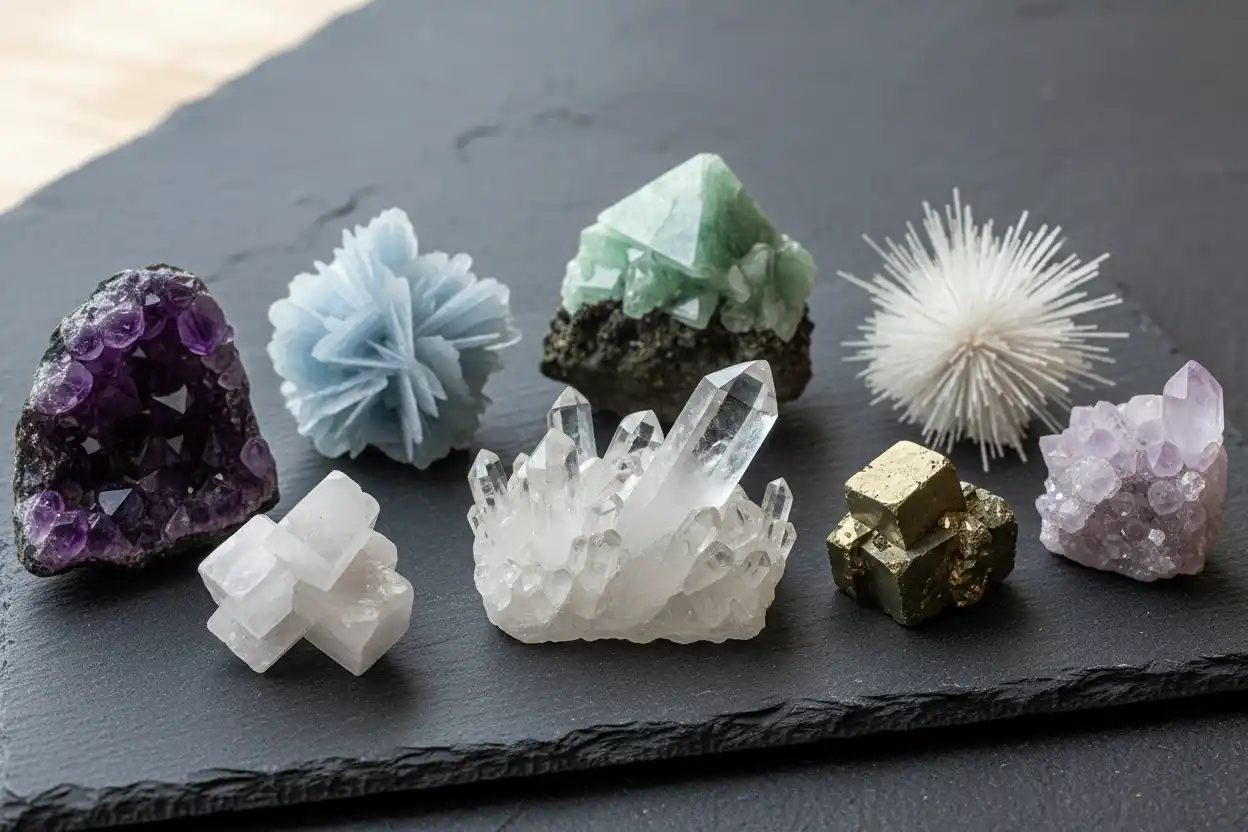
Crystal Clusters: Meaning and Placement
A crystal cluster is a natural or manufactured arrangement containing several crystal points or individuals growing together on one base, matrix or mineral mass. Quartz, amethyst, celestite, apophyllite, calcite and pyrite commonly appear as clusters, although their formation, durability and care differ substantially.
Spiritually, clusters are associated with community, shared growth and distributing attention through several directions. Geologically, however, the form results from crystal growth conditions rather than a proven ability to spread healing energy through a room.
Crystal Clusters at a Glance
| Cluster type | Typical appearance | Main handling concern |
|---|---|---|
| Clear quartz cluster | Several transparent or milky quartz points on one base | Sharp points and fractured matrix |
| Amethyst cluster | Purple quartz points lining a base or cavity | Sunlight fading and broken tips |
| Celestite cluster | Pale-blue crystals in a geode or matrix | Soft, brittle crystals and heavy base |
| Apophyllite cluster | Glassy clear or pale crystals with reflective faces | Prominent cleavage |
| Calcite cluster | Rhombohedral, dogtooth or scalenohedral crystals | Softness, cleavage and acid sensitivity |
| Fluorite cluster | Cubic or octahedral crystals | Perfect cleavage and thermal shock |
| Pyrite cluster | Metallic cubes, pyritohedra or intergrown crystals | Oxidation and sharp edges |
| Aragonite cluster | Radiating, twinned or branching crystals | Brittle points and soft surfaces |
| Spirit quartz | Main quartz core covered in smaller points | Numerous fragile terminations |
| Druzy quartz | Fine sparkling crystal coating over a surface | Delicate microcrystals and possible dye |
| Zeolite cluster | Delicate needles, sprays or mixed cavity minerals | Fragile crystals and dusty matrix |
| Crocoite cluster | Bright orange-red elongated crystals | Toxic metal content and extreme fragility |
What Is a Crystal Cluster?
A crystal cluster contains multiple crystals that developed together.
The crystals may share a common base, grow from one matrix or line the inside of a cavity.
Some clusters contain one mineral species. A quartz cluster may consist almost entirely of quartz points.
Others contain several minerals. A zeolite cavity can include scolecite, stilbite, heulandite and apophyllite on the same matrix.
Intergrowth is normal. Crystals compete for space, overlap and develop incomplete faces where neighboring individuals block growth.
A cluster does not need to be perfectly symmetrical.
How Crystal Clusters Form
Clusters form when mineral-rich fluids or melts deposit material in an environment with enough open space for several crystals to grow.
Hydrothermal veins can produce quartz, calcite and sulfide clusters.
Geodes and volcanic cavities may develop crystal linings when fluids enter hollow spaces.
Pegmatites can produce large intergrown crystals of quartz, feldspar, tourmaline and mica.
Evaporite and sedimentary environments create gypsum, celestite, aragonite and calcite clusters.
The final appearance depends on temperature, pressure, chemistry, growth rate and available space.
Several crystals growing together reflect shared geological conditions rather than a biological community.
Cluster Versus Geode
A cluster is a group of crystals growing together.
A geode is a hollow or partly hollow rock body whose interior may be lined with crystals.
Therefore, a geode can contain a crystal cluster, but the two terms are not identical.
A broken quartz or amethyst geode may expose hundreds of points across an inner wall.
A freestanding quartz cluster can grow in a vein without belonging to a rounded geode.
The unresolved dedicated geode page retains the complete formation and identification intent.
Cluster Versus Druzy
Druzy or drusy describes a surface coated with many tiny crystals.
The completed druzy quartz guide explains this form.
A conventional cluster contains more visibly distinct individual points or crystals.
The boundary can be gradual. A specimen may have large quartz points covered with smaller secondary crystals.
Druzy surfaces can be natural, dyed, coated or attached to manufactured backings.
Magnification helps reveal whether the sparkle comes from true crystal faces, glitter or a metallic coating.
Cluster Versus Single Point
A single crystal point has one principal crystal body and termination.
A cluster contains several intergrown individuals.
Some commercial pieces combine one large central point with many smaller crystals around its base.
A polished tower is not a natural cluster, even when it was cut from clustered or massive material.
The natural form should be distinguished from shaping performed by a lapidary workshop.
Cluster Versus Spirit Quartz
Spirit quartz is a distinctive cluster form.
A larger central quartz crystal becomes coated with a second generation of smaller quartz crystals.
This creates a sparkling surface of many points over one core.
The form is also known commercially as cactus quartz.
Spirit quartz fits cluster symbolism particularly well because the specimen visibly combines individuality and collective growth.
Its numerous small terminations are fragile and should not be scrubbed or stored loose.
Clear Quartz Clusters
The drafted clear quartz guide explains the mineral family and symbolism.
Clear quartz clusters may contain transparent, included, milky or smoky points.
Traditional meanings include clarity, focused intention and distributing attention through several directions.
No reliable evidence shows that multiple points amplify a measurable healing field.
A quartz cluster works well as a display specimen because the hard crystal faces remain durable under careful handling.
However, sharp points can cause cuts, and unstable matrix may break under the cluster’s weight.
Lift it from the base rather than the terminations.
Amethyst Clusters
The drafted amethyst guide owns the complete purple-quartz profile.
Amethyst clusters commonly line geodes or form crusts of purple points.
Their symbolism includes contemplation, moderation and reflective calm.
Color can vary across one specimen because iron-related color centers and crystal thickness differ.
Deep purple tips over a pale base are common.
Prolonged intense sunlight can fade amethyst, so permanent window placement is unsuitable.
Large geodes should stand on secure bases capable of supporting their weight.
Celestite Clusters
The drafted celestite guide explains this pale-blue strontium-sulfate mineral.
Celestite commonly forms crystal-lined geodes and cavities.
Traditional meanings involve peace, spaciousness and quiet perspective.
The crystals are soft and brittle, while the geode can be surprisingly heavy.
Do not lift a celestite cluster by its points.
Place it on a low, stable shelf away from traffic, moisture and vibration.
A heavy geode should never sit above a bed or seating area.
Apophyllite Clusters
Apophyllite commonly forms glassy clear, white, green or pinkish crystals in cavities.
Specimens may include stilbite, heulandite and other zeolite-associated minerals.
Traditional meanings include openness, insight and recognizing patterns.
Apophyllite has prominent cleavage and can separate along smooth planes.
Avoid ultrasonic cleaning, soaking and sudden temperature changes.
Its reflective faces can look exceptionally bright without polishing, making intact natural specimens especially attractive.
Calcite Clusters
Calcite forms many crystal habits, including rhombohedra, dogtooth points and elongated scalenohedra.
It can occur colorless, white, yellow, orange, pink, green, blue and other colors.
Traditional meanings emphasize reframing, perspective and gradual change.
Calcite ranks only 3 on the Mohs scale and has perfect cleavage.
Acids, harsh cleaners and abrasive brushing can etch or scratch it.
A calcite cluster belongs on protected display rather than in a bath, pocket or high-contact altar arrangement.
Fluorite Clusters
Fluorite frequently forms cubic crystals and may also show octahedral or complex modified forms.
Purple, green, blue, yellow and colorless zones can occur within one cluster.
Traditional symbolism focuses on organization, concentration and sorting useful information from distraction.
Fluorite ranks 4 on the Mohs scale and has perfect octahedral cleavage.
Even a visually solid cube can split from impact or temperature change.
Keep clusters away from direct heat, water rituals and hard quartz specimens.
Pyrite Clusters
Pyrite forms metallic cubes, pyritohedra and intergrown masses.
Its symbolism commonly involves confidence, resource awareness and practical prosperity.
Pyrite can oxidize in humid conditions, producing tarnish, iron oxides and acidic sulfate compounds.
Unstable specimens may damage nearby labels, boxes and minerals.
Store pyrite in a dry, ventilated environment and monitor it for powdery residue, odor or surface alteration.
Sharp cube edges can also cut skin.
Aragonite Clusters
Aragonite can form radiating star-like aggregates, branching clusters and twinned crystals.
Brown, tan, white, yellow and reddish forms are common.
Traditional meanings emphasize structure, patience and building stability through repeated action.
Aragonite is soft, brittle and chemically sensitive.
Radiating points can snap easily, while fine dust may accumulate between crystals.
Use air or a very soft brush for cleaning and avoid soaking.
Zeolite Clusters
Zeolite specimens may contain several delicate mineral species within one cavity.
Scolecite, natrolite, mesolite, stilbite and heulandite can form needles, sprays, blades and tabular crystals.
Apophyllite is commonly associated with zeolite specimens even though it belongs to a different mineral group.
These clusters can be extremely fragile.
Needle-like crystals may break into sharp fragments, while the matrix can shed dust.
An enclosed display case provides better protection than frequent handling.
Crocoite and Other Hazardous Clusters
The completed crocoite guide explains this bright orange-red lead chromate mineral.
Crocoite crystals are visually striking but extremely fragile and contain lead and chromium.
They should remain enclosed, labelled and out of reach of children and pets.
Other clusters may contain arsenic, mercury, copper or radioactive components.
The completed toxic crystals safety list provides broader handling guidance.
Do not assume that a beautiful cluster is suitable for a bedroom, bath, drinking-water practice or child’s collection.
Crystal Cluster Meaning
Clusters traditionally symbolize community, collaboration and several individuals growing within one shared environment.
Multiple points may also represent attention moving in several directions.
A cluster can serve as a reminder that cooperation does not require complete sameness.
Spiritually, some practitioners believe clusters distribute or amplify energy throughout a room.
No reliable evidence shows that crystal points create a measurable healing field.
A grounded interpretation uses the cluster as a visible symbol of relationships, teamwork or shared responsibility.
Choosing a Crystal Cluster
Start with mineral identity.
Quartz tolerates more handling than celestite, calcite, fluorite or a delicate zeolite specimen.
Next, inspect the base. The cluster should stand securely without placing pressure on fragile terminations.
Look for:
- Broken points.
- Loose crystals.
- Glue.
- Repairs.
- Dyed surfaces.
- Metallic coatings.
- Crumbling matrix.
- Fresh fractures.
- Unstable saw cuts.
- Artificially attached crystals.
A repaired cluster can still be collectible when the work is disclosed.
The completed crystal identification guide provides broader observational guidance.
Natural Versus Manufactured Clusters
Some commercial clusters are assembled.
Individual crystals may be glued to a matrix, placed on concrete or grown onto manufactured bases.
Aura coatings can create iridescent metallic surfaces on quartz.
Laboratory-grown crystals may form dense, brightly colored clusters.
Manufactured or treated specimens are not automatically undesirable.
The issue is accurate disclosure.
Repeated identical points, visible adhesive, artificial color in crevices or an unnatural base may justify closer inspection.
Do not use flame, solvent or impact tests to investigate a specimen.
Crystal Cluster Placement
Living Room
A stable quartz, amethyst or large calcite cluster can create a visual focal point.
Place it where it cannot be knocked from a narrow shelf.
Avoid unstable coffee-table positions when children or pets are present.
Workspace
Clear quartz, fluorite or pyrite symbolism may suit a desk.
Keep clusters away from the working edge, keyboard movement and drinks.
A small specimen should not occupy the space needed for safe posture and actual work.
Meditation Area
Amethyst, clear quartz, celestite or apophyllite may support a contemplative setting.
Place the cluster in view rather than directly on the body.
The arrangement should leave enough room to sit and move safely.
Bedroom
Small stable specimens can sit on a low dresser or enclosed shelf.
Do not place heavy geodes above the bed.
Sharp clusters should remain away from bedding, where fragments may become hidden.
Entryway
A cluster may serve as a symbolic transition between public and private space.
However, entryways experience vibration, bags, keys and frequent movement.
Use a stable broad-based piece rather than a delicate celestite or zeolite cluster.
Bathroom
Bathrooms are generally poor locations.
Humidity, splashes, cleaning products and hard surfaces can damage gypsum, pyrite, calcite and many mixed-mineral clusters.
Kitchen
Cooking heat, grease, steam and cleaning chemicals create unsuitable conditions.
Heavy clusters near food-preparation areas also introduce contamination and impact risks.
Crystal Clusters and Room Energy
Practitioners may say that a cluster spreads energy across a room because its points face several directions.
This is a symbolic interpretation rather than a measured physical property.
The specimen can still influence a room psychologically through color, texture, scale and the meaning assigned to it.
A calming amethyst display may become associated with a quiet reading routine.
The useful effect comes from environment, expectation and repeated behavior rather than proven crystal radiation.
Using a Cluster for Group Intention
A cluster may represent a family, team or community.
Each person can write one shared value or practical commitment connected with the group.
Place the cluster near the written agreement as a visible reminder.
This approach fits the natural intergrowth symbolism without claiming that the mineral controls other people.
A cluster cannot repair conflict without communication, accountability and compatible action.
Cleaning Crystal Clusters
Clusters collect dust between points and beneath overhangs.
Begin with a camera blower or gentle air puffer.
A very soft brush can remove loose dust from stable quartz and other durable specimens.
Avoid canned air held too close because pressure and cold propellant can damage delicate crystals.
Do not soak a cluster unless every mineral, treatment, matrix and repair is known to tolerate water.
The completed guide to cleansing crystals explains symbolic methods that avoid physical damage.
The drafted guide on showering with crystals explains why prolonged bathroom exposure is unsuitable.
Moving and Storing Clusters
Lift the specimen from its broadest stable base.
Never grip individual crystal points.
Wrap delicate clusters with support around the matrix while preventing packing material from pressing directly against terminations.
Store each specimen separately.
Hard quartz can scratch calcite, fluorite and gypsum, while heavy clusters can crush smaller minerals.
Keep the original label and provenance with the specimen.
For valuable mineral collections, photograph each piece before transport and record repairs or existing damage.
Frequently Asked Questions
1. What is a crystal cluster?
It is a group of several crystals growing together on a common base, matrix or mineral mass.
2. Is a crystal cluster the same as a geode?
No. A geode is a hollow rock body that may contain a crystal cluster inside it.
3. What does a crystal cluster symbolize?
It traditionally symbolizes community, collaboration, shared growth and attention moving in several directions.
4. Do crystal clusters amplify energy?
No reliable evidence shows that clusters create or amplify a measurable healing field. Amplification is a spiritual interpretation.
5. Which crystal cluster is best for beginners?
A stable quartz or amethyst cluster generally tolerates handling better than celestite, calcite or delicate zeolite specimens.
6. Where should a crystal cluster be placed?
Use a low, stable surface away from edges, moisture, heat, pets, children and heavy foot traffic.
7. Can a crystal cluster be placed in a bedroom?
Yes, when it is stable and safely positioned. Heavy geodes and sharp clusters should never be placed above a bed.
8. Can crystal clusters go in water?
Some quartz clusters tolerate brief washing, but many clusters contain soft minerals, porous matrix, glue or treatments. Soaking is generally unnecessary.
9. How do I clean dust from a cluster?
Use a blower or very soft brush and support the specimen from its matrix.
10. How can I tell whether a cluster is glued?
Look for visible adhesive, unnatural attachment points, repeated identical crystals or a base that does not match the mineral growth.
11. Are crystal clusters safe around children and pets?
Large, sharp, toxic or fragile clusters should remain enclosed and out of reach.
12. Are crystal-cluster healing properties scientifically proven?
No. Their room-energy and healing meanings reflect spiritual traditions rather than established physical effects.
Let the Formation Guide the Placement
A cluster records several crystals growing within one geological environment. That natural structure makes it a powerful symbol of community, but it also creates practical weaknesses: sharp points, narrow attachments and irregular heavy bases.
Place the specimen according to its mineral identity and physical stability. A safe, well-supported cluster can remain meaningful without claims that it controls a room or heals the people inside it.
Safety Disclaimer: Crystal-cluster healing and energy properties reflect cultural and spiritual traditions rather than established medical effects. Heavy, sharp, fragile or toxic mineral specimens can cause injury or exposure if mishandled. Keep hazardous clusters enclosed and away from children, pets, food and drinking water.