Amethyst Meaning: Mineral Facts, History & Symbolism
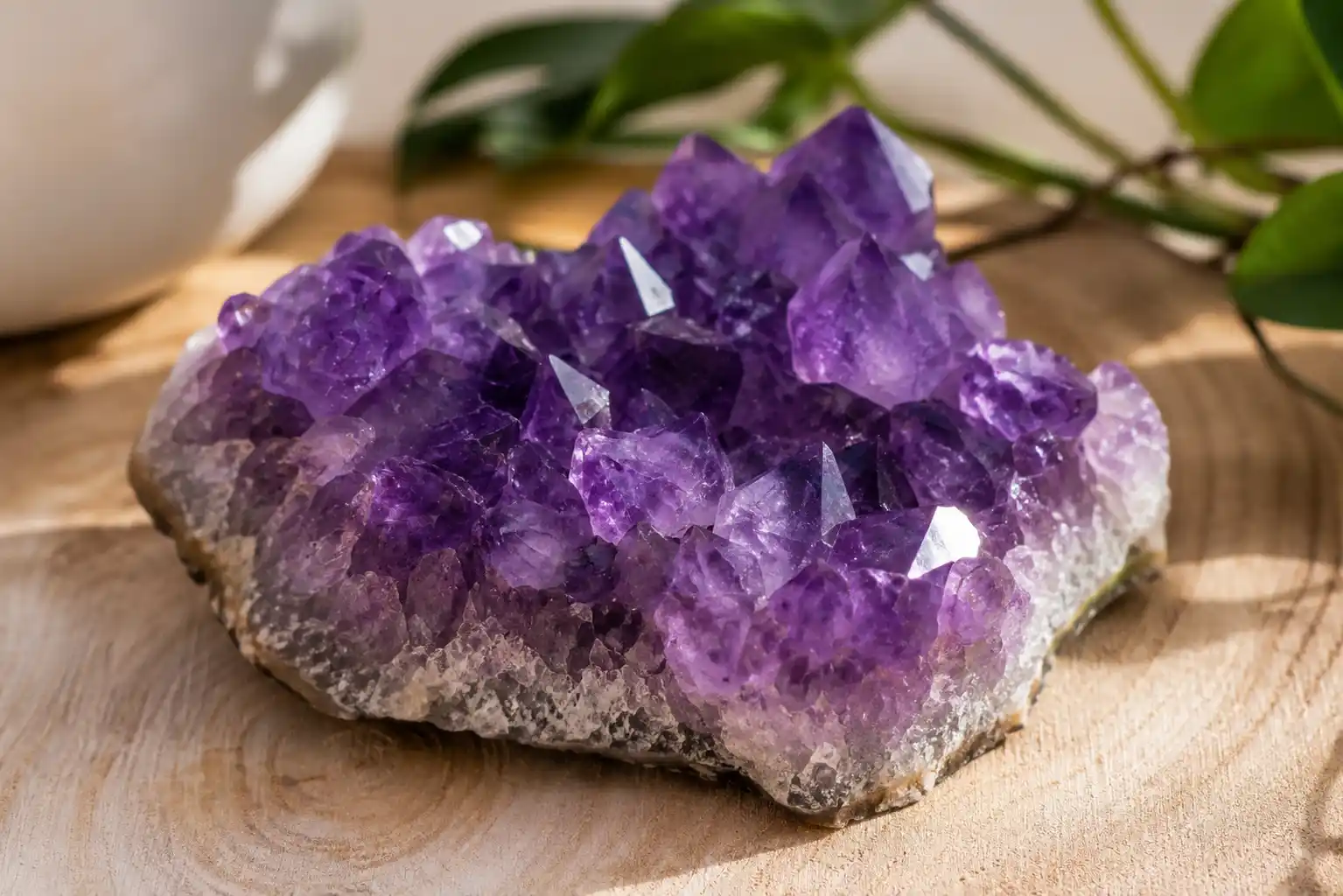
Amethyst is the purple variety of quartz, composed primarily of silicon dioxide, SiO₂. Its violet color develops when trace iron incorporated into quartz interacts with natural irradiation to create color centers that selectively absorb visible light. The result can range from pale lilac through bluish purple to intense reddish purple, often with angular or sector-like color zoning visible inside the crystal.
That mineral identity is the clearest foundation for amethyst meaning. Amethyst is not a separate mineral species from quartz, and its purple color is not evidence of an invisible healing field. It shares quartz’s crystal structure, hardness, optical constants, fracture behavior, and basic chemistry while differing principally in the defect chemistry responsible for its characteristic color.
Human interpretations came later. Across different periods and cultures, amethyst has been associated with restraint, sobriety, protection, religious devotion, clarity, calmness, and personal discipline. Those ideas belong to historical and symbolic traditions rather than measurable gemological properties.
The wider quartz meaning guide explains the mineral species itself, while this page focuses specifically on what makes the purple variety distinct.
Amethyst Identity at a Glance
| Property | Amethyst |
|---|---|
| Mineral species | Quartz |
| Variety | Purple quartz |
| Chemical composition | SiO₂ |
| Crystal system | Trigonal |
| Typical external crystal appearance | Six-sided prism with rhombohedral termination when well formed |
| Color | Pale lilac to violet, bluish purple, purple and reddish purple |
| Major color influence | Trace iron plus irradiation-related color centers |
| Common color feature | Angular, sector or growth-related zoning |
| Refractive index | Approximately 1.544–1.553 |
| Birefringence | Approximately 0.009 |
| Optical character | Uniaxial positive |
| Specific gravity | Approximately 2.66 |
| Mohs hardness | 7 |
| Cleavage | No prominent easy cleavage in normal gem use |
| Fracture | Commonly conchoidal |
| Tenacity | Brittle, with generally good jewelry toughness when sound |
| Luster | Vitreous |
| Transparency | Transparent to translucent |
| Common formation settings | Basalt-hosted geodes, hydrothermal veins, cavities and some pegmatitic environments |
| Synthetic counterpart | Hydrothermally grown synthetic amethyst exists |
| Important treatment issue | Heat can alter or remove purple color |
The word variety matters. Quartz occurs in several familiar forms distinguished partly by color, inclusions, texture or growth characteristics. Amethyst is purple quartz; citrine occupies the yellow-to-orange portion of the quartz family, while ametrine contains visibly separated purple amethyst and yellow-to-orange citrine regions within one quartz crystal.
Those names describe different appearances within the same fundamental SiO₂ mineral framework.
How Amethyst Forms
Amethyst forms when silica-rich fluids crystallize quartz under conditions that also allow suitable trace iron to enter the growing crystal. Natural radiation acting on that iron-bearing quartz can then develop the electronic defects responsible for purple coloration.
The geological setting varies substantially between deposits.
Some of the world’s best-known amethyst occurs inside cavities in volcanic rocks. Large basalt-hosted geodes can develop layered interiors in which the cavity wall is followed by alteration minerals, chalcedony or agate, colorless quartz and finally inward-pointing amethyst crystals. These spectacular geodes demonstrate that the visible purple crystals represent only the final part of a longer sequence of fluid movement, cavity filling and quartz growth.
Amethyst also forms in hydrothermal veins. In these systems, warm silica-bearing fluids move through fractures and open spaces, depositing quartz as temperature, pressure and chemistry change. Iron available in the fluid becomes incorporated into parts of the growing quartz, while later geological radiation helps produce the purple color.
Other occurrences are associated with cavities in granitic and pegmatitic systems or with different low-to-moderate-temperature mineralizing environments.
This diversity creates an important evidence boundary: a loose faceted amethyst cannot be assigned to a basalt geode, hydrothermal vein or pegmatite merely from its purple color.
Formation environment requires geological context, inclusions, associated minerals, provenance or more advanced analysis.
Why Amethyst Is Purple
The purple color of amethyst is produced by trace iron and radiation-related changes within quartz.
Quartz itself is normally colorless when its structure contains no color-producing defects or impurities. During amethyst growth, small amounts of iron can enter positions associated with the quartz lattice. Natural irradiation then changes the electronic state of iron-related defects, creating color centers that absorb particular wavelengths of visible light.
The transmitted and reflected light that remains appears purple.
This explanation is more accurate than saying simply that “iron is purple.” Iron occurs in numerous gems and minerals without making them amethyst, while quartz containing iron does not necessarily become purple unless the appropriate structural and irradiation conditions exist.
Amethyst color can also be unevenly distributed because trace iron was not incorporated identically through every stage or crystallographic growth sector. Darker purple may concentrate beneath certain rhombohedral faces, producing angular bands, triangular sectors, phantom-like zones or other geometric patterns.
These patterns can be useful evidence.
They can also affect cutting because a cutter may orient a stone to place the strongest purple zone where it contributes most effectively to face-up color.
The detailed value consequences of saturation, tone and zoning belong in the amethyst price guide rather than being turned into a pricing discussion here.
Why Some Amethyst Looks Almost Black
Deeply colored amethyst can absorb so much visible light that thick sections appear nearly black under weak illumination.
That does not mean the material is actually black quartz.
Light must travel through the gemstone, interact with the color-producing absorption centers and return to the observer. A thicker optical path means more light can be absorbed, while a thinner edge or strongly backlit area may reveal vivid purple.
Cut also affects this behavior. Deep stones, poorly oriented stones and gems with substantial extinction may look darker than material of similar intrinsic color cut to return more light.
For that reason, evaluating amethyst from a single dark photograph is unreliable. Lighting, exposure, white balance, background color, facet orientation and stone depth can all change the recorded appearance.
Color photographs are evidence of appearance under specific conditions, not complete gemological measurements.
What Color Zoning Can Tell You
Amethyst commonly shows angular darker and lighter purple zones related to crystal growth.
In rough crystals, the strongest purple may concentrate toward crystal terminations or along specific growth sectors. In slices viewed perpendicular to the crystal’s long axis, zoning can sometimes create geometric patterns reflecting the rhombohedral faces under which color developed.
This zoning is different from random surface staining.
A naturally colored zone is integrated with crystal growth. It may continue through the interior, follow crystallographic geometry and interact consistently with internal structures.
A coating or dye tends to behave differently, potentially accumulating along fractures, cavities, scratches or surface irregularities.
The distinction is useful, but visual zoning alone cannot prove natural origin. Hydrothermally grown synthetic amethyst can also show growth structures and color distribution that require experienced interpretation.
Natural Amethyst and Synthetic Amethyst Can Be Very Similar
Synthetic amethyst can be grown by hydrothermal methods that reproduce the essential chemistry, structure and many optical properties of natural quartz.
This is important because synthetic amethyst is real quartz in the mineralogical sense. It is not the same category as purple glass or plastic imitation. The difference is origin: one crystallized through geological processes, while the other was grown under controlled laboratory conditions.
Finished synthetic amethyst can be difficult to separate from natural material because both may be clean, transparent and strongly purple.
Gemologists can examine growth structures, inclusions, infrared spectra and twinning behavior. Brazil-law twinning is particularly useful because it is widespread in natural amethyst and generally absent from conventional hydrothermal synthetic material, although unusual growth circumstances and seed choices prevent this from being treated as an infallible one-observation rule.
A photograph of a transparent purple stone cannot establish natural versus synthetic origin.
For a valuable stone where origin matters commercially, stronger evidence is preferable to confidence based on appearance.
Amethyst Diagnostic Characteristics
Several ordinary gemological properties establish whether a purple stone is compatible with quartz.
Refractive Index
Amethyst has a refractive index of approximately 1.544–1.553, the familiar range of crystalline quartz.
This provides a useful separation from many purple lookalikes whose optical constants lie elsewhere. A suitable polished surface and correct testing technique are still required.
Birefringence
Quartz is doubly refractive, with birefringence of approximately 0.009.
In transparent fashioned material, optical testing can therefore distinguish amethyst from some singly refractive glasses or other substitutes.
Specific Gravity
Amethyst has a specific gravity near 2.66.
Density can provide additional supporting evidence for a loose stone, although inclusions, measurement error and mounted jewelry can complicate testing.
Hardness
Quartz defines Mohs hardness 7.
That makes amethyst resistant to many everyday scratches but still vulnerable to harder materials such as corundum and diamond. Quartz-bearing dust can also abrade polished quartz over time because particles of equal hardness can contribute to wear.
Hardness should be understood as a durability property rather than used as an excuse to scratch-test a finished gem.
Crystal Form
Well-developed rough amethyst commonly shows the characteristic quartz habit: a six-sided prism terminated by rhombohedral faces.
A broken fragment, cabochon or faceted gem may preserve none of that external morphology, so crystal shape is most useful when examining intact specimens.
Amethyst Versus Other Purple Stones
Purple color alone is highly non-diagnostic.
Charoite can be violet or purple but is usually an opaque to translucent aggregate with swirling fibrous textures entirely unlike transparent quartz. The detailed choice between the materials belongs in amethyst vs charoite.
Purple sapphire, fluorite, spinel, glass and several other natural or manufactured materials can also overlap amethyst visually.
The broader purple gemstones guide is useful when the goal is to identify possible purple gem categories rather than assume every violet stone is amethyst.
For symbolism-oriented browsing, purple crystals groups materials by visible color without implying that their mineral structures are related.
This distinction is fundamental: purple is an appearance; amethyst is a particular purple variety of quartz.
A Source-Reconciliation Table for Common Amethyst Claims
| Claim or name | Evidence-based interpretation | What should not be assumed |
|---|---|---|
| “Amethyst is its own mineral species” | Amethyst is the purple variety of quartz | It has chemistry fundamentally different from quartz |
| “Iron makes amethyst purple” | Trace iron is essential to the established color-center mechanism | Iron alone automatically produces purple color |
| “Radiation makes amethyst artificial” | Natural geological radiation helps create ordinary amethyst color | A naturally irradiated crystal is laboratory treated |
| “Darker amethyst is always better” | Strong saturated purple is desirable, but excessive darkness can reduce visible brilliance | The darkest stone automatically has the highest quality |
| “Color zoning proves fake amethyst” | Growth-related color zoning is common in natural amethyst | Uneven purple automatically indicates treatment |
| “Perfectly even color proves natural quality” | Even face-up color can be attractive | Uniform color establishes natural origin |
| “Synthetic amethyst is glass” | Synthetic amethyst can be laboratory-grown crystalline quartz | All manufactured purple stones are merely imitation |
| “Green amethyst” | The commercial expression usually refers to green quartz known as prasiolite | Green quartz remains purple amethyst mineralogically |
| “Chevron amethyst” | Common name for patterned material containing purple amethyst and lighter quartz zones | It is a separate mineral species |
| “Ametrine” | Quartz containing amethyst and citrine color zones | It is unrelated to amethyst |
| “Heating proves the stone is fake” | Natural amethyst can have its color changed through heat treatment | Treated natural quartz is automatically synthetic |
| “Amethyst prevents drunkenness” | This is a documented historical belief connected with the gem’s name | Protection from intoxication is medically established |
| “Amethyst heals anxiety or addiction” | Such statements belong to modern metaphysical traditions | Clinical efficacy has been demonstrated |
| “A clear stone must be synthetic” | Fine natural amethyst can be eye-clean | Lack of obvious inclusions proves laboratory growth |
| “A heavily included stone must be natural” | Natural material can contain inclusions | Inclusions alone establish natural origin |
This table illustrates why amethyst meaning benefits from separating mineral facts, commercial terminology and cultural claims.
A statement can contain a genuine historical or geological element while still reaching an unsupported conclusion.
An Original Amethyst Specimen and Photo Evaluation Checklist
A disciplined photo record cannot replace gemological testing, but it can preserve evidence that ordinary marketplace photographs often discard.
| Evaluation step | What to record | What it can help establish |
|---|---|---|
| Photograph the complete specimen | Matrix, crystal terminations and broken surfaces | Preserves geological and structural context |
| Add a scale | Millimeter or centimeter dimensions | Prevents misleading apparent size |
| Use neutral illumination | Baseline purple hue and tone | Reduces colored-light contamination |
| Keep white balance consistent | Compare several views under the same settings | Reduces artificial color shifts |
| Photograph through thin and thick areas | Differences in apparent darkness | Shows optical-path effects |
| Record color zoning | Angular bands, sectors, phantoms or irregular patches | Documents growth-related color distribution |
| Photograph crystal termination | Rhombohedral faces and prism relationships | Supports quartz morphology where preserved |
| Use magnification | Fluid inclusions, crystals, fractures and growth structures | Provides evidence for later professional interpretation |
| Photograph from several directions | Changes in zoning and internal appearance | Prevents one-angle conclusions |
| Preserve matrix associations | Calcite, agate, quartz, hematite or other attached material | Helps reconstruct specimen context |
| Record any heat-damaged area | Colorless, yellowish or altered zones near damage | Preserves possible treatment or accidental heating evidence |
| Keep original files | Images before saturation or contrast adjustment | Creates a stronger comparison record |
| Preserve locality labels | Old collection labels, numbers and provenance | Protects evidence that appearance cannot replace |
| Avoid scratch testing | Do not damage polished or collectible surfaces | Hardness is not unique enough to justify destruction |
| Escalate important stones | RI, microscopy, polariscope, spectroscopy and laboratory analysis | Moves identification beyond photography |
The checklist deliberately separates observation from conclusion.
A triangular purple zone can be recorded confidently.
Declaring from that photograph alone that the stone is natural, untreated and from a particular locality would exceed the evidence.
“Green Amethyst” Is a Misleading Name
Green quartz sold as green amethyst is better described as prasiolite.
Amethyst means purple quartz. Once the relevant material is green, continuing to call it amethyst creates avoidable confusion even if the green color originated by altering amethyst.
Some amethyst can turn yellow, orange, brownish, colorless or green when heated under suitable conditions. The resulting color depends on the original material and its defect chemistry.
This relationship explains why amethyst, citrine and prasiolite are frequently discussed together.
It does not make their variety names interchangeable.
Detailed treatment disclosure—including heat-induced color changes—belongs in treated amethyst.
How Heat Changes Amethyst
Heating can alter the defects responsible for amethyst’s purple color.
Depending on the material and heating conditions, purple may fade, disappear, become yellow to orange-brown, or in less common cases shift toward green. Much commercial yellow quartz has historically been produced by heating suitable amethyst rough.
This creates two separate questions.
The first is identity: the object remains quartz.
The second is disclosure: its present color may not represent the color in which the natural rough was originally recovered.
For a meaning reference, the important point is that color is structurally responsive and should not be treated as permanent under unlimited heat.
Commercial treatment detection and disclosure deserve their own page because they require considerably more detail than the mineral definition itself.
The Documented History Behind Amethyst
Amethyst has been fashioned into beads, scarabs, amulets, engraved gems and jewelry across several ancient cultures. Museum collections preserve examples from ancient Egypt and the Mediterranean world, demonstrating that the material’s ornamental and symbolic history extends far beyond modern crystal culture.
Its name is derived from the Greek amethystos, commonly interpreted as “not intoxicated” or “not drunken.”
The name connects with an ancient belief that amethyst could protect its owner from drunkenness or excessive intoxication. Classical references preserve that association, and later traditions expanded it into broader ideas of restraint, clear thinking and moderation.
The historical belief is real.
The claimed protective effect is not scientifically demonstrated.
That distinction is important because modern summaries often turn the etymology directly into a medical statement, as though the existence of the ancient belief proves that wearing amethyst changes alcohol metabolism or prevents impairment.
It does not.
Historical sources establish what people believed, not whether the belief was physiologically effective.
Amethyst Meaning and the Symbolism of Restraint
Among amethyst’s symbolic associations, restraint has one of the strongest historical foundations because it follows directly from the gem’s name and its relationship with sobriety traditions.
Modern interpretation can extend restraint beyond alcohol without pretending that the stone causes behavioral change.
Someone might keep an amethyst on a desk as a physical reminder to pause before making an impulsive decision. Another person might associate it with maintaining boundaries, following a planned routine, reducing distraction or approaching emotionally charged conversations with greater deliberation.
The useful mechanism in those examples is the person’s chosen behavior.
The amethyst acts as a cue.
This is a more defensible interpretation than claiming that quartz physically transmits self-control into the nervous system.
Calmness, Clarity and Reflection
Contemporary amethyst meaning frequently emphasizes calmness, mental clarity and reflection.
Those themes make intuitive sense within modern symbolism. Purple has long carried ceremonial and contemplative associations in multiple cultures, while transparent crystals invite visual attention to clarity, zoning, reflection and internal structure.
A person can therefore use amethyst during meditation, journaling or quiet reflection without claiming that a measurable calming substance enters the body.
The distinction is straightforward:
Using amethyst while doing something calming is observable. Claiming the mineral medically causes calmness requires evidence that does not currently exist.
The dedicated amethyst healing properties page owns the detailed discussion of historical and modern healing traditions so that those claims do not overwhelm the mineral reference here.
Does Amethyst Have Proven Healing Properties?
No established gemological or clinical evidence shows that wearing or carrying amethyst treats disease.
Claims involving anxiety disorders, addiction, insomnia, headaches, hormonal problems, pain, immunity, blood circulation or other medical conditions should not be presented as scientifically established properties of quartz.
Amethyst is chemically silicon dioxide containing very small concentrations of impurities and structural defects. Nothing about wearing a polished quartz crystal demonstrates a therapeutic dose-response mechanism comparable with medicine.
Personal ritual is different.
Someone can use amethyst as a reminder to meditate, journal, reduce distractions or follow a personal goal. The benefits of the intentional activity should not be reassigned to an unverified force emitted by the gemstone.
Gems Lore keeps those traditions within the broader Healing Crystal collection while maintaining a clear boundary between symbolism and medical evidence.
Amethyst, Citrine and Ametrine
These three names belong to the quartz family but describe different color expressions.
Amethyst is purple.
Citrine is yellow to orange quartz.
Ametrine displays zones of both amethyst and citrine color within the same crystal.
The relationship is more than visual because heat can change the oxidation and defect state responsible for color in some iron-bearing quartz. Suitable amethyst can therefore lose its purple appearance and develop colors marketed as citrine after heating.
Natural ametrine, however, is not simply two gemstones glued together. Its color zoning occurs within one continuous quartz crystal whose growth and thermal history allowed different regions to develop different color-center behavior.
The dedicated ametrine meaning guide handles that bicolored material as its own subject rather than turning this page into a general quartz-color reference.
Safe Ownership: Amethyst Is Durable, Not Indestructible
Amethyst’s Mohs hardness of 7 makes it suitable for many jewelry applications.
Its quartz structure lacks an easy cleavage comparable with topaz or feldspar, and GIA characterizes its toughness as good. Those qualities make amethyst practical for earrings, necklaces, bracelets and rings when the stone and setting are in sound condition.
Hardness 7 does not mean damage-proof.
A sharp impact can chip an exposed facet edge. Surface abrasions accumulate when a gemstone repeatedly contacts equally hard or harder materials. Existing fractures create local weaknesses, while poor setting construction can allow a durable gemstone to loosen or fall out.
The jewelry format changes the risk.
An amethyst ring receives more frequent knocks than an earring, so setting height and edge protection deserve greater attention.
An amethyst bracelet repeatedly contacts desks, counters and neighboring beads, making abrasion, drill-hole quality and restringing relevant.
Amethyst earrings generally experience less impact but introduce matched-pair and setting-security questions.
An amethyst necklace reduces many impact risks but still depends on the security of the bail, chain, drilling or strand construction.
Those pages own the jewelry-engineering details rather than duplicating them here.
Light and Heat Can Affect Amethyst Color
Some amethyst can fade after prolonged exposure to intense light, while excessive heat can alter its purple color substantially.
This matters for both jewelry and mineral specimens.
A valuable crystal cluster displayed indefinitely in intense direct illumination may not be experiencing the same environment as a gemstone worn occasionally. Likewise, leaving amethyst near strong heat or deliberately testing it with a flame can permanently alter the material.
Abrupt temperature changes can also contribute to fracturing.
Normal ownership does not require keeping amethyst permanently in darkness. It does justify avoiding unnecessary extremes when the specimen’s long-term appearance matters.
How to Clean Amethyst Safely
Warm water, mild soap and gentle manual cleaning are appropriate for ordinary untreated amethyst in sound condition.
Steam is best avoided because quartz can be vulnerable to thermal shock and amethyst color itself is heat-sensitive.
Ultrasonic cleaning may be acceptable for many sound untreated amethysts, but fractures, fillings, dyes, delicate settings or uncertain treatment history can change the decision. Conservative manual cleaning removes that uncertainty.
The complete maintenance procedure belongs in how to clean amethyst jewelry.
Symbolic or ritual practices are a different subject and are covered separately in how to cleanse amethyst. Physical cleaning and spiritual cleansing should not be presented as interchangeable processes.
Buying and Price Questions Need Separate Evidence
A meaning reference can explain what amethyst is, but it should not become a disguised buying guide.
Color, zoning, clarity, cut, size, natural versus synthetic origin, treatment, geographic claims and retail context all affect commercial evaluation. Those variables belong in amethyst price.
Seller selection, return conditions, disclosure, photographs and transaction-specific questions belong in buy amethyst.
Keeping those topics separate avoids a common content problem in which one page tries to answer mineral identity, symbolism, authentication, price, jewelry selection and marketplace advice at the same time without doing any of them deeply.
What a Photograph Cannot Prove
A clear photograph can establish visible facts such as purple hue, apparent zoning, crystal morphology, fractures, polish and broad transparency.
It cannot reliably establish:
natural versus synthetic origin;
heat-treatment history;
geographic origin;
microscopic inclusion identity;
exact refractive index;
exact specific gravity;
whether an internal feature continues in three dimensions;
whether color has been digitally altered;
whether a seller’s provenance statement is correct.
This is why image-based gemstone identification needs calibrated language.
“Consistent with amethyst” may be a defensible photographic conclusion.
“Laboratory-confirmed natural untreated amethyst from a specific mine” is not.
The same evidence principle applies when comparing amethyst with other violet materials through amethyst vs charoite.
Amethyst as a Purple Crystal
People searching by color often encounter amethyst before learning its mineral identity, which is understandable because purple is its most immediate characteristic.
Color-based collections such as purple crystals and purple gemstones are useful for comparing appearance, while alphabetical references such as crystals that start with A help users locate familiar material names.
Those groupings should remain navigation tools rather than classification systems.
Quartz, fluorite, charoite, sapphire and other purple materials do not become mineralogical relatives simply because human vision places them in a similar color family.
What Amethyst Meaning Ultimately Describes
Amethyst meaning becomes clearer when three layers are kept distinct.
Mineralogically, amethyst is purple quartz with SiO₂ chemistry, trigonal structure, refractive index around 1.544–1.553, birefringence near 0.009, specific gravity around 2.66 and Mohs hardness 7. Its color depends on iron-related defects and irradiation rather than on a separate purple mineral component.
Geologically, amethyst can crystallize in basalt-hosted cavities, hydrothermal veins and other quartz-forming environments. Its color zoning, inclusions, associated minerals and crystal morphology can preserve evidence about how individual specimens grew.
Historically and symbolically, amethyst has been worn, carved and interpreted for a very long time. Its name preserves a strong association with sobriety and protection from intoxication, while contemporary traditions often connect it with calmness, clarity, restraint and reflection.
The first two categories can be investigated through mineralogical and gemological evidence.
The third describes human interpretation.
Keeping those categories separate makes amethyst more interesting rather than less meaningful. The gemstone’s purple color records atomic-scale changes involving iron and radiation, its geometric zoning follows the architecture of quartz crystal growth, its natural and hydrothermal synthetic forms can challenge experienced gemologists, and its cultural history shows how one visible material can acquire different meanings as it moves through societies.
That material-first understanding is the strongest foundation for amethyst meaning.