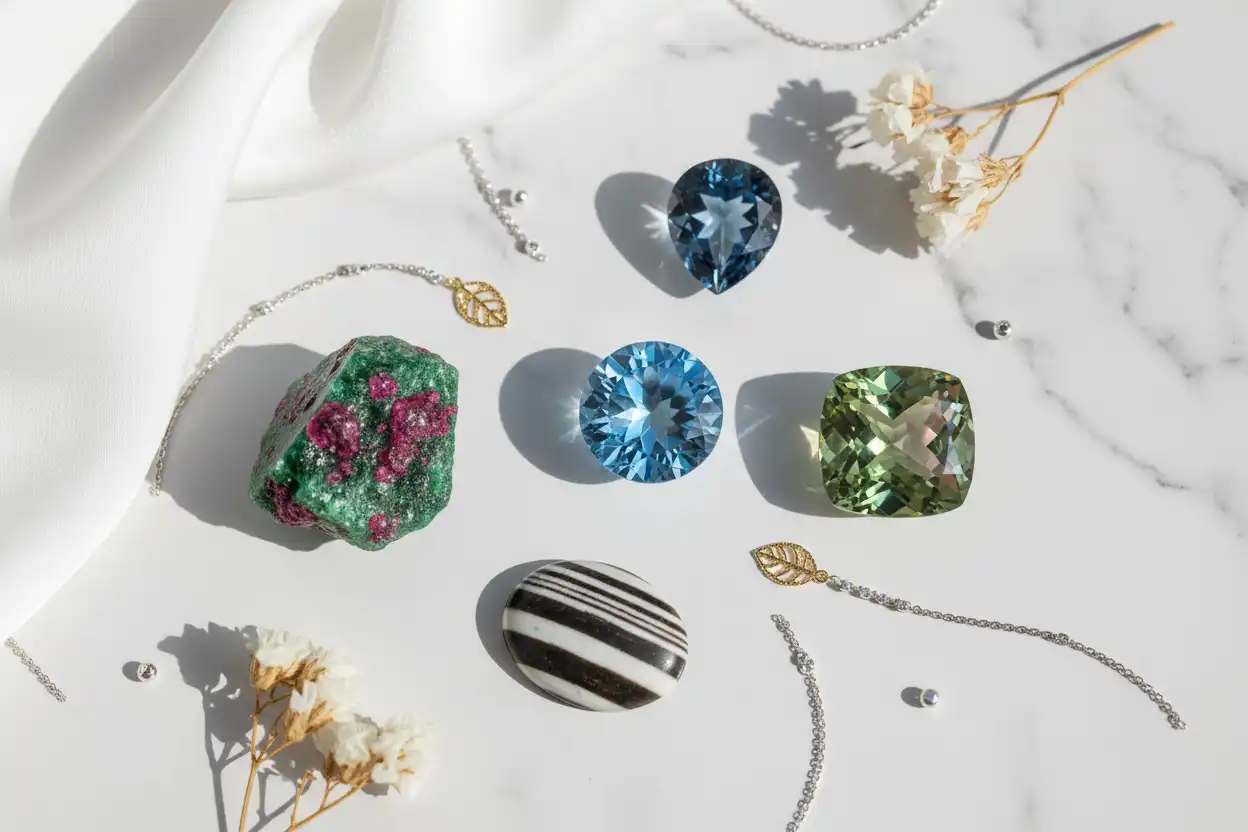
Gemstones That Start With Z: A–Z Guide
Gemstones and gem materials that start with Z include zebra calcite, zebra jasper, zebra stone, zektzerite, zeolite, zincite, zinnwaldite, zircon, zoisite and zunyite.
The final gemstone directory includes patterned lapidary rocks, rare collector minerals, a major natural gemstone, a mineral family and ornamental varieties used in carvings and cabochons.
Traditional meanings are symbolic associations rather than scientifically proven medical effects.
Continue from Gemstones That Start With Y. For a broader specimen-focused overview, explore Crystals That Start With Z.
Z Gemstones at a Glance
| Gemstone or material | Typical appearance | Material type | Common use |
|---|---|---|---|
| Zebra Calcite | White, cream, brown or black bands | Calcite trade variety | Carvings and protected pendants |
| Zebra Jasper | Contrasting black, white, brown or red patterns | Lapidary rock or silica-rich material | Beads and cabochons |
| Zebra Stone | Striped brown, cream, red or white rock | Decorative lapidary rock | Cabochons and carvings |
| Zektzerite | Pale pink, beige or colorless crystals | Rare silicate mineral | Collector specimens and rare gems |
| Zeolite | White, clear, peach, pink or green minerals | Mineral group | Collector specimens |
| Zincite | Red, orange, yellow or dark material | Zinc oxide mineral | Collector gems and specimens |
| Zinnwaldite | Brown, bronze, gray or lilac mica | Mica-group material | Collector specimens |
| Zircon | Colorless, blue, yellow, brown, red or green | Zirconium silicate gemstone | Fine faceted jewelry |
| Zoisite | Green, blue, pink, purple or gray | Silicate gemstone | Faceted gems, beads and carvings |
| Zunyite | White, gray or colorless tetrahedral crystals | Aluminum silicate mineral | Collector specimens |
Zebra Calcite
Zebra calcite is a commercial name for calcite with contrasting stripes, bands or patches.
Its colors may include:
- White and gray.
- Cream and brown.
- Black and white.
- Yellow and dark brown.
- Pinkish or orange tones.
The striped appearance may result from alternating calcite layers, included minerals or mixed carbonate material.
Zebra calcite is traditionally associated with:
- Balance.
- Practical awareness.
- Cooperation.
- Recognizing contrasting viewpoints.
- Creating stability during change.
It belongs to the broader calcite family.
Calcite is soft and acid-sensitive. Zebra calcite is best used for carvings, pendants, earrings and protected decorative jewelry rather than everyday rings.
Zebra Jasper
Zebra jasper is a commercial name for patterned lapidary stone with contrasting stripes, spots or irregular bands.
Common combinations include:
- Black and white.
- Brown and cream.
- Red and gray.
- Green and dark brown.
- Pink and black.
Zebra jasper is traditionally associated with:
- Stability.
- Adaptability.
- Patience.
- Cooperation.
- Balancing work with rest.
The exact composition can vary. Some material is silica-rich, while other examples are rocks containing several minerals.
Solid pieces are commonly cut into:
- Cabochons.
- Beads.
- Pendants.
- Rings.
- Carvings.
Extremely uniform stripes or unusually vivid colors may indicate dye, reconstruction or manufactured imitation.
Zebra Stone
Zebra stone is a commercial name applied to several striped decorative rocks.
Australian zebra stone is especially known for cream, reddish-brown, dark brown or yellow patterns arranged in:
- Parallel bands.
- Spots.
- Wavy stripes.
- Geometric markings.
- Irregular contrasting patches.
Zebra stone is traditionally associated with:
- Individuality.
- Cooperation.
- Adaptability.
- Recognizing personal strengths.
- Finding order within complexity.
It is a rock rather than one mineral crystal. Hardness, porosity and polishing behavior therefore depend on the specific deposit and composition.
Ask for locality and geological information when purchasing valuable or collectible material.
Zektzerite
Zektzerite is a rare silicate mineral containing sodium, lithium and zirconium.
It may occur as:
- Pale pink crystals.
- Colorless grains.
- Cream or beige crystals.
- Crystals embedded in granitic rock.
- Transparent to translucent collector material.
Zektzerite is traditionally associated with:
- Precision.
- Independent thinking.
- Patience.
- Intellectual curiosity.
- Recognizing small but important details.
Transparent crystals are uncommon. Most specimens are collected for mineralogical interest rather than used in mainstream jewelry.
Because zektzerite can resemble other pale minerals, reliable provenance and professional identification matter.
It belongs among the specialist materials discussed in the guide to the rarest gemstones in the world.
Zeolite
Zeolite refers to a large mineral group of hydrated aluminosilicates with open internal structures.
Well-known zeolite minerals include:
- Stilbite.
- Heulandite.
- Scolecite.
- Natrolite.
- Chabazite.
- Analcime.
Zeolite specimens may appear:
- White.
- Clear.
- Peach.
- Pink.
- Yellow.
- Green.
- Reddish.
Zeolites are traditionally associated with:
- Renewal.
- Organization.
- Adaptability.
- Creating space.
- Gradual development.
Many zeolite minerals are soft, porous or cleavable. Delicate sprays and clusters are usually unsuitable for ordinary jewelry.
Safe care depends on the exact zeolite species rather than the group name alone.
Zincite
Zincite is zinc oxide and may appear:
- Red.
- Orange.
- Yellow.
- Brownish red.
- Greenish gray.
- Dark gray.
- Transparent to opaque.
Natural zincite crystals are rare.
Much of the vivid orange-red crystalline material sold in crystal markets originated through industrial smelting processes rather than natural geological growth.
Zincite is traditionally associated with:
- Motivation.
- Purposeful action.
- Confidence.
- Creativity.
- Using energy constructively.
Zincite is relatively soft and brittle. Crystal surfaces may chip or leave residue.
Natural, industrial and laboratory origin should be disclosed accurately.
Zinnwaldite
Zinnwaldite is a lithium- and iron-bearing mica name used for brown, gray, bronze, yellow-brown or lilac layered material.
It commonly occurs as:
- Flat plates.
- Flaky aggregates.
- Sheet-like crystals.
- Reflective brown layers.
- Crystals in granitic pegmatites.
Zinnwaldite is traditionally associated with:
- Flexibility.
- Reflection.
- Adaptability.
- Reconsidering rigid assumptions.
- Understanding situations in layers.
Its sheet structure relates to the wider mica family.
Thin pieces split and flake easily. Avoid soaking, bending, abrasion and loose storage with harder gemstones.
Zircon
Zircon is a natural zirconium silicate gemstone known for strong brilliance and fire.
Its colors include:
- Colorless.
- Blue.
- Yellow.
- Golden brown.
- Orange.
- Red.
- Green.
Zircon is traditionally associated with:
- Wisdom.
- Confidence.
- Prosperity.
- Clear judgment.
- Respect for experience.
Colorless zircon has historically been used as a diamond alternative, but zircon is a distinct natural mineral.
It should not be confused with cubic zirconia, which is a manufactured zirconium oxide material.
Many blue and colorless zircons are heat-treated. Some heat-treated colors may be affected by prolonged bright light or additional heat.
Zircon is relatively hard but brittle, and facet junctions can abrade if stored against harder gems.
The symbolism of individual shades is covered in the zircon color guide.
Zoisite
Zoisite is a silicate mineral occurring in several colors and gem varieties.
Important forms include:
- Blue-violet tanzanite.
- Pink thulite.
- Green zoisite.
- Ruby in zoisite.
- Gray, brown or yellow crystals.
Zoisite is traditionally associated with:
- Growth.
- Transformation.
- Motivation.
- Developing unused abilities.
- Turning ideas into action.
Transparent zoisite may be faceted, while massive thulite and ruby-in-zoisite material are commonly used for cabochons, beads and carvings.
Durability varies by variety, inclusions and crystal orientation.
Tanzanite requires considerably more impact protection than massive ornamental zoisite.
Zunyite
Zunyite is a rare aluminum silicate mineral that commonly forms small tetrahedral crystals.
It may appear:
- White.
- Gray.
- Colorless.
- Pale cream.
- As crystals embedded in altered volcanic rock.
Zunyite is traditionally associated with:
- Structure.
- Patience.
- Organization.
- Careful observation.
- Building knowledge gradually.
Well-formed crystals are mainly valued by mineral collectors.
Their small size and matrix attachment make them unsuitable for ordinary jewelry. Avoid aggressive brushing or ultrasonic cleaning that could loosen crystals from the host rock.
Comparing Z Material Types
The Z directory includes several different categories:
- Zebra calcite is a carbonate trade variety.
- Zebra jasper and zebra stone are patterned lapidary materials.
- Zektzerite, zincite, zircon, zoisite and zunyite are minerals.
- Zeolite is a mineral group.
- Zinnwaldite is a mica-group material.
Trade names do not guarantee one precise geological composition.
The non-destructive observations in How to Identify Crystals can help distinguish rocks, minerals, glass and treated materials.
Which Z Gemstones Are Best for Jewelry?
Best for Fine Jewelry
Zircon is the primary transparent fine-jewelry gemstone in the Z directory.
It works well in:
- Earrings.
- Pendants.
- Occasional-wear rings.
- Collector jewelry.
- Accent-stone designs.
Suitable for Casual Jewelry
Zebra jasper, zebra stone and massive zoisite are practical for beads, carvings and cabochons.
Zebra calcite can be worn in protected pendants but scratches easily.
Specialist Collector Gems
Transparent zektzerite and natural zincite are rare collector materials.
Primarily Display Minerals
Zeolite clusters, zinnwaldite and zunyite are generally too delicate for conventional jewelry.
Buying and Identification Notes
Look for:
- Dyed zebra jasper.
- Variable rocks sold under the zebra stone name.
- Pale minerals misidentified as zektzerite.
- Industrial zincite represented as natural.
- Cubic zirconia sold as zircon.
- Heat-treated zircon without disclosure.
- Serpentine or other green stone sold as zoisite.
- Delicate zeolite groups sold as durable jewelry material.
Laboratory testing is advisable when rarity, treatment or origin significantly affects price.
Care Guide for Z Gemstones
- Keep zebra calcite away from acids and harder gems.
- Check zebra jasper and zebra stone for fractures or porous matrix.
- Protect rare zektzerite crystals from unnecessary handling.
- Clean zeolites according to their exact species.
- Avoid breathing dust or residue from rough zincite.
- Store zinnwaldite flat so its layers do not bend or flake.
- Keep zircon separate from harder gemstones to protect facet edges.
- Treat zoisite according to its variety and internal structure.
- Avoid brushing small zunyite crystals attached to matrix.
- Do not use steam or ultrasonic cleaning when cleavage or matrix attachment creates risk.
The guide to gemstone cleavage explains why a relatively hard gemstone may still chip or split.
Frequently Asked Questions
What is the most valuable gemstone that starts with Z?
Fine natural zircon can be valuable, particularly in attractive blue, red, green or vivid untreated colors. Rare facetable zektzerite may also interest collectors.
Is zircon the same as cubic zirconia?
No. Zircon is a natural mineral, while cubic zirconia is a manufactured material.
Is zebra jasper a true jasper?
The name is commercial. Some material is silica-rich, while other examples may have more complex rock compositions.
Is zebra calcite suitable for rings?
Its softness makes pendants, earrings and protected occasional-wear designs more practical.
Is zeolite one mineral?
No. Zeolite is a large group containing many individual mineral species.
Is commercial zincite always natural?
No. A substantial amount of colorful crystalline zincite in the market has an industrial origin.
Is zoisite the same as tanzanite?
Tanzanite is the blue-to-violet gem variety of zoisite.
Is zinnwaldite durable?
No. Its layered mica structure splits and flakes easily.
Is zunyite used in jewelry?
Rarely. Its crystals are usually small, matrix-bound and primarily valued as mineral specimens.
Complete the Gemstone Alphabet
Restart with Gemstones That Start With A, or browse every alphabetical crystal and gemstone directory through the Crystals 101 collection.