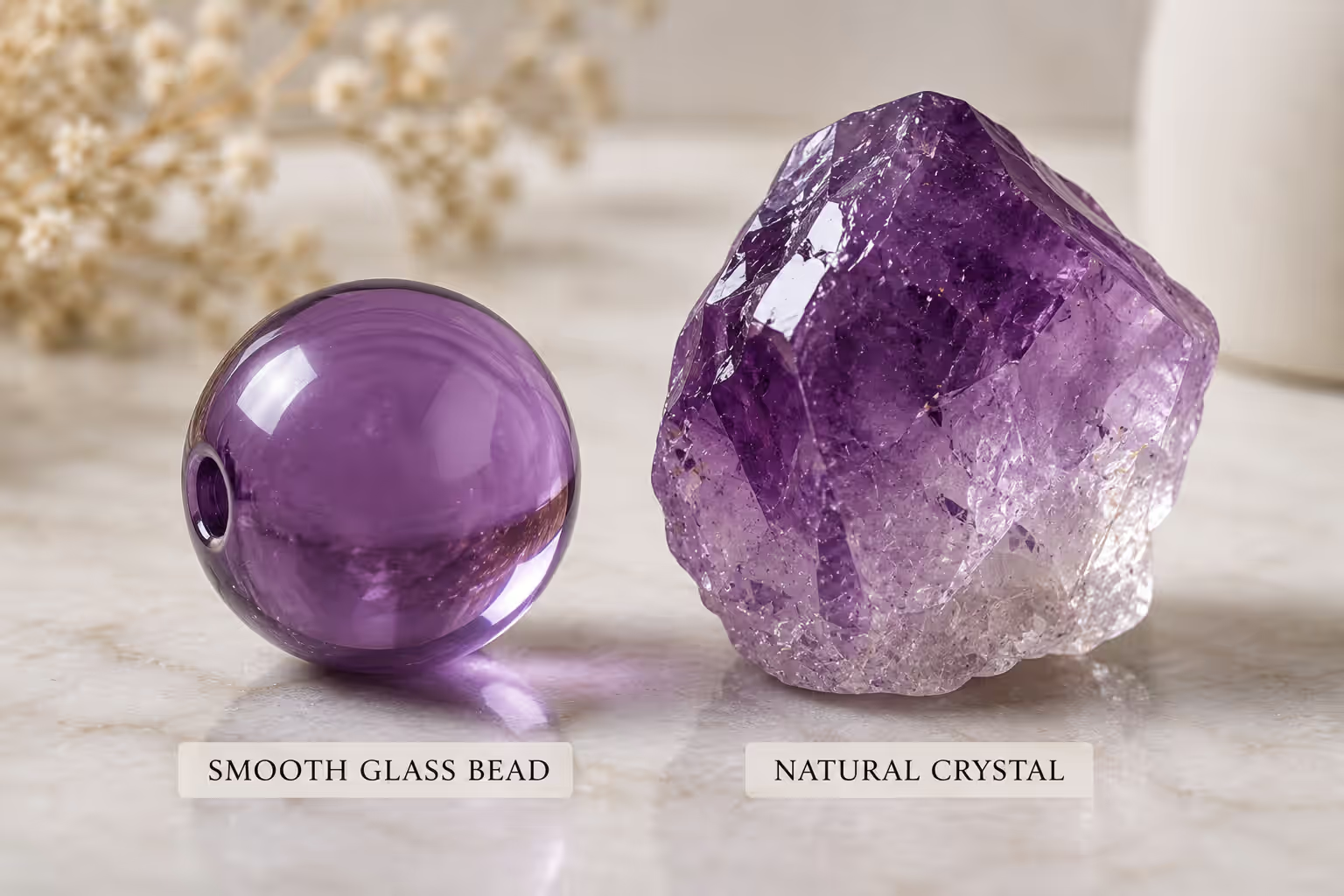
Glass vs Crystal: Key Differences & How to Choose
Glass vs crystal sounds like a simple comparison until the word “crystal” is defined. In mineralogy and gemology, a crystal is a solid whose atoms are arranged with long-range structural order. Ordinary manufactured glass is generally amorphous, meaning it lacks the repeating long-range atomic arrangement characteristic of crystalline solids. Yet everyday language complicates that distinction: “crystal” may refer to a natural mineral specimen, a faceted gemstone, a laboratory-grown crystal, or even “crystal glass” used for decorative glassware. Crystal glass is still glass, while synthetic quartz or synthetic sapphire is crystalline even though it was produced by people.
That structural distinction is the starting point, not an instant home test. Manufactured glass can imitate gemstone color, transparency, chatoyancy, banding, or other visual features surprisingly well. GIA describes glass as a long-established and still-common gem imitation because manufacturers can produce it in virtually any color and adapt it to resemble many natural gems. At the same time, natural glasses such as obsidian and moldavite exist, while genuine crystalline materials can be grown synthetically. The useful question is therefore not simply “natural or fake?” but “What material is this object actually made from, and what evidence supports that identification?”
This page owns that practical glass vs crystal decision. It compares structure, visual clues, testing, durability, treatments, care, and value without turning into a full reference for every possible mineral. Readers working through broader comparison problems can use the Identification category for related material-specific guides.
Glass vs Crystal at a Glance
| Question | Glass | Crystal or crystalline gem |
|---|---|---|
| Atomic structure | Usually amorphous, without long-range periodic order | Long-range ordered crystal structure |
| Natural or manufactured? | Can be natural or manufactured, though jewelry imitations are often manufactured | Can be natural or laboratory-grown |
| Color range | Can be manufactured in almost any color | Depends on mineral chemistry, defects, inclusions, and treatments |
| Common visual clues | Rounded bubbles, flow structures, mold features, unusually uniform color in some products | Growth structures, mineral inclusions, cleavage or fracture features depending on species |
| Are bubbles definitive? | Rounded gas bubbles can strongly support glass identification | Some crystals contain fluid inclusions with gas bubbles, so context matters |
| Refractive index | Varies with glass composition | Varies by mineral species |
| Hardness | Variable; common jewelry glass is not universally harder or softer than every crystal | Ranges from very soft crystals to diamond |
| Optical character | Many glasses are isotropic, though strain effects can complicate observations | Depends on crystal system; may be singly or doubly refractive |
| Treatment possibilities | Coloring, coatings, foils, fusion, backing, assembly, surface effects | Heat, dyeing, filling, diffusion, irradiation, coatings, impregnation and other processes depending on material |
| Value | May be inexpensive imitation or valuable art/collectible glass | Can range from very inexpensive common crystals to rare high-value gems |
| Best identification approach | Combine microscopy and measured properties | Combine the same tests with mineral-specific expectations |
| Can appearance alone decide? | Often no | Often no |
The most important glass vs crystal rule is that no single casual clue works universally. A bubble can be highly informative, but not every glass contains visible bubbles. A natural crystal can be exceptionally clean, while a manufactured material can contain convincing inclusions. A serious identification uses multiple independent observations.
What “Crystal” Means in This Comparison
For gemstone identification, crystal should primarily mean a crystalline mineral or gem material. Quartz, corundum, beryl, spinel, tourmaline, fluorite, calcite, topaz, and many other familiar gems have ordered crystal structures. Their chemistry and crystal symmetry create characteristic physical and optical properties that gemologists can measure.
The term should not be confused with “crystal glass.” Lead crystal and other decorative crystal glass products are types of glass formulated for particular optical, working, or decorative qualities. Government manufacturing guidance explicitly describes lead glass as glass made using lead compounds and used for tableware, decorations, and specialist products. Calling such an object “crystal” in the glassware market does not turn its atomic structure into that of quartz or another mineral crystal.
Likewise, “man-made” does not automatically mean glass. Laboratory-grown ruby, sapphire, spinel, quartz, and other synthetic gems are real crystalline materials with essentially the same basic chemical composition and crystal structure as their natural counterparts. GIA distinguishes these synthetic gems from simulants such as glass, which merely imitate another material’s appearance.
The Structural Difference: Ordered Crystal vs Amorphous Glass
A crystalline solid contains a repeating long-range arrangement of atoms. That ordering is fundamental to properties such as crystal symmetry, cleavage, birefringence, and X-ray diffraction behavior. An amorphous material lacks that three-dimensional long-range periodic order, even though atoms may still have local short-range organization. Glass belongs broadly to this amorphous category.
This difference is invisible to the unaided eye. A perfectly polished glass sphere does not look “structurally random,” and a faceted quartz gemstone does not visibly display its atomic lattice. Structure reveals itself indirectly through physical and optical behavior or directly through laboratory techniques.
That is why glass vs crystal cannot be reliably settled by statements such as “crystal feels more energetic,” “glass looks too perfect,” or “real crystal has to contain flaws.” None of those establishes atomic structure.
Visual Clues: What You Can See Before Testing
Visual examination remains useful because manufactured glass often develops characteristic features during melting, cooling, shaping, joining, or polishing. Rounded gas bubbles are among the classic clues. Flow lines or swirled structures may reflect movement within molten glass, while mold seams, surface dimples, internal fusion boundaries, or exceptionally homogeneous color can provide additional evidence depending on the object.
GIA case studies repeatedly demonstrate the usefulness of such features. Artificial glass fashioned to resemble Paraíba-type tourmaline showed gas bubbles, flow structure, and boundaries between fused glass types. Another greenish-blue glass imitation of gem silica contained numerous bubbles and surface dimples.
Yet none of those observations means that every bubble automatically proves glass. Natural gemstones can contain fluid inclusions in which a gas bubble is trapped within liquid, and synthetic crystal growth can create its own internal features. The shape, distribution, movement, surrounding cavity, and broader inclusion scene all matter.
Why “Bubbles Mean Fake” Is Too Simple
A free-looking, perfectly rounded gas bubble suspended directly in a homogeneous body can be a strong glass clue. Multiple spherical bubbles of different sizes combined with flow lines make the inference stronger. But an inclusion consisting of liquid plus a movable bubble inside a crystal-shaped negative cavity is a different structure entirely.
This is why microscopy is valuable. It lets the examiner see whether the bubble appears to occupy glass directly or belongs to a multi-phase inclusion enclosed by a crystalline host. Experienced gemologists interpret inclusion relationships rather than checking a one-word box marked “bubble.”
A similar principle applies to the broader methods in How to Identify Crystals: individual clues become more reliable when they agree with independent properties.
Perfect Clarity Does Not Prove Glass
Another common glass vs crystal myth is that genuine crystals always have obvious inclusions. Some natural stones are remarkably clean, particularly in small sizes, while laboratory-grown crystals can also be extremely transparent. Conversely, manufactured glass can deliberately contain bubbles, metallic platelets, swirls, or other effects designed to resemble natural inclusions.
GIA has documented manufactured glass containing metallic copper crystals and gas bubbles specifically shaped to imitate high-value natural tourmaline. A visual impression of “natural-looking inclusions” was therefore not enough to establish natural crystal identity.
Clarity is a quality observation, not an origin test.
Flow Lines, Curved Features, and Internal Texture
Flow structure can be especially helpful when comparing glass vs crystal. Molten material can develop curved, wispy, or directional structures during movement and cooling. Some manufactured synthetic crystals also show curved growth features depending on production method, so the interpretation again depends on the candidate material rather than a universal rule.
Natural crystals tend to preserve growth features related to their ordered crystal structure. These can include straight or angular color zoning, mineral inclusions, growth tubes, healed fractures, or other species-specific features. The exact patterns differ between quartz, beryl, corundum, tourmaline, fluorite, feldspar, and other minerals.
A broad comparison such as Fluorite vs Amethyst illustrates why the candidate minerals themselves need to be known before visual features are interpreted.
Refractive Index Is More Useful Than Guessing From Sparkle
A refractometer can substantially improve a glass vs crystal identification because different materials interact with light in characteristic measurable ways. However, there is no single universal refractive index for all glass, just as there is no single refractive index for all crystals. Glass composition can vary, while different minerals have different optical constants.
This means the correct method is not “glass always reads X.” Instead, measure the sample and compare the result with the expected range for the suspected material. In one GIA investigation, artificial glass shaped to imitate tourmaline showed an RI around 1.50, which ruled out the claimed tourmaline. Another glass imitation of gem silica gave an RI around 1.48, compared with approximately 1.54 for the target chalcedony material.
A refractive index is powerful evidence when it matches the testing method and specimen geometry. It is not an identification by itself if several candidate materials share overlapping ranges.
Single and Double Refraction
Many common glasses are optically isotropic, meaning they usually show a single refractive behavior rather than the double refraction displayed by many non-cubic crystals. A polariscope can therefore help separate glass from certain crystalline gems.
The limitation is important: cubic crystals such as spinel and garnet are also normally singly refractive. Glass can additionally show anomalous strain effects. Therefore, “single refraction” cannot simply be translated into “glass.”
The examiner must combine optic character with refractive index, inclusions, density, spectroscopy, and other tests appropriate to the suspected material.
Specific Gravity: Useful, but Never Universal
Specific gravity measures density relative to water and can provide another independent comparison. As with refractive index, manufactured glasses span different compositions and therefore different densities. Natural crystals span an even wider range.
A hydrostatic measurement may quickly expose a mismatch between a claimed gemstone and the actual object. GIA’s artificial blue-amber case, for example, found a density around 2.50 for the glass imitation compared with the much lower density expected for amber. The mismatch was a major clue before spectroscopy confirmed the glass identification.
For glass vs crystal, the principle is simple: measure first, then compare with the expected candidate material. Do not use a memorized “glass density” as though all glass compositions were identical.
Hardness: One of the Most Misused Tests
People frequently claim that crystal is always harder than glass. That is false because “crystal” includes minerals spanning a huge hardness range. Quartz at Mohs 7 will generally resist scratching better than common window-type glass, but calcite at Mohs 3 and gypsum at Mohs 2 are crystalline yet much softer.
A scratch test is also destructive and poorly suited to finished jewelry or polished collector pieces. Testing a polished object against another material can create a permanent scratch on either surface and still produce an ambiguous result if technique is poor.
Use published hardness as supporting information after identification rather than deliberately damaging a valuable object to discover what it is.
Glass Can Be Natural
The glass vs crystal distinction is structural, not synonymous with manufactured versus natural. Obsidian is natural volcanic glass. Moldavite is natural impact-related glass. Both lack the long-range crystalline structure typical of mineral crystals while forming through natural geological events.
This matters because “glass” should not automatically be translated into “fake.” A natural glass specimen can be geologically genuine and collectible. The term “imitation glass” specifically refers to glass being used to represent a different material.
GIA notes that both manufactured and naturally occurring glasses are used as gems and that laboratory methods such as FTIR can help distinguish different glass types when necessary.
Crystal Can Be Synthetic
The reverse is equally important. Synthetic quartz is crystal. Synthetic ruby is crystal. Synthetic sapphire is crystal. These materials are grown by people but reproduce the fundamental composition and crystal structure of their natural counterparts closely enough to be classified as synthetic versions of those gems rather than mere imitations.
A glass ruby imitation, by contrast, only resembles ruby visually. It does not share corundum’s crystal structure and composition.
This distinction becomes essential during buying. “Natural,” “synthetic,” “imitation,” “assembled,” and “treated” describe different things and should not be used interchangeably.
Treatments Are Not the Same as Glass Imitation
A natural or synthetic crystal can also be treated. Heat, irradiation, diffusion, dyeing, fracture filling, impregnation, coatings, and other processes may alter appearance or durability depending on the material. An object does not become glass merely because it has been treated.
Conversely, manufactured glass itself may be colored, coated, foil-backed, fused from different glasses, or combined with other materials to imitate a gem. The mapped Gemstone Treatments Explained guide covers the broader distinction between treatment and material identity.
The practical sequence should be: identify the base material first, then evaluate whether it is natural or synthetic where relevant, and then determine treatment or assembly status.
Doublets and Triplets Complicate the Comparison
An object can contain both crystal and glass. Doublets and triplets are assembled gems made from two or more joined layers, and some use natural material together with glass, plastic, synthetic material, or other components. A natural-looking crown therefore does not prove that the entire stone is one natural crystal.
GIA documents assembled stones in which different components are cemented or fused specifically to imitate higher-value gems. The mapped Gemstone Doublets and Triplets guide covers this construction problem in detail.
Immersion, microscopy, fluorescence, and examination around the girdle can reveal join planes in some assembled stones, but subtle constructions can require laboratory confirmation.
Dyed Glass, Dyed Crystal, and Color Evidence
Color by itself is among the weakest glass vs crystal tests. Manufactured glass can be formulated in almost any hue, and natural gem materials can also be dyed or otherwise color-treated.
A uniformly saturated color may raise questions, particularly when the candidate natural stone is normally more variable, but uniformity is not proof. Some natural crystals genuinely show even color, and some sophisticated glass imitations reproduce zoning and inclusions.
Readers evaluating suspicious color should separate material identity from treatment using the framework in How to Spot Dyed Crystals. Dye concentrations along fractures, drill holes, porous zones, or surface-reaching features can be informative, but their meaning depends on the material.
“Cold to the Touch” Is Not a Reliable Test
A popular home test claims that real crystal stays cold while glass warms quickly. Thermal sensation depends on the object’s mass, thickness, starting temperature, surface finish, thermal conductivity, room conditions, and how long it is held.
A thick glass sphere can feel colder than a small mineral bead simply because it contains more cool material. A stone left in sunlight can feel warm regardless of authenticity.
Touch can describe a subjective experience, but it is not an adequate identification method.
The Sound Test Is Mainly a Glassware Issue
Another claim says crystal “rings” while glass produces a dull sound. This may have some relevance when comparing particular types of tableware, where composition, wall thickness, shape, and construction influence resonance. It is not a useful general test for distinguishing a polished mineral crystal from glass jewelry.
A quartz cabochon and a glass cabochon are not wine glasses engineered to resonate. Striking gemstones together can also chip them.
For gem identification, optical and physical measurements are safer and more meaningful.
Original Information Gain: Glass vs Crystal Decision Matrix
The following matrix translates common real-world observations into appropriate next steps instead of forcing a premature yes-or-no conclusion.
| Observation or situation | Glass becomes more plausible when… | Crystal becomes more plausible when… | Best next check | Confidence from this clue alone |
|---|---|---|---|---|
| Rounded internal bubbles | Multiple free spherical bubbles occur throughout a homogeneous body | Bubble occurs inside a structured fluid inclusion or cavity | Microscopy | Medium |
| Flow or swirl lines | Curved internal flow structures accompany bubbles or uniform material | Straight/angular growth zoning matches a candidate mineral | Microscopy + RI | Medium |
| Perfect transparency | Not diagnostic | Not diagnostic | RI and optic character | Very low |
| Strong uniform color | Manufactured color is plausible | Candidate mineral commonly occurs evenly colored | Spectroscopy/microscopy | Low |
| Mold seam | Clearly associated with formed object | Generally inconsistent with a naturally crystallized loose gem | Surface microscopy | High for molded glass object |
| RI does not match claimed crystal | Strongly supports alternative identity, including possible glass | — | Repeat RI, then additional tests | High |
| RI matches candidate crystal | Some glasses may overlap | Supports candidate when other properties agree | SG + optic tests | Medium |
| Single refraction | Many glasses are singly refractive | Cubic crystals are also singly refractive | RI + microscopy | Low |
| Double refraction | Ordinary glass becomes less likely | Supports many non-cubic crystals | Polariscope/refractometer | Medium |
| Easy scratching | Could fit some glass | Could also fit soft crystals | Avoid destructive testing; identify material first | Low |
| Strong heft | Composition-dependent | Many minerals are dense | Specific gravity | Low |
| “Natural flaws” | Glass can contain intentional or accidental features | Natural crystals can contain genuine inclusions | Microscopy | Low |
| Seller says “crystal” | Could mean decorative glass | Could mean mineral crystal | Ask for exact material name | None |
| Certificate supplied | May identify material accurately or inaccurately depending on issuer/report | Same | Verify issuer and report details | Depends on report |
| High price | Art glass can be valuable | Rare crystals can be valuable | Identify first, value second | None |
The strongest decisions emerge when several independent tests point in the same direction. One visual clue creates a hypothesis; a consistent RI, density, optical response, and microscopic scene can turn that hypothesis into a defensible identification.
Original Same-Lighting Photo Comparison Protocol
When comparing glass vs crystal from photographs, use a controlled image set rather than comparing unrelated seller images. Photograph both objects against the same neutral gray background, under the same diffused light, from the same camera distance and angle. Include a scale reference outside the gem area, then capture reflected light, transmitted light, and a magnified view.
Do not increase saturation on one object or use a black background for only one sample. Keep white balance fixed. Photograph both dry unless surface wetting is itself being investigated. Rotate each specimen through several angles because bubbles, fractures, flow lines, and growth features can disappear at one orientation and become obvious at another.
A photograph still cannot replace laboratory testing, but consistent imaging removes several avoidable sources of false comparison.
Durability: Glass Is Not Automatically More Fragile
Durability comparisons must be material-specific. Common decorative glass can scratch, chip, or abrade during wear, but some specialized glasses are engineered for substantial mechanical strength. Meanwhile, crystalline minerals range from extremely soft and fragile to exceptionally durable.
A quartz crystal at Mohs 7 will normally offer better scratch resistance than many ordinary decorative glasses, while a gypsum crystal will not. Cleavage can make a hard crystal vulnerable to impact even when its surface resists scratching well.
For buying decisions, do not use the single statement “crystal is stronger.” Ask whether the actual concern is scratching, chipping, cleavage, impact, heat, chemicals, or treatment stability.
Jewelry Wear: The Setting Matters
A loose faceted glass imitation may perform adequately in earrings or occasional-wear pendants while showing abrasion much faster in an exposed daily-wear ring. A genuine mineral crystal may likewise be unsuitable for rings if it is soft, cleavable, highly fractured, or sensitive to normal jewelry conditions.
The setting can reduce or amplify those risks. Bezels protect edges, high prong settings expose them, and bracelets experience more impacts than earrings. Drilled glass beads may chip around holes, while crystalline beads can fail along cleavage or fracture zones.
The word crystal therefore cannot establish wearability without naming the mineral.
Care and Cleaning
Warm water, mild soap, and a soft cloth are often the conservative starting point for uncomplicated glass and many stable gemstones, but the correct method depends on treatments, coatings, fracture filling, adhesives, surface decorations, porosity, and the setting.
Ultrasonic or steam cleaning should never be approved simply because an object is called crystal. An assembled stone may contain cement. A fracture-filled crystal may have special restrictions. Decorated glass may carry coatings or foil that should not be aggressively cleaned.
Identify the construction before choosing the cleaning method.
Value: Crystal Is Not Automatically More Valuable
A cheap quartz tumble can cost less than a signed piece of collectible art glass. A mass-produced synthetic crystal can cost less than a historically significant antique glass object. Conversely, fine natural gemstones can be worth dramatically more than visually similar glass imitations.
Material identity is therefore only one component of value. Natural origin, rarity, color, clarity, size, cutting, treatment status, workmanship, brand, provenance, artistic authorship, age, condition, and market demand all contribute.
The useful glass vs crystal buying question is: “Am I paying for the material claimed?” A glass object fairly sold as decorative glass can be an entirely legitimate purchase. The problem arises when glass is represented as a materially different and more valuable gem.
Decision Case: A Cheap “Amethyst Crystal” Pendant
Suppose a vivid purple pendant is inexpensive, nearly flawless, and contains several rounded bubbles. Those observations make manufactured glass plausible, but price and clarity alone do not establish it.
Under magnification, free spherical bubbles and curved flow lines would increase confidence. A measured refractive index inconsistent with quartz would strengthen the case substantially. If the object instead shows quartz-like RI, crystalline optical behavior, and mineral-consistent inclusions, the initial visual suspicion may be wrong.
A targeted comparison such as Heliodor vs Citrine demonstrates the same principle in another color family: visual color is the beginning of identification, not its conclusion.
Decision Case: A Clear Sphere Sold as “Natural Crystal”
The description is incomplete because “crystal” does not specify the mineral. The first buying question should be: natural crystal of what? Quartz? Calcite? Fluorite? Glass sold under decorative terminology?
If the seller cannot name the material, certainty should remain low. A transparent sphere also removes many external crystal-shape clues during polishing, making physical and optical tests more important.
The mapped Clear Quartz vs Selenite comparison illustrates why two materials casually sold as clear or white “crystals” can have substantially different mineral properties.
Decision Case: A Blue-Green Stone With Bubbles
A blue-green cabochon may be glass, natural crystal, chalcedony, an aggregate mineral, treated material, or an assembled product. Numerous perfectly rounded bubbles strongly raise the probability of glass, especially if the color is unusually uniform.
GIA’s documented gem-silica imitation case shows why this matters: greenish-blue glass looked convincing enough to be sold as natural mine material, but microscopic bubbles and measured gemological properties exposed the imitation.
The correct response is not “all blue-green cabochons with bubbles are fake,” but “this inclusion pattern justifies further material testing.”
Fake, Synthetic, Imitation, and Misidentified Are Different
The word fake can blur several distinct categories. A synthetic sapphire is not glass and is not structurally fake sapphire; it is laboratory-grown corundum and must be disclosed as synthetic. A blue glass object may be an imitation sapphire because it resembles sapphire while having different composition and structure. A natural blue spinel sold mistakenly as sapphire is a misidentification, not a synthetic gem.
The mapped How to Spot Fake Crystals guide expands these categories. Keeping terminology precise helps readers understand what testing has actually established.
Laboratory Reports: What They Can Resolve
A qualified gem laboratory can often determine whether a submitted stone is glass or crystalline material and may identify the specific gem species. Depending on the material and requested service, further testing can address natural versus synthetic origin and detectable treatments.
Gemological laboratories combine observations rather than relying on one consumer test. Refractive index, specific gravity, microscopy, spectroscopy, fluorescence, polarized light, Raman analysis, FTIR, and other methods may be used as appropriate. GIA case reports show glass identifications confirmed through combinations of standard gemological testing, microscopy, Raman analysis, and FTIR.
Readers interpreting documentation should use How to Read a Gem Lab Report and distinguish a material-identification report from an appraisal.
Certification Language Needs Care
“Certified crystal” is not automatically meaningful unless the certifying body, report type, specimen identity, and test conclusions are clear. Some sellers use the word certificate for an in-house card that provides little independent evidence.
Independent laboratory documentation can materially reduce uncertainty, but even a genuine report should be read for what it actually says. A report identifying “natural quartz” answers a different question from one providing geographic origin, treatment detection, or monetary valuation.
The mapped Gemstone Certification guide covers that evidence hierarchy in more detail.
When Visual Comparison Is Insufficient
Visual inspection becomes inadequate when the materials overlap closely, the object is valuable, treatment could affect interpretation, the stone is mounted, or the consequences of a wrong identification are significant. The absence of visible bubbles cannot prove crystal. A crystal-like external shape cannot prove crystalline structure either: GIA has documented manufactured glass deliberately shaped into convincing prism-like “crystals.”
Testing is particularly justified when a seller makes a high-value natural-origin claim, when an insurance or estate decision depends on the result, or when a specimen is being scientifically cataloged.
Appropriate uncertainty is preferable to a confident visual guess.
What a Lab Cannot Decide for You
A laboratory can establish material facts, but it does not automatically answer every buying question. Identification as natural quartz does not prove the asking price is reasonable. Confirmation of glass does not mean the object lacks artistic or collectible value. A laboratory also cannot reconstruct missing ownership history merely from composition.
Value still depends on market context, craftsmanship, provenance, condition, rarity, and what is being sold. Identification narrows the problem; it does not replace judgment.
Common Glass vs Crystal Myths
| Claim | Better interpretation |
|---|---|
| “Glass always has bubbles.” | Some glass has diagnostic bubbles, but other glass can be very clean |
| “Real crystals always have inclusions.” | Some natural crystals are exceptionally clean |
| “Crystal is always harder than glass.” | Hardness depends on the specific mineral and glass composition |
| “Glass is always fake.” | Natural glasses exist, and decorative glass can be honestly sold as glass |
| “Man-made means glass.” | Synthetic gemstones can be genuine crystalline materials |
| “A cold stone is real crystal.” | Temperature sensation is not a reliable material test |
| “Crystal rings when tapped.” | Sound is not a dependable gemstone-identification method |
| “A certificate proves everything.” | It proves only what a competent report actually tested and concluded |
| “High price means natural crystal.” | Price alone provides no material identification |
| “A crystal-shaped object must be crystalline.” | Glass can be molded, cut, or polished into crystal-like shapes |
A Practical Buying Workflow
Before buying, ask for the exact material name rather than accepting “crystal” as a complete description. Ask whether the stone is natural, synthetic, imitation, treated, assembled, or unknown where those distinctions matter. Examine photographs for bubbles, flow structures, mold marks, joins, unusual color concentrations, and other clues without assuming any single feature settles the question.
For a low-cost decorative purchase, uncertainty may be acceptable if the listing is honest. For an expensive stone, rare-material claim, investment-like sales pitch, important gift, or collector specimen, the evidence requirement should rise accordingly.
The process is simple: description → visual examination → measured properties → laboratory confirmation when stakes justify it.
Evidence and Reader Limits
This article uses published gemological and materials-science information and does not claim first-hand testing of a reader’s glass, gemstone, bead, sphere, jewelry piece, or mineral specimen. The site’s broader editorial scope is described on About Gems Lore.
Material identification from photos has unavoidable limits. Lighting, editing, mounting, polish, specimen thickness, camera optics, and incomplete views can hide or mimic diagnostic features. The site-wide evidence and safety boundaries are stated in the Gems Lore Disclaimer.
Readers with documented corrections or technically useful evidence can submit it through Contact Gems Lore. Information submitted through site channels is handled under the Privacy Policy.
Frequently Asked Questions About Glass vs Crystal
What is the main difference between glass and crystal?
In the mineralogical sense, the main glass vs crystal difference is atomic structure. Ordinary glass is amorphous and lacks long-range periodic order, while a crystal has an ordered repeating structure. The everyday word “crystal” can also refer to crystal glass, so context matters.
Is crystal always natural?
No. Laboratory-grown quartz, sapphire, ruby, spinel, and other materials are synthetic crystals. They are crystalline but produced by people.
Is glass always man-made?
No. Obsidian and moldavite are natural glasses. Manufactured glass is common in gemstone imitation, but “glass” itself describes material structure rather than automatically describing human manufacture.
How can I tell glass from crystal at home?
Begin with non-destructive observations such as bubbles, flow lines, seams, internal structures, and seller disclosure, but do not expect a single home test to be definitive. Reliable separation may require refractive-index measurements, microscopy, specific gravity, optical testing, spectroscopy, or laboratory analysis.
Do bubbles always mean a stone is glass?
No. Free rounded gas bubbles can strongly suggest manufactured glass, particularly when combined with flow structure, but natural and synthetic crystals can contain fluid inclusions that include gas bubbles. Microscopic context matters.
Does glass scratch more easily than crystal?
Not universally. Common glass is softer than quartz, but many crystalline minerals such as calcite and gypsum are softer than common glass. The exact materials must be compared.
Can glass look exactly like a gemstone?
It can look extremely convincing. GIA documents glass used to imitate numerous gemstones and even phenomenal materials, which is why visual appearance alone may be insufficient.
Is lead crystal actually a crystal?
In tableware terminology, lead crystal is a type of lead-containing glass. The commercial word “crystal” in that context is not the same as the mineralogical meaning of a crystalline solid.
Is synthetic crystal the same as glass?
No. A synthetic gem crystal has an ordered crystalline structure and substantially the same basic composition and structure as its natural counterpart. Glass is generally amorphous.
Can refractive index separate glass from crystal?
Often, but only when interpreted against a specific candidate material. Glasses have variable refractive indices, and crystals also span many values. A mismatch with the claimed gemstone can be highly informative.
Can a laboratory tell if something is glass?
Yes. Standard gemological testing and, when needed, techniques such as Raman spectroscopy or FTIR can identify many glass imitations and distinguish them from crystalline gems.
Is a flawless stone more likely to be glass?
Not necessarily. Natural gems can be very clean, synthetic crystals can be extremely clean, and glass can contain intentionally created inclusions. Flawlessness is not a reliable origin test.
Which is worth more, glass or crystal?
Neither category is automatically more valuable. Fine natural gemstones may be far more valuable than ordinary glass, but collectible antique or studio glass can be worth more than common quartz or inexpensive synthetic crystals. Identity, rarity, workmanship, provenance, condition, and market demand all matter.
Should I scratch a stone to see if it is glass?
Not on a finished or valuable object. Scratch tests can permanently damage the sample and may still produce ambiguous results. Non-destructive gemological testing is preferable.
What should I ask a seller who lists an item simply as “crystal”?
Ask for the exact material identity, whether it is natural or laboratory-grown, whether it has treatments, and whether any independent report supports the description. “Crystal” alone is too broad to establish what you are buying.
Final Perspective
Glass vs crystal is not reliably solved by sparkle, temperature, price, perfection, or one visible bubble. The fundamental distinction is structural: glass is generally amorphous, while crystalline materials possess long-range atomic order. But natural glasses, synthetic crystals, decorative crystal glass, treatments, and assembled stones make everyday labels much more complicated than that definition alone suggests.
The strongest identification combines evidence. Microscopy may reveal gas bubbles, flow structures, joins, or crystal-growth features. Refractive index and specific gravity can test whether the object behaves like the claimed material. Optical testing can determine whether its behavior is compatible with a candidate crystal, while spectroscopy or laboratory analysis can resolve cases that remain ambiguous. GIA’s documented glass imitations repeatedly show why objects that look convincing to the eye can still be separated through measured properties.
For a low-cost decorative object, an honest description may be enough. For an expensive gemstone, rare-crystal claim, estate item, or collector specimen, require evidence proportional to the financial and scientific stakes. In glass vs crystal identification, the most reliable choice is not the material that “looks more real,” but the conclusion supported by the greatest number of consistent observations.