

Learning how to charge crystals is less about finding one mandatory ritual and more about choosing a symbolic practice that respects the physical mineral in front of you. Moonlight, intention, visualization, sound and careful placement near another meaningful stone are among the lowest-risk approaches because they do not require soaking, salt, heat or prolonged sunlight.
In contemporary crystal traditions, charging usually means dedicating a stone to a purpose, refreshing its symbolic role or reconnecting it with an intention. Some practitioners describe this as restoring energy. Scientifically, however, there is no established evidence that crystals become spiritually depleted and then regain a measurable form of metaphysical energy through charging.
That distinction matters because the safest way to learn how to charge crystals is to keep spiritual ritual separate from mineral care. Amethyst can fade after excessive strong light, selenite is vulnerable to water, malachite should not be soaked, and some jewelry contains dyes, fillers, glue or delicate metalwork. A ritual should never damage the object it is intended to honor.
How to Charge Crystals at a Glance
| Charging method | Suitable as a general method? | Main consideration |
|---|---|---|
| Intention | Yes | No physical exposure |
| Visualization | Yes | Safe for fragile and treated stones |
| Sound | Usually | Avoid hard physical contact or strong vibration |
| Indoor moonlight | Usually | Keep stones dry and secure |
| Clear quartz nearby | Usually | Prevent scratching and chipping |
| Selenite nearby | Usually | Selenite itself is soft and water-sensitive |
| Gentle indirect daylight | Sometimes | Color stability varies |
| Direct sunlight | Not universal | Can fade or heat some materials |
| Water | Not a charging requirement | Many stones and jewelry components should not be soaked |
| Salt | Best avoided as a default | Can abrade, corrode or lodge in fractures |
| Soil burial | Usually unnecessary | Moisture, loss, contamination and damage risks |
| Smoke | Optional with precautions | Residue, ventilation, fire and respiratory concerns |
For a mixed collection, intention, visualization, sound and protected indoor moonlight are the most broadly adaptable options.
What Does Charging a Crystal Mean?
Before learning how to charge crystals, it helps to distinguish charging from cleansing.
In modern crystal practice, cleansing usually means symbolically releasing earlier associations, preparing a crystal for a new purpose or marking a transition.
Charging usually means connecting the crystal with an intention, value, practice or symbolic purpose.
For example, someone may cleanse a smoky quartz stone when beginning a new routine and then charge it with the intention to pause and examine facts before making stressful decisions.
Nothing measurable needs to change inside the quartz for that ritual to carry personal meaning.
The crystal can simply become associated with a particular behavior.
This is different from physical cleaning. Dust, skin oil, cosmetics and dirt require appropriate material care rather than moonlight, sound or visualization.
If a crystal needs both physical cleaning and a spiritual ritual, clean it safely first and charge it afterward.
Do Crystals Run Out of Energy?
A common reason people search for how to charge crystals is the belief that a stone has stopped working or has “run out” of energy.
There is no established scientific evidence that crystals contain a reservoir of metaphysical energy that becomes depleted through ordinary handling, meditation, jewelry wear or exposure to another person’s emotions.
Quartz does not become less quartz after a difficult day.
Amethyst does not lose its mineral properties because someone else touched it.
Hematite does not use up its iron-oxide structure while being carried as a grounding stone.
What can change is your relationship with the object.
A crystal may begin to feel ordinary because you have become accustomed to seeing it. Its original intention may no longer be relevant. Your circumstances may have changed. The stone may simply be dirty, damaged or sitting in a place where you no longer notice it.
Within spiritual practice, describing the crystal as “dull,” “heavy” or “depleted” can function as personal language for that experience. Charging can then act as a deliberate reset.
The important distinction is that this is a symbolic practice rather than evidence that a measurable energy supply has been exhausted.
Do You Need to Charge Crystals?
No physical law requires crystals to be spiritually charged.
Minerals remain minerals whether or not a ritual is performed.
You may nevertheless decide to charge a stone when:
you first begin using it,
you assign it a new purpose,
you return to a practice after a long break,
you want to mark a personal transition,
or the old association no longer feels useful.
There is no universal schedule.
If learning how to charge crystals starts creating anxiety about whether every stone has enough energy, simplify the practice. A crystal should support a meaningful routine rather than create another obligation.
Should You Cleanse Before Charging?
Many crystal traditions recommend cleansing before charging, but it is not compulsory.
The sequence makes symbolic sense when you want to mark a clear transition:
Cleanse: release the earlier association.
Charge: establish the new one.
Imagine that rose quartz previously represented recovering from a difficult relationship. Months later, you want it to represent maintaining healthy reciprocal relationships.
A cleansing ritual can mark the end of the first chapter, while charging establishes the new purpose.
When the same intention continues unchanged, there may be no reason to repeat both steps.
The important point is to avoid confusing spiritual cleansing with physical cleaning. The material-specific approach in how to cleanse crystals should always respect hardness, porosity, treatments and jewelry construction.
How to Charge Crystals With Intention
Intention is one of the safest and simplest answers to how to charge crystals.
It requires no water, salt, sunlight, smoke or contact with another mineral.
Place the crystal securely in front of you or hold it comfortably.
Choose one specific purpose.
Instead of:
“I charge this crystal with good energy,”
use something concrete such as:
“When I notice this stone, I will pause before answering when I am angry.”
“This crystal will remind me to complete one focused work session before checking distractions.”
“This stone represents my commitment to communicate the boundary clearly.”
Then decide where the crystal should go so that you encounter it when the intention matters.
The ritual can take thirty seconds or ten minutes. There is no scientifically required charging duration.
How to Charge Crystals With Visualization
Visualization works well for fragile crystals, valuable jewelry and stones whose treatment history is uncertain.
Place the crystal on a padded, stable surface.
Think about what the stone will represent.
Some practitioners imagine light surrounding the crystal. Others visualize the old purpose fading and the new one becoming associated with the object.
The color of the imagined light does not need to correspond with a chakra or gemstone.
You might visualize:
white light for a neutral reset,
green for growth symbolism,
blue for communication,
red for grounded action,
or no color at all.
The imagery is part of the personal ritual. It does not physically alter the crystal structure.
Visualization is particularly useful when deciding how to charge crystals that should not be exposed to water, salt, heat or excessive handling.
How to Charge Crystals in Moonlight
Moonlight is one of the most popular charging traditions because it requires little direct contact with the stone.
The safest version is indoor placement.
Put the crystal on a stable tray, cloth or lined windowsill where it cannot roll or fall. Leave it there for part of the evening or overnight, then return it to normal use.
Direct lunar exposure is not necessary.
Window glass does not prevent a symbolic moonlight ritual.
An indoor location also avoids dew, rain, dirt, wildlife, theft and sudden temperature changes.
Moonlight does not scientifically transfer measurable energy into minerals. The Moon’s phase instead provides a symbolic timing system that many practitioners find meaningful.
Does It Have to Be a Full Moon?
No.
If you are learning how to charge crystals, you do not need to wait for a full moon.
The full moon is popular in modern crystal practice because it symbolizes culmination, visibility and review.
The new moon is usually associated with beginnings, planning and new intentions. The crystals for the new moon guide treats those themes as symbolic prompts rather than claiming that lunar phases physically energize minerals.
Waxing phases may represent building or development.
Waning phases may represent reducing, releasing or completing.
You can also ignore lunar phases entirely and charge a crystal whenever you decide that the ritual would be useful.
How Long Should Crystals Charge in Moonlight?
There is no required duration.
A few minutes can be enough for an intention ritual.
An hour may suit a longer reflective practice.
Leaving a stone indoors overnight is also common.
Longer exposure does not mean stronger charging.
If the stone sits outdoors, additional time can actually create more risk from weather, moisture, animals and temperature variation.
When deciding how to charge crystals, duration should be based on the ritual and material safety rather than the assumption that a stone must absorb a fixed quantity of energy.
How to Charge Crystals With Sound
Sound is another broadly compatible option because it requires little or no physical contact.
Place the crystal securely on a padded surface.
Ring a bell, chime or singing bowl nearby.
You can also use a tuning fork, gentle music, humming, chanting or another sound that has personal meaning.
Several tones or a short period is enough.
Do not place fragile crystals inside a hard metal singing bowl and strike it.
Do not rest delicate crystal points against a vibrating surface.
The ritual does not become more effective because the sound is louder.
Sound is especially useful when learning how to charge crystals that are soft, porous, treated, glued or otherwise unsuitable for wet methods.
How to Charge Crystals With Clear Quartz
Clear quartz is commonly described in modern crystal traditions as an amplifier and charging stone.
If this symbolism fits your practice, place the crystal you want to charge near clear quartz.
Direct contact is unnecessary.
This is important physically because crystal hardness varies. Quartz has Mohs hardness 7 and can scratch softer materials such as fluorite, calcite and gypsum.
Even two quartz specimens can chip one another if sharp points strike polished surfaces.
Use separate pieces of soft cloth or leave a little space between the stones.
There is no established evidence that clear quartz transfers measurable metaphysical energy into another mineral. Its role is symbolic: clarity and amplification can represent making the chosen intention more explicit.
How to Charge Crystals With Selenite
Selenite is another popular companion stone for charging and cleansing rituals.
Place the target stone near a selenite wand, plate or specimen.
Avoid assuming that every crystal can safely be stacked directly on selenite.
Selenite is a form of gypsum and is very soft. A harder stone can scratch it easily, while thin pieces can chip or break.
Use a cloth between the specimens or leave space between them.
Keep selenite dry.
Do not rinse or soak the selenite simply because another crystal can tolerate water.
When deciding how to charge crystals with companion stones, the physical properties of both objects matter.
Can Amethyst Charge Other Crystals?
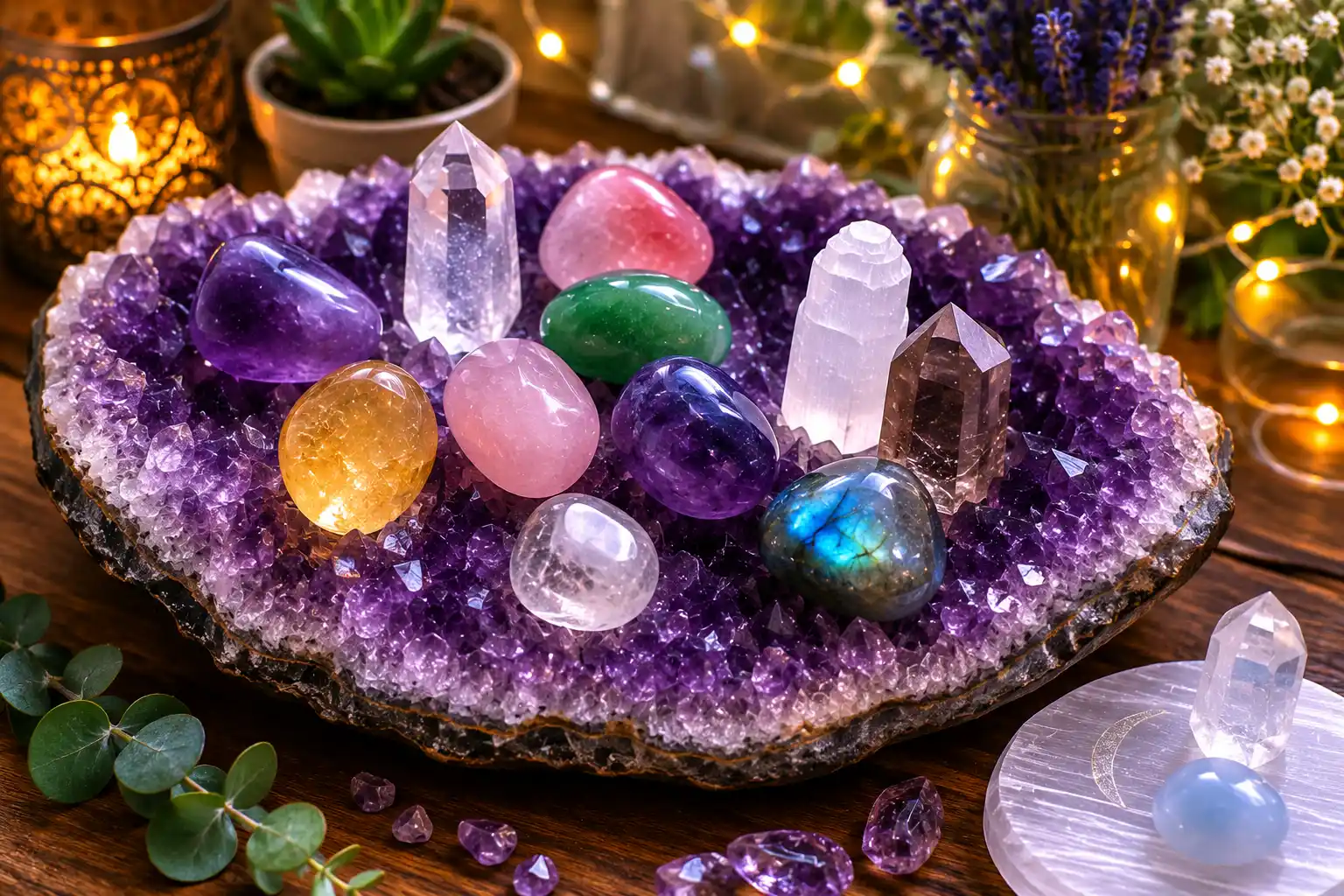
Some modern practices use amethyst clusters or geodes as symbolic charging surfaces.
This can be done carefully.
Place smaller stones nearby rather than wedging them between points.
Amethyst is quartz, so it can scratch softer minerals and may itself be chipped through repeated hard contact.
The same care principles apply to amethyst’s own charging. The how to cleanse and charge amethyst guide explains why moonlight and intention are preferable to prolonged intense sunlight for purple quartz.
Using amethyst as a charging companion is a spiritual convention, not evidence of measurable energy transfer.
Can You Charge Crystals in Sunlight?
Sometimes, but sunlight should never be the automatic answer to how to charge crystals.
Different minerals receive their colors from different trace elements, defects and structural mechanisms. Some colors can fade after prolonged strong illumination.
Amethyst is the classic example. Sustained intense light may gradually weaken its purple color.
Other stones may contain dyes, coatings, resins or fillers whose stability is less predictable.
Sunlight can also heat a crystal, setting or adhesive.
If sunlight is part of your ritual, brief indirect light is more conservative than leaving a mixed collection on a hot windowsill for hours.
A physically damaged stone is not spiritually better charged.
Which Crystals Should You Keep Out of Prolonged Sun?
Amethyst deserves particular caution because prolonged strong light can fade its purple color.
Some fluorite colors can also be light sensitive.
Dyed, irradiated, coated and treated material may have additional concerns.
Unknown stones should be treated conservatively.
Normal daily wear outdoors is different from deliberately placing a gemstone in strong direct sun for hours every day.
If you do not know how light-stable a specimen is, choose intention, sound or indoor moonlight instead.
Those options remove the need to gamble with color.
Can You Charge Crystals With Water?
Water is not necessary for charging.
It is more often used in cleansing rituals, and even then it is not suitable for every stone.
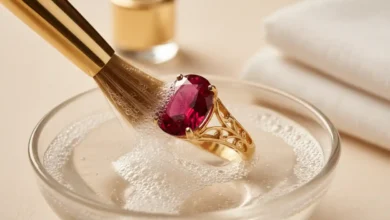
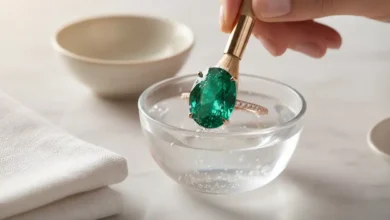
Some sound natural quartz varieties can tolerate a brief rinse. Other minerals may dissolve, oxidize, soften, flake or react poorly to prolonged moisture.
The crystals that can and cannot go in water guide explains why mineral identity, treatments and jewelry construction must be considered separately.
Selenite, calcite, fluorite, pyrite, malachite, turquoise and several other materials should not simply be placed into water because a ritual suggests it.
Most importantly, “safe for brief rinsing” does not mean “safe for drinking.”
Do not make direct crystal elixirs by soaking unidentified stones in water intended for consumption.
Should You Charge Crystals in Salt?
Salt is widely used in spiritual cleansing traditions, but direct salt contact is rarely necessary.
Dry salt crystals can be abrasive.
Salt can enter small fractures, drill holes and jewelry settings.
Saltwater creates additional corrosion and material-compatibility issues.
Soft or porous stones can be damaged.
Metal jewelry components may tarnish or corrode.
A ritual involving salt can be performed without placing the crystal directly into it. Keep the stone on a separate dish or cloth beside the salt if the symbolism matters to you.
When choosing how to charge crystals, low-contact methods usually achieve the same personal purpose with less physical risk.
Can You Charge Crystals by Burying Them in Earth?
Some traditions return crystals to soil as a grounding or renewal ritual.
This is usually unnecessary and carries practical risks.
Soil contains moisture, grit, salts, organic material and microorganisms.
A small stone can be lost.
Soft surfaces can be scratched.
Metal settings can corrode.
Fragile specimens may break during burial or retrieval.
Public parks, archaeological areas, protected land and someone else’s property also create legal and ethical concerns.
If Earth symbolism matters, place the crystal safely on a cloth beside a plant or natural object instead.
There is no need to bury a valuable mineral in order to establish a personal intention.
Can You Charge Crystals With Smoke?
Smoke from incense or herbs appears in many spiritual practices, but it should be used carefully.
Pass the stone briefly through cool smoke rather than holding it over flame.
Keep soot and resinous smoke away from porous materials and jewelry settings.
Ventilate the room.
Consider asthma, respiratory sensitivities, pets, smoke alarms and fire risk.
Do not burn culturally significant plants casually when the practice or material belongs to traditions you have not taken time to understand.
Sound or visualization provides a smoke-free alternative.
How to Charge Crystals for a Specific Intention
The clearest way to learn how to charge crystals is to make the intention specific.
Instead of “charge for love,” decide what part of relationships is within your control.
A rose quartz intention might be:
“I will communicate appreciation rather than assume the other person knows.”
Instead of “charge for money,” use:
“This green aventurine will remind me to review my spending before an unnecessary purchase.”
Instead of “charge for protection,” a black tourmaline intention might be:
“When this stone catches my attention, I will check whether I am ignoring a boundary.”
Instead of “charge for healing,” use:
“This stone will sit beside my medication organizer as a reminder to follow the care plan I already chose with my clinician.”
A precise association turns a vague ritual into something easier to apply.
How to Charge Crystals for Meditation
Choose one stone and one meditation purpose.
The surviving guide to crystals for meditation treats stones as symbolic or tactile focus objects rather than scientifically proven devices.
For example:
Amethyst can represent reflection.
Smoky quartz can represent grounding.
Clear quartz can represent a question.
Rose quartz can represent compassion.
Charge the stone by stating the meditation purpose, then place it where you normally practice.
You do not need to repeat the charging process before every session unless doing so helps mark the beginning of the routine.
How to Charge Crystals for a Crystal Grid
A crystal grid combines stones in a geometric arrangement around a symbolic intention.
Before arranging the stones, define one purpose for the entire grid.
Then decide whether individual stones have different roles.
For example, a creativity grid might use clear quartz to represent purpose, carnelian for action and fluorite for organization.
Charging can happen after the layout is complete by sitting with the arrangement, stating the intention and identifying the action connected with it.
The pattern itself has not been scientifically shown to generate an energy field.
Its practical value comes from turning an abstract intention into a visible arrangement.
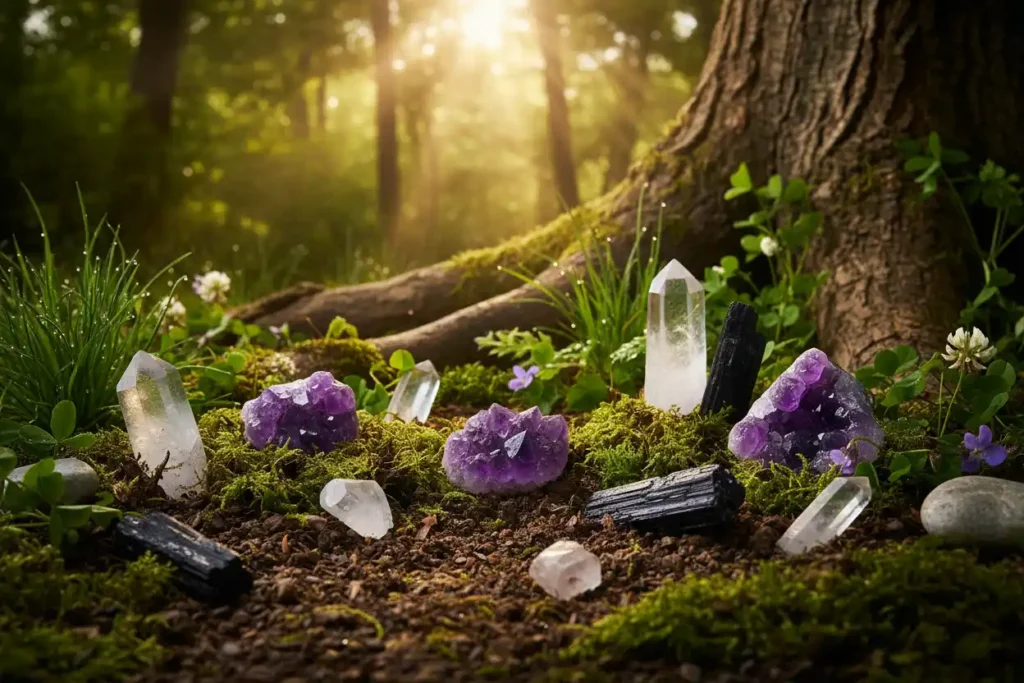
How Often Should You Charge Crystals?
There is no universal schedule.
Some people charge crystals when first acquiring them.
Others repeat a ritual monthly.
Some use lunar phases.
Others recharge only when changing the stone’s purpose.
If a crystal is associated with one stable habit and the association still feels clear, nothing requires you to interrupt that routine simply because a calendar date has arrived.
Learning how to charge crystals should make the practice simpler, not create fear that a stone stops functioning after a certain number of days.
A useful trigger is a change in purpose.
If the stone means something different now, reset the association.
How Do You Know When a Crystal Needs Charging?
There is no scientific test for an energetically depleted crystal.
You cannot measure spiritual charge with a gemstone tester, multimeter or laboratory report.
Within personal practice, you might decide to recharge when:
you have forgotten what the stone represents,
the original intention is complete,
your priorities have changed,
the stone has been stored away for a long time,
or you simply want to mark a new beginning.
A crystal feeling “heavy” or “dull” can be treated as subjective spiritual language.
Before assuming it needs energetic work, also look at the physical object.
It may actually be dusty, greasy, scratched, faded or damaged.
What if a Crystal Still Feels “Off” After Charging?
Nothing requires you to keep using a crystal that no longer feels meaningful.
First check the simple possibilities.
Is it physically dirty?
Has the color changed?
Is the setting damaged?
Do you still care about the intention attached to it?
Does another stone now fit your practice better?
You can clean it appropriately, assign it a different purpose, put it into storage or simply enjoy it as a mineral specimen.
Crystals do not become dangerous because you forgot to charge them.
They do not accumulate scientifically demonstrated negative energy that must be removed before you are safe.
Can Someone Else Charge Your Crystal?
Yes, if you want another person to participate in the ritual.
There is no physical requirement that only the owner can charge a crystal.
If the stone has strong sentimental meaning, however, you may prefer to choose the intention yourself.
When a practitioner handles another person’s crystals, consent and physical care matter.
Valuable jewelry should not be exposed to water, smoke, salt, heat or physical contact without the owner’s permission.
The ritual should respect ownership as well as belief.
Can You Overcharge a Crystal?
There is no scientific evidence that crystals accumulate excessive metaphysical energy from charging.
The practical risks come from the method.
Leaving a light-sensitive stone in direct sunlight for days can fade it.
Leaving a mineral outdoors overnight can expose it to rain or theft.
Repeated soaking can damage sensitive materials.
Repeated hard contact with quartz or selenite plates can scratch or chip surfaces.
If someone says a crystal has been “overcharged,” that may have meaning within their personal spiritual framework, but physical care should be evaluated separately.
Does Charging Change a Crystal Physically?
Normal spiritual charging rituals should not change a mineral’s chemistry, crystal structure, hardness or treatment.
If a crystal changes physically after a ritual, an environmental factor caused that change.
Sunlight can fade some colors.
Water can affect soluble or moisture-sensitive materials.
Acids can etch carbonate minerals.
Heat can damage fillers or adhesives.
Salt can abrade surfaces or affect metal.
The fact that a change happened during a ritual does not make the change energetic.
This is one of the most important principles when learning how to charge crystals safely.
Storing Crystals After Charging
Charging does not change the physical storage requirements of a stone.
Quartz can still scratch softer crystals.
Selenite remains soft.
Fluorite still has strong cleavage.
Pyrite still deserves dry storage.
Spheres still need stable stands.
The how to store crystals safely guide explains how hardness, impact, moisture and light exposure affect mixed collections.
Do not leave a charged crystal permanently on a sunny windowsill simply because that location feels spiritually significant.
Move it to a location that supports both its intention and its preservation.
A Simple Charging Routine for Beginners
If you are new to how to charge crystals, use a routine that works with almost every stone.
First, identify the crystal.
Make sure you understand whether it is fragile, treated or part of jewelry.
Physically clean it only if needed and only with a method suitable for the material.
Place it on a stable cloth.
Choose one intention.
Sit quietly for a minute or two.
State the intention silently, aloud or in writing.
If desired, add sound or protected indoor moonlight.
Then put the stone where its purpose will actually be useful.
That is enough.
You do not need expensive accessories, a rare moon phase or a complicated sequence.
A Safe Method for an Unknown Crystal
Sometimes you receive a stone whose identity is uncertain.
Do not experiment with water, salt, acids, oils or prolonged sunlight.
Place the crystal securely on a soft surface.
Use intention, visualization or sound.
These methods allow you to perform the symbolic ritual without needing to know whether the specimen is quartz, calcite, gypsum, fluorite, treated glass or another material.
Then identify the object before attempting physical cleaning.
This is one of the safest habits to adopt when learning how to charge crystals across a mixed collection.
Frequently Asked Questions
What is the best way to charge crystals?
Intention, visualization, sound and protected indoor moonlight are among the safest general approaches. They work symbolically without requiring water, salt, heat or prolonged sunlight.
How do I charge crystals for the first time?
Identify the stone, physically clean it only if necessary, place it somewhere secure, decide what you want it to represent and state that intention. You can add moonlight or sound if those traditions are meaningful to you.
Do crystals really need to be charged?
No scientific evidence shows that crystals require energetic charging. Charging is a spiritual or personal ritual used to associate a stone with a purpose, value or practice.
Do crystals run out of energy?
There is no established evidence that crystals contain a finite metaphysical energy supply that becomes depleted. A stone may feel less meaningful over time, and charging can be used as a symbolic reset.
How often should I charge my crystals?
There is no required frequency. Recharge them when you change the intention, begin a new routine or want to renew your connection with the symbolic purpose.
How long do crystals need to charge?
There is no scientifically required duration. A few minutes can be sufficient for intention-setting, while some people prefer an hour or an overnight moonlight ritual.
Can I charge crystals overnight?
Yes, but keep them in a secure indoor location. Overnight outdoor placement creates unnecessary risks from moisture, temperature changes, animals, dirt and theft.
Do crystals need a full moon to charge?
No. Full-moon charging is a spiritual tradition rather than a mineral requirement. You can charge crystals during any moon phase or without using lunar symbolism at all.
Can I charge crystals through a window?
Yes. If moonlight is part of your spiritual practice, indoor placement near a window works without exposing the stone to dew, rain or outdoor damage.
Can I charge crystals in sunlight?
Some stones tolerate ordinary daylight, but direct prolonged sunlight is not universally safe. Amethyst and some other colored materials can fade, while heat can affect treatments and jewelry components.
Can clear quartz charge other crystals?
Many crystal traditions use clear quartz symbolically as an amplifier. There is no established evidence of measurable energy transfer. Keep stones physically separated when hardness differences create a scratching risk.
Can selenite charge crystals?
Selenite is commonly used symbolically for charging and cleansing. Keep it dry and avoid rubbing harder crystals against it because gypsum is very soft.
Can amethyst charge other crystals?
Some practitioners use amethyst clusters or geodes for this purpose. Place stones nearby rather than pressing them into delicate crystal points. The practice is symbolic rather than scientifically demonstrated energy transfer.
Should I cleanse crystals before charging them?
You can, especially when changing a stone’s purpose. Cleansing can symbolize releasing the previous association, while charging establishes the new one. The sequence is optional rather than physically necessary.
Can you charge crystals with sound?
Yes. Bells, chimes, singing bowls, humming and other sounds can be used symbolically without exposing the stone to water or chemicals. Keep fragile pieces away from hard vibrating surfaces.
Can I use salt to charge crystals?
Direct salt contact is unnecessary and can be abrasive or damaging to some minerals and jewelry components. If salt symbolism matters, keep the crystal on a separate surface beside it.
Can water charge crystals?
Water is not required for charging and is unsafe for some minerals. Do not soak an unidentified stone, and never assume that a water-resistant gemstone is suitable for direct crystal drinking water.
Can crystals be overcharged?
There is no established scientific mechanism for metaphysical overcharging. However, excessive sunlight, soaking, heat or repeated physical handling can genuinely damage a stone.
What happens if I never charge my crystals?
Nothing happens to their mineral properties. A quartz crystal remains quartz, and an amethyst remains amethyst. Charging is optional and relevant only if it has meaning within your personal or spiritual practice.
How can I charge crystals without moonlight?
Use intention, visualization, sound, a written dedication or careful placement near another meaningful stone. Moonlight is only one symbolic method.
Do I need to charge crystal jewelry differently?
The symbolic process can be the same, but the physical object may need more care. Metal, glue, string, coatings and companion gemstones can make water, salt, sunlight or heat unsuitable.
Making Crystal Charging Meaningful and Safe
The most useful answer to how to charge crystals is also the simplest: choose a method that makes the stone’s purpose clearer without putting the mineral at risk.
Moonlight can mark a reflective ritual.
Sound can mark a transition.
Clear quartz or selenite can serve as symbolic companion stones.
Visualization can establish a new association without any physical exposure.
Intention can connect the crystal directly with a specific behavior.
If a stone seems to have “run out of energy,” you do not need to assume something measurable has left the mineral. Ask whether the intention still matters, whether your circumstances have changed and whether the crystal simply needs appropriate physical care.
At Gems Lore, crystal charging is best treated as a personal or spiritual practice that works alongside—not against—the real properties of the material. Learn what your stone is, choose a low-risk method, define what it represents and return it to ordinary use.
Knowing how to charge crystals should make your practice more intentional, not more fragile, complicated or dependent on fear.
Disclaimer: Crystal charging, cleansing, energy, moonlight rituals and intention-setting are cultural, spiritual or personal practices rather than scientifically established methods for changing a mineral’s measurable energy or treating health conditions. Crystals do not run out of a scientifically demonstrated healing-energy supply, and charging cannot cure illness, guarantee protection, attract money or control another person’s choices. Avoid unsafe soaking, ingestion, direct crystal elixirs, excessive heat, prolonged strong sunlight and other methods that may damage minerals, treatments or jewelry components.