
How to Cleanse Crystals: 8 Safe Methods for Beginners
Learning how to cleanse crystals starts with one important rule: choose the cleansing method based on the crystal, not the trend.
Crystals can be cleansed symbolically through sound, intention, visualization, indirect moonlight, carefully controlled water, cool smoke, indirect salt, nature-based rituals or companion objects. However, no single method is physically safe for every mineral, gemstone or piece of crystal jewelry.
Hardness, cleavage, porosity, treatments, matrix material, settings and sensitivity to moisture or light can all change what is safe.
If you are unsure what crystal you own, sound, intention and visualization are the safest starting methods because they require no water, salt, sunlight, chemicals or direct contact.
In this guide, crystal “cleansing” refers primarily to a spiritual, symbolic or reflective ritual. Scientific evidence does not establish that cleansing removes measurable negative energy or changes a mineral’s physical properties.
How to Cleanse Crystals:
For most crystals, the safest cleansing methods are sound, intention, visualization and protected indirect moonlight.
You can cleanse a crystal by placing it securely on a padded surface and ringing a bell or singing bowl nearby, setting an intention while holding or observing it, visualizing a symbolic reset, or leaving it indoors near indirect moonlight.
Water, salt, sunlight, smoke and soil require more caution because some crystals can dissolve, discolor, scratch, fracture, corrode or otherwise become damaged.
Crystal Cleansing Methods at a Glance
| Cleansing Method | General Compatibility | Main Precaution |
|---|---|---|
| Sound | Excellent | Avoid direct vibration against fragile specimens |
| Intention | Excellent | No major physical exposure |
| Visualization | Excellent | No major physical exposure |
| Indirect moonlight | Very good | Keep crystals dry, secure and indoors |
| Water | Limited | Avoid water-sensitive, porous, soft or treated materials |
| Cool smoke | Moderate | Consider heat, soot and respiratory sensitivity |
| Indirect salt | Good | Avoid direct contact with salt |
| Nature/earth-adjacent | Good | Avoid direct burial in soil |
| Companion stones | Good | Prevent direct contact and scratching |
The safest universal approach is generally dry and non-contact.
What Does Cleansing Crystals Mean?
In crystal traditions, cleansing usually refers to a symbolic ritual intended to reset a crystal, prepare it for meditation, mark a change in purpose or separate it from previous associations.
That is different from physically cleaning a gemstone.
A sound ritual, moonlight placement or visualization exercise does not need to make the mineral look physically different.
Likewise, a crystal that has dirt, skin oil, cosmetics or tarnish on it needs actual material-specific cleaning rather than a symbolic ritual.
Understanding the difference protects the stone and prevents inappropriate cleaning methods.
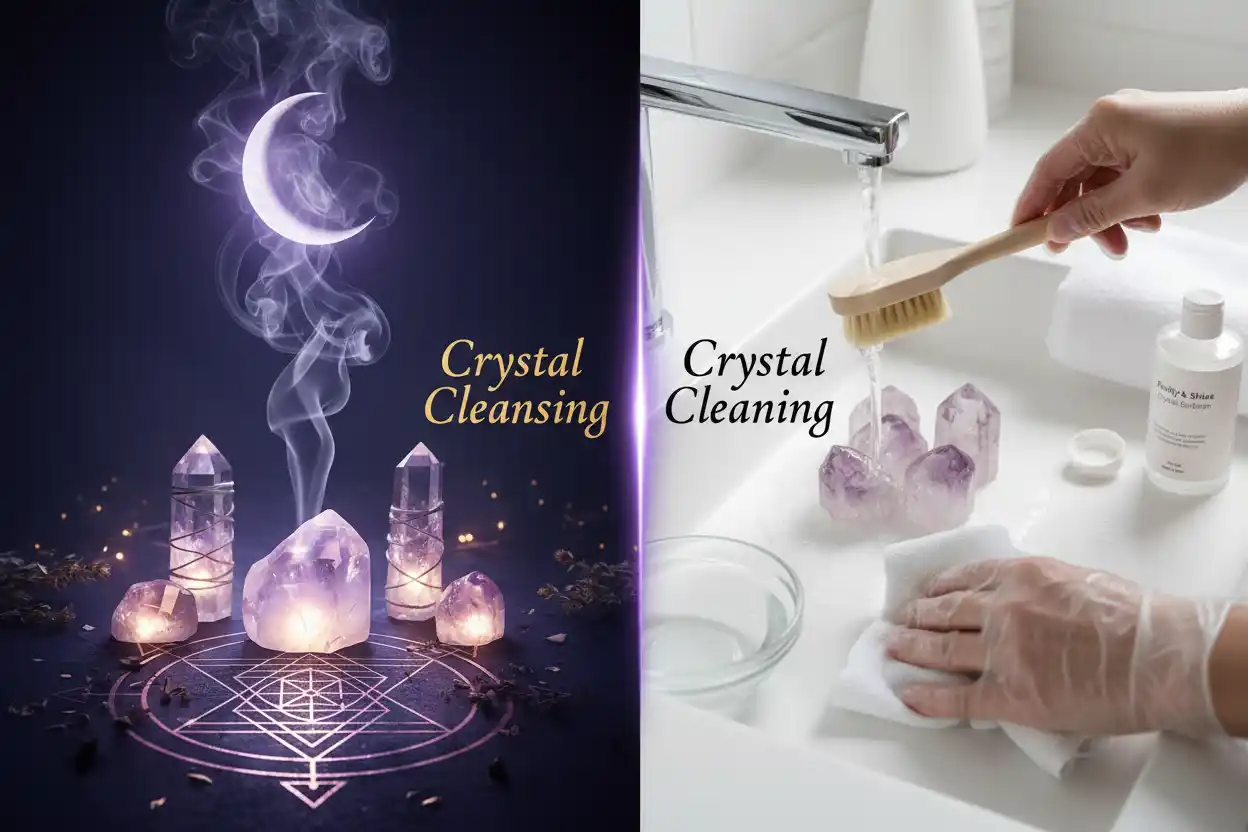
Crystal Cleansing vs. Crystal Cleaning
Physical cleaning removes substances such as dust, skin oil, cosmetics, soap residue, tarnish or soil.
Crystal cleansing is a symbolic, spiritual or personal practice.
For example, ringing a bell beside an amethyst may be used as a cleansing ritual, but it will not remove fingerprints from the stone.
Similarly, rinsing quartz may physically remove dust, but the act only becomes a spiritual cleansing ritual if you personally assign that meaning to it.
When a gemstone genuinely needs cleaning, follow its mineral-specific care requirements. Machine-cleaning limitations are covered separately in Which Gemstones Can Go in an Ultrasonic Cleaner?.
Before Cleansing a Crystal, Identify the Material
One of the most common crystal-cleansing mistakes is assuming that every material sold as a “crystal” can tolerate the same treatment.
A method that causes no problem for durable quartz may damage Amber, Angelite, Calcite, Celestite, Fluorite, Malachite, Pearl, Selenite or Turquoise.
Before choosing a crystal cleansing method, consider four questions.
| Question | Why It Matters |
|---|---|
| Is the crystal soft? | Salt, harder stones and abrasive particles may scratch it |
| Does it have cleavage or brittle points? | Pressure, impact or vibration may cause chips or fractures |
| Is it porous or moisture sensitive? | Water may discolor, weaken or alter the material |
| Is it dyed, coated, filled, glued or strung? | Treatments and construction may impose stricter limits |
The gemstone hardness chart can help you compare scratch resistance.
However, hardness alone does not tell you whether a crystal will break. The distinction between resistance to scratching and resistance to breaking is explained in Gemstone Toughness vs Hardness, while Gemstone Cleavage Explained covers how certain minerals split along structural planes.
When the identity, treatment or construction is uncertain, choose a dry, non-contact cleansing method.
1. How to Cleanse Crystals With Sound
Sound is one of the safest ways to cleanse crystals because it does not require water, sunlight, salt, chemicals or direct contact.
Place the crystal securely on a soft or padded surface.
Then ring a bell, chime, singing bowl or tuning fork nearby. You can also clap gently, hum, chant or play music if those methods fit your personal practice.
A few tones or several minutes are sufficient. There is no scientifically required frequency, musical note or duration.
Avoid placing fragile specimens inside a hard singing bowl and striking it. Celestite blades, Aragonite clusters, Calcite points, Fluorite cubes and other brittle crystals may chip through direct vibration or physical contact.
Sound cleansing is especially useful for jewelry, clusters, carvings, treated gemstones, organic materials and matrix specimens.
The material-specific considerations for a very soft organic gem are covered in How to Cleanse and Charge Amber.
Best for
Sound works particularly well when you do not know whether a crystal can tolerate water, salt or sunlight.
It is also convenient when cleansing several crystals at once because the stones do not need to touch one another.
2. How to Cleanse Crystals With Intention and Visualization
Intention and visualization are the most physically conservative cleansing methods.
Place the crystal somewhere secure or hold it gently if handling is safe.
Decide what you want the crystal to symbolize next. For example, it might represent completing an important task, maintaining a personal boundary, remembering someone, beginning a meditation routine or pausing before reacting.
State that intention aloud or silently.
If visualization is part of your practice, imagine previous associations fading while the object becomes connected with its new purpose.
Because no water, salt, heat, light or chemical exposure is involved, intention cleansing can be used with virtually any mineral or organic gem.
It is particularly appropriate for moisture-sensitive Angelite, discussed in How to Cleanse and Charge Angelite, and brittle Apatite, covered in How to Cleanse and Charge Apatite.
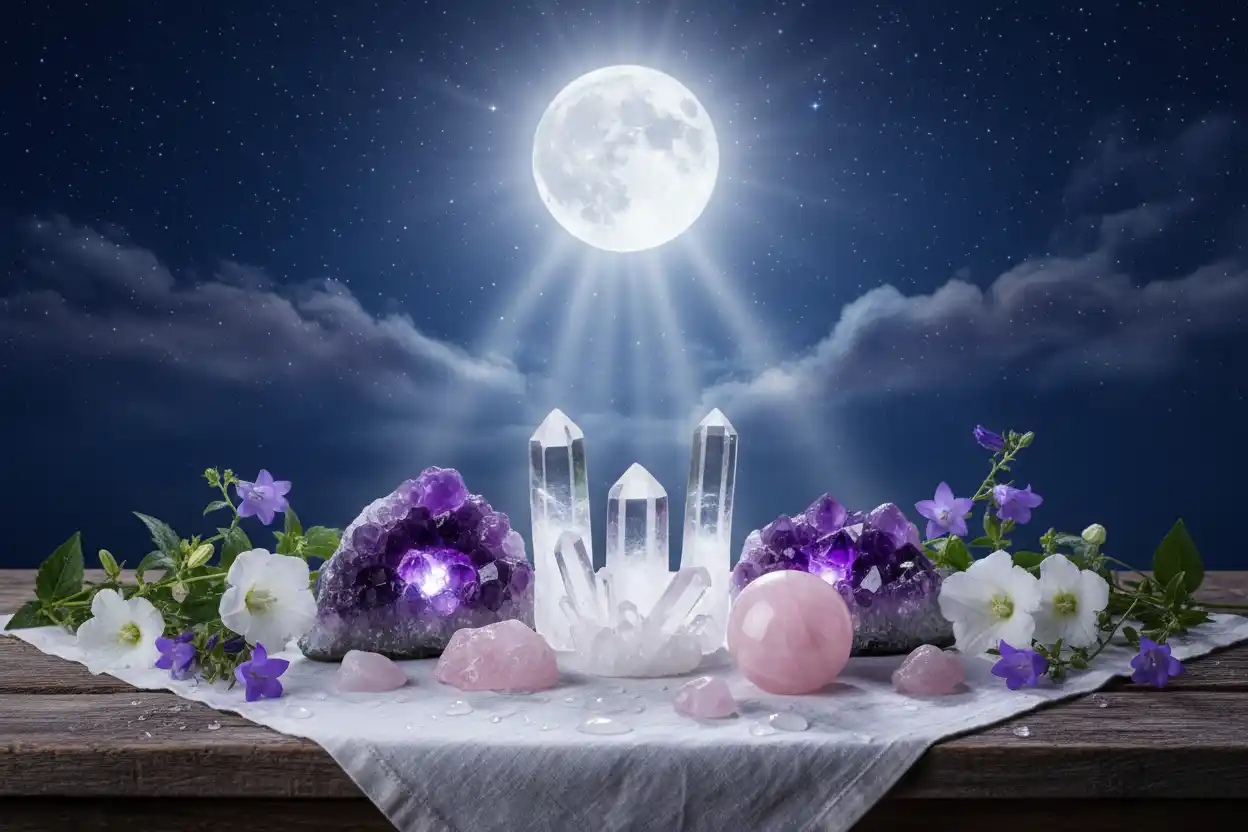
3. How to Cleanse Crystals in Moonlight
Moonlight cleansing is one of the most popular crystal rituals.
The safest approach is indirect indoor moonlight.
Place the crystal near a window on a lined tray, soft cloth or inside an open jewelry box. Leave it there for an hour, several hours or overnight according to your personal practice.
A specific moon phase is not physically necessary. Full moons, new moons and other lunar phases may carry different symbolic meanings within spiritual traditions, but they do not change the mineral’s established physical properties.
Outdoor placement usually creates unnecessary risk.
Rain, dew, temperature changes, animals, dirt, wind, accidental impact and theft can all damage or displace a specimen.
Therefore, leaving the stone indoors near a window gives you the symbolism of moonlight while reducing physical hazards.
This approach works especially well for delicate clusters such as those discussed in How to Cleanse and Charge Celestite.
4. How to Cleanse Crystals With Water
Water is one of the most searched-for crystal cleansing methods, but it is not safe for every crystal.
Before using water, consider the mineral itself as well as treatments, coatings, matrix material, glue, stringing, metal settings and companion stones.
Some sound specimens of Quartz, Garnet, Spinel and Sapphire may tolerate brief contact with lukewarm water.
However, that does not mean every specimen or piece of jewelry made with those stones should be soaked.
Avoid assuming that a mineral is water-safe simply because it is sold as a crystal.
Materials that commonly require extra caution include porous Turquoise, soft Amber, Angelite, Selenite, Pyrite, Malachite, Pearl, many Opals and numerous glued, elastic-strung or treated pieces.
When water is appropriate, a brief controlled rinse is generally more conservative than a prolonged soak.
Use a bowl or closed basin rather than holding a valuable crystal directly above an open drain. Dry the specimen promptly using an appropriate soft material.
For a broader water-safety comparison, see Which Crystals Can and Can’t Go in Water.
Carbonate minerals require additional consideration, as discussed in How to Cleanse and Charge Calcite.
Can you soak crystals overnight?
Do not assume overnight soaking is safe.
Longer water exposure can create more opportunity for dissolution, discoloration, corrosion, weakening of glue, degradation of stringing and penetration into fractures.
A longer ritual is not automatically a better ritual.
5. How to Cleanse Crystals With Smoke
Smoke cleansing appears in many personal and cultural traditions.
If you choose this method, keep the process cool and controlled.
Do not hold crystals over a flame, against burning herbs, near hot charcoal or directly above a candle.
Instead, allow a small amount of cool, dispersed smoke to pass near the object.
Ventilation matters. Also consider children, pets, asthma, allergies and fragrance sensitivity before using incense or other smoke-producing materials.
Smoke can deposit soot, oils and odor on pale, porous or textured surfaces. Therefore, sound or intention may be a cleaner choice for Pearl, Turquoise, Amber, powdery copper minerals and jewelry worn directly against the skin.
A mineral-specific example involving stricter dust and residue considerations is available in How to Cleanse and Charge Azurite.
6. How to Cleanse Crystals With Salt
Salt is commonly recommended for crystal cleansing, but direct salt contact is not universally safe.
Salt grains can scratch softer gemstones, enter drill holes, become trapped between crystal points, lodge in fractures and damage some metal components.
Saltwater creates additional moisture and corrosion concerns.
A safer symbolic alternative is indirect salt cleansing.
Place salt inside one container and place the crystal in a separate lined dish above or beside it. The crystal does not need to touch the salt for the ritual to retain its symbolic meaning.
This approach eliminates most abrasion and residue concerns.
Indirect salt methods are particularly useful for fragile, radiating specimens such as those discussed in How to Cleanse and Charge Aragonite.
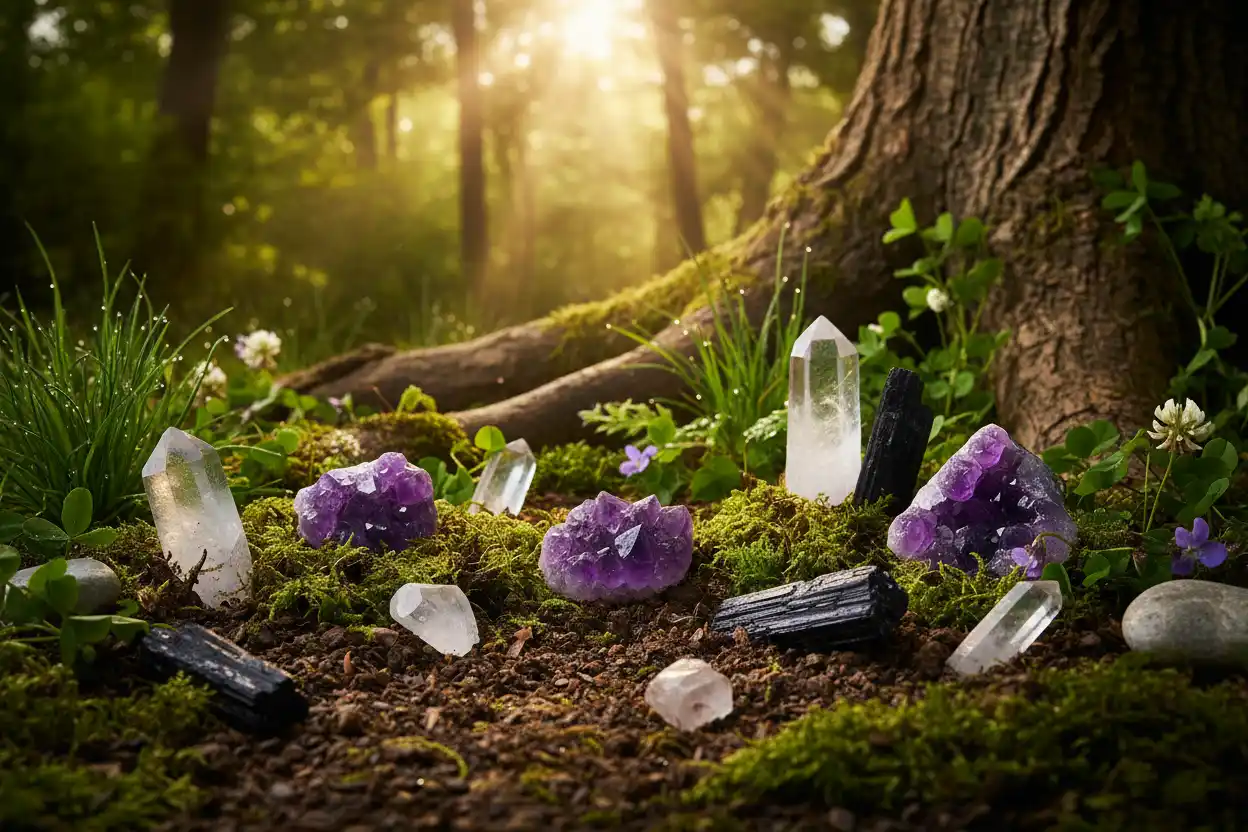
7. How to Cleanse Crystals With Nature or Earth
Some crystal practices use the earth as a symbolic cleansing element.
However, you do not need to bury a gemstone directly in soil.
Soil can contain quartz grains, moisture, fertilizers, organic acids, microorganisms and staining compounds. These may scratch polished stones, enter fractures or clusters, attack metal components and create additional cleaning problems.
Instead, create an earth-adjacent cleansing ritual.
Place the crystal on a padded dish beside a potted plant, piece of untreated wood, dry leaf, garden view or open window.
You preserve the symbolic connection with nature without exposing the stone directly to soil.
Mixed-mineral or relatively delicate materials such as Charoite and Chrysocolla particularly benefit from conservative indirect methods.
8. How to Cleanse Crystals With Selenite or Other Companion Stones
Some practitioners cleanse crystals by placing them near Clear Quartz, Selenite or another symbolic companion stone.
Others use a written intention, photograph or meaningful object instead.
Whatever object you choose, direct contact is unnecessary.
Harder crystals can scratch softer ones. Crystal points can chip polished surfaces, while chains, clasps, earring posts and other jewelry components may also cause damage.
Even two materials with similar hardness can scratch if abrasive dust becomes trapped between them.
Use separate cloths, lined compartments or enough space that the objects cannot roll against each other.
The arrangement might remain for several minutes, several hours or overnight according to personal preference.
A Citrine-specific approach is covered in How to Cleanse and Charge Citrine.
What Is the Safest Way to Cleanse Crystals?
The safest crystal cleansing methods are generally:
intention, visualization and non-contact sound.
These methods avoid the major physical risks associated with water, salt, sunlight, soil, heat and chemical exposure.
Protected indoor moonlight is also relatively low risk when the crystal remains dry, stable and protected from temperature extremes.
If you own an unidentified, expensive, delicate, treated or repaired gemstone, choose one of these conservative methods.
Crystal Cleansing Methods to Use With Caution
Not every popular crystal cleansing technique is universally safe.
Direct sunlight
Sunlight may fade or alter certain stones after prolonged intense exposure.
Amethyst, Citrine, Fluorite, Kunzite and other materials can require particular light precautions.
For a broader comparison, see Which Crystals Can and Can’t Go in the Sun.
Boiling or very hot water
Rapid temperature changes can damage included, fractured or treated gemstones.
Boiling water can also affect coatings, adhesives and jewelry components.
Freezing
Freezing and thawing can introduce temperature stress and create unnecessary risk, particularly when water is present inside fractures or porous material.
Flame and intense heat
Do not expose crystals directly to candles, torches or other flames as a cleansing technique.
Heat can discolor minerals, damage treatments, weaken adhesives and fracture stones.
Chemicals
Essential oils, perfume, sanitizer, alcohol, vinegar, lemon juice and household sprays should not be applied indiscriminately to crystals.
Acids may attack certain minerals, while oils and chemicals can stain porous stones or affect treatments.
A visible chemical reaction is material damage, not proof that cleansing has occurred.
Which Crystals Should Not Go in Water?
No simple name-based rule identifies every water-sensitive crystal.
Instead, consider mineral chemistry, porosity, fractures, treatments and construction.
Common materials that deserve additional caution include Selenite and other gypsum materials, Angelite, Malachite, Turquoise, Pearl, Amber, Pyrite and many Opals.
Likewise, dyed, glued, coated or fracture-filled stones may require stricter care than an untreated mineral specimen.
When unsure, use sound, intention or another dry method instead.
Which Crystals Should Not Be Cleansed in Sunlight?
Some minerals and treatments may fade under strong or prolonged sunlight.
Amethyst and some varieties of Fluorite and Kunzite are well-known examples where prolonged light exposure can be undesirable.
However, the amount of change depends on the material, color origin, intensity and duration of exposure.
For cleansing rituals, sunlight is rarely necessary when safer alternatives such as sound, intention or indirect moonlight are available.
Let the Most Vulnerable Component Set the Rule
A crystal object is not always a single mineral.
For example, a ring might contain durable Sapphire beside fracture-filled Emerald. A bracelet may combine Quartz beads with elastic cord, adhesive, plated metal and softer decorative elements.
In those cases, the most vulnerable material determines how the entire object should be treated.
Similarly, a mineral specimen may contain several species.
A Fluorite cube growing on Calcite or Barite cannot be treated as though the specimen consists only of Fluorite.
Therefore, always assess the complete object rather than one named gemstone.
Choosing a Cleansing Method by Crystal Type
Durable, untreated transparent gemstones may tolerate sound, intention, indirect moonlight and, in certain cases, carefully controlled water exposure.
Soft minerals, carbonates, sulfates, copper minerals, organic gems and porous materials generally benefit from dry or non-contact cleansing methods.
Material-specific instructions remain important because stones with similar appearances can have very different physical properties.
For example, How to Cleanse and Charge Fluorite considers its Mohs hardness of 4, perfect cleavage, color zoning and sensitivity to prolonged intense light.
How to Cleanse and Charge Turquoise focuses on porosity, stabilization, dyes, oils and adhesives.
Meanwhile, How to Cleanse and Charge Selenite addresses the particular softness and moisture sensitivity associated with gypsum materials.
The general rule is simple: when you know the mineral, use the material-specific guidance. When you do not know the mineral, use a dry, non-contact cleansing method.
How Long Should You Cleanse Crystals?
There is no scientifically required cleansing duration.
Sound cleansing may last for a few tones or several minutes. Intention or visualization might take less than a minute. Moonlight cleansing may last for an hour, an evening or overnight.
Longer does not mean stronger.
In fact, extending the process may increase physical risks when sunlight, water, smoke, salt, soil or environmental exposure is involved.
A brief, safe cleansing ritual is preferable to hours of strong sunlight, overnight water soaking or days of burial.
How Often Should You Cleanse Crystals?
There is no scientifically required schedule for cleansing crystals.
Within spiritual practice, some people cleanse a crystal when they first acquire it, after another person handles it, after a difficult event, when changing its symbolic purpose or as part of a monthly routine.
Others cleanse crystals only occasionally.
Frequent cleansing does not make a gemstone physically more powerful. Excessive handling can instead increase the risk of scratches, chips, loosened settings and residue buildup.
Therefore, choose a schedule that supports your personal practice without repeatedly exposing the material to unnecessary physical stress.
Should You Cleanse a Crystal When You First Buy It?
You do not have to cleanse a new crystal.
However, some people choose to perform a brief cleansing ritual when acquiring a stone because it marks the transition into personal ownership.
Sound, intention or visualization works particularly well for this purpose because the technique does not depend on knowing whether the stone can tolerate water, sunlight or salt.
If you bought jewelry or a specimen that is physically dirty, it may also require proper material-specific cleaning.
That is a separate process.
Do You Need to Cleanse Crystals After Someone Touches Them?
There is no scientific requirement to cleanse a crystal after another person touches it.
Some spiritual practices nevertheless use cleansing as a symbolic reset after lending, sharing or handling.
If that ritual matters to you, a quick sound or intention cleanse avoids unnecessary repeated water, sunlight or salt exposure.
Can You Cleanse Several Crystals at Once?
Yes.
Sound, intention and protected moonlight can easily be used for several crystals simultaneously.
Keep the specimens separated so harder stones, sharp points and jewelry components cannot scratch softer surfaces.
You do not need a separate ritual for every stone unless doing so has personal significance.
Cleansing vs. Charging Crystals
Cleansing and charging are often discussed together, but they represent different symbolic ideas.
Cleansing generally refers to resetting or clearing previous associations.
Charging usually refers to establishing or reinforcing an intention.
Neither process has been scientifically established to remove or store measurable metaphysical energy inside a mineral.
Practically, however, the two rituals can be combined.
You might use sound to mark a symbolic reset and then state a new intention for what the crystal will represent.
Crystal Cleansing and Health Claims
Crystal cleansing may form part of meditation, spirituality, personal symbolism or reflective practice, but it should not replace appropriate medical or psychological care.
Likewise, do not ingest mineral material or prepare direct-soak crystal drinking water unless you have reliable information about the mineral, treatments and chemical safety.
Some minerals contain copper, lead, arsenic, mercury, uranium, soluble salts or other constituents that create different risks when ground, dissolved, heated or ingested.
The broader handling framework is covered in the Toxic Crystals safety list.
An intact mineral sitting on a shelf is a very different exposure scenario from grinding, drilling, burning, licking or drinking water in which a mineral has been soaked.
Frequently Asked Questions About How to Cleanse Crystals
What is the best way to cleanse crystals?
The safest general methods are intention, visualization and non-contact sound because they do not require water, salt, sunlight, heat or direct mineral contact.
Indirect indoor moonlight is another relatively low-risk option when the crystal remains dry and securely supported.
What is the easiest way to cleanse crystals?
Sound or intention is usually easiest.
Place the crystal securely on a padded surface and ring a bell or play gentle sound nearby, or simply define what you want the crystal to represent.
Neither method requires special equipment or potentially damaging physical exposure.
What is the safest cleansing method for every crystal?
Intention, visualization and non-contact sound have the widest physical compatibility.
They are particularly useful for delicate, unknown, treated, valuable or repaired stones.
Does cleansing crystals scientifically remove negative energy?
No established scientific evidence demonstrates that crystal cleansing removes or adds measurable metaphysical energy.
Cleansing can still hold cultural, spiritual or personal meaning as a ritual.
Can you cleanse crystals with water?
Some crystals can tolerate brief water contact, but many cannot.
Water-sensitive, porous, soft, treated, glued, strung, metallic or fracture-sensitive materials may be damaged.
Identify the complete object before using water.
Can you cleanse every crystal in moonlight?
Protected indirect indoor moonlight is physically low risk for most crystals because it does not normally involve strong heat or moisture.
Keep specimens indoors, dry and supported rather than leaving them exposed outside overnight.
Can you cleanse crystals without a full moon?
Yes.
A full moon is not physically required to cleanse a crystal.
Different lunar phases may carry different meanings within spiritual practices, but there is no scientifically established cleansing requirement tied to a particular phase.
Can crystals be cleansed in sunlight?
Some crystals may tolerate brief sunlight, but direct sunlight is not universally safe.
Prolonged exposure can fade or alter certain stones and treatments, so safer cleansing methods are generally preferable.
Can crystals be buried in salt?
Direct salt burial is not safe for every gemstone.
Salt may scratch soft stones, become trapped in fractures or drill holes and affect jewelry components.
Indirect salt placement is more conservative.
Can crystals be buried in soil?
Direct burial can expose crystals to moisture, grit, fertilizers, microorganisms and staining material.
Placing a crystal near a plant or another natural object provides a safer symbolic alternative.
Is smoke cleansing safe for crystals?
It can be used cautiously.
Keep crystals away from flame and intense heat, ensure good ventilation and remember that smoke can leave soot, oils or odors on porous surfaces.
Can Selenite cleanse other crystals?
Some crystal traditions use Selenite symbolically as a companion stone for cleansing.
There is no scientific evidence that Selenite removes measurable energy from another mineral.
If you use this ritual, placing crystals nearby rather than directly on Selenite reduces scratching and contact damage.
Can Clear Quartz cleanse other crystals?
Clear Quartz is also used symbolically as a companion stone in some modern crystal traditions.
Direct contact is unnecessary, and there is no scientifically established mechanism showing that Quartz cleanses another stone’s energy.
How long should you cleanse crystals?
There is no required duration.
A sound or intention ritual might last a few minutes, while moonlight placement may last an hour or an evening.
Longer exposure does not make the cleansing scientifically more effective.
How often should crystals be cleansed?
There is no scientifically required cleansing schedule.
Some people cleanse crystals after acquiring them, after changing their intended purpose or as part of an occasional personal routine.
Avoid excessive physical handling or repeated exposure simply for the sake of cleansing.
Should you cleanse a crystal before using it?
You do not have to.
However, performing a short intention, sound or visualization ritual can provide a symbolic starting point if that practice is meaningful to you.
Can you cleanse crystals with music?
Yes, if sound cleansing is part of your practice.
Music does not need a particular frequency to function as a symbolic cleansing ritual.
Keep fragile crystals on a secure padded surface rather than placing them against vibrating speakers.
What should you do if you don’t know what crystal you have?
Avoid water, salt, chemicals, strong sunlight and other potentially damaging methods.
Use intention, visualization or non-contact sound until the material has been accurately identified.
Should a dirty crystal be cleansed or cleaned?
Physical dirt requires proper material-specific cleaning.
Symbolic cleansing serves a different purpose and will not remove oils, soil, cosmetics or other physical residue.
Final Thoughts: How to Cleanse Crystals Safely
The best way to learn how to cleanse crystals is to begin with the material rather than the ritual.
Sound, intention and visualization offer the broadest compatibility because they do not expose the crystal to water, salt, heat, sunlight, chemicals or direct abrasion. Protected indoor moonlight is another conservative option for many specimens.
Water, salt, smoke, soil and sunlight can still form part of personal cleansing practices, but only when the mineral, treatments, setting and construction can tolerate them.
Most importantly, crystal cleansing does not have to produce a physical reaction to be meaningful.
A successful ritual can simply mark a transition, clarify an intention or reconnect an object with a personal practice while leaving its color, polish, crystal points, treatments and setting unchanged.
Disclaimer: Crystal cleansing and charging are spiritual, cultural or personal practices rather than scientifically established methods for changing health, energy or the measurable physical properties of minerals. Use material-specific care information before exposing any crystal to water, salt, sunlight, heat or chemicals.