Best Crystals for Chakras: Top 10 Picks and Meanings
The best-known chakra crystals include black tourmaline, red jasper, carnelian, citrine, rose quartz, green aventurine, aquamarine, sodalite, amethyst and clear quartz. Their colors and traditional meanings are commonly matched with grounding, creativity, confidence, compassion, communication, reflection and spiritual connection.
Chakras belong to South Asian religious, philosophical and contemplative traditions, although the number, names and meanings of energy centers vary among systems. The modern seven-chakra rainbow model is one widely used interpretation rather than the only authentic framework.
Crystals cannot medically open, heal or diagnose a chakra. Their responsible use is symbolic: a stone can help someone select a theme for meditation, journaling or ethical action without presenting a subtle-body concept as measurable anatomy.
Top 10 Chakra Crystals
| Rank | Crystal | Common chakra association | Traditional theme |
|---|---|---|---|
| 1 | Black tourmaline | Root | Boundaries, grounding and protection symbolism |
| 2 | Red jasper | Root | Stability, endurance and physical presence |
| 3 | Carnelian | Sacral | Creativity, initiative and purposeful pleasure |
| 4 | Citrine | Solar plexus | Confidence, resources and deliberate action |
| 5 | Rose quartz | Heart | Compassion, affection and self-respect |
| 6 | Green aventurine | Heart | Renewal, opportunity and gradual emotional growth |
| 7 | Aquamarine | Throat | Clear, composed communication |
| 8 | Sodalite | Throat and third eye | Evidence, thought and responsible expression |
| 9 | Amethyst | Third eye and crown | Reflection, perspective and spiritual contemplation |
| 10 | Clear quartz | Crown or whole-system practice | Clarity and defined intention |
What Is a Chakra?
The word chakra is commonly translated as wheel or disc.
Chakra systems describe subtle centers used within particular forms of meditation, ritual, visualization and spiritual practice.
They should not be treated as physical organs or nerve structures that can be diagnosed through a gemstone.
Many contemporary crystal practices use seven principal chakras aligned from the base of the spine to the top of the head:
| Chakra | Common modern location | Common theme |
|---|---|---|
| Root | Base of the spine | Grounding, survival and material stability |
| Sacral | Lower abdomen | Creativity, feeling and relationship with pleasure |
| Solar plexus | Upper abdomen | Agency, confidence and responsibility |
| Heart | Center of the chest | Compassion, grief and relational care |
| Throat | Throat area | Communication and truthful expression |
| Third eye | Brow area | Insight, reflection and perspective |
| Crown | Top of the head | Spiritual connection and contemplation |
These locations and meanings are spiritual conventions, not medically verified anatomical maps.
How Chakra Crystal Correspondences Developed
Modern crystal correspondence often uses color as the starting point.
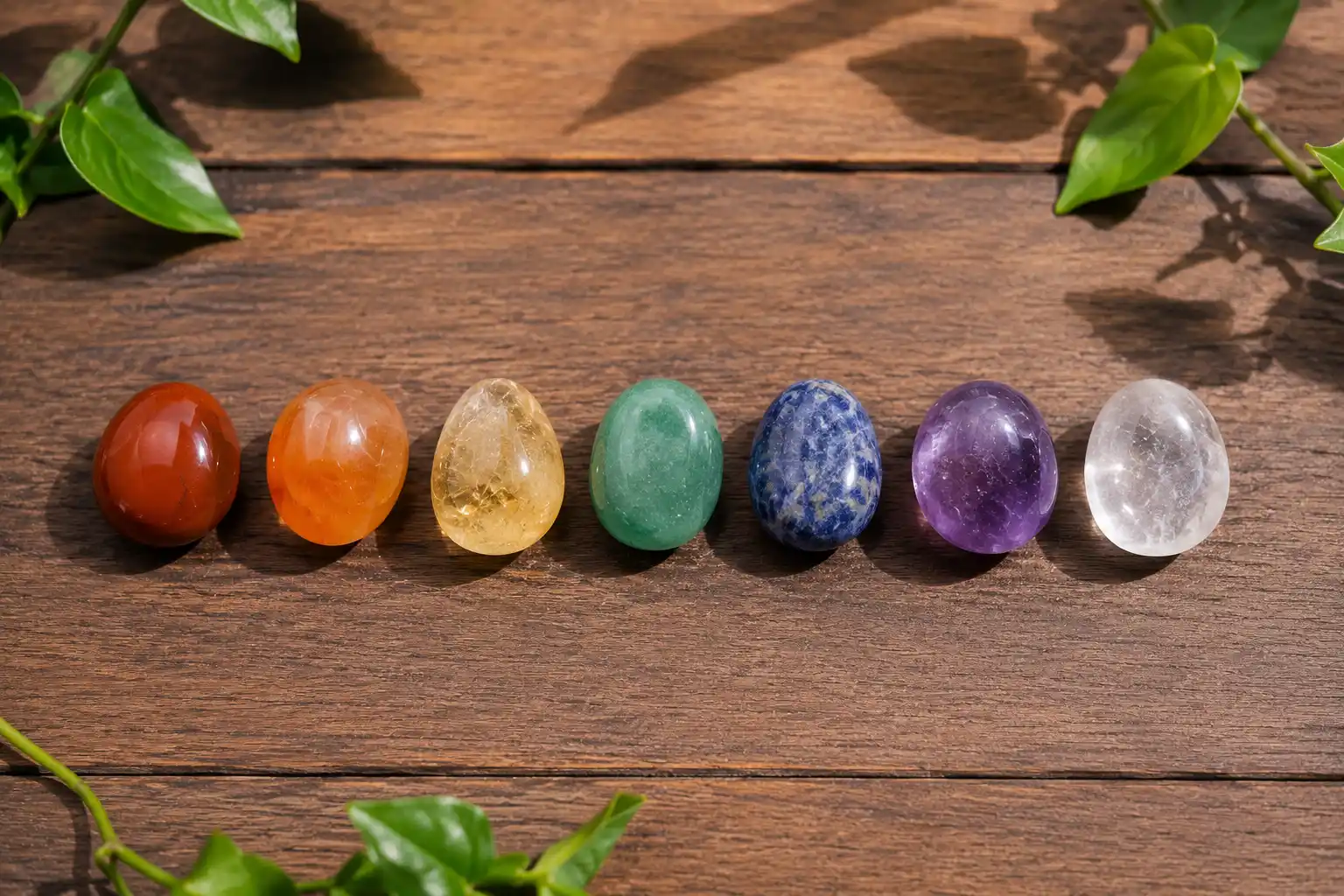
Red and black stones are matched with the root chakra. Orange crystals are assigned to the sacral chakra, yellow to the solar plexus, green or pink to the heart, blue to the throat, indigo or purple to the third eye and white or clear stones to the crown.
Color provides a simple visual system, but it is not a universal ancient rule.
Different teachers, lineages and contemporary practitioners use different correspondences.
A crystal does not need to match a rainbow color exactly to support a reflective theme.
Smoky quartz may be used for grounding, while lapis lazuli can support communication or contemplative practices depending on the system.
1. Black Tourmaline for Root-Chakra Boundaries
Black tourmaline is schorl, a common tourmaline species.
It is widely used in modern root-chakra and protection practices.
The completed root-chakra guide explains the broader grounding, stability and material-security symbolism.
A grounded black tourmaline practice focuses on actual boundaries:
- Locking a door.
- Protecting private time.
- Reviewing financial access.
- Leaving an unsafe interaction.
- Limiting overwhelming communication.
- Creating a stable daily routine.
The completed root-chakra crystal guide covers a wider selection of stones for that energy center.
Black tourmaline cannot block radiation, prevent violence or create physical security.
2. Red Jasper for Root-Chakra Stability
Red jasper is opaque microcrystalline quartz.
It traditionally symbolizes endurance, practical stability and sustained effort.
A red jasper root practice might involve reviewing:
- Food and water.
- Safe shelter.
- Medication.
- Sleep.
- Essential income.
- Transportation.
- Immediate responsibilities.
- Available support.
This approach avoids turning grounding into a vague energetic claim.
The stone represents attending to the material conditions that support daily life.
Red jasper cannot increase stamina, blood circulation or physical strength medically.
3. Carnelian for Sacral-Chakra Creativity
The drafted carnelian guide associates orange-to-red chalcedony with creativity, initiative and purposeful action.
The completed sacral-chakra guide covers modern symbolism involving creativity, emotion and pleasure.
A responsible carnelian practice asks:
- What do I want to create?
- What would make the process sustainable?
- Am I seeking pleasure with consent and responsibility?
- Which action can begin now?
- What limit protects the project or relationship?
The completed sacral-chakra crystal guide contains a broader stone list.
Carnelian cannot increase fertility, libido, reproductive health or creative talent medically.
4. Citrine for Solar-Plexus Agency
The drafted citrine guide links yellow-to-orange quartz with confidence, generosity and purposeful prosperity.
The solar plexus is commonly associated with agency, personal power and responsibility.
A citrine practice can translate personal power into choices:
- State the decision.
- Identify the available resources.
- Review who is affected.
- Accept responsibility for the consequence.
- Avoid claiming authority that has not been granted.
- Revise the plan when evidence changes.
The completed solar-plexus chakra crystal guide owns the dedicated confidence-and-personal-power stone selection.
Most commercial citrine is heat-treated amethyst.
Citrine cannot treat digestive illness, increase metabolism or guarantee wealth.
5. Rose Quartz for Heart-Chakra Compassion
Rose quartz traditionally represents compassion, affection and self-respect.
It is one of the most familiar heart-chakra stones.
A responsible heart practice should include boundaries as well as care.
Ask:
- What form of support is sustainable?
- Has the person asked for help?
- Does compassion require distance?
- Am I abandoning my own needs?
- What action would repair actual harm?
- Which relationship expectation needs clearer consent?
Rose quartz cannot create love, remove grief or make another person forgive.
The heart-chakra symbolism should not be used to pressure someone to reopen an unsafe relationship.
6. Green Aventurine for Heart-Chakra Renewal
Aventurine is quartz containing reflective mineral inclusions.
Green aventurine commonly symbolizes opportunity, renewal and gradual emotional growth.
Its heart-chakra use can focus on trying a new relational behavior without expecting immediate transformation.
For example:
- Ask rather than assume.
- Listen without preparing a defense.
- Make one specific apology.
- Accept a declined invitation.
- Rebuild trust through repeated behavior.
- Allow a relationship to remain different after change.
Manufactured aventurine glass is a separate decorative material and should be labelled accurately.
The stone cannot heal cardiovascular disease or guarantee emotional recovery.
7. Aquamarine for Throat-Chakra Communication
The drafted aquamarine guide associates blue-to-green beryl with calm, direct communication.
The completed throat-chakra guide explains modern symbolism involving voice, truth and expression.
An aquamarine practice can prepare one concise statement:
“The decision I need is…”
“The boundary I am setting is…”
“The help I am requesting is…”
“The information I do not yet have is…”
The completed throat-chakra crystal guide owns the broader stone comparison.
Aquamarine cannot treat thyroid, throat, speech or respiratory conditions.
8. Sodalite for Thoughtful Expression
Sodalite is a blue feldspathoid mineral frequently marked by white calcite.
It is often linked with the throat or third-eye chakra through themes involving reason, evidence and expression.
Use sodalite beside a page divided into:
| What I know | What I infer | What I still need to ask |
|---|
This exercise is useful before speaking, writing or making a decision.
The stone cannot identify truth independently or reveal another person’s thoughts.
Sodalite is softer than quartz and can be confused with dyed material, blue glass and lapis-like products.
9. Amethyst for Third-Eye and Crown Reflection
The drafted amethyst guide associates purple quartz with contemplation, moderation and reflective awareness.
The completed third-eye chakra guide explains modern symbolism involving insight and perspective.
An amethyst practice asks:
- Which assumption am I treating as fact?
- What evidence would change my view?
- Am I confusing a strong feeling with reliable information?
- What does another perspective reveal?
- Is reflection leading to action or avoidance?
The completed third-eye chakra crystal guide owns the dedicated intuition-and-insight selection.
Amethyst is also widely assigned to crown-chakra practice through its contemplative purple color.
It cannot activate psychic ability, treat neurological conditions or prove that an impression is true.
10. Clear Quartz for Crown or Whole-System Intention
The drafted clear quartz guide represents clarity and defined intention.
Clear quartz is often matched with the crown chakra or used across the complete seven-chakra model.
Modern practitioners frequently describe quartz as an amplifier.
Reliable evidence does not show that it increases chakra energy or another gemstone’s healing force.
Its transparency and recognizable point shape make it a useful visual organizer.
A clear quartz practice can begin with one statement:
“The value I am practicing is…”
Then identify the behavior that expresses it.
Spiritual language becomes more useful when connected with ethical action.
Chakra Crystal Colors
| Color | Common modern chakra association | Typical stones |
|---|---|---|
| Black or deep red | Root | Black tourmaline, obsidian and red jasper |
| Orange | Sacral | Carnelian and orange calcite |
| Yellow or gold | Solar plexus | Citrine, tiger’s eye and yellow jasper |
| Green or pink | Heart | Aventurine, rose quartz, jade and rhodonite |
| Blue | Throat | Aquamarine, sodalite and blue lace agate |
| Indigo or deep blue | Third eye | Lapis lazuli, sodalite and iolite |
| Purple, white or clear | Crown | Amethyst, clear quartz and colorless stones |
Color does not identify a mineral.
Several natural stones, glass products and dyed materials can look similar.
The completed crystal-identification guide explains why luster, structure, pattern and treatment also matter.
Chakra Crystals Versus Dedicated Chakra Pages
This article provides a cross-chakra top-ten comparison.
Dedicated chakra pages own the deeper themes, practices and complete stone lists for each energy center.
The distinction prevents one broad roundup from repeating every root, sacral, solar-plexus, heart, throat, third-eye and crown section in full.
Use this guide to select a simple starting stone.
Then move to a dedicated chakra page when a single energy center is the main search intent.
How to Choose a Chakra Crystal
Begin with the theme rather than automatically matching a color.
For example, someone working with heart symbolism may need rhodonite for accountability rather than another stone associated only with softness.
A person exploring throat themes may need sodalite’s evidence symbolism more than a pale-blue aesthetic.
Ask:
- What behavior needs attention?
- Which chakra framework am I using?
- Does the stone’s traditional meaning fit?
- Is the material physically suitable for the intended use?
- Am I making a medical claim?
- What real action will accompany the practice?
The current crystal-meanings chart provides a concise comparison of individual stone symbolism.
A Seven-Chakra Crystal Set
A straightforward set may contain one stone per modern chakra:
| Chakra | Example stone |
|---|---|
| Root | Red jasper |
| Sacral | Carnelian |
| Solar plexus | Citrine |
| Heart | Rose quartz |
| Throat | Aquamarine |
| Third eye | Sodalite |
| Crown | Amethyst or clear quartz |
No exact set is required.
Some practitioners use two stones for one chakra and none for another. Others use one clear quartz piece for the complete practice.
A set should remain manageable, physically compatible and accurately identified.
Chakra Meditation With Crystals
Place one stone on a stable surface.
It does not need to rest directly on the body.
Choose one question associated with the chakra theme.
For root:
“What material need requires attention?”
For sacral:
“What am I trying to create?”
For solar plexus:
“Which decision belongs to me?”
For heart:
“What form of care remains sustainable?”
For throat:
“What needs to be said clearly?”
For third eye:
“Which assumption needs review?”
For crown:
“What value connects this action with a wider purpose?”
Write one answer and one next action.
The crystal structures attention rather than opening a physical energy center.
Placing Chakra Crystals on the Body
Modern practices may place stones near the symbolic location of each chakra.
Use smooth, stable and non-toxic pieces.
Do not put heavy, sharp or unstable minerals on the throat, face, chest, abdomen or spine.
Avoid pressure on injured, numb, painful or recently treated areas.
The stone can be placed beside the person instead.
Chakra placement is not a substitute for medical examination or bodywork training.
If touch involves another person, obtain consent before placing or moving any object near their body.
Chakra Crystal Jewelry
Jewelry allows a symbolic stone to be worn without arranging a full chakra layout.
The drafted crystal-bracelet guide explains fit and construction.
The drafted crystal-necklace guide covers chain length, settings and wearing safety.
A pendant does not need to rest directly over a chakra location to retain personal meaning.
Choose jewelry according to durability, comfort, metal sensitivity and workplace rules.
Remove it during sleep, sports, machinery use and any activity where it may catch or press into the body.
Chakra Crystals in Grids and Wand Practices
The drafted crystal-grid guide explains geometric arrangements and ethical intention setting.
A seven-stone grid may arrange crystals by color, chakra order or the sequence of actions being considered.
The drafted crystal-wand guide explains why symbolic tracing and external massage are different uses.
Tracing a grid or moving a wand above the body does not activate a measurable energy field.
Sharp, fragile and toxic tools should not contact the body.
Cleaning and Storing a Chakra Set
Care each stone according to its material.
Quartz and jasper generally tolerate more handling than calcite, fluorite or gypsum.
Avoid soaking a mixed set because one water-sensitive stone changes what is safe for the complete group.
The completed crystal-cleansing guide distinguishes physical cleaning from symbolic cleansing.
Store stones in separate padded compartments when their hardness differs.
A chakra correspondence does not make physically incompatible stones safe to rub together.
Frequently Asked Questions
1. What are the seven main chakras?
The modern seven-chakra model includes the root, sacral, solar plexus, heart, throat, third eye and crown chakras.
2. What is the best crystal for the root chakra?
Black tourmaline and red jasper are common choices for grounding, boundaries and material stability.
3. What is the best crystal for the sacral chakra?
Carnelian is the most familiar choice because it symbolizes creativity, initiative and purposeful pleasure.
4. What is the best crystal for the solar-plexus chakra?
Citrine commonly represents confidence, agency and deliberate use of resources.
5. What is the best crystal for the heart chakra?
Rose quartz is the classic compassion stone, while green aventurine and rhodonite add renewal and accountability themes.
6. What is the best crystal for the throat chakra?
Aquamarine, sodalite and blue lace agate commonly symbolize clear communication.
7. What is the best crystal for the third-eye chakra?
Amethyst, sodalite, lapis lazuli and iolite are common contemplative choices.
8. What is the best crystal for the crown chakra?
Clear quartz and amethyst are widely used for clarity and spiritual reflection.
9. Must chakra crystals match the rainbow colors?
No. Color is a modern correspondence tool rather than a universal rule.
10. Do chakra stones need to touch the body?
No. They can remain on a nearby surface, in jewelry or within a grid.
11. Can a crystal diagnose a blocked chakra?
No. Chakra blockage is a spiritual interpretation, not a medical diagnosis.
12. Are chakra-healing effects scientifically proven?
No. Chakras and crystal-energy effects are spiritual concepts rather than established anatomical or medical mechanisms.
Use the Chakra Theme to Choose an Action
A chakra system can organize reflection around stability, creativity, agency, compassion, communication, insight and spiritual purpose. The crystal adds color, texture and a consistent visual cue.
Choose one stone and one theme rather than trying to correct the complete system at once. The symbolic practice can support attention, while ethical action and appropriate care address real-world needs.
Disclaimer: Chakra and crystal-healing concepts reflect religious, cultural and spiritual traditions rather than established anatomy or medical treatment. Crystals cannot diagnose or unblock an energy center, treat disease or replace healthcare, counseling, medication or other qualified support.