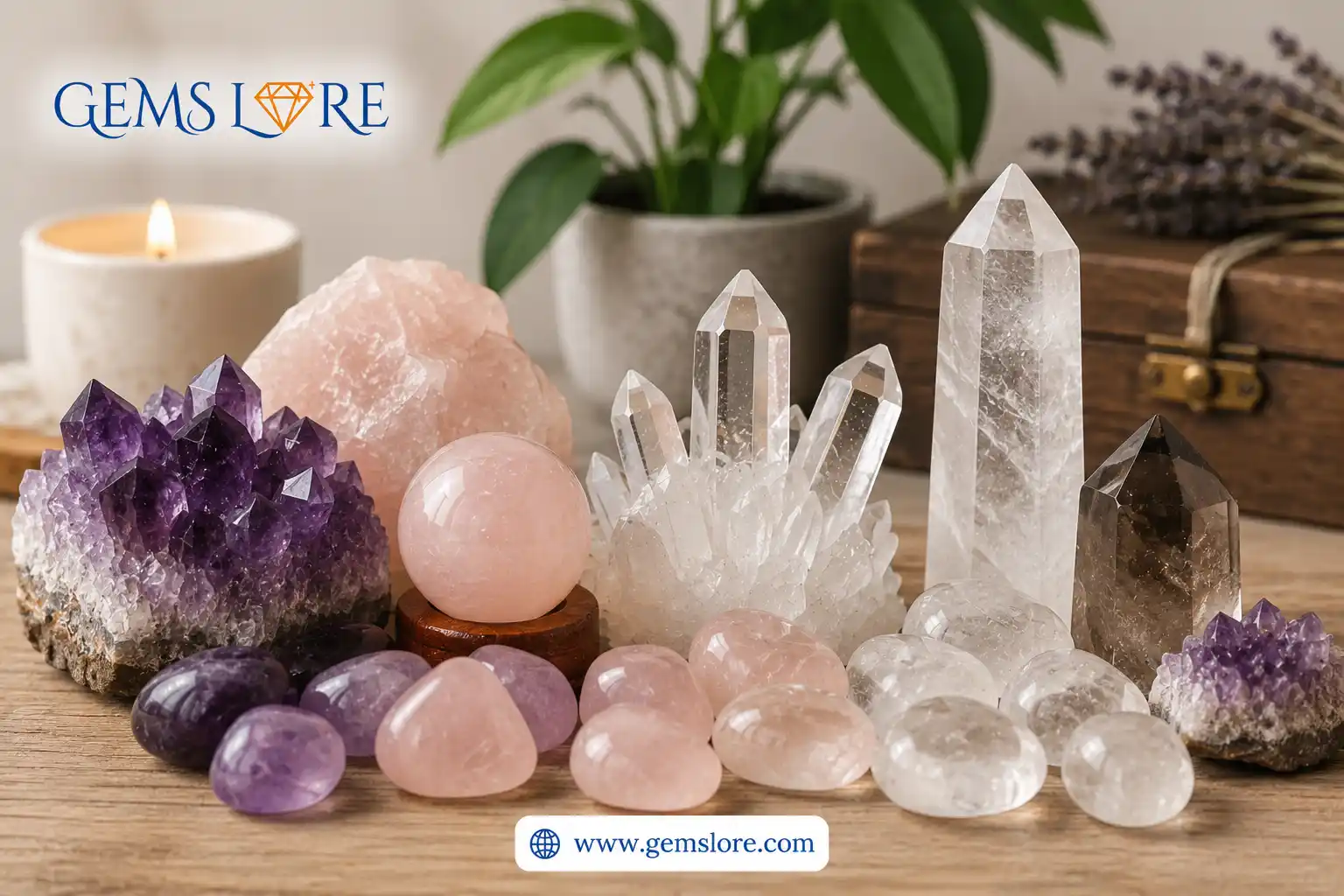
Healing Crystals: Meanings, Uses, Benefits & Safety
Healing crystals are minerals, rocks and gem materials that people use symbolically during meditation, reflection, intention-setting, spiritual practice and everyday routines. Popular choices include clear quartz for intention, amethyst for reflection, rose quartz for compassion, smoky quartz for grounding, carnelian for action, hematite for stability and lapis lazuli for communication.
The word “healing” needs careful context. Healing crystals have not been scientifically established as treatments for disease, injury, anxiety disorders, depression, hormonal problems, infertility, chronic pain or other medical conditions. A stone cannot replace medication, therapy, surgery, rehabilitation or qualified healthcare.
That does not make every crystal practice meaningless. A familiar stone can become a tactile or visual reminder to pause, write something down, communicate a boundary, begin a task, meditate or follow an existing care plan. Historical, cultural and contemporary spiritual traditions also give many stones meanings that people value independently of medical evidence.
The most responsible approach to healing crystals keeps those roles separate: mineral properties remain factual, spiritual meanings remain symbolic, and health decisions remain evidence-based.
Healing Crystals at a Glance
| Crystal | Common traditional association | Grounded practical use |
|---|---|---|
| Clear quartz | Clarity and intention | Define one objective or question |
| Amethyst | Reflection and moderation | Pause, meditate or review a situation |
| Rose quartz | Compassion and affection | Practice kinder self-talk or relationship reflection |
| Smoky quartz | Grounding and release | Return attention to present facts |
| Hematite | Stability and focus | Use weight and texture as a tactile anchor |
| Carnelian | Courage and initiative | Begin a task instead of waiting for perfect confidence |
| Sodalite | Logic and communication | Organize information before speaking |
| Lapis lazuli | Truth and wisdom | Examine facts and communicate clearly |
| Black tourmaline | Protection and boundaries | Reinforce practical limits and safety habits |
| Citrine | Optimism and resourcefulness | Identify possibilities within real constraints |
| Howlite | Patience and slowing down | Pause before responding |
| Red jasper | Stability and persistence | Follow a sustainable routine |
Healing crystals should be chosen by purpose and physical suitability rather than by the number of benefits attributed to them.
What Are Healing Crystals?
The phrase healing crystals does not describe a scientific mineral category.
Quartz, hematite, fluorite, calcite, lapis lazuli, tourmaline and selenite are very different materials. Some are individual minerals, some are varieties of a mineral, and others are rocks made from several minerals.
They also differ dramatically in hardness, cleavage, porosity, chemical composition and safe handling.
That matters because spiritual descriptions often group healing crystals together as though they can all be worn, washed, soaked or placed around a home in the same way.
They cannot.
Hematite is an iron oxide. Fluorite is calcium fluoride. Quartz is silicon dioxide. Lapis lazuli is a rock composed primarily of lazurite with other minerals such as calcite and pyrite.
The meaning assigned to a stone does not change that mineralogy.
A good healing crystals practice therefore starts by knowing what the material actually is.
What Does “Healing” Mean in Crystal Practice?
Healing can mean several different things in ordinary language.
In medicine, healing can refer to physiological recovery: a wound closing, tissue repairing or illness resolving.
In personal or spiritual language, healing may describe grief processing, reflection, renewed confidence, acceptance, rebuilding after a difficult event or establishing healthier routines.
Those meanings should not be confused.
Healing crystals may be used within the second category as symbolic objects. They have not been demonstrated to repair tissue or cure disease through crystal energy.
A person recovering from an injury might keep red jasper beside a rehabilitation schedule as a reminder to complete prescribed exercises. The useful part is adherence to the rehabilitation plan, not a claim that the stone repairs ligaments.
Someone going through a breakup might keep rose quartz beside a journal as a symbol of self-respect. That ritual can have personal meaning without claiming that the crystal controls another person’s emotions.
Healing crystals are most responsibly used when the symbolic role is translated into something observable.
Do Healing Crystals Actually Work?
Scientific evidence does not establish that healing crystals emit a therapeutic energy capable of treating medical or psychological conditions.
People may still report feeling calmer, more focused or emotionally supported while using a stone. Several ordinary mechanisms can contribute to that experience.
Ritual can create structure.
Expectation can influence subjective experience.
A smooth or heavy object can provide a sensory focus.
Taking time to sit quietly may reduce stimulation.
Journaling can make thoughts easier to examine.
A meaningful object can remind someone of a decision they have already made.
None of those explanations requires healing crystals to possess a medically active force.
This distinction allows a person to enjoy crystal traditions without overstating what has been demonstrated.
Healing Crystals and the Placebo Effect
The word placebo is sometimes misunderstood as meaning that an experience is fake.
That is too simplistic.
Expectations, context and ritual can influence how people perceive symptoms and emotional states. However, experiencing subjective relief does not establish that a crystal itself treated the underlying cause.
That distinction matters when symptoms could indicate illness or injury.
If someone feels temporarily calmer while holding healing crystals, that experience can be valued. It should not be used as evidence that the stone treated an anxiety disorder, changed blood pressure or corrected another medical condition.
A useful ritual and a proven treatment are different categories.
How to Choose Healing Crystals
Start with the actual reason you want a stone.
Avoid beginning with a list containing fifty supposed properties.
Ask what you want the healing crystals to represent.
If the goal is staying present during a stressful period, smoky quartz or hematite may make sense symbolically.
If the goal is practicing self-compassion, rose quartz fits more naturally.
If you need to organize a complicated decision, sodalite or clear quartz may provide a clearer reminder.
If you keep postponing a task because you are waiting to feel ready, carnelian can symbolize beginning.
The detailed guide to crystals for mental clarity demonstrates this decision-based approach: identify the actual thinking problem first, then choose a stone whose symbolism matches the required response.
Healing crystals work better as personal cues when each one has a defined purpose.
Healing Crystals for Grounding
Grounding is one of the most common themes in crystal practice.
Smoky quartz, hematite, black tourmaline and red jasper are frequently chosen because their colors, density or traditional meanings evoke stability and physical presence.
A grounded practice can be extremely simple.
Hold a smooth stone and notice its weight.
Identify where your feet or body contact the floor or chair.
Name several things visible in the room.
Then ask: What is happening right now, and what needs action?
Hematite is particularly suitable as a tactile object because of its unusual density. The deeper guide to hematite healing properties explains how its grounding symbolism can be used without confusing its iron content with medical treatment.
Healing crystals do not physically “ground energy” in a scientifically established sense. Their more defensible role is helping mark a return to immediate surroundings and observable facts.
Healing Crystals for Stress
Stress frequently comes from identifiable demands such as workload, conflict, caregiving, deadlines, financial uncertainty or lack of rest.
Using healing crystals effectively means identifying which demand requires a response.
Smoky quartz can represent grounding.
Howlite can represent a pause before reacting.
Blue lace agate can represent a conversation.
Clear quartz can represent one immediate priority.
Red jasper can represent steady effort.
The dedicated guide to crystals for stress connects each symbolic stone with an appropriate practical response.
Healing crystals cannot remove cortisol, prevent burnout or make an unsustainable workload harmless. Sometimes the correct response is not another meditation. It is changing the demand, requesting help, resting or obtaining qualified support.
Healing Crystals for Emotional Reflection
Emotional healing is another area where terminology matters.
Sadness, grief, anger, disappointment and uncertainty are not automatically conditions that need to be “cleansed.”
Emotions provide information.
Rose quartz is traditionally associated with compassion. Rhodonite is often connected with repair and accountability. Blue lace agate can symbolize measured expression, while smoky quartz can support a grounding routine.
The guide to crystals for emotional healing focuses on self-awareness, integration and small constructive actions rather than promises that stones erase painful emotions.
Healing crystals may accompany emotional reflection, but trauma, depression, abuse and persistent severe distress require appropriate professional support.
Healing Crystals for Confidence
Confidence is often described as an energy that a stone will give you.
A more practical interpretation is preparation followed by action.
Healing crystals such as carnelian, tiger’s eye, sunstone and hematite can become cues for different parts of that process.
Carnelian can represent beginning despite ordinary uncertainty.
Tiger’s eye can represent evaluating risk.
Hematite can represent preparation and stability.
The broader crystals for confidence approach treats confidence as something strengthened through experience rather than something a mineral inserts into a person.
Healing crystals cannot guarantee successful interviews, presentations, competitions or relationships.
They can remind you of the behavior you planned to use.
Healing Crystals for Patience
Howlite, smoky quartz, moonstone and blue lace agate are often associated with patience.
Patience does not mean doing nothing indefinitely.
Sometimes patience means allowing a process time to unfold. In other situations, the correct response is asking for clarification, enforcing a boundary or changing an ineffective plan.
The crystals for patience guide separates waiting constructively from passivity.
Healing crystals are particularly useful symbolically here because the object can represent the pause between an emotion and a response.
The pause should eventually lead to an appropriate decision.
Healing Crystals for Communication
Sodalite, lapis lazuli, aquamarine and blue lace agate are commonly associated with communication.
Their role is most useful when tied to specific behaviors.
Write down what actually happened.
Identify what needs to be said.
Separate a request from an accusation.
Listen to the answer.
Verify important information.
Lapis lazuli healing properties explores how truth, communication and wisdom symbolism can be translated into practical reflection while keeping medical and psychic claims outside the evidence.
Healing crystals cannot detect lies, read thoughts or force another person to understand you.
Communication still depends on language, listening, evidence and boundaries.
Healing Crystals and Meditation
Healing crystals can function naturally as meditation objects because they provide something stable to observe or hold.
Choose a smooth stone or place a specimen securely in view.
Notice its color, pattern, temperature and texture.
Return attention to the stone when thoughts wander, then return to breathing.
You do not need to interpret every thought, sensation or image as a message from the crystal.
A useful meditation can simply end with one observation or practical action.
Heavy, sharp and fragile healing crystals should remain on stable surfaces rather than being balanced on the body.
If meditation creates panic, dissociation, traumatic flashbacks or worsening distress, stop the practice and use an appropriate source of support.
Healing Crystals and Chakras
Chakras belong to religious, spiritual and philosophical traditions originating in South Asia, with modern Western crystal practices later developing extensive color-and-stone correspondences.
Contemporary systems commonly connect red or black stones with the root chakra, orange stones with the sacral chakra, yellow stones with the solar plexus, green and pink stones with the heart, blue stones with the throat, indigo stones with the third eye and violet or clear stones with the crown.
These correspondences are spiritual rather than anatomical.
The heart chakra guide, for example, explains heart-centered symbolism through compassion, reciprocity, grief and boundaries without suggesting that green or pink healing crystals medically treat the heart.
A chakra practice can be meaningful while remaining distinct from healthcare.
Chest pain needs medical assessment, not heart-chakra balancing.
A thyroid problem is not diagnosed through a throat stone.
A headache does not establish a blocked third eye.
Keeping those distinctions clear makes healing crystals safer to discuss and use.
Healing Crystals and Reiki
Some Reiki practitioners place stones in treatment spaces, hold them during preparation or use them as symbolic markers for intentions.
Clear quartz, smoky quartz, rose quartz and selenite are common examples.
The guide to crystals for Reiki explains why consent, hygiene and professional boundaries matter when crystals are used with another person.
Healing crystals do not diagnose blocked energy.
They cannot reveal another person’s health condition.
They do not turn Reiki into a medically proven treatment.
If a practitioner works with clients, the role of the stone should be explained accurately and consent should be obtained before placing objects on or near someone’s body.
Healing Crystals for Physical Illness
This is where the strongest safety boundary is needed.
Healing crystals should not be described as treatments for cancer, diabetes, infection, infertility, thyroid disease, high blood pressure, heart disease, kidney problems, autoimmune disease, neurological conditions or other illnesses.
A mineral does not transfer medically useful nutrients into the body merely because it contains an element.
Hematite contains iron, but wearing hematite does not treat iron-deficiency anemia.
Lepidolite can contain lithium, but holding it does not deliver a therapeutic lithium dose.
Copper-bearing minerals do not provide medically controlled copper supplementation through ordinary handling.
Healing crystals may sit beside a medication schedule, rehabilitation plan or appointment notebook as personal reminders. They must not replace the plan.
Healing Crystals for Pain
Some people use smooth healing crystals as sensory objects while resting or practicing relaxation.
That does not establish that the mineral treats pain.
Pain may result from injury, inflammation, infection, nerve problems, overuse or many other causes.
New, severe, persistent or unexplained pain deserves appropriate assessment.
Do not place sharp stones on injured tissue.
Do not massage fractured minerals over the skin.
Do not interpret increasing pain as “energy moving” or “detoxification.”
Healing crystals should never pressure someone to tolerate a symptom that requires care.
Healing Crystals for Anxiety and Mental Health
A crystal can be used as part of an ordinary grounding routine, but healing crystals cannot diagnose or treat anxiety disorders, panic disorder, depression, PTSD, OCD, bipolar disorder, psychosis or another mental-health condition.
A smooth stone may provide a tactile cue.
A journaling ritual may help organize thoughts.
A meditation may be relaxing for some people.
Those activities can coexist with therapy, medication and other appropriate care.
The same principle appears throughout Gems Lore’s stress and emotional-healing resources: healing crystals should reinforce coping practices rather than create dependency on an object.
If someone begins to believe that being without a particular stone makes them unsafe, that belief deserves attention rather than reinforcement.
Popular Healing Crystals and What They Represent
There is no single “most powerful” stone.
Different healing crystals fit different intentions.
Clear Quartz
Clear quartz is commonly associated with clarity and intention.
Use it beside a written objective rather than assigning it every possible purpose at once.
A useful question is: What exactly am I trying to understand, decide or do?
Amethyst
Amethyst traditionally symbolizes reflection, moderation and spiritual awareness.
It works particularly well as a quiet meditation or journaling object.
Its purple color can fade with prolonged intense sunlight, so display placement matters.
Rose Quartz
Rose quartz is one of the most familiar healing crystals for compassion, affection and self-respect.
Use it to represent a behavior within your control: speaking to yourself more fairly, expressing appreciation or setting a respectful relationship boundary.
It cannot make another person fall in love or return to a relationship.
Smoky Quartz
Smoky quartz is associated with grounding and release.
Use it when the practical need is distinguishing present facts from imagined future outcomes.
Hematite
Hematite’s weight and metallic appearance make it a strong symbol of stability.
The mineral’s traditional healing reputation is covered in hematite healing properties, where its blood and iron symbolism is kept separate from medical claims.
Agate
Agate is traditionally associated with stability, patience and balance.
Because agate is durable and available in many patterns, it also works well as a tactile pocket stone.
The agate healing properties guide explains how its symbolism can be used for grounding, communication and reflection while keeping geology and medical evidence distinct.
Lapis Lazuli
Lapis lazuli commonly represents truth, communication and wisdom.
It is actually a rock rather than one mineral, typically containing lazurite, calcite and pyrite.
Its symbolism works best when paired with fact-checking, preparation and clear speech.
How to Use Healing Crystals
The simplest method is usually the most sustainable.
Choose one stone.
Choose one purpose.
Choose one associated behavior.
If smoky quartz represents grounding, hold it for a minute while naming the immediate facts.
If rose quartz represents self-compassion, place it near a journal and write one accurate statement instead of a harsh generalization.
If sodalite represents clear communication, keep it beside the notes for an important conversation.
If carnelian represents action, place it where you begin the task.
Healing crystals become less useful when every stone supposedly performs ten unrelated jobs.
Clear associations are easier to remember.
Carrying Healing Crystals
A tumbled stone in a pouch or pocket is one of the easiest ways to use healing crystals.
Check that the stone is smooth, durable and large enough that it does not create a choking hazard around children.
Do not carry loose fragile clusters, brittle blades or toxic mineral specimens casually.
Some minerals can fracture and create sharp surfaces.
Others can produce hazardous dust if damaged.
A stone suitable for a display cabinet is not automatically suitable for a pocket.
Wearing Healing Crystals
Jewelry can keep healing crystals accessible without requiring frequent handling.
However, the jewelry still needs to be appropriate for the activity.
Remove necklaces, bracelets and rings around machinery, sport, manual work or situations where jewelry can snag.
Consider mineral durability too.
Quartz generally tolerates frequent wear better than soft fluorite or easily cleaved selenite.
A symbolic meaning does not make a fragile gemstone harder.
Healing Crystals at Home
Healing crystals can mark functional areas around a home.
A grounding stone might sit near a desk.
Rose quartz could represent respectful communication in a shared space.
A meditation stone can remain in a quiet area.
The main rules are physical.
Use secure stands for spheres.
Keep heavy objects away from shelf edges.
Protect fading stones from prolonged strong sunlight.
Keep sharp clusters away from walkways.
Avoid putting swallowable stones where children or pets can reach them.
Healing crystals should make a space more intentional, not less safe.
Healing Crystals for Children
Children require stricter precautions.
The crystals for children guide emphasizes supervision, choking risks, sleep safety and the importance of not telling children that illness, fear or family problems are caused by bad energy.
Healing crystals should never be placed loose in a young child’s bed.
Do not encourage children to lick, suck or ingest mineral material.
Avoid teaching them that a stone guarantees protection.
An older child may enjoy a smooth crystal as a symbolic object, but the practice should remain optional and age-appropriate.
Healing Crystals Around Pets
Do not place healing crystals in pet drinking water, food bowls or bedding.
Animals may chew or swallow small stones.
Fragments can injure the mouth or digestive tract, while some mineral compositions or surface treatments create additional concerns.
Heavy specimens can also fall onto animals.
A crystal cannot treat a pet’s illness or anxiety.
Behavioral changes, persistent distress or physical symptoms need appropriate veterinary attention.
Can You Put Healing Crystals in Water?
Do not assume so.
Water compatibility depends on mineral composition, fractures, porosity, treatments, coatings, fillers, attached metals and the purpose of exposure.
Some healing crystals can physically tolerate brief contact with clean water.
Others may dissolve, rust, become dull, release material, damage fillers or deteriorate.
Even when a crystal itself tolerates water, that does not mean it belongs in drinking water.
Direct crystal elixirs create unnecessary risks because mineral identity, contaminants and treatments may be uncertain.
Do not drink water in which healing crystals have been soaked.
Healing Crystals and Sunlight
Sunlight is another method that should never be treated as universal.
Amethyst and some other colored materials can fade with prolonged intense light.
Heat can also affect certain treated or fracture-filled stones.
A brief ritual does not need to become hours of exposure.
When the mineral’s light stability is uncertain, choose a lower-risk symbolic method instead.
Healing crystals do not require physical damage in order to be spiritually meaningful.
Cleansing Healing Crystals
Crystal cleansing usually refers to a spiritual ritual rather than physical sanitation.
Some practitioners use sound, visualization, prayer, moonlight, smoke or simple intention to mark a reset.
There is no scientific requirement to energetically cleanse healing crystals.
If you enjoy the ritual, choose a method that is compatible with the mineral.
Do not automatically use salt, prolonged water, acids or intense sunlight.
Physical dirt still requires appropriate physical cleaning. Sound cannot remove skin oil, and moonlight does not disinfect a contaminated surface.
Symbolic cleansing and material care are separate tasks.
Charging Healing Crystals
Charging is another contemporary spiritual practice in which a crystal is assigned or renewed for an intention.
A practical version is simple.
Clean the stone appropriately if needed.
Choose one purpose.
Write the associated action.
Place the stone where that action happens.
For example, instead of “charge this crystal for success,” use a concrete intention such as “this stone will remind me to prepare before each client presentation.”
Healing crystals do not accumulate a scientifically measurable charge through moonlight, intention or contact with other crystals.
The value is in the association you create.
Crystal Grids and Healing Crystals
Crystal grids arrange stones into geometric patterns around a stated intention.
They can serve as visual planning or meditation tools.
If a grid represents communication, for example, each stone can correspond to listening, clarity, boundaries and follow-through.
The geometry itself has not been shown to create a therapeutic energy field.
Physical placement matters more than supposed energetic direction.
Do not build grids on floors where people can step on them or where children and pets can access small stones.
Keep healing crystals stable and easy to clean.
How Many Healing Crystals Do You Need?
One can be enough.
A beginner does not need a collection of fifty healing crystals.
Start with one or two stones whose roles are easy to distinguish.
A balanced three-stone set might include smoky quartz for grounding, rose quartz for compassion and clear quartz for intention.
Someone focused on work may prefer hematite for stability, sodalite for organized thinking and carnelian for action.
More healing crystals do not create stronger results.
A smaller collection is often easier to understand, store and maintain safely.
Choosing Healing Crystals by Color
Color can be a useful symbolic shortcut, but it should not replace mineral identification.
Red crystals are often associated with action, courage and grounded presence. Green and pink stones commonly appear in heart-centered traditions. Blue stones often symbolize communication, while purple materials are frequently connected with contemplation.
These color associations are cultural.
Two stones of the same color can have completely different physical properties.
Red jasper and cinnabar are both red, but they should not be handled identically.
Green aventurine and malachite are both green, but their chemistry and care differ.
When selecting healing crystals, use color for symbolism and mineral identity for safety.
Natural, Treated and Manufactured Healing Crystals
A crystal does not need to be untreated or geologically rare in order to carry personal meaning.
However, accurate identification matters.
Some materials are dyed.
Some are coated.
Some are reconstructed.
Some are laboratory grown.
Others are glass or manufactured products sold under crystal-style trade names.
That does not automatically make an object useless for symbolic practice. The problem begins when sellers misrepresent what it is.
Healing crystals should be purchased with the same basic standard applied to other gemstones: clear identity, honest treatment disclosure and a price appropriate to the material.
Expensive Healing Crystals Are Not More Powerful
Price reflects rarity, size, quality, cutting, provenance, demand and commercial factors.
It does not measure spiritual effectiveness.
A small piece of common quartz can represent an intention just as effectively as an expensive collector specimen.
Paying more does not produce stronger healing.
Likewise, terms such as “high vibration,” “master healer,” “AAA healing grade” or “activated crystal” do not create standardized gemological quality categories.
Buy healing crystals because you appreciate the material and understand what it is—not because a seller creates fear that a cheaper stone will fail you.
Red Flags in Healing Crystal Claims
Be cautious when a seller or practitioner claims that healing crystals can:
cure disease,
replace medication,
reverse infertility,
prevent miscarriage,
change hormones,
eliminate tumors,
repair broken bones,
treat psychiatric disorders,
guarantee pregnancy,
cause weight loss,
remove toxins,
prevent infection,
guarantee wealth,
force someone to fall in love,
or protect a person from every accident.
Those claims move far beyond cultural symbolism.
Another warning sign is pressure to buy increasingly expensive healing crystals because ordinary stones supposedly cannot handle your “energy.”
Responsible crystal practice should increase personal agency, not dependency.
When Healing Crystals Are Not Enough
Sometimes the appropriate response is professional help.
Healing crystals should not delay medical attention for severe pain, breathing problems, chest symptoms, significant bleeding, infection, neurological changes, poisoning or other urgent health concerns.
They should not replace therapy or crisis support when emotional distress becomes severe.
They should not replace safety planning in abusive situations.
They should not substitute for veterinary care when an animal is ill.
They should not replace evidence-based financial, legal or professional advice in high-stakes decisions.
A personal spiritual practice and qualified support can coexist.
Using one does not require rejecting the other.
Frequently Asked Questions
What are healing crystals?
Healing crystals are minerals, rocks or gem materials used within cultural, spiritual and personal practices for symbolic purposes such as grounding, compassion, reflection, intention and meditation. They are not a scientifically recognized category of medical treatment.
What are the best healing crystals for beginners?
Clear quartz, rose quartz, smoky quartz, amethyst and hematite are versatile starting choices. Choose one or two according to the purpose you actually want them to represent.
Do healing crystals really heal the body?
There is no established scientific evidence that healing crystals cure disease, repair injury or biologically alter the body through crystal energy. They can instead be used as symbolic or sensory objects within supportive routines.
What is the most powerful healing crystal?
There is no scientifically established most powerful crystal. Clear quartz is frequently called a “master healer” in modern crystal traditions, but that title is symbolic rather than a measured therapeutic ranking.
Which healing crystals are good for grounding?
Smoky quartz, hematite, black tourmaline and red jasper are common symbolic grounding choices. Their most practical use is as reminders to return attention to immediate surroundings, facts and next actions.
Which healing crystals are associated with emotional healing?
Rose quartz, rhodonite, smoky quartz, moonstone and blue lace agate commonly appear in emotional-healing traditions. Their symbolism should not be confused with treatment for trauma, depression or anxiety disorders.
Can healing crystals help with stress?
A crystal can provide a tactile or visual cue within a stress-management routine. It cannot medically remove stress hormones or correct an unsafe workload, but it may remind someone to pause, prioritize, communicate or rest.
Can healing crystals treat anxiety?
No crystal has been established as a treatment for an anxiety disorder. A smooth stone may be used during grounding or reflection, but persistent or severe anxiety deserves appropriate professional support.
Can healing crystals replace medication?
No. Do not stop, reduce or replace prescribed medication because of a crystal recommendation. Changes to medical treatment should be discussed with an appropriate healthcare professional.
Can I sleep with healing crystals?
A stable stone can remain on a safe bedside surface. Avoid loose, sharp, heavy or brittle healing crystals in the bed, especially around children. Jewelry can also create pressure, snagging or entanglement risks during sleep.
Can healing crystals go in drinking water?
Do not prepare direct crystal-infused drinking water. Mineral composition, treatments, surface contamination and attached materials can make direct immersion unnecessary and potentially unsafe.
Do healing crystals need cleansing?
There is no scientific requirement to energetically cleanse a crystal. Cleansing can be an optional spiritual ritual, while physical cleaning should follow the actual mineral’s care requirements.
How often should healing crystals be charged?
There is no scientifically required schedule. If charging is part of your spiritual practice, reset the intention whenever the stone changes purpose or when doing so helps you reconnect it with a specific behavior.
Can healing crystals be used with Reiki?
Yes, as symbolic objects within Reiki practice. The crystals for Reiki guide explains appropriate consent, hygiene and healthcare boundaries. Crystals cannot diagnose or medically treat a client.
Are healing crystals safe for children?
Some can be used under appropriate adult supervision, but small stones create choking risks and some minerals are unsuitable for casual handling. The crystals for children safety guide covers these distinctions in detail.
Are expensive healing crystals better than cheap ones?
No evidence shows that price increases a crystal’s spiritual effectiveness. Cost reflects gemstone rarity, quality, size, processing, provenance and market demand—not healing power.
Can healing crystals attract money or love?
There is no evidence that a stone guarantees money, employment, romantic interest, reconciliation or another person’s decisions. Prosperity and love symbolism should remain personal or cultural rather than predictive.
How should I start using healing crystals?
Choose one stone, define one symbolic purpose and connect it with one practical behavior. Use the stone consistently for that role before adding more.
A Grounded Way to Work With Healing Crystals
Healing crystals are most useful when they make an intention more specific rather than more mysterious.
If smoky quartz means grounding, let it remind you to return to present facts.
If rose quartz means compassion, connect it with kinder and more accurate language.
If hematite represents stability, use it beside a routine you are trying to maintain.
If sodalite represents clear thinking, pair it with organizing information before a decision.
If carnelian symbolizes courage, let it mark the moment when preparation ends and action begins.
That approach preserves what many people appreciate about healing crystals—the beauty, ritual, history and symbolism—without claiming that minerals perform medical treatment.
It also keeps the practice flexible. You do not become dependent on possessing the correct crystal, cleansing it at the correct moment or purchasing increasingly rare specimens. The stone remains a meaningful object, while your decisions, habits, relationships, healthcare and practical support remain where real-world responsibility belongs.
At Gems Lore, healing crystals are best approached as a meeting point between mineral knowledge and human symbolism: learn what the stone physically is, understand the traditions attached to it, use it safely and remain clear about what the evidence does and does not support.
Disclaimer: Healing crystals and their associations with energy, chakras, protection, emotional healing and spiritual wellbeing reflect historical, cultural and contemporary belief traditions rather than established medical or psychological treatments. Crystals cannot diagnose, cure or prevent disease, replace medication or professional care, guarantee relationship or financial outcomes, or make unsafe circumstances harmless. Never ingest crystals or use unidentified minerals in drinking water, and use appropriate professional or emergency support whenever health, safety or severe emotional distress requires it.