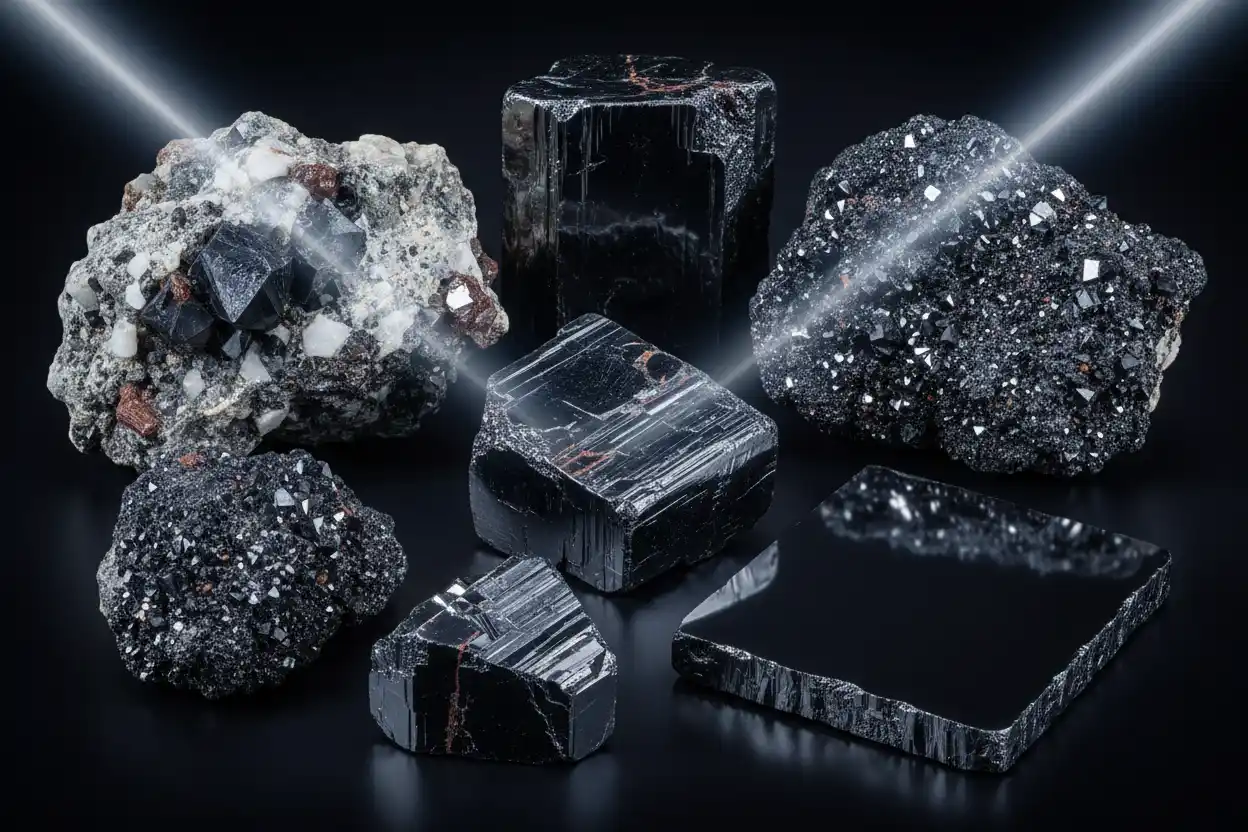
Ilmenite Meaning: Properties, Uses & Symbolism
Ilmenite meaning begins with an iron-titanium oxide rather than with a conventional transparent gemstone. Ilmenite is a valid mineral species with the ideal formula Fe²⁺Ti⁴⁺O₃. It belongs to the ilmenite group, crystallizes in the trigonal system, is normally opaque, and typically appears iron-black to black with metallic or submetallic luster. Mindat gives Mohs hardness of 5–6, measured density around 4.68–4.76 g/cm³, a black to reddish-brown streak, brittle tenacity, and no ordinary cleavage, although crystallographic parting can occur.
These properties make ilmenite physically different from many stones marketed primarily for beauty or transparency. Its visual character comes from opacity, high density, dark Fe-Ti oxide chemistry, reflected-light behavior, crystal form, intergrowths, and geological context. The mineral is also industrially important: ilmenite and rutile are the principal titanium-bearing ore minerals, and economically important ilmenite occurs both in large magmatic deposits and in heavy-mineral sands concentrated by sedimentary processes.
A responsible discussion of ilmenite meaning therefore needs three clearly separated layers. The first is mineralogy: FeTiO₃ chemistry, trigonal structure, hardness, density, magnetism, streak, formation, alteration, and identification. The second is documented human history, including its naming after the Ilmen Mountains and its importance as a titanium ore. The third is modern symbolism, where dark metallic ilmenite may be associated with stability, persistence, boundaries, grounded action, resilience, or examining hidden structure. Those themes can be meaningful as personal interpretations, but they are not scientifically demonstrated effects of iron, titanium, magnetism, or mineral contact.
Readers exploring other material-first references can browse the Gemstone Guides. This page keeps ilmenite meaning focused on identity, formation, recognizable traits, documented history, symbolism boundaries, and safe ownership while linking to specialized Ilmenite pages for topics that require deeper treatment.
Ilmenite Meaning at a Glance
| Property or question | Evidence-aware summary |
|---|---|
| Mineral species | Ilmenite |
| Ideal formula | Fe²⁺Ti⁴⁺O₃ |
| Mineral class | Oxide |
| Mineral group | Ilmenite group |
| Crystal system | Trigonal |
| Typical color | Iron-black to black |
| Luster | Metallic to submetallic |
| Transparency | Opaque |
| Mohs hardness | 5–6 |
| Specific gravity | Approximately 4.68–4.76 |
| Streak | Black to reddish brown |
| Cleavage | None normally observed |
| Parting | Can occur along crystallographic/twin-related planes |
| Tenacity | Brittle |
| Magnetism | Commonly weakly magnetic rather than strongly magnetic |
| Reflected-light appearance | Grayish white with brown tint; strongly anisotropic |
| Typical geological occurrence | Igneous rocks, layered mafic intrusions, pegmatites, carbonatites, high-grade metamorphic rocks, heavy-mineral sands |
| Important economic role | Major titanium ore mineral |
| Main look-alikes | Magnetite, hematite and other opaque Fe-Ti oxides |
| Modern symbolism | Stability, persistence, grounding, boundaries, deliberate action |
| Scientific status of symbolism | Interpretive rather than demonstrated physiological effect |
The combination of black metallic appearance, relatively high density, black-to-brownish streak, weak magnetism, and Fe-Ti oxide chemistry provides a much stronger ilmenite identification framework than color alone. The Handbook of Mineralogy describes ilmenite as weakly magnetic, brittle, Mohs 5–6, and about 4.72 g/cm³ in measured density.
What Is Ilmenite?
Ilmenite is iron titanium oxide.
Its ideal crystal chemistry places divalent iron and tetravalent titanium in an ordered oxide structure represented by FeTiO₃. Mindat gives the more explicit oxidation-state formula Fe²⁺Ti⁴⁺O₃ and recognizes ilmenite as a member of the ilmenite group.
Natural ilmenite does not always match an absolutely pure end-member composition. Magnesium, manganese, ferric iron, and other elements can substitute into natural crystals. The species also participates in compositional relationships with minerals such as geikielite, MgTiO₃, and pyrophanite, MnTiO₃.
This chemical variability should not be confused with a change in the core definition.
A dark oxide grain can contain magnesium or manganese while remaining ilmenite if the relevant site occupancies stay within ilmenite classification.
Conversely, simply containing iron and titanium does not automatically make a black mineral ilmenite.
Structure and composition both matter.
Ilmenite Identity Table
| Characteristic | Ilmenite |
|---|---|
| Ideal composition | Fe²⁺Ti⁴⁺O₃ |
| Mineral family | Oxide |
| Group | Ilmenite group |
| Crystal system | Trigonal |
| Common crystal habit | Thick tabular, rhombohedral, platy, granular or massive |
| Common aggregate form | Disseminated grains, massive concentrations, heavy-mineral sand grains |
| Color | Iron-black to black |
| Streak | Black to reddish brown |
| Luster | Metallic to submetallic |
| Transparency | Opaque |
| Hardness | Mohs 5–6 |
| Density | About 4.68–4.76 g/cm³ |
| Cleavage | None observed in ordinary descriptions |
| Parting | Possible along twin-related crystallographic planes |
| Fracture | Conchoidal to subconchoidal |
| Tenacity | Brittle |
| Magnetic response | Usually weak |
| Reflected-light optical behavior | Strong anisotropy and bireflectance |
| Major geological role | Accessory and ore mineral |
| Major commercial role | Titanium feedstock |
| Main identification caution | Black metallic appearance overlaps magnetite, hematite and mixed Fe-Ti oxides |
The density deserves attention. A small ilmenite specimen can feel unexpectedly heavy for its size because its density is nearly five times that of water and substantially higher than many common silicate minerals.
That heavy feel is useful as a clue.
It is not a complete test.
Why Is Ilmenite Black?
Ilmenite’s black appearance is fundamentally tied to its Fe-Ti oxide electronic structure and strong absorption of visible light rather than to a colorful trace chromophore of the type responsible for many transparent gems.
The mineral is opaque in ordinary hand specimens. In reflected-light microscopy it is not perfectly neutral black: authoritative mineral descriptions give a grayish-white reflected appearance with a brown tint, together with strong anisotropy and brownish bireflectance.
This creates an important distinction between body appearance and reflected-light optical behavior.
A crystal can look iron-black to the unaided eye while showing subtle gray, pinkish-brown, or dark-brown differences under polished-section microscopy.
Those reflected-light variations are mineralogical phenomena.
They are not evidence of an aura, “hidden fire,” or stored energetic charge.
More specialized discussion of reflectance, anisotropy, polished-section appearance, spectral behavior, and magnetic-optical relationships belongs in Ilmenite Optical Properties and Color Behavior.
Metallic Luster Does Not Mean Ilmenite Is Titanium Metal
Ilmenite contains titanium.
It is not metallic titanium.
Titanium in ilmenite is chemically bound with iron and oxygen in an oxide crystal lattice. Producing titanium metal requires industrial chemical and metallurgical processing; a natural ilmenite specimen does not display the strength-to-weight ratio, corrosion behavior, or engineering properties of refined titanium simply because it contains Ti.
USGS describes ilmenite as one of the principal titanium-bearing ore minerals from which titanium feedstocks ultimately derive.
Ore is a geological source material.
Metal is a processed product.
The two should not be treated as interchangeable.
Is Ilmenite Magnetic?
Ilmenite is commonly described as weakly magnetic.
The Handbook of Mineralogy specifically lists weak magnetic behavior for ilmenite.
That makes magnetism useful for comparison with magnetite, but it should not be turned into a rigid home test.
Natural ilmenite can contain hematite components, exsolution textures, magnetite inclusions, alteration phases, or other magnetic minerals that strengthen a specimen’s response. Likewise, grain size and the strength of the magnet affect what the user observes.
A strongly magnetic black grain raises magnetite as an important possibility.
A weak response does not prove pure ilmenite.
Ilmenite Versus Magnetite
Magnetite and ilmenite commonly occur together and can appear very similar in hand specimen.
Magnetite is Fe₃O₄, belongs to the spinel structure, is isometric, has measured density around 5.175 g/cm³, produces a black streak, and is usually readily distinguished by strong magnetic behavior.
Ilmenite is FeTiO₃, trigonal, somewhat less dense, and typically only weakly magnetic.
The practical comparison is therefore:
| Trait | Ilmenite | Magnetite |
|---|---|---|
| Formula | FeTiO₃ | Fe₃O₄ |
| Crystal system | Trigonal | Isometric |
| Typical density | 4.68–4.76 | About 5.18 |
| Magnetism | Usually weak | Usually strong |
| Streak | Black to reddish brown | Black |
| Titanium | Essential major element | Not essential to ideal magnetite |
| Common relationship | Can coexist/intergrow with magnetite | Can coexist/intergrow with ilmenite |
Mixed grains can defeat simple tests.
When an ilmenite-magnetite intergrowth matters scientifically, microscopy, X-ray diffraction, electron-microprobe chemistry, or another appropriate analytical method is stronger than testing attraction with a refrigerator magnet.
Ilmenite Versus Hematite
Hematite creates a different problem.
Both ilmenite and hematite are trigonal oxides with related structural characteristics, and natural Fe-Ti oxide systems can produce solid solutions and intergrowth textures.
Hematite is Fe₂O₃, typically has density near 5.26 g/cm³, Mohs hardness 5–6, and a characteristically reddish-brown streak even when the hand specimen itself looks steel-gray or black.
Ilmenite’s streak ranges from black toward reddish brown, so streak alone does not solve every intermediate or mixed specimen.
Composition matters.
Mindat also documents ferrian ilmenite containing significant Fe₂O₃ component within the ilmenite-hematite relationship.
Nature does not always present perfectly pure textbook grains.
Why Ilmenite and Hematite Intergrow
Ilmenite and hematite have closely related structures, and Fe-Ti oxide compositions can reorganize during cooling or oxidation.
This can create microscopic lamellae, exsolution textures, oxidation products, or composite grains in which more than one phase is present.
These structures matter in petrology because they can preserve information about temperature, oxygen conditions, cooling history, and later alteration.
They also matter for identification because one black grain may not be compositionally uniform.
A polished section can reveal relationships invisible at hand-specimen scale.
Ilmenite as an Inclusion in Gemstones
Ilmenite is not only found as massive ore or black mineral grains.
It can occur microscopically inside other gemstones.
GIA’s review of phenomenal corundum notes that hematite and ilmenite needle inclusions can occur in sapphire and ruby, sometimes with crystallographic orientations that contribute to star effects. In some corundum, ilmenite/hematite needles occur in a different orientation from rutile needles, and combined inclusion sets can contribute to twelve-rayed stars.
GIA has also documented ilmenite inclusions directly within natural corundum during geological investigations.
That makes an important conceptual distinction:
A sapphire containing microscopic ilmenite remains corundum.
An ilmenite crystal remains ilmenite.
The presence of an inclusion does not change the host mineral into the inclusion species.
The detailed specimen-scale relationships belong in the Ilmenite Microscope Inclusion Notebook.
Can Ilmenite Cause a Star in Sapphire?
Ilmenite can participate in star-forming inclusion systems in some corundum.
The mechanism is reflection and scattering from oriented microscopic inclusions rather than any property of massive ilmenite itself.
GIA’s modern review shows that ilmenite and hematite needles can occur in orientation relationships capable of producing asterism in natural corundum.
This does not mean every star sapphire contains ilmenite.
Rutile is also a major star-forming inclusion, and individual stones may contain different populations or combinations.
The host, inclusion orientation, size, number density, and cutting geometry all matter.
How Ilmenite Forms
Ilmenite is widespread because Fe and Ti are common constituents of many igneous and metamorphic systems.
The Handbook of Mineralogy records ilmenite as a common accessory mineral in granites, gabbros, kimberlites, granite pegmatites, carbonatites, and high-grade metamorphic rocks. It can become economically concentrated in layered mafic intrusions and in black-sand placer deposits.
USGS describes two particularly important titanium-resource settings: major magmatic deposits associated with Proterozoic anorthosite plutonic suites and heavy-mineral deposits created by alluvial, fluvial, and wind-driven concentration.
Those are very different geological pathways.
A large primary ilmenite crystal crystallized within an igneous body.
A rounded beach-sand grain may have weathered from older rock, been transported over a substantial distance, and then become concentrated because its high density allowed hydraulic sorting.
The detailed crystallization sequence, oxygen conditions, exsolution, host-rock relationships, weathering, and placer concentration belong in Ilmenite Formation and Deposit Geology.
Ilmenite in Mafic and Anorthositic Rocks
Mafic magmas contain relatively abundant iron, magnesium, calcium, and titanium.
As magma cools, Fe-Ti oxide minerals can crystallize along with silicates such as pyroxene and feldspar. Under favorable conditions, repeated magmatic differentiation concentrates ilmenite into oxide-rich layers large enough to form ore bodies.
USGS identifies major magmatic ilmenite resources hosted by anorthosite plutonic suites.
The mineral itself is therefore not merely an isolated black crystal.
At deposit scale, it can be part of the history of a huge cooling magma system.
Ilmenite in Black Sands
High density makes ilmenite resistant to being transported exactly like ordinary quartz and feldspar grains.
Weathering releases ilmenite from source rocks. Rivers, waves, currents, wind, and gravity then sort sediment partly according to grain size and density. Heavy minerals can become concentrated into dark layers or lenses known broadly as heavy-mineral sands.
USGS identifies ilmenite, rutile, and leucoxene among important titanium-bearing components of coastal heavy-mineral deposits.
A black beach-sand grain is therefore potentially the final result of several geological stages:
primary crystallization,
rock uplift,
weathering,
transport,
abrasion,
sedimentary sorting,
and concentration.
That history makes placer ilmenite very different in appearance from a sharp collector crystal while preserving the same core mineral identity.
Weathering and Leucoxene
Ilmenite does not remain chemically unchanged forever at Earth’s surface.
Weathering and alteration can preferentially remove iron and change the Ti-rich residue. USGS describes leucoxene as an alteration product of ilmenite in heavy-mineral sands.
Leucoxene is generally a textural or commercial term rather than one simple mineral species. Altered grains can contain Ti-rich phases such as rutile or anatase along with residual and secondary components.
This makes weathered ilmenite identification more complicated than fresh FeTiO₃.
A pale or brown alteration rim can represent real chemical modification rather than surface dirt.
Ilmenite and Titanium Resources
Ilmenite is one of the most important natural sources of titanium.
USGS notes that ilmenite and rutile are the principal titanium-bearing ore minerals. Most titanium mineral production ultimately supports titanium dioxide pigment manufacture, while a smaller portion feeds titanium metal and alloy production after extensive processing.
The industrial importance should not be confused with gemstone value.
A large ilmenite ore grain can be economically useful without being a valuable collector specimen.
A sharp historical crystal can be collectible despite representing very little industrial titanium.
Mineral specimen value and commodity value follow different criteria.
Diagnostic Characteristics of Ilmenite
A practical ilmenite identification uses a package of evidence.
| Observation or test | Ilmenite-compatible result | Limitation |
|---|---|---|
| Color | Iron-black to black | Many minerals overlap |
| Luster | Metallic/submetallic | Not specific |
| Streak | Black to reddish brown | Can overlap Fe oxides |
| Hardness | 5–6 | Overlaps hematite and magnetite |
| Density | 4.68–4.76 | Useful but requires measurement |
| Magnetism | Usually weak | Intergrowths can change response |
| Crystal habit | Thick tabular/rhombohedral | Massive grains may lose habit |
| Cleavage | None obvious | Broken grains may be ambiguous |
| Reflected-light anisotropy | Strong | Requires polished-section microscopy |
| Chemistry | Fe + Ti dominant | Strong evidence |
| XRD/Raman | Ilmenite structural signature | Strong identification |
The pattern matters more than any one result.
Black color alone is weak.
A combination of density, magnetic behavior, streak, structure, and chemistry can be compelling.
Why a Magnet Test Can Mislead
A simple magnet can be useful for sorting heavy-mineral sands.
It is not infallible.
Magnet strength varies enormously.
Very small grains respond differently from large specimens.
Ilmenite can intergrow with magnetite.
Oxidation can generate complex Fe-Ti oxide assemblages.
A supposedly weakly magnetic ilmenite crystal may therefore show more response than expected if magnetite is present.
Conversely, a very weak test magnet may not produce an obvious response even from some magnetic material.
Use magnetism as one observation rather than as the entire identification.
Why Streak Testing Also Has Limits
Ilmenite produces a black to reddish-brown streak.
Hematite famously produces a reddish-brown streak, while magnetite gives black.
This makes streak useful but imperfect.
A Ti-rich hematite can darken.
An altered ilmenite grain can contain several phases.
Fine mixtures can produce intermediate-looking powders.
Additionally, dragging a fine collector crystal across an unglazed streak plate can damage it.
For important specimens, non-destructive methods are preferable.
Original Information Gain: Ilmenite Name and Claim Audit
| Name or claim | Evidence-aware interpretation | What should not automatically be assumed | Stronger evidence when needed |
|---|---|---|---|
| Ilmenite | Valid mineral species Fe²⁺Ti⁴⁺O₃ | Any black Fe-Ti grain | Structural/chemical identification |
| Iron titanium oxide | Accurate broad description | Titanium metal | Mineral remains an oxide |
| Titano-iron ore | Historical/industrial wording | Pure ilmenite specimen | Ore may contain multiple phases |
| Ferrian ilmenite | Ilmenite with significant Fe₂O₃ component | Separate unrelated mineral | Composition |
| Magnesian ilmenite | Mg-bearing ilmenite | Geikielite automatically | Determine dominant chemistry |
| Black sand ilmenite | Placer ilmenite grain | Specific source rock | Provenance/geology |
| Leucoxene | Alteration product/material derived largely from Ti-bearing minerals | One formal mineral species | Mineralogical analysis |
| “Magnetic ilmenite” | Could reflect ilmenite plus composition/intergrowths | Strong magnetism is universal | Check magnetite/intergrowths |
| “Titanium crystal” | Trade shorthand | Metallic titanium properties | Explain FeTiO₃ identity |
| “Grounding stone” | Modern symbolism | Electrical grounding of the body | No established mechanism |
| “Magnetic healing stone” | Wellness/metaphysical language | Magnetic therapy effect | Clinical evidence required |
| “Iron stone for blood” | Chemistry-to-health inference | Nutritional iron transfer | Mineral contact is not supplementation |
| “Titanium energy” | Symbolic wording | Titanium metal properties transferred to wearer | No physical basis |
| “EMF blocker” | Unsupported protective claim | Electromagnetic shielding in ordinary use | Instrumental evidence required |
| “Detox mineral” | Wellness claim | Physiological toxin removal | Clinical evidence required |
The most persistent error is the transition from elemental name to biological or engineering function. Ilmenite contains iron and titanium, but the elements are chemically bound within an oxide crystal.
Original Specimen and Photo Checklist
| Observation | Photograph can often support | Photograph cannot reliably prove |
|---|---|---|
| Iron-black body color | Appearance | Ilmenite identity |
| Metallic/submetallic luster | Surface reflection | Exact chemistry |
| Thick tabular habit | Ilmenite-compatible morphology | Pure FeTiO₃ |
| Rhombohedral outline | Crystal-form clue | Magnetism |
| Rounded black sand grain | Transported heavy-mineral habit | Source locality |
| Brown alteration rim | Weathering relationship | Exact alteration mineral |
| Intergrowth with light mineral | Texture | Mineral identity of both phases |
| Internal lamellae | Exsolution/intergrowth texture | Hematite vs magnetite without analysis |
| Weak attraction to magnet | Magnetic behavior | Pure ilmenite |
| Strong attraction to magnet | Possible magnetite component | Magnetite identity alone |
| Black/brown streak | Useful physical clue | Exact composition |
| Old “Ilmen Mountains” label | Provenance claim | Authentic locality without records |
| “Healing magnetic field” | Nothing clinically established | Therapeutic action |
For a useful specimen record, photograph ilmenite under diffuse light and under oblique reflected light. Metallic minerals can look featureless black when the lighting is too flat.
A second image should show crystal habit or matrix.
For sand grains, include scale and photograph multiple grains rather than selecting only the most visually perfect black particle.
Original Evidence Hierarchy for Ilmenite Identification
| Evidence level | What it supports |
|---|---|
| Black metallic appearance | Ilmenite is one possibility |
| Heavy feel and Fe-oxide appearance | Narrows field somewhat |
| Weak magnetic response | Supports ilmenite over strong magnetite |
| Black-to-brownish streak | Further support |
| Trigonal/tabular morphology | Useful when preserved |
| Reflected-light microscopy | Strong Fe-Ti oxide information |
| Raman/XRD | Strong structural identification |
| SEM-EDS or microprobe | Chemical composition |
| Structure plus chemistry | Strong species confirmation |
| Provenance plus analysis | Strongest collector documentation |
The hierarchy is particularly important in opaque minerals because ordinary visual transparency tests are unavailable.
Documented History of the Ilmenite Name
Ilmenite was named by Adolph Theodor Kupffer after the Ilmen Mountains in Russia, where the type material was described. Mindat records the name as introduced in 1827 and identifies Pit No. 3 in the Ilmen Mountains as the type locality.
The name is geographical.
It does not historically mean grounding, strength, magnetism, protection, darkness, or titanium energy.
Modern symbolic interpretations can be discussed separately, but they should not be projected backward into the original etymology.
Ilmenite and the History of Titanium
Ilmenite became technologically important because it contains a large proportion of titanium oxide component.
Today it remains a principal titanium mineral feedstock alongside rutile.
Titanium dioxide derived through industrial processing is widely used as a white pigment because of its high refractive index, while refined titanium metal and alloys have very different engineering uses.
The transformation from black ilmenite ore to white TiO₂ pigment is itself a striking reminder that the properties of an industrial product cannot be inferred from the hand specimen’s color.
A black ore can become feedstock for a white pigment.
Mineral identity and processed-product behavior are different levels of chemistry.
Ilmenite Versus Hypersthene
Hypersthene Meaning concerns a historical name for iron-bearing orthopyroxene rather than an oxide mineral.
Commercial hypersthene-type material can be dark gray to black and may show bronze or silver schiller, creating superficial visual overlap with metallic ilmenite.
The physical differences are substantial.
Hypersthene-type material is a silicate with pyroxene cleavage and generally lower density. Ilmenite is a dense Fe-Ti oxide with metallic/submetallic luster and no ordinary cleavage.
The same dark color therefore emerges from very different mineral systems.
Ilmenite Versus Iceland Spar
Iceland Spar Meaning concerns exceptionally transparent calcite.
Iceland spar is colorless, Mohs 3, strongly cleavage-prone and famous for extreme double refraction. Ilmenite is opaque, black, denser, harder and metallic.
Few specimens could look more different, yet both are useful examples of why optical appearance reflects crystal structure.
Iceland spar is studied largely through transmitted light.
Ilmenite is studied largely through reflected light.
Ilmenite Versus Imperial Topaz
Imperial Topaz Meaning concerns transparent colored topaz, an aluminum fluorosilicate.
Topaz is significantly harder and gem-quality imperial material is valued for transparent orange, pinkish-orange or golden color. Ilmenite is opaque and normally black.
A dark mineral inclusion within topaz would need separate identification.
The host gem’s identity never establishes the inclusion’s identity automatically.
Ilmenite Versus Indicolite
Indicolite Meaning concerns blue tourmaline.
Indicolite is transparent to translucent borosilicate material whose blue body color is governed by trace-element and charge-transfer processes within tourmaline.
Ilmenite’s opaque black appearance comes from an Fe-Ti oxide system.
This is a useful contrast between gemstone color produced through selective transmission and an opaque mineral dominated by absorption and reflection.
Modern Ilmenite Meaning
Modern ilmenite meaning commonly centers on grounding, resilience, persistence, boundaries, practical focus, deliberate action, and working with pressure or change.
Several themes are understandable from appearance and geology.
Ilmenite is dark, dense, heavy for its size, and commonly survives weathering well enough to become concentrated in heavy-mineral sands. It also crystallizes within magmatic systems and can persist through later geological events.
Those observations provide strong metaphors.
They do not demonstrate that the mineral transfers stability or resilience biologically.
Ilmenite and Grounding
Grounding is one of the most common symbolic associations given to dense dark minerals.
A responsible practice makes grounding behavioral.
Use the stone as a cue to identify:
what is happening now,
what evidence is available,
what is within your control,
and what concrete action can be completed next.
That process can reduce vague thinking because it redirects attention toward present facts.
Ilmenite itself has not been shown to electrically ground the human body through ordinary contact.
Ilmenite and Stability
High density can make ilmenite feel physically substantial in the hand.
That makes stability an intuitive metaphor.
A practical stability exercise could connect the specimen to regular habits: keeping a schedule, maintaining records, completing routine work, or building contingency plans before problems arise.
The stone does not stabilize finances, relationships, mood, or external circumstances automatically.
It can symbolize the behaviors that do.
Ilmenite and Persistence
Ilmenite can survive weathering, erosion, transport, and sedimentary sorting sufficiently well to become concentrated in placer deposits.
That geological history lends itself naturally to persistence symbolism.
The useful lesson is not that the crystal magically transfers geological durability into a person.
It is that repeated processes can gradually concentrate what persists.
A personal equivalent might be consistent practice, saving, learning, rehabilitation, or long-term creative work.
Ilmenite and Boundaries
Opaque ilmenite does not transmit visible light in the way a transparent gemstone does.
Modern symbolism sometimes interprets this visual quality as protection or boundaries.
A grounded boundary practice can instead define:
what behavior is acceptable,
what behavior is not,
what consequence follows a crossed boundary,
and which part of the situation remains under personal control.
The mineral cannot force another person to comply.
It can serve as a reminder to act consistently.
Ilmenite and Transformation
Industrial ilmenite provides a striking metaphor for transformation because black Fe-Ti oxide ore can become a feedstock for products with entirely different physical appearances and functions after extensive processing.
That does not mean ilmenite transforms human energy.
It does provide a material example of transformation requiring actual processes rather than intention alone.
Change happens through mechanisms.
In personal symbolism, the parallel could be preparation, repeated work, feedback, and adaptation.
Ilmenite and “Magnetic Energy”
Because ilmenite can be weakly magnetic, metaphysical descriptions sometimes turn that measurable property into broad claims about attraction, manifestation, electromagnetic balance, or healing.
That reasoning does not follow.
Weak mineral magnetism is a physical response to a magnetic field.
It does not demonstrate attraction of wealth, relationships, opportunities, thoughts, or “negative energy.”
It also does not establish meaningful shielding against electromagnetic fields in normal jewelry use.
A property can be real while the analogy built on it remains symbolic.
Ilmenite Healing Claims
There is no established scientific evidence that carrying or wearing ilmenite treats anemia, blood disorders, anxiety, depression, neurological disease, cardiovascular conditions, chronic pain, hormonal disorders, infertility, immune dysfunction, or other medical problems.
Ilmenite contains iron.
That does not make the mineral an iron supplement.
Ilmenite contains titanium.
That does not confer the biological behavior of a medical titanium implant.
Elements in a geological crystal lattice are not automatically transferred to the body in a therapeutic form or dose.
The broader safety and wellness boundary used by Gems Lore is stated in the Gems Lore Disclaimer.
Iron in Ilmenite Is Not Nutritional Iron
Iron deficiency is a medical and nutritional issue.
Ilmenite’s Fe²⁺ occurs inside an FeTiO₃ crystal structure.
Holding or wearing the mineral does not provide a controlled oral or injectable iron dose.
Grinding an ore mineral to obtain iron would introduce uncontrolled mineral material and potentially other phases while destroying the specimen.
Mineral chemistry should not be converted into improvised supplementation.
Titanium in Ilmenite Is Not Implant-Grade Titanium
Titanium metal and titanium alloys are widely used because refined engineering materials have useful strength and corrosion properties.
Ilmenite is not titanium metal.
The Ti⁴⁺ is chemically bound in an oxide structure with iron and oxygen.
A polished ilmenite stone should therefore not be described as providing the medical or mechanical benefits associated with manufactured titanium products.
Similar element names do not make material functions equivalent.
Safe Ownership of Intact Ilmenite
Ordinary handling of an intact ilmenite crystal or polished specimen is different from industrial ore processing.
The mineral is brittle and can chip under impact.
Sharp crystal edges deserve ordinary care.
Heavy specimens can also damage softer minerals stored against them even if the ilmenite surface itself is not exceptionally hard.
For collection storage, keep fine crystals separated enough to prevent rubbing and impact.
Cutting and Polishing
Ilmenite is not a conventional transparent faceting material, but attractive massive or crystalline material can be polished, cut into cabochons, incorporated into mineral-art pieces, or prepared as polished sections for microscopy.
The challenge is retaining a clean reflective surface while accounting for brittleness, fractures, intergrowths, and possible alteration.
Mixed rock can polish unevenly because associated silicates and oxides have different hardness and abrasion responses.
The specialized lapidary decisions belong in Ilmenite Cutting, Orientation and Polish.
Jewelry Wear
Ilmenite’s hardness of 5–6 provides moderate scratch resistance, but opacity and density do not equal toughness.
Brittle material, thin pieces, fractures, intergrowth boundaries, or exposed crystal edges can chip under impact.
Heavy cabochons also place different mechanical demands on settings than lighter materials of the same dimensions.
The detailed relationship among setting pressure, stone thickness, exposed edges, impact protection, and long-term wear belongs in Ilmenite Setting and Wear Engineering.
Intact Specimen Versus Processing Dust
Handling intact ilmenite is different from sawing, grinding, sanding, drilling, crushing, or milling mineral material.
Processing can produce fine particulate matter from ilmenite and any associated quartz, feldspar, pyroxene, amphibole, magnetite, alteration products, or other phases in the specimen.
Professional or serious hobby processing should use appropriate dust controls, wet methods where suitable, eye protection, machine safeguards, ventilation, and correctly selected respiratory protection when required.
Do not generate mineral powder deliberately for spiritual use.
Do Not Ingest Ilmenite
Ilmenite should not be powdered, swallowed, added to supplements, or deliberately soaked to prepare mineral drinking-water elixirs.
Natural specimens can contain other minerals, alteration products, contaminants, polishing residues, or matrix phases in addition to FeTiO₃.
Ore-grade chemistry is not food-grade chemistry.
Symbolic practice does not require ingestion.
Specimen Conservation
A strong ilmenite specimen can preserve crystal form, twinning, intergrowths, alteration rims, matrix relationships, locality history, old labels, and evidence of magmatic or metamorphic processes.
Aggressive cleaning or cutting can remove much of that information.
Before modifying an important specimen, photograph all sides and record dimensions, weight, crystal habit, matrix, visible intergrowths, alteration, magnet response where documented, locality, historical labels, and analytical results.
The Ilmenite Specimen Conservation Record provides the dedicated framework for preserving that information.
Preserve Old Names and Analytical Updates Together
An older specimen may be labeled simply “titanic iron,” “titaniferous iron ore,” or ilmenite from a historical locality.
Do not discard an old label because terminology or analytical precision improved later.
Preserve the original documentation and add a modern note if analysis changes or refines the identification.
Historical provenance and modern mineralogy answer different questions.
Both can be valuable.
Original Source-Comparison Framework
| Source type | Best question it answers | Main limitation |
|---|---|---|
| Mineralogical database | Formula, species status, hardness, density, streak, type locality | Does not authenticate one specimen |
| Handbook of Mineralogy | Standard physical properties and occurrence | General reference rather than specimen analysis |
| USGS resource research | How and where ilmenite forms economic deposits | Commodity focus rather than metaphysical or specimen value |
| GIA inclusion research | Can ilmenite occur microscopically in gemstones and affect phenomena? | Applies to studied host gems |
| Reflected-light microscopy | How does opaque ilmenite behave optically? | Requires polished sample and expertise |
| Magnet test | Relative magnetic response | Easily confused by intergrowths |
| SEM-EDS/microprobe | What elements and proportions are present? | Chemical result may need structural context |
| XRD/Raman | What mineral structure is present? | Sample/access requirements |
| Old collection label | What historical identification/provenance was recorded? | Not independent analytical proof |
| Metaphysical source | What symbolism is practiced today? | Cannot establish mineralogy or medicine |
This framework demonstrates why a commodity report should not be cited to prove spiritual meaning and why a crystal-shop description should not be used as evidence for Fe-Ti oxide chemistry.
Evidence and Technical Limits
This article does not claim first-hand mining, private microprobe analysis, unpublished reflected-light microscopy, laboratory identification of reader specimens, or direct examination of every material sold as ilmenite. The broader sourcing approach used by Gems Lore is described on About Gems Lore.
Difficult specimens may require polished-section microscopy, X-ray diffraction, Raman spectroscopy, SEM-EDS, electron-microprobe analysis, magnetic susceptibility measurement, or specialist ore-mineral review. Weathered grains and ilmenite-magnetite-hematite intergrowths can be particularly difficult to classify from appearance.
Readers with documented analytical corrections, locality records, historical labels, or stronger technical evidence can submit them through Contact Gems Lore. Information submitted through site channels is handled according to the Privacy Policy.
Frequently Asked Questions About Ilmenite Meaning
What is ilmenite meaning?
Ilmenite meaning combines its identity as a dense black Fe-Ti oxide with modern symbolic themes such as stability, persistence, grounding, boundaries, resilience, and deliberate action. Those themes are interpretations rather than scientifically demonstrated physiological effects.
What is ilmenite?
Ilmenite is an iron-titanium oxide mineral with ideal formula Fe²⁺Ti⁴⁺O₃. It is trigonal, opaque, black, metallic to submetallic, and an important titanium ore mineral.
Is ilmenite a real mineral species?
Yes. Ilmenite is a valid grandfathered mineral species and the defining member of the ilmenite group.
Why is ilmenite black?
Its Fe-Ti oxide electronic structure strongly absorbs visible light, leaving the mineral opaque and iron-black in ordinary observation. In reflected-light microscopy it can show grayish-white and brownish optical tones.
How hard is ilmenite?
Ilmenite has Mohs hardness approximately 5–6.
What is ilmenite’s specific gravity?
Measured density is commonly around 4.68–4.76 g/cm³.
Is ilmenite magnetic?
Ilmenite is generally weakly magnetic. Strong magnetism can indicate magnetite, intergrowths, or other magnetic phases and should not be interpreted from one simple test alone.
What color streak does ilmenite make?
Its streak ranges from black to reddish brown.
What is the difference between ilmenite and magnetite?
Ilmenite is FeTiO₃ and normally weakly magnetic. Magnetite is Fe₃O₄, has higher density, is isometric, and is usually strongly magnetic.
What is the difference between ilmenite and hematite?
Ilmenite contains essential Ti and Fe²⁺, while hematite is Fe₂O₃. Hematite commonly has a distinctly reddish-brown streak and higher density, although natural Fe-Ti oxide mixtures and intergrowths can complicate identification.
Where does ilmenite form?
Ilmenite occurs in igneous rocks, pegmatites, carbonatites and high-grade metamorphic rocks and can become concentrated in layered mafic intrusions and heavy-mineral placer deposits.
Why is ilmenite economically important?
Ilmenite is one of the principal titanium-bearing ore minerals and is a major feedstock source for titanium dioxide and, after further industrial processing, titanium products.
What is leucoxene?
Leucoxene is a Ti-rich alteration product/material commonly produced during weathering of ilmenite rather than one simple universally defined mineral species. USGS identifies it as an alteration product of ilmenite in heavy-mineral sands.
Can ilmenite occur inside gemstones?
Yes. GIA has documented ilmenite inclusions in corundum, and oriented ilmenite/hematite needles can contribute to asterism in some natural sapphires.
Can ilmenite produce a star sapphire?
Oriented microscopic ilmenite or hematite needles can contribute to star phenomena in some corundum, sometimes together with rutile. That phenomenon belongs to the corundum host and inclusion geometry rather than to massive ilmenite.
Who named ilmenite?
Adolph Theodor Kupffer named ilmenite after the Ilmen Mountains, Russia, where the type material was described.
Is ilmenite the same as titanium?
No. Ilmenite is FeTiO₃, an oxide mineral containing titanium. Titanium metal is a refined industrial material produced through extensive processing.
Does ilmenite have healing properties?
There is no established scientific evidence that carrying or wearing ilmenite treats disease or creates specific physiological healing effects.
Does the iron in ilmenite help anemia?
No demonstrated therapeutic iron delivery occurs from wearing ilmenite. Iron bound inside FeTiO₃ is not equivalent to a regulated iron supplement.
Does ilmenite block EMF?
There is no established evidence that an ordinary ilmenite stone worn or placed nearby provides meaningful electromagnetic shielding for people or electronic environments.
Can ilmenite go in drinking water?
Ilmenite should not be powdered, ingested, or deliberately used to prepare gemstone drinking-water elixirs. Geological specimens are not food or pharmaceutical products.
Final Perspective
Ilmenite meaning becomes more informative once the black metallic appearance is connected to the correct material identity. Ilmenite is Fe²⁺Ti⁴⁺O₃: a dense trigonal oxide with Mohs hardness 5–6, specific gravity around 4.68–4.76, black-to-reddish-brown streak, metallic to submetallic luster, brittle behavior, and typically weak magnetism.
Its geological role is much larger than a single specimen. Ilmenite occurs as an accessory mineral in numerous igneous and metamorphic rocks, can become concentrated into enormous magmatic ore bodies, and survives erosion well enough to accumulate in heavy-mineral sands. These deposits make it one of the world’s principal titanium ore minerals.
Its microscopic role is equally interesting. Ilmenite can occur inside other gemstones, including corundum, where oriented oxide needles may contribute to star phenomena. The same mineral can therefore be an industrial ore, a collector crystal, a microscopic inclusion, a rock-forming accessory, or a transported black-sand grain depending on scale and context.
Modern associations with stability, grounding, persistence, resilience, boundaries, and deliberate action can still form a responsible ilmenite meaning. The mineral’s density and geological durability provide intuitive metaphors, but those metaphors should not be converted into claims that FeTiO₃ treats disease, supplies iron, transfers titanium’s engineering properties, blocks electromagnetic fields, or produces a therapeutic magnetic effect.
The evidence-aware approach is straightforward: identify ilmenite through a combination of physical, structural, and chemical evidence; distinguish it from magnetite and hematite; treat magnetic response and streak as clues rather than absolute tests; preserve intergrowths and historical labels; separate ore-mineral chemistry from nutrition or medicine; avoid ingestion and unnecessary dust generation; and allow symbolism to remain an interpretation built on top of an already significant mineral rather than a substitute for understanding it.