
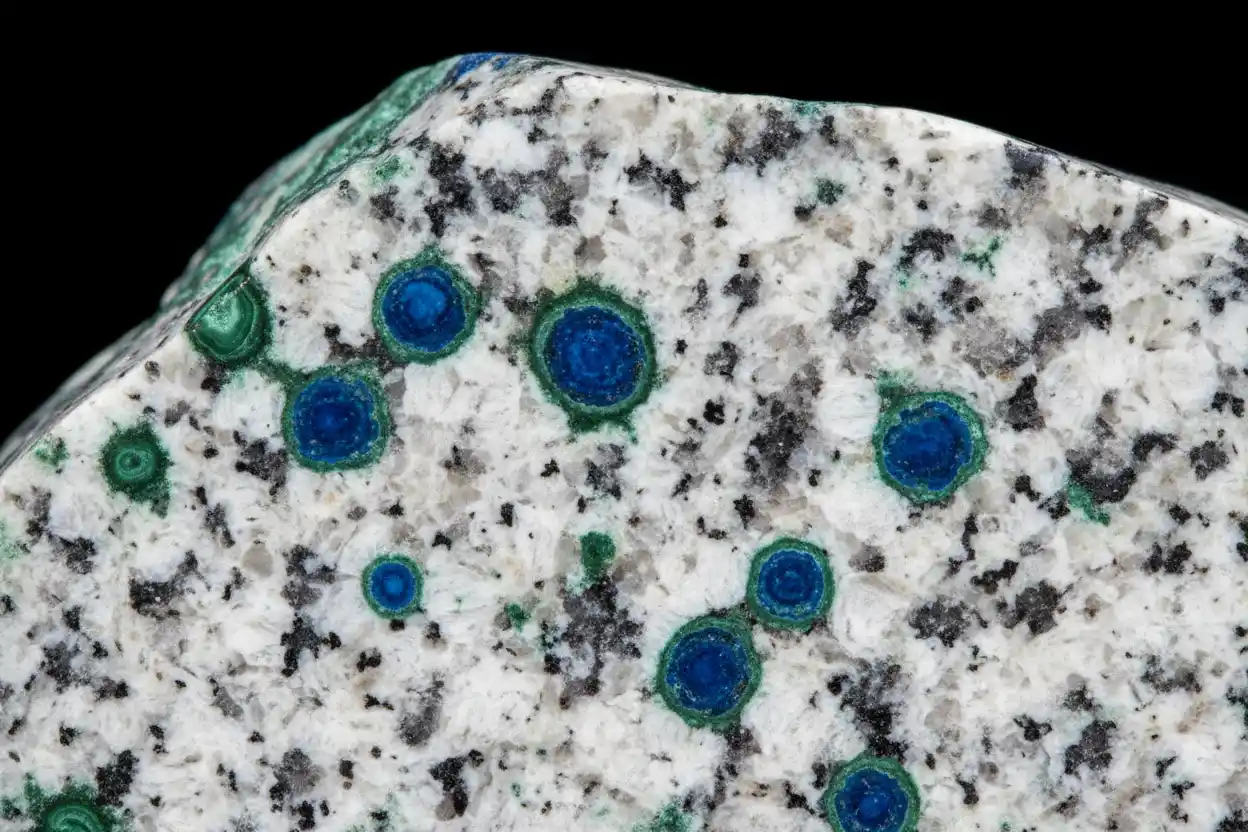

K2 stone is a commercial name for a pale granitic rock from Gilgit-Baltistan, Pakistan, marked by vivid blue azurite concentrations and occasional green malachite staining. It is neither a separate mineral species nor true jasper, and current locality information places the material in the wider Khaplu and Ghanche region rather than on the summit of K2 itself.
K2 Stone at a Glance
| Property | K2 Stone Characteristics |
|---|---|
| Material type | Azurite-bearing granitic or locally gneissic lapidary rock |
| Composition | Variable mixture of quartz, albite or sodium-rich plagioclase, mica and blue azurite, sometimes with malachite |
| Colors | White, cream or pale gray matrix with vivid blue spots, black mica flecks and occasional green areas |
| Crystal system | None for the rock as a whole; each mineral has its own structure |
| Habit or texture | Fine-grained granitic rock with rounded blue concentrations, fracture staining and scattered mica |
| Luster | Dull in rough form; vitreous to pearly across polished mineral grains |
| Transparency | Opaque |
| Mohs hardness | Mixed; approximately 6–7 for much of the matrix and 3.5–4 for azurite |
| Cleavage | Variable according to feldspar, mica and azurite components |
| Tenacity | Generally compact but brittle across fractures and mineral boundaries |
| Common uses | Cabochons, pendants, beads, spheres, towers, palm stones and display slabs |
| Main care concern | Acid-sensitive copper minerals, mixed hardness, possible dye or resin and inaccurate locality claims |
What Is K2 Stone?
K2 stone is a patterned rock rather than a single crystal.
The pale matrix consists mainly of granitic minerals such as quartz, albite or sodium-rich plagioclase, muscovite and biotite. Bright blue areas contain azurite, while green patches may contain malachite.
Retailers also use the names:
- K2 granite
- K2 jasper
- Raindrop azurite
- K2 azurite
- Azurite granite
“K2 granite” is the most geologically useful of those labels, although some pieces show aligned mica and a slightly gneissic texture.
“K2 jasper” is inaccurate because the rock does not consist mainly of opaque microcrystalline silica. Its visible feldspar and mica grains place it outside conventional jasper classification.
The page is therefore best understood as a trade-name material guide, not as the description of a newly discovered mineral species.
Is K2 Stone Found on K2 Mountain?
The K2 name connects the material with the Karakoram region of northern Pakistan, but the exact commercial story has often been exaggerated.
Older descriptions placed the rock near the base of K2. More specific modern locality records identify an azurite-in-granite occurrence near Khaplu in Ghanche District, Gilgit-Baltistan, and distinguish it from K2 Peak itself.
Retail rough may also pass through Skardu, the principal trading and transport center for many minerals from the region.
Accordingly, a careful description should say that K2 stone comes from the wider Gilgit-Baltistan or Khaplu region rather than claiming that miners collect it directly from the mountain’s slopes.
The remote-origin story contributes to marketing, but verifiable district and quarry information provides more value than dramatic altitude claims.
What Is the White Matrix?
The white-to-gray host is a fine-grained granitoid.
Common minerals include quartz, albite or other sodium-rich plagioclase, muscovite and biotite. Individual pieces may contain additional feldspar, iron oxides and alteration minerals.
Quartz contributes hardness and a glassy polish. Feldspar creates much of the pale body and may show small reflective cleavage faces. Black mica appears as flakes or thin streaks.
Some specimens have aligned biotite grains, suggesting deformation or gneissic fabric. Therefore, “granite” works as a broad commercial description, while a formal rock name would require thin-section analysis and measured mineral proportions.
The material should not be assigned one chemical formula because each mineral component has its own composition.
The wider types of gemstones guide explains why lapidary rocks can be used ornamentally without becoming mineral species.
What Causes the Blue Spots?
Azurite is a copper carbonate hydroxide mineral with the formula Cu₃(CO₃)₂(OH)₂.
In K2 stone, the blue areas are not usually solid, perfectly spherical azurite crystals. Instead, azurite occupies grain boundaries, tiny fractures and porous or altered zones within the granitic matrix.
That distribution creates rounded blue concentrations that resemble ink drops or painted circles. Under magnification, the texture of the pale granite may continue through the blue area.
The azurite formed after the host rock crystallized. Copper-bearing fluids moved through fractures and reactive zones, then deposited blue copper carbonate during later alteration.
Some specimens also show green malachite, which can develop through related copper-rich weathering processes.
The close relationship with copper chemistry makes the copper mineral guide useful for understanding why azurite and malachite frequently occur together.
Are the Blue Spots Natural?
Natural blue-spotted material exists and has undergone mineralogical examination.
However, K2 stone attracts suspicion because the contrast looks almost artificial. A bright blue circle inside white granite resembles paint, dye or printed decoration.
Magnification provides useful evidence. In natural material, azurite follows grain boundaries and microfractures, while quartz, feldspar and mica textures remain visible through portions of the blue area.
The spots also vary in diameter, shape and saturation. Some have soft diffusion edges, irregular internal patterns or green malachite near the margins.
Artificial pieces may show pigment sitting only on the polished surface, intense color concentrated in every crack or identical blue circles repeated across several products.
Natural appearance still does not prove a specific locality. Identity and origin remain separate questions.
How K2 Stone Forms
The formation took place in at least two major stages.
First, magma cooled and crystallized into the pale granitoid host. Quartz, feldspar and mica formed an interlocking rock texture.
Later, copper-bearing fluids moved through fractures, grain boundaries and altered mineral zones. Near-surface oxidation conditions allowed copper carbonates to precipitate as azurite and, in some areas, malachite.
The rounded blue patterns may reflect the way fluid spread outward through porous microstructures rather than the growth of isolated round crystals.
Continued weathering opened fractures, released blocks from the bedrock and moved material downslope into colluvial deposits. Miners and collectors then recovered pieces suitable for cutting.
This secondary copper mineralization explains why azurite can occur in a rock that initially crystallized without visible blue copper minerals.
K2 Stone vs Azurite
Azurite is one mineral. K2 stone is a rock that contains azurite.
A solid azurite specimen may be deep blue throughout and can form visible crystals. K2 stone instead shows blue areas dispersed through white granitic matrix.
The two also differ in durability. Pure azurite ranks only 3.5–4 on the Mohs scale, while much of the K2 matrix approaches the hardness of feldspar and quartz.
Because the azurite occurs largely as staining and fine material inside the matrix, a polished K2 cabochon may behave more uniformly than a cabochon made from a large solid azurite crystal.
Nevertheless, acids and heat can still affect the blue copper carbonate.
K2 Stone vs Jasper
Jasper consists mainly of opaque microcrystalline silica with mineral impurities.
K2 stone has visible feldspar, quartz and mica grains. It is therefore granitic rather than jasper.
The difference becomes apparent under magnification. Jasper usually presents a dense, fine silica texture without obvious feldspar cleavage or mica flakes.
Calling the material K2 jasper remains common in retail listings, but buyers should understand that the name describes a product category rather than geology.
K2 Stone vs Lapis Lazuli and Sodalite
Lapis lazuli is a blue metamorphic rock dominated by lazurite and commonly accompanied by calcite and pyrite.
K2 stone reverses the color arrangement: its body is white or pale, while blue occurs as isolated azurite spots.
Sodalite commonly forms blue masses with white calcite veins. It does not usually show discrete cornflower-blue circles in granite.
Dyed white stone can imitate all three materials. Identification should therefore consider texture, hardness, color distribution and spectroscopy rather than name alone.
How to Identify K2 Stone
Begin with the granitic matrix.
A hand lens should reveal interlocking pale grains, reflective feldspar surfaces and scattered black mica. The blue areas should intersect those natural textures instead of forming a smooth paint layer above them.
The matrix should resist a steel point better than calcite or gypsum, although destructive scratch tests are inappropriate for polished pieces.
Under magnification, natural azurite may occupy fractures and grain boundaries. Green malachite can appear as irregular stains beside the blue.
Raman spectroscopy can confirm azurite and malachite, while X-ray diffraction can identify the principal matrix minerals.
The process in how to identify crystals should treat the sample as a multi-mineral rock. One successful azurite test does not identify every component or prove the claimed origin.
Fake and Misleading K2 Stone
The most likely imitations involve dyed granite, resin composites and printed or surface-painted rock.
Dye may concentrate in fractures and porous feldspar. Strong blue pigment can also collect around drill holes or unfinished edges.
Resin composites may contain crushed white stone mixed with blue pigment. Small bubbles, mold seams and repeating patterns can expose the construction.
Some sellers use ordinary white granite with blue paint. Scratching a hidden edge may reveal surface-only color, but buyers should not damage finished jewelry during testing.
Digital saturation also creates misleading listings. Natural azurite can be vivid, yet photographs may intensify the blue while whitening the matrix and removing gray areas.
The warning signs in how to spot fake crystals provide the broader framework for dye, coatings and reconstructed stone.
Hardness, Cleavage and Durability
K2 stone has no single Mohs hardness.
Quartz grains approach 7, feldspar commonly ranks near 6 and azurite ranks approximately 3.5–4. The gemstone hardness chart should therefore be applied to each component.
Feldspar has cleavage, mica splits into thin sheets and azurite can fracture or cleave within softer blue-rich areas. The principles in gemstone cleavage explain why the rock can develop local weaknesses even when its quartz-rich matrix feels hard.
Compact cabochons can tolerate ordinary wear, but open fractures and large blue concentrations may chip. As discussed in gemstone toughness versus hardness, mixed hardness also causes uneven abrasion and polish.
Jewelry and Lapidary Uses
K2 stone is commonly cut into cabochons because a smooth dome displays several blue spots while preserving structural thickness.
Pendants and earrings are practical choices. Brooches, bolo ties and collector jewelry can also use large scenic pieces.
Rings require a protective setting. Quartz-rich matrix may resist surface wear, but feldspar cleavage, grain boundaries and softer copper-rich areas remain vulnerable.
Spheres, palm stones, towers and polished slabs are popular because they show pattern across a larger area.
The stone’s blue-and-white palette gives it a place in both blue gemstones and blue crystals discussions, although it remains an ornamental rock rather than a facetable blue gem.
Pale areas can also resemble entries in the white gemstones category, but the blue azurite pattern provides its real commercial identity.
Treatments and Stabilization
Most K2 stone receives sawing, shaping and polishing.
Fractures may be filled with resin to improve cutting yield. A clear coating or wax can deepen the blue and create a wetter-looking polish.
Dye can strengthen pale azurite areas or create entirely artificial spots. Reconstructed material may combine stone powder, resin and pigment.
The categories in gemstone treatments explained help distinguish ordinary polishing from filling, dye and composite construction.
Treatment does not automatically make an object unusable, but it affects durability, care and value. A seller should disclose resin when it occupies open pits or large fractures.
K2 Stone Price and Value
K2 stone remains moderately priced because it is sold mainly as lapidary rock rather than as a rare faceted gem.
| K2 Stone Product | Broad Current Asking Range |
|---|---|
| Small tumbled stone | $3–$12 |
| Commercial cabochon | $8–$30 |
| Better large-pattern cabochon | $25–$75 |
| Exceptional designer cabochon | $75–$150+ |
| Small tower, palm stone or freeform | $15–$50 |
| 40–60 mm sphere | $30–$100 |
| Large sphere or display carving | $100–$300+ |
| Attractive natural specimen or slab | $25–$250, depending on size and pattern |
Value depends on pattern rather than one standardized price per carat.
The most desirable pieces show vivid natural blue, balanced spot distribution, a clean pale matrix and minimal fractures. Several well-positioned spots often look better than a surface crowded with weak gray-blue staining.
Extremely uniform circles may appear attractive but should also receive close authenticity inspection.
How to Buy K2 Stone
Ask the seller to identify the material as azurite-bearing granite or granitoid rather than a newly discovered mineral.
Origin should be described as Gilgit-Baltistan, Khaplu, Ghanche or the wider northern Pakistan region when documentation supports it. Claims that the stone was mined directly from the summit or at extreme climbing altitude are not credible.
Request photographs of the front, back and an unfinished edge. Natural pattern should continue into the rock rather than disappear beneath the polished surface.
The seller should also disclose dye, resin, coating and reconstructed material. A wet photograph can make azurite spots look more saturated, so dry neutral-light images are important.
Because the tracker marks this trade-name page for editorial review, K2 stone should not become a family or authority page for unrelated minerals. Its identity rests on the underlying granite and azurite, not on metaphysical branding.
Cleaning K2 Stone
Use a soft cloth with lukewarm water and a small amount of mild soap. Keep contact brief and dry the item immediately.
Avoid vinegar, lemon juice, acidic cleaners and chemical jewelry dips. Azurite and malachite are copper carbonates that react with acids.
Prolonged soaking can enter fractures, weaken glue and affect fillers. The broader guide to crystals that can and cannot go in water should therefore place K2 stone in the brief-hand-cleaning rather than soaking category.
Ultrasonic and steam systems are unsuitable. The cautions in gemstones and ultrasonic cleaners apply because the material contains several minerals with different fracture and thermal behavior.
Store polished pieces separately from harder gems. Heat and prolonged strong sunlight can also weaken resin or alter coatings, even when the natural rock remains stable.
K2 Stone Meaning and Symbolism
K2 stone is a recent commercial material with no established ancient spiritual tradition under that name.
Its symbolism comes mainly from modern crystal culture and from the visual contrast between blue azurite and pale granite.
Common interpretations include perspective, combining ambition with practical planning, remaining calm during difficult work and finding vivid possibilities within ordinary conditions.
The mountain-associated name also inspires themes of perseverance and long-term goals. However, those associations come from marketing and personal reflection rather than an ancient K2 stone tradition.
Scientific evidence does not show that the rock activates intuition, improves communication or creates measurable healing energy.
Its real formation offers a grounded metaphor: blue copper minerals entered an older pale rock through later fractures and grain boundaries, changing its appearance without erasing the original granite.
Frequently Asked Questions About K2 Stone
Is K2 stone a real mineral?
No. It is a multi-mineral rock composed mainly of pale granitoid with blue azurite and occasional malachite.
Is K2 stone really jasper?
No. K2 jasper is a commercial name, but the material has a granitic texture with quartz, feldspar and mica.
Does K2 stone come from K2 mountain?
It comes from the wider Gilgit-Baltistan region. Current locality records place the occurrence near Khaplu rather than on K2 Peak itself.
What are the blue spots?
They are azurite concentrations and staining within fractures, grain boundaries and altered parts of the granite.
Are the blue spots painted?
Natural examples exist. However, dyed and painted imitations are possible, so texture and color penetration should be examined.
Why are some spots green?
Green areas commonly contain malachite, another copper carbonate mineral associated with azurite alteration.
How hard is K2 stone?
The matrix commonly ranges around 6–7, while azurite is approximately 3.5–4. The rock has no single uniform hardness.
Is K2 stone suitable for rings?
Compact cabochons can work in protective settings. Pendants and earrings face less impact and are safer choices.
Can K2 stone go in water?
Brief hand washing is acceptable for stable untreated material. Avoid soaking, acids and heavily fractured or resin-filled pieces.
Can K2 stone go in an ultrasonic cleaner?
No. Vibration and heat can damage grain boundaries, fillings and softer copper-rich areas.
How can I recognize fake K2 stone?
Look for surface-only pigment, identical repeated spots, color concentrated in drill holes, mold seams, resin bubbles or blue circles that conceal rather than follow the granite texture.
What makes K2 stone valuable?
Natural vivid azurite, balanced pattern, clean matrix, large usable size, good polish, limited fractures and documented Pakistani origin create value.
K2 stone is listed in both Crystals That Start With K and Gemstones That Start With K, but its correct identity remains azurite-bearing rock rather than an individual crystal species.
Safety disclaimer: K2 stone can release respirable crystalline-silica dust from quartz and feldspar, along with copper-bearing dust from azurite or malachite. Do not ingest, lick, dry-cut or use the material in drinking water. Use wet lapidary methods, effective extraction, eye protection and suitable respiratory protection.