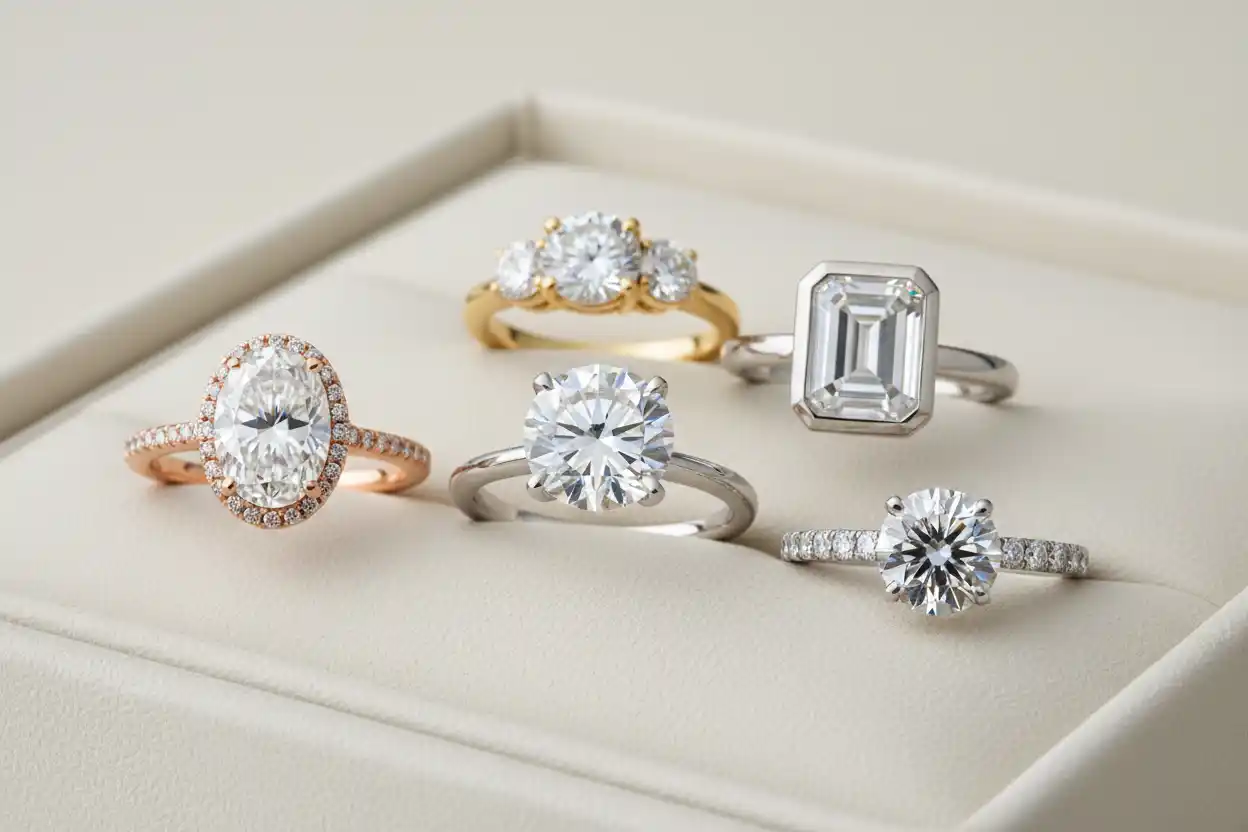
Lab Diamond Engagement Rings: A Complete Buyer’s Guide
A laboratory-grown diamond engagement ring contains a diamond made through a controlled manufacturing process rather than mined from a natural deposit. The finished crystal is diamond: carbon arranged in the diamond structure, with the same fundamental hardness, refractive properties, fire, and everyday durability expected from mined diamond.
The origin difference remains commercially important. Laboratory-grown diamonds are manufactured through high-pressure, high-temperature or chemical vapor deposition processes, may receive post-growth treatment, and usually occupy a different price and resale market from natural diamonds.
A strong purchase therefore requires more than finding the largest stone within the budget. Cut quality, face-up dimensions, color, clarity, report terminology, growth origin, treatment, setting, metal, proportions, warranty, and replacement expectations should all be evaluated together.
The broader lab diamond guide explains the material’s identity, physical properties, manufacturing processes, and symbolism. This page owns the engagement-ring decision.
What Is a Lab Diamond?
A laboratory-grown diamond is a diamond crystal created in a manufacturing environment.
The two main processes are:
- High-pressure, high-temperature growth, usually abbreviated HPHT
- Chemical vapor deposition, usually abbreviated CVD
Both begin with a diamond seed or substrate. HPHT recreates high-pressure and high-temperature conditions, while CVD builds diamond through carbon-bearing gas in a low-pressure chamber.
The finished stone can be cut and polished through the same general methods used for mined diamond. It can also receive independent laboratory examination.
The guide to lab-grown versus natural gemstones explains why a laboratory-grown counterpart differs from an imitation. Moissanite and cubic zirconia resemble diamond but do not share its chemical composition and crystal structure.
Lab Diamond Is Not Fake Diamond
“Fake diamond” is often used loosely, but it obscures three separate categories:
| Product | Composition | Relationship to diamond |
|---|---|---|
| Laboratory-grown diamond | Carbon in diamond structure | Manufactured diamond |
| Mined diamond | Carbon in diamond structure | Naturally formed diamond |
| Moissanite | Silicon carbide | Diamond simulant |
| Cubic zirconia | Zirconium oxide | Diamond simulant |
| Glass | Amorphous silicate material | Diamond imitation |
A laboratory-grown diamond should be disclosed clearly as laboratory-grown or laboratory-created. It should not be presented simply as “diamond” in a way that implies mined origin.
Likewise, a seller should not use “simulated diamond” for a lab diamond, because simulated normally describes a lookalike rather than a diamond.
Why Choose a Lab Diamond Engagement Ring?
Laboratory-grown diamonds generally allow buyers to obtain a larger face-up size, higher apparent color, or higher clarity within the same initial budget.
They also make matched side stones and pavé easier to source consistently. Fancy shapes, colored diamonds, and customized dimensions can be more accessible than equivalent natural options.
A lab diamond may suit a couple that prioritizes:
- Visible size
- Diamond’s hardness and optical character
- Lower initial cost than comparable mined diamond
- A modern manufactured origin
- A specific fancy shape or color
- A ring intended for wear rather than rarity-based collecting
However, lower initial cost does not automatically establish long-term value, sustainability, ethical superiority, or resale strength. Those claims require separate evidence.
The lab diamond price guide owns current price behavior and market context, which can change much faster than the gem’s physical properties.
Lab Diamond vs Natural Diamond for an Engagement Ring
Both materials can provide the same fundamental hardness and diamond optical performance. They can also receive equivalent setting styles and routine jewelry care.
The central differences involve origin, supply, price structure, rarity narrative, report language, secondary-market expectations, and personal preference.
A natural diamond is geologically finite and extracted from the Earth. A lab diamond is manufactured and can be produced repeatedly as technology and capacity expand.
The diamond engagement-ring guide owns natural-diamond ring selection. The general diamond buying guide covers natural diamond quality and documentation, while the diamond price guide addresses its distinct market.
Neither choice is universally correct. The couple should decide whether visible appearance, geological origin, initial price, long-term rarity, or manufacturing transparency matters most.
Begin With Cut, Not Carat Weight
Cut quality has the greatest influence on the brightness, fire, scintillation, and apparent liveliness of a colorless diamond.
A poorly proportioned large stone can look dull, dark, watery, or smaller than expected. A well-cut smaller diamond can appear brighter and visually broader.
For round brilliants, examine cut assessment, table percentage, total depth, crown and pavilion relationships, girdle, symmetry, polish, and face-up pattern.
Fancy shapes do not always receive a universal overall cut grade. Buyers should study video, dimensions, bow-tie effects, light leakage, outline symmetry, and facet pattern rather than relying solely on polish and symmetry grades.
The complete lab diamond buying guide owns the loose-stone evaluation. In an engagement ring, cut must also suit the setting and wedding-band arrangement.
Carat Weight Versus Face-Up Size
Carat measures weight, not visible diameter.
Two lab diamonds of equal weight can look different in size because one is deeper, has a thicker girdle, or uses a different shape. Compare millimeter measurements as well as carat weight.
Elongated ovals, pears, marquises, and emerald cuts may appear larger than round diamonds of the same weight. However, an extremely shallow stone can show windowing, while an extremely deep stone hides weight beneath the setting.
The center should look balanced on the intended finger. A larger stone is not automatically better when the setting becomes top-heavy or the proportions reduce brilliance.
Choosing Color
Colorless-to-near-colorless diamonds are traditionally discussed through a D-to-Z scale. However, current laboratory reporting practices are not identical across every institution.
Some laboratories continue to provide letter color grades for laboratory-grown diamonds. Current GIA quality assessments for eligible colorless-to-near-colorless lab diamonds use broader Premium or Standard classifications rather than presenting the same full grading format used for natural diamonds.
Therefore, compare the actual report system rather than assuming all letters and labels mean the same thing.
For practical ring selection:
- A colorless grade can suit white metal and high-contrast designs.
- Near-colorless material often appears white once mounted.
- Yellow or rose gold can mask a small amount of bodycolor.
- Large emerald and Asscher cuts reveal bodycolor more readily.
- Strong blue, pink, yellow, or other fancy lab-grown colors require different evaluation.
The types of lab diamond guide separates colorless, near-colorless, fancy-color, CVD, HPHT, treated, and other categories. Symbolic interpretations belong to the separate lab diamond color guide.
Choosing Clarity
Clarity describes internal inclusions and external blemishes observed under standardized magnification.
An engagement-ring diamond does not need to be flawless. The practical target is often a stone whose inclusions are not distracting face-up and do not create a durability concern.
Inspect:
- Inclusion visibility without magnification
- Dark inclusions beneath the table
- Reflective inclusions that multiply through the facets
- Surface-reaching features
- Cavities near prongs
- Clouds that reduce transparency
- Strain or growth features visible in certain lighting
An “eye-clean” description is subjective. Ask the seller to state the viewing distance, lighting, and whether the conclusion applies from the top, side, or all directions.
Growth Method: CVD or HPHT
Both processes produce diamond. One is not automatically better for an engagement ring.
HPHT-Grown Diamonds
HPHT diamonds grow under high pressure and high temperature. Some may contain metallic flux inclusions, sector-related growth, or distinctive fluorescence and phosphorescence.
CVD-Grown Diamonds
CVD diamonds grow layer by layer on a substrate. Some may show growth striations, brown or gray components, strain, or post-growth treatment evidence.
Many CVD diamonds undergo HPHT post-growth treatment to improve color. This does not turn them into HPHT-grown diamonds; the report may identify CVD growth with post-growth treatment.
Buy the finished diamond’s appearance and documented quality rather than selecting a growth method through marketing claims alone.
Post-Growth Treatment
Laboratory-grown diamonds may receive post-growth treatment to modify color.
A credible report should disclose growth type and detectable treatment when the reporting service provides those details.
Post-growth treatment is different from fracture filling, coating, or a composite product. It can be an accepted manufacturing step, but it should remain transparent.
Ask whether the seller’s lifetime warranty, upgrade policy, or replacement terms distinguish untreated from post-growth-treated lab diamonds.
Understanding the Report
A report is not simply a decorative certificate. It should be matched to the exact center diamond.
Verify:
- Laboratory name
- Report number
- Laboratory-grown identification
- Growth method when stated
- Post-growth treatment when stated
- Shape and cutting style
- Measurements
- Carat weight
- Quality assessment or 4Cs information
- Polish and symmetry
- Fluorescence
- Comments
- Laser inscription
- Report-verification database entry
The gemstone certification guide explains why a laboratory report differs from an appraisal, warranty, receipt, or retailer guarantee.
Current GIA lab-grown reports do not necessarily resemble older GIA reports or reports from other laboratories. A buyer should not reject a legitimate report merely because it uses different terminology, but should understand precisely what the document does and does not assess.
Check the Laser Inscription
Many graded laboratory-grown diamonds carry a girdle inscription identifying them as laboratory-grown and giving the report number.
Use magnification to confirm that the inscription agrees with the report. However, inscription alone is not infallible. It may be difficult to locate after mounting, can be altered, and fraudulent inscriptions have appeared on other gem materials.
The stone’s dimensions, weight, shape, and identifying characteristics should also match the report.
For a mounted ring, ask the jeweler to show the inscription before delivery and record it on the invoice.
Choosing a Shape
Round Brilliant
Round diamonds offer standardized proportions, strong light return, and broad setting availability. They usually command more per carat than many fancy shapes.
Oval
Oval cuts appear elongated and can provide substantial face-up size. Examine the bow-tie area, outline symmetry, shoulder shape, and tip protection.
Emerald Cut
Emerald cuts emphasize clarity, transparency, and broad flashes rather than intense scintillation. Color and inclusions are more visible, so careful selection matters.
Cushion
Cushions range from broad antique-inspired facets to crushed-ice patterns. Compare actual videos because two cushion diamonds can have very different appearances.
Pear and Marquise
These elongated shapes can appear large for their weight. Their points require V-prongs or protective bezels.
Radiant
Radiants combine a rectangular or square outline with brilliant-style faceting. They can hide inclusions well but vary greatly in pattern and bow-tie effect.
Asscher
Asscher cuts create a geometric hall-of-mirrors appearance. Symmetry, depth, color, and clarity deserve close attention.
Setting Styles
| Setting | Main advantage | Main concern |
|---|---|---|
| Four-prong solitaire | Minimal metal and open view | Less redundancy than six prongs |
| Six-prong solitaire | Strong center-stone security | Slightly more metal |
| Bezel | Protects most of the girdle | Can change apparent size and light entry |
| Halo | Increases visual spread | Many small prongs require maintenance |
| Hidden halo | Adds side detail | Does not enlarge the face-up outline as much |
| Three-stone | Symbolic and balanced | Side stones must align and remain secure |
| Pavé | Adds sparkle along the shank | Small stones can loosen during wear or resizing |
| Cathedral | Supports a raised center | Height can increase snagging |
| Tension | Contemporary appearance | Requires specialist engineering and maintenance |
| East-west | Distinctive orientation | Wedding-band fit may need customization |
A ring intended for unrestricted daily wear should favor secure prongs, enough metal beneath the stone, and a profile that does not catch constantly.
Metal Choices
Platinum provides durable prongs and a naturally white appearance. It develops a surface patina rather than losing metal in exactly the same way as some gold alloys, although it remains expensive and relatively heavy.
White gold offers a lower-cost white appearance but may require rhodium replating. Alloy composition and nickel sensitivity should be checked.
Yellow gold creates contrast and can make near-colorless diamonds appear whiter face-up. Rose gold provides a warmer romantic appearance but may reflect color into an open setting.
The shank should remain thick enough for future maintenance and limited resizing. Extremely delicate bands may bend, spin, or wear quickly, particularly beneath a large center stone.
Side Stones and Pavé
Side stones should be disclosed as laboratory-grown, natural, or simulated. A ring can contain a lab-grown center with natural melee, or the reverse.
Do not assume that a report for the center diamond identifies every small stone in the mounting.
Matched lab-grown side stones can provide consistent color and clarity. However, tiny pavé settings create more maintenance points and can complicate resizing.
A wedding band should not press against exposed center-stone or halo girdles. When the set is designed together, spacing and height can be controlled more effectively.
Lab Diamond vs Moissanite for an Engagement Ring
Moissanite offers high durability, strong brilliance, intense fire, and a lower initial price. It is silicon carbide rather than diamond.
A lab diamond has diamond’s optical character, single refraction, and carbon crystal structure. Moissanite generally produces more rainbow fire and may show facet doubling under magnification.
The direct lab diamond versus moissanite guide owns identification. The separate moissanite engagement-ring guide should guide buyers who already prefer moissanite.
Couples considering a wider range can consult best diamond alternatives and best gemstones for engagement rings.
White Gemstone Alternatives
A colorless center does not need to be diamond or moissanite. White sapphire, zircon, spinel, topaz, quartz, and other stones provide different combinations of brilliance, fire, durability, and price.
The guide to white gemstones for engagement rings compares those alternatives without treating them as optically or physically identical.
A lab diamond remains the strongest choice when the buyer specifically wants diamond’s hardness and optical appearance without mined origin.
Budgeting
Set the complete ring budget rather than spending the entire amount on the center stone.
Account for:
- Center diamond
- Setting
- Side stones
- Metal
- Custom design
- Taxes
- Shipping
- Insurance
- Resizing
- Maintenance
- Wedding-band compatibility
- Future prong or shank work
Lab-diamond prices can move quickly as production and retail competition change. Avoid assuming that today’s retail price predicts future resale value.
The primary value of an engagement ring may be personal and wearable rather than financial. Buyers who need investment liquidity should not rely on a lab diamond ring as a substitute for a diversified asset.
Resale, Trade-In and Replacement
Laboratory-grown diamonds often have weaker resale performance than natural diamonds relative to their original retail price. The exact outcome depends on the seller, market conditions, stone quality, brand, and available replacement cost.
Ask whether the jeweler offers:
- Lifetime trade-up
- Buyback
- Replacement for loss
- Prong inspections
- Resizing
- Manufacturing warranty
- Center-stone upgrade
- Store credit rather than cash
- Restrictions on eligible reports
- Minimum additional spend
Read the written terms. A verbal “lifetime upgrade” promise may include substantial conditions.
For insurance, use a realistic replacement valuation rather than an inflated appraisal that increases premiums without guaranteeing a higher settlement.
Sustainability and Ethical Claims
Laboratory growth avoids conventional diamond mining, but that fact alone does not establish a complete environmental or ethical profile.
Manufacturing consumes energy and materials. Environmental impact varies by electricity source, facility efficiency, location, equipment, and disclosure. Carbon-neutral and renewable-energy claims should identify the standard, boundary, and verifier.
Natural-diamond supply chains also vary widely. A couple should compare evidence rather than accepting universal claims that one origin is automatically ethical or unethical.
FTC-style advertising principles also apply to environmental language. Broad claims such as “eco-friendly,” “zero impact,” or “sustainable” require clear substantiation.
Buying Online
The safeguards in How to Buy Gemstones Online Without Getting Scammed apply directly to lab-diamond rings.
Request:
| Buying detail | What to confirm |
|---|---|
| Origin | Laboratory-grown diamond |
| Growth method | HPHT or CVD when reported |
| Post-growth treatment | Written disclosure |
| Report | Verifiable number matching the stone |
| Dimensions | Millimeter measurements and carat weight |
| Video | Neutral lighting and movement |
| Setting | Metal, prongs, side stones and construction |
| Side-stone origin | Natural, laboratory-grown or simulant |
| Ring size | Current size and resizing limitations |
| Returns | Inspection period and shipping responsibility |
| Warranty | Written maintenance and replacement terms |
| Appraisal | Replacement purpose and realistic assumptions |
Keep screenshots of the listing, report, and seller communications until the return period has ended.
Cleaning and Maintenance
Diamond is highly resistant to scratching, but grease and residue quickly reduce its brilliance. The setting is usually more vulnerable than the stone.
Follow How to Clean Lab Diamond Jewelry Safely for routine care.
Warm water, mild soap, and a soft brush are generally safe. Clean beneath the center diamond and around pavé carefully.
Have frequently worn rings inspected for loose prongs, bent shanks, worn settings, chipped girdles, and missing side stones. Remove the ring for heavy lifting, gym work, gardening, mechanical work, swimming, and harsh household chemicals.
Frequently Asked Questions
1. Is a lab diamond a real diamond?
Yes. It has the diamond crystal structure and corresponding chemical, optical, and physical properties, but it has a manufactured rather than mined origin.
2. Is a lab diamond suitable for an everyday engagement ring?
Yes. Diamond’s Mohs hardness of 10 and strong wearability make it suitable for daily use, although the setting still requires care and inspection.
3. Should I prioritize carat weight or cut?
Prioritize cut and face-up appearance. A brighter, well-proportioned diamond often looks better than a larger stone with poor light performance.
4. Is CVD better than HPHT?
Neither process is automatically better. Evaluate the finished stone’s appearance, report, treatment, cut, color, clarity, and price.
5. Are lab diamonds always colorless and flawless?
No. They occur in different colors and clarity levels and may contain growth-related inclusions, strain, or post-growth treatment evidence.
6. Does every lab-diamond report use the 4Cs?
No. Reporting systems differ. Some laboratories use 4Cs grades, while current GIA assessments for eligible colorless-to-near-colorless lab diamonds use Premium or Standard categories.
7. Is a laser inscription enough to prove the diamond matches the report?
It is helpful but should be checked alongside measurements, weight, shape, and report details. Fraudulent or altered inscriptions are possible.
8. Do lab diamonds have resale value?
They can have resale value, but resale offers are often much lower than original retail prices and may change as new production prices change.
9. Can a jeweler tell a lab diamond from a natural diamond by looking at it?
Usually not with unaided vision. Conclusive origin determination commonly requires specialized screening and laboratory equipment.
10. Is moissanite the same as a lab diamond?
No. Moissanite is silicon carbide and a diamond simulant. It has different optical properties, density, refraction, and laboratory test results.
11. Are lab diamonds automatically sustainable?
No. Environmental performance depends on energy source, manufacturing efficiency, facility practices, and the scope of the claim.
12. What paperwork should come with the ring?
Keep the laboratory report, itemized invoice, treatment and origin disclosure, metal and side-stone details, warranty, return policy, appraisal, sizing record, and insurance documentation.
A strong lab-diamond engagement-ring purchase is built around transparent origin, excellent light performance, secure construction, and realistic expectations. The best ring does not simply maximize carat weight. It balances face-up beauty, report quality, metal strength, setting height, wedding-band fit, service terms, and the couple’s priorities regarding origin and long-term value.