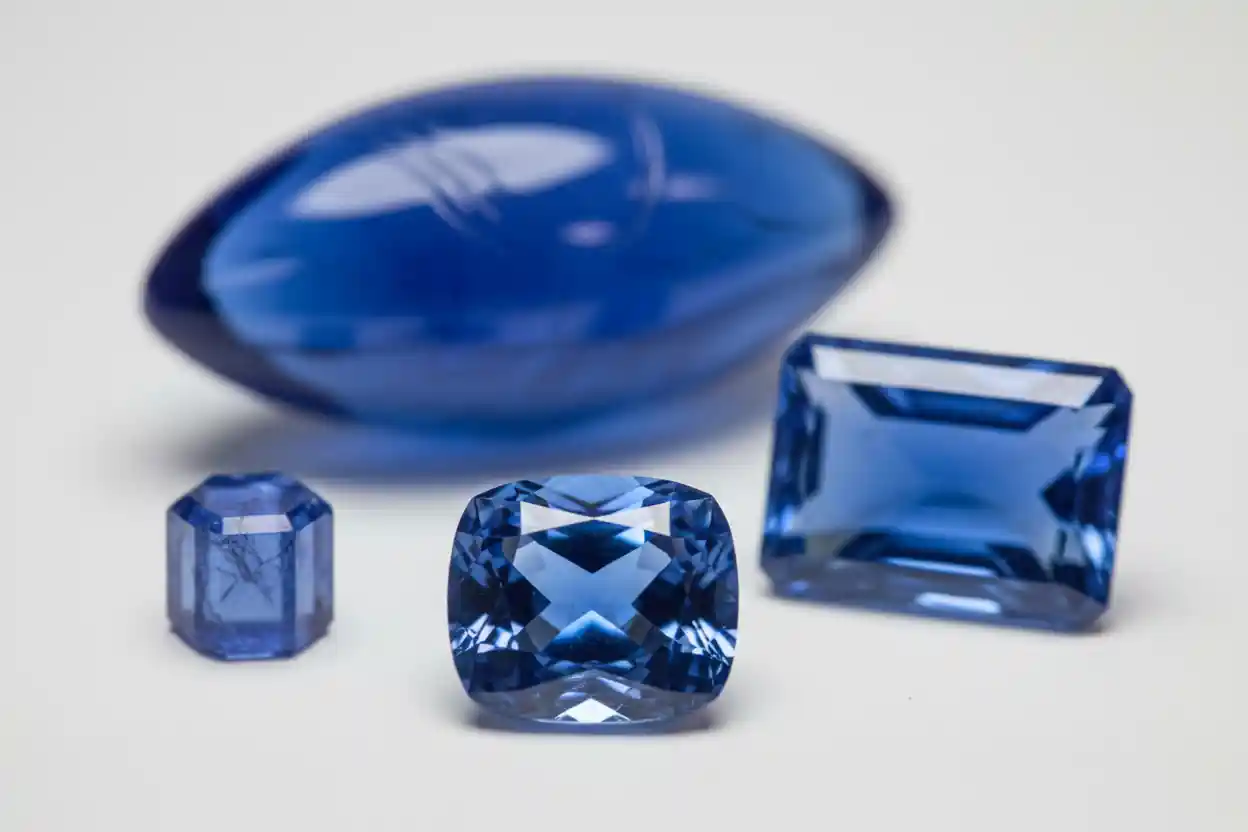
Lab Sapphire Meaning: Healing Properties, Uses & Symbolism
Lab sapphire meaning begins with an origin distinction, not a different mineral identity. A correctly described laboratory-grown sapphire is synthetic corundum produced under controlled conditions rather than through natural geological growth. Sapphire is the non-red gem variety of corundum, Al₂O₃, and GIA records its fundamental properties at refractive index 1.762–1.770, birefringence 0.008–0.010, specific gravity around 4.00, and Mohs hardness 9. Laboratory-grown sapphire is intended to reproduce those corundum properties rather than simply imitate sapphire’s appearance.
That distinction separates laboratory-grown sapphire from blue glass, synthetic spinel used as a sapphire imitation, coated materials, and other products that can look similar while belonging to different material classes. FTC guidance states that terms such as laboratory-grown, laboratory-created, or synthetic should be used for a manufactured gemstone only when it possesses essentially the same optical, physical, and chemical properties as the corresponding mined stone, and the laboratory origin should be disclosed clearly.
The symbolism is a different evidence category. General sapphire traditions have long associated the gem with themes such as loyalty, truth, wisdom, authority, reflection, or commitment, but laboratory-grown sapphire as a manufacturing category is modern. A person can reasonably extend older sapphire symbolism to a synthetic sapphire or give laboratory origin newer meanings—precision, deliberate creation, accessibility, technological achievement, or transparent disclosure—without treating those ideas as measurable effects of corundum. This article keeps material science, growth history, documented uses, and symbolism separate within the Healing Crystal collection.
Lab Sapphire at a Glance
| Feature | Evidence-based description |
|---|---|
| Material | Sapphire |
| Mineral species | Corundum |
| Formula | Al₂O₃ |
| Sapphire definition | Gem corundum in colors other than red |
| Crystal system | Trigonal |
| Origin | Laboratory-grown rather than naturally geological |
| Major synthetic methods | Flame fusion, Czochralski pulling, flux growth, hydrothermal growth, and other specialized methods |
| Refractive index | Approximately 1.762–1.770 |
| Birefringence | Approximately 0.008–0.010 |
| Specific gravity | About 4.00 |
| Mohs hardness | 9 |
| Cleavage | None |
| Toughness | Excellent in sound corundum |
| Optical character | Uniaxial negative |
| Familiar color | Blue |
| Other possible colors | Colorless, pink, yellow, orange, green, purple, violet, and others |
| Classic blue color mechanism | Fe²⁺–Ti⁴⁺ intervalence charge transfer |
| Pink color | Primarily Cr³⁺ |
| Yellow possibilities | Iron-related and defect-related chromophores, with synthetic dopants also used |
| Classic flame-fusion clue | Curved growth banding |
| Flux-growth clue | Flux residues or characteristic inclusions |
| Hydrothermal clues | Method-specific internal growth structures and spectroscopic features |
| Same geological origin as natural sapphire? | No |
| Same base mineral species? | Yes |
| Proven crystal-healing effect | None established |
What Lab Sapphire Actually Is
Laboratory-grown sapphire is corundum manufactured through crystal-growth technology. The word synthetic has a precise gemological meaning here: it indicates a laboratory-produced counterpart with essentially the same key material properties as the natural gemstone. It does not mean that the object is merely colored to resemble sapphire. GIA specifically lists synthetic corundum among the most widely available laboratory-grown gem materials and notes that corundum can be produced using more synthesis methods than many other gemstones.
The simplest framework is:
Natural sapphire: corundum + geological origin.
Lab sapphire: corundum + controlled laboratory growth.
Sapphire imitation: another material + sapphire-like appearance.
An identification report can therefore conclude that a stone is synthetic sapphire without implying that it is glass, plastic, or “fake corundum.”
This same material-versus-origin distinction is important when evaluating buy Lab Sapphire, because a buyer needs to know whether a product is genuinely laboratory-grown corundum before comparing color, size, price, or jewelry design.
Identity Table
| Claim or observation | Evidence-based interpretation | Diagnostic strength |
|---|---|---|
| Al₂O₃ chemistry | Corundum chemistry | Fundamental |
| Trigonal structure | Corundum structure | Fundamental |
| RI 1.762–1.770 | Compatible with corundum | Strong species evidence |
| SG near 4.00 | Compatible with corundum | Strong species evidence |
| Mohs 9 | Corundum property | Strong conceptually |
| No cleavage | Characteristic | Supporting |
| Blue color | Compatible with sapphire | Weak for origin |
| Curved growth bands | Classic flame-fusion clue | Strong synthetic evidence |
| Angular natural-looking zoning | Can occur in natural sapphire | Supporting, not absolute |
| Platinum crystal inclusion | Can support certain flux synthetics | Strong in context |
| Hydrothermal internal structure | Supports hydrothermal synthesis | Strong in context |
| Perfect clarity | Does not prove laboratory origin | Weak |
| Strong fluorescence | Does not automatically prove synthetic origin | Weak alone |
| “Created sapphire” label | Commercial representation | Requires verification |
| Glass with blue color | Not lab sapphire | Different material |
| Diffusion-treated synthetic corundum | Still synthetic sapphire, with additional treatment | Origin and treatment must both be stated |
Flame-Fusion Sapphire
Flame fusion, also called the Verneuil process, is one of the best-known methods for producing synthetic sapphire. Powdered chemical feed material passes through a high-temperature flame, melts, and accumulates on a support where a corundum boule grows. GIA describes flame fusion as the least expensive and one of the most common synthetic-gem processes, particularly for corundum and spinel.
The method often leaves an especially useful diagnostic feature: curved growth banding. Natural sapphire commonly shows angular or straight crystallographically controlled zoning, while Verneuil sapphire can display curved bands that follow the shape of the growing boule. GIA notes that this curved banding can be obvious under magnification or suitable short-wave ultraviolet observation and remains a classic way to identify flame-fusion synthetic sapphire.
Gas bubbles and other melt-growth structures may also occur, although no individual synthetic sapphire is required to contain every classic feature.
Flame-fusion material can range from inexpensive calibrated jewelry stones to larger crystals, star sapphires, technical corundum, and colored material produced with deliberate dopants.
Czochralski-Pulled Sapphire
Czochralski growth starts with molten material in a crucible. A seed crystal contacts the melt and is slowly pulled while rotating, allowing a large single crystal to develop. GIA lists synthetic corundum among gemstones produced by crystal pulling and notes that the method can create high-quality crystals with carefully controlled chemistry.
This process has become especially important outside ordinary jewelry because synthetic sapphire can be produced with high purity, uniform doping, and substantial dimensions for technological applications and research.
Czochralski-grown material also demonstrates why laboratory sapphire should not be thought of as one standardized commercial stone. Different growth technologies can produce different impurity distributions, internal structures, crystal forms, and optical behavior while all remaining synthetic corundum.
The detailed differences between laboratory growth methods and natural corundum geology belong in Lab Sapphire formation and deposit geology.
Flux-Grown Sapphire
Flux growth is a solution process rather than a direct melt-growth method. The components required for corundum dissolve in a molten flux and crystallize more gradually as conditions are controlled.
GIA notes that sapphire can be grown through flux methods and that flux-grown synthetic sapphires have circulated commercially for a long time. Microscopically, the growth medium can leave diagnostically useful inclusions. GIA’s synthetic-sapphire inclusion collection includes a tapered platinum crystal in a flux-grown Chatham sapphire as an example of a feature strongly associated with its growth environment.
Flux material may also contain residues, veils, fingerprints, or other structures unfamiliar to someone expecting a perfectly clean laboratory stone.
Those inclusions should not automatically be treated as defects. They can provide valuable evidence about how the crystal formed.
Hydrothermal Sapphire
Hydrothermal synthesis uses hot aqueous solutions under pressure to transport dissolved components and grow crystals under controlled conditions.
GIA research on hydrothermal synthetic sapphire demonstrates that the method can produce gem-quality material across several colors and can create method-specific internal features as well as distinctive infrared evidence related to hydroxyl and carbon-oxygen groups.
Some hydrothermal synthetic sapphires show roiled, angular, or chevron-like growth structures. The important point is not that every hydrothermal sapphire has one universal visual fingerprint, but that the growth environment leaves evidence different from both natural geological growth and melt-grown synthetics.
A laboratory may therefore use microscopy, infrared spectroscopy, UV response, chemistry, and other tools together rather than relying on one inclusion.
Why Blue Lab Sapphire Is Blue
Pure corundum is colorless. Blue sapphire color arises when appropriate trace elements and defect chemistry alter the way the crystal absorbs visible light.
GIA identifies neighboring Fe²⁺ and Ti⁴⁺ ions as the principal chromophore responsible for classic blue sapphire. Their interaction produces intervalence charge transfer that strongly absorbs parts of the visible spectrum and leaves the stone appearing blue.
Laboratory growers can deliberately introduce suitable trace-element combinations into corundum, meaning iron and titanium are not evidence of natural geological origin by themselves.
The same underlying principle applies to other sapphire colors. Chromium produces pink corundum and, at stronger appropriate concentrations, red ruby; iron-related and defect-related processes can produce yellow; vanadium can contribute violet, purple, or color-change behavior; and laboratory growth may also employ dopants that are uncommon or differently distributed in natural material.
The detailed chromophore discussion belongs in Lab Sapphire optical properties and color behavior, while symbolic interpretations of blue, pink, yellow, white, and other colors are separated into Lab Sapphire color meaning.
Lab Sapphire Comes in Far More Than Blue
Sapphire means non-red gem corundum, not simply blue corundum. GIA identifies sapphire in every color except red, because red corundum is classified as ruby.
Laboratory-grown sapphire can therefore be manufactured as:
- blue;
- pink;
- yellow;
- orange;
- purple;
- violet;
- green;
- colorless;
- color-change;
- star material;
- unusually colored research material.
This broad palette is possible because laboratory growth gives researchers and manufacturers considerable control over impurities and defects.
That does not mean every synthetic color perfectly duplicates a natural chromophore system. Some laboratory colors are produced with dopants or defect combinations chosen primarily because they produce a desired optical effect.
Original Claim Audit: Common Lab Sapphire Statements Tested
| Common statement | Evidence status | More accurate interpretation |
|---|---|---|
| “Lab sapphire is fake sapphire.” | Misleading | Proper laboratory-grown sapphire is synthetic corundum |
| “Lab sapphire is blue glass.” | Incorrect | Glass is a sapphire imitation |
| “Synthetic sapphire has different hardness.” | Incorrect as a general rule | Sapphire remains Mohs 9 corundum |
| “All lab sapphire is flame fusion.” | Incorrect | Flame fusion, pulling, flux, hydrothermal, and other methods exist |
| “Curved bands strongly support flame-fusion origin.” | Supported | A classic synthetic-corundum clue |
| “Every synthetic sapphire has curved bands.” | Incorrect | Other growth methods have different structures |
| “A perfectly clean sapphire must be synthetic.” | Incorrect | Natural stones can be clean; synthetics can be included |
| “Visible inclusions prove natural origin.” | Incorrect | Synthetic material can contain diagnostic inclusions |
| “Blue color proves natural sapphire.” | Incorrect | Blue synthetic corundum is widely produced |
| “Iron and titanium prove natural sapphire.” | Incorrect | Growers can incorporate color-causing trace elements deliberately |
| “Strong fluorescence proves synthetic origin.” | Too simplistic | UV behavior is supportive evidence, not a universal verdict |
| “Lab sapphire cannot be treated.” | Incorrect | Synthetic corundum can receive post-growth diffusion, dye, filling, or other modification |
| “Laboratory-grown means untreated.” | Incorrect | Growth origin and treatment history are separate |
| “All lab sapphire is inexpensive.” | Incorrect | Growth method, size, precision, provenance, and retail channel can vary widely |
| “Lab sapphire has no historical or scientific value.” | Incorrect | Synthetic sapphire is important in research and technology |
| “Lab sapphire carries ancient lab-specific symbolism.” | Unsupported | Laboratory-grown sapphire is a modern material category |
| “Blue lab sapphire scientifically improves communication.” | Unsupported | Symbolism does not establish physiological effects |
| “Wearing sapphire changes brain function.” | Unsupported | No established evidence supports such therapeutic claims |
This table is intentionally stricter than retail marketing. A statement can be emotionally appealing without qualifying as gemological evidence.
Original Specimen and Photo Checklist
A useful lab sapphire record should capture what can actually be observed before interpretation.
| Field | What to record | Why it matters |
|---|---|---|
| Color | Blue, pink, yellow, green, colorless, other | Establishes real appearance |
| Tone | Light, medium, dark | Affects visual performance |
| Saturation | Weak, moderate, vivid | Helps compare stones |
| Color zoning | Curved, angular, straight, patchy, uniform | Strong growth information |
| Rough form | Boule, pulled crystal, plate, faceted gem, cabochon | May support growth context |
| Curved striae | Present/absent/uncertain | Flame-fusion clue |
| Gas bubbles | Size, shape, distribution | Useful in some melt-grown material |
| Flux inclusions | Present/absent/type | Supports flux synthesis |
| Metallic inclusions | Shape and reflectivity | Can support particular growth environments |
| Hydrothermal structures | Chevron, roiled, seed-related, other | Supports hydrothermal growth |
| RI | Exact reading | Confirms corundum |
| SG | Exact measurement | Confirms corundum |
| Pleochroism | Directional colors | Normal sapphire optical behavior |
| Fluorescence | Long-wave and short-wave response | Supporting evidence |
| Spectrum | Color-related absorption | Helps characterize chromophores |
| Surface color concentration | Present/absent | Can indicate diffusion or coating |
| Fracture filling | Present/absent/uncertain | Changes treatment and care interpretation |
| Report | Laboratory and conclusion | Strong transaction-level evidence |
| Photograph conditions | Light, white balance, magnification | Makes color comparisons reproducible |
A checklist should record evidence, not assign a made-up “95% natural” or “90% synthetic” probability from photographs.
Diagnostic Traits: Species Identification Comes First
Routine gemological instruments can identify a transparent stone as corundum through its RI, birefringence, SG, optic character, spectrum, and other physical properties. GIA lists sapphire at RI 1.762–1.770, birefringence 0.008–0.010, SG 4.00, and Mohs 9.
Those measurements answer:
Is this corundum?
They do not necessarily answer:
Did this corundum grow naturally or synthetically?
Natural and synthetic sapphire overlap precisely because synthetic production seeks to create corundum.
The second question therefore requires growth evidence.
Microscopy Is Often the Most Efficient Origin Tool
GIA describes the binocular microscope as one of the most important tools for separating natural, synthetic, and treated sapphire. Synthetic stones produced by flame fusion, flux, hydrothermal, and other methods show growth features different from those typically seen in natural corundum.
Classic examples include:
- curved banding in flame-fusion sapphire;
- gas bubbles associated with melt growth;
- platinum inclusions in some flux-grown stones;
- hydrothermal growth textures;
- surface-related color concentrations after some diffusion treatments.
Natural sapphire may instead contain rutile needles, zircon, apatite, spinel, feldspar, fluid inclusions, angular zoning, healed fractures, or geological mineral assemblages depending on origin.
The detailed microscopic workflow belongs in the Lab Sapphire microscope inclusion notebook rather than reducing origin to one inclusion.
Difficult Synthetics Can Look Surprisingly Natural
Synthetic identification becomes harder when manufactured material contains unexpected features.
GIA has documented laboratory-grown sapphire containing twinning, tubules, orange staining, and partially crystallized foreign material that appeared unusually natural under ordinary observation. Curved fluorescence banding and trace-element chemistry ultimately supported flame-fusion synthetic origin.
This is a valuable warning against memorized internet rules.
“Natural-looking inclusion” does not equal natural geological origin.
The inclusion must fit the complete crystal-growth story.
Treatments Are Separate From Synthetic Origin
A laboratory-grown sapphire can be synthetic and untreated after growth.
It can also be synthetic and additionally treated.
GIA has documented melt-grown synthetic sapphire subjected to titanium and beryllium diffusion, as well as synthetic sapphire modified through quench-crackling and dyeing.
This makes three different questions necessary:
- Is the material corundum?
- Is the corundum natural or laboratory-grown?
- Has the sapphire received additional treatment?
One answer should never be used as a shortcut for the other two.
Diffusion Treatment
Lattice diffusion uses heat and chemicals to introduce color-causing elements into sapphire. GIA notes that treated color may penetrate only a shallow surface layer in some stones or much deeper in others.
A laboratory-grown colorless sapphire can therefore begin as synthetic corundum and later be modified to produce blue or another color.
That stone remains laboratory-grown sapphire, but the treatment should be identified separately.
If diffusion is shallow, repolishing or damage may remove some treated color. This is an ownership issue, not merely a disclosure technicality.
Safe Ownership
Sound laboratory-grown sapphire inherits corundum’s excellent jewelry properties. GIA rates sapphire Mohs 9, with excellent toughness and no cleavage, making it suitable for rings and other jewelry exposed to regular wear.
Laboratory origin does not make corundum softer.
The main exceptions arise when the individual stone has:
- significant fractures;
- vulnerable inclusions;
- shallow diffusion treatment;
- glass-filled fractures;
- dye;
- coatings;
- damaged facet junctions;
- an insecure setting.
These factors can change the practical ownership profile even when the underlying crystal remains sapphire.
Setting-specific risks such as prong pressure, exposed corners, girdle protection, and high-impact wear belong in Lab Sapphire setting and wear engineering.
Cleaning
Warm soapy water is a conservative cleaning method for sapphire. GIA states that ultrasonic and steam cleaning are generally appropriate for untreated, heat-treated, and lattice-diffusion-treated sapphire, while fracture-filled, cavity-filled, or dyed material should receive much more cautious treatment.
That distinction again shows why “lab grown” is not itself a complete care instruction.
A synthetic sapphire ring containing a filled stone can need more conservative treatment than an untreated synthetic sapphire pendant.
Detailed cleaning procedures belong in how to clean Lab Sapphire jewelry.
Bracelet, Earring, Necklace, and Ring Use
Corundum’s high hardness makes synthetic sapphire practical across many jewelry formats, but construction matters.
A Lab Sapphire bracelet experiences repeated contact with desks, clothing, adjacent beads, clasps, and other hard surfaces, so drill-hole quality and stringing construction matter in addition to stone hardness.
Lab Sapphire earrings generally face less impact but introduce questions about matched color, weight, backs, metal, and setting security.
A Lab Sapphire necklace introduces pendant orientation, chain balance, clasp security, drilling, and movement.
A Lab Sapphire ring is exposed to the greatest routine impact and therefore places more importance on setting geometry even though sapphire itself is durable.
These construction questions should not be confused with lab sapphire meaning or symbolism.
Cutting and Orientation
Synthetic sapphire can be cut poorly or exceptionally well. Laboratory origin does not guarantee symmetry, brightness, or sensible proportions.
Pleochroism, color zoning, rough morphology, seed orientation, curved boule structure, inclusion placement, and desired weight retention all influence cutting decisions.
A flame-fusion boule may present different planning problems from a flux-grown or pulled crystal. Precision cutting can also increase finished-gem cost substantially even when synthetic rough is inexpensive.
Detailed orientation, yield, polishing, windowing, extinction, and facet-design decisions belong in Lab Sapphire cutting, orientation, and polish.
Price Is Not Meaning
Laboratory-grown sapphire often allows attractive color, clarity, and size at lower cost than exceptionally fine natural sapphire because manufacturing does not reproduce the same geological scarcity.
That does not create one fixed synthetic-sapphire price.
Growth method, manufacturer, size, color, transparency, cutting, treatment, provenance, calibrated dimensions, and retail channel can all affect asking price.
The market-value framework belongs on Lab Sapphire price rather than being folded into symbolic interpretations.
Documented History
Synthetic sapphire developed from the broader effort to reproduce corundum in controlled environments. Flame fusion became the first commercially successful route for synthetic corundum, and GIA notes that early synthetic sapphires appear in historic decorative jewelry. Flux-grown sapphire later entered the commercial market, while pulling and hydrothermal methods expanded both gem production and technical applications.
Synthetic sapphire is also important well beyond jewelry. High-purity manufactured corundum has optical, electronic, scientific, and mechanical uses because it combines hardness, transparency, thermal stability, and controllable composition. GIA specifically notes synthetic sapphire’s use in highly durable windows, including scanner and spacecraft applications.
Those technological uses are documented properties of the material.
They do not establish healing effects.
Modern Lab Sapphire Symbolism
General sapphire symbolism commonly centers on truth, loyalty, wisdom, commitment, reflection, authority, or mental discipline.
Someone choosing laboratory-grown sapphire may use the same themes because the stone is sapphire material and visually participates in the broader sapphire tradition.
Laboratory origin can add contemporary meanings:
- deliberate creation;
- technological skill;
- precision;
- repeatability;
- transparency about origin;
- choosing beauty without geological rarity;
- accessibility.
A person may use a blue lab sapphire as a reminder to communicate carefully or remain intellectually disciplined. That is a symbolic use of an object.
It is not evidence that the stone changes neural activity or biochemistry.
Symbolism Boundary
A gemological statement can say synthetic sapphire is laboratory-grown Al₂O₃ corundum.
An optical statement can explain Fe²⁺–Ti⁴⁺ blue color.
A manufacturing statement can identify flame-fusion, pulling, flux, or hydrothermal growth.
A historical statement can describe technological and jewelry use.
A symbolic statement can associate sapphire with wisdom, loyalty, focus, or commitment.
These categories should remain distinct.
Blue color does not physically produce calmness.
Mohs hardness 9 does not create emotional resilience.
Laboratory precision does not improve cognitive precision.
A synthetic crystal does not biologically alter communication ability.
Healing Claims and Evidence
Statements that lab sapphire heals anxiety, regulates hormones, improves eyesight, controls blood pressure, strengthens the brain, treats depression, enhances fertility, removes toxins, or changes neurological function are not established gemological or medical facts.
Corundum is chemically stable under ordinary wear. Its aluminum and trace elements are incorporated into a crystal lattice rather than delivered as therapeutic doses through skin contact.
Do not grind or ingest sapphire for health purposes.
A gemstone can be used as a personal reminder, meditation object, piece of jewelry, or symbolic possession without being presented as a medical device.
What a Photograph Can Establish
A photograph can document:
- color;
- saturation;
- zoning;
- cut;
- rough form;
- visible inclusions;
- curved banding if sufficiently clear;
- damage;
- surface color concentrations;
- size when a scale is included.
A photograph cannot reliably establish:
- exact chemistry;
- RI;
- SG;
- every synthetic growth method;
- whether a clean stone is natural or synthetic;
- trace-element concentration;
- hidden treatment;
- the complete origin conclusion.
The strongest photographs are therefore descriptive records rather than final laboratory verdicts.
When Advanced Testing Matters
Standard gemological testing can establish corundum identity. Microscopy may then resolve many classic flame-fusion or flux-grown stones.
When those features are absent or ambiguous, laboratories can escalate to:
- UV-visible spectroscopy;
- FTIR;
- Raman spectroscopy;
- fluorescence imaging;
- trace-element chemistry;
- advanced microscopy.
Hydrothermal synthetic sapphire, unusually clean melt-grown material, treated synthetics, and stones containing deliberately natural-looking features may require this stronger evidence.
No responsible identification method should force certainty when evidence remains incomplete.
Specimen and Research Value
A synthetic sapphire can have scientific or collector significance beyond jewelry.
Examples include:
- early commercial boules;
- unusual flux-grown crystals;
- experimental hydrothermal material;
- Czochralski research crystals;
- synthetic star sapphire;
- unusual dopant chemistry;
- material used as analytical standards;
- specimens preserving distinctive growth sectors;
- documented technological samples.
GIA research itself uses carefully grown synthetic sapphire as trace-element standards because high-purity controlled crystals can provide compositions difficult to obtain from heterogeneous natural material.
For such specimens, original labels, manufacturer information, growth method, laboratory data, seed relationships, rough morphology, and historical context can be more important than jewelry clarity.
Long-term documentation belongs in the Lab Sapphire specimen conservation record.
Common Lab Sapphire Misunderstandings
The first misconception is that laboratory-grown sapphire is blue glass. Proper synthetic sapphire is corundum.
A second is that synthetic means imitation. In gemological usage, a synthetic gemstone is the laboratory-grown counterpart of a natural material.
A third is that all laboratory sapphire comes from flame fusion. Multiple production technologies exist.
A fourth is that every synthetic sapphire displays curved striae. Curved banding is characteristic of flame fusion, not every growth method.
A fifth is that perfect clarity proves laboratory origin. It does not.
A sixth is that visible inclusions prove geological origin. Flux, hydrothermal, and melt-grown synthetics can all contain inclusions.
A seventh is that blue sapphire automatically contains only iron and titanium. Blue color is commonly tied to Fe-Ti interaction, but actual color chemistry and treatment history can be more complex.
An eighth is that synthetic origin guarantees no additional treatment. Diffusion, dyeing, filling, and other modifications can be applied to manufactured corundum.
A ninth is that laboratory-grown sapphire has no legitimate historical or technological value. Synthetic corundum has extensive jewelry, scientific, optical, and industrial applications.
A tenth is that lab sapphire meaning describes a scientifically measurable energy. The symbolic meaning belongs to people; the measurable properties belong to corundum.
A Practical Evidence Hierarchy
The weakest evidence is a product listing saying “lab sapphire.”
A better level is a neutral-light photograph showing actual color and inclusions.
RI and SG can establish corundum identity.
Magnification can identify growth structures such as curved flame-fusion banding or certain flux inclusions.
Spectroscopy and fluorescence can add growth or treatment evidence.
Trace-element analysis can become important in difficult cases.
An independent gemological report is the strongest transaction-level evidence when natural-versus-laboratory origin materially affects price.
The strength of the investigation should match the financial importance of the claim.
Frequently Asked Questions
What is lab sapphire?
Lab sapphire is laboratory-grown corundum, Al₂O₃, manufactured to have essentially the same fundamental material properties as sapphire that forms naturally.
Is lab sapphire real sapphire?
It is sapphire material with laboratory origin. It is not a naturally mined sapphire, but it is fundamentally different from a glass or spinel imitation.
Is synthetic sapphire fake?
Not in technical gemological terminology. Synthetic sapphire means laboratory-grown corundum whose optical, physical, and chemical properties correspond essentially to sapphire.
Is lab sapphire glass?
No. Glass can imitate sapphire, but genuine laboratory-grown sapphire is crystalline corundum.
What is lab sapphire made of?
Its principal composition is aluminum oxide, Al₂O₃. Trace elements and crystal defects can create different colors.
How hard is lab sapphire?
As corundum, it is approximately Mohs 9 and has excellent toughness with no cleavage.
Does lab sapphire have the same RI as natural sapphire?
Their species-level ranges substantially overlap because both are corundum. GIA lists sapphire at approximately 1.762–1.770.
How is lab sapphire made?
Important methods include flame fusion, Czochralski pulling, flux growth, hydrothermal growth, and other specialized synthesis methods.
What is flame-fusion sapphire?
It is synthetic corundum grown from melted powdered feed material in a high-temperature flame. Curved growth banding is one of its classic identifying features.
What is Czochralski sapphire?
It is synthetic sapphire grown by pulling a seed crystal slowly from molten corundum material, allowing controlled production of large, high-quality crystals.
What is flux-grown sapphire?
It is synthetic corundum crystallized from components dissolved in a molten flux. Growth-related inclusions, including characteristic metallic or flux features, can help identify the method.
What is hydrothermal sapphire?
It is synthetic sapphire grown from hot pressurized solutions. Hydrothermal material can display distinctive internal structures and spectroscopic evidence.
Why is blue lab sapphire blue?
The classic blue sapphire chromophore is the interaction of neighboring Fe²⁺ and Ti⁴⁺ ions in the corundum lattice.
Can lab sapphire be pink?
Yes. Chromium can produce pink coloration in corundum; sufficiently red chromium-bearing corundum is classified as ruby rather than sapphire.
Can lab sapphire be yellow, green, purple, or colorless?
Yes. Synthetic sapphire can be produced across a wide range of colors through controlled trace elements, defects, and manufacturing conditions.
Can lab sapphire have inclusions?
Yes. Synthetic sapphires can contain curved bands, gas bubbles, flux inclusions, metallic crystals, seed features, hydrothermal structures, and other method-specific inclusions.
Does a flawless sapphire prove laboratory origin?
No. Clarity alone cannot establish whether a sapphire is natural or synthetic.
Do curved bands prove lab sapphire?
Curved growth banding is strong evidence for flame-fusion synthetic sapphire when correctly observed, but other synthetic growth methods do not necessarily display it.
Can strong fluorescence prove a sapphire is synthetic?
No. Fluorescence can support an origin interpretation but should be considered with growth structures, chemistry, and other evidence.
Can lab sapphire be treated after growth?
Yes. GIA has documented laboratory-grown sapphire receiving diffusion, dyeing, quench-crackling, and other post-growth modification.
Is lab sapphire suitable for daily jewelry?
Yes, when the stone is sound and its treatment does not introduce special vulnerabilities. Corundum’s Mohs 9 hardness, excellent toughness, and lack of cleavage make sapphire one of the stronger jewelry materials.
How should lab sapphire be cleaned?
Warm soapy water is a conservative choice. Treatment status should be checked before using more aggressive methods because filled or dyed material requires greater caution.
What does lab sapphire symbolize?
Modern symbolic interpretations can include wisdom, loyalty, truth, focus, commitment, deliberate creation, or technological precision. These are human meanings rather than measured physical properties.
Does lab sapphire have healing properties?
No established scientific evidence shows that wearing or holding laboratory-grown sapphire treats physical or psychological illness.
Does blue lab sapphire improve communication or calmness?
Those are modern symbolic claims. Blue color results from optical absorption within corundum and does not establish a neurological or therapeutic mechanism.
Is lab sapphire less valuable than natural sapphire?
Laboratory production usually creates a different scarcity and pricing framework. Actual value depends on color, size, clarity, cut, growth method, provenance, treatment, documentation, and retail channel.
Can a photo prove that sapphire is laboratory grown?
No. Photography may reveal diagnostic growth features in some stones, but difficult cases can require microscopy, spectroscopy, fluorescence imaging, or trace-element analysis.
How can a laboratory tell natural and synthetic sapphire apart?
Laboratories combine growth structures, inclusions, spectroscopy, fluorescence, chemistry, and other evidence appropriate to the specimen.