
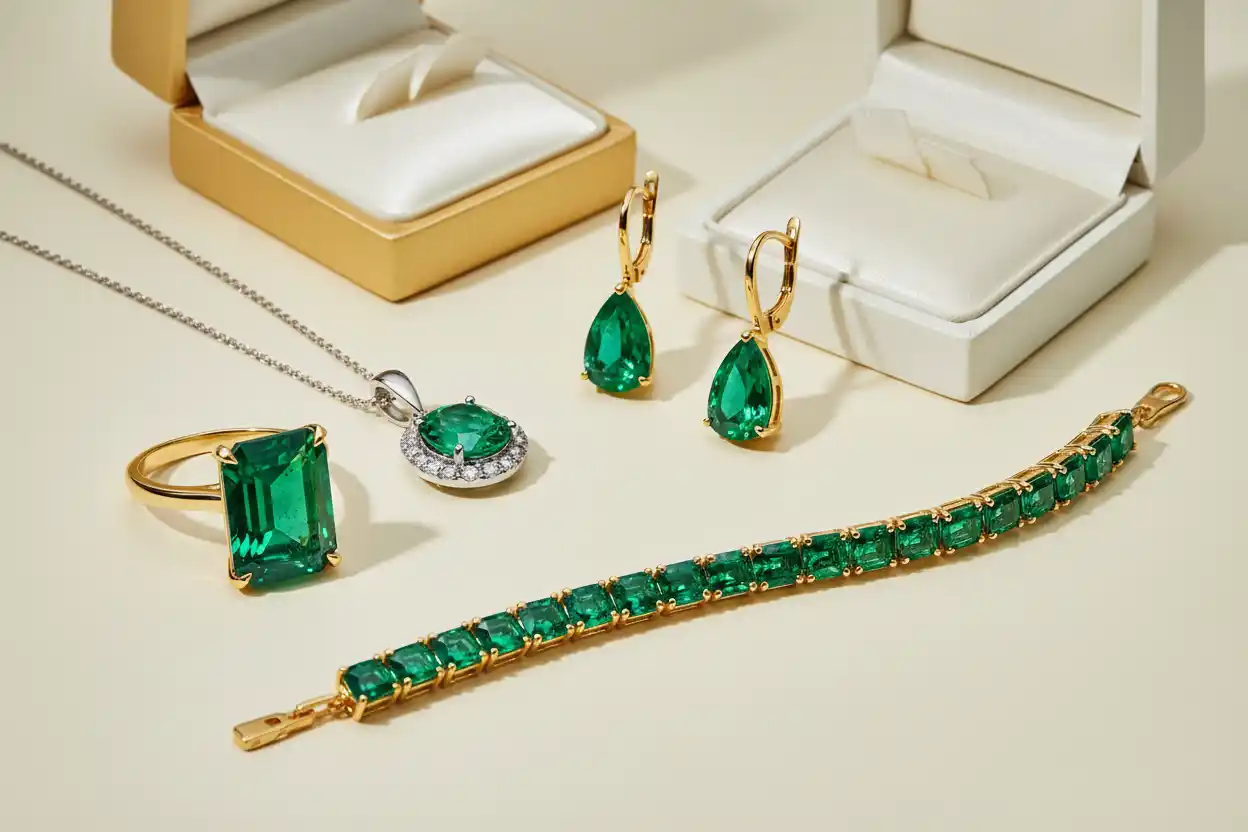

May birthstone jewelry centers on Emerald, one of the most recognizable colored gemstones in fine jewelry. Its green color can range from cool bluish green to balanced forest green and slightly warmer yellowish green, giving buyers options from subtle everyday pieces to formal statement designs.
Choosing an Emerald gift requires more attention than choosing color alone. Natural Emeralds commonly contain fissures, and many receive oil or resin treatment to improve apparent clarity. Setting protection, filler disclosure, metal construction and the recipient’s wearing habits all affect whether the jewelry remains beautiful.
Laboratory-grown Emerald provides another legitimate option. It offers the same essential beryl identity with laboratory origin, often allowing stronger clarity or larger size within a lower budget. It should be represented clearly rather than sold as mined Emerald.
The companion May Birthstone guide explains Emerald’s month-specific history and symbolism. This page focuses on finished jewelry, recipients, settings, metals, budgets and gift presentation.
May Birthstone Jewelry at a Glance
| Jewelry type | Best suited to | Main advantage | Main concern |
|---|---|---|---|
| Stud earrings | First gift and daily wear | No sizing and low impact | Pair matching and secure backs |
| Drop earrings | Formal or expressive gift | Larger visible color | Weight and setting movement |
| Solitaire pendant | Versatile birthday gift | Easy sizing and protected position | Bail and chain strength |
| Station necklace | Modern understated style | Several small green accents | Flipping stations and matching |
| Everyday ring | Frequent personal wear | Constant visibility | Fissures, impact and sizing |
| Engagement ring | Long-term relationship gift | Strong symbolism and color | Setting protection and maintenance |
| Tennis bracelet | Formal coordinated jewelry | Continuous green line | Clasp, link and wrist impact |
| Bead bracelet | Casual or artisan styling | Organic texture and color | Treatment, drill holes and abrasion |
| Signet ring | Low-profile personal design | Protective metal and engraving | Stone thickness and repair |
| Anniversary jewelry | Twentieth or thirty-fifth milestone | Established tradition | Long-term treatment and documentation |
| Family birthstone piece | Parent or grandparent | Combines several birthdays | Hardness and setting compatibility |
| Laboratory-grown Emerald jewelry | Larger visual impact for budget | Strong color and clarity | Clear origin disclosure |
Choosing the Right Jewelry Type
The recipient’s lifestyle should guide the design before carat size or setting trend.
Earrings and necklaces expose Emerald to less impact than hand jewelry. They work well for recipients who are active, work with their hands or do not want to remove jewelry constantly.
Rings provide the most visible and personally engaging format but require a sound stone, protective setting and realistic care.
Bracelets move against desks, clothing and surrounding links, so construction and fit become especially important.
The complete material-selection process belongs to the Emerald Buying Guide. Once the stone is selected, the dedicated jewelry pages provide format-specific guidance.
Emerald Rings
An Emerald ring can range from a small bezel-set birthstone to a large three-stone or halo design.
The Emerald Rings guide owns setting height, cut shape, band style and daily-wear decisions.
A full or partial bezel can protect vulnerable edges. A prong setting may show more of the stone, but prongs should avoid surface-reaching fractures and remain substantial enough to prevent movement.
Emerald cuts have trimmed corners that reduce point vulnerability. Ovals and cushions also work well because they avoid the sharp ends of pears and marquises.
Before buying a gift ring, confirm the recipient’s exact size and whether the design can be resized. Eternity bands, complex halos and full bezels may limit future alteration.
Emerald Engagement Rings
Emerald can create a distinctive engagement ring, particularly for a May birthday or a couple who values green.
The Emerald Engagement Ring guide owns the complete bridal-buying workflow.
Natural Emerald is durable enough for careful regular wear but requires more maintenance than diamond, sapphire or spinel. A low setting, protected corners and strong metal improve long-term performance.
The broader Best Gemstones for Engagement Rings provides a durability comparison, while Green Gemstones for Engagement Rings compares Emerald with Tsavorite, Green Sapphire and other alternatives.
A buyer should also consider replacement difficulty. Every natural Emerald has different color, inclusions and proportions, so an exact match may be impossible if the center stone is damaged.
Emerald Earrings
Emerald earrings are among the safest and easiest May gifts.
No ring or wrist size is required, and the stones receive little impact during normal wear.
The Emerald Earrings guide owns pair matching, backs, settings and comfort.
Studs suit daily use and professional clothing. Drops allow larger stones and greater color visibility, while hoops and climbers create more contemporary designs.
A matched pair should coordinate in hue, tone, clarity, dimensions and cut. Exact inclusion patterns do not need to match, but one stone should not appear substantially darker or more heavily fractured.
Large studs need supportive backs to prevent tilting. Valuable drops benefit from locking backs or leverback closures.
Emerald Necklaces
A solitaire pendant is the most versatile May birthstone gift.
The Emerald Necklaces guide owns pendant balance, bail construction, chain length and necklace styles.
A bezel-set pendant provides strong protection, while prong settings allow more light and visibility. The stone should hang face-forward and remain supported beneath the pavilion.
Princess-length chains suit many recipients because the Emerald rests on the upper chest. A longer pendant swings more and may strike furniture.
For a high-value gift, the chain should match the center stone’s quality. A fine Emerald on a weak, undersized chain creates both visual and security problems.
Emerald Bracelets
Emerald bracelets may use articulated links, tennis-style arrangements, cabochons, beads, stations or charms.
The Emerald Bracelets guide owns fit, matching, clasp security and construction.
Wrist jewelry receives frequent impact. Small Emeralds should sit low within settings that protect their edges without preventing the links from flexing.
A tennis bracelet requires uniform color and approximate matching across many stones. Slight variations are natural, but one dark or cloudy section can disrupt the complete line.
The clasp should include a positive closure and, for valuable pieces, a secondary safety feature.
A loose bracelet swings and strikes surfaces. A tight one places pressure on links and settings. Wearable length matters more than the laid-flat measurement.
Natural Emerald vs Laboratory-Grown Emerald Jewelry
Laboratory-grown Emerald can provide a vivid, transparent appearance at a lower purchase price.
The Lab Emerald guide explains its composition and growth, while the Lab Emerald Buying Guide owns selection.
Synthetic Emerald is not glass and should not be called fake. It has laboratory origin and different rarity and resale characteristics.
A gift recipient may prefer mined origin, lower environmental disturbance, greater apparent clarity or simply a larger design. Those preferences are personal rather than universal.
The invoice must state laboratory-grown or synthetic clearly. The Lab Emerald Price Guide should be used instead of natural-Emerald prices when comparing value.
Choosing Emerald Color
Color preference should be assessed under neutral light.
Cool bluish green often suits white metals, while balanced or slightly warmer green can work beautifully in yellow gold. Rose gold creates a softer contrast but may make yellowish components more noticeable.
A very dark Emerald may look dramatic under display lighting but lose color in an ordinary room. A pale stone may appear larger for the budget but offer less of the saturated green expected from May jewelry.
Color consistency matters especially in pairs and multi-stone designs.
The natural Emerald Price Guide owns value rather than this gift guide. Buyers should avoid judging quality through non-standard labels such as AAA or investment grade without supporting evidence.
Clarity and Inclusions
Inclusions are normal in natural Emerald.
A gift-quality stone does not need to be flawless, but the inclusions should not prevent attractive transparency or threaten durability.
Fractures near a corner, girdle or prong are more concerning than an internal crystal away from the setting.
Strong magnified product photographs can make every inclusion appear alarming, while distant photographs can hide major fissures. Video and an independent report provide better context for expensive purchases.
Laboratory-grown Emeralds also contain growth features, but their patterns differ from natural material.
Oil and Resin Treatment
Most natural Emerald jewelry should be assumed to require a treatment question.
Colorless oil is traditional, while wax, natural resin and artificial resin also occur. Some stones contain only minor filler; others have significant fissure filling.
Treatment affects price and cleaning. Heat, solvents, steam and ultrasonic vibration can damage or remove filler.
Ask for the type and extent of clarity enhancement in writing. A vague claim that the stone is enhanced does not provide enough detail for a high-value purchase.
A recognized laboratory report can describe detectable filler and whether the Emerald is natural or laboratory-grown. The Gemstone Certification guide explains report limitations.
Metal Choices
Yellow gold creates a classic rich contrast with Emerald.
White gold and platinum emphasize cooler green and create a crisp contemporary appearance. Sterling silver suits lower-cost designs but may require more frequent polishing.
Rose gold can be attractive with lighter or bluish-green stones, although the combination is more dependent on personal taste.
The strongest setting is not always the heaviest-looking one. Prong thickness, bezel fit, solder quality, shank dimensions and clasp construction matter more than decorative mass.
Recipients with metal sensitivities need clear alloy information. The Best Gemstones and Metals for Sensitive Skin explains nickel, plating, solder and post considerations.
Choosing a Gift by Recipient
A first birthstone gift usually works well as small Emerald studs or a solitaire pendant.
A partner may appreciate a ring, matched earrings, an anniversary pendant or a personalized piece. Parents and grandparents may prefer family birthstone jewelry containing several children’s or grandchildren’s stones.
Someone with an active lifestyle may get more use from protected earrings than a tall cocktail ring.
A recipient who prefers strong visual impact but has a fixed budget may be better served by a laboratory-grown Emerald or a halo design than a weakly colored large natural stone.
Personal style should outweigh assumptions based on age or gender. Signets, minimal bezels, classic solitaires and elaborate vintage designs can be adapted for any wearer.
May Birthstone Anniversary Gifts
Emerald is associated with the twentieth and thirty-fifth wedding anniversaries.
The Anniversary Gemstones by Year guide provides the complete list, while Best Gemstones for Anniversary Gifts compares formats.
A twentieth-anniversary gift might use a ring or pendant that adds Emerald to an existing jewelry collection. A thirty-fifth-anniversary design may prioritize heirloom construction and independent documentation.
An anniversary stone does not need to be large. A well-cut, richly colored Emerald in a durable setting can carry more long-term value than a bigger but heavily fractured stone.
Family Birthstone Jewelry
Family jewelry may combine May Emerald with diamonds, sapphires, rubies, garnets or other monthly stones.
The design must account for differences in hardness and toughness. Diamond and sapphire can scratch Emerald if their girdles touch directly.
Each stone should sit in its own secure setting, with enough metal separating vulnerable edges.
When adding future birthstones is likely, choose a modular pendant, charm bracelet or ring design that can be expanded without rebuilding the complete piece.
The Birthstones by Month guide helps plan multi-month combinations accurately.
Buying Emerald Jewelry Online
Follow How to Buy Gemstones Online Without Getting Scammed.
Request neutral-light video, exact gemstone dimensions, treatment disclosure, natural or laboratory origin, metal alloy, total weight and return terms.
For a ring, confirm size and resizing limits. For earrings, request the weight per earring and closure type. For a pendant, confirm chain length, gauge and bail dimensions. For bracelets, confirm wearable length and clasp construction.
A report number should be verified independently where possible. The report should match the stone’s dimensions and identifying details.
A generous return period is essential because Emerald color can appear different on a screen.
Care and Long-Term Maintenance
Follow How to Clean Emerald Jewelry Safely.
Use lukewarm water, mild soap and a soft brush. Avoid long soaking periods.
Steam and ultrasonic cleaning should not be used for ordinary Emerald jewelry. Heat and vibration can affect fractures and filler.
A jeweler should inspect frequently worn rings and bracelets periodically. Prongs can loosen, and filler condition may change over time.
Store each piece separately from diamonds and sapphires. Put jewelry on after perfume, cosmetics and hairspray have dried.
Frequently Asked Questions
1. What is the best May birthstone jewelry gift?
Emerald studs or a solitaire pendant are the easiest versatile gifts because they require little sizing information and protect the stone well.
2. Is Emerald suitable for everyday jewelry?
It can be worn regularly when the stone is sound and well protected, but rings and bracelets need greater care than earrings and pendants.
3. Which Emerald jewelry is safest?
Bezel-set earrings and pendants generally provide the safest combination of low impact and edge protection.
4. Is laboratory-grown Emerald acceptable for a birthstone gift?
Yes. It is synthetic Emerald with laboratory origin and should be disclosed clearly.
5. What metal looks best with Emerald?
Yellow gold creates classic contrast, while white gold and platinum emphasize cooler green. The best choice depends on the stone and recipient.
6. Are Emerald engagement rings practical?
They can be practical for a careful wearer with a protected setting. Sapphire, spinel and diamond provide greater tolerance for unrestricted wear.
7. Are most natural Emeralds treated?
Many contain oil, wax or resin in surface-reaching fissures. The type and extent should be disclosed.
8. Does a heavily included Emerald make a poor gift?
Not automatically. Inclusions are expected, but fractures that threaten durability or greatly reduce transparency should affect price and setting choice.
9. Should Emerald jewelry have a laboratory report?
A report is particularly useful for valuable stones, natural-origin claims, significant treatment questions and laboratory-grown identification.
10. Is Emerald an anniversary gemstone?
Yes. It is associated with the twentieth and thirty-fifth wedding anniversaries.
11. Can Emerald jewelry be cleaned ultrasonically?
Generally no. Ultrasonic vibration can affect fissures and clarity-enhancing fillers.
12. What should accompany an Emerald gift?
Include the stone identity, natural or laboratory origin, known treatments, metal description, care instructions, report and return documentation.
May birthstone jewelry succeeds when it is chosen for the recipient rather than for the month alone. Emerald offers extraordinary green color, but its fissures, treatments and settings require honest evaluation. A well-protected stone with clear disclosure becomes a meaningful gift that can be worn; a larger stone selected only for appearance may remain too fragile for the life it was meant to celebrate.