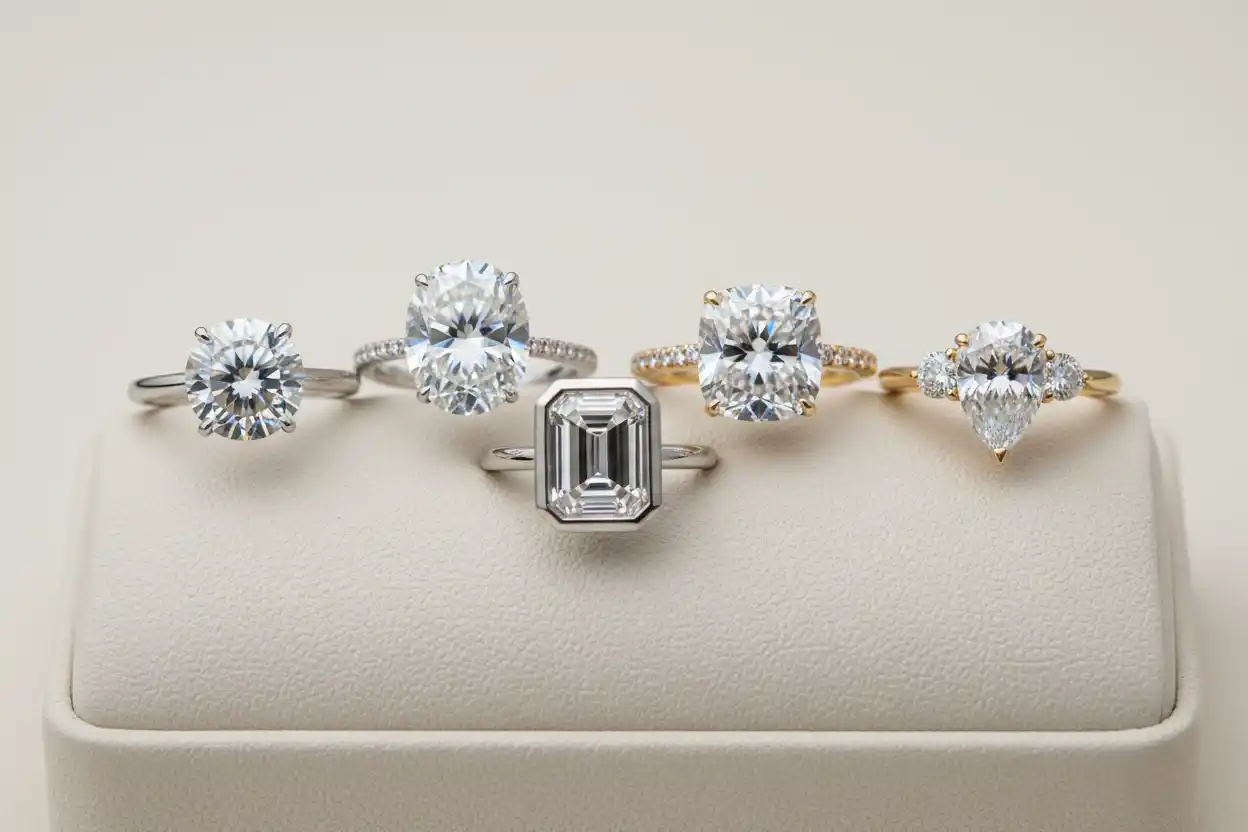
Moissanite Engagement Rings: Complete Buyer’s Guide
Moissanite engagement rings offer high brilliance, strong rainbow fire and excellent durability at a price that can support larger visual dimensions or more elaborate settings than many diamond budgets allow. The material is especially appealing to couples who prioritize design, size and everyday wearability over diamond identity.
Modern jewelry Moissanite is laboratory-grown silicon carbide. It is not a mined diamond, laboratory-grown diamond or synthetic diamond. A responsible seller should use the word Moissanite clearly and describe any color treatment, coating, brand or warranty without implying that the center is diamond.
The central stone is only one part of the purchase. Cut style, face-up size, ring architecture, prong placement, wedding-band fit, metal thickness, sizing, repair options and long-term expectations determine whether the ring functions as well as it photographs.
The general Moissanite gemstone guide owns the material’s composition and history. This page focuses specifically on choosing it for a long-term engagement ring.
Moissanite Engagement Rings at a Glance
| Decision | What matters most |
|---|---|
| Gem identity | Laboratory-grown silicon carbide, disclosed clearly |
| Durability | Approximately 9.25 Mohs hardness with good toughness |
| Visual character | Strong brilliance and more rainbow fire than diamond |
| Most familiar cut | Round brilliant |
| High-spread cuts | Oval, pear, marquise and elongated cushion |
| Restrained optical style | Emerald or Asscher cut |
| Safest center setting | Secure bezel or substantial multi-prong basket |
| Classic bridal setting | Four- or six-prong solitaire |
| Main sizing metric | Millimeter dimensions, not only carat equivalent |
| Main construction issue | Prongs, gallery, shank and wedding-band clearance |
| Main disclosure issue | Must not be sold as diamond or lab diamond |
| Main value consideration | Setting quality and stone replacement, not rarity appreciation |
Is Moissanite Suitable for an Engagement Ring?
Moissanite is one of the strongest non-diamond choices for a ring intended to be worn frequently.
Its hardness of approximately 9.25 provides excellent resistance to scratching. The Gemstone Hardness Chart places it above sapphire, ruby, topaz and most other transparent jewelry stones.
It also has good practical toughness. The difference between resistance to scratching and resistance to breaking is explained in Gemstone Toughness vs Hardness.
Moissanite can still chip under a severe blow, and a ring can fail through bent prongs or cracked metal even when the stone remains intact. Nevertheless, it is far more suitable for unrestricted long-term wear than opal, moonstone, pearl, fluorite or other softer alternatives.
The Best Gemstones for Engagement Rings compares Moissanite with sapphire, spinel, ruby and additional durable choices.
Moissanite Is Not a Diamond
Moissanite and diamond differ in composition, structure, density and optical behavior.
Diamond is carbon. Moissanite is silicon carbide. Laboratory-grown diamond remains diamond because it has the carbon crystal structure, while laboratory-grown Moissanite remains a separate material.
The Moissanite vs Diamond vs Lab Diamond guide owns the three-way comparison. The Lab Diamond vs Moissanite page addresses the two laboratory-produced choices directly.
A Moissanite ring should be selected because the couple likes Moissanite’s appearance and value proposition—not because a seller has blurred the identity.
The invoice, appraisal and insurance description should name the center correctly.
Moissanite’s Optical Character
Moissanite has very high refractive indices and stronger dispersion than diamond.
Its brilliance can appear intense, while its fire separates light into conspicuous spectral colors. Red, green, blue and yellow flashes are especially visible in large brilliant cuts under concentrated light.
Some buyers consider this lively fire a major advantage. Others prefer diamond’s more restrained balance of white brilliance, colored fire and scintillation.
The difference should be evaluated under several environments. Jewelry-store spotlights maximize rainbow flashes, while diffused daylight and ordinary indoor lighting provide a more realistic view.
A ring should be purchased for how it looks during normal life rather than for one carefully controlled showroom angle.
Choosing the Center-Stone Size
Moissanite is often sold through diamond-equivalent weight rather than actual scale weight.
Because the two materials have different densities, a Moissanite with the same diameter as a one-carat round diamond does not necessarily weigh one carat.
Millimeter dimensions provide the clearest basis for comparison. For elongated stones, use length, width and depth together.
A large stone changes more than appearance. It may require additional prongs, a wider shank, a higher gallery and greater clearance above the finger.
Very large Moissanites display more spectral fire and can appear visually different from a diamond of the same size. Couples should consider whether the desired scale fits the wearer’s hand and style rather than simply maximizing dimensions within the budget.
Round Brilliant Moissanite
Round brilliant is the most familiar and consistently cut Moissanite shape.
Its symmetrical facet pattern produces strong brightness and hides slight differences in color well. It is also easy to pair with straight, curved and contoured wedding bands.
A six-prong solitaire offers greater setting redundancy, while four prongs reveal more of the girdle and create a squarer outline.
Round cuts generally show Moissanite’s rainbow dispersion clearly, especially as size increases.
Hearts-and-arrows or precision-cut descriptions may indicate tighter optical symmetry, but the seller should provide actual images or performance information rather than relying only on a label.
Oval Moissanite
Oval Moissanite provides greater face-up length than a round of similar apparent weight.
It can make the finger look longer and supports solitaire, halo, three-stone and pavé designs.
Oval cutting varies widely. Some stones have a dark bow-tie across the center, while others have a crushed-ice or splintery facet appearance.
A small bow-tie can add contrast and movement. A severe dark band that remains stationary under different light reduces visual balance.
Length-to-width ratio determines whether the oval appears broad or slender. The buyer should compare actual measurements rather than accepting one ideal ratio.
Cushion and Radiant Moissanite
Cushions range from square to elongated and can have rounded or more defined corners.
Traditional brilliant cushions show larger organized facets, while modified or crushed-ice cuts create many smaller reflections.
Radiant cuts combine a rectangular outline with brilliant-style faceting. They often show strong fire and work well in hidden-halo or pavé settings.
A couple seeking a crisp, organized optical pattern should avoid buying solely from a shape label. Two cushions of the same dimensions can look entirely different because of facet structure.
Rounded corners provide better protection than sharp square points, but the setting should still hold the stone securely.
Pear and Marquise Moissanite
Pear and marquise cuts create substantial apparent spread and strong finger coverage.
Their points require protection. A V-shaped prong or complete bezel should cover each tip rather than leaving it exposed.
Both shapes can show bow-tie effects and significant variation in outline.
A pear should have balanced shoulders and a centered point. A marquise should not look excessively narrow, bulged or uneven from side to side.
These shapes can make a strong engagement statement, but the setting and wedding-band plan should be designed around their elongated footprint.
Emerald and Asscher Cuts
Step-cut Moissanite produces broad flashes rather than the dense scintillation of a round brilliant.
Emerald cuts emphasize transparency, symmetry and parallel facet reflections. Asscher cuts create a square, concentric hall-of-mirrors appearance.
Step facets can make double refraction more noticeable. Some viewers enjoy the added visual complexity, while others find it less diamond-like.
These cuts also reveal bodycolor and inclusions more readily. A stone marketed as colorless should be examined from both the face and side.
An emerald-cut center often pairs well with baguette accents, bezels and clean architectural settings.
Antique and Specialty Cuts
Old European, old mine, rose, portrait and specialty cuts provide a less conventional Moissanite appearance.
Antique-style cuts often use larger facets, smaller tables and distinctive culets. They can soften the modern high-fire effect and suit vintage settings.
Rose cuts have a flat base and faceted dome. They provide a broad face-up size but less depth and brilliance than a full brilliant cut.
Specialty cutting can add value through craftsmanship rather than material rarity. Replacement may be more difficult if the center is damaged because the original proportions may not be standard.
Colorless and Near-Colorless Moissanite
Modern colorless Moissanite can appear visually white in many settings.
Near-colorless stones may show a slight gray, yellow, green or warm cast, especially from the side or in larger sizes.
Seller color categories are not automatically equivalent to independent diamond grading. A D–F equivalent label should be interpreted as the manufacturer’s comparison terminology.
White metals emphasize any cool or gray undertone. Yellow and rose gold can make mild warmth less noticeable.
The Types of Moissanite guide owns color categories and varieties.
Colored and Coated Centers
Moissanite can be produced in gray, yellow, green, blue and other colors.
Some colors extend throughout the material, while pink, purple and fashion shades may rely on surface coatings.
The treated-Moissanite guide explains treatment and coating stability.
A coated center should not be repolished or exposed casually to repair processes that may damage the surface layer. The treatment must be disclosed before a jeweler applies heat or abrasives.
Colored centers can create distinctive engagement rings, but matching a replacement later may be difficult if the exact treatment is discontinued.
Solitaire Settings
A solitaire allows the center stone to dominate the design.
Four-prong settings reveal more of the stone, while six prongs create additional security and a rounder visual outline. Cathedral shoulders rise toward the center and can provide structural support.
A low setting reduces snagging but may prevent a straight wedding band from sitting flush. A high setting provides band clearance but exposes the center to more impact.
The gallery should support the basket without looking unusually thin. A large stone on a very narrow connection can loosen when the ring is struck.
The broader Moissanite Rings guide owns non-bridal ring styling, while this page focuses on bridal functionality.
Bezel Settings
A bezel surrounds the center with metal.
It offers strong girdle protection, a smooth profile and reduced snagging. It is well suited to active wearers or anyone who prefers a modern appearance.
A full bezel covers part of the girdle and can make a stone look slightly smaller. A partial bezel leaves selected sides open while retaining more protection than prongs.
The ring should include access beneath the pavilion for cleaning.
Resizing and stone replacement can be more labor-intensive than with a conventional prong setting, so long-term serviceability should be discussed before purchase.
Halo and Hidden-Halo Settings
A visible halo surrounds the center with smaller stones, increasing face-up spread and contrast.
A hidden halo sits beneath the girdle and becomes visible mainly from the side. It adds detail without changing the top outline substantially.
Halos contain many small prongs and require more maintenance. They can also make wedding-band fit difficult when the lower gallery projects outward.
Moissanite accents provide optical consistency, while diamond accents create a mix of materials with different fire.
The invoice should identify the halo stones separately rather than implying that every clear stone is the same material.
Three-Stone and Side-Stone Rings
Three-stone designs place one accent on each side of the center.
Matching side stones can be Moissanite, diamond or colored gemstones. Their dimensions and facet styles should support rather than compete with the center.
Pear, trapezoid, tapered baguette and round side stones create different outlines.
Hard side stones do not pose a problem when the settings keep the girdles separated. Direct contact between adjacent stones can cause abrasion or metal wear.
Replacing a matched side stone may be more difficult than replacing a standard round accent.
Pavé Bands
Pavé places small stones closely across the band.
The design adds brilliance but reduces the amount of solid metal available for future sizing. Very thin pavé shanks can bend, allowing small stones to loosen.
Shared-prong pavé looks delicate but depends on precise metalwork. Bead-set or channel-like designs may offer greater containment.
The underside of the shank usually receives the most wear and should retain enough thickness for long-term service.
A wearer who works frequently with their hands may prefer a plain or partially pavé band.
Choosing the Metal
Platinum provides a dense, naturally white setting with strong prong durability, although it develops a surface patina and costs more than most gold alloys.
White gold offers a bright appearance but is commonly rhodium plated. The plating can wear and require renewal.
Yellow gold creates warm contrast and can conceal slight warmth in the Moissanite. Rose gold produces a softer appearance but may emphasize certain gray or green undertones.
Fourteen-karat gold generally provides greater hardness than higher-purity gold, while eighteen-karat gold contains more gold and a richer color.
The Best Gemstones and Metals for Sensitive Skin explains nickel, palladium alloys and metal sensitivity.
Shank Width and Structural Strength
A very thin band can make the center appear larger, but it may bend under routine wear.
Large stones and high baskets need enough metal to resist twisting. The narrowest visually fashionable shank is not always the strongest long-term choice.
A tapered band can appear delicate near the center while retaining additional thickness beneath the finger.
The inside should feel smooth, and sizing joints should not create obvious weak points.
Ask for the ring’s metal weight and shank measurements when comparing similar designs online.
Wedding-Band Fit
Wedding-band compatibility should be considered before the engagement ring is ordered.
A straight band sits flush only when the center basket, prongs and decorative gallery provide enough side clearance.
Low baskets, halos and protruding side stones may create a gap. Some couples like that spacing, while others need a curved or contoured band.
Try the complete pair together whenever possible. A computer rendering does not always show how prongs and pavé edges meet.
The two rings should not rub in a way that wears away prongs or scratches the metal continuously.
Ring Size and Resizing
Confirm the intended finger size before choosing a setting.
Wide bands usually fit more tightly than narrow bands. Finger size also changes with temperature and time of day.
Plain solitaires are generally easier to resize than eternity bands, full pavé, tension designs and intricate three-stone settings.
Large resizing changes can affect symmetry and prong alignment. A jeweler may need to rebuild part of the shank rather than stretch it.
An engraved message should be placed where likely future sizing will not remove it.
Moissanite vs Diamond Engagement Rings
The Diamond Engagement Ring guide owns natural-diamond bridal buying.
Diamond offers a different material identity, optical balance and established resale market. Moissanite usually provides greater visible size and stronger rainbow dispersion for a lower initial cost.
Diamond ranks 10 on the Mohs scale, while Moissanite is approximately 9.25. Both are durable enough for engagement rings.
The decision should not be framed as one material pretending to be the other. A couple should choose according to appearance, budget, origin preference and long-term expectations.
Moissanite vs Lab Diamond Engagement Rings
Laboratory-grown diamond has the diamond crystal structure and physical properties but forms in a manufacturing environment.
The Lab Diamond Engagement Ring guide owns that choice.
Lab diamonds generally provide diamond optics and formal grading within a lower price than comparable mined diamonds. Moissanite remains less expensive in many sizes and shows greater spectral fire.
Both markets can change, and neither should be purchased with guaranteed appreciation assumptions.
Identity should remain clear throughout the appraisal, insurance and resale process.
Moissanite vs Cubic Zirconia for Bridal Wear
Cubic zirconia is inexpensive and can look bright when new, but it is softer and more prone to surface abrasion over long wear.
Moissanite offers far greater durability and is a more practical permanent center.
The Moissanite vs Cubic Zirconia guide owns the full comparison.
CZ can still work in a temporary proposal ring, travel ring or fashion design when represented accurately.
Budget and Value
There is no universal rule requiring a specific salary multiple or center-stone size.
The Moissanite Price Guide owns current material cost.
A balanced budget should account for the center, metal weight, setting construction, wedding band, resizing, insurance and maintenance.
Large visual size is only valuable when the setting can support it. A smaller stone in a substantial, repairable ring may provide greater long-term usefulness.
Moissanite does not derive value from natural rarity in the same manner as certain mined gemstones. Most resale offers will reflect the finished jewelry, brand and secondhand demand rather than the original retail price.
The Best Diamond Alternatives guide provides additional budget-conscious options.
Buying the Center Stone
The Moissanite Buying Guide owns detailed cut, color and seller evaluation.
Request actual dimensions, continuous video, facet style, color description, treatment disclosure and return terms.
A stock video of a similar stone is not equivalent to footage of the exact center being purchased.
Inspect the stone loose when possible before final setting. This makes it easier to assess color from the side, facet pattern and any coating.
The Real vs Fake Moissanite guide covers identification and tester limitations.
Reports, Appraisals and Warranties
An identification report can confirm whether the stone is Moissanite and document its dimensions and observable characteristics.
It should not be confused with a diamond grading report or a guarantee of resale value.
The Gemstone Certification guide explains these limits.
A finished-ring appraisal should identify Moissanite correctly, describe the metal and list accent-stone identities.
Review the warranty for prong repair, stone loss, replating, resizing and replacement. Some warranties require periodic inspections and exclude accidental damage.
The safeguards in How to Buy Gemstones Online Without Getting Scammed apply to custom bridal purchases.
Cleaning and Long-Term Care
Follow How to Clean Moissanite Jewelry Safely.
Warm water, mild soap and a soft brush remove oil from the pavilion and restore brilliance.
Remove the ring before heavy lifting, mechanical work, harsh cleaning, swimming and activities likely to bend the setting.
Have prongs and pavé inspected periodically. A stone that begins moving should not be worn until repaired.
Store the ring separately so it does not scratch softer gemstones or become scratched at the metal surfaces by another hard ring.
Frequently Asked Questions
1. Is Moissanite durable enough for an engagement ring?
Yes. Its hardness of approximately 9.25 and good toughness make it one of the strongest diamond alternatives.
2. Is Moissanite a fake diamond?
No. It is a distinct laboratory-grown silicon-carbide gemstone that may be used as a diamond simulant.
3. Which Moissanite cut looks most like a diamond?
Round brilliant usually gives the most familiar diamond-like outline. Step cuts and large crushed-ice styles may reveal Moissanite’s different optics more clearly.
4. Does Moissanite look too rainbow-like?
It displays more spectral fire than diamond. The effect becomes stronger in large stones and concentrated lighting.
5. What size should I choose?
Use millimeter dimensions, hand proportions, setting strength and personal style rather than maximizing carat-equivalent numbers.
6. Is a bezel safer than prongs?
A bezel protects the girdle and snags less. Prongs show more stone and can remain secure when well made and maintained.
7. Can a straight wedding band sit flush?
It depends on the center basket, halo and side profile. Low or projecting settings may require a curved band.
8. Is Moissanite better than laboratory-grown diamond?
Neither is universally better. Lab diamond offers diamond identity and optics, while Moissanite generally offers more fire and visual size for the price.
9. Can Moissanite be coated?
Yes. Some fashion colors use surface coatings that require disclosure and more conservative care.
10. Does a Moissanite engagement ring need a certificate?
A report can confirm identity, but exact dimensions, seller disclosure, setting quality and return terms are often more important.
11. Does Moissanite retain its value?
Secondhand value is usually lower than original retail and depends on brand, setting, metal and market demand. It should not be purchased with guaranteed appreciation expectations.
12. How often should the ring be inspected?
A frequently worn ring should receive periodic inspection and immediate attention whenever a prong catches, a stone moves or the band bends.
A successful Moissanite engagement ring is not a compromise disguised as a diamond. It is a deliberate choice of silicon carbide for its brilliance, fire, durability and design flexibility. When the identity is clear and the setting is engineered for long wear, the ring can serve its bridal purpose without depending on comparison language.