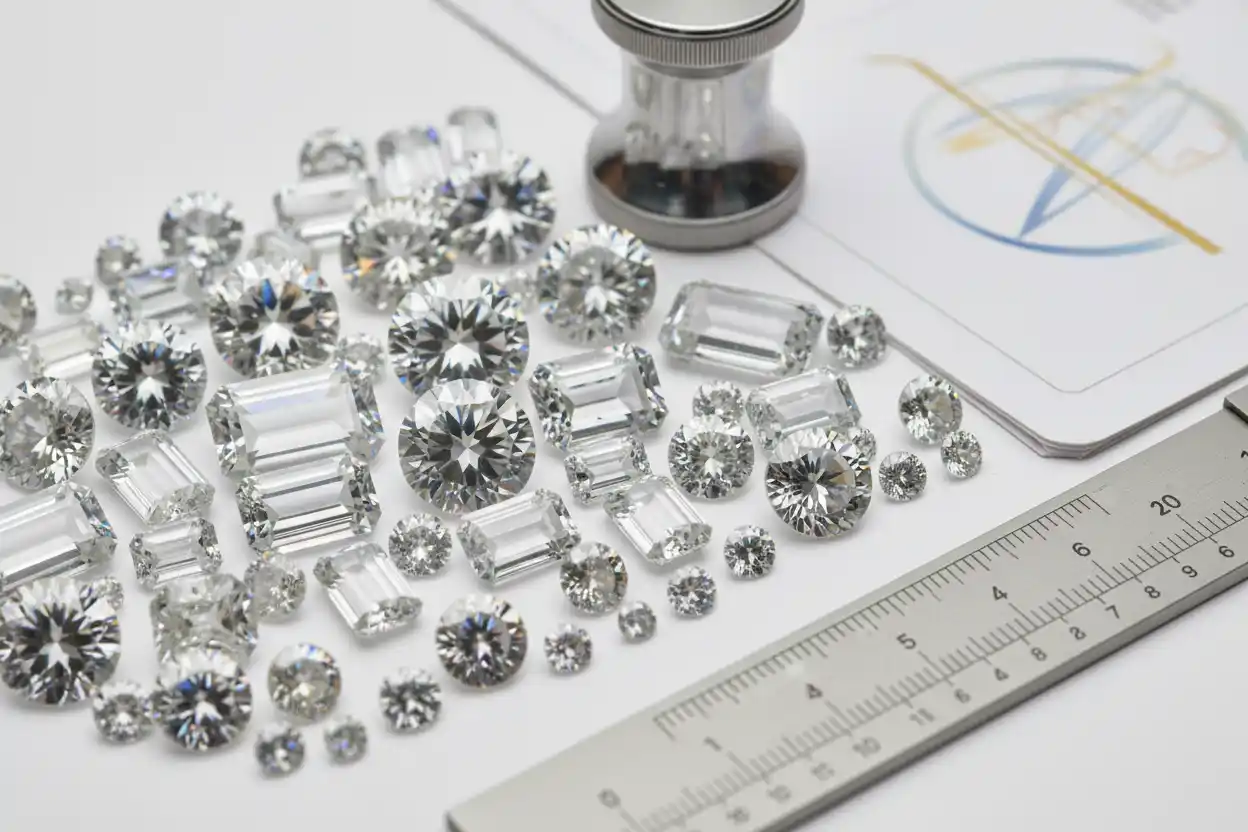
Buy Moissanite: How to Compare Listings, Quality, Disclosure & Price
If you want to buy moissanite, compare cut quality, dimensions, color, clarity, seller disclosure, brand or producer, grading paperwork, warranty, and return terms before focusing on a carat-style number. Jewelry moissanite is lab-created silicon carbide, not diamond, and natural moissanite is so rare that GIA states gem-quality natural crystals have not been found for the jewelry market. Modern moissanite is popular because it combines high durability with strong brilliance and noticeably intense rainbow fire.
Pricing varies dramatically. A generic loose-stone seller can advertise small lab-grown moissanite starting around $25, while current certified premium stones can cost roughly $600 for a 1-carat diamond-equivalent round, around $900 to $1,200 in the 1.25 to 2-carat range, and well above $1,000 for larger branded or carefully graded stones. The moissanite price therefore depends as much on positioning, cutting, producer, and paperwork as on apparent size.
Confirm That You Are Buying Moissanite
Moissanite and diamond can look similar at first glance, but they are different gems. Moissanite is silicon carbide, while diamond is carbon. Moissanite also shows much stronger dispersion, producing more rainbow-colored flashes, and it is doubly refractive rather than singly refractive like diamond.
GIA notes that traditional thermal diamond testers can mistake moissanite for diamond because both conduct heat efficiently. A positive response on an old thermal probe therefore does not prove that a stone is diamond.
This is one reason the real vs fake moissanite distinction should rely on appropriate testing rather than home tricks. Modern combination testers, microscopy, optical examination, and professional gemological equipment can separate moissanite from diamond and cubic zirconia much more reliably.
Understand Diamond Equivalent Weight Before Comparing Listings
One of the most confusing parts of moissanite shopping is the way size is advertised. Many sellers use diamond equivalent weight, often shortened to DEW, instead of actual moissanite weight. A stone described as 1 carat may therefore mean that it has dimensions similar to a 1-carat diamond, not that the moissanite itself weighs exactly 1 carat.
Moissanite has a different density from diamond, so equal-size stones do not necessarily have equal weights. Millimeter dimensions are therefore extremely important.
For a round stone, a listing around 6.5 mm is commonly marketed as approximately 1 carat diamond equivalent. Around 8 mm is often presented near 2 carats diamond equivalent, while a round near 9 mm may be marketed around 3 carats diamond equivalent. Always compare actual measurements rather than relying only on the carat-style label.
Cut Quality Has a Major Effect on Appearance
Moissanite naturally has very high brilliance and fire, but poor cutting can still create a weak-looking stone. Proportions determine how efficiently light returns to the eye, how much rainbow fire appears, and whether distracting dark or transparent areas develop.
Round brilliant and hearts-and-arrows cuts are popular because they can produce strong light return. Ovals, pears, cushions, emerald cuts, radiants, marquises, and elongated shapes create different visual effects and may show moissanite’s double refraction differently.
The moissanite quality grading should therefore place substantial weight on cut, symmetry, polish, proportions, and face-up appearance rather than treating color and clarity labels as the entire quality story.
Decide How Much Rainbow Fire You Actually Want
Moissanite has more than twice the fire of diamond according to GIA. Many buyers love this appearance because the stone can show vivid rainbow flashes under spot lighting, sunlight, and jewelry-store illumination.
Others prefer a quieter diamond-like look. Larger moissanites can make the strong spectral flashes even more noticeable, and GIA notes that very large stones may show an especially intense display.
View moissanite under several lighting conditions before buying if possible. Jewelry-store spotlights can exaggerate fire, while diffuse daylight may provide a more realistic sense of everyday appearance.
Colorlessness Can Affect Price
Colorless and near-colorless moissanite dominate the engagement-ring market. GIA notes that the value of moissanite often depends partly on its degree of colorlessness.
Many sellers use diamond-style labels such as D, E, F, G, or H. These can help organize one retailer’s inventory, but moissanite does not have one universally applied grading system identical to diamond grading across every seller.
Look at the stone itself. Some near-colorless moissanites may show slight warmth, grayness, or yellowish tones from certain directions. The difference can become easier to notice in larger sizes or step cuts.
Clarity Is Usually High
Commercial jewelry moissanite is normally quite clean. Small inclusions can occur, but many stones appear eye-clean without requiring the extremely high clarity premiums seen in rare natural diamonds.
Retailers may use VS, VVS, or similar diamond-style terminology. Those labels are useful only when the seller explains how they are assigned and whether the stone comes with independent or producer-specific documentation.
A VVS label should not make you overlook poor cutting. Once inclusions are difficult to see without magnification, a better-cut VS stone may offer a stronger face-up appearance than a weakly cut VVS example.
Current Certified Moissanite Price Examples
Current certified loose listings illustrate the premium segment of the market.
| Current loose moissanite example | Listed size | Color and clarity | Asking price |
|---|---|---|---|
| Round hearts and arrows | 1.00 ct DEW | F, VS1 | $605 |
| Round hearts and arrows | 1.25 ct DEW | D, VVS2 | $915 |
| Round Forever One | 1.50 ct DEW | D, VVS1 | $1,165 |
| Round hearts and arrows | 2.00 ct DEW | F, VVS1 | $1,185 |
| Round | 3.00 ct DEW | F, VS1 | $1,365 sale price |
| Round hearts and arrows | 3.00 ct DEW | F, VVS1 | $1,585 sale price |
| Round | 4.50 ct DEW | F, VS1 | $2,515 sale price |
These examples should not be interpreted as the minimum cost of moissanite. Generic stones can sell for far less. They show what current certified and branded retail positioning can look like when cutting, grading, warranty coverage, and retailer services are included.
Brand Can Change the Price Substantially
Producer and retailer reputation can create a large price difference between two moissanites that appear similar on paper. Charles & Colvard’s Forever One line, for example, remains a recognizable premium name, while many other factories now produce colorless moissanite at much lower prices.
A brand premium may include controlled cutting, warranty protection, consistent color, engraving, customer support, documentation, and predictable replacement policies. Whether that premium is worthwhile depends on what the buyer values.
Do not assume that an unbranded moissanite is automatically poor quality. Instead, compare actual dimensions, cut performance, color, clarity, report details, return rights, and price.
A Certificate Is Only as Useful as Its Issuer
A grading card can make a listing look more authoritative, but not all reports carry equal weight. Some moissanites come with reports from independent gem laboratories, while others include seller or factory cards.
GIA has documented synthetic moissanite carrying fraudulent inscriptions linked to diamond report numbers. That makes report verification important when a seller uses a famous laboratory name or inscription to support a major price premium.
Check the issuing organization, report number, measurements, stone description, and any online verification system. A certificate should support the identity of the actual stone rather than merely accompany the package.
Moissanite Is Not a Lab-Grown Diamond
This distinction should be explicit in every listing. A lab-grown diamond is crystallized carbon with diamond’s essential properties. Moissanite is silicon carbide and is a diamond simulant when used to imitate a diamond appearance.
The FTC advises sellers to represent gemstones accurately and disclose whether a stone is lab-created or an imitation of another gem. A listing should not describe moissanite in a way that could reasonably lead a buyer to believe it is diamond.
If you are deciding between the two, lab diamond price follows a different market because lab-grown diamonds and moissanite are different products with different grading systems, production costs, optical behavior, and resale patterns.
Colored Moissanite Needs Extra Disclosure
Moissanite is available in yellow, green, blue, black, and other colors. Some color can be produced during growth through changes in crystal chemistry, while certain unusual shades may be created through surface coating.
GIA has documented coated synthetic moissanite, including studies of blue and pink coatings. Coating can affect care and durability because the color may depend partly on a surface layer rather than the entire crystal.
Ask whether the color is intrinsic or coating-created when purchasing unusual hues, particularly when the seller charges a premium for pink, blue, or another uncommon shade.
Durability Is Excellent for Daily Jewelry
Moissanite has a Mohs hardness of about 9.25, making it one of the hardest gems used in jewelry. It resists scratching better than most common alternatives and works well for rings worn frequently.
Hardness does not mean indestructible. Any faceted gem can chip if struck hard enough at a vulnerable edge, and setting quality still matters.
Inspect prongs, bezels, and exposed corners carefully, especially on pears, marquises, emerald cuts, and other shapes with points or corners.
Compare Return and Warranty Terms
Two similarly priced stones can offer very different overall value when one seller provides easy returns, warranty coverage, resizing support, and clear replacement terms while another offers little after-sale service.
Online moissanite can also look different from photographs once you see it under ordinary light. A useful return period gives you time to judge color, fire, cut, size, and overall appearance in person.
Read exclusions carefully. Some custom jewelry, engraved stones, resized rings, or altered settings may have different return conditions.
Resale Expectations Should Stay Conservative
Moissanite production is repeatable, and many suppliers compete in the market. This keeps replacement supply available and generally limits secondhand scarcity premiums.
A branded piece may attract more buyer recognition than an unknown stone, while gold or platinum settings retain separate value. Even so, the original retail price should not be viewed as a guaranteed resale figure.
Buy moissanite primarily for appearance, durability, size, and budget rather than because you expect the loose stone to appreciate.
Personal Meaning Is Separate From Buying Quality
The moissanite meaning may include modern symbolic associations created around brilliance, endurance, individuality, or commitment. These ideas do not determine commercial quality.
The moissanite benefits discussed in personal or symbolic contexts are also separate from gemological value. Price should remain tied to identity, dimensions, cutting, color, clarity, producer, documentation, warranty, and market demand.
FAQs
Is moissanite a real gemstone?
Yes. Moissanite is silicon carbide and is its own gemstone. Jewelry moissanite is lab-created because natural gem-quality moissanite is extraordinarily rare.
Is moissanite the same as a lab-grown diamond?
No. Moissanite is silicon carbide, while lab-grown diamond is carbon with diamond’s essential crystal structure and properties.
How much does a 1-carat moissanite cost?
A generic stone can cost far less than a premium certified stone. Current certified 1-carat diamond-equivalent examples are around $600 to $755 in the premium market.
Why are some moissanites only $25?
Low-cost sellers can offer small generic lab-grown stones with less branding, grading, warranty support, or retail overhead. The price alone does not establish quality.
Is D color moissanite worth paying more for?
It can be if you strongly prefer a colorless appearance, but cut quality and face-up performance should still come first.
Does VVS moissanite look better than VS?
Not necessarily. Both can appear clean without magnification. Once clarity is high, cutting often produces a more noticeable visual difference.
Can a diamond tester identify moissanite?
Some older thermal testers can incorrectly respond as if moissanite were diamond. Modern multi-test instruments and professional gemological methods are more reliable.
Is moissanite good for an engagement ring?
Yes. Its 9.25 Mohs hardness, strong brilliance, and resistance to scratching make it well suited to frequent jewelry wear.
Should moissanite have a certificate?
A report is useful for expensive stones or when specific grading claims affect price. Check who issued it and verify report details when possible.
Does moissanite keep its value?
Secondhand prices are often below original retail because new stones remain readily available. Brand, setting, condition, and precious metal can affect resale.
Conclusion
To buy moissanite well, compare actual dimensions, cut performance, color, clarity, producer, paperwork, return terms, and warranty rather than relying on a carat-style number or diamond-like appearance. Modern moissanite can offer excellent durability and strong brilliance, but generic and premium stones occupy very different price tiers. Clear disclosure and like-for-like comparison are the strongest safeguards.