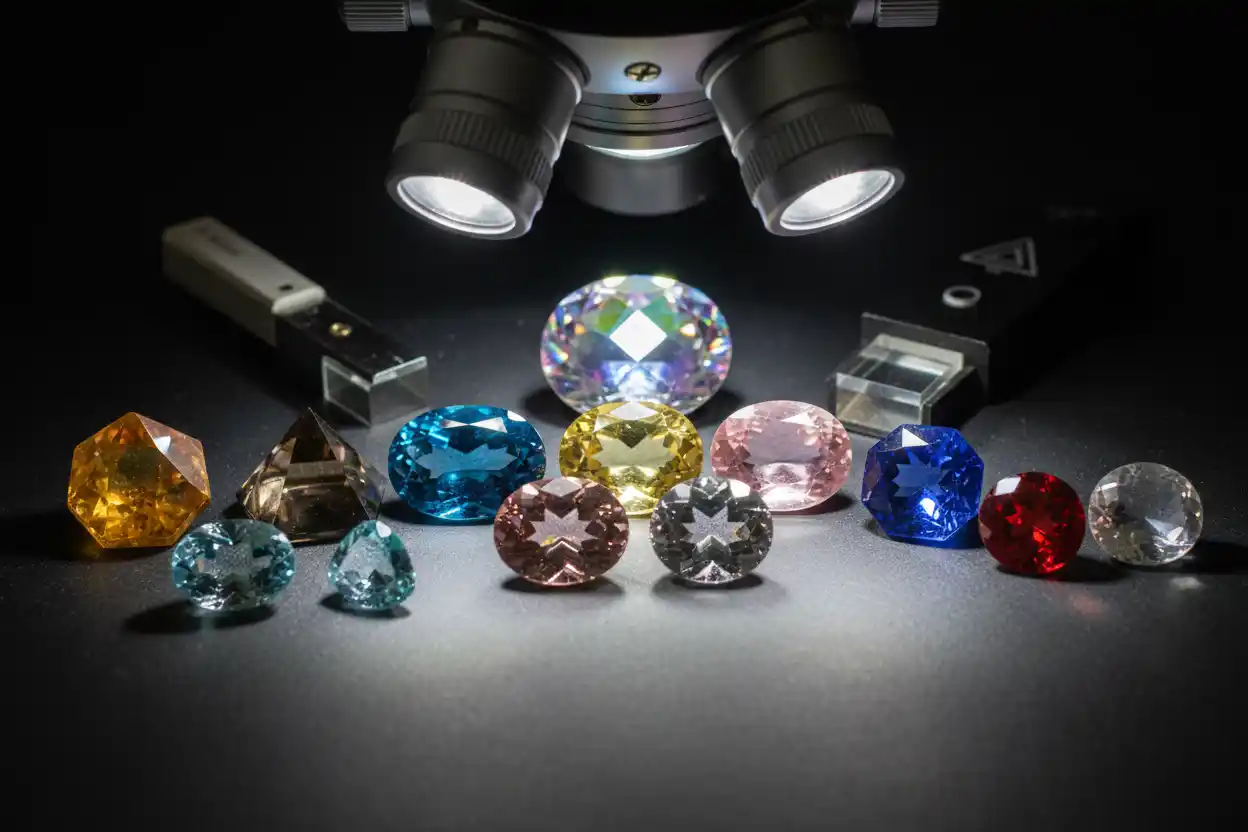
Real vs Fake Topaz: Natural, Treated and Imitation Tests
Real natural topaz is an aluminum fluorosilicate mineral that occurs in colorless, blue, yellow, orange, brown, pink, red, purple and pale-green varieties. It is a distinct gem species rather than a general trade name for any transparent yellow or blue stone.
Most commercial blue topaz begins as natural colorless topaz that receives irradiation and heat treatment. Mystic topaz is usually colorless topaz covered by a thin interference coating. Both products contain genuine topaz, but their finished colors are treated.
Imitations include glass, cubic zirconia, synthetic spinel, quartz, citrine, aquamarine, zircon and other transparent gems. True synthetic topaz has been produced, but it is not a major low-cost jewelry product; many objects casually labeled synthetic topaz are unrelated simulants.
A proper identification must confirm the topaz species, evaluate treatment and distinguish natural growth from any laboratory-grown or assembled material.
This page owns that authenticity workflow. The planned treated and synthetic topaz guide retains irradiation, heat, coating, filling, diffusion and synthetic-growth details.
Genuine Topaz vs Common Lookalikes
| Feature | Natural topaz | Treated blue or coated topaz | Citrine or quartz | Aquamarine | Glass or cubic zirconia |
|---|---|---|---|---|---|
| Material | Natural topaz | Natural topaz with altered color or surface | Quartz | Beryl | Manufactured material |
| Mohs hardness | 8 | 8 in the topaz body | 7 | 7.5–8 | Glass about 5–6; CZ about 8–8.5 |
| Refractive index | Approximately 1.619–1.627 | Same topaz range unless tester contacts coating | About 1.544–1.553 | About 1.577–1.583 | Material-dependent |
| Specific gravity | About 3.53 | About 3.53 | About 2.66 | About 2.72 | Glass variable; CZ about 5.6–6.0 |
| Birefringence | About 0.008–0.010 | Same topaz behavior | About 0.009 | About 0.005–0.009 | Glass and CZ singly refractive |
| Cleavage | Perfect basal cleavage | Same structural weakness | No cleavage in quartz | Imperfect beryl cleavage | No mineral cleavage in glass or CZ |
| Typical clarity | Frequently eye-clean | Frequently eye-clean | Often clean | Frequently eye-clean | Usually very clean |
| Main treatment | Colorless, brown, yellow, pink or orange may be natural | Irradiation, heat and coating are common by product | Heat and irradiation possible | Heating common | Color manufactured |
| Best confirmation | RI, density, cleavage awareness, microscopy and spectroscopy | Same tests plus treatment analysis | Standard gem testing | Standard gem testing | Standard material identification |
Topaz commonly forms in large clean crystals, so large size and high clarity do not automatically indicate glass.
What Is Genuine Topaz?
The completed topaz meaning guide owns geology, symbolism, localities and general properties.
Topaz has the composition Al₂SiO₄(F,OH)₂ and crystallizes in the orthorhombic system.
It commonly forms in granitic pegmatites, rhyolitic cavities and hydrothermal environments. Crystals can become exceptionally large and transparent.
The completed types-of-topaz guide owns colorless, blue, imperial, pink, yellow, brown and coated trade varieties.
Natural topaz should not be identified through color alone because several treatments and simulants produce the same hues.
Natural Topaz Colors
Colorless topaz is abundant.
Yellow, brown and pale blue can occur naturally. Orange, pink, red and purple-red material is rarer and generally more valuable.
Chromium contributes to natural pink, red and violet-to-purple colors in selected topaz.
Color centers and defects produce many yellow, brown and blue shades.
A strong color does not automatically prove treatment, but market context matters. A large intense blue stone is overwhelmingly more likely to be irradiated and heated than naturally blue.
Blue Topaz
Most blue topaz begins as colorless natural material.
Irradiation creates color centers, and heat treatment adjusts or stabilizes the final blue. Different irradiation processes produce commercial shades such as Sky Blue, Swiss Blue and London Blue.
These names describe market colors rather than mine localities or distinct mineral species.
The completed London blue topaz guide owns that darker gray-blue trade variety.
Treated blue topaz remains natural topaz as its base material. Its color origin must be understood separately.
Is Irradiated Blue Topaz Safe?
Commercial release is controlled under national radiation-safety regulations.
Properly processed stones are held and tested until residual radioactivity falls within regulatory limits.
A consumer cannot determine regulatory compliance with a home radiation rumor or visual test.
Purchase from established suppliers with traceable treatment channels.
Safety compliance does not make the color natural; it confirms that the treated product can enter the legal market.
Sky, Swiss and London Blue
Sky Blue generally describes pale to medium blue.
Swiss Blue is commonly brighter and more saturated, while London Blue is usually darker and grayer or greenish blue.
No universal global color master defines these names precisely. Two sellers may use them differently.
The terms do not reveal the exact irradiation source, treatment facility or natural starting color.
Compare the exact stone rather than buying the trade label alone.
Imperial Topaz
Imperial topaz is a valuable color trade category commonly associated with orange, pinkish orange, reddish orange, pink or red topaz.
There is no single universally enforced color boundary.
Some dealers reserve the name for topaz from Ouro Preto, Brazil, while others use it for qualifying color regardless of origin.
Color, saturation, treatment and laboratory identification matter more than the word imperial.
A brown or yellow stone should not receive a premium merely because a seller adds the label.
Mystic Topaz
Mystic topaz is usually colorless natural topaz with a thin metallic-oxide coating.
The coating creates rainbow, green, purple, pink and blue interference colors.
The topaz base is genuine, but the appearance is entirely treatment-dependent.
Inspect facet edges, scratches and areas beneath prongs for coating wear.
Repolishing, abrasion and some chemicals can remove or damage the film.
White Topaz
White topaz is colorless topaz.
It can imitate diamond in affordable jewelry but displays less brilliance and fire.
Large clean white topaz is common and should not receive a rarity premium based on clarity alone.
Glass, cubic zirconia and colorless quartz can resemble it.
Density and refractive index separate those materials more reliably than sparkle.
Yellow Topaz
Yellow topaz ranges from pale straw to golden and brownish yellow.
It can be confused with citrine, yellow sapphire, heliodor and glass.
Some yellow-to-brown topaz colors may fade after prolonged heat or strong light.
Natural-color claims should be treated cautiously when a premium is attached.
The planned citrine versus yellow topaz guide owns the direct quartz comparison.
Topaz Versus Citrine
Citrine is quartz and is much lighter in density.
Topaz also has a higher refractive index and perfect cleavage, while quartz lacks cleavage.
Both can be pale yellow, golden, orange or brownish.
The recently drafted real-versus-fake citrine guide explains heated amethyst, natural citrine and glass.
Color and affordability cannot identify either mineral accurately.
Topaz Versus Aquamarine
Aquamarine is blue-to-greenish-blue beryl.
Topaz is considerably denser and has a higher refractive index. Aquamarine commonly displays a lighter green-blue tone and characteristic beryl inclusions, though treated blue topaz can match the color closely.
The planned aquamarine versus topaz guide owns the broad comparison.
The planned aquamarine versus blue topaz guide concentrates specifically on the familiar blue trade stones.
The recently drafted real-versus-fake aquamarine guide retains aquamarine-specific synthetic and Maxixe-type boundaries.
Topaz Versus Sapphire
Sapphire is corundum and ranks 9 on the Mohs scale.
It is denser, more refractive and lacks topaz’s perfect basal cleavage.
Blue, yellow, pink and colorless sapphires can overlap topaz visually.
Natural sapphire generally carries a different price structure, while laboratory-grown sapphire can be inexpensive.
The recently drafted real-versus-fake sapphire guide owns sapphire growth-origin and treatment testing.
Topaz Versus Zircon
Zircon is a natural zirconium silicate mineral.
It has higher dispersion and commonly shows obvious double refraction through rear facet junctions.
Topaz’s density and refractive properties differ.
Blue zircon is usually heated, creating a separate treatment question.
Zircon should not be confused with cubic zirconia, a manufactured zirconium-oxide material.
Glass Imitations
Glass can reproduce any topaz color.
Round bubbles, curved flow lines, mold seams and a homogeneous interior support glass identification.
Topaz is normally doubly refractive, while ordinary glass is isotropic.
Glass generally feels lighter than cubic zirconia but may overlap subjective topaz heft depending on composition.
High-quality optical glass can lack visible bubbles. Refractive-index testing provides stronger evidence.
Cubic Zirconia
Cubic zirconia can imitate colorless, pink, yellow and blue topaz.
It is substantially denser, so an equal-size loose CZ weighs much more.
CZ also produces greater brilliance and broad rainbow flashes.
Its refractive index is higher, and it is singly refractive.
The completed cubic zirconia buying guide owns quality and purchase evaluation.
Synthetic Spinel
Synthetic spinel is manufactured in many topaz-like colors.
It has a higher refractive index, greater hardness and single refraction.
Flame-fusion material may show curved growth lines and bubbles.
A laboratory-grown spinel is not synthetic topaz because the chemical composition and crystal structure differ.
The seller should state the actual material rather than using a generic created topaz label.
Does Synthetic Topaz Exist?
Laboratory-grown topaz has been produced experimentally and for research.
It is not a major commercial synthetic gemstone because natural colorless topaz is abundant and inexpensive.
A low-cost product advertised as synthetic topaz is often glass, cubic zirconia or synthetic spinel.
The correct description should name the actual material and avoid implying chemical equivalence without evidence.
Natural Topaz Inclusions
Topaz used in jewelry is frequently eye-clean.
Inclusions may include liquid-filled cavities, two-phase inclusions, mineral crystals, growth tubes and partially healed fractures.
Clean appearance does not prove glass or laboratory growth.
Large natural crystals can yield sizeable flawless-looking gems.
Manufactured glass may also be clean, making physical measurements more useful than inclusion absence.
Heat Treatment
Heat can alter yellow, brown, pink and blue-related color states.
It is routinely combined with irradiation in the production of blue topaz.
Some pink topaz is produced by heating suitable brown or orange material.
The treatment generally does not change topaz’s basic refractive index, density or hardness.
Visual inspection alone may not establish the complete treatment history.
Coated Topaz
Besides mystic topaz, colorless or pale topaz may receive coatings that create pink, blue, green or other colors.
Look for abrasion at facet edges and a different underlying body at chips.
A coating can cause inconsistent color when viewed from the side.
Contact with jewelry tools, polishing compounds and chemicals can damage it.
The completed gemstone-treatment guide explains coating, heat and irradiation as separate processes.
Filled and Assembled Material
Fractures may contain transparent filler, although filling is less central to the topaz market than color treatment.
Doublets can combine a topaz or quartz crown with colored glass, adhesive or another base.
Inspect the girdle for a straight boundary, flattened bubbles and a sudden change in inclusions.
Closed settings can hide construction.
The material should be described as assembled rather than solid topaz when multiple layers create the visible gem.
Perfect Cleavage
Topaz has perfect basal cleavage.
A sharp impact parallel to that direction can split the gem cleanly.
Cleavage is not usually visible in every polished stone, but it strongly affects cutting, setting and repair.
The completed gemstone-cleavage guide explains why a hardness of 8 does not prevent structural breakage.
Never strike or pry a suspected stone to expose cleavage.
Hardness and Durability
Topaz ranks 8 on the gemstone hardness chart.
It resists scratching better than quartz, glass and beryl, but sapphire and diamond are harder.
The perfect cleavage makes impact a more serious risk than the hardness number suggests.
The completed gemstone toughness-versus-hardness guide provides the complete durability distinction.
Scratch testing cannot distinguish natural from treated or synthetic topaz safely.
Refractive Index and Density
Topaz generally measures approximately 1.619–1.627 in refractive index and about 3.53 in specific gravity.
Those properties separate it from quartz, aquamarine, glass, zircon and cubic zirconia.
Natural colorless and treated blue topaz share the same mineral measurements.
A coating may interfere if the refractometer contacts the film rather than an exposed topaz surface.
Hydrostatic testing requires a loose stone without attached metal.
Pleochroism
Topaz is pleochroic, although the effect varies with color and saturation.
Pink, orange and brown stones can show more visible directional differences than pale blue or colorless material.
A dichroscope may support topaz identity, while ordinary glass and CZ remain singly refractive.
Other natural lookalikes are also pleochroic, so the observation must agree with refractive index and density.
Ultraviolet Light
Topaz fluorescence varies by color, treatment and source.
Some stones fluoresce while others remain inert.
Coatings, glass and synthetic materials can also react.
Ultraviolet light may reveal inconsistent surface treatment but cannot provide a universal topaz result.
Spectroscopy and Chemical Analysis
Visible spectroscopy can examine color centers and chromium-related color.
Raman spectroscopy confirms topaz and distinguishes quartz, beryl, glass and CZ.
Chemical analysis identifies aluminum, silicon, fluorine and trace elements consistent with topaz.
Advanced testing may investigate treatment, coating and unusual synthetic claims.
The completed gemstone-certification guide explains report scope. Use how to read a gem-lab report to determine whether the document identifies treatment as well as the topaz species.
A Safe Home Inspection Sequence
Clean the stone gently and inspect it under neutral light.
Compare color from the front, side and back, looking for coating wear or color concentrated on one surface.
Use a loupe to identify bubbles, flow lines, natural inclusions, filler and join planes.
A polariscope or dichroscope can separate several singly refractive imitations.
Professional refractive-index and density measurements confirm topaz efficiently.
Do not scratch, heat, drop or expose the stone to abrupt temperature changes.
When a rare-color or untreated claim affects price, obtain independent testing.
Buying Genuine Topaz
The completed topaz buying guide owns color, clarity, cut and seller evaluation.
The topaz price guide explains why ordinary blue and colorless material differs from fine imperial, pink and red topaz.
Ask whether color is natural, irradiated, heated or coated.
Blue topaz should normally be assumed treated, while an imperial label should not be accepted as an official laboratory grade.
For remote purchases, follow how to buy gemstones online and verify documentation before the return period expires.
Jewelry and Care
A topaz ring needs protection from sharp impact despite the stone’s hardness.
A topaz bracelet faces more knocks than topaz earrings or a topaz necklace.
Use the completed topaz jewelry cleaning guide and avoid steam, ultrasonic cleaning, extreme heat and abrupt temperature changes.
Coated mystic topaz should receive only gentle cleaning.
Topaz’s calendar tradition appears in the completed November birthstone guide.
Frequently Asked Questions
1. What is genuine natural topaz?
It is naturally formed aluminum fluorosilicate with topaz’s characteristic crystal structure and physical properties.
2. Is most blue topaz treated?
Yes. Nearly all strong blue topaz in ordinary jewelry receives irradiation and heat treatment.
3. Is irradiated blue topaz fake?
No. The base is natural topaz, but its blue color is treated.
4. Is mystic topaz genuine topaz?
It normally has a genuine colorless-topaz base covered by an artificial interference coating.
5. Is Imperial topaz an official laboratory grade?
No. The term is used inconsistently for selected orange, pink, red or related colors.
6. Does synthetic topaz exist?
It has been produced, but it is not a major commercial synthetic. Many inexpensive alleged synthetics are glass, CZ or synthetic spinel.
7. Can natural topaz be flawless?
Yes. Topaz often forms in large clean crystals and commonly yields eye-clean gems.
8. How can topaz be distinguished from citrine?
Topaz is denser, more refractive and has perfect cleavage. Citrine is lighter quartz without cleavage.
9. How can topaz be distinguished from aquamarine?
Topaz is much denser and more refractive, while aquamarine belongs to beryl and commonly has a greener blue.
10. Do bubbles prove topaz is glass?
Smooth round bubbles in a homogeneous body strongly suggest glass, but one inclusion should be interpreted with optical tests.
11. Can a scratch test authenticate topaz?
No. It can damage the gem and cannot determine color treatment or natural growth origin.
12. When should topaz receive laboratory testing?
Testing is useful for fine imperial, pink or red stones, natural-blue claims, coatings, assembled stones and suspected synthetic material.
Topaz authentication begins with mineral properties rather than a commercial color name. Quartz, aquamarine, glass and cubic zirconia can reproduce its appearance, while irradiation and coating can transform genuine colorless topaz. Refractive index, density and careful surface examination resolve most material questions; rare-color and untreated premiums deserve independent laboratory evidence.
Topaz appears in Crystals That Start With T and Gemstones That Start With T.