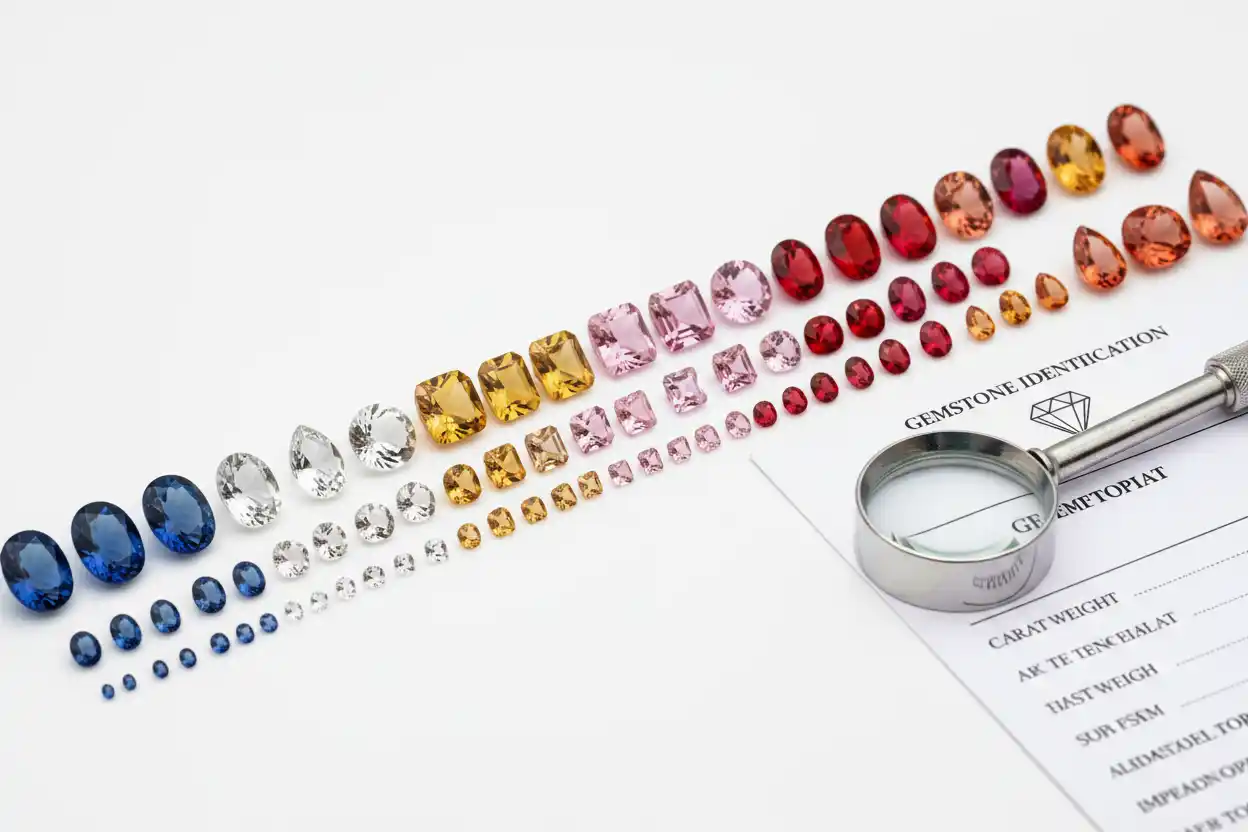
Topaz Price Guide: Value and Cost in 2026
Topaz prices in 2026 range from approximately $5 per carat for mass-market treated blue or colorless material to more than $2,000 per carat for exceptional Imperial, pink or red Topaz. Most attractive blue, white and yellow jewelry Topaz costs between about $10 and $150 per carat.
The variety must be identified before comparing prices. Blue Topaz, Imperial Topaz, natural pink Topaz, yellow Topaz and coated Mystic Topaz belong to very different markets even though they share the same mineral identity.
Topaz Prices by Variety in 2026
| Topaz variety | Broad 2026 retail range | Main value factors |
|---|---|---|
| Colorless or White Topaz | $5–$50 per carat | Transparency, cut and size |
| Sky Blue Topaz | $5–$20 per carat | Even color and cutting |
| Swiss Blue Topaz | $10–$35 per carat | Bright blue color and brilliance |
| London Blue Topaz | $15–$60 per carat | Dark teal-blue color and cut |
| Yellow or Golden Topaz | $20–$200 per carat | Natural color, saturation and clarity |
| Imperial Topaz | $100–$1,800+ per carat | Orange-pink color, origin, size and treatment |
| Natural Pink Topaz | $100–$1,000+ per carat | Natural color, saturation and rarity |
| Red Topaz | $500–$3,000+ per carat | Rare natural red color and documentation |
| Mystic Topaz | $10–$100 per carat | Coating quality, cutting and setting |
| Brown or Sherry Topaz | $10–$150 per carat | Natural color, transparency and demand |
Blue Topaz commonly shows little increase in price per carat as weight rises because treated material is readily available in large clean stones. Imperial and rare pink-red Topaz receive much steeper size premiums.
The principles behind color, treatment, size and rarity are explained in How Gemstone Prices Are Determined.
What Is Topaz?
Topaz is an aluminum fluorosilicate mineral with a Mohs hardness of 8.
It occurs naturally in colorless, yellow, brown, orange, pink, red, violet and pale-blue appearances. However, most strong blue Topaz in modern jewelry began as colorless material and received irradiation followed by heat treatment.
Topaz is hard enough to resist many scratches, yet it has perfect cleavage. A sharp impact can split the gem along an internal structural plane.
The completed Topaz guide owns the mineral’s geology, properties and traditional symbolism. The completed Types of Topaz page owns the full variety classification.
This page focuses on current price differences among those varieties.
Color Is the Main Topaz Value Factor
Topaz value depends more on color than on clarity because clean crystals can grow to substantial sizes.
Mass-market blue and colorless stones are inexpensive despite excellent transparency. Rare natural orange-pink, red or saturated pink color commands much stronger prices.
Fine Topaz should show an attractive hue without excessive gray, brown or darkness. The color must also remain visible after cutting.
A pale five-carat stone can appear nearly colorless when mounted. Conversely, a deep stone may preserve saturation but contain hidden weight beneath the girdle.
Color descriptions such as London Blue, Swiss Blue, Imperial, sherry and precious Topaz are trade terms rather than universal laboratory grades.
The symbolic interpretation of different colors belongs to Topaz Color Meaning and Symbolism.
Blue Topaz Prices
Blue Topaz is one of the most affordable large transparent gemstones.
Most commercial stones cost approximately $5 to $50 per carat. Precision-cut gems, designer stones and unusually attractive London Blue examples may cost more.
Sky Blue Topaz
Sky Blue is the lightest common commercial variety. Its pale color resembles a light Aquamarine.
Loose stones commonly cost about $5 to $15 per carat. Large calibrated sizes remain inexpensive because the treatment supply is broad.
Swiss Blue Topaz
Swiss Blue shows brighter medium-to-strong blue color.
Most stones cost approximately $10 to $35 per carat. Fine cutting can create additional value, but size alone produces only a small premium.
London Blue Topaz
London Blue normally appears deeper blue, teal-blue or slightly grayish blue.
Commercial gems commonly cost approximately $15 to $60 per carat. Strongly cut stones with open color sit near the upper end.
Excessively dark London Blue can look nearly black indoors. The completed London Blue Topaz guide owns the variety’s material-specific background.
Blue Topaz should be distinguished from Aquamarine through the dedicated Aquamarine vs Blue Topaz and Aquamarine vs Topaz guides.
Why Blue Topaz Is So Affordable
Natural strongly blue Topaz is rare. The commercial market instead uses abundant colorless rough that responds predictably to irradiation and heating.
Large quantities of treated material entered jewelry supply chains, reducing the scarcity premium.
This is why a clean twenty-carat blue Topaz can cost less than a two-carat fine Imperial Topaz.
Treatment does not make blue Topaz an imitation. It remains natural Topaz whose color was modified after mining.
However, the treatment should be disclosed. A seller should not describe common irradiated blue material as rare natural blue Topaz without strong laboratory evidence.
Imperial Topaz Prices
Imperial Topaz occupies the most established premium Topaz market.
Most commercial-to-fine stones range from approximately $100 to $1,800 per carat. Exceptional orange-pink, pinkish-orange and reddish stones can exceed $2,000 per carat.
The term Imperial has no single universal color definition. It is commonly applied to golden-orange, orange-pink, pink-orange and reddish Topaz, particularly material associated with Ouro Preto, Brazil.
Fine stones should display:
- Strong orange, pink or reddish color
- High transparency
- Minimal brown or gray
- Balanced cutting
- Natural or clearly disclosed color history
- Useful size without excessive hidden depth
The completed Imperial Topaz guide owns the variety’s origin and historical context.
A pale yellow stone should not receive an Imperial premium merely because the seller uses the name.
Pink and Red Topaz
Natural Pink Topaz is much rarer than treated blue material.
Commercial-to-fine pink stones commonly range from approximately $100 to $700 per carat. Strongly saturated natural pink gems can exceed $1,000 per carat.
Natural red Topaz is rarer still. Fine documented stones may cost $500 to $3,000 per carat or more.
Some pink Topaz owes its appearance to treatment, coating or irradiation. Treated stones can be attractive but should not be priced as rare natural-color material.
Pink and red hues can also be exaggerated through rose-gold settings, warm illumination and digital editing.
A major premium should therefore be supported by independent testing and neutral-light video.
Yellow and Golden Topaz
Yellow Topaz ranges from pale straw and lemon yellow to rich golden and orange-yellow.
Commercial stones commonly cost approximately $20 to $100 per carat. Fine natural golden material may reach $100 to $200 per carat, while exceptional orange-pink stones may move into the Imperial market.
The completed Yellow Topaz guide owns the variety’s full material context.
Yellow Topaz can resemble Citrine, although the two have different hardness, refractive properties, cleavage and density. Their direct distinction belongs to Citrine vs Yellow Topaz.
Natural yellow color deserves accurate disclosure because irradiated, heated and coated quartz products can be marketed with confusing golden trade names.
White Topaz Prices
White Topaz is colorless natural Topaz.
Most loose stones cost approximately $5 to $50 per carat. Precision cutting and designer provenance can raise prices beyond this range.
Colorless material is widely available and does not have Diamond’s dispersion or scarcity. Consequently, its price remains modest even in large sizes.
A well-cut stone can show strong brilliance, but poor cutting produces a glassy window or weak center.
White Topaz is sometimes used as an affordable Diamond alternative. It scratches less easily than quartz but can still split along its perfect cleavage.
The completed White Topaz guide owns the variety’s identity and use.
Mystic Topaz Prices
Mystic Topaz is normally colorless Topaz coated with a thin interference film.
The coating creates shifting green, purple, blue, pink and rainbow colors.
Loose stones commonly cost approximately $10 to $100 per carat. The base material is inexpensive, so the retail value comes mainly from coating quality, cutting and jewelry design.
The coating can scratch, abrade or become damaged during repair. It should be disclosed clearly.
Mystic Topaz should not be priced as a naturally multicolored rare gem.
The completed Mystic Topaz guide owns the coated variety’s appearance and care concerns.
Brown, Sherry and Champagne Topaz
Brown Topaz occurs naturally and can range from pale champagne to cognac, sherry and dark reddish brown.
Commercial stones commonly cost approximately $10 to $75 per carat. Fine reddish-brown or sherry-colored gems may reach $75 to $150 per carat.
Demand is lower than for Imperial pink-orange or vivid blue material.
Brown color can fade in some stones after prolonged light exposure, depending on the color mechanism.
The name sherry Topaz should indicate a warm brown-to-orange appearance rather than function as proof of rare origin or untreated color.
Clarity and Transparency
Faceted Topaz is generally expected to appear eye-clean.
Clean rough is available in large sizes, particularly in blue, colorless and yellow material. Therefore, obvious fractures, dark crystals and dense clouds reduce value substantially.
Imperial, natural pink and red stones may receive more inclusion tolerance because their colors are scarcer.
Surface-reaching fractures deserve special attention because Topaz has perfect cleavage. A fracture near the girdle can increase setting risk.
Clarity should not be evaluated without cutting. A flawless stone can still look lifeless when it has a broad window or excessive extinction.
Cut Quality
Topaz crystals often grow as long prisms, encouraging cutters to produce elongated ovals, pears, emerald cuts and cushions.
A shallow stone can show a transparent central window. Excessive depth adds hidden weight and reduces face-up size.
Blue and White Topaz rough is affordable, so poor mass-market cutting should not receive a premium.
Precision-cut Topaz may cost considerably more because the lapidary work improves brilliance, symmetry and visual spread.
Rounds require greater rough loss and may cost more in rare natural colors.
The complete selection process belongs to the Topaz Buying Guide.
Topaz Prices by Size
| Carat weight | Blue or White Topaz | Fine yellow or brown Topaz | Imperial or natural pink-red Topaz |
|---|---|---|---|
| Under 2 ct | $5–$30 per carat | $20–$100 per carat | $100–$700 per carat |
| 2–5 ct | $5–$40 per carat | $25–$125 per carat | $150–$1,000 per carat |
| 5–10 ct | $5–$50 per carat | $30–$150 per carat | $250–$1,500 per carat |
| 10–20 ct | $5–$50 per carat | $30–$175 per carat | $400–$2,000+ per carat |
| Above 20 ct | Little mass-market premium | Color and cut dominate | Individually evaluated |
Blue Topaz prices remain relatively flat across weight categories. Fine Imperial Topaz becomes much more expensive when strong pink-orange or red color continues into large stones.
Ouro Preto and Brazilian Topaz
Brazil is the world’s most important commercial source of Topaz.
Minas Gerais supplies colorless, blue-treatment rough, yellow, brown, pink and Imperial material.
The Ouro Preto region is particularly associated with Imperial Topaz.
Fine documented Ouro Preto stones may receive a provenance premium, especially when they have rich orange-pink or reddish color.
However, Brazilian origin alone does not establish quality. The country also produces abundant inexpensive colorless and pale material.
A seller should not charge Imperial prices for ordinary yellow Brazilian Topaz without the required color quality.
Pakistan, Russia, Sri Lanka and Other Sources
Pakistan has produced pink, golden and colorless Topaz from pegmatite deposits.
Russia is historically associated with rare pink Topaz, though modern commercial supply is limited.
Sri Lanka, Nigeria, Namibia, Mexico and the United States have also produced Topaz.
Origin matters most when it supports a rare natural color or important mineral specimen. For ordinary blue and colorless jewelry, treatment, cut and price are more relevant than mining country.
Treatment and Color Stability
The major Topaz treatments include:
- Irradiation followed by heating for blue color
- Surface coating for Mystic Topaz
- Coating or diffusion-like surface modification for some pink and rainbow colors
- Heat treatment to alter certain yellow, orange or brown appearances
Blue Topaz treatment is normally stable during wear. Mystic coatings are less durable because they remain near the surface.
Irradiated stones should enter commerce only after meeting applicable safety requirements.
Treatment details and identification belong to How to Spot Treated or Synthetic Topaz.
The general enhancement framework appears in Gemstone Treatments Explained.
Topaz Jewelry Prices in 2026
| Jewelry type | Broad U.S. retail range |
|---|---|
| Silver Blue Topaz earrings or pendant | $40–$400 |
| Silver or gold-plated Topaz ring | $75–$500 |
| Gold Blue or White Topaz jewelry | $300–$2,500 |
| Gold Imperial Topaz ring | $1,000–$12,000+ |
| Fine natural pink or red Topaz jewel | $3,000–$30,000+ |
| Signed high-jewelry Topaz piece | Individually evaluated |
The setting often costs more than an ordinary blue or white center stone.
Style-specific selection belongs to the Topaz Ring Guide, Topaz Earrings Guide, Topaz Necklace Guide and Topaz Bracelet Guide.
Topaz’s birthstone role belongs to the November Birthstone Guide.
Durability and Care
Topaz has excellent scratch resistance but perfect cleavage.
A hard blow can split the gem even when the surface shows little prior wear.
Protective settings are particularly important for large rings and stones with sharp corners.
Warm water, mild soap and a soft brush provide the safest cleaning method. Steam and ultrasonic cleaning should be avoided, especially for fractured, coated or filled stones.
Complete maintenance guidance belongs to How to Clean Topaz Jewelry Safely.
Certification and Resale Value
Most ordinary blue or white Topaz does not justify a major laboratory report.
Documentation becomes more useful when:
- Imperial, natural pink or red color creates a premium
- Untreated color is claimed
- Mystic or another coating may be present
- A rare origin affects price
- The stone may be Aquamarine, Citrine or glass
- The jewel requires insurance documentation
The complete authenticity process belongs to Real vs Fake Topaz.
Commercial blue and white Topaz generally resell below retail because replacement stones are inexpensive. Fine Imperial, pink and red Topaz have stronger collector potential.
The broader framework appears in Do Gemstones Hold Their Value?.
Frequently Asked Questions
1. How much is Topaz worth per carat in 2026?
Topaz ranges from approximately $5 per carat for commercial blue or colorless material to more than $2,000 per carat for exceptional Imperial, pink or red stones.
2. Which type of Topaz is most valuable?
Fine natural red, pink and Imperial Topaz generally receive the strongest prices.
3. How much is Blue Topaz?
Most Blue Topaz costs approximately $5 to $50 per carat.
4. How much is Imperial Topaz?
Commercial-to-fine Imperial Topaz commonly ranges from $100 to $1,800 per carat. Exceptional stones may cost more.
5. Is London Blue Topaz expensive?
Most London Blue Topaz costs approximately $15 to $60 per carat because treated supply is widely available.
6. How much is natural Pink Topaz?
Natural Pink Topaz commonly ranges from $100 to $1,000 per carat, with rare saturated stones reaching higher prices.
7. Is Mystic Topaz valuable?
Mystic Topaz usually costs $10 to $100 per carat. Its rainbow appearance comes from a surface coating rather than natural multicolor zoning.
8. Does large Topaz cost more per carat?
Blue and White Topaz receive little size premium. Imperial and rare pink-red varieties rise substantially when fine color continues at large sizes.
9. Is Blue Topaz naturally blue?
Most commercial Blue Topaz began as colorless Topaz and received irradiation and heat treatment.
10. Is Topaz suitable for an engagement ring?
It can be used with a protective setting, but perfect cleavage makes it more vulnerable to sharp impact than Sapphire or Diamond.
11. Does Topaz need a laboratory report?
Commercial blue and white stones usually do not. Reports are useful for expensive Imperial, natural pink, red or untreated-color claims.
12. Is Topaz a good investment?
Commercial treated Topaz has weak resale potential. Fine Imperial and rare natural pink-red stones may attract collectors, but appreciation is not guaranteed.
Topaz Pricing Begins With the Color’s Origin
A twenty-carat Blue Topaz and a two-carat Imperial Topaz share the same mineral identity but not the same rarity. Treatment creates an abundant blue market, while natural orange-pink and red colors remain difficult to replace.
In 2026, most mainstream Topaz costs below $100 per carat. Prices above that level should correspond to fine Imperial, pink or red color, strong cutting, natural-color evidence or provenance—not size and transparency alone.