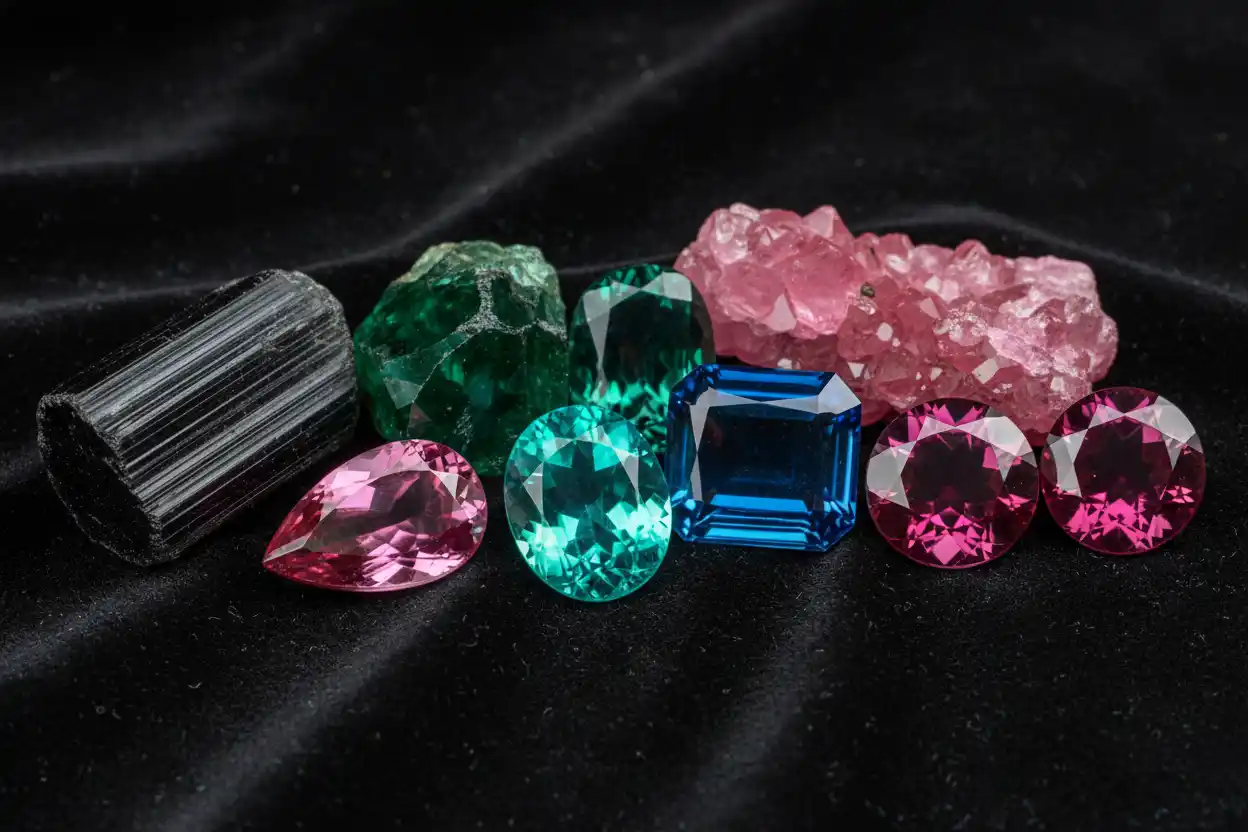
Tourmaline Meaning, Properties, Colors, Types and Value
Tourmaline is a chemically complex group of borosilicate minerals capable of producing almost every gemstone color. Black schorl is abundant in granites and pegmatites, while transparent elbaite, liddicoatite, dravite and uvite provide pink, green, blue, red, yellow, brown and multicolored gems.
The group’s exceptional color diversity comes from changes in species, trace chemistry, growth zoning and oxidation state. Consequently, tourmaline is not one chemically uniform stone, and commercial color names do not always identify the underlying mineral species.
Tourmaline at a Glance
| Property | Tourmaline |
|---|---|
| Mineral classification | Complex borosilicate group |
| General composition | Variable sodium-, calcium-, lithium-, magnesium-, iron- and aluminum-bearing borosilicates |
| Main gem species | Elbaite, liddicoatite, dravite and uvite |
| Common black species | Schorl |
| Crystal system | Trigonal |
| Common habit | Striated prisms with rounded triangular cross-sections |
| Colors | Colorless, black, brown, red, pink, orange, yellow, green, blue, violet and multicolored |
| Luster | Vitreous |
| Transparency | Transparent to opaque |
| Refractive indices | Commonly approximately 1.61–1.67 |
| Specific gravity | Commonly approximately 3.0–3.3 |
| Mohs hardness | Approximately 7–7.5 |
| Cleavage | None or indistinct |
| Tenacity | Brittle |
| Special properties | Strong pleochroism, pyroelectricity and piezoelectricity |
| Main care concern | Fractures, heat sensitivity, thermal shock and undisclosed enhancement |
What Is Tourmaline?
Tourmaline is a mineral supergroup rather than one species with a simple fixed formula.
Its structure can accept numerous combinations of sodium, calcium, lithium, magnesium, iron, aluminum, chromium, vanadium, manganese and other elements.
These substitutions change color, density, refractive index and geological occurrence.
Transparent jewelry material commonly belongs to elbaite or liddicoatite, while dravite and uvite provide important brown, green and occasionally gem-quality crystals. Schorl dominates the black mineral market.
The full species and commercial-variety classification appears in Types of Tourmaline. This parent page explains the family as a whole without replacing the search intent of its dedicated color and variety guides.
Tourmaline Crystal Structure
Tourmaline forms elongated trigonal prisms.
A cross-section commonly resembles a rounded triangle rather than a perfect hexagon.
Longitudinal striations run along many crystal faces, creating one of the group’s most recognizable field features.
The two ends of a crystal can develop differently because tourmaline is polar. This structural polarity contributes to its pyroelectric and piezoelectric behavior.
Heating, cooling or applying pressure can create an electrical charge across the crystal. These physical effects are real and measurable, although they do not establish metaphysical healing claims.
How Tourmaline Gets Its Colors
Tourmaline color results from complex interactions among trace elements, charge-transfer processes and structural defects.
Iron commonly contributes black, blue, green and brown shades.
Manganese helps produce pink and red.
Copper creates the vivid blue-to-green appearance associated with Paraíba-type tourmaline, often with manganese influencing the final hue.
Chromium and vanadium produce saturated green. Despite the name Chrome Tourmaline, vanadium may contribute more strongly than chromium in many stones.
Color can vary during crystal growth as fluid chemistry changes. This creates bicolored, tricolored and concentrically zoned crystals.
The broader traditional color associations remain with Tourmaline Color Meaning and Symbolism.
Major Tourmaline Species
Schorl
Schorl is iron-rich and usually black or extremely dark brown, blue or green.
It is the most common tourmaline species and the mineral behind most Black Tourmaline products.
Schorl commonly forms in granite, pegmatite and metamorphic rock.
Although it can polish well, most material is opaque and valued as crystals, carvings, beads or cabochons rather than transparent faceted gems.
Elbaite
Elbaite is a lithium-rich species responsible for many gem-quality pink, red, green, blue and multicolored stones.
Rubellite, indicolite, verdelite and many Watermelon Tourmalines belong to elbaite.
Its chemistry changes readily during pegmatite crystallization, producing dramatic color zoning.
Liddicoatite
Liddicoatite is calcium-rich and especially known for complex triangular and concentric color zoning.
Madagascar produces notable multicolored slices.
Some stones historically called elbaite have later proved to be liddicoatite after chemical analysis.
Dravite
Dravite is magnesium-rich and commonly brown, yellow-brown or dark green.
Gem-quality material can be transparent and attractive, while opaque crystals occur in metamorphic and calcium-magnesium-rich environments.
Uvite
Uvite is calcium-magnesium-rich.
It commonly forms green, brown, black or reddish crystals and can occur in marble and calc-silicate rocks.
Important Tourmaline Varieties
Rubellite
Rubellite is saturated red, pinkish-red or purplish-red tourmaline.
A fine stone should retain an attractive red appearance under different lighting rather than becoming weak pink or overly brown.
Rubellite may contain visible liquid-rich inclusions. Fine color can remain more important than perfect clarity.
Verdelite
Verdelite is a commercial name for green gem tourmaline.
Colors range from yellow-green and forest green to blue-green.
The name does not identify one species or coloring element.
Indicolite
Indicolite describes blue tourmaline.
Fine stones range from medium blue to blue-green and teal.
Dark rough requires careful cutting orientation because strong pleochroism can make one direction appear nearly black.
Paraíba Tourmaline
Paraíba Tourmaline is copper-bearing tourmaline known for vivid blue, green-blue and green colors.
The first important material came from Paraíba State in Brazil. Copper-bearing tourmaline was later found in Nigeria and Mozambique.
Color and copper chemistry define the commercial category more strongly than geographic origin alone, although Brazilian stones can receive major provenance premiums.
Chrome Tourmaline
Chrome Tourmaline is intense green dravite or uvite colored largely by vanadium and chromium.
It can resemble fine tsavorite garnet or emerald.
Stones are often small because dark saturation limits the usable size of the rough.
Cat’s-Eye Tourmaline
Parallel tube-like inclusions can create chatoyancy when the gem is cut as a cabochon.
A valuable cat’s eye should be sharp, centered and mobile rather than broad and diffuse.
Watermelon and Parti-Colored Tourmaline
Watermelon Tourmaline has a pink or red center surrounded by green.
Other parti-colored crystals may contain pink and green longitudinal bands, blue-green zones or several stacked colors.
The distinction depends on how color is arranged within the original crystal.
How Tourmaline Forms
Tourmaline commonly forms in granitic pegmatites.
As magma crystallizes, water, boron, lithium and other mobile elements accumulate in the remaining fluid-rich melt.
The changing fluid composition allows different tourmaline zones to grow in sequence. An early black crystal can later receive a green or pink outer layer.
Tourmaline also forms in hydrothermal veins and metamorphic rocks.
Dravite and uvite are common in magnesium- or calcium-rich metamorphic environments, while schorl occurs widely in granite and altered rock.
Because tourmaline resists weathering, crystals can survive erosion and concentrate in alluvial deposits.
Important Sources
Brazil is one of the largest and most diverse sources, producing green, pink, blue, rubellite, Watermelon and copper-bearing Paraíba material.
Mozambique supplies Paraíba-type blue and green stones, rubellite and other gem colors.
Nigeria produces copper-bearing tourmaline as well as green, pink and bicolored rough.
Afghanistan and Pakistan yield fine pegmatite crystals in pink, green, blue and multicolored combinations.
Madagascar is especially important for liddicoatite slices and complex zoning.
Namibia supplies vivid green and blue-green material, including historically important tourmaline from the Erongo region.
Sri Lanka produces waterworn crystals in many colors.
California and Maine are classic United States sources of gem elbaite, while other states contain schorl and dravite.
Russia, Tanzania, Kenya and several additional countries contribute to the market.
Inclusions
Tourmaline commonly grows in fluid-rich environments, so liquid and gas inclusions are frequent.
Thread-like tubes often run parallel to the crystal’s length.
Healed fractures can form fingerprint-like patterns.
Mineral crystals and color-zone boundaries may also be visible.
In cabochons, parallel tubes can produce a cat’s-eye effect.
Rubellite and Paraíba Tourmaline are often accepted with more inclusions than green or blue material because exceptional color can outweigh perfect clarity.
Surface-reaching fractures deserve careful inspection because they can contain filling material and reduce durability.
Tourmaline Treatments
Heat can lighten overly dark green and blue tourmaline or modify other colors.
Irradiation can strengthen pink, red and related hues in suitable material.
Fracture filling with oil, resin or another substance can reduce the visibility of surface-reaching cracks.
Coatings and assembled products are less common but possible.
Some enhancements are difficult to detect in ordinary retail settings. Therefore, important stones should receive independent laboratory evaluation.
The complete treatment discussion remains with Treated Tourmaline.
Treatment does not necessarily make a gemstone unsuitable, but it should affect price and care instructions.
Synthetic Tourmaline and Imitations
True synthetic tourmaline has been produced for research but is not a major jewelry product.
Most imitations are glass, synthetic spinel, synthetic corundum, dyed quartz or assembled material.
Glass may show bubbles and flow lines, while real tourmaline commonly displays pleochroism, natural zoning and growth tubes.
Quartz and tourmaline have different refractive indices and densities.
The consumer testing sequence appears in Real vs Fake Tourmaline.
Cutting Tourmaline
Tourmaline’s elongated crystal shape encourages rectangular, emerald, oval and elongated cushion cuts.
Pleochroism strongly affects orientation.
To lighten overly dark material, cutters often place the table parallel to the crystal’s length. To deepen a pale stone, they may orient it more nearly perpendicular.
Cross-sectional slices preserve concentric zoning, while lengthwise cuts display longitudinal bands.
Included rough becomes cabochons, beads and carvings.
Cutters must avoid excessive heat because fluid-filled fractures can expand or open during polishing.
Hardness and Jewelry Durability
Tourmaline measures approximately 7–7.5 on the Gemstone Hardness Chart.
It resists many everyday scratches and has no strong cleavage.
Nevertheless, tourmaline is brittle. Long crystals, thin slices and heavily fractured stones can break under impact.
The practical difference appears in Gemstone Toughness vs Hardness.
Rings can work for regular careful wear, particularly when the stone is clean and protected.
Highly included rubellite, Paraíba and multicolored slices require more cautious settings.
Tourmaline Jewelry
A Tourmaline Ring can emphasize one vivid color or a bicolored transition.
Tourmaline Necklaces suit larger crystals and elongated cuts.
Tourmaline Earrings require careful matching because natural color varies significantly.
Tourmaline Bracelets should use secure settings and stones without exposed fractures.
Tourmaline and opal are recognized in the October Birthstone Guide.
Tourmaline Prices in 2026
Tourmaline has one of the widest price ranges of any gemstone family.
| Variety | Indicative retail range |
|---|---|
| Black tourmaline crystals and small polished pieces | $2–$30 per piece |
| Commercial green or pink faceted tourmaline | $20–$300 per carat |
| Fine rubellite | $300–$1,500+ per carat |
| Fine indicolite | $400–$2,000+ per carat |
| Chrome Tourmaline | $200–$1,500+ per carat |
| Fine cat’s-eye material | $100–$1,000+ per carat |
| Paraíba-type tourmaline | $5,000–$50,000+ per carat |
| Exceptional Brazilian Paraíba | Potentially above these ranges |
These figures are indicative, not formal grades. Color, copper content, origin, clarity, cut and size can create dramatic differences.
Ordinary dark green material may remain inexpensive, while a small neon copper-bearing stone can cost more than a much larger gem of another variety.
The broader valuation workflow belongs to the Tourmaline Price Guide.
What Determines Tourmaline Value?
Color is normally the most important factor.
Strong saturation should remain bright rather than becoming black or muddy.
Paraíba blue-green, vivid rubellite red, fine indicolite blue and saturated Chrome Tourmaline green command the strongest premiums.
Clarity expectations vary. Green tourmaline is often expected to be clean, while rubellite and Paraíba can retain high value with visible inclusions.
Cut controls pleochroism, darkness and face-up brilliance.
Size increases value sharply when fine color and clarity remain intact.
Species and locality matter most for collector crystals and premium Paraíba material.
Treatments, fracture filling and repair must be disclosed.
Buying Tourmaline
Use the Tourmaline Buying Guide for the full purchase process.
Ask for the observed color, mineral species when known, treatment and geographic origin.
View the stone under several lighting conditions because tourmaline can shift from attractive to overly dark.
Inspect surface-reaching fractures and parallel tubes.
Require an independent report for expensive Paraíba, rubellite, indicolite or Chrome Tourmaline.
Do not rely on a color name alone to establish chemistry. A vivid green stone is not automatically Chrome Tourmaline, and a blue-green stone is not automatically copper-bearing Paraíba.
Cleaning and Storage
Clean tourmaline with lukewarm water, mild soap and a soft brush.
Avoid steam and sudden temperature changes.
Ultrasonic cleaning should be avoided for fractured, filled or heavily included stones.
Heat from jewelry repair can expand liquid inclusions and open fractures.
Store each stone away from harder sapphire and diamond jewelry.
Long crystals and slices should receive padded support rather than pressure on their ends or thin edges.
Tourmaline Meaning and Symbolism
Tourmaline has accumulated different symbolic associations according to color and culture.
Modern traditions connect black tourmaline with boundaries, green tourmaline with growth, pink tourmaline with compassion, blue tourmaline with communication and multicolored crystals with integration.
Its ability to carry several colors within one crystal supports symbolism involving complexity, adaptability and changing conditions during personal growth.
These interpretations are cultural, spiritual or personal rather than scientifically demonstrated effects.
Frequently Asked Questions
Is tourmaline one mineral?
Tourmaline is a supergroup containing numerous related mineral species with different compositions.
What is the rarest tourmaline?
Fine copper-bearing Paraíba Tourmaline is among the rarest and most valuable commercial varieties.
Why does tourmaline occur in so many colors?
Its crystal structure accepts many elements, and fluid chemistry can change repeatedly while one crystal grows.
Is black tourmaline the same as schorl?
Most black tourmaline sold commercially is schorl, although other species can also become very dark.
Is Rubellite a separate mineral?
Rubellite is a red-to-purplish-red gem trade variety, usually belonging to elbaite.
Is Tourmaline naturally multicolored?
Yes. Changes in chemistry during crystal growth can produce natural bicolored, tricolored and concentrically zoned crystals.
Is tourmaline treated?
Some stones are heated, irradiated or fracture filled. Many are also sold untreated.
Is tourmaline suitable for everyday rings?
Generally yes, provided the gem is not heavily fractured and the setting protects exposed edges.
Can tourmaline go in water?
Brief washing is usually safe for solid untreated stones. Avoid soaking filled, glued, highly fractured or assembled pieces.
How much is tourmaline worth?
Common material may cost only a few dollars, while fine Paraíba Tourmaline can reach tens of thousands of dollars per carat.
Does tourmaline have scientifically proven healing properties?
No. Symbolic traditions may hold personal meaning, but scientific evidence does not establish healing effects.
Tourmaline’s defining feature is not one color but its capacity to record changing chemistry within a single crystal. That complexity explains why species, zoning, treatment and cutting orientation matter as much as the color name on a sales label.
Tourmaline appears in Crystals That Start With T and Gemstones That Start With T.