Watermelon Tourmaline: Meaning, Properties & Symbolism
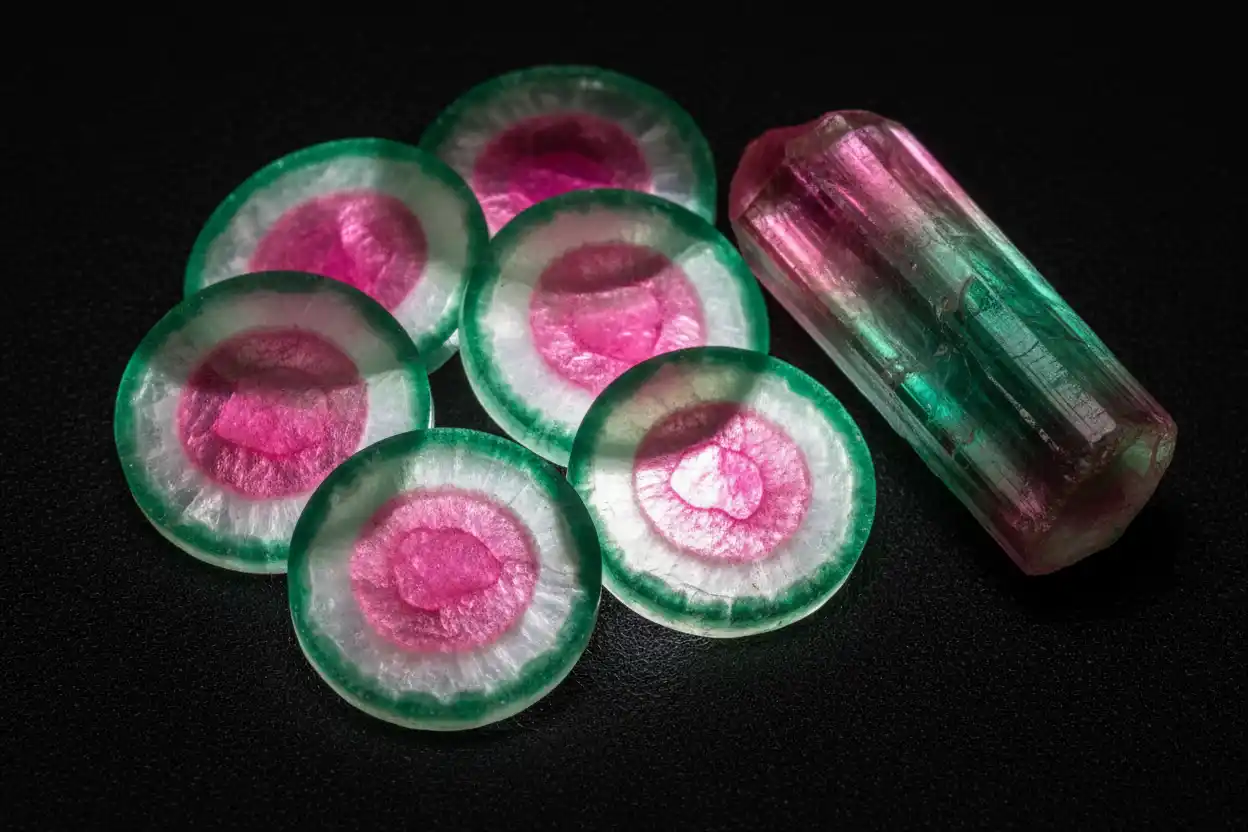
Watermelon Tourmaline is concentrically color-zoned tourmaline with a pink or red center surrounded by a green outer region. A pale colorless, white or yellowish transition may separate the two main zones, creating the appearance of watermelon flesh, rind and inner pith.
The name describes color arrangement rather than one separate mineral species. Most gem material belongs to elbaite or liddicoatite, while the exact species requires chemical analysis.
Watermelon Tourmaline at a Glance
| Property | Watermelon Tourmaline |
| Material type | Pink-and-green color-zoned tourmaline |
| Common species | Elbaite and liddicoatite |
| Color arrangement | Pink or red core with green outer zone |
| Crystal system | Trigonal |
| Crystal habit | Striated prismatic crystals with rounded triangular cross-sections |
| Luster | Vitreous |
| Transparency | Transparent to opaque |
| Refractive indices | Commonly approximately 1.61–1.67 |
| Specific gravity | Commonly approximately 3.0–3.2 |
| Mohs hardness | Approximately 7–7.5 |
| Cleavage | None or indistinct |
| Tenacity | Brittle |
| Common cuts | Cross-sectional slices, cabochons, free forms, beads and faceted gems |
| Main care concern | Natural fractures, thin slice edges, heat sensitivity and filling |
What Is Watermelon Tourmaline?
Watermelon Tourmaline forms when the chemical environment changes during crystal growth.
The earliest stage develops a manganese-rich pink or red center. Later fluid introduces chemistry favorable to green growth, commonly involving iron.
Because the outer layer follows the crystal’s perimeter, a cross-section shows pink in the middle and green around the edge.
Not every pink-and-green tourmaline qualifies as watermelon.
A lengthwise crystal with pink at one end and green at the other is bicolored or parti-colored tourmaline. True watermelon structure is radial or concentric around the central axis.
The parent Tourmaline Guide owns family-level mineralogy, while Types of Tourmaline places Watermelon Tourmaline within the wider species and variety system.
Color Structure
The pink center can range from pale blush and salmon to vivid raspberry or red.
The green rind may appear pale mint, olive, forest green, blue-green or nearly black.
A colorless or white zone often lies between the center and outer rim.
Some crystals contain several alternating pink, green, colorless and yellow bands rather than one simple two-color pattern.
The strongest market demand generally favors clearly separated pink and green with enough transparency to show the zoning cleanly.
The traditional symbolism of the separate colors is compared in Tourmaline Color Meaning and Symbolism.
Elbaite and Liddicoatite
Many Watermelon Tourmalines belong to elbaite, the lithium-rich species responsible for a large share of transparent gem tourmaline.
Madagascan slices frequently belong to liddicoatite, which is calcium-rich and known for complex triangular color zoning.
Visual appearance cannot always separate the species.
Both can produce vivid pink cores and green rims.
A laboratory uses chemical analysis, Raman spectroscopy and structural data when species-level naming matters.
For normal jewelry sales, Watermelon Tourmaline may be an adequate variety description when the pink-green arrangement is genuine and treatment is disclosed.
How Watermelon Tourmaline Forms
Watermelon Tourmaline develops mainly in evolved granitic pegmatites.
Boron, lithium, water and other mobile elements concentrate in late-stage magma and fluid.
Tourmaline begins growing from one chemical mixture. As crystallization continues, nearby feldspar, quartz and mica remove elements from the fluid, while new fluid enters the pocket.
Manganese supports pink or red growth. Later iron-bearing conditions commonly create green.
The changing chemistry can happen repeatedly, producing several concentric layers.
Cracks may develop as the crystal cools or as later geological pressure affects the pegmatite.
Important Sources
Brazil, especially Minas Gerais, supplies large quantities of Watermelon Tourmaline for jewelry and mineral collections.
The Cruzeiro and other pegmatites have produced substantial pink-and-green crystals and polished slices.
Madagascar is known for complex liddicoatite zoning, including triangular pink, green, yellow and colorless patterns.
Afghanistan and Pakistan produce elongated gem crystals with pink-green zoning in mountain pegmatites.
Nigeria and Mozambique supply pink, green and bicolored tourmaline, including watermelon-like material.
California and Maine are historic United States sources of gem elbaite.
Origin should not be inferred from pattern alone because similar zoning develops in several pegmatite provinces.
Cross-Sectional and Lengthwise Cuts
Cross-sectional slices are the classic form.
The cutter saws perpendicular to the crystal’s length, exposing the pink center and green rim.
The natural triangular outline may be retained, rounded into a cabochon or framed as a free-form pendant.
Lengthwise cutting reveals long parallel bands. A pink core may run through the center with green along the sides.
Faceting can increase brilliance but may blend the colors, hide the concentric arrangement or create uneven extinction.
Thin slices show the pattern clearly but are vulnerable to chips and fractures.
Watermelon Tourmaline Versus Parti-Colored Tourmaline
Parti-colored tourmaline contains more than one color.
The category includes pink-and-green, blue-and-green, red-and-colorless and many other combinations.
Watermelon is a specific type of parti-color arrangement with a central pink or red zone surrounded by green.
A longitudinal pink-to-green stone can be beautiful and valuable, but it should not be called watermelon unless the original radial structure supports the name.
Watermelon Tourmaline Versus Rubellite and Verdelite
The center may resemble Rubellite, while the outer layer resembles Verdelite.
However, a Watermelon Tourmaline is evaluated as one color-zoned crystal rather than as separate rubellite and verdelite gems joined together.
Its appeal depends on the transition, symmetry and relationship between the zones.
A seller should not calculate the value by assigning separate premium variety prices to each color area.
Inclusions and Fractures
Fluid-filled tubes, healed fractures and mineral inclusions are common.
Color-zone boundaries can concentrate internal stress.
Thin slices may contain fractures that run from the center toward the outer rim.
Some fractures enhance the visual texture, but surface-reaching cracks reduce durability and can contain resin or oil.
Highly transparent material with vivid zoning is substantially rarer than included commercial slices.
Inclusions are often accepted when the pattern remains attractive and structurally stable.
Identifying Natural Watermelon Tourmaline
The host material should show tourmaline’s refractive index, density and optical behavior.
Natural crystals often preserve longitudinal striations and a rounded triangular outline.
The pink and green zones should follow growth structure rather than appearing as flat layers glued together.
Magnification may reveal natural tubes, healed fractures and gradual transition bands.
Dyed quartz, glass and resin can imitate the color combination.
Glass may contain bubbles, while dyed material often shows color concentrated in fractures or pores.
Composite slices can contain separate pink and green components joined with adhesive.
The broader checks remain with Real vs Fake Tourmaline.
Treatments
Watermelon Tourmaline may be heated to alter green or blue-green areas.
Irradiation can intensify pink and red zones.
Fracture filling with oil or resin can improve apparent clarity and stabilize cracked slices.
Coatings and assembled products are possible but less routine.
A treatment applied to one color region may affect the apparent balance of the whole stone.
Important transparent or high-priced pieces should receive independent laboratory testing.
The complete treatment discussion belongs to Treated Tourmaline.
Cutting and Jewelry Suitability
Tourmaline’s hardness of 7–7.5 gives Watermelon Tourmaline reasonable scratch resistance.
It lacks strong cleavage, but brittleness and fractures remain important.
Cross-sectional slices are more fragile than thick cabochons because their edges are thin and their broad surfaces can flex under pressure.
Pendants and earrings are the safest choices.
A Watermelon Tourmaline Ring should use a thick, structurally sound stone in a protective setting.
Watermelon Tourmaline Necklaces display large slices without exposing them to constant impact.
Watermelon Tourmaline Earrings require careful matching because no two natural slices are identical.
Watermelon Tourmaline Bracelets face more impact and should use robust beads or protected settings.
Watermelon Tourmaline Prices in 2026
Indicative retail and dealer asking ranges vary according to transparency, color separation, size and cut:
| Material | Broad indicative range |
| Included commercial slices and beads | $5–$40 per carat |
| Better cabochons and clean slices | $40–$150 per carat |
| Fine transparent faceted or designer material | $150–$500+ per carat |
| Exceptional vivid, clean and well-balanced stones | Potentially above $500 per carat |
Many polished slices are priced by piece rather than carat.
A large included slice can cost less than a small transparent gem with vivid raspberry and green zoning.
The Watermelon Tourmaline Buying Guide provides the complete quality comparison.
What Determines Value?
Clear color separation is central.
The pink center should remain visible and visually balanced against the green rind.
Vivid raspberry, red-pink and saturated green generally command more than pale or muddy colors.
Transparency adds value, although attractive included slices retain a strong decorative market.
Symmetry matters in cross-sections. A centered core and complete rim are more desirable than an off-center fragment when all other qualities are equal.
Cut and polish should display the zoning without unnecessary thickness, chipped edges or a large window.
Natural versus treated color and fracture filling affect price.
Origin contributes less than appearance unless the specimen has important locality documentation.
Buying Guidance
View both sides of a slice under neutral light.
Ask whether it is natural tourmaline, a composite, dyed material or resin.
Check the edge for glue lines and separate layers.
Inspect surface-reaching fractures and drill holes.
Request treatment disclosure, especially for expensive transparent stones.
Do not pay a watermelon premium for ordinary longitudinal pink-and-green bicolor unless the arrangement fits the variety name.
Compare dimensions and usable face-up pattern rather than carat weight alone.
Cleaning and Storage
Clean with lukewarm water, mild soap and a soft brush.
Avoid ultrasonic and steam cleaners when fractures or filling are present.
Do not move the stone suddenly between hot and cold conditions.
Remove rings and bracelets before manual work.
Store slices flat in padded compartments so pressure does not concentrate on thin edges.
Keep the stone away from harder sapphire and diamond jewelry.
Meaning and Symbolism
Modern crystal traditions associate Watermelon Tourmaline with emotional balance, openness, compassion and maintaining boundaries without becoming closed off.
The pink center and green outer zone encourage symbolism involving tenderness protected by resilience.
Its gradual color transitions can represent growth that preserves earlier experiences rather than erasing them.
These meanings are cultural, spiritual or personal rather than scientifically demonstrated effects.
Frequently Asked Questions
Is Watermelon Tourmaline natural?
Yes. Natural pink-and-green zoning forms when pegmatite-fluid chemistry changes during crystal growth.
Is Watermelon Tourmaline a separate mineral?
No. It is a color-zoned variety, commonly belonging to elbaite or liddicoatite.
What makes the center pink?
Manganese-related chemistry commonly contributes to the pink or red core.
What makes the outer layer green?
Iron and other trace-element conditions commonly produce the green outer growth.
Is every pink-and-green tourmaline watermelon?
No. True Watermelon Tourmaline has a pink or red center surrounded radially by green.
Is Watermelon Tourmaline treated?
Some stones are heated, irradiated or fracture filled, while many are sold untreated.
Is it suitable for a ring?
A thick, unfractured stone can work in a protective ring. Thin slices are safer in pendants or earrings.
Why are slices so common?
Cutting across the crystal displays the concentric pink center and green rim most clearly.
How much is Watermelon Tourmaline worth?
Commercial included material may cost under $40 per carat, while fine transparent stones can reach hundreds of dollars per carat.
Can it go in water?
Brief cleaning is normally safe for untreated solid material. Avoid soaking filled, glued or heavily fractured slices.
Does Watermelon Tourmaline have scientifically proven healing properties?
No. Its symbolism may be meaningful personally, but scientific evidence does not establish healing effects.
Watermelon Tourmaline is most distinctive when the cut respects the crystal’s growth history. A complete pink core, gradual transition and intact green rim show changing pegmatite chemistry more clearly than any added marketing label.
Watermelon Tourmaline appears in Crystals That Start With W and Gemstones That Start With W.