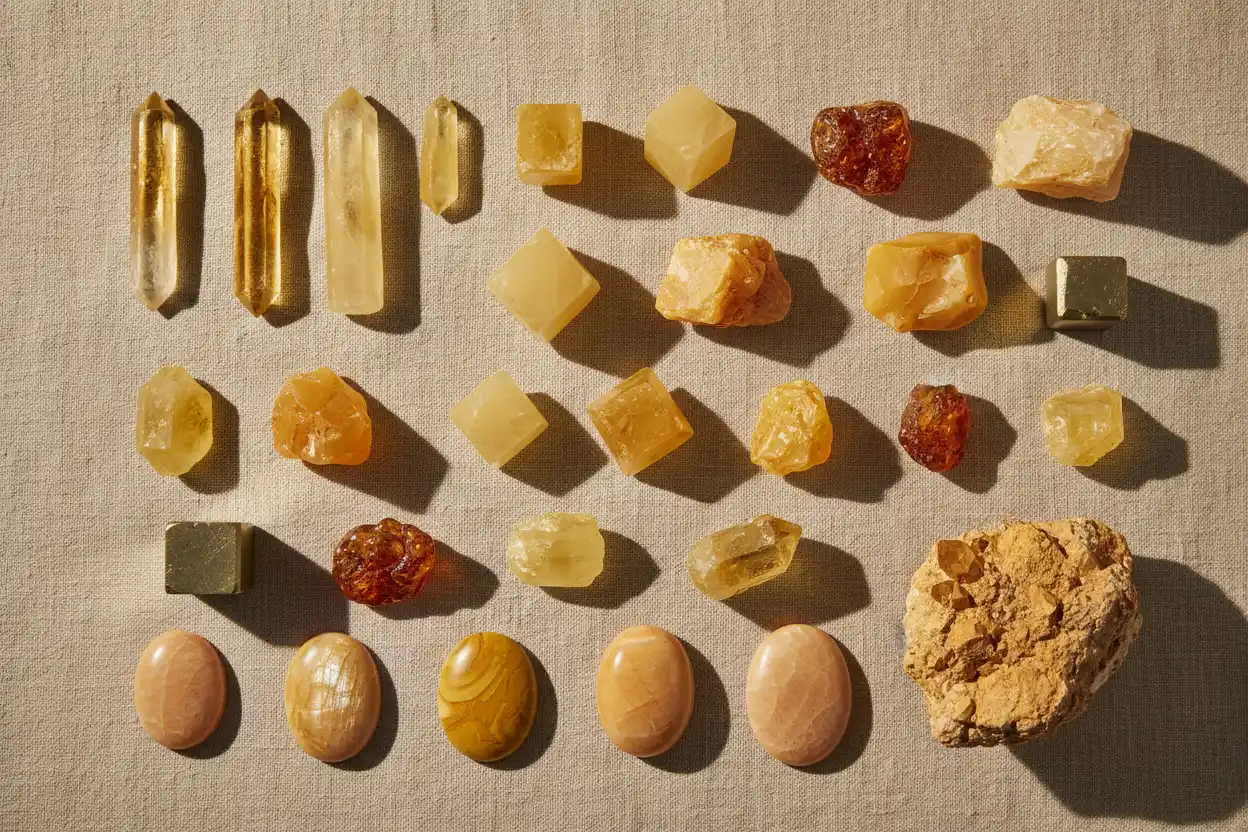
Yellow Crystals: Meanings, Names and Complete List
Yellow crystals range from transparent golden gemstones to opaque ochre stones, metallic minerals, fossilized resin and iron-stained Quartz. Their shared color does not make them one mineral family or give them identical physical properties.
Within modern crystal traditions, yellow stones are commonly associated with optimism, confidence, creativity, motivation, personal agency and clear decision-making. These meanings are symbolic and cultural rather than scientifically established healing effects.
Some yellow crystals are durable enough for rings and bracelets, while others dissolve, fade, cleave or scratch easily. Consequently, every stone should be identified before it is cleaned, placed in water or worn regularly.
This guide provides the broad crystal-collection list. The yellow gemstones guide focuses more closely on cut gems, jewelry uses and treatments, while the yellow engagement-ring stones guide compares durability for daily-wear rings.
What Makes Crystals Yellow?
Yellow color develops through several unrelated physical processes.
In Citrine, iron-related color centers within Quartz produce pale yellow, golden and brownish-orange hues. Yellow Sapphire can gain color through iron-related mechanisms, heat treatment or diffusion processes.
Yellow Calcite may contain iron-related impurities, while Yellow Fluorite can owe its color to structural defects, trace elements or irradiation-related color centers.
Golden Healer Quartz and some Yellow Quartz specimens gain their color from iron-oxide coatings, films or inclusions rather than from the Quartz lattice itself.
Pyrite and Chalcopyrite look golden because their metallic surfaces reflect light selectively. Amber appears yellow because its organic molecular structure absorbs part of the visible spectrum.
Therefore, visual color alone cannot identify a stone. Two yellow objects can have entirely different chemistry, durability and safety requirements.
Complete Yellow Crystals List
| Yellow crystal or material | What it is | Typical appearance | Traditional association | Main care concern |
|---|---|---|---|---|
| Citrine | Yellow-to-orange crystalline Quartz | Transparent pale yellow to reddish orange | Confidence and motivation | Heat treatment and thermal shock |
| Yellow Quartz | Broad yellow Quartz category | Transparent, cloudy or iron-stained | Clarity and steady optimism | Treatment and naming confusion |
| Lemon Quartz | Yellow-green Quartz | Bright lemon or chartreuse | Fresh ideas and focus | Irradiation and heat treatment |
| Golden Healer Quartz | Iron-stained or coated Quartz | Clear-to-cloudy Quartz with golden films | Renewal and symbolic cleansing | Surface coatings and fractures |
| Yellow Calcite | Calcium carbonate | Pale lemon to golden yellow | Perspective and emotional release | Acids, softness and cleavage |
| Honey Calcite | Golden-to-brown Calcite | Honey, amber-yellow or caramel | Persistence and confidence | Acids and scratching |
| Yellow Fluorite | Calcium fluoride | Pale yellow to vivid golden crystals | Organization and discernment | Cleavage, fading and heat |
| Yellow Jasper | Opaque silica-rich material | Mustard, ochre, tan and brown-yellow | Endurance and grounded optimism | Dye and broad trade naming |
| Yellow Opal | Hydrated silica mineraloid | Cream, lemon, honey or golden yellow | Imagination and adaptability | Heat, dehydration and crazing |
| Yellow Sapphire | Yellow Corundum | Pale straw to vivid golden yellow | Wisdom and disciplined confidence | Heat, diffusion and synthetic origin |
| Yellow Topaz | Yellow Topaz | Pale yellow, sherry or golden | Intention and honest communication | Perfect cleavage |
| Heliodor | Yellow Beryl | Pale yellow to golden green-yellow | Direction and personal purpose | Fractures and treatment |
| Chrysoberyl | Chrysoberyl mineral | Yellow-green to honey yellow | Resilience and practical judgment | Identity and inclusions |
| Sunstone | Aventurescent Feldspar | Yellow, peach, orange or red with sparkle | Independence and enthusiasm | Cleavage and surface abrasion |
| Amber | Fossilized plant resin | Lemon, honey, orange and brown | Warmth and ancestral memory | Heat, chemicals and imitations |
| Pyrite | Iron sulfide | Brassy metallic gold | Resourcefulness and boundaries | Oxidation and moisture |
| Chalcopyrite | Copper iron sulfide | Brassy gold, often iridescent | Possibility and transformation | Tarnish and acid alteration |
| Golden Obsidian | Volcanic glass with golden sheen | Black glass with directional gold reflection | Self-reflection and confidence | Brittle glass fracture |
| Goldstone | Manufactured glass | Brown, blue or green glass with glitter | Ambition in modern traditions | Manufactured identity |
| Libyan Desert Glass | Natural silica-rich desert glass | Pale yellow to golden translucent glass | Change and resilience | Provenance and glass imitations |
The category uses the broad crystal-shop meaning of “crystal.” Amber is organic, Opal is a mineraloid, Obsidian and Libyan Desert Glass are natural glasses, and Goldstone is manufactured.
Citrine
Citrine is the transparent yellow-to-brownish-orange variety of Quartz.
Its colors range from pale straw and lemon-yellow to golden orange and reddish brown. Traditionally, Citrine represents confidence, motivation, generosity and approaching opportunity with an active mindset.
Natural yellow Quartz is relatively uncommon. Most commercial Citrine results from heating Amethyst, and some lime-yellow material develops through treatment of Smoky Quartz.
Heat-treated Citrine remains Quartz and can be attractive, but sellers should disclose the treatment rather than presenting every orange cluster as naturally yellow.
The stone has Mohs hardness 7 and works well in beads, pendants and rings when fractures are limited. The Citrine buying guide covers color, cutting and treatment in greater detail.
Yellow Quartz
Yellow Quartz is a broad appearance-based category rather than one narrowly defined gem variety.
It can include natural Citrine, treated Quartz, Lemon Quartz, iron-stained Quartz and cloudy Quartz containing yellow mineral inclusions.
Traditional associations emphasize clearer priorities, patience and maintaining a constructive outlook during slow progress.
A seller should explain whether the color lies within the Quartz lattice, follows fractures or forms an external coating.
Bright yellow crack networks may indicate dyed or treated material, while irregular golden films can result from natural iron oxides.
The term Yellow Quartz should not automatically create a rarity premium over ordinary treated Citrine or iron-stained Quartz.
Lemon Quartz
Lemon Quartz generally refers to bright yellow or yellow-green transparent Quartz.
The color may be created through irradiation followed by heat treatment, although natural-looking yellow-green Quartz also occurs.
Modern symbolic interpretations connect Lemon Quartz with alertness, curiosity, new ideas and mental flexibility.
The name describes color rather than a separate mineral species. Lemon Quartz retains Quartz hardness and basic care requirements.
Very bright chartreuse material should receive treatment disclosure, especially when large stones appear exceptionally clean and evenly colored.
Golden Healer Quartz
Golden Healer Quartz is a trade name usually applied to Quartz with yellow, orange or golden iron-oxide films, staining or inclusions.
The iron-rich material may coat the exterior, follow fractures or occur within the Quartz.
Traditional meanings focus on renewal, integrating difficult experiences and symbolic cleansing.
The appearance differs from transparent Citrine because color may form cloudy films rather than a uniform body hue.
Some pieces are acid-cleaned, coated or artificially stained. Inspect chipped edges and surface recesses to determine whether the color remains natural and stable.
Because iron-rich coatings can be thin, abrasive cleaning may remove part of the appearance.
Yellow Calcite
Yellow Calcite is a yellow variety of calcium carbonate.
It commonly appears pale lemon, butter yellow, golden cream or cloudy translucent yellow.
Traditional crystal practices associate it with examining choices, releasing unproductive patterns and creating a more hopeful perspective.
Calcite has Mohs hardness 3 and perfect cleavage. Consequently, it scratches easily and can break along smooth internal planes.
Acids damage Calcite. Vinegar, citrus juice and household descaling products should never be used for testing or cleaning.
Many Yellow Calcite carvings contain fractures, wax or resin, so soaking and ultrasonic cleaning are inappropriate.
Honey Calcite
Honey Calcite ranges from warm golden yellow to amber-brown and caramel.
It remains Calcite rather than a separate mineral species, although its richer color creates a distinct retail identity.
Traditional meanings emphasize persistence, learning from experience and building confidence through repeated practical effort.
Honey Calcite can be confused with Yellow Calcite, Amber, Aragonite and dyed carbonate material. The boundaries between Yellow Calcite and Honey Calcite are commercial rather than mineralogical.
The completed guide to buying genuine Honey Calcite covers color, glass, Aragonite and resin concerns.
Yellow Fluorite
Yellow Fluorite is calcium fluoride with pale yellow, golden, honey or brownish-yellow color.
It may form cubes, octahedra, complex crystals, massive rough and banded material.
Traditional associations include organization, discernment and choosing among competing possibilities.
Fluorite has Mohs hardness 4 and perfect octahedral cleavage. Even a minor impact can split a crystal along an internal plane.
Strong sunlight and heat may affect some Fluorite colors. Therefore, specimens should be displayed away from intense windows and rapid temperature changes.
Yellow Fluorite can resemble Citrine, Yellow Calcite, glass and Yellow Sapphire in photographs, but its physical properties differ significantly.
Yellow Jasper
Yellow Jasper is an opaque yellow, mustard, tan, ochre or brownish silica-rich material.
It may contain spots, veins, bands, brecciation and iron-rich patterns.
Traditional meanings emphasize endurance, practical optimism and continuing steadily without ignoring real limitations.
The Jasper trade category covers numerous opaque silica-rich rocks, so composition and naming can vary.
Bright uniform yellow pieces may be dyed. Natural colors commonly include muted ochre, mustard, tan and brown-yellow rather than one perfectly even lemon tone.
Sound material is durable enough for worry stones, beads, carvings and everyday jewelry.
Yellow Opal
Yellow Opal is Opal with a yellow, cream, lemon, honey or golden body.
Some material displays play-of-color, while common Yellow Opal lacks spectral flashes.
Traditional interpretations emphasize imagination, flexibility and allowing ideas to develop without demanding immediate certainty.
Opal consists of hydrated silica and generally has lower hardness and stability than Quartz.
Heat, dehydration, rapid temperature change and impact can cause cracking or crazing in susceptible stones.
Dyed common Opal, resin and glass can imitate strong yellow body color. Doublets and triplets must be disclosed when assembled layers are present.
Yellow Sapphire
Yellow Sapphire is yellow Corundum, the same mineral species as blue Sapphire and Ruby.
Colors range from pale straw to vivid lemon, canary and orange-yellow.
Traditional symbolism often connects Yellow Sapphire with wisdom, disciplined confidence, prosperity and long-term planning.
Its Mohs hardness 9 makes it one of the most practical yellow stones for daily jewelry.
However, natural, heat-treated, beryllium-diffused and synthetic Yellow Sapphire all occur. Color stability can also require laboratory assessment in selected stones.
The Citrine versus Yellow Sapphire guide explains their differences without reducing the comparison to color.
Yellow Topaz
Yellow Topaz includes yellow, golden and brownish-yellow Topaz.
Traditional associations emphasize honest intention, self-direction and following through on spoken commitments.
Topaz has Mohs hardness 8 but perfect cleavage. It resists scratching better than Quartz but can split under a strong impact in the wrong direction.
Yellow Topaz can be confused with Citrine because both are transparent yellow gems. Historically misleading names such as topaz quartz increased that confusion.
The Citrine versus Yellow Topaz guide owns the direct gemological comparison.
Imperial Topaz overlaps partly with yellow-orange Topaz but carries narrower color and origin expectations.
Heliodor
Heliodor is the yellow-to-greenish-yellow variety of Beryl.
It belongs to the same mineral family as Emerald, Aquamarine, Morganite and Goshenite.
Traditional meanings include direction, personal purpose and approaching responsibility with confidence.
Heliodor can show pale lemon, golden yellow, greenish yellow or honey tones. Larger transparent stones are possible because Beryl crystals can grow to substantial sizes.
Its hardness of approximately 7.5 to 8 supports jewelry use, although fractures and elongated inclusions can affect toughness.
The Heliodor buying guide covers cutting, color, reports and value.
Chrysoberyl
Chrysoberyl is a distinct beryllium aluminum oxide mineral rather than a form of Beryl.
Transparent material commonly appears yellow, yellow-green, greenish yellow or honey brown.
Traditional symbolism emphasizes resilience, realistic judgment and preserving attention during change.
Chrysoberyl has Mohs hardness 8.5 and generally good toughness, making fine transparent material suitable for frequent wear.
Cat’s-eye Chrysoberyl shows a sharp moving band and belongs to a specialized phenomenal-gem market.
Alexandrite is the color-change variety of Chrysoberyl and should not be confused with ordinary yellow material.
Sunstone
Sunstone is a Feldspar variety that may appear yellow, peach, orange, red, green or colorless.
Some material displays aventurescence from reflective platelets, while other transparent Sunstone has little visible sparkle.
Traditional meanings include independence, enthusiasm and taking action without waiting for perfect conditions.
Sunstone has moderate hardness but cleavage, making it less impact-resistant than Quartz or Sapphire.
The Sunstone buying guide covers Oregon material, copper inclusions, Feldspar identity and treatment.
A glittering appearance does not automatically prove natural Sunstone because Goldstone and synthetic aventurine glass can imitate sparkle.
Amber
Amber is fossilized plant resin rather than a mineral crystal.
Natural colors range from pale lemon and honey yellow to orange, red, brown, greenish and nearly black.
Traditional associations include warmth, memory, continuity and connection with the natural past.
Amber is lightweight and relatively soft. Heat, alcohol, perfume, cosmetics and household chemicals can damage its surface.
Plastic, pressed Amber, Copal, resin and reconstructed material occur widely.
The Amber buying guide covers age, inclusions, treatments and imitation testing.
Pyrite
Pyrite is iron sulfide with a brassy metallic-yellow appearance.
It commonly forms cubes, pyritohedra, octahedra, nodules and granular masses.
Traditional meanings emphasize resourcefulness, boundaries and recognizing practical opportunities.
Pyrite’s gold-like color led to the name fool’s gold, although its cubic form, brittleness and dark streak distinguish it from native Gold.
Moisture and oxygen can oxidize unstable specimens, creating acidic products and damaging nearby minerals or storage materials.
The stone should remain dry and should not be placed in drinking water.
Chalcopyrite
Chalcopyrite is a copper iron sulfide with brassy-yellow metallic color.
Natural surfaces may tarnish into purple, blue, green and orange iridescence.
Traditional associations focus on possibility, change and finding value in overlooked material.
Many intensely rainbow-colored specimens have been chemically treated to accelerate tarnish. They remain natural Chalcopyrite with altered surfaces when disclosed.
The mineral is softer than Pyrite and commonly has a warmer yellow tone.
Acids, moisture and abrasion can affect the surface. It should remain a display mineral rather than an elixir ingredient.
Golden Obsidian
Golden Obsidian is black volcanic glass showing a directional golden sheen.
The effect becomes visible when microscopic structures or inclusions reflect light from the correct angle.
Traditional meanings emphasize self-reflection, confidence and examining motives honestly.
Golden Obsidian remains brittle natural glass. Fresh fractures can create extremely sharp edges.
Coated glass and metallic-film products can imitate the effect, so the golden reflection should appear within the stone and move naturally as it turns.
Goldstone
Goldstone is manufactured glass containing reflective metallic crystals.
Brown Goldstone commonly holds copper-rich sparkles, while blue and green forms use different colorants and reflective particles.
Although it is not natural, modern crystal traditions associate Goldstone with ambition, persistence and celebrating progress.
The material is legitimate when identified clearly as glass.
It should not be sold as natural Sunstone, Aventurine, Gold Quartz or a mineral formed in the ground.
Its durability resembles glass rather than Quartz, and sharp chips can develop after impact.
Libyan Desert Glass
Libyan Desert Glass is pale yellow-to-golden natural silica-rich glass found in the Great Sand Sea of Egypt and Libya.
Scientific evidence links its formation to an extreme high-temperature impact-related event, although details of the exact process remain a research topic.
Traditional symbolism emphasizes transformation, resilience and adapting after major disruption.
Provenance matters because yellow bottle glass, slag and resin can imitate the appearance.
Natural pieces may be translucent, pitted, frosted or partly clear. Cut gems lose much of the surface context that supports identification.
Yellow Crystals for Confidence
Citrine, Yellow Sapphire, Sunstone and Heliodor are common symbolic choices for confidence.
However, confidence generally grows through preparation, experience and tolerating manageable uncertainty rather than through mineral exposure.
A stone can serve as a reminder to take one concrete action. For example, Citrine might accompany a written goal, while Sunstone may represent speaking up during a planned conversation.
The object works best when connected to behavior rather than passive expectation.
Yellow Crystals for Motivation
Yellow Jasper, Pyrite and Honey Calcite are traditionally associated with persistence and practical motivation.
Their colors may evoke sunlight, metal, earth and warmth, but that visual symbolism is subjective.
Use the stone as a prompt to define the next task clearly.
A useful ritual might involve holding the stone, writing one action that can be completed today and beginning before the plan feels perfect.
Motivation often follows action rather than arriving first.
Yellow Crystals for Creativity
Yellow Opal, Lemon Quartz and Yellow Fluorite are commonly selected for creative work.
Their symbolic roles emphasize curiosity, idea generation and organizing possibilities.
A practical use involves placing one stone near a notebook, sketchbook or workstation and associating it with a short creative session.
The stone does not generate ideas independently. Instead, it may help mark the transition from distraction to deliberate practice.
Yellow Crystals for the Solar Plexus Tradition
Modern chakra practices often connect yellow stones with the solar plexus area and themes such as personal agency, self-respect and purposeful action.
Common selections include Citrine, Yellow Jasper, Honey Calcite and Yellow Sapphire.
Chakra systems come from spiritual and cultural traditions rather than modern anatomical science. Respectful use should avoid presenting one universal interpretation as medically established.
A person may use the color symbolically during meditation while still relying on evidence-based care for physical or mental-health concerns.
Safe Cleaning Across Yellow Stones
There is no universal cleaning method for yellow crystals.
Quartz-family stones such as Citrine and Yellow Jasper usually tolerate mild soap and lukewarm water when untreated and structurally sound.
Calcite should avoid acids and prolonged soaking. Pyrite and Chalcopyrite should remain dry. Amber needs protection from alcohol, heat and cosmetics.
Yellow Opal should avoid heat and rapid temperature changes, while Yellow Fluorite requires protection from impact and prolonged intense light.
When identity or treatment is uncertain, use a dry soft cloth and seek professional guidance.
Frequently Asked Questions
1. What do yellow crystals traditionally symbolize?
They commonly symbolize optimism, confidence, creativity, motivation and personal agency, although interpretations vary among cultures and individuals.
2. Are yellow crystals scientifically proven to improve confidence?
No. Crystal-healing effects have not been established scientifically, although a stone can serve as a personal reminder or focus object.
3. What is the most common yellow crystal?
Citrine and Yellow Calcite are among the most familiar yellow materials in crystal shops, although most commercial Citrine is heat-treated Quartz.
4. Is Citrine naturally yellow?
Natural Citrine exists, but most material in the market results from heating Amethyst or other Quartz.
5. Is Yellow Quartz the same as Citrine?
Not always. Yellow Quartz can include Citrine, Lemon Quartz, iron-stained Quartz and treated material.
6. Is Amber a crystal?
No. Amber is fossilized plant resin, but crystal shops commonly include it in yellow-stone collections.
7. Is Pyrite a yellow crystal?
Pyrite is a crystalline iron sulfide mineral with metallic brassy-yellow color rather than a transparent yellow body.
8. Which yellow crystals should not go in water?
Pyrite, Chalcopyrite, Calcite, Amber, Opal, Fluorite and treated or composite stones should not be soaked casually.
9. Which yellow crystal is most durable for jewelry?
Yellow Sapphire is among the strongest choices, while Chrysoberyl and Quartz-family stones also provide useful durability.
10. Can yellow crystals be dyed or treated?
Yes. Heat, irradiation, diffusion, dye, coating and resin treatments occur across several yellow materials.
11. Is Goldstone a natural crystal?
No. Goldstone is manufactured glass containing reflective metallic crystals.
12. What is the safest way to choose a yellow crystal?
Identify the material first, confirm treatments and select a form whose care requirements match how it will be used.
Let the Material Define the Yellow Stone
A yellow collection can contain Quartz, Corundum, Calcite, Feldspar, sulfides, organic resin and natural glass. Color connects them visually, but geology determines how each piece should be handled.
The Y crystal directory and Y gemstone directory organize relevant names alphabetically. Choose each yellow stone for its real identity first and its symbolism second.
Wellness and safety note: Crystal meanings are cultural and spiritual traditions rather than medical claims. Do not ingest crystals, prepare mineral elixirs or use stones as substitutes for professional care. Yellow materials can contain sulfides, soluble carbonates, silica, organic compounds or applied treatments, so confirm identity before using water, heat, sunlight or cleaning chemicals.