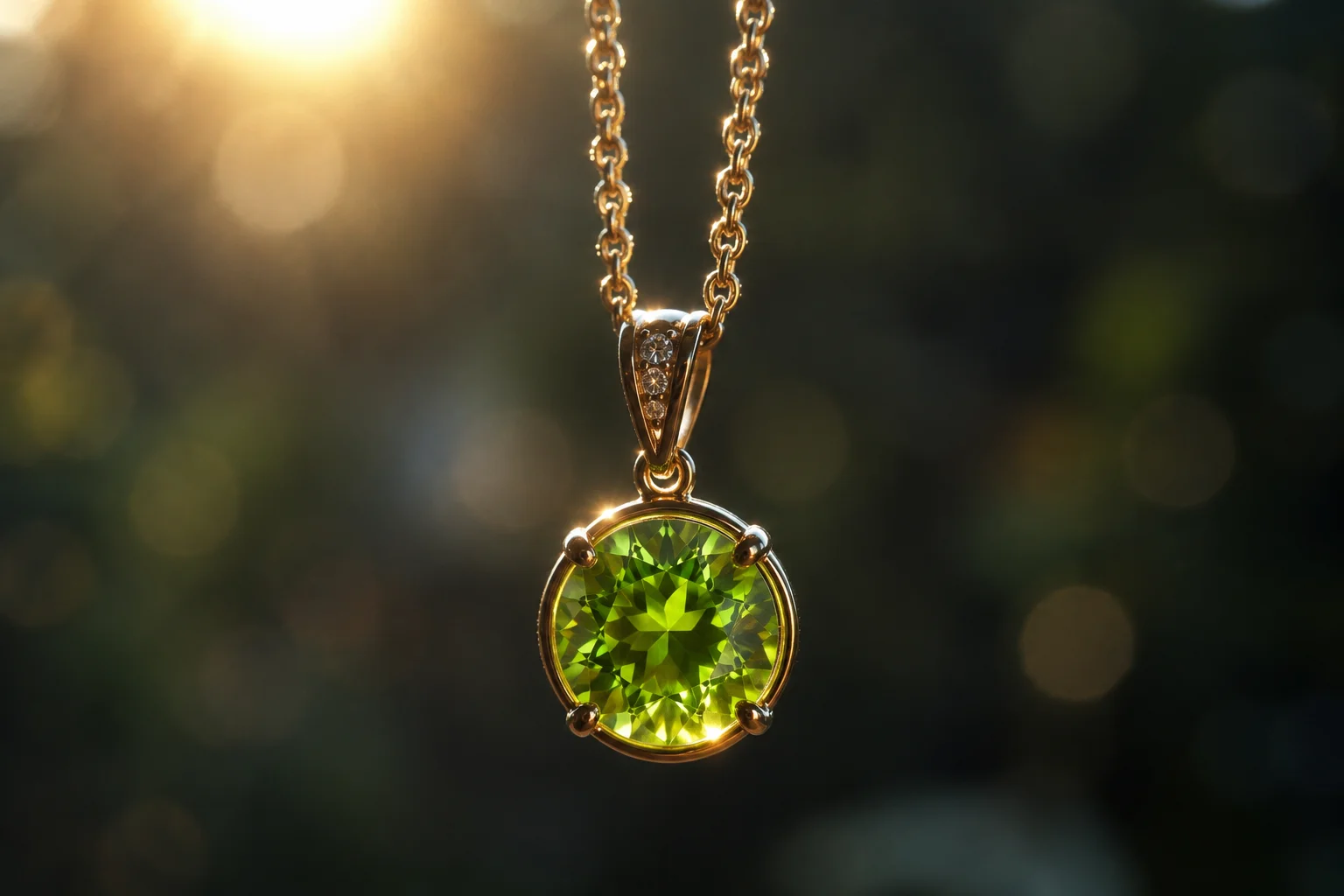
Demantoid Garnet Necklaces and Pendants: Buying Guide
A demantoid garnet necklace places one of the world’s most brilliant green gems in a comparatively protected jewelry format. Pendants receive fewer impacts than rings and bracelets, making them well suited to demantoid’s moderate hardness and exceptional optical fire.
Solitaire pendants highlight one fine stone, while halos, clusters and station necklaces create greater visual presence from smaller demantoids. The best design combines lively color, strong cutting, a secure bail and a chain proportioned to the pendant’s weight.
Demantoid Necklace Guide at a Glance
| Factor | What to look for |
|---|---|
| Gem identity | Natural demantoid, the green variety of andradite garnet |
| Color | Bright yellowish green to vivid green with visible life |
| Cut | Strong brilliance, limited windowing and balanced proportions |
| Pendant setting | Secure prongs, bezel or protective halo |
| Bail | Large and strong enough for the chain and pendant weight |
| Chain | Appropriate thickness, length and metal |
| Clasp | Secure lobster, box or other dependable mechanism |
| Best everyday style | Low-profile solitaire or bezel pendant |
| Best statement style | Halo, cluster, rivière or graduated necklace |
| Main care concern | Abrasion, snagging, loose bails and chain failure |
Why Demantoid Is Well Suited to Necklaces
Necklaces place the gemstone away from most hard work surfaces. This reduces the repeated impact and abrasion experienced by bracelets and rings.
Demantoid’s strong dispersion also performs well near the face, where changing angles and ordinary movement reveal flashes of spectral color.
A necklace can display one larger stone or a sequence of smaller gems. Because fine demantoid rough is commonly small, designs using several modest stones may provide stronger overall visual presence than one large centerpiece.
The drafted demantoid garnet meaning guide explains the gem’s mineralogy, sources and famous horsetail inclusions.
Solitaire Demantoid Pendants
A solitaire pendant centers one demantoid without competing gemstones.
Round brilliant cuts provide strong fire, while ovals and cushions may offer greater face-up dimensions for their weight. Pear-shaped demantoids create a natural drop but require protection around the pointed end.
Inspect the stone in ordinary light. A solitaire has no surrounding design to conceal darkness, windowing or weak color.
The setting should support the gem without covering so much surface that brilliance becomes restricted.
A modest well-cut demantoid often appears more attractive than a larger but poorly proportioned stone.
Bezel Pendants
A bezel surrounds the gem’s girdle with metal.
This style offers excellent edge protection and a clean modern appearance. It is particularly suitable for everyday pendants or stones with thin girdle areas.
A full bezel may slightly reduce the amount of visible stone, but a skilled design can still display strong brilliance.
Check that the metal follows the outline evenly. Irregular gaps or rough edges may indicate poor workmanship.
The back may be open to allow cleaning and light access, although it should not contain sharp surfaces against clothing or skin.
Prong-Set Pendants
Prongs expose more of the demantoid and can create a light, traditional appearance.
Four-prong settings suit rounds, ovals and cushions, while pears may need a protective V-prong at the point. Six prongs provide additional security but cover more of a small gem.
Each prong should make firm, even contact. The stone should not click or rotate when handled gently.
Prongs that catch knitwear or hair need professional adjustment. Repeated snagging can weaken them and eventually release the stone.
Halo Pendants
Halo pendants surround demantoid with diamonds or other small accent gems.
The frame can increase apparent size and create strong contrast between white sparkle and green body color. Yellow-gold halos offer a warmer historic appearance, while white metals create a crisp visual boundary.
Evaluate the center demantoid independently before considering the halo. Accent stones should enhance rather than distract from its quality.
The additional prongs require periodic inspection. Closely packed halos also collect residue and need accessible openwork for cleaning.
Cluster and Floral Pendants
Cluster pendants arrange several small demantoids into floral, leaf or geometric shapes.
This format suits a gem that commonly occurs in small sizes. A group of bright well-matched stones can create a larger green presence without relying on one rare large specimen.
Color variation should look intentional. A slightly lighter center or darker outline may form an attractive design, while random mismatching can appear uneven.
Antique-inspired clusters may include diamonds, enamel or engraved gold. Check older settings carefully for worn prongs and previous repairs.
Station Necklaces
Station necklaces space small demantoids along a chain.
They create an understated design that can be worn alone or layered. Bezel settings are particularly practical because they reduce snagging and keep each stone oriented.
Inspect whether the stations flip constantly. Balanced construction should allow the gem faces to remain visible during normal movement.
Chain links between stations must support the total gemstone value. Very fine chains may look elegant but require careful handling.
Rivière and Line Necklaces
A rivière-style necklace presents a continuous or graduated line of faceted stones.
A demantoid rivière can be exceptionally rare because it requires many gems matched for color, cut and size. Even small inconsistencies become visible across a continuous row.
The necklace should articulate smoothly around the neck without allowing stones to collide. Back settings must remain comfortable and free from sharp edges.
Secure box clasps with safety mechanisms are preferable for high-value line necklaces.
Beaded Demantoid Necklaces
Demantoid beads are less common than faceted mounted gems, particularly in fine transparent quality.
Confirm whether the product contains actual demantoid, another green garnet, mixed andradite or a trade-name material. The word garnet alone does not establish the variety.
Drill holes can create weak points. Inspect beads for cracks, rough openings and color concentrations suggesting dye.
Stringing material should suit the bead weight, and valuable strands should be knotted or otherwise constructed to reduce loss if the cord breaks.
Choosing Demantoid Color
Demantoid ranges from yellowish green to vivid green.
Fine color should appear lively rather than muddy, gray or nearly black. Highly saturated stones usually receive strong demand, although lighter gems may display more visible fire.
Examine the pendant under diffuse daylight-equivalent, warm and neutral lighting.
A stone that looks green only beneath intense retail spotlights may appear substantially darker during normal wear.
When a necklace includes several demantoids, matching or deliberate graduation becomes especially important.
Judging Brilliance and Fire
Demantoid’s high dispersion creates rainbow flashes when the cut returns light effectively.
Look for brightness across the complete face. A transparent central area may indicate windowing, while broad dark zones may result from poor proportions or lighting.
Round cuts commonly show strong brilliance, although a well-cut oval or cushion can also perform beautifully.
The completed demantoid buying guide provides a fuller checklist covering color, clarity, cut, origin and reports.
Do not judge performance solely under concentrated showroom lighting.
Clarity and Inclusions
Demantoid may contain crystals, needles, fractures and famous radiating horsetail inclusions.
An attractive horsetail can add collector character and value. However, it should not reduce transparency so severely that the pendant appears dull.
Surface-reaching fractures require particular attention because they may affect durability and cleaning options.
Horsetails do not prove Russian origin. Therefore, origin premiums should depend on independent laboratory evidence rather than one inclusion alone.
Pendant Size and Carat Weight
Fine demantoid becomes increasingly rare as size rises.
Face-up dimensions often matter more than carat weight in a pendant. Two stones of equal weight may appear different because of depth, outline and cutting proportions.
A deep stone can retain weight while looking small from the front. Conversely, an overly shallow stone may appear larger but show windowing.
Request millimeter dimensions along with carat weight.
The completed demantoid garnet price guide explains how size premiums interact with quality and origin.
Choosing the Bail
The bail connects the pendant with its chain and deserves careful inspection.
It should be large enough for the chain and any end fittings to pass through. A tiny bail may restrict replacement-chain options.
Fixed bails keep the pendant orientation stable, while articulated bails allow more movement. Hidden bails create a streamlined appearance but may be harder to inspect.
Check solder seams and connecting rings. A secure gemstone setting cannot prevent loss when the bail fails.
Choosing the Chain
The chain should match the pendant’s weight and visual scale.
| Chain type | Appearance | Practical consideration |
|---|---|---|
| Cable chain | Classic round or oval links | Versatile and easy to repair |
| Rolo chain | Rounded substantial links | Strong visual balance with medium pendants |
| Box chain | Structured square links | Smooth appearance but may kink if bent sharply |
| Wheat chain | Flexible woven texture | Strong and elegant for valuable pendants |
| Snake chain | Smooth continuous surface | Can kink and may be harder to repair |
| Fine curb chain | Flat interlocking links | Suitable for smaller pendants |
An extremely thin chain may not provide enough security for a valuable demantoid.
Necklace Lengths
| Length | Typical placement | Best use |
|---|---|---|
| 14–16 inches | Choker to base of neck | Small pendants and open necklines |
| 18 inches | Around the collarbone | Most versatile pendant length |
| 20–24 inches | Upper chest | Larger pendants and layering |
| 28–36 inches | Lower chest | Statement designs and long layering |
Actual placement varies with body proportions, clothing and pendant size.
An adjustable chain adds flexibility but should still use strong links and a secure closure.
Choosing the Metal
Yellow gold complements demantoid’s warmer yellow-green components and reflects its historic jewelry associations.
White gold and platinum create crisp contrast and work especially well with diamond halos. Rose gold may suit warmer stones but can compete with pale green color.
Metal choice affects weight, maintenance and allergy risk. Ask for the precise alloy and fineness.
A high-value pendant should use construction appropriate to its gem value rather than an excessively light setting designed only to reduce metal cost.
Demantoid vs Tsavorite Necklaces
Demantoid is green andradite, while tsavorite is green grossular.
Tsavorite is generally harder and may display richer pure green. Demantoid is somewhat softer but offers stronger dispersion and fire.
Both work well in necklaces because the format reduces impact. Demantoid suits buyers who prioritize rarity, historic character and optical flashes, while tsavorite may appeal to those seeking a saturated green appearance.
The completed types of garnet guide provides broader garnet-group context.
Demantoid vs Emerald Necklaces
Emerald commonly shows a deeper bluish green and less spectral fire. Demantoid may appear brighter and more yellowish green.
Emerald frequently contains visible inclusions and may receive oil or resin treatment. Demantoid is commonly untreated, although disclosure remains important.
Pendants protect both gems better than rings. The choice should depend on preferred appearance, treatment expectations and budget rather than the assumption that emerald is automatically more prestigious.
Demantoid vs Sphene Pendants
Sphene produces extraordinary dispersion and may have a similar yellow-green appearance.
However, sphene is softer and more vulnerable to abrasion. Demantoid provides greater practicality for a pendant that may contact clothing and chains.
The completed sphene versus demantoid guide explains how gemologists distinguish them.
Neither stone should be identified through color or sparkle alone.
Styling Demantoid Necklaces
A small solitaire pendant works easily with office clothing, evening wear and simple everyday outfits.
Halo and cluster designs suit formal settings, while station necklaces create understated color across a larger area.
Yellow-gold demantoid pairs naturally with cream, brown, navy and warm neutrals. White-metal designs stand out against black, violet and cool gray.
Match the necklace scale to the neckline. A small pendant may disappear beneath a heavily detailed collar, while a large cluster can compete with embellished clothing.
Layering Demantoid Necklaces
Layering works best when chains differ enough in length to reduce tangling.
Keep the demantoid pendant as the main focal point and use simpler chains above or below it. Avoid layering beside rough gemstone beads or hard diamond chains that can scratch the setting and stone.
Check that clasps remain behind the neck and that pendants do not strike each other repeatedly.
A necklace separator may help, although it should be compatible with the chain weight and metal.
Wearing Demantoid Safely
Put the necklace on after applying perfume, hairspray, sunscreen and cosmetics.
Remove it before sleeping, bathing, swimming, exercising or changing clothing that may catch the pendant.
Long necklaces should not be worn around machinery, young children or activities where the chain may snag.
The drafted guide to demantoid garnet earrings provides a lower-maintenance alternative for wearers who prefer no chain around the neck.
Cleaning a Demantoid Necklace
Warm water, mild soap and a soft brush provide the safest general method.
Support the pendant and chain while cleaning rather than allowing the piece to hang by one link. Brush gently behind the stone and around the bail.
Rinse briefly, then dry completely with a lint-free cloth.
Steam cleaning is not recommended. Ultrasonic cleaning may be unsuitable for fractured stones, filled material, antique pieces or delicate chains.
The completed guide to cleaning demantoid garnet jewelry covers care in greater detail.
Storage
Close the clasp and lay the necklace flat in a padded compartment.
Keep the chain separated from other pieces to reduce knots. The pendant should not rub against diamonds, sapphires or other hard gemstones.
For long necklaces, use a dedicated compartment or padded roll rather than folding the chain sharply.
Store laboratory reports, receipts and appraisals separately in a secure location.
Professional Inspection and Repair
Have the necklace examined when the stone moves, a prong catches fabric, the bail opens or the chain develops stretched links.
A jeweler can inspect solder joints, clasp tension, prongs and previous repairs under magnification.
Do not continue wearing the necklace when a component appears weak. Pendant loss frequently results from bail or chain failure rather than the gemstone setting itself.
The completed guide asking whether garnet is durable enough for everyday wear provides additional context for appropriate use.
Buying Checklist
Before purchasing, confirm:
- Natural demantoid identity
- Carat weight and millimeter dimensions
- Color under ordinary lighting
- Cut and visible windowing
- Clarity and surface-reaching fractures
- Treatment disclosure
- Claimed origin documentation
- Metal identity and fineness
- Chain length and thickness
- Bail dimensions
- Clasp type
- Return and repair policies
A laboratory report may be appropriate when origin, treatment or identity materially affects the price.
Conclusion
Demantoid garnet necklaces and pendants combine exceptional green fire with a jewelry format that protects the gem better than most rings and bracelets.
A solitaire emphasizes one fine stone, while halos and clusters increase visual presence. Station and rivière necklaces use matched smaller gems to create a continuous effect.
Prioritize color, cutting and secure construction. The bail, chain and clasp deserve as much attention as the demantoid because failure in any component can result in loss.
Frequently Asked Questions
1. Is demantoid suitable for necklaces?
Yes. Necklaces and pendants are among the safest formats because they receive fewer impacts than rings and bracelets.
2. What is the best demantoid pendant style?
A low-profile solitaire or bezel pendant offers a strong combination of visibility, protection and everyday practicality.
3. What color should a demantoid necklace have?
Lively yellowish green to vivid green with good brightness and visible fire generally provides the strongest appearance.
4. Are large demantoid pendants rare?
Yes. Fine demantoid becomes increasingly scarce above one carat, especially when color and cutting remain strong.
5. Which chain is best for a demantoid pendant?
Cable, rolo, wheat and well-made box chains can all work. The chain must be strong enough for the pendant’s weight.
6. Is a bezel setting good for demantoid?
Yes. A bezel protects the girdle and can provide excellent security without preventing a well-cut stone from looking bright.
7. Can demantoid necklaces be worn every day?
A securely constructed pendant can be worn regularly with care, but it should be removed during sleep, bathing, sports and manual activity.
8. Which metal looks best with demantoid?
Yellow gold creates warm contrast, while white gold and platinum emphasize a cooler green and pair well with diamonds.
9. Is demantoid better than emerald for a necklace?
Neither is universally better. Demantoid offers stronger fire, while emerald provides a different green color and gem tradition.
10. How should a demantoid necklace be cleaned?
Use warm mild soapy water and a soft brush. Avoid steam and seek professional advice before ultrasonic cleaning.
11. Can a demantoid pendant go in water?
Brief rinsing is generally acceptable for untreated intact demantoid, but soaking may affect the setting, chain or any treatment.
12. Should a demantoid necklace have a laboratory report?
A report is advisable when natural identity, treatment or claimed origin materially affects the purchase price.