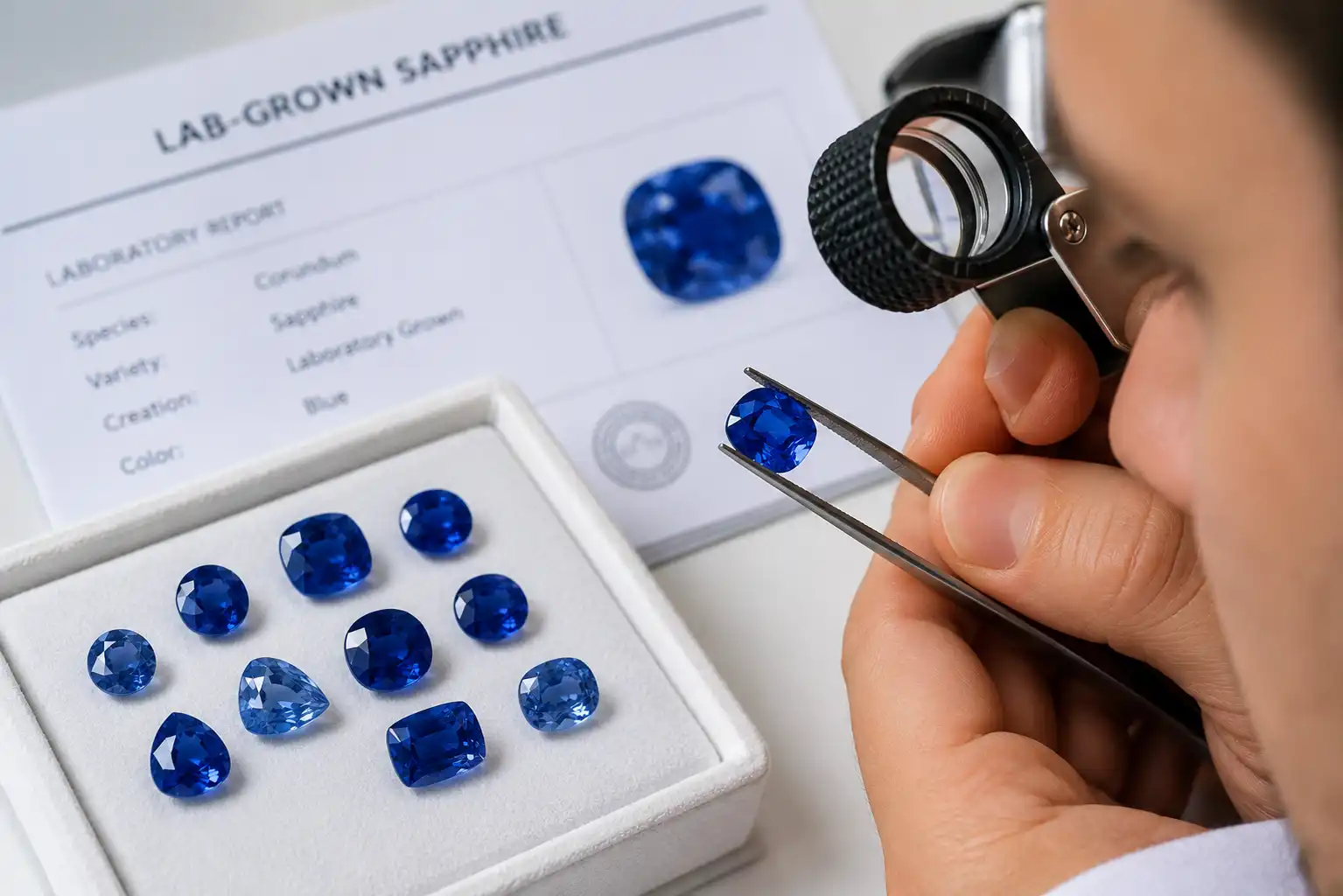
Buy Lab Sapphire: Buyer Essentials, Price, Quality & Documentation
To buy lab sapphire intelligently, begin by confirming that the stone is genuinely laboratory-grown corundum rather than blue glass, synthetic spinel, cubic zirconia, or another sapphire imitation. Sapphire is corundum in every color except red, which is called ruby, and synthetic sapphire possesses essentially the same fundamental mineral identity as natural sapphire while crystallizing through a technological process rather than inside the Earth. GIA recognizes several synthetic-sapphire growth technologies, including flame fusion, flux, pulled methods, and hydrothermal growth, and notes that flux-grown, pulled, and hydrothermal synthetic sapphires can be convincing enough to require proper gemological examination for reliable separation from natural material.
Laboratory-grown origin does not determine whether the finished gemstone is attractive. Color, tone, saturation, transparency, clarity, cutting, dimensions, growth method, star phenomena where applicable, post-growth modification, condition, documentation, and seller disclosure still control whether a particular stone represents good value. GIA identifies color as sapphire’s dominant quality factor, with strong to vivid saturation generally preferred and fine blue sapphires occupying a medium to medium-dark tonal range rather than appearing extremely pale or almost black. Synthetic production can make those desirable colors accessible in large, clean stones, but the lower geological rarity means a lab sapphire should be compared with other laboratory-grown sapphires rather than priced from natural Kashmir, Myanmar, Sri Lankan, or Madagascar sapphire benchmarks.
Buy Lab Sapphire At a Glance
| Buying Factor | What to Examine | Why It Matters |
|---|---|---|
| Identity | Laboratory-grown corundum rather than a simulant | Synthetic sapphire is sapphire material; glass or CZ is not |
| Growth Method | Flame fusion, flux, hydrothermal, pulled, or other documented process | Manufacturing method affects inclusions, supply, cost, and collector interest |
| Color | Hue, tone, saturation, evenness | Color is sapphire’s leading visual quality factor |
| Transparency | Bright transparent appearance | Cloudiness reduces brilliance in ordinary faceted material |
| Clarity | Curved growth, flux residues, zoning, bubbles, fractures, other features | Growth features can help establish synthetic origin and affect beauty |
| Cut | Brightness, symmetry, polish, windowing, extinction | Poor cutting can waste excellent color |
| Carat Weight | Weight together with dimensions | Large synthetic sapphire is not geologically rare like comparable natural sapphire |
| Star Effect | Sharpness, centering, movement, contrast | Synthetic star sapphire forms a separate phenomenal category |
| Post-Growth Treatment | Dyeing, quench crackling, diffusion, coating, filling, or other modification | Synthetic origin and later treatment are separate questions |
| Durability | Solid corundum versus treated or composite condition | Corundum itself is highly durable |
| Documentation | Independent report confirming synthetic sapphire and detectable treatments | Especially important for expensive specialty synthetics |
| Geographic Claims | Manufacturing provenance rather than mine origin | A lab sapphire cannot acquire Kashmir or Ceylon geological origin |
| Seller Grade | Actual attributes behind AAA, AAAA, premium, or investment terminology | GIA does not issue an overall sapphire quality grade |
| Return Rights | Real inspection and refund terms | Sapphire color can change substantially with lighting and photography |
Synthetic Sapphire Is Corundum, Not a Sapphire-Looking Substitute
Corundum is aluminum oxide, and blue, pink, yellow, green, purple, white, black, orange, and other non-red colors fall within the sapphire family. GIA lists sapphire at Mohs 9 and identifies its mineral species as corundum, while laboratory-grown counterparts reproduce the essential characteristics of that material through artificial crystal growth.
This distinction separates laboratory-grown sapphire from inexpensive blue glass, cubic zirconia, synthetic spinel, or other materials that may be marketed as sapphire alternatives. A simulant can resemble sapphire visually while having different hardness, refractive behavior, density, durability, chemistry, and long-term wear characteristics. A buyer comparing a genuine synthetic blue sapphire with a blue glass stone is therefore not comparing two grades of one gemstone.
The same principle applies across Gems Lore’s manufactured-gem guides. A buyer using the buy lab ruby guide is evaluating red synthetic corundum, while someone using buy lab emerald is considering synthetic beryl produced by entirely different growth technologies. Laboratory-grown does not describe one material category; it describes technological origin.
Flame Fusion Is the Most Common Synthetic Sapphire Route
GIA notes that most synthetic ruby and sapphire encountered in the market has historically been produced through Verneuil flame fusion. Flame-fusion corundum often shows curved growth banding rather than the angular growth zoning more typical of natural sapphire, giving gemologists one important diagnostic clue.
The process is efficient enough to produce substantial quantities of clean synthetic corundum, which helps explain why even large blue, pink, yellow, or colorless flame-fusion sapphires can remain relatively affordable. A ten-carat flame-fusion stone may look impressive without representing significant manufacturing scarcity.
That affordability should not be interpreted as evidence that the stone is fake. It reflects a mature manufacturing process capable of producing substantial gem-quality material. The buyer should instead decide whether the color, cut, size, and price make sense for the intended jewelry.
Flux-Grown Synthetic Sapphire Can Occupy a Higher Specialty Tier
Flux growth uses a molten solvent from which corundum crystallizes more slowly, and GIA documents flux-grown synthetic sapphires containing characteristic wispy flux veils, flux fingerprints, and flux-filled cavities. An unusually large flux-grown synthetic sapphire studied in the trade showed prominent flux residues and color zoning that helped establish its synthetic origin.
Flux-grown material can cost more than common flame-fusion sapphire because growth can be slower, production volumes lower, and individual manufacturers more specialized. Vintage or historically notable flux-grown material can also interest collectors of synthetic-gem technology.
The growth method alone still does not make a stone beautiful. A vivid, well-cut flame-fusion sapphire can outperform a poorly colored flux-grown specimen visually, so the manufacturing premium should be considered after evaluating the actual gemstone.
Hydrothermal Synthetic Sapphire Is Another Genuine Category
Hydrothermal growth uses high-pressure autoclaves containing supercritical fluids, mineralizers, and seed crystals. GIA explains that hydrothermal methods can produce synthetic sapphire as well as ruby, emerald, spinel, quartz, and other gem materials, while research into Tairus hydrothermal sapphires documents a wide spectrum of colors produced through controlled dopants and identifiable growth-related characteristics.
Hydrothermal synthetic sapphire may carry a specialty premium because the equipment, pressure environment, growth rate, and production complexity differ from flame fusion. The method can also produce crystal forms and internal features that interest collectors and gemologists.
A seller who uses the word hydrothermal as an automatic luxury grade should still explain why the particular stone deserves its price. Color, transparency, cut, dimensions, inclusions, manufacturer, and documentation remain essential.
Pulled Synthetic Sapphire Also Exists
GIA’s synthetic-gem overview includes pulled sapphire among convincing synthetic counterparts. Pulled methods such as Czochralski growth produce crystals from a melt while controlling crystal orientation and composition, and synthetic sapphire grown by these technologies has extensive industrial use in addition to gem applications.
A buyer may encounter pulled sapphire in specialist jewelry or technical-material contexts rather than routine mass-market gemstone inventory.
As with every synthetic method, the process name describes how the crystal grew rather than how attractive the polished stone is.
Color Remains the Most Important Sapphire Quality Factor
GIA identifies strong to vivid saturation as preferable across sapphire colors and describes the most highly valued blue sapphires as velvety blue to violetish blue with medium to medium-dark tone. Stones that are too pale, excessively gray, strongly greenish, or so dark that brilliance disappears generally receive less demand in the natural market.
Those same visual principles are useful when choosing laboratory-grown sapphire, even though geological rarity is no longer part of the value equation. A synthetic blue sapphire that remains vivid and lively in ordinary lighting usually offers stronger aesthetic value than an over-dark stone that appears nearly black away from intense photography lamps.
Buy the color you see rather than the color name. Terms such as royal blue, cornflower blue, Kashmir color, or Ceylon blue may be useful visual descriptions, but they do not give a laboratory-grown sapphire geographic mine provenance.
Fancy-Color Lab Sapphire Offers a Broad Palette
Synthetic sapphire can be produced in pink, yellow, orange, green, purple, violet, colorless, blue, and color-change varieties by controlling trace elements and growth conditions. GIA’s sapphire quality guide confirms that natural sapphire itself spans essentially every corundum color except red, so laboratory production is replicating a naturally broad color family rather than creating an entirely new naming system.
Color preference becomes especially personal outside the blue market. A vivid pink synthetic sapphire can offer an excellent alternative to natural pink corundum, while yellow or colorless sapphire may appeal to buyers prioritizing durability.
The key is accurate labeling. A synthetic orange-pink sapphire should not be sold as rare natural padparadscha merely because its manufactured color resembles that prized natural category.
“Kashmir,” “Ceylon,” and “Burma” Are Not Lab-Sapphire Origins
Kashmir, Sri Lanka, Myanmar, Madagascar, Montana, and other locality names refer to natural geological sapphire sources. A synthetic sapphire crystallized in a laboratory cannot have those mine origins.
GIA offers geographic-origin opinions for eligible natural sapphire through its Identification & Origin Report, whereas the standard Identification Report establishes whether a submitted stone is natural or laboratory-grown and lists detectable treatments.
A phrase such as Kashmir-color lab sapphire should therefore be interpreted only as a seller’s color comparison, never as proof of geological origin.
Clarity Expectations Should Reflect Synthetic Production
Natural sapphire frequently contains mineral crystals, rutile silk, partially healed fractures, fingerprints, color zoning, and other inclusions. GIA notes that very high-clarity natural blue sapphire is rare and can command a substantial premium.
Synthetic sapphire can be much cleaner because manufacturers control the growth environment. An eye-clean lab sapphire therefore should not receive the natural-sapphire clarity premium automatically.
The practical buying question is whether inclusions or growth structures interfere with transparency, color, durability, or beauty. A tiny diagnostic growth feature visible only under magnification can be much less important than a large central bubble or fracture visible during normal wear.
Curved Growth Banding Can Support Flame-Fusion Identification
GIA identifies curved growth banding as a hallmark of flame-fusion synthetic sapphire and contrasts it with the more angular zoning of natural corundum. Deep-UV or short-wave fluorescence can sometimes make this curved structure especially apparent.
This is useful gemological evidence, but consumers should not assume that the absence of obvious curved lines means the sapphire is natural. Some synthetics have subtle features, while other growth methods show entirely different internal structures.
Professional identification relies on multiple observations rather than one visual trick.
Flux Inclusions Can Look Surprisingly Natural
Flux-grown synthetic sapphire can contain wispy veils, fingerprints, cavities, and internal residues that resemble features found in natural gemstones. GIA’s inclusion references document synthetic sapphires grown through flux, flame fusion, hydrothermal, and other processes precisely because their internal scenes vary greatly.
A stone containing natural-looking inclusions is therefore not automatically mined.
When natural versus synthetic origin carries a large price difference, a recognized laboratory report is much stronger evidence than informal inclusion interpretation.
Synthetic Star Sapphire Is a Legitimate Phenomenal Gem
GIA notes that manufacturers can deliberately grow synthetic ruby and sapphire with inclusions arranged to create asterism. The resulting cabochons are genuine synthetic corundum displaying an intentionally produced star effect rather than glass imitations.
A good star synthetic sapphire should be judged for bodycolor, sharpness of the rays, centering, symmetry, movement across the dome, contrast, cabochon proportions, and overall polish. GIA’s natural star-sapphire framework similarly emphasizes a distinct centered star, even rays, and smooth movement as desirable optical qualities.
Synthetic origin changes rarity and price, not the importance of an attractive optical phenomenon.
Large Size Does Not Create the Same Scarcity as Natural Sapphire
Fine natural sapphire becomes more valuable as size increases because large crystals retaining fine color and clarity are increasingly rare. GIA notes that size has a stronger influence on the price of fine-quality natural sapphire than on commercial material.
Laboratory growth removes that geological size constraint. Manufacturers can produce large boules or crystals when the growth process permits, making substantial carat weights far more attainable.
A large flux or hydrothermal stone can still command a manufacturing premium if production is difficult, but weight should be interpreted within the specific synthetic category rather than by using natural-sapphire rarity assumptions.
Compare Dimensions With Carat Weight
Carat weight tells you mass but not visible spread. A synthetic sapphire can be cut very deep to intensify color or maximize retained material, leaving a large percentage of its weight hidden below the girdle.
Compare length, width, and depth. A slightly lighter gem with better face-up dimensions and stronger brilliance can provide substantially better jewelry value.
The same principle applies to every colored gemstone: cut quality and visible appearance matter more than chasing a round-number weight milestone.
Cut Controls Brightness and Color Presentation
GIA emphasizes that sapphire cutting must manage color zoning, pleochroism, rough shape, tone, proportions, and weight retention, and that poor cutting makes a gemstone less marketable.
Synthetic sapphire may give cutters more freedom because the rough can be inexpensive relative to natural fine sapphire, but mass production can also encourage shallow, deep, asymmetrical, or poorly polished commercial cuts.
Look for a lively face-up appearance with balanced brightness, minimal windowing, controlled extinction, good polish, and an outline appropriate to the jewelry design.
Post-Growth Treatment Is Separate From Synthetic Origin
A laboratory-grown sapphire can receive further treatment after growth. GIA recently documented colorless laboratory-grown sapphire that had been quench-crackled and dyed bluish green, producing artificially induced fractures that absorbed dye and completely changed the visual appearance.
This example demonstrates why “synthetic sapphire” is not a complete treatment disclosure. Growth origin answers where the corundum crystallized; dyeing, diffusion, coating, fracture filling, heat exposure, or another later modification answers a different question.
If post-growth treatment affects appearance, value, or care, it should be disclosed clearly.
Copper Diffusion Is Relevant to Feldspar, Not a Standard Sapphire Buying Assumption
Diffusion treatments are well established across several gem categories, including natural sapphire and certain feldspars. GIA explains that lattice diffusion can introduce color-causing elements into sapphire and also documents copper diffusion in labradorite and andesine.
For laboratory-grown sapphire specifically, buyers should not assume every stone has undergone diffusion merely because such treatment is technologically possible.
A proper report should describe detectable treatment rather than asking consumers to infer treatment from the fact that the stone is synthetic.
Solid Synthetic Sapphire Is Highly Durable
Corundum ranks 9 on the Mohs scale, has excellent toughness, and lacks cleavage, making sapphire an excellent choice for rings and other daily-wear jewelry. GIA also describes corundum as stable under normal wearing conditions and resistant to ordinary light, heat, and common chemicals.
Laboratory-grown sapphire shares those basic corundum properties.
Durability can change when significant fracture filling, dye-bearing induced cracks, assembled construction, or another treatment introduces a weaker component, so care should follow the actual condition of the gemstone rather than the sapphire name alone.
Warm Soapy Water Is a Conservative Cleaning Choice
GIA states that warm soapy water is always safe for sapphire and notes that fracture-filled, cavity-filled, or dyed material deserves more conservative cleaning.
Solid untreated synthetic corundum can tolerate normal jewelry wear extremely well, but the safest approach is still to know whether post-growth treatment is present before using aggressive cleaning equipment.
A jeweler should be told that the stone is synthetic sapphire and given any treatment information before repair or heat-intensive work.
GIA Can Confirm Laboratory-Grown Sapphire
GIA’s Colored Stone Identification Report identifies and describes the material, states whether it is natural or synthetic, and lists detectable treatments. Reports also include weight, measurements, shape, cutting style, color, and a photograph.
GIA explicitly states that it does not issue an overall quality grade for sapphire or other colored stones.
AAA, AAAA, 5A, premium blue, royal grade, and investment quality therefore remain seller-defined labels unless the merchant publishes a transparent private methodology.
Lab Sapphire Versus Lab Ruby
Laboratory-grown sapphire and laboratory-grown ruby are both synthetic corundum, with color separating the variety names. Red corundum is ruby; other corundum colors are sapphire.
Gems Lore’s buy lab ruby guide explains the red-corundum market, while lab ruby price shows why flame-fusion, flux, hydrothermal, historical producer, and star material can occupy different price tiers.
The same synthetic-growth principles apply to sapphire, but consumer demand varies substantially by color and phenomenon.
Lab Sapphire Versus Lab Emerald
Synthetic emerald is beryl rather than corundum and generally relies on flux and hydrothermal production rather than the broad range of scalable synthetic-corundum methods.
The Gems Lore buy lab emerald guide and lab emerald price guide provide the proper comparison.
Laboratory origin does not make different mineral species equivalent in manufacturing cost, durability, supply, or market behavior.
Common Red Flags When You Buy Lab Sapphire
Be cautious when:
Synthetic origin is hidden in fine print.
Blue glass or synthetic spinel is described as laboratory-grown sapphire.
A seller claims Kashmir, Ceylon, or Burmese geological origin for a lab-grown stone.
Large flame-fusion size is marketed as extreme rarity.
Hydrothermal or flux terminology is used as a quality grade without showing the stone’s actual color and cut.
Natural-looking inclusions are presented as proof of natural origin.
A star sapphire has weak, off-center rays but receives a strong phenomenon premium.
Post-growth dyeing, filling, or other treatment is concealed.
AAAA is presented as an official GIA sapphire grade.
A GIA identification report is described as a monetary appraisal.
A seller promises appreciation because synthetic corundum is “rare.”
How to Compare Lab Sapphire Listings Fairly
Compare confirmed synthetic corundum identity, growth method, manufacturer where known, color, tone, saturation, transparency, clarity, weight, dimensions, cut, star effect if present, post-growth treatment, condition, documentation, jewelry setting, warranty, and return terms. A mass-produced ten-carat flame-fusion sapphire should not be compared mechanically with a specialty hydrothermal stone, vintage flux-grown synthetic, or fine natural Kashmir sapphire simply because their face-up colors overlap.
Conclusion
To buy lab sapphire successfully, identify the material correctly and then evaluate it as a manufactured corundum gemstone rather than as a cheaper natural sapphire. Synthetic sapphire can be grown by flame fusion, flux, pulled, hydrothermal, and related technologies, and GIA confirms that several of these products can closely imitate natural gemstones.
Color remains the most important visual quality factor, while transparency, clarity, cut, dimensions, star phenomena, post-growth treatment, and condition refine the buying decision. GIA also confirms sapphire’s excellent durability at Mohs 9 with no cleavage, giving solid synthetic sapphire outstanding practicality for frequently worn jewelry.
The strongest purchase combines clear laboratory-grown disclosure, attractive real-world color, good cutting, efficient dimensions, appropriate growth-method information, honest treatment disclosure, reliable documentation when warranted, and a price benchmarked against comparable synthetic sapphire rather than prestigious natural origins.
Frequently Asked Questions
Is laboratory-grown sapphire real sapphire?
Laboratory-grown sapphire is synthetic corundum rather than a sapphire-looking imitation. It shares sapphire’s essential mineral identity but crystallizes through technological growth rather than geological formation.
What is the most common lab sapphire growth method?
Verneuil flame fusion is historically the most common synthetic sapphire method in the gem market, and GIA notes that most synthetic ruby and sapphire has been produced by this technique.
Can sapphire be grown hydrothermally?
Yes. GIA confirms that hydrothermal methods can produce synthetic sapphire, and specific hydrothermal sapphire products have been studied gemologically.
Is flux-grown sapphire better than flame-fusion sapphire?
Not automatically. Flux growth can be slower and less abundant and may have greater collector interest, but actual color, transparency, cut, size, condition, and price determine whether an individual stone is better.
What color lab sapphire is best?
For blue sapphire, GIA generally favors strong to vivid saturation with medium to medium-dark tone and blue to violetish-blue appearance. Fancy colors follow their own hue preferences.
Can lab sapphire have inclusions?
Yes. Synthetic sapphires can show curved banding, bubbles, flux residues, zoning, hydrothermal growth features, and other inclusions depending on the growth process.
Are synthetic star sapphires genuine sapphire?
Yes. Manufacturers can grow synthetic corundum with oriented inclusions that produce asterism. The stone is synthetic sapphire with an artificially produced star phenomenon.
Can lab sapphire receive additional treatment?
Yes. GIA has documented laboratory-grown sapphire that was quench-crackled and dyed after growth, demonstrating that synthetic origin and subsequent treatment are separate issues.
How durable is lab sapphire?
Solid synthetic sapphire shares corundum’s Mohs hardness of 9, excellent toughness, and lack of cleavage, making it highly suitable for daily-wear jewelry.
Can GIA identify laboratory-grown sapphire?
Yes. GIA’s Colored Stone Identification Report states whether material is natural or synthetic and lists detectable treatments.
Does GIA grade lab sapphire AAA?
No. GIA states that it does not provide an overall quality grade for sapphire or other colored stones. AAA and similar terms are retailer-defined.
Can lab sapphire be called Kashmir sapphire?
Not as a geological origin. Kashmir refers to natural sapphire from a specific source. A synthetic sapphire can only have manufacturing provenance, though a seller might use Kashmir-like solely as a color comparison.
Is lab sapphire a guaranteed investment?
No. Manufacturing capacity, growth method, producer reputation, jewelry craftsmanship, condition, collector demand, and secondary-market liquidity can all change. Synthetic sapphire should normally be purchased for appearance, durability, jewelry use, or specialist collecting rather than guaranteed appreciation.