Agate Color Meaning: Symbolism, Uses & Color Guide
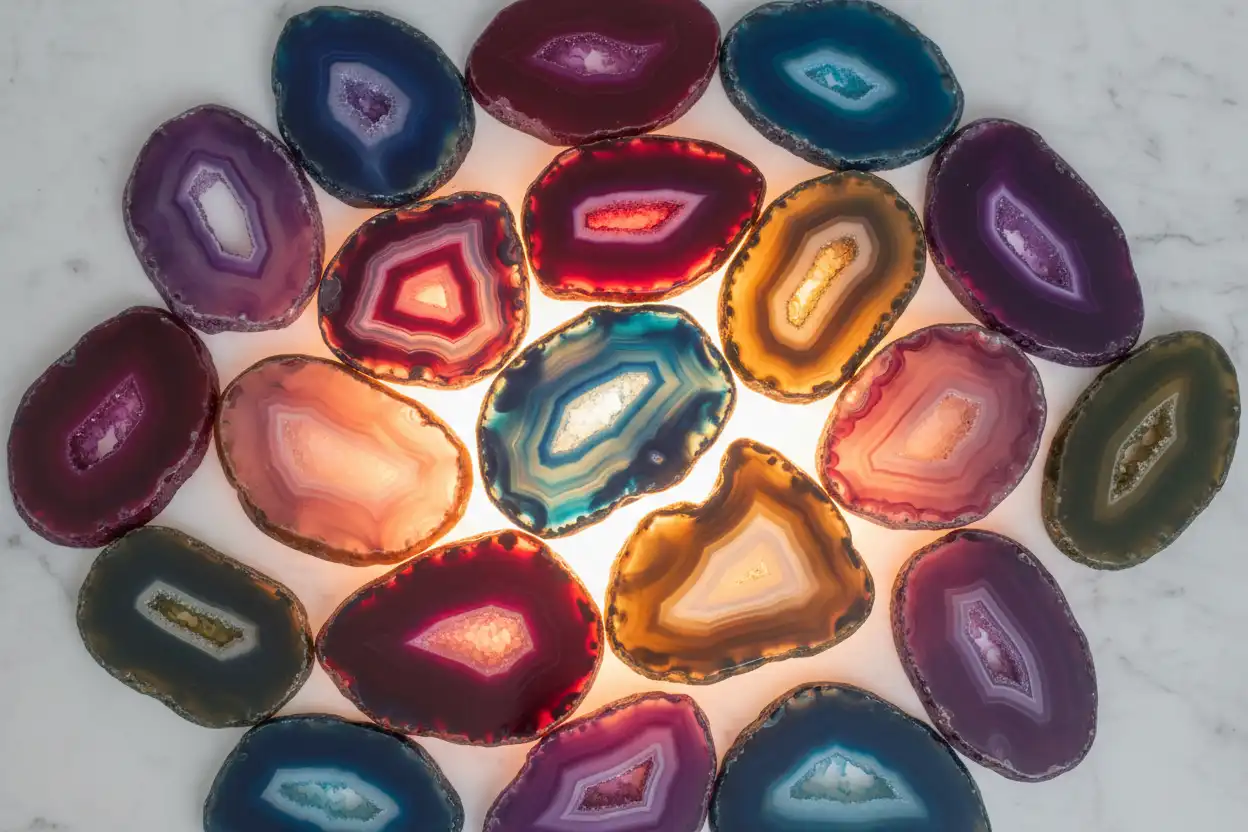
Agate color meaning varies widely because agate occurs in white, gray, brown, red, orange, yellow, blue, green, pink, purple, black and complex multicolored patterns. In contemporary crystal traditions, blue may symbolize calm communication, red may represent courage, green may suggest growth, and black may represent boundaries or stability.
Color symbolism is only one part of the story.
Agate is a form of chalcedony composed mainly of microscopic silica. Its real colors can develop from iron oxides, manganese compounds, clay minerals, chlorite, other inclusions and repeated stages of mineral deposition. Commercial agate is also frequently dyed, heated or otherwise enhanced, which means an intense color may reflect treatment rather than an unusually rare natural variety.
A useful way to understand agate color meaning is:
Color → Cause → Context
First, notice the color that attracts you.
Then ask what physically produced it.
Finally, consider what that color symbolizes to you and whether the interpretation fits the situation where you want to use the stone.
This approach keeps symbolic agate color meaning separate from mineral identification. A blue stone does not scientifically create calm, and a red stone does not biologically increase courage. Color symbolism can still provide a personal reflection cue without becoming a medical or supernatural claim.
For the mineral’s broader identity, formation, physical properties and general symbolism, the main agate meaning resource covers the material as a whole. This page stays focused on color.
Agate Color Meaning at a Glance
| Agate color | Common symbolic meaning | Natural-color notes | Common buying concern |
|---|---|---|---|
| Blue | Calm, communication, patience | Soft blue-gray can occur naturally | Vivid electric blue is often dyed |
| Green | Growth, renewal, balance | Green inclusions and muted green occur naturally | Uniform emerald green may be treated |
| Red | Courage, endurance, action | Iron oxides can create natural red-brown tones | Heat or dye may intensify color |
| Orange | Creativity, warmth, motivation | Natural iron-related orange occurs | Can overlap with treated chalcedony or carnelian |
| Yellow | Optimism, confidence, focus | Yellow-brown iron coloration occurs | Strong uniform yellow may be enhanced |
| Pink | Affection, warmth, self-compassion | Muted pinkish tones occur naturally | Hot pink is commonly dyed |
| Purple | Reflection, imagination, individuality | Natural purple agate is less common | Strong violet is frequently treated |
| Black | Boundaries, discipline, stability | Natural dark bands occur | Uniform commercial black is often dyed |
| White | Clarity, simplicity, new beginnings | Common natural agate component | Bleaching may brighten some material |
| Gray | Patience, neutrality, perspective | Very common natural color | Usually less treatment-dependent |
| Brown | Grounding, practicality, resilience | Common natural iron-rich color | Evaluate polish and pattern rather than saturation |
| Multicolor | Integration, adaptability, complexity | Natural agates often combine several colors | Rainbow combinations may be dyed |
These associations summarize modern symbolic traditions rather than fixed rules. Agate color meaning can also be personal. A brown agate inherited from a family member may carry more emotional meaning for you than any standardized color interpretation.
What Gives Agate Its Colors?
Before exploring agate color meaning individually, it helps to understand why agate has so many colors in the first place.
Agate is chalcedony—a dense aggregate of microscopic silica structures, primarily quartz with variable amounts of moganite and other minor components.
As silica-rich material fills cavities or fractures, changing conditions can create layers that differ in:
mineral inclusions, iron content, manganese content, porosity, transparency, particle size and trace chemistry.
These differences can produce bands of contrasting colors inside one nodule.
Iron compounds are especially important in many red, orange, yellow and brown agates.
Manganese minerals can create dark or branching features.
Green may come from chlorite, celadonite or other mineral inclusions.
Some blue material develops naturally through subtle structural or mineral effects, although very intense commercial blue often results from dye.
Agate therefore does not have one single “color-producing element.”
Its appearance records multiple geological processes.
The distinction between simple color names and pattern-, locality- or inclusion-based varieties is explored separately in types of agate.
Natural Agate Colors vs. Dyed Colors
Understanding treatment is essential to interpreting agate color meaning responsibly.
Agate has been dyed for a long time because some of its microscopic layers absorb coloring agents more readily than others.
This can create striking contrast.
A pale band may absorb substantial dye while a denser neighboring band remains nearly unchanged.
The result can look dramatic and still be genuine agate underneath.
Dyed agate is therefore not necessarily fake.
The important issue is disclosure.
A seller should not market ordinary dyed chalcedony as an exceptionally rare naturally electric-blue, neon-pink or vivid-purple agate.
The dedicated treated agate guide covers enhancement clues in greater detail.
For color interpretation, remember one simple rule:
Symbolic meaning does not depend on whether the color is natural. Market value and buying expectations often do.
If you personally associate blue with thoughtful communication, a dyed blue stone can still serve that symbolic purpose.
It simply should not be sold to you as something it is not.
How to Read Agate Color Meaning
Agate color meaning becomes more useful when you avoid treating colors as commands.
A blue stone does not mean you must remain calm.
It can remind you to communicate thoughtfully.
A red stone does not guarantee confidence.
It can represent choosing action despite uncertainty.
A black stone does not create supernatural protection.
It can symbolize maintaining a real boundary.
Think of the color as a prompt rather than a power.
A simple framework is:
Notice the color.
Name the quality you associate with it.
Choose one behavior that expresses that quality.
If blue represents communication, prepare what you need to say.
If green represents growth, identify the habit you want to develop.
If brown represents grounding, return to the facts of the situation.
Agate color meaning becomes practical when the symbolism affects behavior rather than remaining a vague label.
Blue Agate Color Meaning
Blue agate color meaning commonly centers on calm communication, patience, thoughtful speech and attentive listening.
Blue carries broad cultural associations with sky, water, spaciousness and calm, which helps explain why blue stones are so frequently connected with communication and emotional composure in modern crystal traditions.
A grounded way to use blue agate color meaning is before an important conversation.
Instead of expecting the stone to make the conversation go well, ask yourself:
What happened?
What do I need the other person to understand?
What specific outcome or response am I requesting?
That process creates clarity.
The stone simply represents the intention to communicate deliberately.
Is Blue Agate Naturally Blue?
Yes, naturally blue agate exists.
However, natural color is commonly softer than the intense royal blue, turquoise or electric blue seen in many inexpensive commercial slices and beads.
Natural blue-gray and lavender-blue tones can occur.
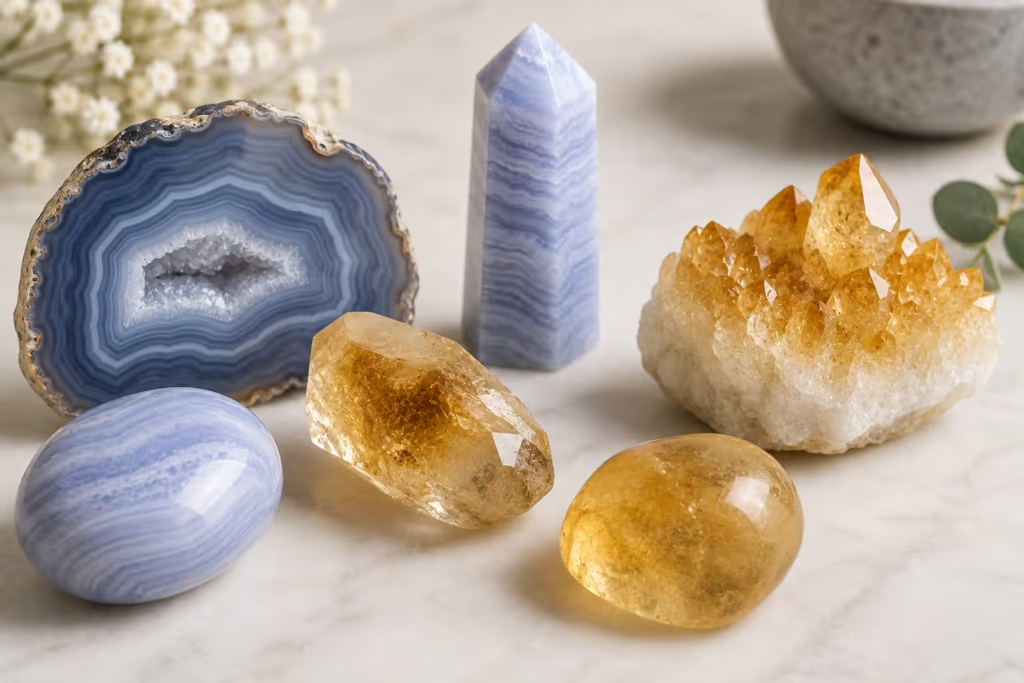
One particularly recognizable variety is blue lace agate, known for pale blue and white lace-like banding.
Strong uniform saturation should prompt treatment questions.
A vivid dyed stone may still be attractive and durable. The problem arises only when treatment is hidden.
Green Agate Color Meaning
Green agate color meaning commonly symbolizes growth, renewal, patience, adaptability and connection with nature.
Green naturally evokes leaves, vegetation and seasonal renewal, so growth symbolism is unsurprising.
Yet useful growth rarely means “everything will improve.”
A more grounded green agate color meaning is:
What can I develop gradually through repeated action?
Perhaps you are improving a skill.
Rebuilding savings.
Developing a relationship.
Changing a work habit.
Learning to set clearer boundaries.
Growth becomes measurable when a behavior changes.
Is Green Agate Natural?
Some agate displays natural green colors or green mineral inclusions.
However, highly saturated uniform green material is frequently dyed.
This is particularly important because different materials can be grouped casually under “green agate.”
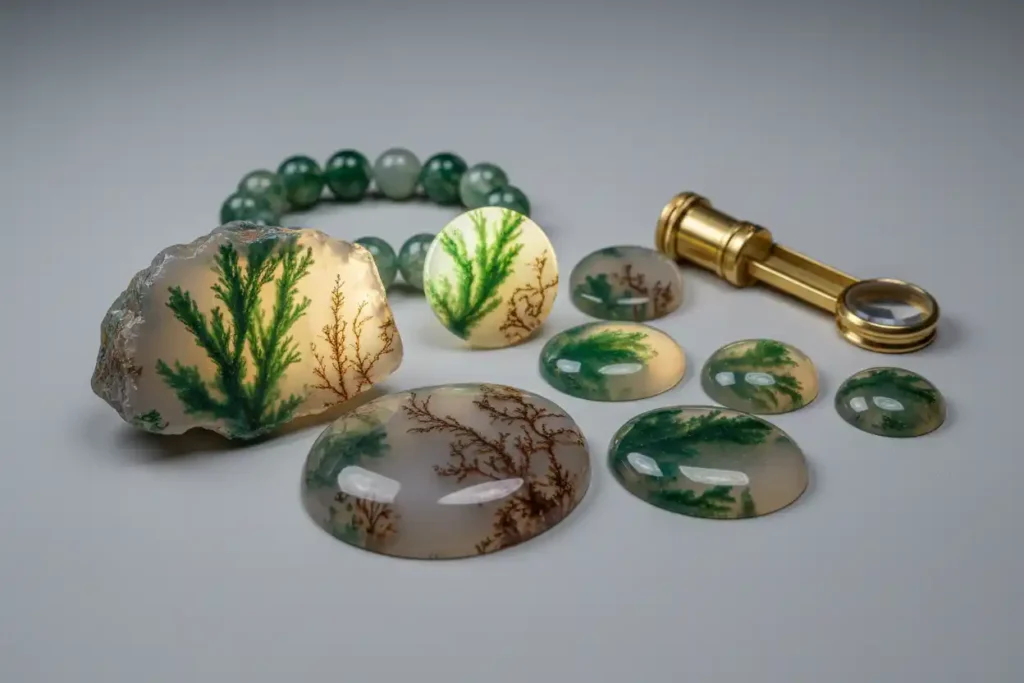
Moss agate is valued for branching, moss-like inclusions rather than simple green body color, while tree agate typically shows green branching patterns against a lighter background.
Those visual identities should not be reduced to generic green color.
Red Agate Color Meaning
Red agate color meaning is usually associated with courage, endurance, determination and taking practical action.
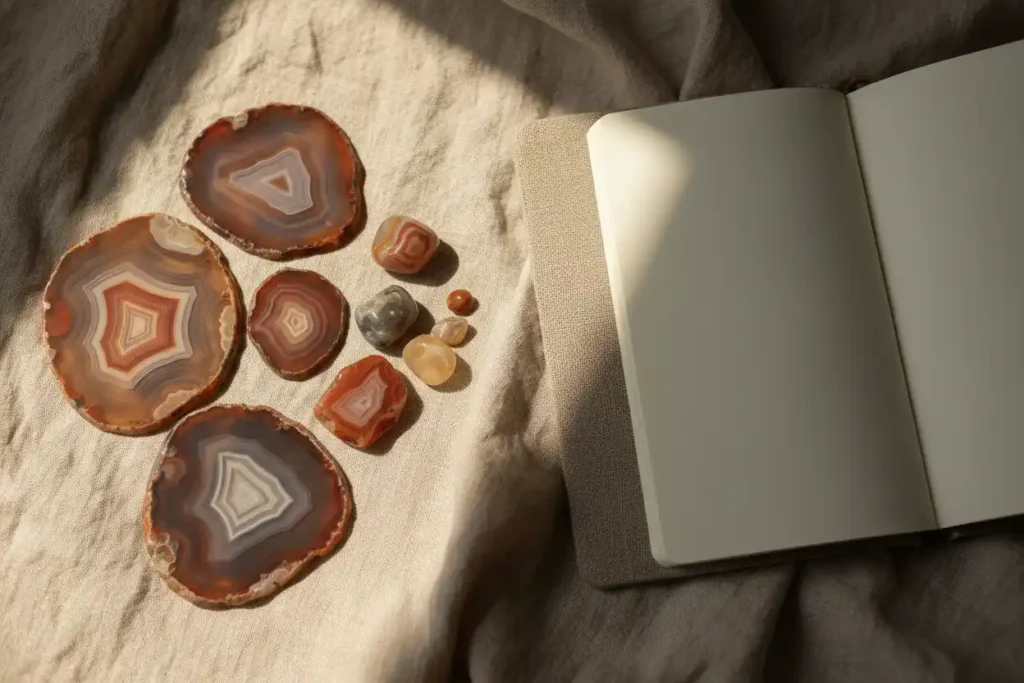
Iron oxides can naturally create brick-red, rust-red and red-brown coloration in agate.
These earthy reds differ visually from the highly saturated artificial scarlets sometimes seen in dyed commercial pieces.
A useful red agate color meaning is action despite discomfort.
Courage does not require the absence of fear.
You may be nervous before an interview and still attend.
You may dislike conflict and still communicate a boundary.
You may feel uncertain about a project and still complete the next necessary step.
The stone does not supply courage biologically.
It can represent the decision to act using the preparation you already have.
Red Agate vs. Carnelian
Red and orange agate terminology overlaps commercially with carnelian.
Carnelian is translucent orange to reddish chalcedony, generally valued more for relatively even body color than for classic agate banding.
Some stones combine characteristics of both.
Trade naming can therefore be inconsistent.
The dedicated carnelian meaning page covers that material separately.
When buying, focus less on whether a seller has chosen the perfect commercial name and more on whether color, treatment and material identity are represented honestly.
Orange Agate Color Meaning
Orange agate color meaning commonly represents creativity, enthusiasm, warmth, sociability and beginning something actively.
Orange sits visually between energetic red and optimistic yellow.
That makes it especially suitable as a symbol for turning an idea into action.
A grounded use might involve a creative project.
Instead of asking whether orange agate will “increase creativity,” identify the first visible action:
write the first paragraph;
sketch the first concept;
prepare the materials;
schedule the first hour.
Symbolic agate color meaning becomes far more useful when it reduces the distance between intention and activity.
Orange Agate and Fire Agate Are Not the Same
Ordinary orange body color should not be confused with fire agate.
Fire agate is prized for an iridescent optical effect created by thin internal mineral layers over botryoidal chalcedony.
Its shifting flashes of red, orange, gold, green and other colors are fundamentally different from a simple orange-colored agate.
That distinction matters for identification and value.
Yellow Agate Color Meaning
Yellow agate color meaning is generally associated with optimism, confidence, learning and mental focus.
Yellow naturally suggests light and visibility, which makes clarity a particularly fitting symbolic theme.
Useful optimism is not:
“Everything will work out exactly as I want.”
It is:
“I do not know the outcome, but I can still make a constructive decision.”
That distinction prevents yellow agate color meaning from becoming unrealistic positivity.
If you associate yellow with focus, use the stone as a reminder to define one priority before beginning work.
If you associate it with confidence, use it before a prepared action rather than expecting confidence to arrive first.
Natural yellow agate can occur through iron-bearing coloration, often blending into cream, gold, orange or brown.
Very intense uniform yellow may be enhanced.
Pink Agate Color Meaning
Pink agate color meaning commonly centers on affection, emotional warmth, kindness and self-compassion.
These meanings come largely from the cultural associations already attached to pink.
A grounded interpretation of self-compassion does not mean excusing every mistake.
It means evaluating mistakes without turning them into a permanent identity.
Instead of:
“I failed, therefore I am a failure.”
Try:
“This attempt failed. What information does that give me?”
That is a practical form of kindness toward yourself because it preserves accountability without unnecessary self-attack.
Is Pink Agate Natural?
Muted pink and pinkish-brown tones can occur naturally in some agates.
However, vivid bubblegum pink, hot pink and strongly saturated magenta are commonly created through dyeing.
Dyed pink agate can still be genuine chalcedony underneath.
Ask about treatment when natural color affects the price or your personal preference.
Purple Agate Color Meaning
Purple agate color meaning is commonly associated with contemplation, imagination, individuality and reflective judgment.
Purple has long carried cultural associations with rarity, ceremony, spirituality and creativity, although specific gemstone meanings vary by tradition.
A practical interpretation is independent reflection.
Before accepting an opinion because it is widely repeated, ask:
What evidence supports it?
Does it fit this particular situation?
What would make me change my mind?
That form of reflection prevents intuition from becoming unquestionable certainty.
Is Purple Agate Natural?
Natural purple-toned agate can occur, but strongly saturated purple material in inexpensive commercial jewelry is frequently dyed.
Look particularly carefully at color concentrated in fractures, drill holes, porous bands or surface-reaching areas.
Treatment clues are useful, but visual inspection alone is not always conclusive.
When the identity itself is uncertain, the real vs. fake agate resource focuses on material authentication rather than symbolism.
Black Agate Color Meaning
Black agate color meaning commonly symbolizes boundaries, discipline, stability, privacy and protection.
Protection is often presented metaphysically as blocking negative energy.
There is no established scientific evidence that black agate creates a supernatural protective shield.
A more grounded interpretation focuses on practical boundaries.
Protection can mean:
keeping personal information private;
leaving an unsafe situation;
using a strong password;
declining a commitment you cannot sustain;
or limiting contact that repeatedly violates a stated boundary.
The black agate color meaning becomes powerful as a reminder precisely because the action remains yours.
Is Black Agate Natural?
Agate can contain naturally very dark gray, brown or black bands.
However, uniformly black commercial chalcedony is frequently treated.
Historically and commercially, porous chalcedony has been darkened using several methods.
Black color alone therefore does not prove natural rarity.
Black agate can also be confused commercially with onyx, black jasper, obsidian and glass.
True onyx is a banded chalcedony variety characterized by relatively parallel bands, although the trade often uses “black onyx” much more broadly.
White Agate Color Meaning
White agate color meaning commonly represents clarity, simplicity, patience and new beginnings.
White bands are extremely common in natural agate.
They can alternate with gray, brown, blue, red or nearly transparent chalcedony.
A grounded white agate color meaning is simplification.
When a situation feels overwhelming, ask:
What is the actual decision?
What information is necessary?
What can wait?
What is outside my control?
Clarity often comes from removing unnecessary questions rather than finding answers to all of them.
White agate does not scientifically clear the mind.
Its appearance can simply become a cue to reduce complexity.
Gray Agate Color Meaning
Gray agate color meaning is commonly associated with neutrality, patience, balance and accepting uncertainty.
Gray is one of agate’s most natural and widespread colors.
It may appear silver-gray, blue-gray, smoky gray or brown-gray.
Because gray is less dramatic than vivid dyed colors, it can be overlooked commercially.
Symbolically, that subtlety is part of its strength.
Not every problem has a black-or-white answer.
Sometimes evidence remains incomplete.
Two competing priorities may both be legitimate.
A person can make a reasonable decision without knowing exactly how events will unfold.
Gray agate color meaning can represent becoming comfortable enough with uncertainty to decide responsibly anyway.
Brown Agate Color Meaning
Brown agate color meaning commonly symbolizes grounding, practicality, endurance and long-term thinking.
Natural brown, tan and red-brown colors are common in agate because iron-related minerals frequently influence chalcedony.
A grounded brown agate color meaning is particularly useful for planning.
Instead of asking:
“What do I want eventually?”
ask:
“What system would make that outcome more likely?”
If the goal is saving money, the system may be an automatic transfer.
If the goal is learning, the system may be scheduled study.
If the goal is better communication, the system may be raising issues earlier rather than after resentment grows.
Brown symbolism works best when grounded means practical, not merely spiritually connected to Earth.
Multicolored Agate Meaning
Multicolored agate color meaning commonly represents adaptability, integration, complexity and balancing competing priorities.
Natural agate frequently combines several colors.
One slice might contain white, gray, brown, red and orange bands.
Another might show translucent chalcedony beside dark mineral inclusions.
Multiple colors can represent the idea that different qualities are useful in different situations.
You may need patience and courage.
Clarity and flexibility.
Boundaries and compassion.
There is no requirement to choose one symbolic quality permanently.
That makes multicolored agate particularly suitable for the idea of integration.
Natural Multicolor vs. Rainbow-Dyed Agate
Natural multicolor agate usually shows geological relationships between bands and inclusions.
Rainbow-dyed agate may display vivid blue, pink, purple and green following porous zones.
Both can be decorative.
They belong to different treatment categories.
When purchasing, the question is not whether dyed rainbow agate is “bad.”
It is whether you are being told accurately what created the appearance.
Does Agate Color Change Its Physical Properties?
Color can correspond with different inclusions or treatments, but changing agate color does not transform the stone into an entirely different physical material.
Most compact agate remains chalcedony with broadly similar quartz-family characteristics.
Typical hardness is around 6.5–7 on the Mohs scale.
Agate lacks prominent cleavage and is generally durable when compact and fracture-free.
However, actual durability can still vary because of:
open cavities;
fractures;
porosity;
druzy surfaces;
mineral inclusions;
dye;
resin;
backing;
coatings;
or assembled construction.
This is why agate color meaning should never be used as a care guide.
A dyed blue slice and an untreated gray cabochon may share the same basic silica identity while responding differently to prolonged chemical exposure.
Does Agate Color Change Its Healing Properties?
There is no scientific evidence that different agate colors produce different medical healing effects.
Modern metaphysical systems often assign blue agate to communication, red to vitality, green to emotional growth and black to protection.
Those associations are symbolic.
They should not be interpreted as evidence that one color treats a specific organ, hormone, disease or psychological condition.
Color can still affect subjective experience.
Someone may find pale blue visually calming.
Another person may find bright red energizing.
Those personal responses are not the same as a demonstrated medical effect.
The distinction matters.
Agate Color Meaning and Chakras
Modern chakra traditions often connect agate color meaning with the chakra traditionally associated with the same color.
Red or dark agate may be linked with the root chakra.
Orange with the sacral chakra.
Yellow with the solar plexus.
Green or pink with the heart.
Blue with the throat.
Purple with the third eye or crown depending on the system.
White may be associated with the crown.
These correspondences are contemporary spiritual interpretations.
There is no laboratory test showing that an agate physically activates a chakra.
If chakra symbolism is meaningful to you, color can provide a simple organizing framework without being treated as anatomy or medicine.
Choosing an Agate Color by Intention
You do not need a complicated chart to choose between colors.
Start with the behavior you actually want to reinforce.
If you want to communicate more clearly, blue symbolism may be useful.
If you are working on consistent growth, green may fit.
If you need to take a difficult but prepared action, red may appeal.
If creativity is the goal, orange can provide an obvious visual cue.
For optimism without denying reality, yellow is a natural choice.
Pink may represent kindness.
Purple can represent reflection.
Black can represent boundaries.
White can symbolize simplifying a situation.
Gray can represent accepting uncertainty.
Brown may symbolize practical stability.
The best agate color meaning is the one specific enough to remind you what you intended to do.
Which Agate Color Is Best for Love?
There is no scientifically or spiritually universal “best” agate color for love.
Pink is commonly associated with affection, tenderness and emotional openness.
Green may symbolize growth within a relationship.
Blue can represent communication.
Red may symbolize courage and commitment.
The useful question is what the relationship actually needs.
If communication is the problem, choosing blue because a chart says pink is the “love color” may make less personal sense.
Agate color meaning becomes more meaningful when the symbolism reflects the real situation rather than a fixed formula.
Which Agate Color Is Best for Protection?
Black, dark brown and red agates are frequently associated with protection in modern crystal traditions.
However, no agate color has been scientifically shown to prevent accidents, repel harmful people or create a protective energy field.
Use protection symbolism as a behavioral reminder.
A black agate may remind you to maintain a boundary.
A red agate might represent acting promptly when something is unsafe.
A brown stone may symbolize practical preparation.
Real safety should still depend on appropriate action.
Which Agate Color Is Best for Confidence?
Yellow, red and orange commonly appear in confidence-focused agate color meaning.
They emphasize slightly different ideas.
Yellow can symbolize confidence through clarity.
Red can represent courage to act despite fear.
Orange can symbolize willingness to experiment and begin.
Choose according to the obstacle.
If you know what to do but feel afraid, red symbolism may fit.
If uncertainty is the problem, yellow may be more relevant.
If perfectionism prevents you from starting, orange can represent experimentation.
Which Agate Color Is Best for Calm?
Blue, white and gray are frequently chosen for calm symbolism.
Blue can represent measured communication.
White may symbolize reducing complexity.
Gray can represent accepting uncertainty without rushing toward a forced answer.
None of these colors scientifically sedates the nervous system.
If looking at a particular stone feels pleasant, that subjective experience can still be worthwhile.
Use it alongside actual calming behaviors rather than treating the mineral as medical treatment.
Agate Color Meaning for Jewelry
Color often determines why someone chooses agate jewelry in the first place.
Because agate is widely available, jewelry can be chosen for pattern and symbolism without requiring unusually rare material.
A blue pendant might represent communication.
A brown ring can symbolize stability.
A multicolored bracelet may represent adaptability.
Physical suitability still matters.
Compact polished agate is generally durable enough for many jewelry uses, but thin slices can chip and druzy material can be more vulnerable.
Dyed jewelry should also be kept away from aggressive chemicals that may affect color stability.
How to Spot Dyed Agate by Color
No single visual clue proves dyeing, but several features can justify closer examination.
Extremely intense electric blue, hot pink, bright purple or emerald green are common treatment signals in inexpensive agate.
Look closely at areas where color may concentrate.
Fractures, drill holes, pits, porous bands and surface-reaching zones may absorb more dye.
Color that looks unnaturally uniform across material that would normally show varied layers can also be suspicious.
However, some natural agates are genuinely vivid.
Do not destroy the stone with scratch, solvent, heat or acid tests simply to satisfy curiosity.
Seller disclosure and appropriate gemological examination are better approaches when treatment matters financially.
Does Dyed Agate Have Less Value?
Usually, treatment affects market expectations, but there is no universal price penalty.
Common dyed decorative agate can be inexpensive because the underlying material is abundant.
A beautifully cut dyed piece may still have artistic or jewelry value.
Natural-color collector agates from desirable localities can command much higher prices because natural pattern, rarity and provenance matter to collectors.
The relevant comparison is not:
“Dyed or natural—which one is good?”
It is:
“Is the stone accurately described and appropriately priced for what it is?”
That is the better buying standard.
How Agate Color Affects Value
Color affects value differently depending on the variety.
For common commercial agate, attractive pattern and cutting may matter more than any one color.
For locality-defined collector agates, natural color combinations can be a major part of desirability.
For fire agate, optical play-of-color matters more than simple body color.
For blue lace agate, delicate natural blue-and-white banding helps define the material.
For dyed decorative slices, craftsmanship and appearance may matter more than natural rarity.
Therefore, there is no universal ranking where blue is worth more than red or green is worth more than brown.
Value depends on the specific material.
Agate Color vs. Agate Variety
Agate color meaning and agate variety are related but not identical.
“Blue agate” is primarily a color description.
“Blue lace agate” includes a distinctive lace-like banding style.
“Botswana agate” is locality-based.
“Moss agate” is named for inclusion patterns.
“Fire agate” is defined largely by an optical effect.
“Onyx” describes a particular style of banded chalcedony in the mineralogical sense.
One stone can therefore have several valid descriptions.
A Botswana agate may be gray, pink and white.
A fire agate can display orange, green and gold.
A moss agate can contain green, brown and transparent areas.
This is why agate color meaning should not replace variety identification.
How to Choose Natural-Looking Agate Colors
If natural appearance matters to you, prioritize complexity over perfect uniformity.
Natural agate often contains:
uneven bands;
subtle shifts in saturation;
translucent and opaque areas;
white or gray layers;
iron-colored brown or red zones;
and irregular mineral inclusions.
This does not mean uniform-looking agate is automatically treated.
It means highly saturated uniform color deserves more investigation when the seller also claims untreated natural rarity.
Ask for photographs under ordinary daylight or neutral indoor illumination.
Images heavily edited for saturation can make treatment assessment even harder.
Caring for Different Agate Colors
Stable untreated agate is generally straightforward to care for.
Use lukewarm water, mild soap and a soft cloth or soft brush where appropriate.
Avoid sudden temperature changes.
Avoid strong household chemicals.
Thin slices should be protected from impact.
For dyed, coated, resin-filled or assembled agate, conservative care becomes even more important.
Do not assume a cleaning method is safe simply because the underlying chalcedony is durable.
Treatments can be more sensitive than the base mineral.
Store agate away from much harder gems that could scratch it and from softer stones that agate itself could damage.
Can Agate Color Fade?
Some treated colors can be less stable than natural coloration.
Prolonged exposure to strong sunlight, heat or chemicals may affect certain dyes or coatings.
Natural mineral colors can also vary in stability depending on the material, but agate’s commercial color concerns are often treatment-related.
If you own strongly dyed agate, store it away from unnecessary prolonged sunlight and harsh chemicals.
Normal jewelry wear is different from deliberately leaving the piece for weeks on a hot windowsill.
What Makes Agate Color Meaning Unique?
Agate color meaning is more interesting than assigning one spiritual benefit to each shade.
Agate often contains multiple colors inside one stone.
Those colors formed at different stages, under changing chemical conditions, or through later treatment.
That creates a more distinctive symbolic lesson:
color provides context, not destiny.
Blue can remind you to communicate.
Green can represent development.
Red can represent action.
Gray can represent uncertainty.
But none of those qualities has to define the entire stone—or the entire person using it.
A multicolored agate makes the point especially clearly.
Different circumstances can call for different qualities.
You can be patient in one situation and decisive in another.
Compassionate without abandoning boundaries.
Optimistic without ignoring evidence.
Agate color meaning works best as a flexible visual language rather than a rigid spiritual rulebook.
Frequently Asked Questions
What is agate color meaning?
Agate color meaning refers to the symbolic interpretations associated with different agate colors. Blue commonly represents communication, green growth, red courage, yellow optimism, black boundaries, white clarity and brown grounding. These are symbolic traditions rather than scientifically proven effects.
What is the most common natural agate color?
White, gray, cream, brown and muted red-orange tones are among the most common natural appearances. Many agates combine several colors.
What does blue agate mean?
Blue agate color meaning commonly centers on calm communication, patience, thoughtful expression and listening.
What does green agate mean?
Green agate color meaning usually represents growth, renewal, adaptability and balance.
What does red agate mean?
Red agate color meaning is traditionally associated with courage, endurance, determination and practical action.
What does orange agate mean?
Orange agate color meaning commonly symbolizes creativity, motivation, enthusiasm and willingness to begin.
What does yellow agate mean?
Yellow agate color meaning often centers on optimism, confidence, clarity and focused decision-making.
What does pink agate mean?
Pink agate color meaning commonly represents affection, kindness, emotional warmth and self-compassion.
What does purple agate mean?
Purple agate color meaning is generally associated with reflection, imagination, individuality and introspection.
What does black agate mean?
Black agate color meaning commonly symbolizes boundaries, discipline, stability and protection. It does not scientifically create a supernatural protective field.
What does white agate mean?
White agate color meaning usually represents simplicity, clarity, patience and fresh beginnings.
What does gray agate mean?
Gray agate color meaning is associated with balance, neutral judgment, patience and accepting uncertainty.
What does brown agate mean?
Brown agate color meaning commonly symbolizes grounding, practicality, resilience and long-term stability.
What does multicolored agate mean?
Multicolored agate color meaning often represents integration, adaptability and balancing several priorities or personal qualities.
Which agate color is best for love?
Pink is commonly associated with affection, but green may symbolize relationship growth and blue may represent communication. There is no universally best agate color for love.
Which agate color is best for protection?
Black, brown and red are frequently linked with protection symbolism. No agate color has been scientifically shown to prevent harm, so practical safety measures remain essential.
Which agate color is best for confidence?
Yellow, red and orange are commonly used for confidence symbolism. Yellow emphasizes clarity, red courage and orange willingness to act or experiment.
Which agate color is best for calm?
Blue, white and gray are commonly associated with calm, patience and composure. These are symbolic or subjective associations rather than medical effects.
Are bright agate colors natural?
Some natural agates are vivid, but electric blue, hot pink, saturated purple, bright emerald green and rainbow combinations are frequently dyed.
Is dyed agate fake?
No. If genuine chalcedony has been dyed, it remains agate. The important issue is whether the treatment is disclosed accurately.
Does agate color affect value?
Yes, but not through one universal ranking. Natural color, pattern, treatment, variety, locality, cutting and collector demand all influence value differently.
Does agate color affect healing properties?
There is no scientific evidence that different agate colors produce different medical healing effects. Color-specific healing claims belong to metaphysical traditions.
Can one agate have several natural colors?
Yes. Agate commonly contains multiple natural bands created by changing conditions during mineral deposition.
Is black agate always dyed?
No. Naturally dark agate exists, but much uniformly black commercial chalcedony is treated, so disclosure matters.
Is blue agate always dyed?
No. Natural blue and blue-gray agate exists. Very intense electric or royal-blue commercial material is more likely to be dyed.
Is green agate always dyed?
No. Natural green colors and green mineral inclusions occur, but uniformly saturated bright green commercial agate is frequently enhanced.
Is pink agate naturally occurring?
Muted natural pinkish tones can occur, but highly saturated hot-pink commercial agate is commonly dyed.
How can I tell if agate color is natural?
Look at overall pattern, saturation and whether color collects in fractures, drill holes or porous layers. These are clues rather than proof. Seller disclosure or professional examination is more reliable when treatment significantly affects value.
The Core Meaning of Agate Colors
Agate color meaning provides a simple visual language for qualities people may want to remember.
Blue can represent communication.
Green can symbolize development.
Red can stand for courage.
Orange can represent creativity.
Yellow can suggest optimism.
Pink can symbolize warmth.
Purple can represent reflection.
Black can stand for boundaries.
White can represent clarity.
Gray can symbolize acceptance of uncertainty.
Brown can suggest practical stability.
Multicolored agate can represent integration.
But the mineralogical side matters just as much.
Agate color may be natural, heat-influenced, dyed, coated or affected by mineral inclusions. A spectacular color does not automatically indicate rarity, and treatment does not automatically make genuine agate fake.
The strongest way to understand agate color meaning is therefore:
Color → Cause → Context.
Choose the color that resonates with you.
Understand what physically created its appearance.
Then decide what that color will symbolize in your actual life.
That keeps agate color meaning useful without confusing symbolism with mineral science—and allows the extraordinary natural and treated colors of agate to be appreciated for what they truly are.