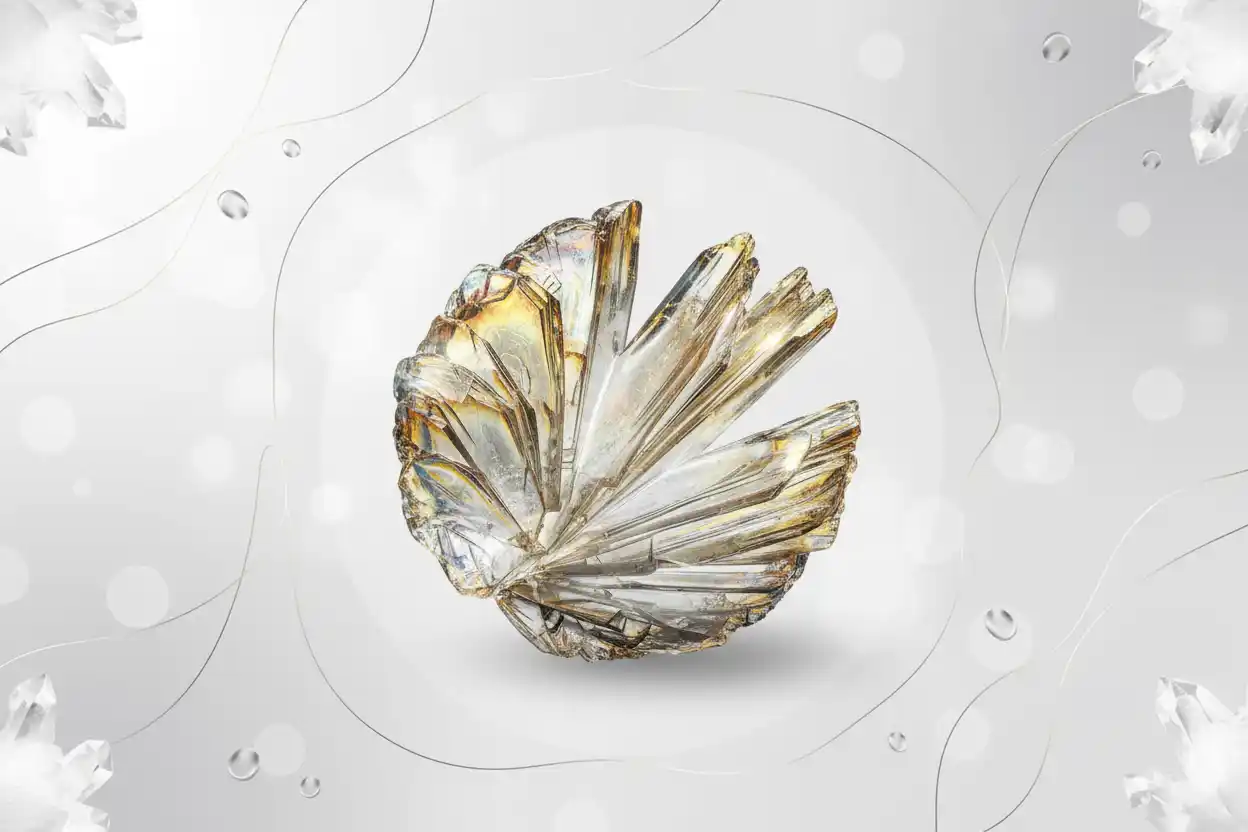
Mica: Types, Properties & Meaning
Mica is the name of a mineral group whose members share a layered sheet-silicate structure and exceptionally strong basal cleavage. Their crystals split into thin plates or flakes, producing the reflective sparkle seen in granite, schist, mineral specimens, cosmetics, coatings, and decorative products.
Because mica is a group rather than one species, it has no single chemical formula, color, hardness, or exact formation environment. Muscovite, phlogopite, dark iron-rich micas, lithium micas, and brittle micas differ significantly despite their related structures.
Mica at a Glance
| Property | Mica group |
|---|---|
| Material type | Group of phyllosilicate minerals |
| Composition | Variable potassium-, sodium-, calcium-, magnesium-, iron-, lithium-, aluminum-, fluorine-, and hydroxyl-bearing silicates |
| Common colors | Colorless, silver, white, gray, brown, black, green, yellow, pink, purple, bronze, and reddish |
| Crystal system | Most common micas are monoclinic, but one system should not be assigned to every group member |
| Typical habit | Platy, tabular, pseudohexagonal, flaky, scaly, foliated, or stacked “books” |
| Luster | Vitreous to pearly |
| Transparency | Transparent in thin sheets to opaque |
| Mohs hardness | Commonly about 2–3 for many true micas; some brittle micas are harder |
| Cleavage | Perfect basal cleavage |
| Tenacity | Thin sheets may be elastic or flexible; larger crystals and aggregates can be brittle |
| Common uses | Electrical insulation, fillers, coatings, cosmetics, pigments, construction products, specimens, carvings, and limited jewelry |
| Main care concern | Splitting, peeling, scratching, flaking, coatings, and inhalation of fine dust |
Mica Is a Mineral Group
The mica group contains dozens of related sheet silicates. Their structures consist of strongly bonded silicate layers separated by comparatively weaker interlayer bonds.
Those weak interlayer connections allow a crystal to split parallel to its base. Consequently, a thick mica book can separate into numerous smooth sheets.
The layers themselves remain relatively strong. A very thin muscovite or phlogopite sheet can bend and spring back, even though the crystal separates readily between layers.
Mica minerals are commonly divided through chemical and structural criteria, including true micas, brittle micas, and interlayer-deficient micas. Within those divisions, species differ according to the ions occupying structural sites.
Therefore, the word mica provides a family identity rather than a complete mineral diagnosis. A specimen still needs a more specific name whenever chemistry, value, or care depends on the individual member.
Why Mica Splits into Thin Sheets
Each structural layer contains linked silica tetrahedra attached to an octahedral sheet containing aluminum, magnesium, iron, lithium, or other elements. Together, these units form a layered sandwich.
Potassium or another interlayer ion holds adjacent sandwiches together. However, bonding between the sandwiches is weaker than bonding within them.
When pressure is applied in the correct direction, the crystal separates along its basal plane. This produces mica’s perfect cleavage and characteristic flat sheets.
The split surfaces are often smooth, reflective, and pearly. Fresh sheets may be transparent or translucent even when the original book looks dark.
This structure explains both mica’s usefulness and its weakness. Large sheets can resist heat and electrical flow, yet a sharp edge or repeated bending may peel them apart.
Major Mica Types
Muscovite
Muscovite is a potassium-aluminum mica and one of the most familiar group members. It commonly appears colorless, silvery, pale gray, tan, greenish, or faintly pink.
Large muscovite books can split into transparent, elastic sheets. Historically, such sheets served as heat-resistant windows and viewing panels before modern glass became widely available for some applications.
The dedicated muscovite guide owns its exact chemistry, localities, specimen qualities, and symbolism. At the family level, its main importance is that it demonstrates the classic transparent-sheet behavior associated with mica.
Phlogopite
Phlogopite is a magnesium-rich mica usually found in brown, bronze, yellow-brown, reddish-brown, or greenish plates. It occurs in magnesium-rich igneous and metamorphic rocks, including certain marbles, ultramafic rocks, and carbonatites.
Its heat resistance makes phlogopite commercially important. Thin sheets can remain flexible, although iron content and alteration may affect color and performance.
Dark Iron-Rich Micas
The name biotite has historically been used for dark brown or black iron- and magnesium-rich micas. Modern mineral nomenclature treats much material called biotite as a compositional series or field term rather than one simple species.
Dark mica commonly occurs in granite, diorite, gneiss, schist, and many other rocks. Weathering can turn black plates bronze, golden brown, or greenish.
A black color does not automatically identify biotite. Phlogopite, annite-rich mica, altered material, and other dark sheet silicates can overlap visually.
Fuchsite
Fuchsite is chromium-bearing muscovite. Chromium produces green coloration that may range from pale mint to vivid emerald or blue-green.
Fuchsite often forms sparkling plates, foliated masses, or inclusions in quartz-rich rock. More compact material can be cut, although pure flaky fuchsite remains soft and strongly cleavable.
When corundum crystals occur in a fuchsite-rich host, the material may be sold as ruby in fuchsite. That composite requires separate durability and identification considerations.
Lithium Micas
The commercial word lepidolite commonly describes pink, lavender, lilac, gray, or purple lithium-rich mica of the polylithionite-trilithionite compositional series. Its full identity and ornamental use belong on the dedicated lepidolite guide.
Lithium pegmatites may contain lithium mica alongside quartz, feldspar, tourmaline, spodumene, and other rare-element minerals. Compact intergrowths can produce attractive carvings and cabochons, while platy crystals remain fragile.
Zinnwaldite is another lithium- and iron-bearing mica associated with granites, greisens, and rare-element pegmatites. Brown, bronze, gray, or violet tones may appear depending on composition and alteration.
How Mica Forms
Mica minerals develop in igneous, metamorphic, hydrothermal, and sedimentary environments. Their chemistry records the composition, pressure, temperature, fluids, and alteration history of the host rock.
Muscovite commonly crystallizes in granites and granite pegmatites. Pegmatites may produce unusually large books because their late-stage melts contain water, fluxing elements, and sufficient space for coarse crystal growth.
Dark iron-magnesium micas occur in a wider range of igneous rocks. As magma crystallizes, their composition responds to iron, magnesium, aluminum, potassium, oxygen conditions, and temperature.
Regional metamorphism produces mica-rich schists and gneisses from clay-rich sedimentary rocks. During recrystallization, platy mica grains align perpendicular to pressure, creating foliation.
Hydrothermal alteration can convert feldspar and other minerals into fine white mica. Sericite is a textural term commonly used for very fine-grained white mica produced through alteration rather than a single approved mineral species.
Weathering breaks mica into smaller flakes that enter soil, sand, and sediment. Their reflective surfaces can create glittering stream deposits without indicating gold or another metallic mineral.
Important Mica-Producing Regions
India has a long history of sheet-mica mining and processing, particularly in pegmatite districts. Madagascar has become a major producer of natural sheet mica and also supplies attractive collector specimens.
Brazil produces muscovite, lithium micas, fuchsite, and mica-bearing pegmatite specimens from Minas Gerais and other regions. Large crystals may occur with quartz, feldspar, tourmaline, and beryl.
Pakistan and Afghanistan supply muscovite books and complex pegmatite specimens containing aquamarine, tourmaline, topaz, garnet, and other minerals.
Russia, Canada, the United States, Namibia, Zimbabwe, Tanzania, and several European countries have also produced commercial or collectible mica.
A country label alone does not establish value. Specific mine provenance, crystal size, associated minerals, condition, and species identification matter more for a collector specimen.
Identifying Mica
Perfect basal cleavage provides mica’s clearest field characteristic. A crystal should separate into thin, smooth plates parallel to one dominant plane.
Many true mica sheets bend without snapping immediately. Muscovite and phlogopite commonly show elastic behavior, meaning a bent sheet tends to return toward its original position.
Luster ranges from vitreous on crystal faces to pearly on cleavage surfaces. Thin sheets may transmit light, while thick books, iron-rich varieties, and massive aggregates can look opaque.
Pseudohexagonal outlines are common because the plate edges approximate six-sided forms. However, mica’s internal symmetry is not necessarily hexagonal.
Hardness usually falls below common glass and quartz. A knife may scratch many micas, but destructive testing is inappropriate for a fine specimen.
The procedures in how to identify crystals help distinguish cleavage, fracture, habit, streak, and hardness. Laboratory identification may use X-ray diffraction, chemical analysis, Raman spectroscopy, or electron-microprobe work.
Mica and Similar Layered Minerals
Chlorite can resemble green or dark mica and also has a platy habit. Its sheets are generally less elastic, and its hardness, composition, optical properties, and alteration textures differ.
Talc is extremely soft, feels greasy, and usually occurs as foliated or massive material rather than resilient transparent books. A fingernail scratches it more readily than most mica.
Gypsum can split along cleavage and form transparent sheets, but it is softer and has different crystal forms. It also lacks mica’s characteristic elasticity.
Vermiculite resembles mica because it develops through alteration of mica-like minerals. Heating causes it to expand dramatically into lightweight accordion-like particles.
Thin manufactured plastic, resin, or glass flakes may imitate decorative mica. Repeated identical shapes, melting behavior, and absence of natural cleavage provide clues, although destructive tests should not be used on finished objects.
Industrial and Decorative Uses
Mica’s electrical resistance, heat stability, low thermal conductivity, reflectivity, and cleavage make it useful far beyond mineral collecting.
Sheet mica appears in electrical and electronic insulation, viewing windows, heating equipment, specialized instrumentation, and composite components. Reconstituted mica products combine small flakes with binders to form larger usable sheets.
Ground mica enters paint, joint compound, roofing, plastics, rubber, drilling products, welding materials, and other industrial mixtures. Plate-like particles can improve reinforcement, surface appearance, and barrier performance.
Cosmetic-grade mica creates shimmer in eyeshadow, highlighter, lipstick, nail products, and body cosmetics. Manufacturers may coat mica flakes with titanium dioxide, iron oxides, or other approved colorants to create interference and metallic effects.
Decorative crafts use natural or synthetic mica flakes in resin, plaster, candles, paint, paper, and architectural finishes. These products should not be confused automatically with collectible mineral specimens.
Is Mica a Gemstone?
Individual mica sheets rarely function as conventional gems because they are soft and separate easily along cleavage. Faceting them would produce fragile stones with little practical durability.
More compact mica aggregates and mica-bearing rocks can be cut into cabochons, beads, spheres, and carvings. Their sparkle comes from many reflective flakes rather than from one transparent crystal.
Fuchsite-rich quartz, ruby in fuchsite, lepidolite-rich rock, and mica-bearing pegmatites appear more frequently in jewelry than pure muscovite books.
The exact hardness of a composite depends on its constituents. Quartz-rich material may resist scratches better than its exposed mica flakes, while soft mica-rich zones can undercut during polishing.
The gemstone hardness chart provides general context, but multi-mineral material should never receive one false hardness based only on its hardest component.
Jewelry Suitability
Mica-bearing cabochons work best in pendants, earrings, brooches, and other protected formats. Their reflective texture can remain visible without exposing the surface to constant abrasion.
Rings and bracelets require greater caution. Protruding flakes may peel, while contact with countertops, tools, and harder jewelry can leave scratches.
A bezel can protect an edge, but excessive setting pressure may cause delamination along mica-rich layers. Thin drilled pieces may also split around the hole.
Resin stabilization can improve the coherence of a flaky aggregate. Nevertheless, stabilization does not transform a soft mica-rich stone into a high-toughness gem.
A compact material should be evaluated according to its full rock texture rather than the mica group alone. This distinction is central to gemstone toughness versus hardness.
Treatments and Imitations
Dyeing can intensify purple, green, blue, pink, black, or metallic colors in porous mica-bearing materials. Dye often concentrates along cleavage planes, fractures, and grain boundaries.
Resin impregnation may hold loose flakes together and improve the polish of compact material. Fillers can also conceal pits or stabilize fractures.
Surface coatings increase shine or add iridescent color. Cosmetic and craft mica is intentionally coated as part of manufacturing, while a collectible specimen should disclose any artificial coating.
Pressed flakes mixed with resin can form composite slabs, cabochons, beads, or decorative sheets. These products may contain genuine mica but are not solid natural crystals.
Synthetic fluorphlogopite is manufactured for cosmetics, coatings, insulation, and other applications. It shares mica-like structural properties but is not mined natural phlogopite.
The broad principles in gemstone treatments explained help separate acceptable disclosed enhancement from misleading presentation.
Current Mica Asking Prices
Mica is common, but specimen quality ranges from inexpensive classroom pieces to costly combinations with rare pegmatite minerals.
| Mica product | Broad retail asking range |
|---|---|
| Small educational cleavage specimen | About $4–$15 |
| Small muscovite or dark-mica book | About $10–$35 |
| Attractive medium mica crystal or cluster | About $25–$100 |
| Large book or aesthetic association specimen | About $75–$300 |
| Fine specimen with aquamarine, tourmaline, apatite, or other desirable minerals | About $100–$1,000 or more |
| Mica-bearing cabochon | About $10–$75 |
| Bead strand | About $10–$50 |
| Small sphere, palm stone, or carving | About $20–$100 |
| Large polished object | About $75–$300 or more |
These amounts are broad asking prices rather than appraisals. Individual mica species may follow different markets, so detailed pricing for fuchsite, lepidolite, muscovite, or zinnwaldite belongs with their dedicated pages.
What Gives a Mica Specimen Value?
Crystal size matters when a book remains complete, well formed, and visually balanced. Large undamaged plates are harder to preserve than small flakes.
Clarity can raise the appeal of muscovite and phlogopite sheets. Transparent windows, attractive zoning, and clean pseudohexagonal outlines make a specimen easier to display.
Color affects demand for lithium mica, fuchsite, and unusual species. However, natural saturation should be distinguished from dye, coating, reflected background color, and photographic editing.
Associated minerals often contribute most of the value. Aquamarine, tourmaline, topaz, apatite, garnet, quartz, or feldspar arranged aesthetically on mica may produce a significant collector specimen.
Condition remains critical. Cleaved edges are natural, but crushed corners, peeling books, glue, loose flakes, and unstable matrix reduce durability.
Provenance and species confirmation also matter. A precise mine label and reliable chemical identification can distinguish an uncommon mica from an ordinary lookalike.
Buying Mica
Ask whether the product is an individual mica species, a mica-rich rock, a composite, or decorative flakes. The word mica alone may be too broad for meaningful comparison.
Inspect books from several angles. A thick specimen can hide internal separations, crushed layers, glue, or missing plates.
For jewelry, check whether the surface sheds flakes when touched lightly. Loose mica indicates that wear will probably enlarge the damaged area.
Ask about resin stabilization, dye, coating, and backing. Treatments may make a cabochon more wearable, but the seller should identify them.
Keep child-page intent separate. Buyers interested specifically in chromium-green material should consult the fuchsite guide, while purple lithium-rich material belongs with lepidolite rather than a generic mica description.
Mica is included in the crystals beginning with M directory. The group is not placed automatically in every conventional gemstone context because many mica species are collected as specimens rather than cut as gems.
Cleaning and Storage
Dust a mica specimen with a soft dry brush directed along, rather than against, the natural layers. Aggressive brushing can lift flakes from the edges.
Avoid soaking books or flaky specimens. Water may enter between layers, affect associated minerals, loosen glue, or redistribute iron staining.
A compact, resin-stabilized cabochon may tolerate brief cleaning with a damp cloth. However, treatment condition should be confirmed first.
Do not use ultrasonic or steam cleaning. Vibration can extend cleavage, while heat can damage resin, coatings, inclusions, and assembled material.
Store thin sheets flat in a rigid container with soft support. Large books should rest on their strongest base rather than on delicate projecting plates.
Keep mica separate from hard minerals and sharp-edged specimens. Even a stable book can be scratched, peeled, or crushed during contact.
The water-safety guide for crystals gives broader context, although the species, associated minerals, and treatment determine the response of an individual piece.
Mica Meaning and Symbolism
Mica’s layered structure has inspired modern interpretations involving self-reflection, flexibility, perspective, and seeing several levels within one situation.
Its reflective surfaces are sometimes associated with clarity, self-awareness, and recognizing distorted appearances. Meanwhile, the ability of thin sheets to bend without immediately breaking can symbolize adaptability.
Different colored micas carry additional modern associations. Green fuchsite is often linked with renewal, while purple lithium mica is connected with calm or transition in contemporary crystal practice.
Those interpretations belong to spiritual and personal belief systems. Scientific evidence does not show that mica balances emotions, removes harmful energy, or treats health conditions.
Frequently Asked Questions
Is mica one mineral?
No. Mica is a group containing many related sheet-silicate minerals with different chemical compositions.
What are the best-known mica types?
Muscovite, phlogopite, dark iron-rich micas commonly called biotite, fuchsite, lithium micas called lepidolite, and zinnwaldite are among the best-known names.
Why does mica split into thin sheets?
Its crystal structure contains strongly bonded layers separated by weaker interlayer bonds. The crystal breaks easily parallel to those layers.
Are all mica sheets flexible?
Many true micas form flexible or elastic sheets, but flexibility varies with species, thickness, alteration, inclusions, and damage. Brittle micas behave differently.
How do muscovite and dark mica differ?
Muscovite is typically light colored and aluminum-rich, while dark micas contain more iron and magnesium. Exact identification may require chemical or structural testing.
Is fuchsite a separate mica species?
Fuchsite is chromium-bearing muscovite. It is a mineral variety rather than a completely unrelated species.
Is lepidolite one exact mineral?
The name commonly refers to lithium-rich mica in a compositional series. Precise identification may require analysis rather than color alone.
Can pure mica be used in jewelry?
Thin pure mica sheets are generally too soft and cleavable for durable jewelry. Compact mica-bearing rocks and stabilized aggregates are more practical.
Can mica specimens be washed?
Brief contact may be harmless for some compact pieces, but soaking flaky books is not recommended. Water can enter cleavage planes or affect associated minerals and glue.
Is mica commonly dyed?
Decorative and lapidary mica-bearing materials may be dyed, coated, filled, or resin-stabilized. Cosmetic mica is also intentionally coated to create color effects.
Is finished mica safe to handle?
Stable solid specimens are generally suitable for normal handling. Fine airborne mica dust presents a different occupational hazard and should not be inhaled.
What makes mica expensive?
Large undamaged books, unusual species, attractive color, transparent sheets, precise provenance, and associations with desirable pegmatite minerals can raise value.
Mica is best understood as a structural family whose layers create both its usefulness and its fragility. The next logical step for a light, transparent book specimen is the dedicated muscovite guide, where its species-level chemistry and collector qualities can be examined without repeating the entire mica group.
Cutting, grinding, sanding, or handling powdered mica can release respirable mineral dust. Use wet-working methods, local dust extraction, eye protection, and suitable respiratory protection; do not use lapidary or industrial mica powder as an ingestible product.