Lepidolite: Meaning, Healing Properties & Uses
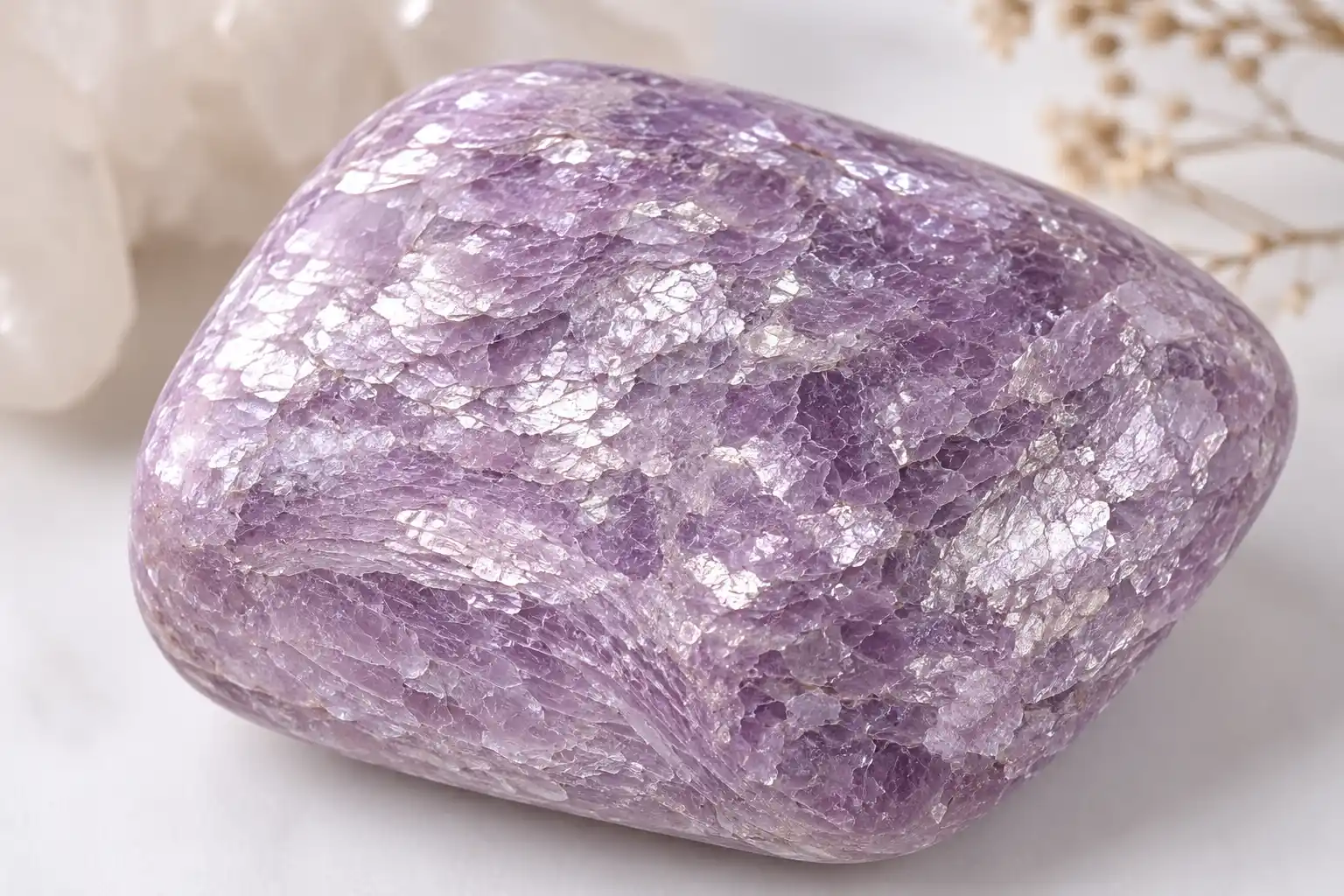
Lepidolite is a pink, lilac, violet-gray or silvery lithium-rich mica found mainly in granite pegmatites. It may form as sparkling layered crystals, scaly aggregates, fine-grained masses or ornamental rock mixed with quartz, feldspar and other pegmatite minerals.
Its appearance has made it popular in mineral collections and modern crystal practice, where it is associated with transition, calm reflection, sleep and emotional balance. However, the lithium within Lepidolite does not pass through the skin as medication, and the stone has no scientifically established ability to treat anxiety, bipolar disorder, depression or insomnia.
The broader Mica guide explains the layered structure shared by mica minerals. This article focuses on Lepidolite’s lithium-bearing composition, formation, appearance, uses, symbolism and responsible handling.
Lepidolite at a Glance
| Property | Lepidolite |
|---|---|
| Mineral family | Mica group |
| General composition | Variable potassium-lithium-aluminum silicate with fluorine and hydroxyl |
| Common formula | K(Li,Al)₃(Si,Al)₄O₁₀(F,OH)₂ |
| Modern classification | Group or series name for lithium-rich mica material |
| Crystal system | Commonly monoclinic polytypes |
| Typical colors | Lilac, lavender, pink, rose-red, violet-gray, white and colorless |
| Transparency | Transparent in rare crystals; commonly translucent to opaque |
| Luster | Pearly to vitreous |
| Mohs hardness | Approximately 2.5–4 |
| Cleavage | Perfect basal cleavage |
| Tenacity | Flexible and elastic in thin sheets |
| Specific gravity | Commonly around 2.8–2.9 |
| Typical occurrence | Granite pegmatites, greisens and some quartz veins |
| Common uses | Mineral specimens, lithium ore, carvings, cabochons and decorative objects |
| Main care concern | Flaking, scratching, cleavage and mixed-mineral weakness |
What Is Lepidolite?
Lepidolite is a traditional mineral and trade name applied to lithium-rich mica. Modern mineral classification treats the name more cautiously than older gem and collector literature because material called Lepidolite can fall within a compositional series involving minerals such as polylithionite and trilithionite.
For most collectors, lapidaries and crystal buyers, Lepidolite remains a practical name for lilac, pink or violet lithium mica. Nevertheless, an exact scientific identification may require chemical analysis and X-ray diffraction rather than color alone.
Like other mica minerals, Lepidolite has a sheet-silicate structure. Strong bonding occurs within each silicate layer, while weaker bonding separates one layer from the next. This arrangement produces the perfect cleavage and flexible flakes characteristic of the mica family.
A bright purple rock containing Lepidolite may also include quartz, feldspar, tourmaline or spodumene. In that case, the polished object is technically a multi-mineral rock rather than one pure Lepidolite crystal.
How Lepidolite Forms
Lepidolite most commonly develops during the late stages of granite-pegmatite crystallization.
Pegmatites form from volatile-rich residual melts and fluids left after a granitic magma has crystallized much of its common quartz, feldspar and mica. Elements that do not fit easily into early-forming minerals become concentrated in the remaining melt.
Lithium, rubidium, cesium, fluorine, boron, beryllium and tantalum may accumulate during this late stage. Under suitable conditions, they enter minerals such as Lepidolite, spodumene, tourmaline, beryl, pollucite and amblygonite.
The presence of Lepidolite can therefore signal a highly evolved rare-element pegmatite. Miners and collectors may use it as an indicator that tourmaline, beryl or other collectible minerals occur nearby, although its presence does not guarantee a gem pocket.
Lepidolite can also form by replacement, where lithium-rich fluids alter an earlier mica such as muscovite or biotite.
Why Lepidolite Contains Lithium
Lithium occupies selected structural positions within the mica layers, replacing some aluminum, magnesium or iron according to the mineral’s composition.
The amount varies among specimens. Rubidium and cesium can also substitute for potassium, while fluorine may replace part of the hydroxyl content.
Lepidolite has historically served as a lithium ore and remains one of several lithium-bearing mineral resources. Spodumene and brines are generally more prominent in modern large-scale lithium production, but Lepidolite deposits can be economically important in some regions.
The presence of lithium does not make the mineral medicinal. Pharmaceutical lithium compounds are manufactured, purified, measured and prescribed in controlled doses. Lithium locked inside a silicate mineral does not provide the same chemical exposure through wearing or holding a polished stone.
The Lithium Quartz guide covers a different trade material: quartz with pink, mauve or smoky inclusions associated with lithium-rich pegmatite environments. It should not be confused with lithium mica.
Lepidolite Color
Lepidolite commonly appears lilac, lavender, pink, rose-red, pale violet or violet-gray. White, colorless and yellowish material also occurs.
Lithium itself is not a sufficient explanation for purple color. Trace manganese, iron, structural defects and compositional variation can all influence the visible shade.
Fine-grained Lepidolite often looks softly mauve, while coarse mica books can show stronger pink or violet color along pearly cleavage surfaces. Silvery reflection from the mica layers may make a specimen look lighter from one angle.
Color can vary across one pegmatite. A polished palm stone may contain pink mica beside white quartz, smoky quartz or cream feldspar.
The Purple Crystals guide places Lepidolite among amethyst, fluorite, charoite and other purple materials. The Lavender Crystals guide focuses specifically on pale lilac and mauve stones, while Lavender Gemstones covers jewelry-grade alternatives.
Crystal Habit and Texture
Lepidolite can occur as tabular or pseudohexagonal crystals, mica books, scaly aggregates, rosettes and massive fine-grained material.
Thin sheets are flexible and may bend before returning toward their original position. This elastic behavior is characteristic of many micas.
Coarse plates can separate easily along cleavage. Fine-grained masses may feel more cohesive because many tiny flakes interlock with quartz and feldspar.
Sparkle should not be confused with exceptional gem quality. A surface can glitter strongly because thousands of cleavage faces reflect light, even when the material is too soft or flaky for practical jewelry.
Transparent facetable crystals are rare. Most Lepidolite sold in the metaphysical and lapidary markets is massive, mixed with other minerals or fashioned into simple polished forms.
Minerals Commonly Found With Lepidolite
Lepidolite frequently shares pegmatites with quartz, microcline, albite, spodumene, elbaite tourmaline, beryl, topaz, cassiterite, amblygonite and pollucite.
The Tourmaline guide explains the complex borosilicate crystals often found in the same rare-element pegmatites.
Kunzite is the pink-to-violet gem variety of spodumene and can occur beside Lepidolite. Although their colors overlap, kunzite is a prismatic gem material with much higher hardness, while Lepidolite separates into mica sheets.
Pale Amethyst may also resemble polished Lepidolite from a distance. Amethyst is quartz with hardness 7 and no mica-like basal cleavage.
The associated mineral assemblage can help establish geological context, but it cannot prove identity without direct examination.
Important Sources
Lepidolite occurs in lithium-rich pegmatites on several continents.
Well-known material has come from Brazil, the United States, Canada, the Czech Republic, Russia, Sweden, Madagascar, Zimbabwe, Namibia, Mozambique, Afghanistan and Pakistan.
California and Maine have produced classic North American specimens, while Brazilian and African pegmatites supply ornamental material and mineral specimens.
Locality affects collector interest when it is documented. Color alone cannot prove that a stone came from Brazil, Madagascar or another source.
A carved object made from mixed Lepidolite-bearing rock may have passed through several cutting and trading centers after the rough left the mine. Seller location should not be mistaken for geological origin.
Is Lepidolite a Gemstone?
Lepidolite can be used ornamentally, but it is not a durable conventional gem.
Rare transparent crystals may be faceted for collections rather than frequent wear. Fine-grained massive material can be fashioned into cabochons, beads, carvings, spheres and palm stones.
Its low hardness and perfect cleavage limit jewelry use. Loose mica flakes can separate, and mixed-mineral pieces may polish unevenly.
A pendant or occasional pair of earrings is more practical than a ring or bracelet. Even then, the stone should be protected from impact, friction and moisture around the setting.
The Gemstone Hardness Chart places Lepidolite below quartz and many familiar jewelry stones. Gemstone Toughness vs Hardness explains why cleavage can create additional breakage risk.
Lepidolite Jewelry and Decorative Uses
Most Lepidolite jewelry uses compact material mixed with quartz or feldspar rather than large pure mica crystals.
Cabochons may show lavender mica flakes within a pale matrix. Beads can produce a sparkling surface but may abrade around drill holes.
A bezel setting provides better edge support than exposed prongs. Closed backs can reinforce a thin cabochon, although they may also conceal resin or composite construction.
Large decorative spheres, towers and carvings often contain several minerals. Their durability depends on the strongest and weakest components together.
A heavily flaky specimen should remain a display piece rather than being forced into wearable jewelry.
How to Identify Lepidolite
The strongest non-destructive clue is mica structure.
A genuine specimen may show thin plates, pearly cleavage, flexible flakes and a layered texture. Massive material can be harder to recognize because quartz and feldspar obscure the mica sheets.
Color is not conclusive. Dyed mica, purple glass, resin composites, fluorite, calcite and other stones can imitate its lavender appearance.
A magnified examination may reveal individual platy mica grains with highly reflective cleavage surfaces. Quartz areas appear glassier and lack the same sheet structure.
Hardness testing is destructive and particularly unsuitable because Lepidolite scratches easily. Raman spectroscopy, X-ray diffraction and chemical analysis provide stronger professional identification.
The broader How to Identify Crystals guide explains why several observations must support one conclusion.
Treatments, Composites and Misleading Products
Lepidolite is not routinely treated through one standard gem process, but commercial products can be dyed, resin-stabilized, coated, glued or reconstructed.
Resin may hold flaky material together or create a high-gloss polish. A coating can conceal uneven texture, while dye may strengthen pale purple.
Some products sold as Lepidolite are mica-rich rocks rather than pure mineral. That description is not necessarily deceptive when the seller explains the mixture.
“Purple jade” is sometimes used for dense Lepidolite-rich ornamental rock, but it is not jadeite or nephrite.
Artificially bright, completely uniform beads deserve closer examination. Natural massive material normally shows variation in grain, color and associated minerals.
Buying Lepidolite
The dedicated guide on Where to Buy Real Lepidolite owns seller selection and authenticity checks.
A buyer should ask whether the item is a crystal specimen, massive Lepidolite, Lepidolite-bearing pegmatite or resin-stabilized composite.
Clear photographs should show the sides and reverse rather than only the most purple face. Product dimensions and weight help reveal whether a carving is solid stone or a lightweight resin imitation.
For jewelry, inspect drill holes, edges and setting pressure. Crumbling flakes and cracks near the mounting are more important than minor natural color variation.
Very large polished objects can be affordable because massive mixed material occurs in sizable pieces. Size alone does not indicate rarity or purity.
Lepidolite Meaning and Symbolism
Modern crystal traditions associate Lepidolite with transition, emotional regulation, rest, patience and releasing patterns that no longer serve a useful purpose.
Its layered structure inspires symbolism involving gradual change. Rather than one dramatic break, mica separates sheet by sheet, which can represent adapting through a sequence of manageable decisions.
Its lithium content has also influenced modern claims about mood and calm. This symbolism should not be presented as pharmacology.
A practical use might involve placing a Lepidolite stone beside a written transition plan. Each time the stone is noticed, the person can review the next concrete step rather than expecting the mineral to create emotional stability.
The Best Crystals for Transformation guide compares Lepidolite with other stones used symbolically during life changes.
Lepidolite Healing Properties
Crystal-healing practitioners may claim that Lepidolite relieves anxiety, stabilizes mood, treats depression, supports addiction recovery or improves sleep.
These effects are not scientifically established. The lithium in the mineral is chemically bound within its crystal structure and is not a substitute for prescribed lithium carbonate, psychotherapy, sleep treatment or medical care.
The Healing Crystals beginner’s guide explains how a stone can be used as a ritual cue without being described as medicine.
A Lepidolite ritual can still support a useful behavior. For example, someone might hold a smooth stone while practicing paced breathing, preparing questions for a clinician or identifying one manageable task.
The practical action may help. The mineral should not receive credit for a biological treatment effect that has not been demonstrated.
Lepidolite for Anxiety and Stress
Lepidolite frequently appears in lists of crystals for anxiety and crystals for stress.
A controlled ritual can create a pause during a stressful moment. The person may focus on the stone’s texture, slow their breathing and name the immediate problem.
That calming experience can arise from attention, expectation and the behavioral routine rather than a field emitted by the mica.
Persistent anxiety, panic attacks, severe mood changes, self-harm thoughts or inability to function require qualified professional support.
A crystal should never be used to adjust, stop or replace psychiatric medication.
Lepidolite and Sleep
Lepidolite is also included in modern lists of crystals for sleep.
A stone on a bedside table may serve as a cue to begin a consistent wind-down routine: reducing screen use, dimming lights, writing tomorrow’s tasks and keeping a regular sleep schedule.
Loose flaky specimens should not be placed beneath a pillow. Small mica pieces can detach, and hard objects can cause discomfort during sleep.
Insomnia can have medical, psychological, environmental and medication-related causes. Persistent sleep problems deserve appropriate evaluation.
Chakra Associations
Lavender Lepidolite is commonly linked with the Crown Chakra and Third Eye Chakra.
Within those spiritual systems, the crown represents meaning and connection, while the third eye represents insight and reflection.
A person may use Lepidolite during meditation or journaling as a symbolic focus. Chakras are spiritual concepts rather than measurable anatomical structures.
The stone cannot activate psychic perception, diagnose illness or guarantee spiritual development.
Cleaning and Storage
Lepidolite should be handled more carefully than quartz.
A dry, soft brush or microfiber cloth is the safest routine method. Brief contact with a slightly damp cloth may be suitable for compact polished material, but prolonged soaking can enter cleavage layers and affect glue, resin or associated minerals.
Ultrasonic and steam cleaning are inappropriate. Vibration can separate flakes, while heat may damage resin or mixed-mineral components.
Do not scrub a mica book, use abrasive powder or peel layers to test flexibility.
Store Lepidolite separately in a padded box. Quartz, sapphire and many common gemstones can scratch it.
The Crystals That Start With L and Gemstones That Start With L directories place it within the broader alphabetical collection.
Frequently Asked Questions
1. What is Lepidolite?
Lepidolite is a traditional name for pink, purple or violet-gray lithium-rich mica commonly found in granite pegmatites.
2. Is Lepidolite one mineral species?
Modern mineralogy treats the name as a group or series term covering lithium-rich mica compositions rather than one narrowly defined species.
3. Does Lepidolite contain lithium?
Yes. Lithium occupies structural positions within the mica, although the amount varies.
4. Does the lithium in Lepidolite work like medication?
No. Lithium locked within a silicate mineral does not provide a controlled pharmaceutical dose through touching or wearing the stone.
5. What gives Lepidolite its purple color?
Manganese, iron, structural defects and compositional differences may contribute. Lithium alone is not a complete color explanation.
6. Is Lepidolite soft?
Yes. Its hardness is approximately 2.5–4, and it has perfect cleavage that allows it to separate into sheets.
7. Can Lepidolite be used in jewelry?
Compact material can be used in protected pendants, earrings and cabochons, but it is unsuitable for rough daily wear.
8. Is Lepidolite the same as lithium quartz?
No. Lepidolite is mica, while lithium quartz is a trade term for quartz containing pink or mauve inclusions from lithium-rich environments.
9. Can Lepidolite go in water?
Brief damp cleaning may be acceptable for compact material, but soaking can affect cleavage layers, associated minerals, resin and glue.
10. Does Lepidolite treat anxiety or bipolar disorder?
No scientifically established evidence supports those claims. It should not replace medication, therapy or professional care.
11. Is every purple mica Lepidolite?
No. Exact identification may require chemical analysis or X-ray diffraction because several mica compositions can appear similar.
12. How should Lepidolite be stored?
Keep it dry, padded and separate from harder stones to prevent scratches, flaking and pressure damage.
Lepidolite’s real importance lies in the chemistry of evolved pegmatites. Lithium, fluorine and other unusual elements became concentrated late in the crystallization process, creating a layered mica that can appear delicately lilac yet record an extreme geological environment. Its symbolism may focus on calm transition, but its material story is one of chemical concentration and structural complexity.
Lepidolite healing, lithium, sleep, chakra and emotional-balance claims are spiritual or personal beliefs rather than scientifically established medical effects. Do not ingest the mineral, use it to make drinking elixirs, alter medication, replace therapy or delay professional care.